






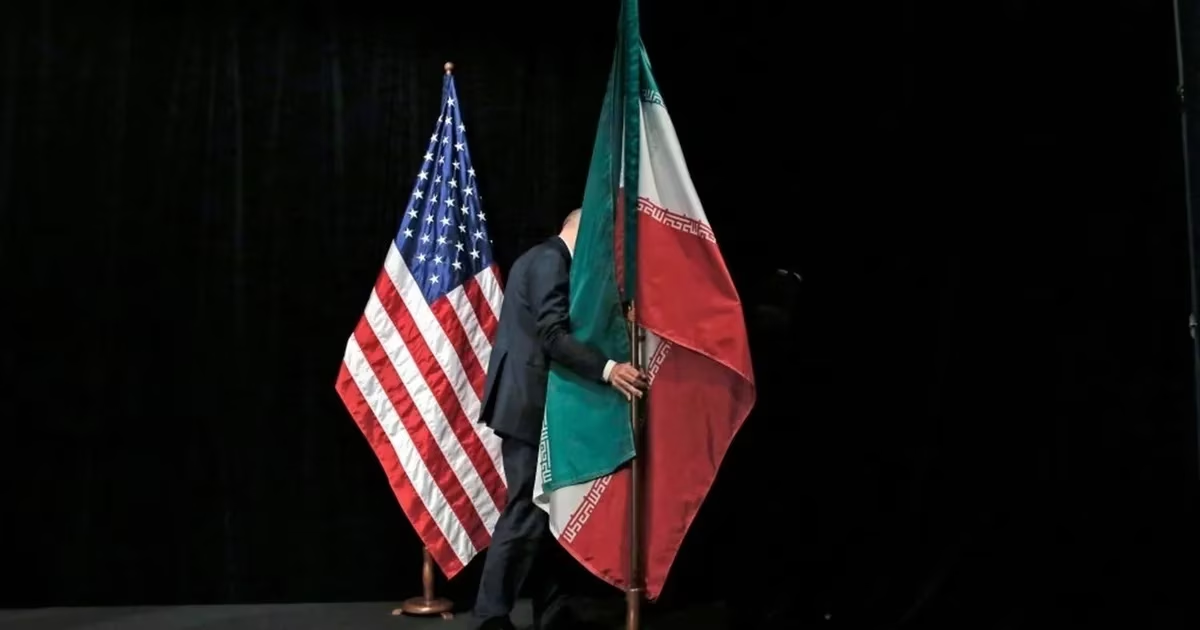
International press sources revealed a radical shift in the confrontation between the United States and Iran, as Washington moved from demanding 'unconditional surrender' to accepting a temporary truce aimed at de-escalating the conflict. The report indicated that US President Donald Trump practically ended up accepting comfortable understandings with Tehran, after more than a hundred days of military escalation that followed the outbreak of war last February.
The terms of the new truce stipulate extending the fragile ceasefire for an additional sixty days, with an Iranian commitment to gradually reopen the Strait of Hormuz to international navigation. Technical measures include removing naval mines planted by Tehran and refraining from imposing any additional fees on cargo ships, thus ending a crisis that directly threatened global energy supplies.
Observers believe that the Islamic Republic's ability to withstand American and Israeli strikes, and its possession of a strategic leverage in the Strait of Hormuz, forced the White House to re-evaluate its calculations. Trump praised the agreement, which reflects a new political realism aimed at avoiding a long-term attrition that could lead to a global oil price explosion.
Sources quoted former US Ambassador to Israel, Dan Shapiro, as saying that this agreement is much weaker than the ambitious goals announced by Washington at the beginning of the conflict. Shapiro explained that the American focus ultimately centered on securing energy corridors, reflecting Tehran's success in convincing the US administration that ending the war on limited terms is better than its continuation.
On the nuclear front, the agreement included Iran's reaffirmation of its commitment not to develop nuclear weapons, with a mechanism for addressing its enriched uranium stockpile. Information indicates that Tehran agreed to reduce enrichment levels at its nuclear sites, to be under direct and strict supervision by International Atomic Energy Agency inspectors.
Iran currently possesses a massive stockpile exceeding nine thousand kilograms of uranium, including about 440 kilograms enriched to near weapons-grade levels. Through these understandings, Trump's team seeks to neutralize what the President describes as 'nuclear dust,' pending deeper negotiations scheduled to begin after the official signing of the memorandum of understanding.
In exchange for these technical concessions, Washington granted Tehran exemptions allowing it to continue selling oil in global markets throughout the truce period. This measure aims to alleviate economic pressures on the American domestic front, where fuel prices exceeded the four-dollar-per-gallon threshold, posing a political threat to the Republican Party ahead of the elections.
Informed diplomats believe that these understandings do not represent a final agreement, but rather a step to de-escalate the situation and prevent the strengthening of hardline currents within Iran. Sources confirmed that pursuing a complete surrender of the Iranian regime would have led to a more complex and dangerous situation for American interests in the region.
For its part, Tehran is focusing on achieving rapid economic gains to repair the damage caused by military attacks on its infrastructure. Despite losses in its military arsenal and the assassination of a number of its leaders, the regime showed cohesion with the transfer of power and the appointment of Mojtaba Khamenei as the new Supreme Leader succeeding his father.
Recent confrontations proved Iran's actual ability to disrupt five global oil and gas exports, as well as carry out precise strikes against American bases in the region. These facts gave the Iranian negotiator additional leverage, especially given Trump's desire to close foreign war files and focus on domestic affairs.
It is noteworthy that the new memorandum of understanding ignores thorny issues such as the ballistic missile and drone programs, as well as Iran's regional influence. These issues have always been a source of concern for Arab countries and Israel, which warned against engaging in a military confrontation that does not achieve clear strategic objectives.
Domestically in Israel, Prime Minister Benjamin Netanyahu faces increasing pressure as elections approach, finding it difficult to market the war's outcomes as a real success. Experts believe that Israel cannot continue escalation against Iran without full American cover, especially regarding air defense systems and military funding.
Researcher Sanam Vakil from Chatham House indicates that both parties hold each other in a state of uneasy balance, with Washington using sanctions while Tehran uses the Strait of Hormuz. She adds that Trump's negotiation style may make this transitional phase last longer than the announced sixty days, with the risks that entails.
The question remains about the ability of this agreement to endure and transform into a comprehensive settlement, especially given Iran's history of prolonging negotiations. However, the only constant now is that the 'terms of the game' have changed, and the option of comprehensive military confrontation has receded in favor of a diplomacy of necessity imposed by realities on the ground.
The essence of the agreement currently lies in the reopening of the Strait of Hormuz, which has become the most important issue in the entire scene, revealing the extent of influence Iran possessed.
شارك برأيك
A Shift in Washington's Strategy: How Tehran Imposed 'Terms of the Game' on Trump?