






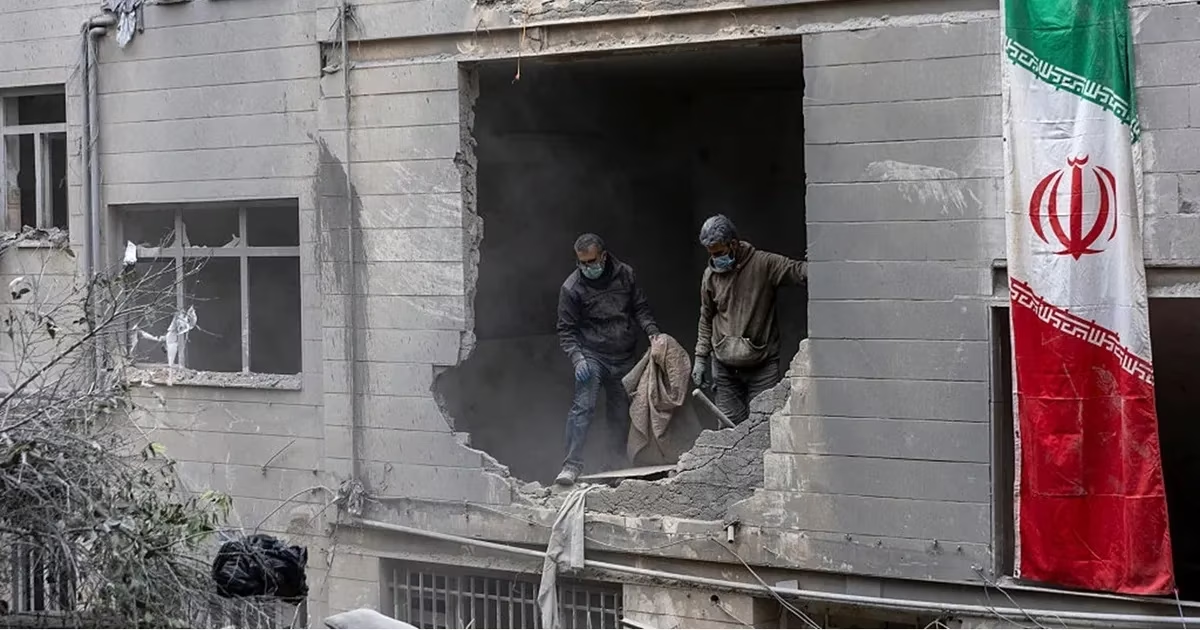
The administration of US President Donald Trump is considering a strategic proposal that includes allowing the establishment of a massive investment fund worth up to $300 billion dedicated to Iran. This approach comes within the framework of seeking a final and comprehensive settlement that ends the state of animosity between Washington and Tehran, and puts an end to tensions related to the Iranian nuclear program, which raises widespread international concern.
Informed sources stated that Washington has seriously discussed the possibility of easing economic sanctions imposed on Tehran in parallel with the launch of this fund dedicated to the country's reconstruction. The sources indicated that these major financial incentives will be closely linked to the extent of the Iranian side's commitment to the terms of the memorandum of understanding expected to be officially signed in Switzerland next Friday.
The US administration is setting strict conditions for activating this fund, most notably reaching a final settlement within the framework of the proposed memorandum, and extending the ceasefire agreement for an additional 60 days. US requirements also include guaranteeing freedom of navigation and the full reopening of the Strait of Hormuz, with technical negotiations continuing on the nuclear file to ensure its peaceful nature.
Regarding the structural details of the fund, officials explained that the money will not be paid from government budgets or taxpayers, but will rely entirely on investments from private companies wishing to enter the Iranian market. Iran represents an attractive market for investment privileges due to its population of nearly 90 million people, in addition to its vast reserves of energy resources and natural gas.
A wide range of international companies, especially from Europe, South Korea, and Japan, as well as major American companies, have shown initial interest in investing in vital Iranian sectors. However, the legal and administrative mechanism that will govern the operation of this fund and its organizational structure is still under discussion to ensure that funds are not leaked to unintended parties.
For his part, US Vice President J.D. Vance stated that this fund represents both a pressure tool and an incentive, emphasizing that it is one of the privileges available to Iran if it proves its seriousness. Vance stressed that access to these huge sums is entirely contingent on Tehran fulfilling all its obligations under the anticipated agreement, without any leniency in security standards.
This plan faces internal political challenges in Washington, as Trump seeks to balance offering economic incentives with avoiding criticism that might accuse him of rewarding the Iranian regime. This step recalls the sharp criticism Trump previously directed at the 2015 agreement, where he accused the previous administration at the time of providing cash financial facilities without obtaining sufficient guarantees.
Based on the new approach, any easing of sanctions or release of frozen Iranian assets in international banks will be carried out according to a strict timeline and in multiple stages. Each stage of funding will remain linked to tangible progress in nuclear negotiations, where Washington may resort to providing limited financial steps initially as a gesture to build trust between the two parties.
Regarding the technical nuclear aspect, Washington and Tehran have agreed on a mechanism for dealing with enriched uranium stockpiles, which includes reducing the quantities within Iranian territory. Reports indicate that Iran currently possesses more than 9,000 kilograms of uranium, including about 440 kilograms that have reached critical enrichment levels approaching the requirements for producing a nuclear weapon, which will be placed under close international supervision.
The reconstruction fund represents one of the privileges that Iran can obtain as long as it adheres to its part of the agreement.
شارك برأيك
Trump's Grand Plan: A $300 Billion Fund for a Final Deal with Iran