






Washington's Message
Washington – Said Arikat – 6/13/2026
US President Donald Trump's announcement of the imminent signing of an initial agreement with Iran to halt confrontation and reopen the Strait of Hormuz sparked a wave of questions about the prospects for success of the anticipated understanding, after Tehran quickly questioned the timing set by the US President, and at the same time revealed fundamental differences with Washington regarding the nature and content of the agreement.
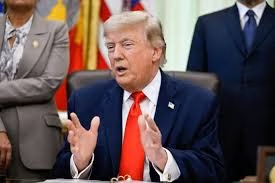
Trump said via his “Truth Social” platform that an initial sixty-day memorandum of understanding would be signed electronically on Sunday, stressing that the agreement would immediately lead to the reopening of the Strait of Hormuz to international shipping. However, Iranian Foreign Ministry spokesman Ismail Baqaei denied that the signing would take place on that date, explaining that the agreement “will not be signed tomorrow,” referring to Sunday, without ruling out the possibility of its completion in the following days.
This early contradiction reveals the continued crisis of confidence between the two sides, despite increasing talk of their approaching an understanding that could put an end to the most dangerous confrontation the region has witnessed in years. While Trump seeks to present the agreement as a major political and diplomatic achievement, Tehran prefers to keep expectations low, fearing being held responsible for any potential setback in the negotiations.
In an indication of ongoing mediation efforts, Pakistani Prime Minister Shehbaz Sharif announced that preparations for the electronic signing were underway over the weekend, to be followed by technical talks between the concerned parties. This indicates that the agreement is still in a transitional phase that requires executive and technical arrangements before it turns into a stable and applicable understanding.
But the most important disagreement is not about the timing, but about the essence of the agreement itself. According to officials in the Trump administration, the understanding includes ending Iran's nuclear program and removing its enriched uranium stockpile, conditions that Washington considers fundamental to any lasting settlement. Trump also stressed that the agreement would not include any financial transfers or payments to Iran in exchange for the signing.
In contrast, Iranian Foreign Minister Abbas Araqchi presented a completely different narrative, asserting that the initial agreement is nothing more than a framework for a ceasefire and creating conditions for broader and more comprehensive negotiations. Tehran also expects, according to information circulating in diplomatic circles, the lifting of US naval restrictions imposed in the region, while continuing its role in managing the affairs of the Strait in coordination with the Sultanate of Oman.
This discrepancy reflects a fundamental difference in the two sides' vision of the agreement. Washington speaks of a strategic settlement addressing the nuclear file and regional navigation security, while Tehran views the understanding as a temporary truce that prevents a slide into a wider war and gives it an opportunity to continue negotiating from a position of strength.
These developments came days after a dangerous military escalation in the waters of the Gulf. The US Central Command announced the downing of a number of attack drones that it said Iran launched towards commercial vessels in the Strait of Hormuz. These incidents served as a reminder of the magnitude of the risks threatening one of the world's most important maritime passages, through which a large percentage of global oil and gas exports pass.
International markets hope that the anticipated agreement will contribute to restoring stability to energy markets, which have been repeatedly shaken by the crisis. The full reopening of the Strait would ease pressure on oil prices and maritime shipping, and give the global economy a much-needed breather amid increasing geopolitical tensions.
Nevertheless, optimism remains cautious. Previous experiences between Washington and Tehran have shown that reaching initial understandings does not necessarily mean their success in withstanding political and security complexities. Moreover, the most sensitive issues, foremost among them Iran's nuclear program, economic sanctions, and Iran's regional role, are still far from being resolved.
Thus, it seems that the anticipated agreement, if indeed signed, will not represent the end of the crisis as much as it will be the beginning of a new phase of negotiation and political bargaining. The gaps between the two sides are still wide, and true success will not be measured by the signing date or the accompanying political celebrations, but by the ability of both sides to transform the temporary de-escalation into a sustainable settlement that addresses the roots of the conflict instead of postponing its explosion.
Trump between Political Achievement and Implementation Test
Trump seeks to use the anticipated agreement as proof of his ability to manage international crises through pressure and negotiation rather than open wars. However, the real challenge lies not in announcing the agreement, but in ensuring its implementation. The recent history of US-Iranian relations is full of understandings that collapsed under the weight of political differences and conflicting interpretations. Therefore, any attempt to present the agreement as a final victory may be premature, especially given the continued disagreement over its most basic provisions.
Iran Tries to Establish a New Equation
Tehran seems keen to exploit the crisis to redefine the rules of engagement with it in the Gulf. It does not want the agreement to appear as a response to American pressure, but rather seeks to portray it as international recognition of its role and influence in the region's security. Hence its insistence on maintaining some forms of administrative and political presence in the Strait of Hormuz, in addition to its refusal to make fundamental concessions on sensitive issues before obtaining tangible gains related to sanctions and restrictions imposed on it.
Strait of Hormuz Remains Hostage to Tensions
The crisis has once again proven that the Strait of Hormuz remains the most dangerous choke point in the global economy. The mere threat of its closure or restriction of navigation is enough to disrupt international markets and raise energy prices. Therefore, the international community is following the current negotiations with great concern, not only because of their political dimensions, but also because of their direct economic repercussions. Moreover, any failure to establish de-escalation could plunge the world into a new spiral of financial and commercial turmoil.
Temporary Truce or Beginning of Lasting Peace?
Despite the positive atmosphere that accompanied the announcement of the agreement, the reality indicates that most of the elements of disagreement between Washington and Tehran still exist. The nuclear program, sanctions, regional influence, and maritime security arrangements are all unresolved issues. Therefore, it seems that the discussion currently revolves around a temporary truce rather than a comprehensive peace agreement. If the de-escalation period is not used to address these issues, the coming months may turn into merely a short break before a new round of escalation.
شارك برأيك
Trump announces signing of Hormuz agreement on Sunday… Tehran questions timing and reveals deep disagreements over settlement terms