






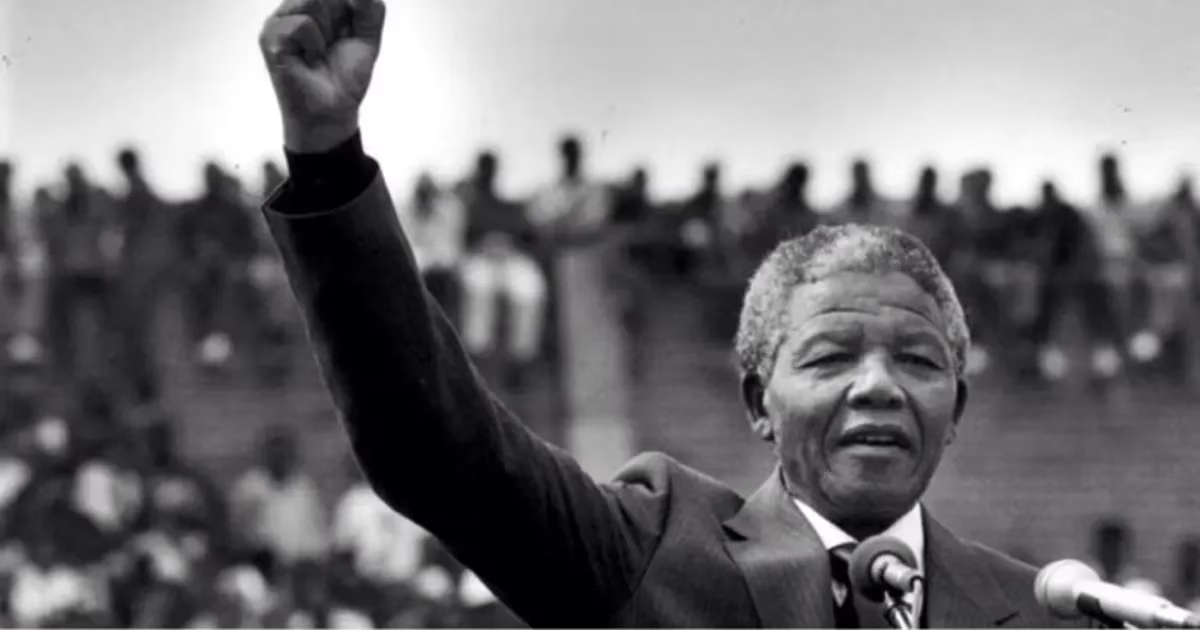
A new British documentary has reopened the files of South African leader Nelson Mandela, shedding light on a historical period when he was viewed as a 'terrorist' and a security threat, before he transformed into one of the most prominent symbols of freedom in the modern era. The report, published by The Guardian coinciding with the screening of the film 'Free Nelson Mandela', revealed the behind-the-scenes political and diplomatic struggle that took place in Western capitals regarding the legitimacy of the African National Congress's struggle.
The documentary, produced by 'Rogan Productions', reviews three decades of intense international activism against the apartheid system. The documentary material traces the long path that began with clandestine work and exile, leading to the historic moment of Mandela's release in 1990, and then his election as president of the country four years after arduous negotiations.
Sources quoted British activist and former minister Peter Hain as saying that the perception of Mandela in the West was not always as rosy as it is today. Former British Prime Minister Margaret Thatcher openly described him as a terrorist, a stance that reflected the views of a wide segment of the Western political elite who feared the actions of the African National Congress during the Cold War era.
Hain explained that activists who opposed the apartheid regime in Britain faced immense security pressures and systematic smear campaigns. The former minister revealed painful personal details, including receiving a letter bomb and attempts to fabricate criminal charges against him, with the aim of deterring him from his political activism supporting the African cause and isolating the racist regime internationally.
The work included live testimonies from Dali Tambo, son of the late leader Oliver Tambo, who lived for many years in exile in London. Tambo recounted how his family lived under the constant fear of assassination by the intelligence agencies of the Pretoria regime, especially after repeated incidents of liquidating opponents abroad, which made his childhood associated with the obsession of security and surveillance.
Tambo pointed out that his father and his comrades in the leadership of the African National Congress worked with the certainty of fighters, although they sometimes did not expect to live long enough to witness the end of the apartheid system. Nevertheless, political and diplomatic work continued from London, which became a global center for mobilizing support against racial discrimination and pressuring hesitant governments.
The report highlighted the pivotal role played by sports and cultural boycotts as an effective pressure tool to isolate South Africa from the international community. Activists led extensive campaigns to prevent tours of South African sports teams, which contributed to moving the battle from the corridors of politics to stadiums and streets, and drew the attention of global public opinion to the justice of the cause.
On the cultural front, the song 'Free Nelson Mandela' became a cross-border anthem, sung by millions around the world to demand the breaking of the jailer's chains. British artists and musicians played a crucial role in mobilizing the masses, especially through major festivals that made Mandela's cause a human issue that could not be divided.
Sources considered the famous Wembley Stadium concert in 1988 to be the major 'turning point' in the international campaign. That event, watched by hundreds of millions on television screens, succeeded in transforming Mandela from a political prisoner behind bars into a global icon whose freedom was demanded by peoples, which put Western governments in an embarrassing position before their own people.
Away from politics, the documentary addressed the human aspects of Mandela's personality, describing him as a man who possessed an innate ability to connect with ordinary people. Despite his towering stature, he remained 'Uncle Nelson' to those close to him, a man whose years in prison did not taint him with the bitterness of revenge, but rather emerged with a spirit calling for reconciliation and building.
Returning to the roots of the struggle, Mandela was born in 1918 in a rural village in the Eastern Cape, and began his life as a lawyer defending the rights of blacks. He joined the ranks of the African National Congress early on, initially believing in peaceful resistance, but a radical transformation occurred after the Sharpeville massacre in 1960, which showed the brutality of the regime in suppressing unarmed demonstrators.
This transformation led Mandela to establish the military wing 'Umkhonto we Sizwe', a decision he made with his comrades after being convinced that peaceful action alone would not overthrow a heavily armed regime. Although the operations targeted government facilities and avoided civilians, they were the pretext used by Western powers to classify him as an extremist for many years.
Mandela spent 27 years in prison, during which he transformed from an isolated prisoner on Robben Island into a symbol of global resilience. Thanks to increasing international pressure and geopolitical changes, the white minority government was forced to negotiate with him, and he was released in 1990 to lead his country towards a democratic transition that spared it the specter of civil war.
Despite the great legacy left by Mandela, the documentary indicates that controversy still exists regarding the results of the political settlement. While he succeeded in legally ending apartheid, South Africa still faces deep economic and social challenges, which opens the door for researchers' questions about the completeness of the dream for which 'Uncle Nelson' fought.
Western public opinion did not treat Mandela as a global hero; rather, he was portrayed as a terrorist until the late 1980s.
شارك برأيك
From 'Terrorist' to Freedom Icon: British Documentary Explores Nelson Mandela's Journey