






US President Donald Trump's political ambitions face a severe test in the Middle East, where his usual tendency towards dominance clashes with a complex military reality involving Iran. Despite the displays of power that have characterized his career, the escalating crisis has begun to place clear limits on his ability to impose his will on allies and adversaries alike.
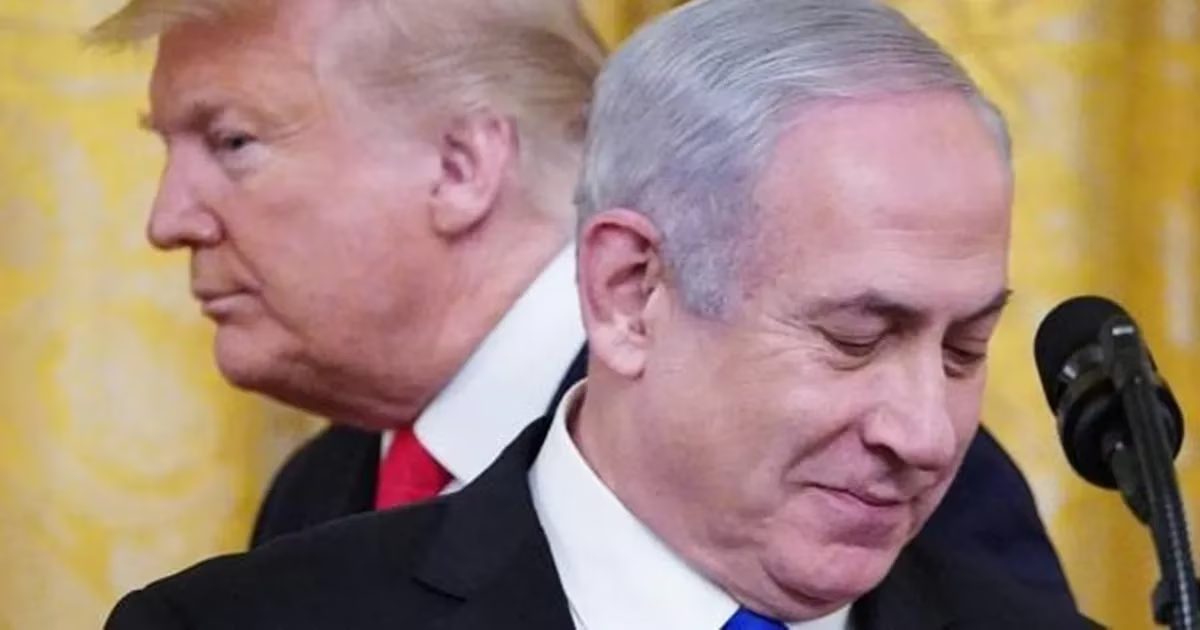
In a striking escalation of rhetoric towards his closest ally, Trump asserted that Israeli Prime Minister Benjamin Netanyahu would be forced to agree to a deal formula negotiated by Washington with Tehran. Trump stressed in press statements that he holds the ultimate decision-making power, a clear indication of his rejection of any Israeli moves that might undermine the path set by the US administration.
The White House's pressure did not stop at diplomatic statements but extended to direct directives via social media demanding an immediate ceasefire. These calls came at a sensitive time as Trump tries to prevent the region from sliding into a comprehensive confrontation that could derail his electoral promises to end foreign wars.
One hundred days after the outbreak of military confrontation last February, Trump finds himself stuck in the same 'quagmire' he previously warned against and criticized his predecessors for. Despite the tactical truce recently announced by Tehran and Tel Aviv, the deep roots of the conflict remain without radical solutions appearing on the near horizon.
Observers and former US State Department officials believe that Trump waged a 'war of choice' built on mistaken assessments of the balance of power in the region. Overestimating US military effectiveness, while underestimating Iranian defensive and offensive capabilities, led the situation to a stalemate from which it is currently difficult to exit.
Iran's effective control over the Strait of Hormuz represents one of the most prominent challenges that the US administration has failed to address despite imposing a counter-blockade. This closure of the vital shipping lane has given Tehran enormous economic leverage, capable of directly influencing global energy prices and the calculations of American voters.
Domestically in the US, warnings are escalating from military experts belonging to hardline research centers, indicating that Trump may be forced to conclude a 'bad deal' to avoid strategic defeat. They fear that rushing to end the conflict could entrench Iran's influence in international waterways without offering real concessions on its nuclear file.
Trump expressed his growing frustration with internal pressures and criticisms dogging his administration regarding the pace of military or diplomatic action. He called on his critics to calm down and wait, claiming that things would ultimately end in his favor, even though the reality on the ground indicates complexities that go beyond mere media optimism.
Compared to the US invasion of Iraq, the current war with Iran highlights the limits of American firepower and the rapid exposure of its inability to achieve a quick resolution. While Baghdad fell in weeks, Tehran proved a greater ability to maneuver and wage attrition, making the 'short adventure' Trump promised enter its fourth month without tangible results.
Experts warn that any additional escalation could lead to a dangerous depletion of US ammunition stockpiles, weakening Washington's military position on other fronts such as Europe and Asia. This depletion places the administration before choices, the least bad of which is bitter, between costly escalation or a retreat that could be interpreted as strategic weakness.
The volatile relationship between Trump and Netanyahu plays a pivotal role in complicating the scene, especially after the violent raids launched by the occupation forces in Lebanon. Trump revealed a sharp phone call with Netanyahu, expressing his anger at moves that could drag the United States into a wider conflict it does not desire.
Despite Trump's ability to exert strong influence over Netanyahu, given the latter's need for American support to ensure his political survival, the biggest challenge remains on the Iranian side. Diplomatic sources confirm that Washington has not yet succeeded in changing the strategic calculations of the leadership in Tehran, which represents the major sticking point.
Recent opinion polls indicate widespread public dissatisfaction with involvement in this war, which raises concerns for the Republican Party as the midterm elections approach. This public pressure reduces Trump's room for maneuver and forces him to seek a quick exit that saves face with his electoral base.
Ultimately, the 'dealmaker' finds himself facing a real test of his ability to manage a major international crisis where military and economic interests intertwine. The outcomes of this confrontation, whether it ends with a comprehensive agreement or continues as a war of attrition, will have a profound impact on the future of American influence in the region and on Trump's own political ambitions.
I am the decision-maker, and Netanyahu will have no choice but to accept the agreement that the United States negotiated with Iran.
شارك برأيك
Middle East Quagmire: Trump's Drive for Control Collides with Iranian Resistance