






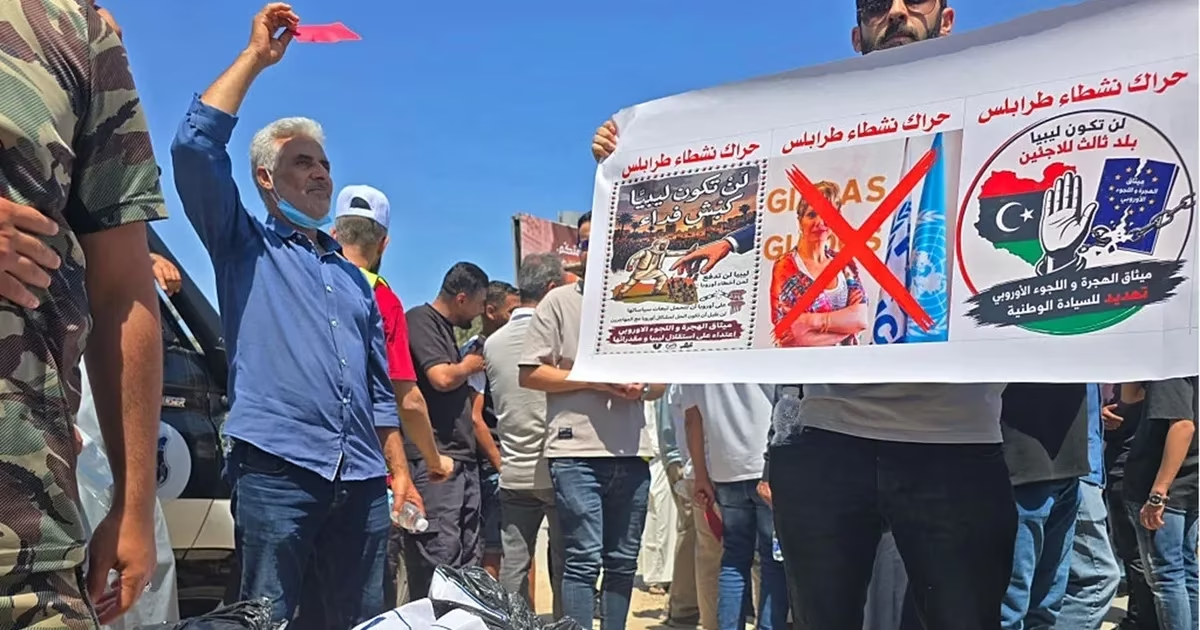
The recent popular protests in Libyan cities against projects to resettle irregular migrants have reopened a strategic debate about the dialectical relationship between human rights and the state's right to protect its national security. Voices have emerged criticizing these movements, describing them as racist, which has raised questions about the accuracy of this legal and objective description in light of the challenges facing the Libyan state.
Observers believe that the automatic link between demanding border control and violating human rights lacks depth, as the primary function of public authority since the emergence of the modern state has been to provide security and stability. Without a stable state that controls its borders, the exercise of rights and freedoms becomes practically impossible.
The philosophy of protecting the state's entity is based on historical experiences and solid political theories, where thinkers like Thomas Hobbes considered security the primary goal of the social contract. This approach was evident in the policies of global leaders such as Winston Churchill and Charles de Gaulle, who prioritized the survival and stability of the state above all other considerations during major crises.
In the modern era, Western democracies have adopted a conciliatory approach based on balancing the requirements of national security with human rights obligations. This balance grants the state the right to take exceptional measures to protect its borders, provided that these measures are necessary, proportionate, and subject to strict legal and judicial oversight.
Regarding the issue of irregular migration, international law does not compel states to accept the permanent settlement of foreigners or to forcibly change their demographic composition. Regulating entry and residence is at the core of national sovereignty, which all states exercise daily to protect their supreme interests and societies.
Major countries such as the United States, France, and Italy have adopted strict policies towards uncontrolled migration flows, considering this a natural exercise of their sovereign prerogatives. These countries have not been accused of deviating from international principles; rather, they have considered border protection the fundamental pillar of the state's existence and continuity.
The Libyan situation is particularly complex due to its open geographical location and vast land borders that are difficult to fully control. Institutional fragility and political division further heighten the sensitivity of the migration issue, directly linking popular fears of resettlement to the future of the national entity.
Libyan concerns are not limited to security and economic aspects but extend to national identity, demographic balance, and social cohesion. Societies have a legitimate right to preserve their cultural components, a debate that is strongly present even in the oldest Western democracies, which are witnessing controversy over the effects of migration.
Peaceful expression of rejection of resettlement falls within the freedom of opinion and participation in public affairs and should not be used as a pretext to betray citizens. Demanding the regulation of foreign presence is not a crime in itself; rather, it is a sovereign demand found in the programs of major political parties around the world.
The Libyan legislator, in Law No. (19) of 2010 concerning combating irregular migration, emphasizes that border control is an integral part of protecting public order. Subsequent legislation has reinforced this direction, considering the issue a strategic matter that goes beyond mere regulation of residence to protecting the state's entity.
It is essential to clearly distinguish between rejecting resettlement policies and practices of hatred or violence against migrants, as respecting human dignity is an undisputed moral and legal duty. However, this respect does not necessarily mean waiving the state's right to protect its demographic composition and national security from external threats.
A state that fails to protect its sovereignty will inevitably fail to protect the rights of its citizens or residents on its territory, leading to the collapse of the social contract. Therefore, defending borders is essentially defending the legal framework that allows for the existence and flourishing of rights and freedoms.
The fundamental question facing Libya today is not about the legitimacy of border protection but about how to exercise this right legally and fairly. This requires building strong institutions capable of managing the migration file away from emotional reactions, ensuring the nation's interest without compromising human dignity.
Ultimately, the responsibility of the modern state remains to find that fine line between sovereignty and humanity. A state that squanders rights weakens its legitimacy, and a state that compromises its sovereignty loses its existence, and between these two paths lies the future of stability in Libya.
There is no freedom for those who have no state, and no rights for those who have no security; national sovereignty is the primary guarantor of the exercise of freedoms.

شارك برأيك
The Dialectic of Sovereignty and Human Rights: Has Rejecting Resettlement in Libya Become a Crime?