






Washington – Said Arikat – 5/6/2026
News Analysis
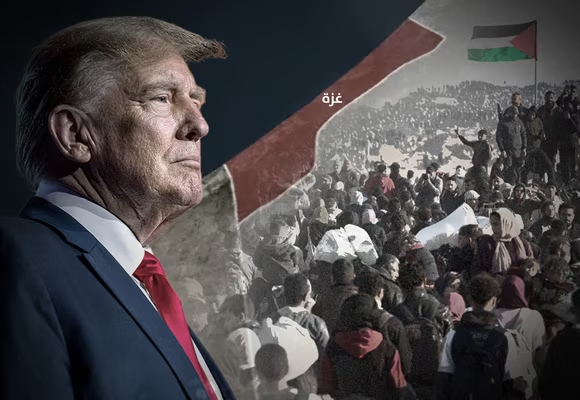
The ongoing predicament in the Gaza Strip, under US President Donald Trump's plan, reveals a crisis deeper than a mere technical dispute over Hamas's disarmament. Since the twenty-point plan was introduced last September, it has been clear that the American approach is based on imposing unilateral security conditions, ignoring the political roots of the conflict, and granting Israel wide leeway to impose new realities on the ground under the guise of a faltering "peace process."
Months after the start of a truce described as fragile, signs of gradual failure are emerging; the political process has clashed with the condition of disarmament, which has become a systematic obstruction tool rather than an entry point for a solution. In the absence of any real American pressure on Israel, Israeli military control has expanded to include about two-thirds of the Strip, reflecting the use of negotiations as a cover to reshape the geographical and political reality in Gaza.
The American administration, which officially declares its commitment to the diplomatic path, is practically biased towards Israel's security vision, having reduced the settlement to the demand for "dismantling Hamas," without providing any integrated political framework that guarantees an end to the occupation or addresses the causes of the conflict. US Secretary of State Marco Rubio has repeatedly affirmed that the agreement "depends entirely" on disarmament, a proposition that reflects Washington's adoption of the Israeli narrative, ignoring the imbalance of power and the absence of any reciprocal commitments from the Israeli side.
In contrast, Hamas refuses to relinquish its weapons, not only as a military tool but as a negotiating leverage in the absence of trust. The movement has linked any discussion on this issue to a complete Israeli withdrawal from the Strip, a demand Israel categorically rejects, thus perpetuating a vicious cycle. However, portraying this rejection as the sole obstacle ignores the fact that Israel itself shows no willingness to end its occupation or cease its military operations; instead, it continues to expand its control, benefiting from American cover.
Notably, the American plan, which formally moved into its second phase last January, has not achieved any real progress. The proposed technocratic government has not seen the light of day, disarmament has not begun, and reconstruction remains postponed promises. This stagnation reflects not only the complexity of the issue but also reveals the absence of genuine political will, especially from the American side, to push the process towards tangible results.
In this context, Israel appears to be the biggest beneficiary of the stalemate, as it continues to manage the conflict according to its interests, without incurring any significant political or legal cost. As for Washington, it plays the role of a "biased mediator," content with issuing statements, without using the available pressure tools, which empties its role of any credibility.
At the same time, the humanitarian situation in the Strip is deteriorating, with Israeli raids continuing, and civilian lives remaining hostage to fragile military balances. Despite talk of a truce, the number of casualties confirms that violence has not actually stopped, but its pace and forms have changed.
With the American administration preoccupied with other regional issues, primarily Iran, the Gaza file recedes to the margins of priorities, opening the door to further deterioration. UN warnings of a potential collapse of the truce and a return to widespread confrontations reflect the fragility of the situation, in the absence of any real political horizon.
The American approach in Gaza reflects a structural flaw in understanding the nature of the conflict, as the crisis is reduced to a narrow security dimension, while the political and historical context of the occupation is ignored. This reduction serves the Israeli narrative, which seeks to portray the conflict as a matter of "counter-terrorism," not as a national liberation issue. Thus, Washington transforms from a supposed mediator into an actual party to the conflict, reproducing existing power imbalances, and contributing to prolonging the crisis instead of resolving it.
Israel employs the disarmament condition as a strategic tool to perpetuate its control over Gaza, not as a step towards a settlement. Insisting on this condition before any withdrawal empties the political process of its content and gives it a pretext to continue military expansion. In the absence of real international accountability, this policy becomes a model for managing the conflict by force, where security is used as a cover to reshape the demographic and geographical reality in the Strip.
The American bias is not limited to rhetoric but extends to the absence of any real pressure on Israel to adhere to balanced commitments. While Washington exerts political pressure on Palestinian factions, it contents itself with the role of an encouraging observer towards Israel, creating a grave imbalance in the negotiation process. This disparity weakens the trust of other parties in any American initiative and reinforces the conviction that Washington is unable—or unwilling—to play the role of an impartial mediator.
The ultimate result of this scenario is the entrenchment of a "no-solution" situation, where stalemate becomes a policy in itself. Instead of progressing towards a comprehensive settlement, a fragmented reality is established, where crises are managed without being resolved. Under this approach, Palestinian civilians pay the highest price, while Israel benefits from the absence of accountability, and the United States retains a superficial role that does not rise to the level of international responsibility.
شارك برأيك
Gaza's Predicament Under Trump's Plan: Fragile Truce, Political Stalemate, and American Bias Entrenching the Status Quo