






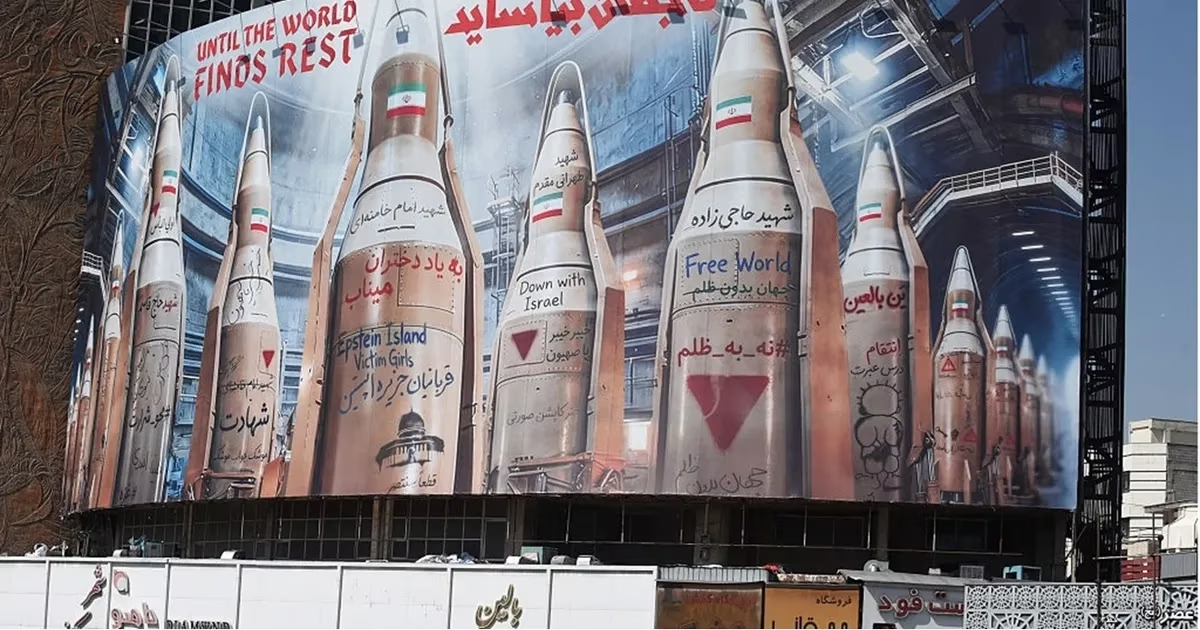
International press reports indicate that the joint war led by the United States and the occupation state against Iran has entered its fifth week with no signs of an imminent surrender by Tehran. Despite significant military setbacks and the loss of prominent leaders, estimates suggest that the timeline set by President Donald Trump is nearing its end without a radical change in the regime's structure.
Media sources quoted Israeli officials admitting that the conflict might end with the Iranian government remaining in power, which could create a sense of frustration among those who expected a rapid collapse. This is due to the disparity between declared objectives and the slow pace of military achievements compared to the momentum that accompanied operations in their early stages.
An Israeli military official explained that Iran represents an enormous geographical and security challenge, being a country eighty times larger than Israel and roughly half the size of the European continent. He added that the Iranian regime has succeeded over decades in building a complex security apparatus, which makes its mere resilience in the face of current attacks a victory from its perspective.
The official pointed out that the media narrative considering the regime's survival a defeat for Washington and Tel Aviv is inaccurate from the Israeli strategic perspective. From their point of view, a state that threatened to wipe Israel off the map reaching a stage where survival is considered a victory reflects the extent of the damage inflicted on its capabilities.
Sources emphasized that overthrowing the regime in Tehran was never a declared military objective of the current air operations; rather, the focus was on eliminating direct existential threats. Military leaders believe that weakening the regime creates suitable conditions for the Iranian people to choose change themselves if they wish to do so in the future.
Regarding the outcomes of the war, the military official predicted a scenario where both sides declare victory simultaneously, with the Iranian regime viewing its survival as a historical success. In contrast, Israel and the United States will consider that they have achieved their goals by destroying military infrastructure and unprecedentedly weakening Tehran's offensive capabilities.
Intelligence reports observed cracks in the combat morale of Iranian forces and increasing difficulties in coordinating organized missile barrages. Sources confirmed that field commanders are now forced to accompany their soldiers to carry out missions due to the spread of fear and confusion among ground forces.
Intelligence information also revealed that Iranian forces resorted to launching missiles from hidden positions under bridges and tunnels to avoid intense aerial surveillance. This defensive tactic has led to a significant decrease in the number of missile attacks launched from the region, indicating a decline in offensive initiative capabilities.
At the leadership level, an increase in individual decision-making by field military commanders has been observed over the past two weeks, reflecting a weakness in central coordination. Observers believe that the absence of a unified and cohesive Revolutionary Guard leadership has led to a state of disarray in the management of daily military operations.
For his part, Ofir Akunis, the Israeli Consul in New York, stated that the Iranian security establishment is weakening day by day despite its continued control over state joints. He described the current situation as very fragile, especially with the possibility of other regional parties, such as the Ansar Allah group in Yemen, entering the confrontation more broadly.
Despite the profound effects of the air campaign on the stability of the Iranian state, Akunis ruled out an imminent government collapse at present. He pointed out that the possibility of an internal uprising remains complex due to the presence of currents that oppose the regime but at the same time reject external military intervention in their country.
Regarding the American position, the Trump administration's messages were inconsistent regarding the final war objectives and the possibility of deploying ground troops. While Trump set short deadlines for ending operations, he later reaffirmed that he would not send soldiers to participate in ground operations, emphasizing that securing international waterways should be a collective responsibility.
It is important to realize that the Iranian regime manages a country 80 times larger than Israel, and they are now in a position where they consider mere survival a victory.
شارك برأيك
End of War Scenarios: Israeli Estimates Suggest Iranian Regime Survival and Both Sides Declaring Victory