






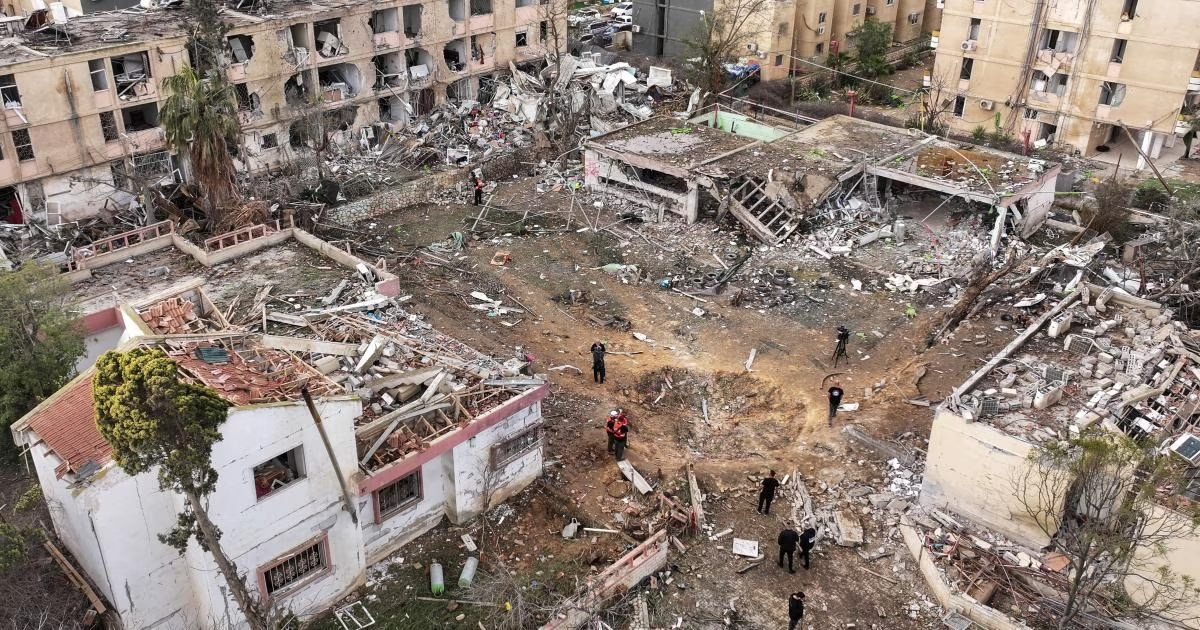
The city of Arad, located in the Negev region of the occupied territories, witnessed widespread destruction affecting an entire residential block, following a missile attack by an Iranian missile last night. Israeli Prime Minister Benjamin Netanyahu described the incident as a 'difficult evening,' confirming during his visit to the affected site that the extent of material losses was very significant and unprecedented in that area.
Field sources reported that the missile that fell in Arad carried an explosive warhead weighing approximately 450 kilograms, according to initial military estimates. This massive explosion completely or partially destroyed more than 100 residential apartments, in addition to causing severe damage to surrounding buildings and vehicles parked in the area.
Regarding human casualties, medical teams recorded about 100 injured in Arad alone, while about 75 others were injured in the nearby Dimona area, approximately 40 kilometers away. Injuries varied between shrapnel wounds and severe panic attacks due to the force of the explosion that shook the entire southern region.
Rescue and relief teams continue to work at the targeted site to remove debris and assess the final damage, amid indications that the actual destruction may exceed what initial images showed. This attack is considered the most impactful in terms of the scale of material destruction and the number of injured in a single location since the beginning of the current escalation.
The missile's success in reaching its target raised sharp questions within Israeli media and military circles about the efficiency of air defense systems. Criticism focused on the failure of radars and batteries to intercept the missile despite high alert levels and continuous American technical support in this field.
The spokesperson for the Israeli army refused to disclose the identity of the system that failed in the interception operation but ruled out that the American 'THAAD' system was responsible. Military analyses suggest that the Israeli 'Arrow' system failed to deal with the incoming Iranian aerial threat.
In a brief comment, one of the Israeli Air Force commanders considered that revealing details of the technical failure in the media would be a 'foolish act.' He explained that providing such information might give the Iranian side intelligence and technical vulnerabilities that could be exploited in future missile attacks to bypass defenses.
The attack led to a widespread wave of displacement, with about 1,000 people leaving Arad for fear of repeated shelling or due to losing their homes. Hebrew press reports stated that about 450 displaced persons were transferred to hotels in the Dead Sea area to provide them with temporary shelter after their residential neighborhoods were damaged.
The greatest damage was concentrated in neighborhoods inhabited by ultra-Orthodox Jews (Haredim), which exacerbated the humanitarian crisis due to the large family sizes in those areas. Dozens of families became homeless as a result of their apartments being destroyed, rendering them uninhabitable for the time being.
Internal voices in Israel, which had been calling for continued military operations, began to recede in the face of the scenes of destruction in Arad and Dimona. The discussion now focuses on the increasing danger of Iranian missiles and their ability to penetrate airspace and reach vital targets twice in one day.
Estimates indicate that the missile used is not the most powerful in the Iranian arsenal, as Tehran possesses missiles with warheads weighing over one ton. This raises deep concern among the Israeli military leadership about the possibility of multiplied destruction if more advanced weapons are used.
For the first time, Israel faces a missile threat of this destructive magnitude, compared to missiles previously launched from other fronts such as Gaza, Lebanon, or Yemen. The destructive power of Iranian warheads has placed the Israeli home front before a security challenge it has not experienced in previous wars.
Despite official calls to adhere to Home Front Command instructions, public concern is growing about the ineffectiveness of shelters against such heavy missiles. The scenes of destruction in the Negev remain present as evidence of a qualitative shift in the nature of direct military confrontation and its effects on populated areas.
This is a difficult evening, and adherence to Home Front Command instructions helps reduce human casualties despite the extent of the destruction.
شارك برأيك
Unprecedented Devastation in Arad: Iranian Missiles Penetrate Israeli Defenses, Leaving Hundreds Injured and Displaced