






Rapid military developments in the Middle East are painting grim scenarios for the global energy sector, as direct confrontations have led to a sharp drop in supplies. Consumers around the world have found themselves forced to pay exorbitant amounts for fuel, coinciding with international calls to reduce consumption to counter the growing deficit.
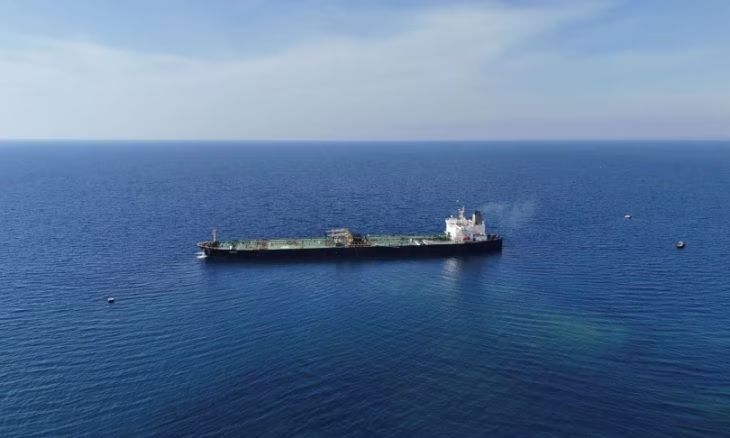
The effective closure of the Strait of Hormuz is the harshest blow to the global economy, as the passage of about 20% of oil and liquefied natural gas supplies has ceased since the start of air raids on February 28. This vital waterway adjacent to the Iranian coast represents the main lifeline for energy flowing from the Gulf to international markets.
The damage was not limited to navigation but extended to essential infrastructure, as mutual strikes targeted gas fields, oil refineries, and vital ports. Sector experts confirm that the extent of the destruction inflicted on facilities in the Middle East will require many years of repair operations to restore production capacity to what it was.
The International Energy Agency described this disruption as the worst in the history of the global energy sector, surpassing the effects of the famous Arab oil embargo of 1973. The global market has so far lost about 400 million barrels of supplies, which is equivalent to the world's entire consumption for four continuous days, creating a huge gap between supply and demand.
This crisis was directly reflected in prices, which jumped by 50%, with the price of a barrel of oil exceeding $110, while crude oil designated for Asian markets recorded record figures approaching $164. These insane increases placed enormous pressure on the transportation and industrial sectors, and their effects began to appear clearly in daily living costs.
In an attempt to contain the situation, many countries resorted to harsh austerity measures to preserve their fuel reserves. Thailand imposed restrictions on employee travel and elevator use. In a related context, Bangladesh closed its universities, while Britain implemented emergency plans that included reducing speed limits on roads to save gasoline and diesel consumption.
On the American front, the price shock turned into a heavy political burden on President Donald Trump, who is trying to justify involvement in the war to domestic public opinion. Trump sharply criticized Washington's NATO allies, describing them as cowards for not providing sufficient support for military operations against Tehran.
The escalation also affected strategic gas facilities, as Iran's South Pars field and Qatar's Ras Laffan complex were subjected to missile strikes that led to a halt in production. Responsible sources in the energy sector stated that the attacks will lead to the loss of millions of tons of liquefied gas annually, which represents a direct threat to energy security in Europe and Asia.
The International Energy Agency warned that spending 400 million barrels from emergency reserves would not be enough, as this amount only covers twenty days of the deficit resulting from the war. Financial analysts believe that forced demand reduction is the only remaining solution for the market in light of the severe shortage of refined petroleum products.
Away from the transportation sector, jet fuel prices in Europe reached record levels of $220 per barrel, threatening a sharp rise in ticket prices and disruption of air traffic. In the United States, gasoline prices at retail stations have risen by more than a dollar per gallon since the start of military operations, exacerbating inflation.
The effects of the war extend to the global agricultural sector, as fertilizer supply chains, one-third of which pass through the Strait of Hormuz, have been disrupted, leading to a 40% increase in urea prices. This severe shortage has forced fertilizer factories in India and Malaysia to reduce production or close completely, threatening a catastrophic agricultural season.
The United Nations Food and Agriculture Organization (FAO) warned that the continuation of the conflict for additional weeks would lead to a significant disruption in global grain and feed supplies. Since half of the world's food depends on chemical fertilizers, the rise in their costs will inevitably lead to a jump in the prices of meat, dairy, and basic food products.
The International Gas Union calls for an immediate halt to targeting energy facilities and securing shipping in the Strait of Hormuz to ensure the flow of raw materials necessary for the pharmaceutical and plastic industries. Experts confirm that the current situation is no longer just a price crisis, but has become an existential threat that shakes the foundations of the modern global economy.
In light of these facts, the world remains hostage to field developments in the Middle East, where energy, food, and political issues intertwine in an unprecedented way. With the continuation of mutual strikes, fears are growing of the global economy entering a long-term stagflationary recession, from which it will be difficult to emerge without a comprehensive political settlement that restores stability to the region.
This crisis cannot be overcome by saving; what will happen is that prices will rise to such an extent that people stop consuming.
شارك برأيك
Earthquake in Energy Markets: War in the Middle East Pushes Prices to Record Levels and Threatens Food Supplies