






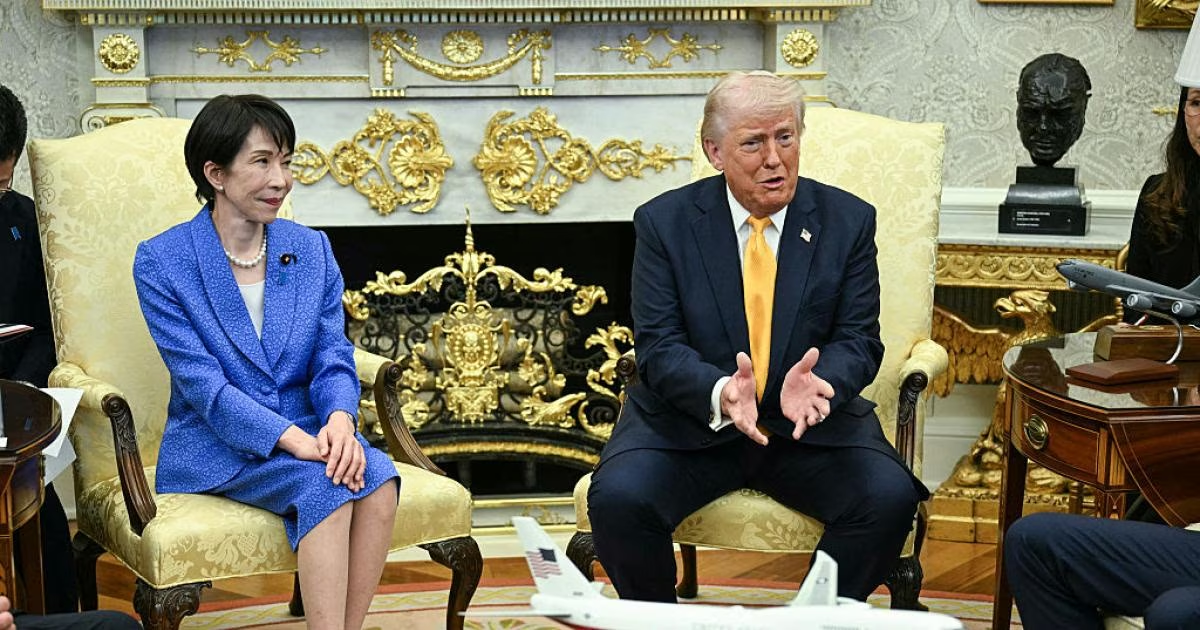
US President Donald Trump announced on Thursday that he had made a direct request to Israeli Prime Minister Benjamin Netanyahu to immediately cease targeting energy facilities within Iranian territory. Trump's statements came during his reception of Japanese Prime Minister Sanae Takayishi in the Oval Office, where he assured reporters that Netanyahu had responded to this request and would not repeat such operations in the near future.
Israeli officials revealed that the recent attack carried out by the occupation army on gas facilities in Iran's South Pars field was coordinated with the US administration, despite ruling out its repetition for now. The officials explained that this attack led to a dangerous escalation in the region, as Tehran launched retaliatory air attacks targeting energy infrastructure in several Middle Eastern countries, thus expanding the scope of the confrontation that has been ongoing for weeks.
In an attempt to disavow direct consequences, Trump indicated via social media platforms that Washington was not aware in advance of the specific details of the attack on the gas field. The US President added that Israel had pledged not to target Iranian gas fields again, unless Tehran first targeted vital facilities in Qatar.
Israeli sources likened the current situation to previous attacks that targeted Iranian fuel depots, which the American side had then tried to distance itself from. US Secretary of Defense Pete Hegseth had previously stated that those operations were not American in origin, indicating that there is sometimes a divergence in target selection between the two allies.
Iranian retaliatory attacks caused severe damage to the world's largest gas plant in Qatar, in addition to targeting a major oil refinery in Saudi Arabia. Authorities in the United Arab Emirates were also forced to temporarily close some gas facilities as a precautionary measure due to escalating military tensions in the Gulf waters.
Informed sources in the region reported that Gulf countries rushed to request official clarifications from the Trump administration regarding the nature of the sudden Israeli attacks. One country contacted the US Central Command, which denied prior knowledge of the attack, creating a state of diplomatic and military confusion regarding the true level of coordination between Tel Aviv and Washington.
In a related context, Trump's special envoy, Steve Witkoff, continued to communicate with leaders in the region to clarify that the attack on the Pars field was not a joint military operation. However, Witkoff acknowledged that Washington had prior information about Israeli intentions, despite not being directly involved in the planning or field execution of the airstrike.
Despite the absence of an official Israeli announcement of responsibility, intelligence reports confirm close coordination in general air operations between the two sides. Officials' statements reveal that strategic objectives may differ, with Israel focusing on eliminating Iranian leaders, while Washington prioritizes the destruction of Iranian missile and naval capabilities.
For his part, Iranian Foreign Minister Abbas Araghchi issued a strong warning, emphasizing that Tehran would not adhere to any policy of restraint if its vital facilities were subjected to new attacks. Araghchi stressed that the previous Iranian response used only a small fraction of the available military capabilities, and that any future escalation would be met with full and unprecedented force.
The Iranian minister explained that the only reason his country had previously exercised restraint was in response to international demands to de-escalate and prevent the region from sliding into a full-scale war. He considered that targeting energy infrastructure represents a crossing of red lines and a direct aggression that necessitates an overwhelming response targeting all parties involved in the aggression.
In conclusion of his statements, Araghchi described the bombing of fuel tanks in Tehran as an act of 'environmental genocide' that caused long-term damage to the population and the biosphere. These developments come amid a state of international anticipation for what will happen in the Middle East, with continued political and military tensions between major and regional powers.
I informed Netanyahu that he must not attack Iranian energy facilities, and he will not do so again.
شارك برأيك
Trump demands Netanyahu stop targeting Iranian energy facilities, Tehran vows unprecedented response