






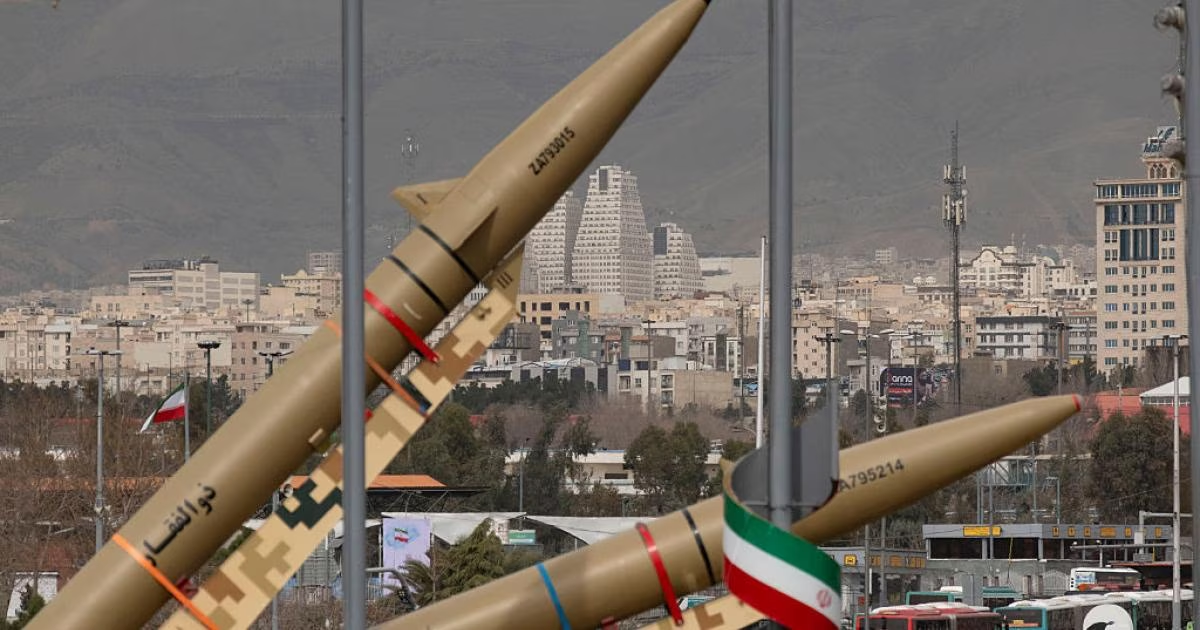
The Islamic Republic of Iran continues to strengthen its position among the major military powers in the world, as the 2026 Global Firepower Index ranked it sixteenth out of 145 countries included in the careful review. Tehran achieved a power index of 0.3199, which reflects a remarkable development in its defensive and offensive capabilities compared to previous years, despite the continuation of international sanctions imposed on it.
Data from the International Institute for Strategic Studies indicates that the Iranian armed forces are among the largest in the West Asia region in terms of human power. The military formations include at least 580,000 active-duty soldiers, supported by about 200,000 trained reservists, distributed between the regular army and the Islamic Revolutionary Guard Corps, which represents a fundamental pillar in the country's military doctrine.
In addition to the regular forces, the "Basij" stands out as a voluntary paramilitary force directly affiliated with the Revolutionary Guard, with analysts estimating that the number of volunteers could reach millions. The Revolutionary Guard also manages the "Quds Force," an elite unit tasked with external missions, including coordination with allied forces within what is known as the "Axis of Resistance" in the region.
Regarding missile capabilities, Tehran possesses one of the largest and most diverse arsenals in the region, including more than 20 types of ballistic and cruise missiles. These missiles are characterized by varying ranges and high destructive capabilities, specifically designed to provide a strategic deterrent capability capable of reaching long-range targets exceeding 2,000 kilometers.
"Sejjil" and "Khorramshahr" missiles top the list of the most dangerous weapons with a range of 2,000 to 3,000 kilometers, capable of carrying heavy warheads weighing between 750 and 1,500 kilograms. The arsenal also includes "Ghadr," "Emad," and "Fattah 2" missiles, in addition to the "Paveh" cruise missile with a range of up to 1,650 kilometers, which places all regional bases within targeting range.
Iranian missile technology has witnessed a qualitative shift from reliance on liquid fuel in early generations such as "Shahab" missiles, to the use of solid fuel in newer models. This shift has significantly contributed to increasing thrust and reducing preparation time for launch, which enhances the effectiveness of missiles in rapid combat operations and defensive maneuvers.
In the skies of the region, Iran has emerged as a leading power in the field of drones, possessing, according to specialized sources, about 3,894 drones. These drones vary between reconnaissance missions, which constitute 82% of the total, and offensive missions, which represent 18%, and these drones have proven high tactical efficiency as a low-cost and high-impact weapon.
The "Shahed 129" drone is one of the most prominent offensive pieces in the Iranian arsenal, a drone capable of long-duration flight and carrying anti-armor missiles. The "Arash-2" drone also stands out with a range of up to 2,000 kilometers, and the "Mohajer 6" drone, which is used for surveillance and precise attack operations, giving Tehran flexible air capabilities away from traditional fighters.
As for the air force, it still relies mainly on a mix of old American fighters such as the "F-4 Phantom" and "F-14 Tomcat," along with Russian and Chinese aircraft. Despite the age of these aircraft, Iran has succeeded in developing domestically produced fighters such as "Saeqeh," "Kowsar," and "Azarakhsh," in an attempt to bridge the technological gap and modernize its aging air fleet.
On the ground force front, the Iranian army possesses a huge arsenal of approximately 1,500 main battle tanks, varying between Soviet "T-54/55" models and their developed Iranian versions. The ground force also includes hundreds of infantry fighting vehicles and armored personnel carriers, providing high mobility and troop protection in various operational theaters.
Regarding artillery, sources reported that Iran possesses approximately 7,000 artillery systems, including self-propelled howitzers of various models. These systems include domestically produced "Raad" cannons, and North Korean and American-made cannons, making it one of the strongest artillery forces in the region in terms of firepower density and variety of options.
Despite this significant conventional strength, defense experts indicate that Iran still faces technological challenges that make it lag behind the military development of the United States and Israel. However, reliance on local manufacturing and innovation in the fields of missiles and drones has enabled it to create a deterrent balance that compensates for the lack of some advanced technical aspects.
The nuclear file remains the most controversial issue, as international reports confirm that Iran possesses the knowledge and infrastructure necessary to produce a nuclear weapon if the political decision is made. Despite Tehran's continuous denial of any military intentions for its nuclear program, analysts believe in its ability to produce enough fissile material to make a bomb within a few months.
In conclusion, the 2026 military ranking shows that Iran has managed to build an integrated defense system based on self-sufficiency in many vital sectors. This development positions it as a regional player that cannot be overlooked, and represents a continuous challenge to security balances in the Middle East, especially with the continued development of the ranges and accuracy of its strategic weapons.
Tehran possesses one of the largest arsenals of ballistic missiles and drones in the West Asia region, with capabilities capable of striking targets up to 3,000 kilometers away.
شارك برأيك
Iran's Military Capabilities in 2026: A Huge Missile Arsenal and Advanced Global Ranking