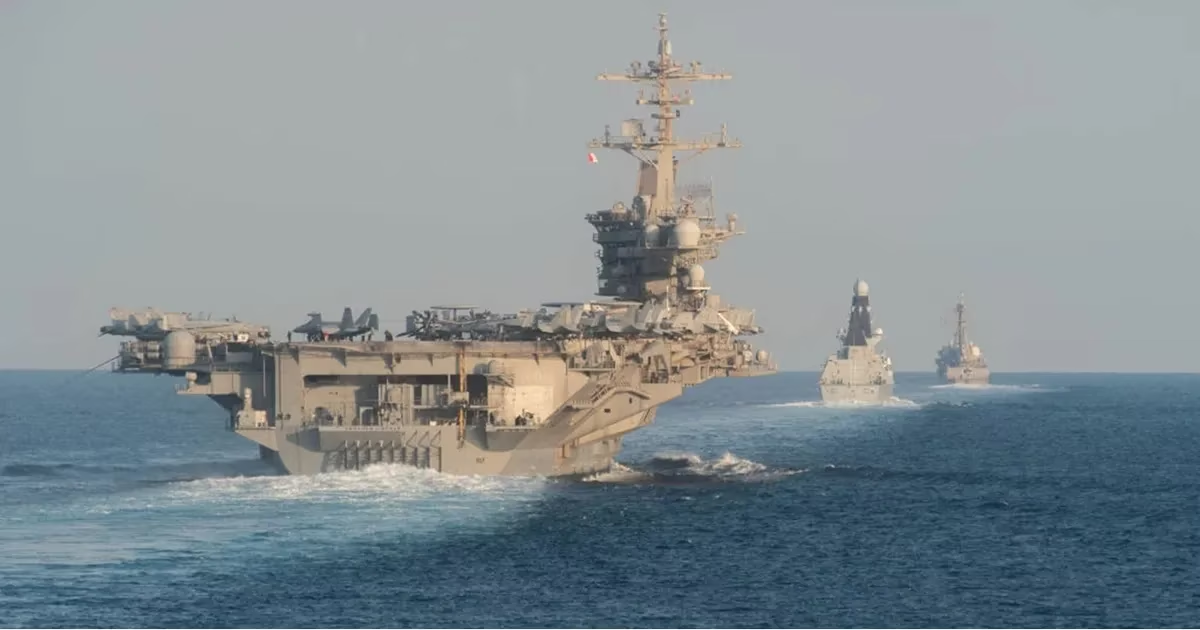







Throughout history, wars have not merely been pure military confrontations; rather, they are the product of temporal contexts, precise timings, and political legitimacy that grants them continuity. Today, the United States faces a real crisis in providing these elements in its potential conflict with Iran, as American steps lack the international and internal consensus required to engage in a confrontation of this magnitude.
Observers believe that the upcoming war, if it occurs, will not be a war of necessity for the American people, but is essentially a war sought by Israeli Prime Minister Benjamin Netanyahu. Opinion polls show a lack of internal consensus in Washington, amidst sharp political polarization that is afflicting American society and weakening the administration's ability to make fateful decisions.
On the European front, the scene appears more complex, as the old continent is experiencing a state of disintegration and a search for lost security between the hammer of Russian policies and the anvil of American trends during the Trump era. Europe currently lacks a clear vision for the future of the international system, making it unable to effectively engage in new military adventures.
In contrast, China and Russia emerge as international powers that sense an imminent danger to their influence if Washington manages to resolve the conflict in its favor. For Beijing and Moscow, Tehran represents the key to future balances, which has prompted both countries to change their approach towards providing clear logistical, technical, and political support to the Iranian side.
For China, the region represents an economic lung and a vital corridor for the 'Silk Road' project, making Iran's stability or resilience a supreme strategic interest. This intersection of interests has pushed major powers to stand against American unilateral hegemony over the Middle East's resources, which strengthens Tehran's negotiating and field position.
Regionally, Arab and international stances are witnessing a remarkable shift, as most countries in the region refuse overt cooperation with American plans to strike Iran. With limited exceptions, regional cover is absent for any military action, placing Washington in a political isolation it has not experienced in its previous wars in the region.
The positions of Pakistan and Afghanistan emerge as additional pressure factors, as both countries have shown readiness to support Tehran in the event of direct aggression. This regional alignment gives Iran a strategic depth that extends beyond its geographical borders, complicating the mission of any military alliance led by the United States and Britain.
In Iraq, the position appears more cohesive with the Iranian side at official, popular, and religious levels, where the confrontation is viewed as a war on an Islamic and jurisprudential model. Iraqi resistance forces consider themselves an integral part of this battle, directly threatening American interests in the region.
Regarding non-state actors, Iran's allies in the region still possess qualitative influence capabilities despite the blows they have received in recent years. Israel seriously fears the opening of multiple fronts, especially as the justifications for resistance in Lebanon and Palestine grow stronger with the continuation of occupation and aggression.
Internally, the Islamic Republic is experiencing a state of national cohesion and unity of political and military stance, a phase described as the best in decades. Failed intelligence attempts have contributed to revealing vulnerabilities and strengthening the internal front, making Iran more prepared to face any escalatory scenarios.
Tehran's defensive strategy relies on 'long breath' and dragging adversaries into a war of attrition whose cost the global economy cannot bear. The Iranian leadership knows that the current American administration is incapable of resolving a swift military conflict, or even developing a safe exit plan that ensures it does not sink into the sands of the Middle East.
The threat of a nuclear option by Washington or Tel Aviv may push other countries to declare a nuclear umbrella for Iran, completely changing the rules of engagement. This deterrent balance makes military adventure fraught with risks that could permanently end the era of American hegemony over the international system.
The United States has lost the element of surprise, which represents half the strength of war, after its plans, prepared for many years, were exposed. In contrast, recent missile tests have proven that Iran possesses military surprises capable of shaking the security of major cities in the Israeli entity and undermining its strategic superiority.
In conclusion, the upcoming confrontation will not be with a weak or fragmented state, as happened in previous American experiences, but with a fully-fledged state with a solid fighting doctrine. If Iran succeeds in thwarting American objectives, history may record that this confrontation was the major turning point in bringing Washington down from the throne of unipolarity.
Iran today is the international fulcrum and the key to its future balances, and its steadfastness may lead to the fall of American global hegemony from its throne.
شارك برأيك
Wars Are Not Only Military: Why Is Washington Lacking Elements of Power in Confronting Iran?