






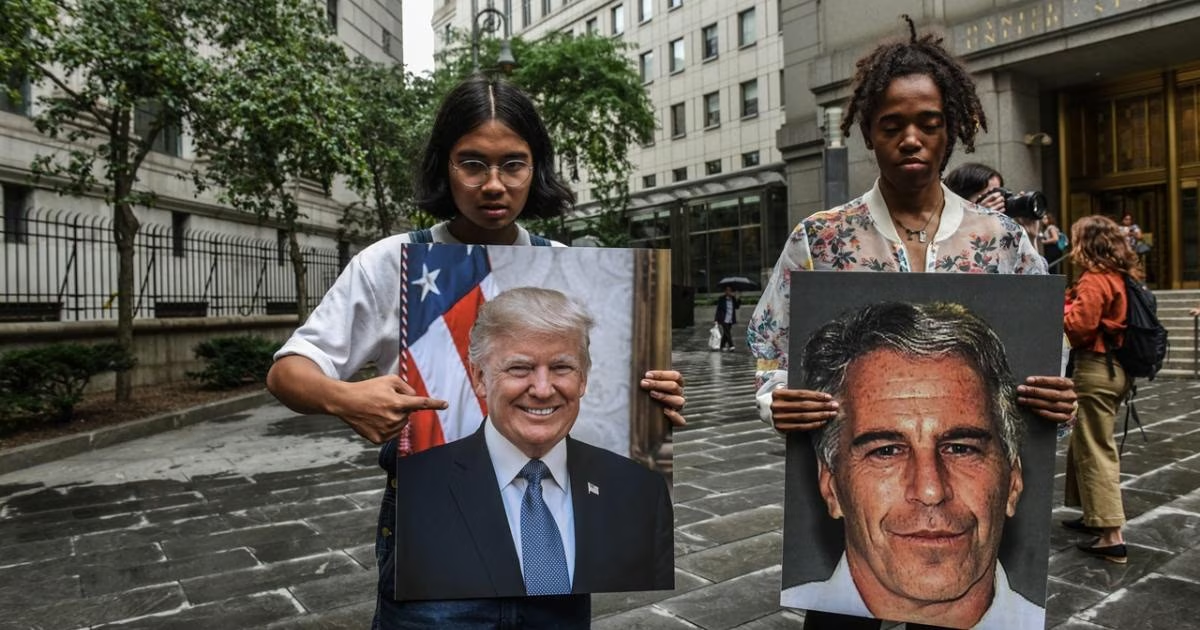
The repercussions of the files of the late American billionaire Jeffrey Epstein, convicted of widespread sexual exploitation crimes, continue to send shockwaves through global political and legal circles. These documents have led to complex judicial investigations, resignations of high-ranking officials, and even divisions within European royal families.
In the heart of Washington D.C., US President Donald Trump called for moving past this issue and focusing on the future, a move his Democratic opponents considered an attempt to cover up facts that could incriminate the current administration. These calls come at a time when the opposition insists on the full disclosure of all withheld documents to ensure justice.
For her part, US Attorney General Pam Bondi emerged as the first line of defense for President Trump before Congress, where she affirmed in her testimony that the current administration is the most transparent in US history. However, these statements were met with sharp criticism from members of the Democratic Party who view her conduct as political bias.
Reports indicate that Jeffrey Epstein operated a complex sexual exploitation network targeting underage girls, some as young as 14. Epstein's life ended in his New York cell in 2019, leaving unanswered questions about the international figures involved with him in these suspicious activities.
The list of names linked to the case includes high-profile figures, among them former President Bill Clinton, British Prince Andrew, and former Israeli Prime Minister Ehud Barak. Donald Trump's name also appeared in the documents, placing him under public and legal scrutiny despite the administration's continuous denial of any illegal connection.
In this context, Yvette Alexander, a member of the Washington D.C. Council, affirmed that the Department of Justice has a responsibility to protect the community and victims, not to defend the occupant of the White House. She clarified that the remaining documents contain explicit names of perpetrators and thousands of victims awaiting legal redress.
Alexander stressed in statements to media sources that the Attorney General has not yet met with any of the victims whose names are mentioned in the files, raising doubts about the seriousness of the ongoing investigations. She considered that the current focus is on protecting political interests rather than prosecuting those involved in Epstein's network.
Attention was also drawn to the situation of Ghislaine Maxwell, Epstein's associate, who is serving her sentence under conditions described as 'comfortable,' while trying to negotiate to avoid revealing more secrets. Observers believe that the prosecution's failure to obtain her full testimony represents a major loophole in the criminal case.
On the other hand, political analyst Peter Rough believes that the case has become an arena for partisan conflict, with Democrats seeking to politically condemn Trump despite some events having occurred more than two decades ago. Rough pointed out that the passage of time has led to the disappearance of some evidence and changes in witness testimonies, making legal conviction a complex matter.
Rough warned that the full release of documents might include unverified information, which could open the door to the publication of claims that are difficult to verify and harm the reputation of potentially innocent people. He considered that the Attorney General personally taking over the investigations is a departure from the professional context that requires specialized investigators.
For his part, Leon Fresco, former Deputy Assistant Attorney General, focused on the principles of transparency and accountability as essential pillars for resolving this crisis. He clarified that there is a clear law from Congress mandating the publication of documents, and that any delay or intermittent publication fuels conspiracy theories and erodes public trust in judicial institutions.
Fresco noted that global interest in the case stems from the involvement of figures who provided services or received social facilities from Epstein, leading to resounding resignations. He affirmed that the fundamental question now concerns the accuracy of the information provided by officials to Congress about the nature of their previous relationships with the convicted billionaire.
Legal experts believe that the top priority should be to identify the systemic loopholes that allowed Epstein to continue his crimes for many years without deterrence. They call for radical reforms in human trafficking laws and ensuring that these crimes do not fall under the statute of limitations, no matter how long it takes or how high-ranking the involved parties are.
In conclusion, the Epstein case remains a true test of the integrity of the American judiciary and its ability to separate political tug-of-wars from achieving criminal justice. As information continues to flow, the American public awaits what the coming days will bring in terms of surprises that could reshape the political landscape before the upcoming elections.
The Department of Justice bears the responsibility of protecting the United States and holding criminals accountable, not protecting the President from the repercussions of Epstein's files.
شارك برأيك
Epstein Scandals Haunt the White House: Accusations Against the Department of Justice for Protecting Trump and a Struggle to Uncover Documents