






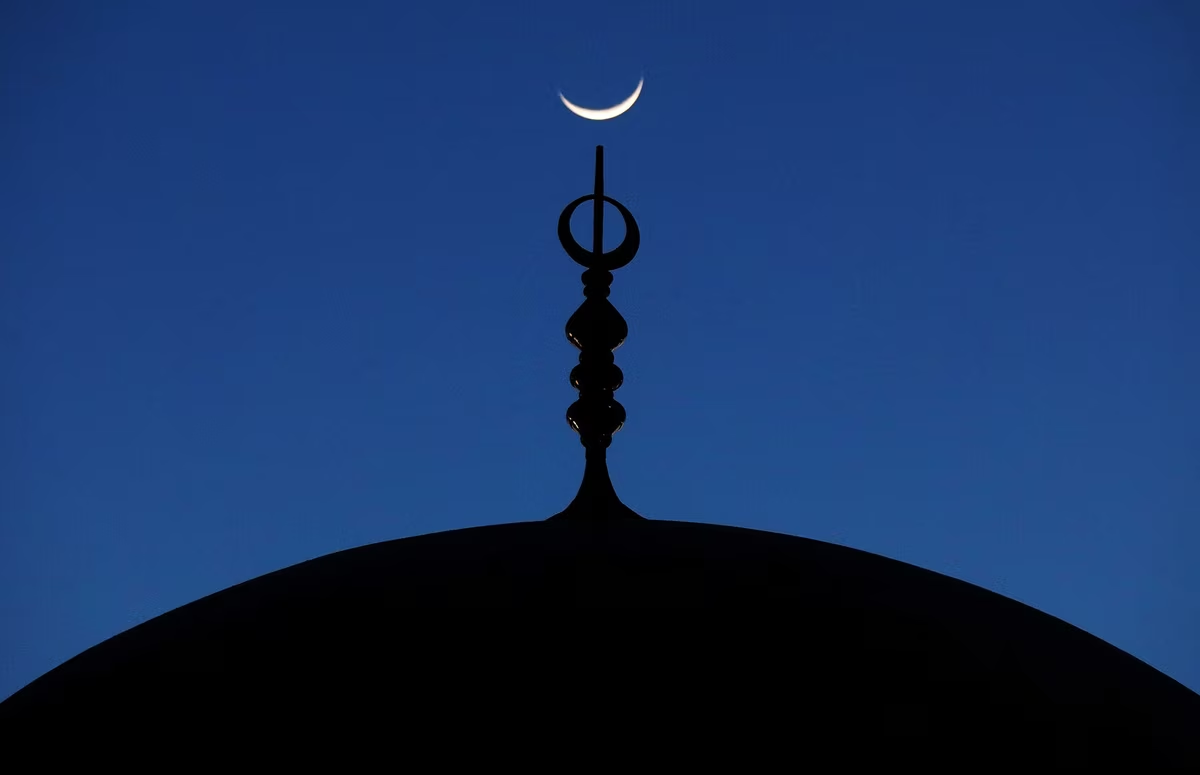
The Jeddah Astronomical Society has determined the date for the appearance of the Ramadan crescent moon in the sky during the current month of February, according to astronomical calculations. This month witnesses a number of diverse astronomical phenomena, making it one of the most distinctive months for observation, and providing astronomy enthusiasts with an opportunity to follow the moon, planets, and stars and enjoy striking cosmic scenes.
In this regard, the head of the Jeddah Astronomical Society, Engineer Majed Abu Zahra, explained that the observation of faint celestial bodies is affected during the first week of February due to the bright moonlight, as the moon was full on the first of the month. Abu Zahra clarified that the name 'Snow Moon' is not a scientific astronomical term, but rather a traditional name used by some indigenous North American cultures due to its historical association with the period of snowfall.
The head of the society affirmed that astronomy does not rely on such designations in scientific classification, as the moon is known according to its geometric state in its orbit, such as 'Full Moon' when it is at an elongation of approximately 180 degrees from the sun. He mentioned that the full moon follows a high path in the northern hemisphere sky, rising with sunset and setting with sunrise, following the path of the summer sun.
Sources added that on the night of February 2nd or 3rd, depending on the geographical location, the waning gibbous moon will pass in front of the star Regulus, the brightest star in the constellation Leo, in a phenomenon known as occultation, which is observed across a geographical range extending from Northwest Africa to parts of North America, while it is seen as a conjunction in Saudi Arabia and most Arab countries.
Regarding Ramadan, Abu Zahra said that February 18th will witness the observation of the thin Ramadan crescent between the planets Mercury and Venus shortly after sunset, which requires a clear western horizon free of obstructions, while the waxing crescent will appear on the evening of February 19th near Saturn in a low scene on the western horizon after sunset.
The head of the Astronomical Society explained that Jupiter is the most prominent celestial body during this month, appearing in the constellation Gemini and easily distinguishable as a very bright point in the southeastern horizon after sunset. He also indicated that Saturn is making its last evening appearances this season, being seen low in the southwest at the beginning of the month and setting early.
February 18th will witness the observation of the thin Ramadan crescent between the planets Mercury and Venus shortly after sunset.
شارك برأيك
Jeddah Astronomical Society Determines Astronomical Date for Ramadan Crescent Moon Appearance