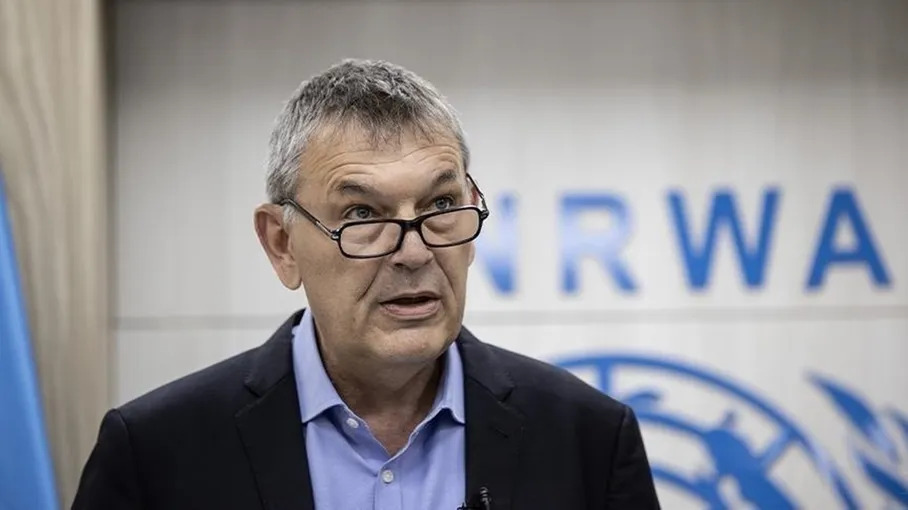







The Commissioner-General of the United Nations Relief and Works Agency for Palestine Refugees in the Near East (UNRWA), Philippe Lazzarini, confirmed that with the ceasefire in the Gaza Strip now in effect, the reconstruction process must begin, justice must be achieved, and the issue of recovery must be taken seriously by both the Palestinian and Israeli communities.
Lazzarini stated in an article published by The Guardian that after two years of brutal war in Gaza, the fragile ceasefire, part of the first phase of U.S. President Donald Trump's 20-point plan, provides some relief to a war-weary population.
He added that "for my colleagues at UNRWA working on the ground in Gaza, the ongoing fear of being killed by bombs and weapons may have lessened, but there is still much to be concerned about - access to shelter, food, and clean water remains a challenge, and winter is approaching rapidly."
He explained that there is no time to waste in addressing the widespread hunger and disease. The scale of physical and psychological trauma is immense, and expectations for access to healthcare and education are rising.
The coming weeks and months will determine whether this critical moment will lead to a new dawn or be a prelude to further despair.
He noted that the United Nations, including UNRWA, has the experience and resources necessary to effectively and widely meet critical humanitarian needs, but it must be allowed to operate freely and independently, without arbitrary and unreasonable restrictions on the entry and exit of supplies and personnel.
He pointed out that "the road to recovery in Gaza will not be easy; the ceasefire is fragile, with near-daily violations testing the resolve of its guarantors, and a ceasefire that prolongs the absence of war without charting a viable path to peace will only lead to a repetition of the catastrophic mistakes of the past. A truly peaceful future requires a genuine investment in a final political solution to the Israeli-Palestinian conflict."
He stated that "basic security is essential to underpin recovery. The ceasefire must be reinforced by an international stabilization force tasked with maintaining calm, protecting vital infrastructure, and ensuring humanitarian aid access."
This force will create the necessary space to rebuild Palestinian institutions.
He added that "the success of the stabilization force, and the transition from emergency to stability, will also depend on providing Palestinians in Gaza with reliable public services and a credible path to peace and respect for human rights."
This can only be achieved through an efficient civil apparatus that enjoys the trust of the community.
He added: "We have previously seen the consequences of underestimating the need for stable and effective public services, with the most notable example being what happened in Iraq when the dismantling of the civil administration in 2003 led to a governance vacuum that caused years of instability.
Professionals, administrators, and community leaders in Gaza must be part of the solution, not victims of political changes."
He emphasized that "UNRWA," with its thousands of Palestinian employees, has the capacity, experience, and community trust necessary to provide healthcare, education, and other public services to the affected population.
For decades, the agency's teachers, doctors, and engineers have formed a vital part of an effective public service system for millions of Palestinian refugees in Gaza and the region.
He noted that the International Court of Justice reaffirmed the competence of UNRWA staff in its advisory opinion issued last month, emphasizing the agency's indispensable humanitarian role and concluding that it remains a neutral and independent actor.
He said that the educational services provided by "UNRWA," including the prestigious human rights program, will be essential to prevent the emergence of extremism fueled by the brutal blockade imposed on Gaza and the atrocities committed over the past two years.
Nearly 700,000 school-aged children now live among the rubble, deprived not only of their homes and loved ones but also of education.
Returning these children to school is crucial to ensuring peace and stability in Gaza and the wider region.
Lazzarini explained that alongside humanitarian relief efforts and the resumption of public services, businesses and donors must be able to trust that peace will endure and that reconstruction efforts will not be in vain.
He stressed that the people of Gaza need the promise of a normal life, with permanent housing, functioning hospitals, and schools.
Rebuilding Gaza means restoring good governance, justice, and a firm belief that peace is still possible within the framework of a two-state solution.
He pointed out that this requires that the "yellow line" in the agreement - drawn for temporary security coordination - does not turn into further fragmentation with a new dividing
شارك برأيك
Lazareini calls for empowering "UNRWA" to support Gaza.. "We have the expertise and want to make peace successful"