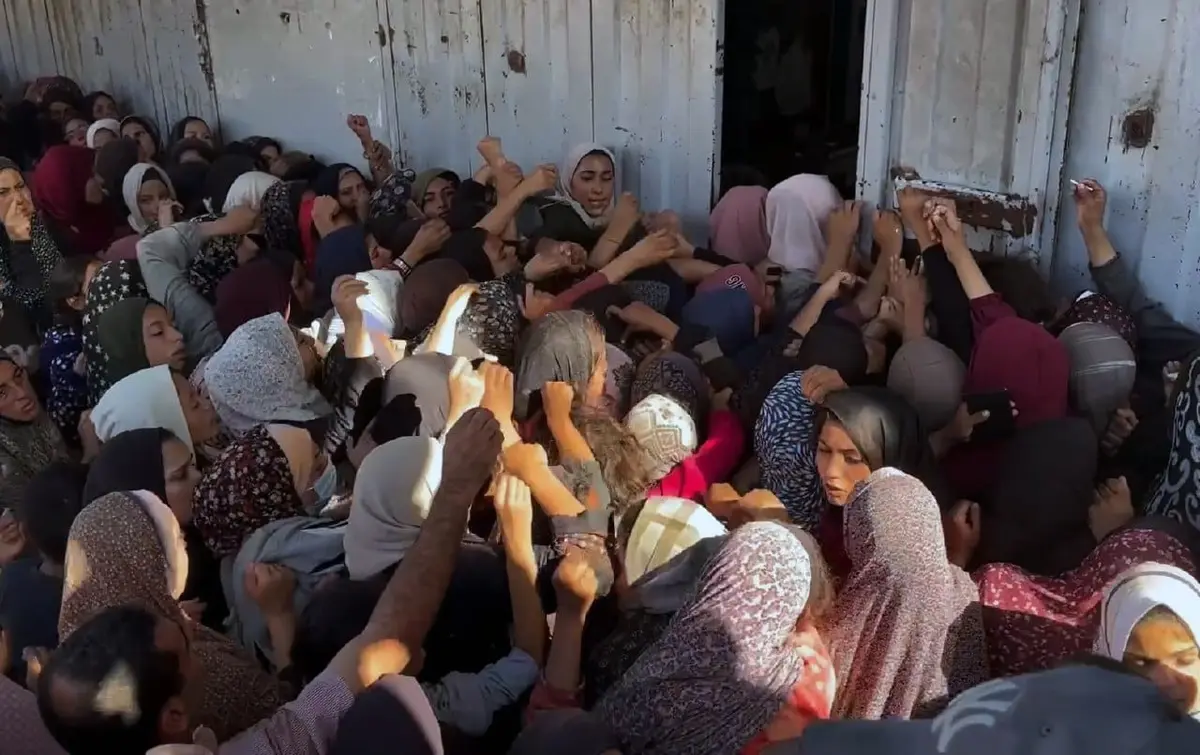







The Guardian reported on Wednesday that aid workers confirmed that new Israeli measures - intended to improve the humanitarian situation in Gaza - fall far short of what is needed, and that aid access remains restricted amid the worsening famine facing the population.
The occupation announced the new measures, which went into effect on Sunday, and include daily humanitarian pauses, airdrops of aid, and humanitarian corridors for UN aid trucks. This came after mounting international pressure to alleviate the hunger crisis.
Relief organizations have confirmed that the Israeli occupation's blockade of humanitarian aid in the Gaza Strip is the primary cause of the hunger crisis, which has led to the deaths of 151 Palestinians from starvation, more than half of them in the past 30 days. As the crisis continues to worsen, the Israeli army continues its attacks on the Strip, resulting in the deaths of 48 people yesterday who were trying to obtain aid.
Oxfam's policy officer, Bushra Khalidi, commented on the new Israeli aid measures: "Twenty-one months on, these are mere token gestures. They are theatrical, and in my view, designed to distract from scrutiny. We are being blocked and delayed at every turn."
The occupation claims that the number of aid trucks entering Gaza has increased since the announcement of the new measures, with more than 200 trucks entering on Tuesday, according to the Israeli Customs Authority (COGAT). This equates to about 70 trucks entering daily on average since the end of May.
However, the number of aid trucks remains far short of the 500-600 that the UN said were needed to support Gaza's two million residents, and some relief agencies have indicated that the true scale of the need is now much greater than 600 trucks, given that the Strip's population is facing famine.
"The needs are much greater than they were before the war, but access is actually worse," Khalidi added. "The famine cannot be solved with 10 or even 300 trucks. What we need are not partial solutions, but real, systemic changes."
Residents and medical workers confirmed that they have not yet felt any change in their daily conditions, as malnutrition continues to spread throughout the Strip.
"We hear a lot of news about more aid arriving, but this is just media talk. The situation on the ground has not changed since Sunday. Food supplies have not reached the targeted population," Dr. Nour El Din El Amsi, from the medical team of the non-governmental organization Project Hope, told the newspaper.
He added that malnourished children still come to his clinic daily for food, while the number of his patients is doubling, and that he has run out of "high-energy biscuits" used to treat malnutrition to give them.
Despite the announcement of increased aid measures, humanitarian workers from international organizations reported new bureaucratic obstacles behind the scenes, preventing them from delivering aid to Gaza.
Among these obstacles is the new registration process for international NGOs, which requires non-UN aid organizations to register with the newly established Israeli Ministry of Diaspora Affairs and Combating Antisemitism.
As part of the registration process, international NGOs are required to provide the identity details of their Palestinian staff, which most refuse to do, fearing it would have repercussions for their safety in Gaza and the West Bank.
They point to the high number of humanitarian workers killed by the occupation in Gaza as an indicator of the risks involved in providing information about their employees to the occupation, and it is unclear whether the occupation will allow them to register without providing that information.
Some imports into Gaza by international NGOs that have yet to receive registration from the new Israeli ministry have been indefinitely delayed by Israeli customs, according to humanitarian workers familiar with supply chain logistics in Gaza, as have their own imports. They fear that customs officials will not allow them to import goods into Gaza without registering them with the occupation, jeopardizing their ability to send aid to the besieged enclave.
“While the clear violations on the ground in Gaza have a significant impact on public opinion, the bureaucratic access violations don’t have the same impact on people because they are tedious and complicated, but that’s what’s preventing aid from getting in,” one aid worker told the newspaper.
Requests for clarification from the customs authority have not yielded any answers, which humanitarian workers said is part of a "deliberate policy" to make the entry of aid into Gaza as complicated as possible. They said that customs officials' explanations for the refusal or delay of aid imports into Gaza have been rare, leaving humanitarian workers trying to guess what is allowed in.
The humanitarian worker added that Israeli customs officials were constantly throwing away dates and olives without explanation, and after combining their experiences with other aid organizations, they realized that the common denominator was fruits or vegetables that contained pits or seeds that could be planted.
Later, shipments containing date paste and pitted olives were successfully allowed into the Strip.



شارك برأيك
Israel's new measures are futile in its attempt to end the hunger crisis in Gaza.