






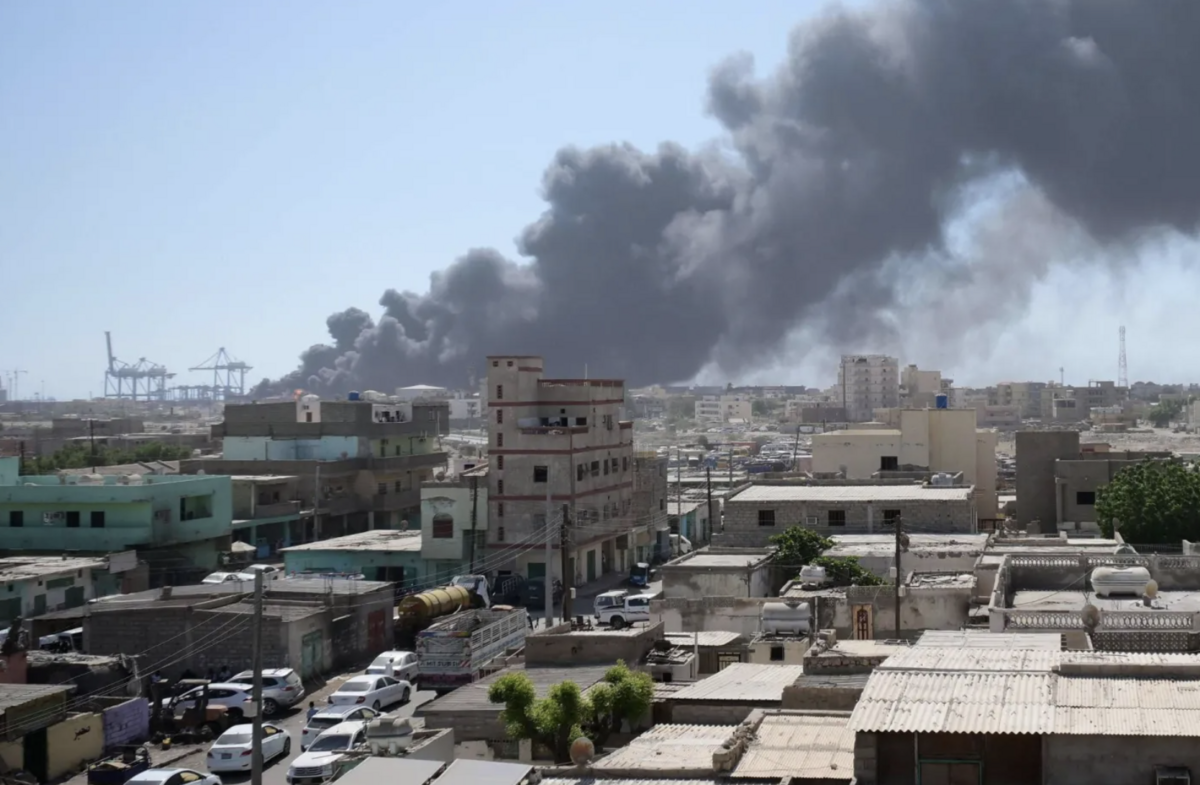
Sudan's war, which has been raging for more than two years between the army and the Rapid Support Forces, has recently intensified in the Kordofan region, with its three states, home to most of the oil fields, such as Heglig, Abu Jabara, and Balila.
Al-Obeid, the largest city in the region in central Sudan, was again attacked by drones early Monday, targeting several locations in the city, sparking intense fear and panic among residents. The attack on the capital of North Kordofan coincides with mobilization and violent fighting in the three Kordofan states.
Local sources told Asharq Al-Awsat that the drones targeted the Al-Radif neighborhood in the east of the city, resulting in varying degrees of civilian casualties. One source said that one of the drones was seen flying over the headquarters of the Sudanese army's Fifth Camel Corps Division.
After the army took full control of the capital, Khartoum, fighting with the Rapid Support Forces shifted westward toward the states of North, South, and West Kordofan.
Siege of Al-Ubayyid
The Rapid Support Forces' targeting of the city is part of a series of attacks against the army and its supporting forces following their withdrawal from the towns of Al-Khawi, Al-Dubaibiyat, and Al-Hamadi surrounding Al-Obeid. This has paved the way for the Rapid Support Forces to besiege Al-Obeid from three directions.
The attack reveals major gaps in the army's air defense systems in the city. Media reports previously revealed that the Rapid Support Forces had acquired advanced drones, which were used in recent battles in several areas of the three Kordofan states.
Sources indicated that the nearest area controlled by the Rapid Support Forces is the city of Bara, less than 50 kilometers northeast of El Obeid. In addition, its forces are deployed in large numbers in the towns of El Khowy, El Hammadi, and Kazigil, which are also close to El Obeid.
In West Kordofan, violent clashes continue between the two sides in the town of Babanusa, home to the headquarters of the army's 22nd Infantry Division. The division previously lost three of its important military garrisons in the towns of Nahud, Al-Fula, and Heglig to the Rapid Support Forces.
"Western Rescue" Road
Sources within the Rapid Support Forces reported that their forces control all of Babanusa and are simultaneously besieging the army's military division headquarters from several axes. They added that "the city's complete fall is only a matter of time."
The Western Rescue Road, which links the capital, Khartoum, to the states of Kordofan before ending in the states of Darfur, is of paramount importance in the battles between the army and the Rapid Support Forces. The army aims to use it as an entry point for its forces to penetrate Darfur, while the Rapid Support Forces view it as an advanced defense line for the region and a basis for their ambition to re-enter the capital, Khartoum.
West Kordofan State, which borders South Sudan, includes approximately 15 localities and most of Sudan's oil fields. It has been witnessing the fiercest fighting between the two warring parties.
North Kordofan state is witnessing intermittent fighting, but the Rapid Support Forces (RSF) have escalated their drone attacks on the capital, El Obeid, and the city of Rahad. As the RSF seeks to advance toward El Obeid from areas under its control in the north of the state, particularly the city of Bara, the army is seeking to end the RSF's presence in the north of the state and some areas in the south, in preparation for lifting the siege on South Kordofan.
South Kordofan, the last of the three Kordofan states, is also witnessing fierce fighting between the army on one side and the Rapid Support Forces (RSF) and the Sudan People's Liberation Movement (SPLM) led by Abdel Aziz al-Hilu on the other. Battles took place in which the army seized control of the Dabaibat and Hamadi areas with the aim of lifting the siege on the cities of Dilling and Kadugli, before the RSF recaptured them.
El Fasher city
Meanwhile, Mohamed Ahmed al-Khidr, commander of the 6th Infantry Division in El Fasher, the largest city in Darfur, confirmed that the army has been repelling an attempt by the Rapid Support Forces (RSF) to storm the city for more than a year. However, eyewitnesses confirmed to Asharq Al-Awsat that army forces are carrying out special operations against the RSF in areas surrounding the city.
For its part, the Sudan Liberation Movement, led by Al-Hadi Idris, stated that its forces are cooperating with the Rapid Support Forces to evacuate civilians from El Fasher and the surrounding camps to the Selek camp in the Korma area.
Sudan has been embroiled in a war since April 2023 between the army and the Rapid Support Forces, which erupted over a dispute between them before the transition to civilian rule. The United Nations says the conflict has displaced more than 12 million people and pushed half the population into the grip of severe hunger.
Two years after the outbreak of the war, the army succeeded in expelling the Rapid Support Forces from most of central Sudan. The forces shifted their tactics from ground incursions to drone attacks targeting power plants and other facilities deep within army-controlled territory. The army continues to launch airstrikes in Darfur, the stronghold of the Rapid Support Forces, while both sides engage in ground battles for control of the strategic city of El Fasher.
شارك برأيك
Sudan's war rages in Kordofan region