






Washington – Said Arikat – 3/4/2026
US President Donald Trump stated that Israel would adhere to a ceasefire if he decided to end the ongoing war with Iran, emphasizing his direct ability to influence Israeli decisions. In an interview with Time Magazine, Trump said: "They will do what I ask them to do… They will stop when I stop," indicating that the continuation of operations depends on whether Israel is subjected to what he described as "provocation."
This statement raises questions about the consistency of the American position, as it contradicts what Trump had previously announced in an interview with the Israeli website "The Times of Israel," when he affirmed that ending the war would be a "joint" decision in coordination with Israeli Prime Minister Benjamin Netanyahu.
An extensive report published by "Time" magazine indicates that the decision to engage in war came as a result of close coordination between Washington and Tel Aviv, with subsequent American attempts to find a way out of the conflict amid declining popularity within the United States. The report quotes an Israeli official—who preferred to remain anonymous—as saying that Netanyahu's room for maneuver remains limited without direct support from Trump.
The report also reveals details about how the decision to launch the war was made, as Trump held a meeting on February 27 during which he hinted at canceling the operation, before reactivating it later through a small circle of his trusted advisors, and finalizing the initial strikes.
In contrast, the report highlights continuous pressure exerted by Netanyahu to push the US administration towards adopting a long-term military option against Iran. According to a source who attended a lengthy meeting between the two parties in Washington, Netanyahu stressed the necessity of completing the military path, considering that Tehran is seeking to gain time in its race towards acquiring nuclear capabilities.
Despite the intensity of the confrontation, Trump acknowledged in his interview with the magazine Iran's ability to endure, describing it as "very stubborn," and noting that it is under significant pressure, even going so far as to say that he sees Iranians as "better negotiators than fighters."
Trump's statements reflect a personal inclination in managing foreign policy, where war and peace decisions are reduced to an individual's will, bypassing traditional institutional frameworks. This approach raises concerns in pro-Israel American political circles, as it suggests that the relationship with Israel is not a balanced strategic partnership, but a one-way influence relationship. Furthermore, linking a ceasefire to a personal decision weakens Washington's credibility as an international mediator and reinforces the impression that US foreign policy is subject to immediate calculations rather than being the product of a long-term strategic vision.
The contradiction between Trump's current and previous statements also reveals confusion in determining the nature of the American decision in this war. While earlier discussions spoke of a "joint decision," the rhetoric now tends towards individuality. This shift may reflect increasing internal pressures, especially with the declining popularity of the war among American public opinion. It also raises questions about the extent of Israeli decision-making independence, and whether Tel Aviv is indeed an equal partner or subordinate to the American decision on critical issues.
Several experts in Washington believe that the relationship between Trump and Netanyahu is more complex than it appears in public statements, with some even believing that Benjamin Netanyahu exerts a reverse influence, leading Trump's directions rather than being subordinate to him. This view is based on the intense pressure Netanyahu exerted to push Washington towards war on Iran, and Trump's repeated responses to these pressures, reflecting a deep intertwining in decision-making between the two parties.
Trump's acknowledgment of Iran's resilience highlights a gap between expectations and reality in this war. Instead of achieving a quick resolution, Tehran has shown an ability to absorb strikes, complicating Washington and Tel Aviv's calculations. Moreover, describing Iranians as "better negotiators than fighters" may implicitly suggest an awareness of the limitations of the military option, and opens the door to the possibility of returning to the diplomatic path, despite the continuous escalation in political rhetoric.
שתף את דעתך
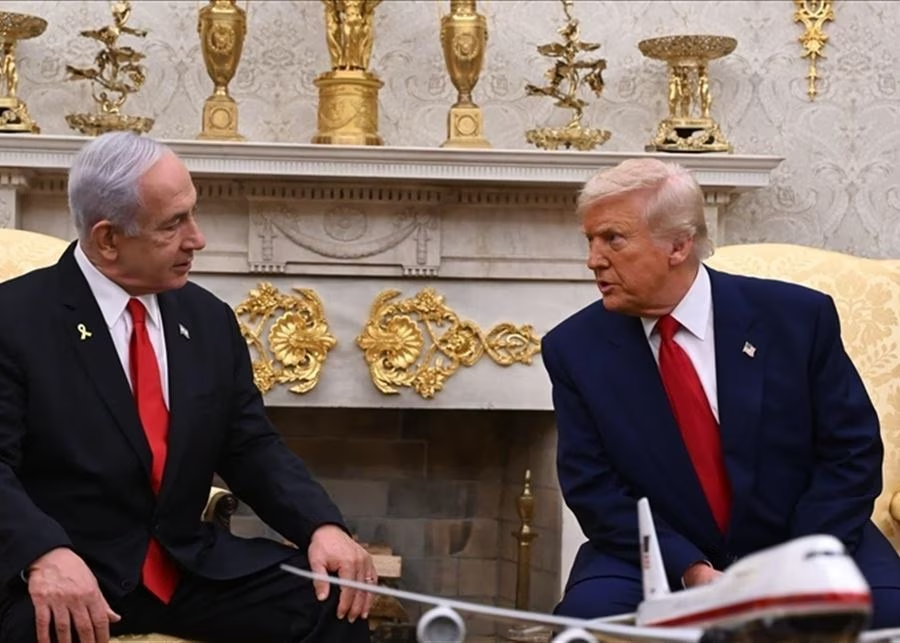
Trump asserts his sole ability to stop war with Iran amid debate over Netanyahu's role in guiding US decision