





News Analysis
Washington, D.C - Wars are often framed as unavoidable—products of failed diplomacy or last-resort necessity. But the U.S.–Israeli war with Iran tells a different story. This was not a conflict that emerged after negotiations collapsed. It was a war launched while negotiations were still underway—twice. That distinction is not semantic. It goes to the heart of how this crisis began, and why its consequences are now being felt far beyond the battlefield.
In both 2025 and 2026, the United States and Iran were actively engaged in diplomatic talks when military action was initiated. Beginning in April 2025, negotiations mediated by Oman proceeded through multiple rounds in Muscat and Rome. Far from breaking down, these talks were repeatedly described as constructive, with both sides agreeing to continue discussions. Diplomacy was not stalled; it was slow, imperfect, and ongoing—exactly as complex negotiations tend to be.
The same pattern held in early 2026. Talks resumed in February and were again characterized as a “good start,” with further negotiations expected. Just days before the February 28 attack, officials indicated that an agreement could still be within reach. There was no clear endpoint, no mutually recognized deadline, and no definitive collapse. Diplomacy had not ended. It was still unfolding.
And yet, in both instances, Israel chose to act militarily—first in June 2025, then again on February 28, 2026—effectively overriding an active negotiating track and drawing the United States into war. These were not reactive moves taken after diplomacy had been exhausted; they were preemptive actions taken while diplomacy was still alive.
This raises a fundamental question: if negotiations were ongoing, and by all indications still viable, why was war necessary?
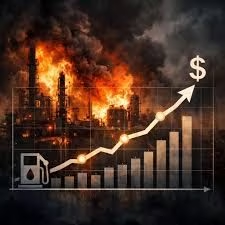
The economic consequences underscore the cost of that decision. A study by Bloomberg estimates that fears of a wider war erased more than $2.5 trillion from global bond markets in March alone—the worst monthly loss in years. This is not a routine correction. It is a signal of systemic stress, driven by geopolitical escalation.
The same analysis points to an even broader shock: global equities have lost an estimated $11.5 trillion in market value, reflecting a level of disruption that extends across sectors and continents. Investors are not merely reacting to uncertainty; they are repricing risk in a world where political decisions are once again overriding economic fundamentals.
The mechanism behind this disruption is both simple and severe. War drives up oil prices. Higher energy costs ripple through supply chains, increasing the cost of production, transportation, and basic goods. This fuels inflation, which in turn erodes the real value of fixed-income assets such as bonds. As inflation rises, central banks are pressured to tighten monetary policy, pushing interest rates higher and slowing growth. What begins as a geopolitical decision quickly cascades into a global economic shock.
As noted by Michael Brown, a senior strategist at Pepperstone, investor concern is increasingly centered on inflation—particularly that driven by rising energy prices. Large energy-importing economies, he warns, are especially vulnerable, facing both accelerating inflation and deteriorating government bond performance.
This vulnerability is especially acute in the United Kingdom and across Europe, where dependence on imported energy amplifies exposure to price spikes. For these economies, the likely path forward includes tighter monetary policy, higher borrowing costs, and weaker growth. In the worst-case scenario, the combination of inflation and stagnation could tip major economies toward recession—reviving fears of stagflation that many believed had been left behind decades ago.
But to focus solely on markets and macroeconomics is to miss the deeper issue. The economic fallout is not an accident; it is the consequence of political choice.
In both 2025 and 2026, military action did not follow the failure of diplomacy. It interrupted it. This distinction matters because it challenges the central narrative often used to justify war—that force becomes necessary only when all other options have been exhausted. Here, the record suggests the opposite: alternatives were still being actively pursued when they were overtaken by military escalation.
Diplomacy is rarely neat or decisive. It advances unevenly, shaped by competing interests, domestic pressures, and shifting regional dynamics. Progress is often incremental, and setbacks are inevitable. But that is not a sign of failure—it is the nature of the process. To abandon negotiations because they are incomplete is to misunderstand what diplomacy is.
The decision to move from negotiation to war, under such conditions, is not inevitability—it is agency. It reflects a judgment that the risks of continued diplomacy outweigh the risks of conflict. Yet the economic data now emerging suggests that this calculation may have been deeply flawed.
Inflation is rising across global markets. Financial systems are under strain. Growth projections are being revised downward. The costs are being distributed worldwide, affecting not only the parties to the conflict but also economies and populations with no direct stake in it.
The tragedy, then, is not simply that war occurred. It is that it occurred while alternatives still existed—and that those alternatives were not allowed to run their course.
There is a broader lesson here. When military force is used not as a last resort but as a parallel track—or even a substitute—for diplomacy, the consequences extend far beyond immediate strategic objectives. They reshape markets, destabilize economies, and impose costs on a global scale.
The question now is not only how this war began, but what it signals about the future. Will diplomacy continue to be treated as a prelude to force rather than an alternative to it? Will negotiations be given time to succeed, or cut short by decisions made in the name of urgency?
In an interconnected global economy, the answers to these questions matter not just for peace and security, but for economic stability itself. Because as this conflict makes clear, when war is chosen over diplomacy, the price is paid by everyone.

ג 24 מרץ 2026 10:09 am - שעון ירושלים
War and Inflation: A Crisis Manufactured, Not Inevitable
שתף את דעתך
War and Inflation: A Crisis Manufactured, Not Inevitable