






By Said Arikat
March 1, 2026
News Analysis
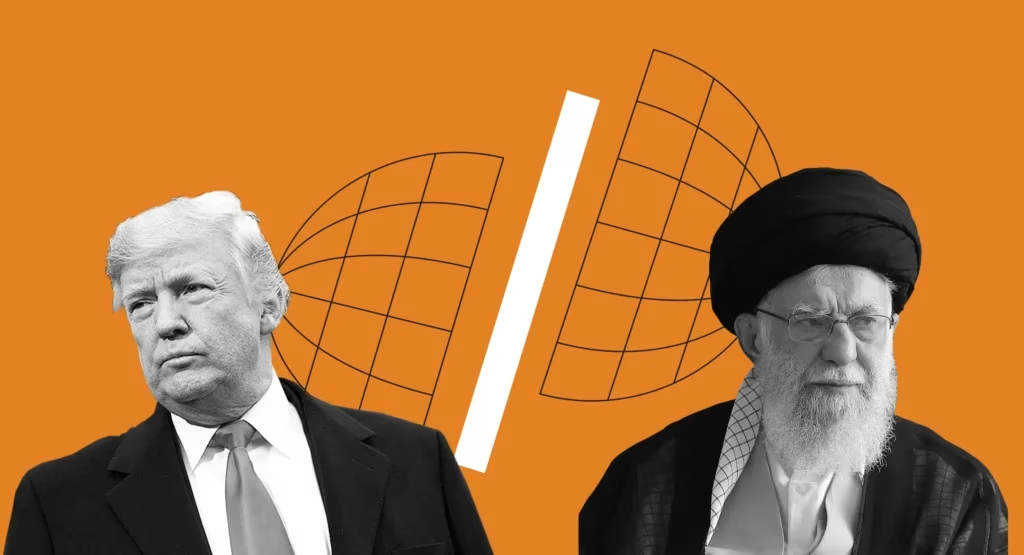
Washington, D.C- News of the assassination of Iran’s Supreme Leader, Ali Khamenei, in a joint American-Israeli strike has sent shockwaves across the Middle East, raising urgent questions about escalation, deterrence, and the future of diplomacy. President Donald Trump may derive personal and political satisfaction from eliminating a longtime adversary, presenting the operation as decisive strength. Yet history suggests that killing a leader rarely produces the regime change promised in triumphant rhetoric. Power structures adapt, hardliners consolidate, and conflicts often deepen rather than end. Trump himself may see this moment as an incentive to pursue meaningful rather than deceptive diplomacy, bringing the region closer not to victory, but to peace.
In the volatile aftermath of such escalation, growing speculation suggests Trump may ultimately accept a nuclear agreement with Iran closely resembling the Joint Comprehensive Plan of Action, the deal signed in July 2015 under President Barack Obama and abandoned by Trump in 2018. Despite years of denunciations portraying the accord as a diplomatic failure, emerging political and strategic realities appear to be guiding Washington back toward a framework that differs more in presentation than in substance.
The irony is difficult to ignore. Trump withdrew from the agreement promising a better deal, arguing that maximum pressure, combining crippling sanctions with diplomatic isolation, would force Iran to accept far stricter terms. Nearly a decade later, the United States faces an Iran with a significantly expanded nuclear program, diminished trust in American commitments, and stronger incentives to resist additional concessions. The negotiating landscape now suggests Tehran has little reason to offer more than what it already accepted in 2015.
Under the original agreement, Iran accepted sweeping compromises: strict caps on uranium enrichment, a drastic reduction of its nuclear stockpile, limits on centrifuge development, and one of the most intrusive international inspection regimes ever negotiated. Many arms control specialists argued even then that Iran had conceded the maximum politically sustainable limits. The collapse of the deal following the American withdrawal reinforced Iranian skepticism toward future guarantees, narrowing diplomatic possibilities and raising the political cost of renewed negotiations.
Against this backdrop, current tensions, including military signaling and escalating rhetoric, appear partly designed to create political cover. Accepting a deal similar to the original agreement without first demonstrating confrontation would risk exposing Trump to accusations that he reversed one of his defining foreign policy decisions. Escalation, therefore, may function less as a pathway to war than as a staging ground for declaring victory before returning to diplomacy under a different narrative.
Trump has framed recent military strikes in explicitly political terms, openly encouraging Iranians to overthrow their government. In a statement directed at the Iranian people after the bombardment, he urged citizens to seize what he described as an opportunity for change, effectively invoking regime change as an implicit objective. Yet modern history offers little evidence that aerial bombardment alone topples entrenched governments. Regime change has historically required prolonged occupation and massive troop deployments, commitments Washington shows no willingness to undertake. Few American policymakers appear prepared to send hundreds of thousands of troops to occupy Iran, rendering the rhetoric strategically disconnected from military reality.
The likely adjustments to any renewed agreement are expected to be modest. The most frequently discussed change involves extending the so called sunset clauses, which phase out certain nuclear restrictions over time. Lengthening these timelines, perhaps from roughly two decades to closer to thirty years, would allow Washington to claim improvements while leaving the agreement’s core architecture largely intact. Substantively, the framework would remain recognizably similar to the deal Trump once condemned as unacceptable.
A broader and more controversial dimension of the crisis lies in regional dynamics shaping American decision making, particularly Israel’s long standing opposition to diplomatic engagement with Iran. Successive Israeli governments have argued that sustained pressure, and if necessary military force, is the only reliable means of constraining Tehran. Critics within the United States counter that Israeli security priorities have repeatedly drawn Washington toward confrontations whose long term costs are borne primarily by American forces and taxpayers rather than regional actors themselves.
Recent history offers sobering precedents. The United States entered prolonged conflicts in Iraq, Libya, and Syria amid promises of quick strategic gains, only to find itself entangled in complex regional struggles that proved extraordinarily difficult to exit. Each intervention reshaped regional power balances in unpredictable ways while deepening American military and political commitments far beyond initial expectations. Skeptics warn that escalating confrontation with Iran risks repeating this familiar pattern, a cycle in which short term political messaging overrides long term strategy and locks Washington into conflicts it later struggles to unwind.
For Trump, the political calculus may ultimately outweigh ideological consistency. By escalating pressure first and negotiating later, he could present a revived agreement as proof that coercion succeeded where diplomacy alone allegedly failed. Such a narrative would allow him to claim personal triumph while effectively returning to a diplomatic baseline established years earlier, reframed as a new victory rather than a policy reversal.
שתף את דעתך
Trump’s Iran Paradox: Escalation as a Path Back to Diplomacy