






Washington, D.C. — For more than three decades, the two-state solution has served as the international community’s default formula for resolving the Israeli–Palestinian conflict. It appears with ritual regularity in presidential speeches, United Nations resolutions, and European communiqués. Yet repetition has not produced resolution. As the language hardened into orthodoxy, the material foundations necessary to realize it steadily eroded. What remains today is less a political program than a diplomatic incantation.
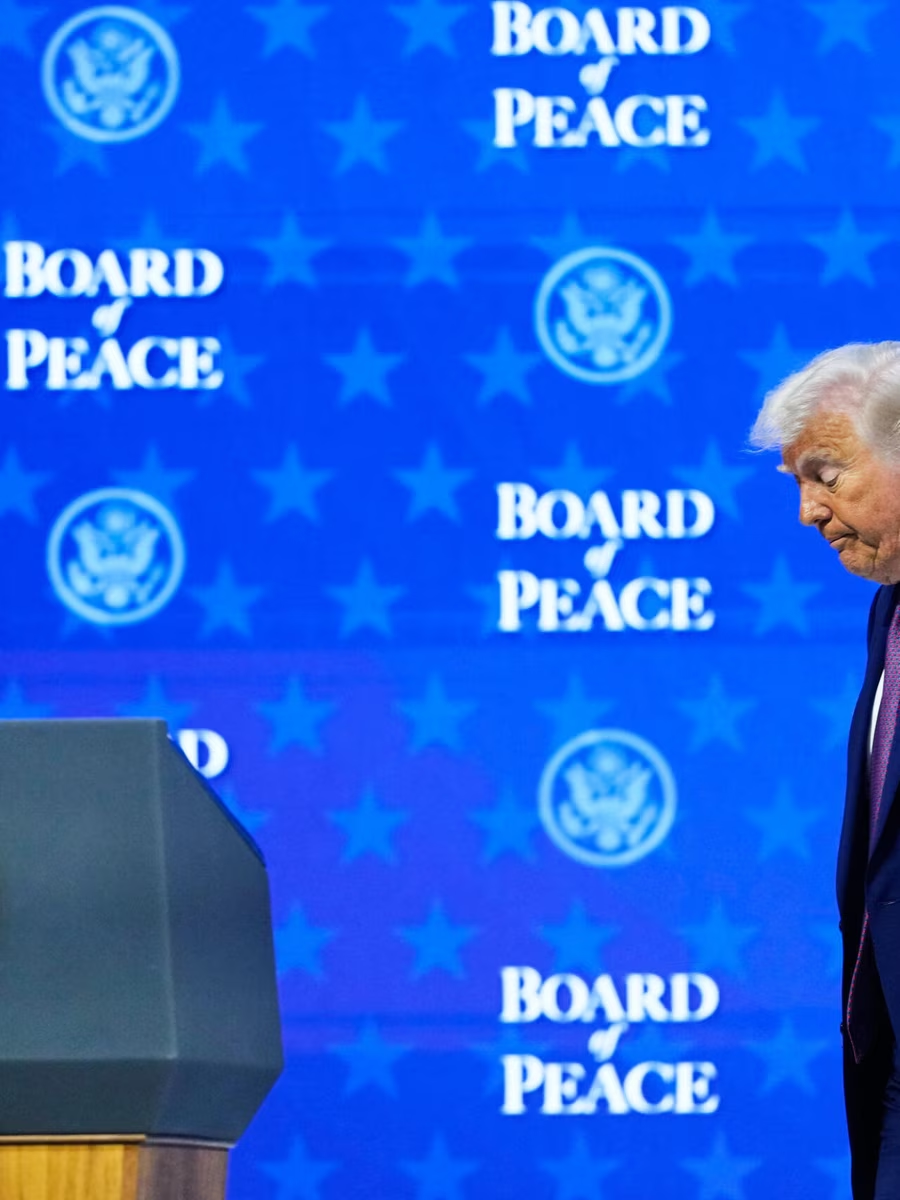
Recent diplomacy has only reinforced that reality. The “Board of Peace” meeting convened in Washington on February 19 under U.S. President Donald Trump’s chairmanship was presented as a renewed push for regional stabilization. In substance, it demonstrated how detached official discourse has become from conditions on the ground. The gathering preserved the vocabulary of peace while avoiding the structural transformations that have rendered territorial partition increasingly implausible. Such forums now resemble rituals designed to sustain a narrative long after its feasibility has expired.
The flaw is not philosophical. The idea of two peoples exercising sovereignty in two states retains moral coherence in theory. The failure is political. The two-state solution is no longer tethered to enforceable steps, binding timelines, or consequences for noncompliance. It has become a diplomatic alibi—language that signals moderation and responsibility while sparing governments the political cost of enforcement or accountability.
The confusion begins with mistaking a slogan for a strategy. A credible plan would define borders, mandate withdrawal, dismantle settlements deemed illegal under international law, and secure genuine Palestinian sovereignty. Instead, process has replaced outcome. Negotiations are elevated above results. Calls to “return to talks” obscure a fundamental asymmetry: one side retains the power to reshape realities unilaterally, while the other negotiates over territory that continues to fragment.
The notion that occupation is temporary has likewise collapsed. The Israeli presence in the West Bank has evolved into a system of territorial integration. Settlements are embedded in a network of roads, military zones, and administrative regimes that divide Palestinian areas into disconnected enclaves. Expansion continues, accompanied by escalating settler violence, often carried out under the watch—or protection—of Israeli forces. This is not a frozen dispute awaiting compromise; it is an active process of consolidation that narrows the horizon of partition with each passing year.
Diplomatic language further blurs the distinction between statehood and sovereignty. The Palestinian state frequently envisioned would be demilitarized, territorially discontinuous, and subordinate in matters of borders, airspace, and security. A polity lacking authority over land, resources, and external relations does not meet the threshold of sovereign equality. Administrative autonomy under overarching control is not self-determination.
The original Oslo bargain—security and normalization in exchange for statehood—has effectively unraveled. Israel has secured expanding regional integration and strategic cooperation, while Palestinian sovereignty remains indefinitely deferred. When one party accrues tangible diplomatic and economic benefits absent reciprocal territorial concessions, negotiations cease to function as instruments of compromise. They instead stabilize and legitimize imbalance.
Time compounds the distortion. Each year of inconclusive diplomacy coincides with further settlement growth and territorial entrenchment. International initiatives absorb pressure without reversing facts on the ground. Assertions that two states remain “within reach” increasingly sound less like sober analysis than institutional habit.
The symmetrical framing of the conflict reinforces the illusion. The language of “two sides” suggests parity between actors of comparable power. In practice, one authority exercises overarching control over borders, land allocation, population registries, and security across the territory, while the other operates under layered restrictions and military oversight. Recasting structural inequality as mutual intransigence obscures responsibility and diffuses accountability.
International law has been diluted in the process. Settlements, annexation, and self-determination—issues grounded in established legal norms—are routinely recast as negotiable “final status” matters. Violations become bargaining positions; rights become concessions to be traded. Through endless procedure, the abnormal is normalized.
The political utility of this framework is evident. By affirming support for a negotiated two-state outcome, Western governments align themselves rhetorically with international law while avoiding measures—conditionality, sanctions, recognition—that might alter incentives. The vocabulary of peace substitutes for policies capable of changing realities. The formula manages the conflict; it does not resolve it.
At some point, Palestinians must confront the implications of this trajectory. Continued reliance on a framework that lacks territorial feasibility, political enforcement, and meaningful international backing risks prolonging strategic paralysis. Clinging to the promise of imminent statehood may serve external diplomatic interests more than Palestinian self-determination. Disabusing themselves of the illusion is not a renunciation of rights; it may be a precondition for redefining them on firmer ground.
Two states may once have represented a plausible historical compromise. Today, absent dismantlement of the settlement enterprise and the restoration of genuine sovereignty, the formula functions primarily as cover for inaction. The central illusion is not simply diplomatic. It is the belief that repetition can substitute for reality—and that language alone can reverse facts deliberately created on the ground.
שתף את דעתך
The Two-State Hocus Pocus: The Diplomacy of Illusion