PALESTINE

Sat 09 Dec 2023 8:40 am - Jerusalem Time

UNRWA official: Civil order is collapsing in Gaza

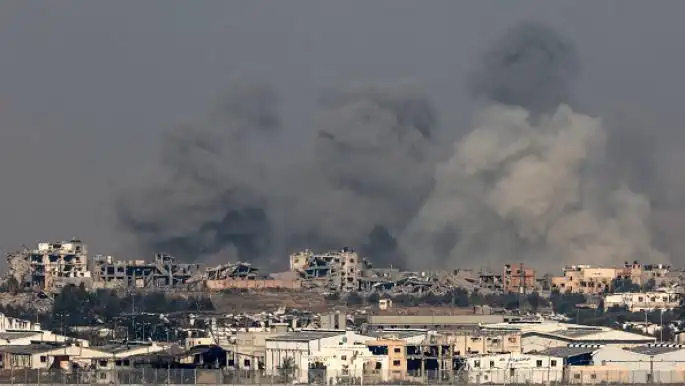
An official at the United Nations Relief and Works Agency for Palestine Refugees (UNRWA) warned that civil order is collapsing in Gaza, where a devastating war has been raging between Israel and the Islamic Resistance Movement (Hamas) for more than two months.


UNRWA operations official in the Gaza Strip, Thomas White, said in his account on the (X) platform, “Civil order is collapsing in Gaza. The streets look lonely, especially after dark.”


White also warned of the spread of famine among the population of Gaza, and said that "some aid convoys are being looted and United Nations vehicles are being stoned. The local community is on the verge of complete collapse."


The UNRWA official published pictures showing thousands of Palestinians gathering around an UNRWA flour distribution center in the city of Deir al-Balah in the central Gaza Strip, commenting that “hunger and disease haunt everyone.”


This comes as the United Nations Office for the Coordination of Humanitarian Affairs (OCHA) said that the pace of humanitarian supplies entering the Gaza Strip is declining daily.


The UN office stated that yesterday witnessed the entry of 69 trucks loaded with humanitarian supplies and 61,000 liters of fuel from Egypt into Gaza, a number much lower than the daily average of 170 trucks and 110,000 liters of fuel that entered during the humanitarian truce between November 24 and 30. the past.


He explained that the aforementioned numbers do not compare with the average load of 500 trucks (including fuel) that entered the Gaza Strip to meet humanitarian needs before the start of the Israeli war on October 7th.


According to the statement, the United Nations’ ability to receive large amounts of aid has been greatly affected during the past few days due to several factors, including the shortage of trucks inside Gaza, after some of them were stranded in the central region, which was separated from the south, in addition to the communication interruption and the increasing number of employees. Those who were unable to come to the Rafah crossing due to the ongoing Israeli attacks on all areas of the Gaza Strip.


It is estimated that nearly 1.9 million people in Gaza, or approximately 85% of the population, have become internally displaced, according to UNRWA.


Nearly 1.2 million of these displaced people have been registered in 156 UNRWA facilities throughout Gaza, including about one million registered in 98 UNRWA shelters in the southern Gaza Strip.


PALESTINE

Sat 09 Dec 2023 8:40 am - Jerusalem Time

Dozens of dead and wounded in Israeli bombing of inhabited homes in Gaza and Rafah

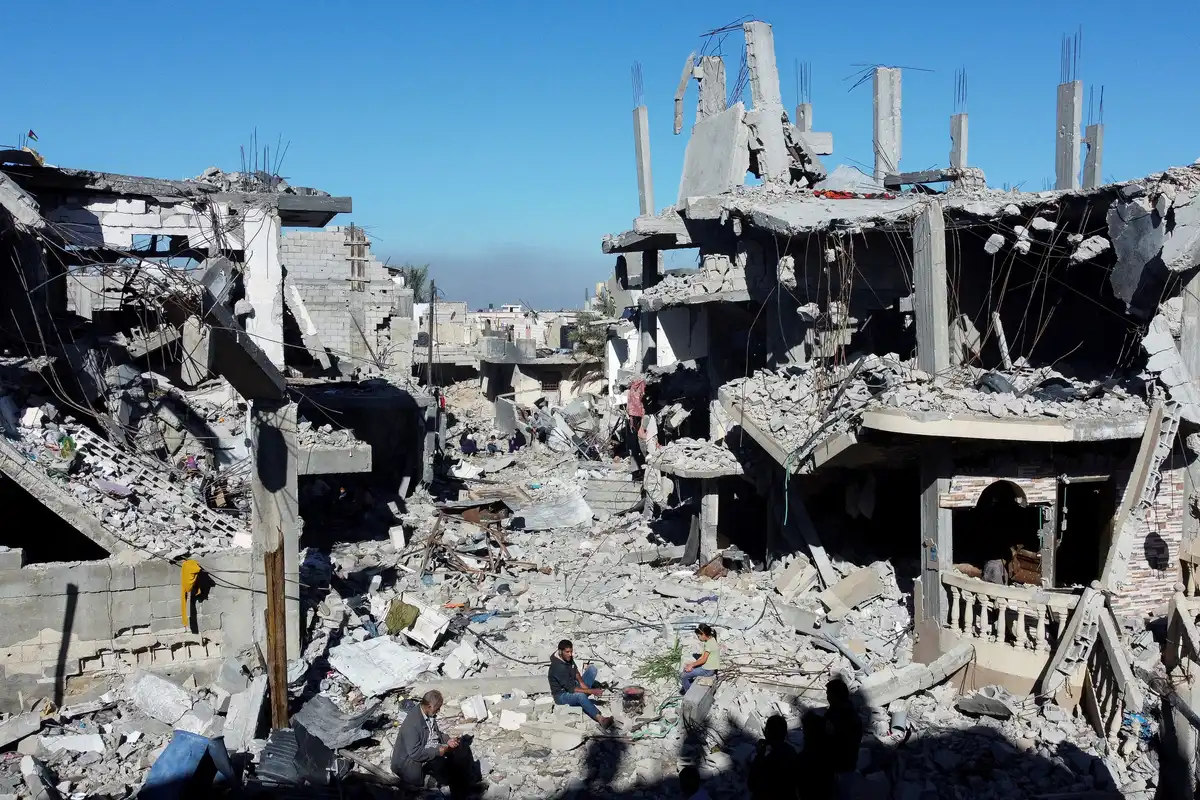
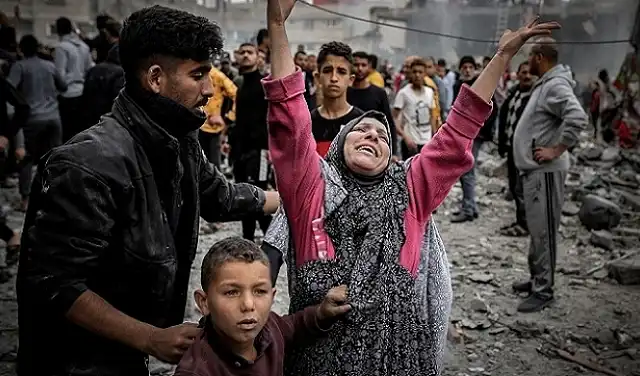
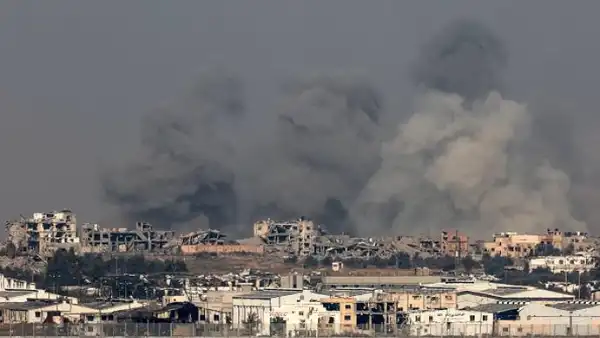
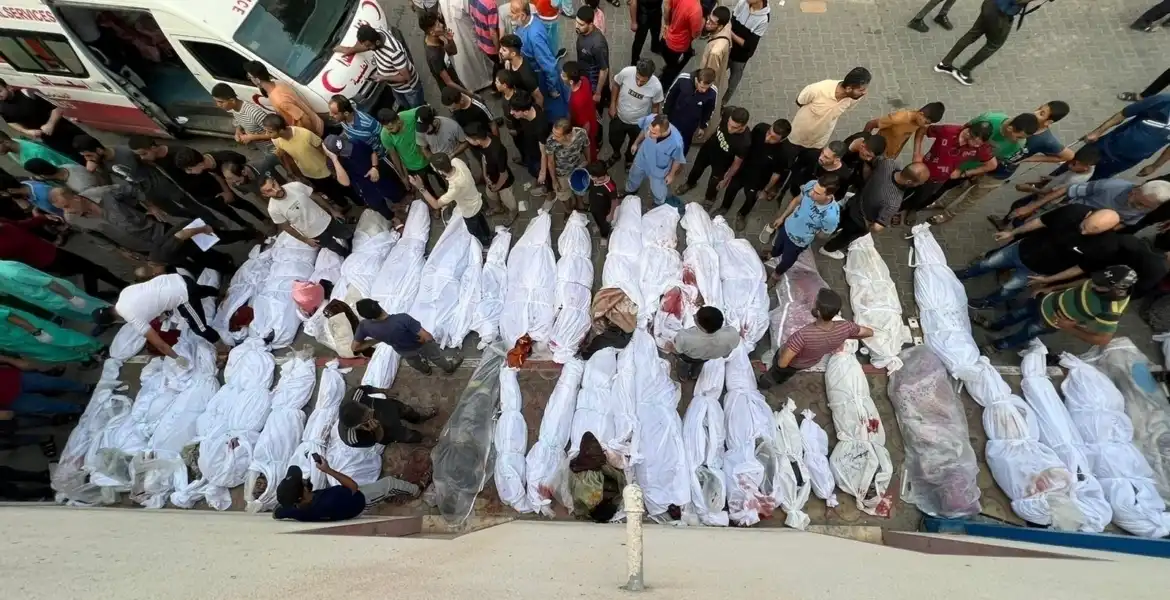
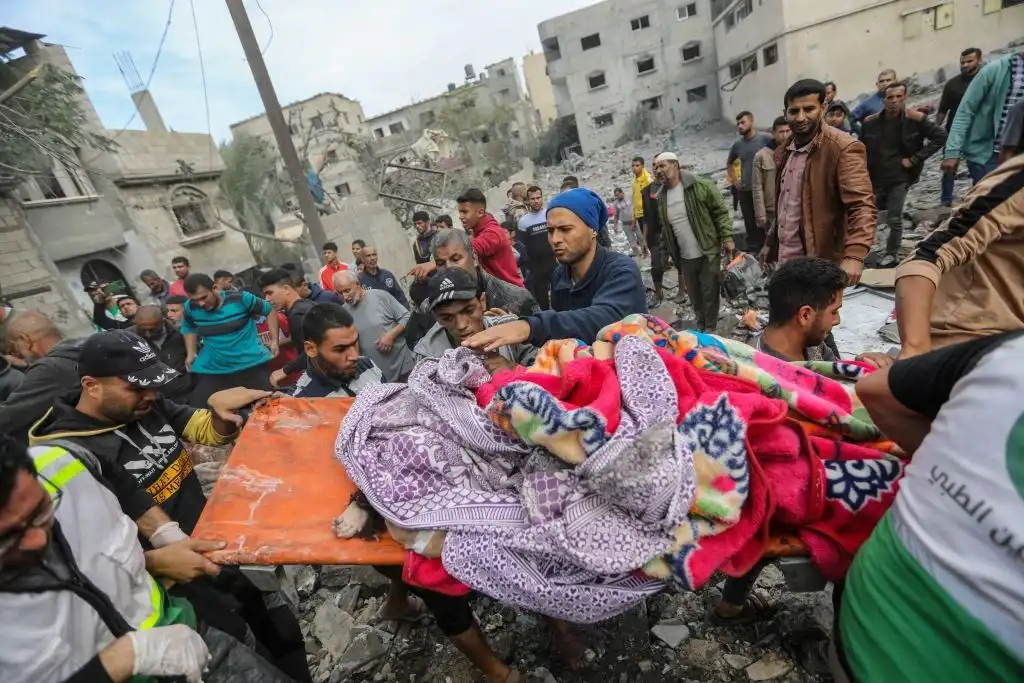
Dozens of citizens were killed and injured, at dawn on Saturday, as a result of Israeli bombing on the cities of Gaza and Rafah in the southern Gaza Strip.


Local sources confirmed that five citizens were killed and a number of others were injured as a result of an Israeli bombing that targeted an inhabited house belonging to the Shteiwi family, west of the Rafah crossing in the southern Gaza Strip.


Dozens were also killed and injured in an Israeli bombing of inhabited homes in the vicinity of the Al-Sahaba Medical Complex in central Gaza, belonging to the Hammad and Atallah families.


Local sources confirmed that there is no possibility of recovering the bodies of the martyrs due to the presence of occupation tanks in areas close to Al-Jalaa Street in the city.


The occupation forces also targeted a house in the Bureij camp and Abu Mahadi land, north of Nuseirat, in the middle of the Gaza Strip, and bombed several sites in the north, center and south of the Gaza Strip.


PALESTINE

Sat 09 Dec 2023 8:21 am - Jerusalem Time

How does "tactical victory" turn into "strategic defeat"?

“The owners of the land usually have the last word in any conflict with foreign occupation, because holding on to the land is the last option for any people, and abandoning it means annihilation, displacement, annihilation as one nation, and dissolution into other peoples.”


“Israel risks exchanging a tactical victory for a strategic defeat,” this is the most serious warning issued by the highest-ranking military official in the US administration, represented by Defense Secretary Lloyd Austin, to the government of Benjamin Netanyahu.


The United States, which is considered the most powerful military power in the world, has had harsh experiences in fighting losing wars despite the massive scale of destruction it caused in Vietnam, Afghanistan, and Iraq, and the number of its deaths hardly compares to the huge numbers of casualties among its enemies. However, it lost its three wars despite “Military victories” achieved on the ground.


Strategic victory is not measured by the number of dead, wounded, and prisoners among the enemy’s ranks, but it has been known since ancient times that it breaks the will of your enemy, to the point where he despairs of achieving victory over you.


- A struggle of wills

When you force your enemy to surrender without firing a single bullet or causing a single casualty, you have achieved a strategic victory. However, if your enemy continues to resist despite the difference in strength and the gap in the number of casualties, then the war becomes a “battle of wills.” Who has the longest breath and the ability to endure? The unity of the internal front and its lack of division is what will achieve strategic victory.


The owners of the land usually have the last word in any conflict with foreign occupation, because holding on to the land is the last option for any people, and abandoning it means annihilation, displacement, annihilation as a single nation, and dissolution into other peoples, while the invaders will return to where they came from.


Here lies the complexity of the Arab-Palestinian conflict because both parties face the diaspora if one of them loses the “battle of will.”


This explains Israel's insistence on displacing and exterminating the residents of Gaza, which is the fate that awaits the residents of the West Bank and East Jerusalem at a later stage, while preserving a weak, willless minority that can be dissolved or at least contained, in a way that does not pose an existential threat to its "state."


But the widespread and barbaric killing of civilians, especially children, with an open roof, has a profound effect on shifting a sector of world public opinion from sympathy with Israel to condemning its crimes.


This is evident in the escalation of demonstrations in cities around the world against “Israeli massacres,” and the increasing criticism of international organizations for the killing of children, women, and journalists in an unprecedented manner in terms of daily and monthly rates, even compared to the First and Second World Wars, and even during the American occupation of Iraq.


Thousands of lawyers and human rights bodies around the world moved with the support of several countries and state leaders, led by the Turkish President, Recep Tayyip Erdogan, and the Algerian President, Abdelmadjid Tebboune, to try Israeli war criminals in the International Criminal Court, although it still lacks courage and impartiality, especially since most of its funding comes from From European and Western countries supportive of Tel Aviv.


Israel is not only losing the battle of world public opinion, but it is also losing the moral battle, and despite its attempts in every way to distort the Hamas movement, the way the Israeli prisoners bid farewell to members of the movement with great affection, love and respect, confirmed the falsity of these accusations.


The Hamas movement’s retention of the military prisoners’ card as part of its vision of ending the war “all for all,” divided Israeli society between demands to liberate the prisoners and pay the price by releasing Palestinian detainees, and those who were strict about the necessity of continuing the war and bombing, even if this led to the death of the Israeli prisoners.


Regardless of which side Israel leans toward, this would deepen the rift and division among members of its society even after the end of the war, which would weaken it even more, make it lose prestige and awe in its regional surroundings, and thus lose its “deterrence power,” which represents the most dangerous type. "Strategic defeat", because it will make it under constant threat and the possibility of repeating the "October 7, 2023" scenario.


Vietnam... Washington's first strategic defeat

One of the most important lessons the United States has learned in its history about wars that are “tactically won and strategically lost” is the Vietnam War, which it entered in 1964 to fight the communist “National Liberation Front of South Vietnam,” known as the “Viet Cong,” who were supported by the North Vietnamese army led by Ho Chi Minh. From it, with the aim of preventing the expansion of communism to the southern part of the country, which was divided into two parts.

The United States threw its weight into this war, rejoicing in its victory in World War II against the Axis forces led by the German Nazis, and also in preventing the communists in North Korea, supported by China and the Soviet Union, from controlling South Korea.


Although the number of American soldiers in Vietnam was doubling until the total number of those sent to the war from its beginning in 1964 until its end in 1973 reached about 2.7 million soldiers, according to the American “Stripes” website, this did not force the “Viet Cong” fighters to surrender. .


The US Army used internationally banned weapons, heavy bombers, and bombs with widespread destruction, and the war caused the deaths of more than a million Vietnamese, compared to about 58,000 Americans, in addition to 304,000 wounded, according to Stripes.


Although the losses of the Vietnamese were much greater than the losses of the Americans, both humanly and materially, the United States was forced to throw in the towel and withdraw from Vietnam instead of continuing a war of attrition with no prospect of victory, especially since American public opinion began to turn against its government, with the increasing number of deaths and coffins arriving from the country. Vietnam.

Although Washington tried to form the largest Vietnamese puppet army, which included many prisoners and criminals released within the framework of the "Vietnamization of the war," this army, which numbered more than a million armed men, collapsed with the withdrawal of the last American soldier from the country.


- Afghanistan.. Washington has not learned its lesson

It is ironic that the most powerful military force in the world, supported by an international and local coalition (the Northern Alliance), faced a modestly armed force (the Taliban) and was able to overthrow its nascent state in Kabul and Kandahar in a short period in 2001, but after 20 years the US army was forced to withdraw.


The same scene was repeated in Saigon, Vietnam, in Kabul, Afghanistan. The American army left, leaving its collaborators hanging on the edges of a helicopter (Vietnam) or a military transport plane (Afghanistan), for fear of revenge from the new rulers.


Just as the communist fighters in South Vietnam took shelter in underground tunnel networks from the bombs of heavy American bombers, the Taliban fighters took refuge in caves and caves in the mountains, which had long been fortresses around which several empires collapsed, whether Indian, British, Soviet, and finally the American.


The indiscriminate killing of civilians makes the revolutionaries “heroes of freedom” in the eyes of their people, and provides them with logistical and human support. This is a lesson that Washington has learned, and the US Secretary of Defense wishes to convey to the Israelis.


The Israeli army's killing of about 16,000 Palestinians will not eliminate Hamas (and this is the main goal it set for the war), just as the American army did not eliminate the "Viet Cong" in Vietnam or the Taliban in Afghanistan.


Rather, the Israeli army's massacres will make the Palestinian people rally more around Hamas, and instead of eliminating it, it will give it greater legitimacy and popularity, and this is a "strategic defeat."

Source: Arab48


OPINIONS

Sat 09 Dec 2023 8:06 am - Jerusalem Time

Israel-Palestine war: Israel’s massacre of Palestine is an assault on the Jewish faith

 Amanda Gelender

Amanda Gelender

Opinion Writer


Resolution passed by the House of Representatives sets the stage for criminalizing pro-Palestinian activism as a hate crime against Jewish people


I am a Jewish person who opposes the settler colonial state of Israel. This is not despite my Judaism, but because of it. My Jewish elders taught me that governments can manipulate and confuse the public to distract from genocide. I learned that media and political leaders dehumanize and demonize the oppressed, turning their backs on mass suffering as an unquestioning public continues to go about their daily lives. I was also instilled with the belief that this is never acceptable, no matter who the oppressor is. So while Jewish people certainly have a right to exist, genocidal settler colonies constructed on mass indigenous graves, do not. Palestinians have an inalienable right to return to their homeland and live in peace.

According to the US House of Representatives, this viewpoint now makes me antisemitic.

Quietly and nearly unanimously, the House passed Resolution 888 on 28 November and Resolution 894 on 5 December with a 311-14 vote with 92 Democrats abstaining by voting "present".


Resolution 888 states, in no uncertain terms, that "denying Israel’s right to exist is a form of antisemitism". While not a law, resolutions articulate the sentiment of Congress. A second resolution, HR 894, elaborates on HR 888 and “clearly and firmly states that anti-Zionism is antisemitism”. This is a dangerous false equivalency that weaponizes antisemitism and further equates my ancient religion with the violent nationalist movement of Zionism. It is an assault on Palestinians and their right to self-determination, and a slap in the face to anti-Zionist Jewish Americans like myself whose commitment to liberation is rooted in our Jewish values.


For context, the US House of Representatives is composed of 435 members. Of this body, 384 identify as Christian, 24 as Jewish and three as Muslim. Only one is Palestinian. More than two-thirds are white.

Sinister undertone

Firstly, we should all be deeply offended that a body with these demographics thinks it has the authority and expertise to determine what is “antisemitic”. Before the passage of HR 894, several Jewish Democrats spoke out against the resolution, stating that it was “just the latest unserious attempt by Republicans to weaponize Jewish pain and the serious problem of antisemitism to score cheap political points”, remarking that the resolution “does not account for the complexity of Judaism itself and ignores nuanced examples [of Jewish sects] which remain staunchly anti-Zionist and quite obviously is not antisemitic". Secondly, these resolutions pave the way for further punishment (such as censure or fines) for Congress members who violate the body’s "sentiment". Before HR 888 passed, the House had already censured its one Palestinian member, Rashida Tlaib, for her statements in support of Palestine during this US-funded annihilation of human dignity in Gaza. These resolutions are a clear and menacing message to anyone else who might dare to agree with her. 


With erroneous statements such as “the Jewish people are native to the Land of Israel”, and by “reaffirming the State of Israel’s right to exist”, these resolutions are a love letter from one colonial government to another: two dying regimes etching their genocidal bond into stone, validating themselves to one another as public opinion slips away. To add insult to genocidal injury, on 5 December, the House introduced HR 6578, a McCarthy-esque “Commission to Study Acts of Antisemitism”. This alarming bill builds on the state’s skewed definition of “antisemitism” to subpoena and force Americans to testify before a newly formed congressional investigative committee. This is a direct attack on Palestinians, anti-Zionist Jews, and all Americans who care about civil liberties and human rights.

As a Jewish person, I wholeheartedly support the Palestinian liberation movement and have never felt threatened inside it


There is a sinister and threatening undertone in telling Jewish Americans that we are “native” to Israel, while simultaneously erasing Palestinian ancestral ties to the land they are fighting to return to. Occupied Palestine should not exist as an optional, second home for Jewish Americans like me when it is the only home for Palestinians.

These resolutions set the stage for criminalizing pro-Palestinian activism as a hate crime against Jewish people. This is an abomination and will have a disproportionate impact on Black and brown activists, who are the primary targets of harassment, arrest and surveillance within movements.

College campuses continue to be a main mark for this type of slander and repression. Twisting antisemitism into a shield and a cudgel for Palestinian genocide betrays every single Jewish ancestor who fought against and died at the hands of fascism. Antisemitism is rooted in centuries of European hatred, and history shows its horrifying effects. Jewish people have advocated for years for the world to take antisemitism seriously. But by smearing people who speak out for Palestinian rights as “antisemitic”, Zionists (most of whom are Christians) dilute the word, distract from genocide, and further endanger Palestinians and all who stand with them, including Jews.


Anti-colonial resistance

Palestinians did not choose the identity of their occupiers. Their resistance is not antisemitic; it is anti-colonial. By stripping the word antisemitism of its essence and equating it with the interests of white supremacy and western imperialism, we dishonor the legacy of our Jewish ancestors. Instead of their memories being blessings, Zionists exploit our dead to enact the same horrors on someone else’s sister, father or child.


As a Jewish person, I wholeheartedly support the Palestinian liberation movement and have never felt threatened inside it. The antisemitic threats I experience daily come from Zionists, who endlessly harass me using Nazi slurs in an attempt to silence dissent. How many of these come from Jewish people themselves? I’ll never know. But the Zionists are working overtime as Palestinians in the US are attacked just for daring to exist in public. I’m too seasoned in this movement to fall for the propaganda of “Jewish” and “Zionist” as synonyms, while Israel continues its merciless genocide undeterred.

The people of the world unequivocally stand with Palestine, even if our governments refuse to. I have never witnessed such an outpouring of sustained, public support for the Palestinian people in my 17 years of anti-Zionist activism. Israel, the US and their Zionist benefactors are now panicking, spending additional billions of dollars on the war for public “sentiment”. They are flooding social media with tropes and lies about the Palestinian people. They pass resolutions in an attempt to scare us into silence. It will not work: our ethics are deeper than their pockets, and the movement cannot be bought. 


Imperial big brothers

Israel has been getting away with torture and mass killings of Palestinians for decades, nestled comfortably in the arms of its imperial big brothers. Israel now finds itself without a playbook, as its flimsy propaganda can’t withstand the light of day. As fast as they release fraudulent recordings, fake videos and falsified Arabic translations, their lies are debunked by masses of young people on social media who are faster. The world sees Israel’s bald-faced lies disseminated unquestioningly by mainstream western media. We can name the paid politicians and influencers. We have watched on our tiny screens the Israeli army assassinate journalists and schoolchildren. We’ve seen the babies that Israel let perish in hospital beds, and the kids digging through rubble with their bare hands, searching desperately for the limbs of their parents. 


When Zionists violently stole the land from Palestinians, they also hijacked Judaism for their own political agenda


We have gained an acute understanding of what white phosphorus does when it burns to the bone. We can identify the network of racist hate surveillance groups masquerading as Jewish advocates.

The world is watching as Israel snipes and starves Palestinians, bombs so-called “safe routes”, besieges hospitals and kills more than 17,000 people in two months, including more than 700 in a single day after the temporary truce.

With protection and material support from the US and other western powers, Israel acts with impunity. Don’t accuse us of anything; we are the world’s only Jewish state and are exempt from scrutiny. Never mind the cries of Holocaust survivors and their descendants demanding that our community’s pain not be used to prop up a US-funded and armed genocide. When Zionists violently stole the land from Palestinians, they also hijacked Judaism for their own political agenda.

My Jewish elders warned me about how all of society can converge to commit genocide under the pretense of making the world safer; that powerful people will unleash every bit of military, political, media and financial power at their disposal to crack down on dissidents and scare the public from resisting.


They also taught me “justice, justice shall you pursue”, and that our duty to rise against tyranny supersedes any other earthly loyalty. Jewish people of conscience know that Israel’s massacre of Palestine is also an assault on the Jewish faith. We refuse to sacrifice the beating heart of Judaism at Zionism’s altar of violent nationalism. 

Source: Middle East Eye

ARAB AND WORLD

Sat 09 Dec 2023 7:58 am - Jerusalem Time

Arab foreign ministers call on Washington for an immediate ceasefire in Gaza


A delegation including foreign ministers from Arab countries and Turkey visiting the United States on Friday called for an immediate cessation of hostilities in the Gaza Strip, calling on Washington to support a draft resolution in the Security Council regarding a ceasefire for humanitarian reasons.


This came in a press conference for members of the liaison delegation of the Organization of Islamic Cooperation and the League of Arab States, which was formed by a decision of the Arab-Islamic Summit in Riyadh on November 11, to discuss ways to stop the aggression in Gaza.


Saudi Foreign Minister Prince Faisal bin Farhan said - during the conference - that "there is a need for an immediate cessation of fighting in Gaza, but this does not seem to be a priority for the international community."


Bin Farhan added, "There must also be a reliable road map to establish a Palestinian state."


Bin Farhan called for Washington to make more efforts to support the ceasefire, saying, “Everyone did not make sufficient efforts, especially those with influence.” He also called for an immediate and significant increase in humanitarian aid in Gaza.


Controversial issue

For his part, Qatari Prime Minister and Foreign Minister Mohammed bin Abdul Rahman Al Thani stressed the importance of having a ceasefire in Gaza, expressing his surprise at its delay, saying, “This is the first time, at least in my life, that I have seen the call for a ceasefire become a controversial issue.” ".


Commenting on the issue of releasing the hostages, the Qatari official said, “Our position has been clear since October 7 to release the hostages as soon as possible,” recalling that the continued Israeli bombing increases the risks to Israeli detainees held by the Palestinian resistance.


Jordanian Foreign Minister Ayman Safadi also said that the Security Council "if it fails in its session on Gaza today to take a decision, it will give a license to Israel to continue its massacre."


Al-Safadi added, "This war will not bring peace and security to Israel, but rather will be a path to more wars and destruction."


Al-Safadi also stressed that "the Palestinians are the ones who decide their fate and the type of government they want," describing the situation in the West Bank as "boiling."


In turn, Egyptian Foreign Minister Sameh Shoukry said that “the solution is a ceasefire,” considering that what is happening in Gaza undermines international law and that there is double standards in the conflict.


Shukri added, "There is a possible collapse of the humanitarian situation in Gaza, and the Security Council must bear its responsibilities," considering "forcing Palestinians in Gaza to flee is a war crime."


Turkish position

At the same conference, Turkish Foreign Minister Hakan Fidan said that the Gaza Strip problem is gradually turning into a regional crisis, and “it has now transcended the Israelis and Palestinians, and therefore the countries of the region must embrace the issue and act consciously and responsibly.”


Fidan pointed out the need for the international community, especially the United States, to fulfill its responsibilities.


Source: Al Jazeera + agencies

PALESTINE

Sat 09 Dec 2023 7:45 am - Jerusalem Time

An Israeli sniper bullet kills the one who said, “I am older than Israel.”

A state of sadness struck social media users after the killing of Hadiya Nassar, the author of the phrase “I am older than Israel,” after she was sniped by the Israeli army, at the age of 80.


Hajja Hadiya became famous at the beginning of the Israeli war on Gaza, when she appeared with the Palestinian photographer Saleh Al-Jaafrawi, and the old woman, with her light-hearted appearance, captured the hearts of those who saw her.


Al-Jaafrawi, who was the reason for Hajja Hadiya’s fame, announced her death, commenting on her famous clip, which he republished via the Story feature, saying: “I was martyred, my beloved, my argument. May God have mercy on you and make your resting place Paradise. You are the one who told me your name is Saleh and you are righteous.”


That day, the photographer met her in the hospital, and she was being treated for fractures in her hands and a minor injury to her face.

Al-Jaafrawi re-published a video of himself with the elderly woman, which he had posted on October 22, while holding her identity card, saying: “You, Hajjah, were born in 1944, meaning you are older than Israel.”


Grandmother Hadiya, with green eyes, beautiful features, and a kind face, captured the hearts of millions, after her conversation with Al-Jaafrawi, after she survived the Israeli bombing of her house. She left it carrying a single souvenir in her pocket. She photographed it with her old oven before the Nakba, and mentioned in the video with Al-Jaafrawi: “I was baking bread.” The clay oven has been in operation for more than 20 years.”


Al-Haja, who was born in 1944, four years before the Nakba, clung to her land like thousands of Palestinians in the Gaza Strip and refused to be uprooted. She affirmed in the video that, “Palestine is our land. I cling to the land. My country, if they begrudge me, Maria, and my family, if they are cruel to me, will yearn.”


In the video clip, Al-Jaafrawi appears flirting with Hadia’s beautiful eyes, saying: “I’m coming to look at you, your eyes are crazy blue and honey,” so she responds to him shyly: “My eyes are green,” while she hides her face with her white handkerchief... the bullet that killed the woman with the green eyes and the sweet face. She wrote an end to her life, but it certainly did not end her impact or her memory... nor did it erase the fact that she was older than Israel.


ARAB AND WORLD

Sat 09 Dec 2023 7:29 am - Jerusalem Time

A former right-wing Israeli minister proposes responding to “Arab Peace Initiative” Sheetrit: Closing one's eyes to the idea would be a grave mistake

One of the former leaders of the ruling Likud Party in Israel called for responding to the 2002 Arab Peace Initiative. Meir Sheetrit, who served in several governments in the past in senior ministerial positions, including Justice and Interior, said that it “is still on the table, and it is almost a certainty.” “It is the only solution for lasting peace for us and for the entire region.”


Sheetrit narrated that since this initiative was put forward, he felt that it was a big thing and regretted that it did not receive any Israeli response. It was the late Saudi King Abdullah bin Abdulaziz who proposed it when he was crown prince, and it became known as the Arab Peace Initiative, and it was approved five times since it was presented by the Arab League in 2002.


"good idea"

He revealed that he spoke with the heads of the Israeli governments in which he served, such as Ariel Sharon, Ehud Barak, and Ehud Olmert, about it, calling for a response to it. He explained that most of them said this was a good idea, but they did nothing to advance it. He added: “With the initiative being approved in Riyadh, I suggested to Prime Minister Ariel Sharon that instead of implementing the plan to disengage from Gaza, he should go to discuss it with Saudi Arabia, by proposing a meeting in Jerusalem or in Riyadh for all the Arab countries participating in the initiative. Unfortunately, he said he thought it was a good idea, but he moved towards disengagement from Gaza and the northern West Bank.


He added: “Later, the Arab initiative was put forward for consideration in Olmert’s government and in the (cabinet), and to my regret here as well, Olmert believed that the initiative was a good idea, but no step was taken in this direction. Also later, as an opposition representative, I tried to persuade Prime Minister Benjamin Netanyahu to initiate a comprehensive solution through the Arab Initiative, but he did not accept my position. After that, I established a lobby in the Knesset to support the Arab Peace Initiative, and it included 42 representatives from different blocs, but we were not able to advance the initiative.”


He wondered: “It is strange, why do the prime ministers in Israel evade the issue? It is possible that they want to please the American administration, which wants to maintain its position as the major mediator between Israel and the Arabs, and therefore they do not take steps in this direction.


Sheetrit wrote an article in the Maariv newspaper on Friday, saying: “Israel’s current situation in the Middle East region seems futile. The expectation is for continued instability in the region, including a continued arms race for all parties involved. On the surface, the situation appears to have no way out and there are no magic solutions to establish stability and peace in Israel and the region, but I believe that there is a possible and correct solution to the maze in which we find ourselves. The Arab and Saudi initiative adopted by the Arab League on March 28, 2002 in Beirut, reflects in practice The joint official position of the Arab countries regarding the solution to the Israeli-Arab conflict.


He added: “The initiative also includes a commitment from 57 Arab and Islamic countries to establish normal peace relations with Israel and announce the end of the conflict with it according to three conditions: The first is a complete Israeli withdrawal from the lines of June 4, 1967, including the Syrian Golan and the Lebanese Shebaa Farms. The second is the establishment of a Palestinian state with Jerusalem as its capital, and the third is a just and agreed upon solution to the refugee issue.”


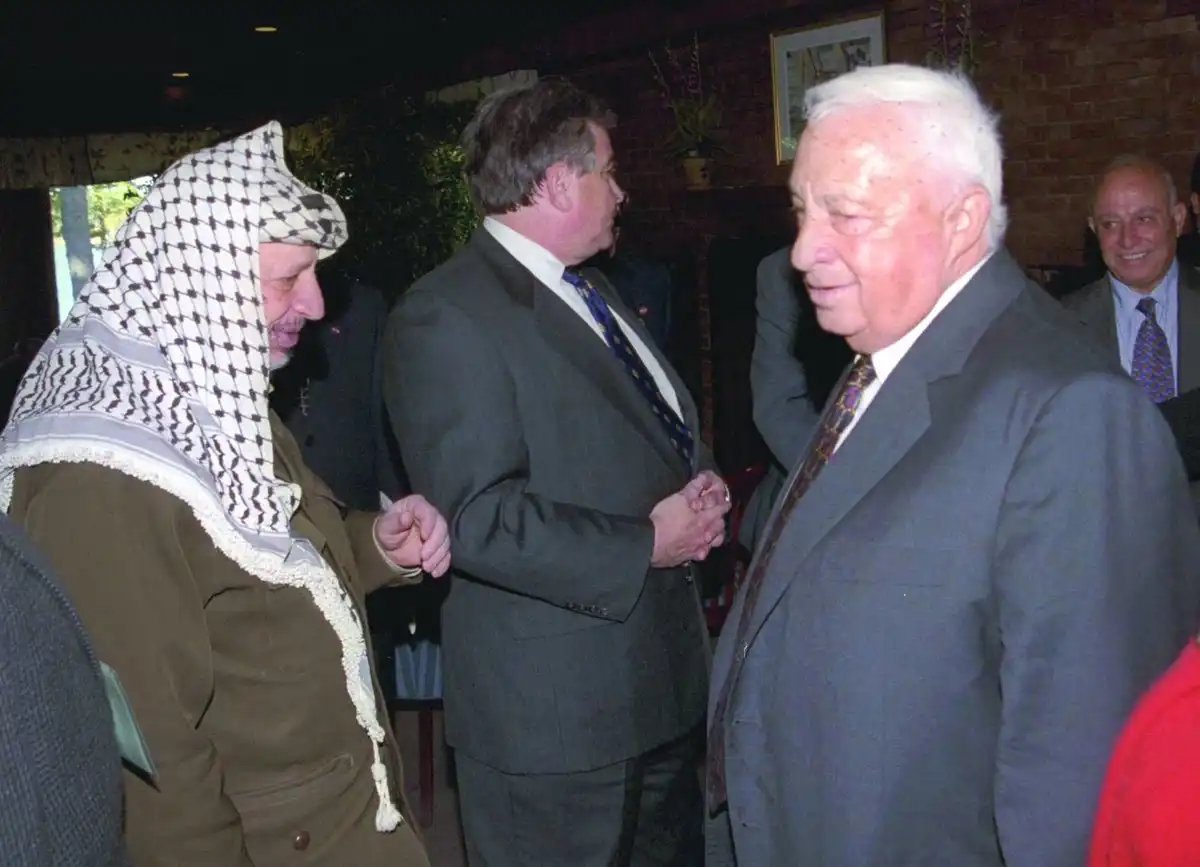
He continued, “The Arab initiative solves the major problem for the Palestinians, because of which both Yasser Arafat regarding Ehud Barak and Abu Mazen regarding Ehud Olmert did not sign the peace agreement even though they were offered almost everything they asked for. No Palestinian leader can sign an agreement without guaranteeing the right of return, but the initiative solves the problem smoothly. Because the formula is (a fair and agreed-upon solution) for refugees. (Agreed upon), meaning that Israel must agree... and demand an Israeli return to the 1967 lines.”


Shetrit said: “Here too, when the initiative was published, I said that in my opinion, there is no Arab leader who believes that Israel will actually return to the 1967 lines, and in my opinion what is meant is to obtain alternative land with a similar area. If Israel annexes land west of the separation wall, about 5 percent of the West Bank, the Palestinians will be given another land close to the West Bank or Gaza.


Sheetrit confirms that such a solution is presented to the citizens of Israel in a popular referendum, according to the law, and he believes that the possibility of obtaining public approval is much greater than an agreement with the Palestinians alone. He says that its inclusion of Arab countries constitutes a guarantee of its implementation. “If all Islamic countries sign peace and normalization with Israel, who will dare to break this agreement?” “If peace is only with the Palestinians, then a coincidental leader who does not want that is enough, and the agreement dies.”


Shetrit, who lives in a town near Gaza, believes that returning the Gaza Strip to the rule of the Palestinian Authority means removing Hamas from power. He says that he was explaining to the aforementioned Israeli prime ministers that the Arab countries were tired of the Palestinians, of terrorism, and of the “Palestinian story.” In some of them there is a “war with terrorism.”


Chetriet concludes, saying: “The decision in this direction is not easy, but ignoring the possibility of achieving comprehensive peace will be a cry for generations.” I expect the Prime Minister of Israel to dare to examine the paths to a comprehensive peace and fight to achieve it. As for closing your eyes to the initiative that is still on the table, it would be a grave mistake.”

ARAB AND WORLD

Sat 09 Dec 2023 7:22 am - Jerusalem Time

Reports reveal the date of the end of the war in Gaza

The British newspaper The Times, citing informed sources, said: US Secretary of State Anthony Blinken informed "Israel" that it has until early January to end its ground operation in Gaza.


The sources added that senior soldiers in the occupation army secretly admit that the Khan Yunis operation is the last large-scale ground attack in the Gaza Strip.


At the same time, Hebrew Channel 12 reported that President Joe Biden called on Israel to stop the war on Gaza by the end of this year, 2023.


In a related context, a senior Israeli defense official told Axios that Israel expects to end its military operation in the city of Khan Yunis in the southern Gaza Strip within three to four weeks.

Axios quoted the Israeli official as saying, "The highly intense phase of the war is likely to continue for another three to four weeks."


Why this is important:


The administration of US President Joe Biden has supported the Israeli operation in Gaza and says it supports Israel's stated goal of overthrowing Hamas in Gaza, but the White House is under increasing international and domestic pressure to ask Israel to end the war.


More than 17,400 Palestinians were martyred in the war, according to the Ministry of Health in Gaza.


News leadership:


A senior Israeli official told Axios that Israeli army forces have “made significant progress” in the northern part of the Gaza Strip, but the operation in the southern city of Khan Yunis, where Israel believes Hamas leadership is based, “has only just begun.”


On Thursday, President Biden spoke with Israeli Prime Minister Benjamin Netanyahu about Israeli military plans and the operation in Khan Yunis.


A similar call took place last night between US Defense Secretary Lloyd Austin and his Israeli counterpart Yoav Galant.


backstage:


A senior Israeli official indicated to Axios that the United States is not “pressing on the brakes” or giving Israel a specific deadline to stop the operation, but is pointing to the fact that time is running out.


The official added that the gap between the Biden administration and the Israeli government relates to the one-month timetable offered by Israel to end the intensive phase of the Gaza war.


White House Deputy National Security Advisor John Feiner told the Aspen Security Forum in Washington on Thursday that the United States has not set a concrete deadline for Israel.

“This is their struggle,” Weiner explained. “However, we have influence, even if we do not have absolute control over what happens on the ground in Gaza.”


what are they saying:


Axios quoted an Israeli army official as saying that the United States would be satisfied if Israel ended the high-intensity phase of the operation by the end of December, while Israel aspires to an end in January.


He added: "The message from the United States is that they want us to end faster, with fewer civilian casualties and more humanitarian aid to Gaza. We want the same thing, but there is another player here, which is the enemy, who does not agree."


He continued: "The United States understands this. We are working together. We need them and they need us."


A spokesman for the US National Security Council said: “These are Israeli military operations, and the Israelis are the ones who will decide their course... and we will continue to support Israel’s efforts to defend itself from Hamas.”


Reuters quoted a White House official as saying: “Israel and Hamas are not close to reaching another agreement on a new humanitarian truce in their ongoing conflict.”


On Wednesday, US National Security Council spokesman John Kirby said: Washington continues to send military aid to Israel to defend itself against Hamas, adding that the focus now is on providing Israel with the weapons and systems it needs in its operations in southern Gaza.


Kirby claimed that "Israel does not intentionally kill civilians, and the Israeli army's mission to spare civilians from the consequences of fighting is very difficult because of the presence of Hamas among civilians."


He explained that Washington does not support a military occupation of Gaza or the reduction of the territory of the Strip, nor displacement outside Gaza.


He continued that the future form of governance of Gaza must be representative of the Palestinians and their aspirations.


He added that the United States will continue to ensure that humanitarian aid reaches the Gaza Strip, even in the absence of a truce.


The American official claimed that "Hamas is the one preventing the International Red Cross from visiting the hostages, and no one else can be blamed."


This is while the newspaper "Jerusalem Post" revealed that the Israeli army is facing resistance in the city of Khan Yunis, south of the Gaza Strip, which is the most intense since the start of the war, noting that the resistance is "fighting for every centimeter."


The Palestinian factions in the Gaza Strip, led by the Al-Qassam Brigades and the Al-Quds Brigades, announced the continued confrontation of the Israeli army’s incursion on several fronts in the Gaza Strip, causing a number of deaths and injuries among soldiers.

ARAB AND WORLD

Sat 09 Dec 2023 7:17 am - Jerusalem Time

Paris "strongly" condemns Israel's approval to build new settlement units in Jerusalem

France affirmed its "strong" condemnation of Israel's decision to allow the construction of housing units in the East Jerusalem settlements, considering that this matter jeopardizes "the possibility of establishing a viable Palestinian state in the future."


French Foreign Ministry spokeswoman Anne-Claire Lugandre reminded on Friday that "settlement is illegal under international law."

She continued: “By approving new settlement construction projects, the Israeli government undermines the possibility of establishing a future viable, contiguous Palestinian state and jeopardizes the horizon of a two-state solution, which is the only solution capable of meeting Israel’s right to security and the legitimate aspirations of the Palestinians to establish a state.”


She added, "We call on the Israeli authorities to reverse this decision."

It is noteworthy that in its Resolution No. 2334 issued in 2016, the United Nations Security Council reaffirmed that “Israel’s establishment of settlements in the Palestinian territories occupied since 1967, including East Jerusalem, constitutes a flagrant violation of international law and a major obstacle to achieving the two-state solution and establishing A comprehensive, just and sustainable peace."


Settlement has also continued under all successive Israeli governments since 1967.


About 300,000 Palestinians and 200,000 Israelis currently reside in East Jerusalem, according to the anti-settlement NGO Ir Amim.


It is noteworthy that the United Nations General Assembly yesterday adopted, by an overwhelming majority, a number of resolutions in favor of Palestine regarding aid and property of Palestinian refugees and UNRWA and investigations into Israel’s practices and Israeli settlements.


The fourth resolution among these resolutions, regarding Israeli settlements in the Palestinian Territory, including East Jerusalem and the occupied Syrian Golan, received the support of 149 countries, 6 countries objected, and 17 countries abstained from voting.

Source: Sama News

PALESTINE

Sat 09 Dec 2023 7:12 am - Jerusalem Time

US government prevents Palestinian Foreign Minister from making statements in Washington

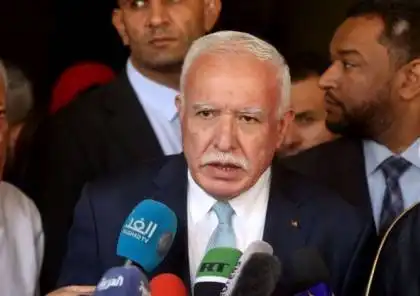
The US government prevented Palestinian Foreign Minister Riyad al-Maliki, a member of the Contact Group of the Organization of Islamic Cooperation and the League of Arab States, from making a statement during his discussions in Washington, DC.


The group members held a press conference at the Four Seasons Hotel in Washington.


After a journalist asked Al-Maliki a question, Saudi Foreign Minister Faisal bin Farhan began speaking and said, “Mr. Al-Maliki cannot answer your question, as the American government imposes restrictions on him, and he cannot communicate with the press.”

The contact group is expected to meet with US Secretary of State Anthony Blinken.

It is planned that the group will go to Canada on Saturday to hold discussions.

The group was formed by a decision from the Arab Islamic Summit, in the Saudi capital, Riyadh, on November 11, to discuss ways to stop the war in Gaza.


(Anatolia)

ARAB AND WORLD

Sat 09 Dec 2023 7:07 am - Jerusalem Time

An Israeli official calls for Palestinian prisoners from Gaza to be buried alive

The deputy head of Israeli municipality in Jerusalem, Aryeh King, called on Friday for burying Palestinian prisoners from the Gaza Strip alive.


Through his account on the “X” platform, King, who is National Security Minister Itamar Ben Gvir’s candidate for mayor of the next West Jerusalem municipality, posted pictures of Palestinian prisoners who were forced by the Israeli army to strip naked except for their underwear.


It is clear from the pictures that the army gathered the prisoners on sandy ground and an Israeli flag was placed on the side of the ground.

Another photo shows members of the Israeli army bringing the prisoners into a military transport vehicle, stripped naked except for their underwear.

In the midst of cold weather, the soldiers gathered the prisoners in the ground, which appeared to contain a large hole.


King called for Palestinian prisoners who were arrested from a shelter in Gaza to be buried alive.

“Israel must cover these ‘Nazis’ with the land that surrounds them,” he wrote.


He added: “Now they must be covered (i.e. buried alive) so that no human being will face them forever.”

When one of the pioneers of the “X” platform responded to him: “You will end up in The Hague at the International Criminal Court” because of his statements, King defended his call and said: “For what?” Killing 'Nazis'?

In another tweet, which the “X” platform considered violating the terms of publication, King wrote: “If I had the opportunity to make the decision, I would have brought 4 huge bulldozers (D9) and ordered all these hundreds of ants to be covered, while they were still alive.”

He added: “They are not human beings and they are not human animals. They are subhuman, and this is the way they should be treated,” in his words.

King is known for his stubborn support for settlement in East Jerusalem and the expulsion of Palestinian residents from their homes there.

On Thursday, Hebrew media reported from the Israeli army pictures of the arrest of dozens of Palestinians after they were forced to strip completely from their homes except for their underwear.

Local sources reported that the Israeli army arrested Palestinians from a shelter center in Gaza, and that some of them were later released and a number of others were kept in detention.

ARAB AND WORLD

Fri 08 Dec 2023 11:00 pm - Jerusalem Time

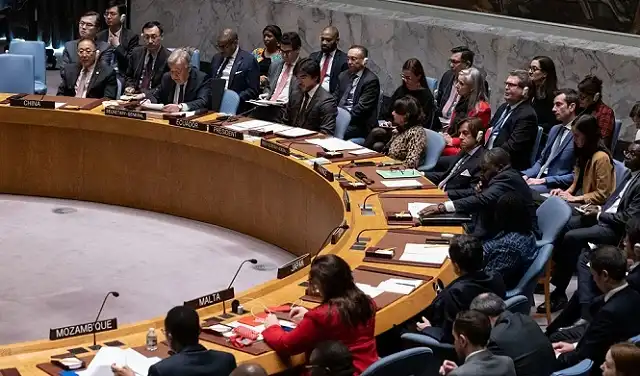
Following US veto: Security Council fails to adopt a draft resolution for ceasefire in Gaza

The UN Security Council failed on Friday evening to pass a draft resolution demanding a ceasefire in the Gaza Strip, after the United States used its veto.


Thirteen out of 15 member states of the UN Security Council voted in favor of the draft resolution, while Britain (which has veto power) abstained from voting, and the United States used its veto, which led to the failure of the draft resolution.


On Friday evening, the United Nations Security Council held an emergency session on the situation in the Gaza Strip, at the United Nations headquarters in New York, under the item entitled “The situation in the Middle East, including the Palestinian issue.”


Ecuador, which holds the presidency of the Security Council for the month of December, announced the session after the letter sent by the Secretary-General of the United Nations, António Guterres, to the Council last Wednesday, based on Article 99 of the Charter of the United Nations, which allows him to “draw the attention” of the Council to the file. “It could jeopardize the maintenance of international peace and security.”


The United Arab Emirates has prepared a draft resolution to be put to a vote in the Security Council, calling in its latest version for an “immediate ceasefire for humanitarian reasons” in Gaza, warning of the “catastrophic humanitarian situation in the Gaza Strip.”


The draft resolution also calls for "protecting civilians" and "ensuring humanitarian access."

ARAB AND WORLD

Fri 08 Dec 2023 10:49 pm - Jerusalem Time

3 Lebanese soldiers were injured in an Israeli bombing

Three Lebanese soldiers were injured as a result of an Israeli bombing in southern Lebanon, according to a medical source, while the army announced a second Israeli attack on a military hospital, without casualties.


For its part, Hezbollah announced the killing of four of its members on Friday.


A medical source told Agence France-Presse, "The vicinity of the Lebanese army position in the coastal area of Ras Naqoura in southern Lebanon, on the border between Lebanon and Israel, was subjected to Israeli shelling with artillery shells, and information indicated that three soldiers were lightly injured."


An Agence France-Presse photographer at the site saw the soldiers lying on stretchers. They appeared to be having difficulty breathing, but there were no open wounds.


This comes two days after the killing of two people, one of whom was a soldier, the first victim from the Lebanese army since the start of the almost daily exchange of fire on the border between Israel and the Iranian-backed Hezbollah following the outbreak of the war on Gaza.


The Israeli army admitted carrying out the bombing and expressed its "regret," saying that it was targeting a Hezbollah position and not the army.


The Lebanese Army said in a statement on Friday that, “On 12/8/2023, the army hospital center in the town of Ain Ebel - the south was bombed by the Israeli enemy, which led to material damage but no casualties.”


Hezbollah claimed responsibility on Friday for a series of attacks against Israeli forces and sites near the border. At the same time, Israel announced its continued bombing of border areas and targeting Hezbollah's infrastructure.


Since October 7, violence on the border has resulted in the killing of at least 120 people in Lebanon, the majority of whom are Hezbollah fighters, as well as 16 civilians, including three journalists, according to an Agence France-Presse count.


On Thursday, a civilian was killed in northern Israel by an anti-tank missile fired from southern Lebanon, bringing the death toll in attacks from Lebanon to at least six Israeli soldiers and four civilians, according to the authorities.


Hezbollah claimed responsibility for launching the missile on Thursday, saying it targeted Israeli military sites.


On the same day, the Palestinian Jihad movement announced the killing of two of its members, bringing the number of its members killed since the start of the escalation in southern Lebanon to eight.


ARAB AND WORLD

Fri 08 Dec 2023 10:41 pm - Jerusalem Time

Biden administration requests approval to sell 45,000 shells to Israel

A current and former American official told Reuters that President Joe Biden's administration asked Congress to approve the sale of 45,000 shells for Merkava tanks to Israel.


They explained that the goal of the deal is to be used by Israel to fight Hamas in the devastated Gaza Strip.


The request comes amid increasing demands to stop the war, which Washington opposes.


The United States opened an air bridge to transport weapons to Israel, since the start of its military operations in the Gaza Strip.


On Wednesday, Israel announced the reception of the 200th plane in the American air bridge to transport weapons, ammunition and military equipment.


In the latest toll, the Ministry of Health in Gaza announced that more than 17,000 Palestinians were killed and more than 46,000 injured in the Israeli bombing of the Strip.

ARAB AND WORLD

Fri 08 Dec 2023 9:55 pm - Jerusalem Time

Macron urges Netanyahu to establish a permanent ceasefire and open the Kerem Shalom crossing

French President Emmanuel Macron on Friday urged Israeli Prime Minister Benjamin Netanyahu to open the Kerem Shalom crossing between Israel and Gaza to deliver much-needed aid to the Strip.


60% of the goods were passing through the Kerem Shalom crossing into the besieged Gaza Strip before October 7 and the start of the Israeli war.


The French presidency stated that Macron spoke in a call with Netanyahu about “the necessity of protecting civilians in Gaza and stressed the importance of reaching a permanent ceasefire.”


The French President added, "Israel must take the necessary measures to put an end to the violence committed by settlers against Palestinian civilians in the West Bank."


At least 263 Palestinians have been killed by settlers and Israeli army fire in the occupied West Bank since the start of the war between Israel and Hamas.


The United Nations Humanitarian Coordinator, Martin Griffiths, said Thursday that he sees “promising indications” that the Kerem Shalom crossing may be opened soon to allow aid to enter.


On Saturday, Macron called for "redoubling efforts to achieve a permanent ceasefire" after the end of a week-long truce.


He also urged Israel to clarify its goal of "destroying" Hamas, warning that achieving this could take "ten years."

PALESTINE

Fri 08 Dec 2023 9:35 pm - Jerusalem Time

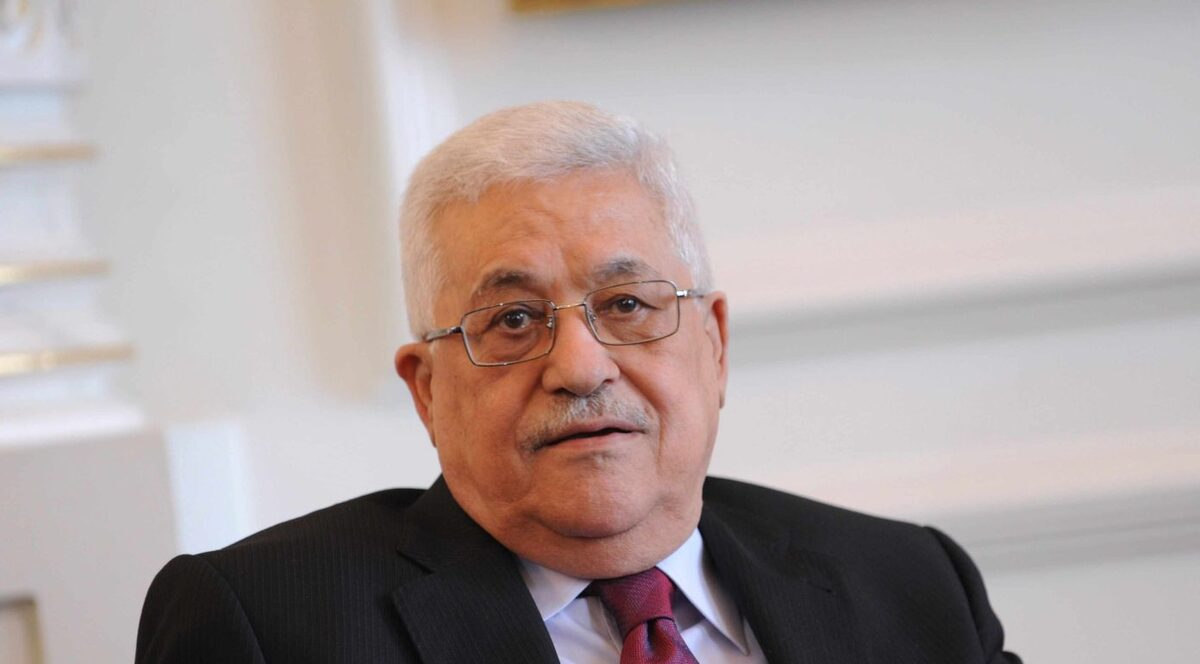
Palestinian president calls for an international peace conference and expresses his willingness to reform the Authority

Palestinian President Mahmoud Abbas on Friday called for an immediate halt to the war on Gaza and the convening of an international peace conference to reach a permanent political solution that leads to the establishment of a Palestinian state. He expressed his readiness to revive the Palestinian Authority, carry out reforms in it, and hold general elections in the Palestinian territories.


Abbas said in an interview with Reuters that the conflict between Israel and the Palestinians in general has reached an alarming stage that requires an international conference and guarantees from world powers.


In addition to the war that Israel is waging in Gaza, he said that Israeli forces have intensified their attacks everywhere in the occupied West Bank since last year, with settlers escalating violence against Palestinian towns.


Abbas stressed his firm position in favor of negotiation instead of armed resistance to end the long-standing occupation, noting that “with peaceful resistance” and “negotiations” will lead “to the establishment of a sovereign Palestinian state in the Gaza Strip, the West Bank and East Jerusalem.”


He expressed his readiness to revive the Authority, carry out reforms in it, and hold presidential and parliamentary elections in the Palestinian territories.


Abbas said that the Palestinian Authority had adhered to all peace agreements signed with Israel since the 1993 Oslo Accords and the understandings that followed, but Israel had backed away from its pledges to end the occupation.


Rule of Gaza

Reuters reported that President Abbas did not present a concrete vision for the post-Israeli war on the Gaza Strip during his interview.


In this context, Abbas said that the Palestinian Authority is still present in Gaza as an institution, and is still paying monthly salaries and expenses estimated at about $140 million to employees, retirees, and needy families. He added, "The Palestinian Authority still has 3 ministers present in Gaza, and stressed the need to rehabilitate the Authority and its need for major international support" to return to the Strip.


The Palestinian President pointed out that “Gaza today is not the Gaza we know. Its hospitals, schools, and infrastructure were destroyed, and its buildings, roads, and mosques were destroyed.” “When we return, we need resources, and Gaza is what it needs for reconstruction.”


Abbas said, "The United States tells us that it supports the two-state solution and that it rejects Israel occupying the Gaza Strip, cutting off any part of its territory, or having security control over the Gaza Strip." He added, "America does not force Israel to do what it says."


Abbas added that Washington fully supports Israel and bears responsibility for what is happening in the Gaza Strip, and it is the only force capable of ordering Israel to stop this war and fulfill its obligations, but he said that it does not do that. He described the United States as a partner of Israel.


He went on to say, "Since the seventh of last October, I have held contacts and meetings with more than one head of state, a prime minister, and senior officials from America and Western countries in order to stop the war, bring humanitarian aid into the Gaza Strip, and prevent the displacement of citizens." He continued, "I am against the displacement of a single citizen, whether from the Gaza Strip or the West Bank."


Activate power

Abbas's statements came after the White House announced, last Wednesday, that Phil Gordon, US Vice President's National Security Advisor, discussed with Palestinian officials in Ramallah the "activation" of the Palestinian Authority.


The British newspaper The Times also reported that a British military team is working in the West Bank to prepare the Palestinian Authority to take over the administration of the Gaza Strip and improve its capabilities.


During the past few days, a number of Authority officials expressed the readiness of Abbas and the Palestinian Authority to return to ruling the Gaza Strip after the end of the Israeli aggression on the Strip.


The American Bloomberg Agency, quoting Palestinian Prime Minister Muhammad Shtayyeh, reported that the Palestinian Authority is working with American officials on a plan to manage the Gaza Strip after the end of the war.


Meanwhile, senior member of the Executive Committee of the Palestine Liberation Organization, Ahmed Majdalani, said that the Palestinian Authority is ready to regain full control over the Gaza Strip as soon as the Israeli war on the Strip ends.


Majdalani explained in a statement to the American magazine "Newsweek" that the Palestinian Authority will accept the proposal of the administration of US President Joe Biden to reunite the Gaza Strip and the West Bank under the control of the Authority, if the international community supports the reconstruction of Gaza and pushes Israel to agree to the two-state solution.


Israel pledged to eliminate Hamas after it carried out the Al-Aqsa Flood Battle on October 7, which led to the killing of 1,200 and the detention and capture of about 240, according to Israeli statistics.


OPINIONS

Fri 08 Dec 2023 7:48 pm - Jerusalem Time

American pressure is mounting, but the price Israel is still able to pay

Israeli N12 Channel

Israeli N12 Channel

Opinion Writer

By Yaki Dayan

The kidnapped were, and remained, at the top of America's list of priorities, starting from the first day of the war. President Joe Biden has said it, and he's repeating it again. The US administration also devotes a lot of efforts and resources to this issue. In this regard, it is noteworthy that the credit for the failure of several rounds of kidnapped release operations goes to the Americans alone, not to the Egyptians or the Qataris. The non-stop American pressure on Qatar and Egypt helped carry out these rounds of releasing the kidnapped persons.

Also at this stage, there is an American team dealing with the issue of the kidnapped people all the time, and working with Qatar and Egypt, in order to reach an additional deal. The United States has provided full support to Israel as the latest round of releases of women and children takes place. It was clear to the Americans that it was Hamas that violated the agreement between the two parties. 


In addition to the work of the American crew specialized in the issue of the kidnapped persons, the Americans are working to collect intelligence information through several means, including drones, and they have also recruited the British for this mission. It is clear to these people that it will be difficult, upon the return of ground operations, to reach an additional deal, but American efforts are continuing to push forward the issue of the release of the kidnapped people.

On the other hand, two types of pressures are being exerted on the American administration, which are always escalating: external international pressure, and pressure coming from within the Democratic Party. As a result of these pressures, the American administration placed several tactical demands before Israel, in addition to the comprehensive strategic demand related to “the day after the war.” 

First, the American administration wants to manage the battle in the south of the Gaza Strip in a different way than what happened in the north. It is expected that the Americans will raise this demand again and again, but implementing this matter on the ground is difficult. However, because Khan Yunis is built differently, the Israelis can, to some extent, respond to this demand.

The second request relates to fuel. The Americans requested the entry of 180,000 liters of fuel, and Israel agreed to enter 120,000 liters. The Americans request the entry of 400 trucks, while Israel agreed to the entry of 200 trucks per day. 

It is clear that the American request has not been fully approved, but Israel realizes, in any case, that it must respond to American pressure to a certain extent, specifically in view of this amount of ammunition and weapons, which the Americans provide, along with a series of issues they are involved in.

Despite everything, Israeli approval to bring in aid and fuel is considered a very small price, compared to the compensation we receive from the American government in this war.

N12 Channel

OPINIONS

Fri 08 Dec 2023 7:19 pm - Jerusalem Time

The war in Gaza is a strategic threat to neighboring countries, and a humanitarian event for Gulf countries

Haaretz

Haaretz

Opinion Writer

By Zvi Barel

Vladimir Putin knows well how to style his entrance. Four Russian SU-35 fighter planes accompanied his presidential plane, the day before yesterday, Wednesday, all the way from Moscow to Riyadh, then to Abu Dhabi, in addition to 21 welcome shots fired by Emirati cannons and the honor guard that stood at the entrance to the Emirati palace, shaking hands with the Crown Prince. The Saudi era, Mohammed bin Salman, and also Mohammed bin Zayed, the ruler of the Emirates - all of this appeared in the Gulf media, and successfully competed with the news coming from the war in the Gaza Strip.

It is true that Gaza still occupies most of the headlines, analyzes and videos, but it is not everything. Even the Palestinians themselves stopped asking, “Where are the Arab leaders, and where is the world regarding the catastrophe we are experiencing,” and not for the first time. The central contribution of Arab and Islamic countries is sending convoys of food and medical aid to field hospitals in the Strip. They even held two summits to discuss what was going on there. Jordan and Turkey also recalled their ambassadors from Israel. But no country has severed its relations with Israel. Once again, Arab countries are discovering that their ability to influence what happens is limited during regional conflicts, even those related to their national security and stability.

The approach of the countries of the region to the war in the Gaza Strip is divided into two basic visions: the first is that the war is a strategic threat to their security; the second is that Gaza is a “humanitarian event,” and based on this assumption, it formulates its policies. 

For example, Egypt believes that it is one of the most threatened Arab countries, due to the inherent danger that hundreds of thousands of Gazans will storm its borders. Its decisive position is that it did not allow any Palestinian refugee to cross the borders, with the exception of some humanitarian cases who can reach hospitals with a special permit, and thus it defines its responsibility in a way that leaves no room for doubt.

This week, a special mission headed by the Coordinator of Government Activities in the West Bank, Ghassan Alyan, and a representative of the Mossad arrived in Egypt, with the aim of calming Cairo regarding Israel’s intention to push the Palestinians into its areas, and that there is no basis for what is published regarding Israel’s plans to implement a process of transferring the Palestinians to Egypt. . Egypt may have been convinced by the Israeli explanations, but it was not convinced that Israel could, or wanted to prevent the spontaneous rush of Gazans to Sinai. To avoid this, it strengthened the defense system on its borders along the Strip.

Egypt controls the Rafah crossing, which is the only gate, after closing the border with Israel, through which aid convoys pass to the Strip. In practice, you can open the crossing as you wish, allow an unlimited number of trucks to enter, and present Israel with a difficult dilemma. However, such a step could push Egypt into a confrontation, not only with Israel, but also with the United States, and thus it could harm other vital strategic interests that are more important, in its view, than the poor condition of the residents of the Gaza Strip.

On Sunday, polling stations will open for Egypt's three-day presidential election. There is no need to check opinion polls or analyze possible scenarios. Sisi will be president until at least 2030. The three competing candidates could receive very small percentages of votes, which Sisi will use as a cover for the democratic elections.

However, the president's main problem is not his election, but rather how he can settle the $29 billion debt during this year. It is true that the International Monetary Fund announced that it is not ready to increase the loans requested by Egypt - from 3 billion to 5 billion dollars - but Egypt will have to endure difficult circumstances, such as moving the exchange rate of the Egyptian pound and privatizing government companies.

Currently, Egyptian residents are forced to stand for long hours to buy a kilo or two of sugar, due to a severe shortage in local production and failed import management. The Egyptian Minister of Supply asked citizens to be patient and not buy sugar until the end of the crisis, which will be “in two weeks,” according to his words. Egypt, which contributed greatly to the negotiations to free the hostages, and in return received many public compliments from US President Joe Biden, will not be able to be content with a certificate of thanks. It must enlist American support in order to obtain additional loans from international institutions. This support is not given for free, without a political return that stipulates full coordination of Israeli military steps in Gaza, and commitment to the size of the agreed-upon aid convoys. Egypt cannot allow the “humanitarian crisis” to harm its strategic interests.


Jordanian pressure is increasing

Jordan is the second threatened country that fears an Israeli transfer that would push West Bank residents into its areas. The auxiliary war taking place in the West Bank, and primarily the increase in settler attacks on the Palestinian population - and the Netanyahu government's ignoring of Washington's warnings - increases the intensity of Jordanian pressure. However, Amman also cannot do much, neither in the West Bank nor in Gaza. This is in addition to the fact that Jordan was pushed aside during American consultations regarding the debate on the day after the war in Gaza, or during the discussion of any political solution pushed by President Biden.

Receiving the residents of Gaza in its areas, after the presence of about a million Syrian refugees in Jordan and the remains of refugees from the Iraq war, is a topic that cannot be talked about. What is worse is that every addition of Palestinian refugees will upset the already sensitive demographic balance and strengthen the Israeli vision that Jordan is the alternative homeland for the Palestinians. It is true that Jordan has increased the intensity of its aggressive statements against Israel, and the regime is ignoring the demonstrations against Israel as well, but the Kingdom is still wary of taking any irreversible steps, thus losing the American safety belt.

It is true that Jordan and Egypt stand as spearheads in opposing the displacement of Palestinians from the Gaza Strip, but they are not the only ones. There is no Arab country that agreed to receive refugees from Gaza, even those that agreed to receive Syrian refugees. The stated justification is ideological - receiving Palestinian refugees means “killing the Palestinian cause,” according to Arab leaders and journalists. But the main reason is the fear that the large numbers of Palestinian refugees from Gaza will lead to the emergence of a new and hostile hotspot, and even to a security threat within the Arab countries. This is because, unlike Syrian and Iraqi refugees, Palestinian refugees do not have a country to return to after the end of the war.

These fears can be heard in Lebanon as well, after Hamas announced the establishment of a new organization called “Vanguards of the Al-Aqsa Flood,” aiming to fight Israel from Lebanese territory. This led to protests that crossed the country's parties, and leaders from all sides of the political system demanded refraining from Hamas' military action in Lebanon.

The Gulf states, led by Saudi Arabia and the UAE, are far from the Gaza border, and until now, they treat the situation in Gaza as a humanitarian disaster. Saudi Arabia leads a group of foreign ministers who met with the leaders of China, Russia, France, and other countries, with the aim of pushing for a humanitarian ceasefire, but not to talk about future political steps.


Limitations of Arab cooperation

Currently, there is a new threat to the Gulf countries, which is the Houthi threat to shipping traffic in the Red Sea. Reuters published news this week, stating that Saudi Arabia turned to the United States for “restraint” regarding its response to the Houthi strikes from Yemen. This is because Riyadh fears that the sharp American response will harm the prospects for the success of the negotiations taking place between Saudi Arabia and the Houthis to end the war, or even return Saudi Arabia to the list of Houthi targets.

The UAE and Saudi Arabia have urgent matters to attend to, such as coordinating the international oil price, for example, which was at the heart of the Russian President’s visit this week. Putin, who has hardly left the house since the beginning of the Russian invasion of Ukraine, can feel safe in Saudi Arabia and the UAE - and not only because of the fighter squadrons that have accompanied him. The two countries did not sign the International Criminal Court, which issued an international arrest warrant against the Russian president.

Saudi Arabia and the UAE also do not adopt the sanctions imposed on Russia, and trade exchange between them and Russia is increasing. Putin even stated this week that "the UAE is Russia's most important trading partner in the Middle East." This statement is true despite the war on Gaza, to describe Israel's relations with Abu Dhabi as well.

The gaps in the positions of Arab countries and their reading of the threat resulting from the war in Gaza should not be surprising. In 2011, the Arab League took an exceptional decision that froze Syria’s membership in the Arab League. The boycott of Syria continued for 12 years, before it returned to the Arab League, without Syria changing its policy towards its citizens. In 2017, Saudi Arabia, the UAE, Bahrain, and Egypt imposed an economic blockade on Qatar due to what was defined as its support for “terrorism,” namely its close ties to Iran, and the Al Jazeera network’s work as a tool for incitement against Arab regimes.

The siege continued for 4 years until reconciliation was reached, and the Arab coalition did not achieve any real results. Qatar is still strengthening its relations with Iran, Al Jazeera has not been closed, and Doha is still funding Hamas. The war in Gaza seems to be added to the Arab conclusions, according to which there are restrictions on the ability to organize collective action against military or political steps in the region.

The only axis that can guarantee the success of these steps is the same axis that links the Arab countries and Washington. But it seems that this axis, so far, is not greatly affected by Arab pressure, and President Joe Biden’s decisions - including the restrictions he imposes on Israel - stem mainly from internal political pressure in the United States, mainly because of the difficult humanitarian price that the Gazans are paying, more than the fear of a crisis with Arab countries.


PALESTINE

Fri 08 Dec 2023 7:12 pm - Jerusalem Time

Israeli war on Gaza: The death toll in one day reached 313 deaths

The Israeli occupation bombed a house near the Gaza European Hospital in Khan Yunis, south of the Gaza Strip, causing dead and wounded. At the same time, the Palestinian Ministry of Health in Gaza announced, on Friday evening, December 8, 2023, that the death toll had risen since the start of the Israeli aggression on the Strip. 17,487 dead and 46,480 injured, noting that during the past hours alone 313 Palestinians were murdered.


Ministry spokesman, Ashraf Al-Qudra, said in a statement posted on the Telegram platform: “Only 313 killed and 558 injured arrived at hospitals during the past hours, and a large number of victims are still under the rubble and on the roads.”


He added that thus the toll rises “since the start of the Israeli aggression to 17,487 martyrs and 46,480 injured,” pointing out that 70 percent of the victims are women and children.


Al-Qudra warned that "the health situation in the south is extremely catastrophic, and hospitals have lost their capacity in departments and intensive care, and the occupancy in them has reached 262%."


He stressed that "the Israeli occupation is still arresting 36 health personnel from the Gaza Strip, led by the Director General of Al-Shifa Medical Complex, Dr. Muhammad Abu Salamiya, in harsh and inhumane conditions."


Al-Qudra called on the International Committee of the Red Cross and the World Health Organization to take immediate action to release the health personnel detained by the Israeli occupation forces.

He continued, "The Israeli occupation is carrying out genocide crimes in schools (against the displaced), sweeping residential neighborhoods in the northern Gaza Strip, and putting hospitals out of service."

Regarding the wounded leaving Gaza, Al-Qudra pointed out that “618 people (407 wounded and 211 sick) left the Gaza Strip through the Rafah land border crossing with Egypt.”


He explained that "less than 1% of the wounded were able to leave the Gaza Strip through the Rafah land crossing, and we lose dozens of wounded every day as a result of the lack of treatment and the delay in their exit from Gaza."

Al-Qudra called on "international institutions to intervene urgently to provide protection, medicines and fuel to the Al-Shifa Medical Complex (west of Gaza City) and hospitals in the northern Gaza Strip in order to enable medical teams to restart them and save the wounded and sick."


He also called on "all parties to provide safe humanitarian corridor in order to ensure the flow of medical supplies and fuel and the exit of hundreds of wounded daily."


Al-Qudra continued: “We call on the medical teams in northern Gaza to go to the Shifa Medical Complex and the hospitals they can reach in order to save the wounded and sick.”

He appealed to "medical staff, retirees, graduates and students from all health specialties to go immediately to work at the Nasser Medical Complex and the Gaza European Hospital in the southern Gaza Strip to rescue the wounded."


Since last October 7, the Israeli army has been waging a devastating war and a stifling siege on all parts of the Gaza Strip, causing massive infrastructure destruction and an “unprecedented humanitarian catastrophe,” according to official Palestinian and UN sources.


ARAB AND WORLD

Fri 08 Dec 2023 6:51 pm - Jerusalem Time

American sources: Biden set a deadline to end the Gaza war, and Israel is ignoring Washington’s demands

American sources said that US President Joe Biden has set a deadline to end the Israeli war on Gaza, while US intelligence believes that Israel has ignored American calls for restraint in its ongoing aggression since the seventh of last October.


The Politico website quoted three Israeli officials as saying that the US President's administration had given Israel until the end of the year to end its war on the Islamic Resistance Movement (Hamas).


One of the officials explained that the US administration advised Israel not to go to Gaza, but the administration of Israeli Prime Minister Benjamin Netanyahu ignored that and proceeded with its plans to penetrate the Strip.


Biden spoke by phone yesterday with Netanyahu, and the White House said that the US President “stressed the urgent need to protect civilians and separate the civilian population from Hamas, including by corridors that allow people to safely exit the designated areas where hostilities are taking place.”


A deadlier attack

On the other hand, the Huffington Post website quoted an American official as saying that American intelligence estimates that the Israeli army continues to operate at the same pace and shows limited concern about civilians despite repeated American calls for restraint.


The official said that there are doubts that the current Israeli military attack is more bloody than the attack on the northern Gaza Strip, which Israel carried out in the first phase of its aggression against Gaza.


The website quoted a US State Department official as saying that it increasingly appears that the Israeli army is waging an “ethnic cleansing campaign” in Gaza, and the American diplomat said that Washington is angry about the way Netanyahu “literally” burned the reputation of the United States to advance his personal political agenda.


In this context, the Associated Press quoted a senior official in the US State Department as saying that Secretary of State Anthony Blinken said in a phone call with Israeli Minister of Strategic Affairs Ron Dermer that the loss of life is still very high in Gaza, and that Israel must make More efforts to allow humanitarian aid into it.


Blinken said, after a press conference yesterday with his British counterpart, David Cameron, that there is a gap between the Israeli government’s declared intentions to protect civilians and the number of casualties in the Strip.


"For example, it is not just about creating safe zones, but also communicating in such a way that non-combatants actually know where they can flee, exactly when and by what route. Food, water and medicine must also be provided to refugees in these safe zones," he added.


The ongoing Israeli raids on the Gaza Strip for two months have left more than 17,000 dead and about 46,000 wounded, in addition to widespread destruction of infrastructure and a worsening humanitarian crisis in light of the displacement of a large number of Gazans, numbering more than two million, to areas in the south of the Strip.

ARAB AND WORLD

Fri 08 Dec 2023 5:55 pm - Jerusalem Time

Netanyahu responds to Palestine Premier’s proposal: There will be no Hamas

On Friday, Israeli Prime Minister Benjamin Netanyahu attacked a Palestinian proposal for Hamas to be a partner in ruling Gaza after the war currently taking place in the Strip.

Netanyahu said in a statement: “There will be no Hamas. We will eliminate it. The fact that this is the Palestinian Authority’s proposal reinforces my policy: The Palestinian Authority is not the solution.”


Bloomberg News Agency quoted Palestinian Prime Minister Muhammad Shtayyeh as saying that the Palestinian Authority is working with American officials on a plan to manage the Gaza Strip after the end of the war.


Shtayyeh said from Ramallah on Thursday that the preferred outcome of the conflict is for Hamas to become “a junior partner of the Palestine Liberation Organization, helping to establish a new independent state that includes the West Bank, Gaza Strip, and East Jerusalem.”


Shtayyeh added, "There will be room for talks if Hamas is ready to reach an agreement and accept the political approach of the Palestine Liberation Organization," noting that the Palestinians "must not be divided."


The Palestinian Prime Minister considered that Israel's goal of completely eliminating Hamas was "unrealistic."


Israel pledged to eliminate Hamas, after the movement's surprise attack on Israeli towns on October 7th.


The Ministry of Health in the Gaza Strip says that more than 17,000 Palestinians have been killed and about 46,000 injured since Israel began bombing the Strip.

PALESTINE

Fri 08 Dec 2023 5:19 pm - Jerusalem Time

Gaza war: Continuous raids and battles in Gaza: The death toll rises to 17,487 dead

The death toll from the ongoing Israeli war on the Gaza Strip rose to 17,487 dead, and 46,480 injured, as air and artillery strikes continued on populated areas and homes throughout the Strip. The death toll among Israeli soldiers rose to 420, according to the Israeli army, which announced today that 4 more of its soldiers were killed in battle.


This comes as the resistance continues to bomb Israeli towns, including Tel Aviv and other towns in the center and south of the country, while fierce battles are taking place with Israeli army forces penetrating into several axes.


The Ministry of Health in Gaza said that the occupation forces are besieging Kamal Adwan Hospital in northern Gaza, and are firing heavily towards the courtyards and patient rooms, while medical staff and the wounded are without water, food, or treatment.


The Ministry of Health appealed to all parties to protect those in Kamal Adwan Hospital and provide water, food, and treatment to the wounded and sick. It also called for the establishment of medical points and mobile clinics in the western regions of Khan Yunis and Rafah to provide health care to the displaced as a result of their inability to access health services.


As the Israeli army intensified its air, land and sea attacks on the Gaza Strip, hundreds took refuge in camps in open areas south of the city of Rafah, near the Egyptian border.

OPINIONS

Fri 08 Dec 2023 2:37 pm - Jerusalem Time

Israel’s Failed Bombing Campaign in Gaza. Collective Punishment Won’t Defeat Hamas

Foreign Affairs

Foreign Affairs

Opinion Writer

By Robert A. Pape

Since October 7, Israel has invaded northern Gaza with some 40,000 combat troops and pummeled the small area with one of the most intense bombing campaigns in history. Nearly two million people have fled their homes as a result. More than 15,000 civilians (including some 6,000 children and 5,000 women) have been killed in the attacks, according to Gaza’s Hamas-run Ministry of Health, and the U.S. State Department has suggested that the true toll may be even higher. Israel has bombed hospitals and ambulances and wrecked about half of northern Gaza’s buildings. It has cut off virtually all water, food deliveries, and electricity generation for Gaza’s 2.2 million inhabitants. By any definition, this campaign counts as a massive act of collective punishment against civilians. Even now, as Israeli forces push deeper into southern Gaza, the exact purpose of Israel’s approach is far from clear. Although Israeli leaders claim to be targeting Hamas alone, the evident lack of discrimination raises real questions about what the government is actually up to. 

Is Israel’s eagerness to shatter Gaza a product of the same incompetence that led to the massive failure of the Israeli military to counter Hamas’s attack on October 7, the plans for which ended up in the hands of Israeli military and intelligence officials more than a year earlier? 

Is wrecking northern Gaza and now southern Gaza a prelude to sending the territory’s entire population to Egypt, as proposed in a “concept paper” produced by the Israeli Intelligence Ministry? 

Whatever the ultimate goal, Israel’s collective devastation of Gaza raises deep moral problems. 

But even judged purely in strategic terms, Israel’s approach is doomed to failure—and indeed, it is already failing. Mass civilian punishment has not convinced Gaza’s residents to stop supporting Hamas. To the contrary, it has only heightened resentment among Palestinians. Nor has the campaign succeeded in dismantling the group ostensibly being targeted. Fifty-plus days of war show that while Israel can demolish Gaza, it cannot destroy Hamas. In fact, the group may be stronger now than it was before.


Israel is hardly the first country to err by placing excessive faith in the coercive magic of airpower. History shows that the large-scale bombing of civilian areas almost never achieves its objectives. Israel would have been better off had it heeded these lessons and responded to the October 7 attack with surgical strikes against Hamas’s leaders and fighters in lieu of the indiscriminate bombing campaign it has chosen. But it is not too late to shift course and adopt a viable alternative strategy for achieving lasting security, an approach that would drive a political wedge between Hamas and the Palestinians rather than bringing them closer together: take meaningful, unilateral steps toward a two-state solution.

-----------

LOSING HEARTS AND MINDS

Since the dawn of airpower, countries have sought to bomb enemies into submission and shatter civilian morale. Pushed to their breaking point, the theory goes, populations will rise up against their own governments and switch sides. This strategy of coercive punishment reached its apogee in World War II. 

History remembers the indiscriminate bombing of cities in that war simply by the place names of the targets: Hamburg (40,000 dead), Darmstadt (12,000), and Dresden (25,000).Now Gaza can be added to this infamous list. Israeli Prime Minister Benjamin Netanyahu has himself likened the current campaign to the Allies’ fight in World War II. While denying that Israel was engaging in collective punishment today, he pointed out that a Royal Air Force strike targeting Gestapo headquarters in Copenhagen killed scores of school children.


What Netanyahu left unmentioned was that none of the Allies’ efforts to punish civilians en masse actually succeeded. In Germany, the Allied bombing campaign, which took off beginning in 1942, wreaked havoc on civilians, destroying one urban area after another and ultimately a total of 58 German cities and towns by the end of the war. But it never sapped civilian morale or prompted an uprising against Adolf Hitler, despite the confident predictions of Allied officials. Indeed, the campaign only encouraged Germans to fight harder for fear of a draconian postwar peace.

A bombing campaign has never caused the targeted population to revolt against its own government.

That failure should not have been so surprising, given what happened when the Nazis tried the same tactic. The Blitz, their bombing of London and other British cities in 1940–41, killed more than 40,000 people, and yet British Prime Minister Winston Churchill refused to capitulate. Instead, he invoked the resulting civilian casualties to rally society to make the sacrifices necessary for victory. Rather than shattering morale, the Blitz motivated the British to organize a years-long effort—with their U.S. and Soviet allies—to counterattack and ultimately conquer the country that had bombed them.

In fact, never in history has a bombing campaign caused the targeted population to revolt against its own government. The United States has tried the tactic numerous times, to no avail. During the Korean War, it destroyed 90 percent of electricity generation in North Korea. In the Vietnam War, it knocked out nearly as much power in North Vietnam. And in the Gulf War, U.S. air attacks disrupted 90 percent of electricity generation in Iraq. But in none of these cases did the population rise up.

The war in Ukraine is the most recent case in point. For nearly two years, Russia has sought to coerce Ukraine through wave after wave of devasting air assaults on cities across the country, killing more than 10,000 civilians, destroying more than 1.5 million homes, and displacing some eight million Ukrainians. Russia is clearly shattering Ukraine. But far from crushing Ukraine’s fighting spirit, this massive civilian punishment has only convinced Ukrainians to fight Russia more intensely than ever.


------------------

A COUNTERPRODUCTIVE CAMPAIGN

This historical pattern is repeating itself in Gaza. Despite nearly two months of heavy military operations—virtually unrestrained by the United States and the rest of the world—Israel has achieved only marginal results. By any meaningful metric, the campaign has not led to Hamas’s even partial defeat. Israel’s air and ground operations have killed as many as 5,000 Hamas fighters (according to Israeli officials), out of a total of about 30,000. But these losses will not significantly reduce the threat to Israeli civilians, since, as the October 7 attacks proved, it takes only a few hundred Hamas fighters to wreak havoc on Israeli communities. Worse, Israeli officials also admit that the military campaign is killing twice as many civilians as Hamas fighters. In other words, Israel is almost certainly producing more terrorists than it is killing, since each dead civilian will have family and friends eager to join Hamas to exact revenge.

Hamas’s military infrastructure, such as it is, has not been meaningfully dismantled, even after the much-vaunted operations against the al-Shifa hospital, which the Israeli military alleged Hamas used as an operational base. As videos released by the Israel Defense Forces show, Israel has captured and destroyed the entrances to many of Hamas’s tunnels, but these can eventually be repaired, just as they were built in the first place. More important, Hamas’s leaders and fighters appear to have abandoned the tunnels before Israeli forces entered them, meaning that the group’s most important infrastructure—its fighters—survived. Hamas has an advantage over Israeli forces: it can easily abandon a fight, blend into the civilian population, and live to fight again on more favorable terms. That is why a large-scale Israeli ground operation is also doomed to failure.

More broadly, Israel’s military campaign has not deeply weakened Hamas’s control over Gaza. Israel has rescued only one of the 240 or so hostages taken in the October 7 attack. The only other hostages freed have been released by Hamas, showing that the group remains in control of its fighters. Despite large-scale power shortages and extensive destruction throughout Gaza, Hamas continues to churn out propaganda videos showing civilian atrocities committed by Israeli forces and intense battles between Hamas fighters and Israeli troops. The group’s propaganda is distributed widely on the messaging app Telegram, where its channel has more than 620,000 subscribers. By the count of the University of Chicago Project on Security and Threats (which I direct), Hamas’s military wing, the Qassam Brigades, has disseminated nearly 200 videos and posters every week from October 11 to November 22 through that channel.


-------------

LAND FOR PEACE

The only way to deal a lasting defeat to Hamas is to attack its leaders and fighters while separating them from the surrounding population. That is easier said than done, however, especially since Hamas draws its ranks directly from the local population rather than from abroad. Indeed, survey evidence shows the extent to which Israel’s military operations are now producing more terrorists than they are killing. In a November 14 poll of Palestinians in Gaza and the West Bank conducted by the Arab World for Research and Development, 76 percent of respondents said they viewed Hamas positively. Compare that with the 27 percent of respondents in both territories who told different pollsters in September that Hamas was “the most deserving of representing the Palestinian people.” The implication is sobering: a vast portion of the more than 500,000 Palestinian men between the ages of 18 and 34 are now ripe recruits for Hamas or other Palestinian groups seeking to target Israel and its civilians.

This result also reinforces the lessons of history. Contrary to conventional wisdom, most terrorists do not choose their vocation owing to religion or ideology, although some certainly do. Rather, most people who become terrorists do so because their land is being taken away.

For decades, I’ve studied the most extreme terrorists—suicide terrorists—and my study of 462 people who killed themselves on missions to kill others in acts of terrorism from 1982 to 2003 remains the largest demographic study of these attackers. I found that there are hundreds of secular suicide terrorists. Indeed, the world’s leader in suicide terrorism during that period was the Tamil Tigers, an openly antireligious, Marxist group in Sri Lanka that carried out more suicide attacks than Hamas or Palestine Islamic Jihad—the two deadliest Palestinian terrorist groups—combined. What 95 percent of the suicide terrorists in my database had in common was that they were fighting back against a military occupation that was controlling territory they considered their homeland.

From 1994 to 2005, Hamas and other Palestinian terrorist groups carried out more than 150 suicide attacks, killing about 1,000 Israelis. Only when Israel withdrew military forces from Gaza did these groups abandon the tactic almost entirely. Since then, the number of Palestinians in Gaza and the West Bank has grown by 50 percent, making it even harder for Israel to control the territories in the long run. There is every reason to think that Israel’s renewed military occupation of Gaza—“for an indefinite period,” according to Netanyahu—will lead to a new, perhaps larger wave of suicide attacks against Israeli civilians.


-------------------

THE SETTLER PROBLEM

Although there are many dimensions to the Israeli-Palestinian conflict, one fact helps clarify the complex picture. Virtually every year since the early 1980s, the Jewish population in the Palestinian territories has grown, even during the years of the Oslo peace process in the 1990s. The growth of settlements has meant the loss of land for the Palestinians and increasing concerns that Israel will confiscate more land to resettle more Jews in the Palestinian territories. Indeed, Yossi Dagan, a prominent settler and member of Netanyahu’s party, has urged the creation of settlements in Gaza, where the last settlements were removed in 2005.The growth of the Jewish population in Palestinian territories is a central factor in fomenting conflict. In the years immediately after the 1967 Arab-Israeli war, the total number of Jews living in the West Bank and Gaza numbered only a few thousand. Israeli-Palestinian relations were mostly harmonious. No Palestinian suicide attacks and few attacks of any kind occurred during this period. 

But things changed after the right-wing government led by the Likud Party came to power in 1977, promising a major expansion of settlements. The number of settlers increased—from about 4,000 in 1977 to 24,000 in 1983 and to 116,000 in 1993. By 2022, about 500,000 Jewish Israeli settlers lived in the Palestinian territories, excluding East Jerusalem, where an additional 230,000 Jews resided. As the settlements grew, the relative harmony between the Israelis and the Palestinians dissipated. First came the creation of Hamas in 1987, and then the first intifada of 1987–93, the second intifada of 2000–2005, and continuing rounds of conflict between Palestinians and Israelis ever since.

The near-continuous growth of the Jewish settlements is a core reason why the idea of a two-state solution has lost credibility since the 1990s. If there is to be a serious pathway to a Palestinian state in the future, that growth must come to an end. After all, why should Palestinians reject Hamas and support a supposed peace process if doing so means only more loss of their land?


---------------------

A LASTING PEACE

Only a two-state solution will lead to lasting security for Israelis and Palestinians alike. That is the only viable approach that will truly undermine Hamas, and Israel can and should unilaterally press forward with a plan, taking steps on its own before negotiating with the Palestinians. The goal should be to revive a process that has been dormant since the last negotiations failed in 2008, 15 years ago. To be clear, Israel should couple this political approach with a military one, engaging in limited, sustained operations against the Hamas leaders and fighters responsible for the atrocities of October 7. But the country must adopt the political element of the strategy now, not later. Israel cannot wait until after some mythical time when Hamas is defeated by military might alone.

Those who doubt that a two-state solution can ever be reached are right that immediately resuming negotiations with the Palestinians would not reduce Hamas’s will to fight. For one thing, the group is an avowed proponent of eliminating Israel. For another, it would be one of the biggest losers in a two-state solution, since a peace deal would almost certainly involve the prohibition of armed Palestinian groups aside from Hamas’s main internal rival, the Palestinian Authority, which would likely enjoy renewed support and legitimacy if it secured an agreement that the majority of Palestinians supported. And even if a two-state solution is achieved, Israel will still need a strong defense capability, since no political solution can completely eliminate the threat of terrorism for years to come.

But that is why the goal now should not be to immediately put forward a final plan for a two-state solution—something that is simply not in the realm of political possibility at the moment. Instead, the immediate objective should be to create a pathway for an eventual Palestinian state. Although skeptics claim that such a pathway is impossible because Israel has no suitable Palestinian partners, in fact, Israel can take crucial steps on its own.


The only way to defeat Hamas is to drive a political wedge between it and the Palestinian people.

The Israeli government could publicly announce that it intends to achieve a state of affairs where the Palestinians live in a state chosen by Palestinians side by side with a Jewish state of Israel. It could announce that it intends to develop a process to achieve that goal by, say, 2030, and will lay out milestones for getting there in the coming months. It could announce that it will immediately freeze Jewish settlements in the West Bank and forgo such settlements in Gaza through 2030 as a down payment that demonstrated its commitment to a genuine two-state solution. And it could announce that it is willing and ready to work with all parties—all countries in the region and beyond, all international organizations, and all Palestinian parties—that are willing to accept these objectives. 

Far from being irrelevant to Israel’s military efforts against Hamas, these political steps would augment a sustained, highly targeted campaign to reduce the near-term threat of attacks from the group. Effective counterterrorism benefits from intelligence from the local population, which is far more likely to be forthcoming if that population has hope of a genuine political alternative to the terrorist group.

Indeed, in the long run, the only way to defeat Hamas is to drive a political wedge between it and the Palestinian people. Unilateral Israeli steps signaling a serious commitment to a new future would decidedly change the framework and dynamics in the Israeli-Palestinian relationship and give Palestinians a genuine alternative to simply supporting Hamas and violence. Israelis, for their part, would be more secure, and the two parties would at long last be on a path toward peace.

Israel’s military operations are producing more terrorists than they are killing.

Of course, the current Israeli government shows no signs of pursuing this plan. That could change, however, especially if the United States decided to use its influence. For instance, the White House could apply more private pressure to Netanyahu’s government to curtail indiscriminate attacks in the air campaign.


But perhaps the most important step that Washington could take now would be to jump-start a major public debate of Israel’s conduct in Gaza, one that allowed alternative strategies to be considered in depth and that brought forth rich public information for Americans, Israelis, and people around the world to evaluate the consequences for themselves. The White House could release U.S. government assessments of the effect that Israel’s military campaign in Gaza is having on Hamas and Palestinian civilians. Congress could hold hearings centered on a simple question: Is the campaign producing more terrorists than it’s killing?


The failure of Israel’s current approach is becoming clearer by the day. Sustained public discussion of that reality, combined with serious consideration of smart alternatives, offers the best chance for convincing Israel to do what is, after all, in its own national interest.


ARAB AND WORLD

Fri 08 Dec 2023 2:27 pm - Jerusalem Time

Israeli General: We will not succeed in eliminating Hamas

An Israeli general confirmed that the war waged by the Israeli occupation army on the Gaza Strip will not succeed in eliminating the rule of the Hamas movement.

In an interview with the newspaper "Haaretz", former deputy staff of the occupation army, Yair Golan, said: "It will not be possible to eliminate the rule of the Hamas movement, at least in the near future."


Golan, who announced yesterday, Thursday, his intention to form a party to compete in the upcoming elections, added that "pressure on Hamas will not lead to stripping the movement of its 'military' power permanently." He pointed to the time factor as one of the obstacles to achieving the goal of eliminating Hamas, pointing out that Israel has a few weeks to end the ground operation throughout the Gaza Strip.

Golan demanded that Israel focus its efforts on trying to return the soldiers and settlers who were captured by the “Izz al-Din al-Qassam Brigades,” the military wing of the Hamas movement, during the “Al-Aqsa Flood” operation last October 7, and work to prevent the smuggling of weapons and weapons into the Gaza Strip, and provide Solutions to the humanitarian crisis there, adding that even if these goals are achieved, “this does not mean that the battle is over.”


He stressed that Israel cannot replicate the military operations it launched in its aggression in the northern Gaza Strip against the southern Gaza Strip, due to the high population density due to the exodus movement there, in addition to the fact that estimates indicate that most of the Israeli prisoners are located there.


He pointed out that prolonging the war for more than several weeks would be met with American rejection, pointing out that eliminating the Hamas movement requires that the Israeli occupation army implement what it carried out in the West Bank during Operation “Defensive Shield,” which began in April 2002 and continued for several months. After that, Israeli military operations continued throughout the West Bank for years.

Source: Alaraby Aljadeed


ARAB AND WORLD

Fri 08 Dec 2023 1:44 pm - Jerusalem Time

After Guterres activated Article 99, the Security Council votes today on a ceasefire in Gaza

Today, Friday, the UN Security Council, under pressure from the Secretary-General of the United Nations, decided on a call for an “immediate ceasefire for humanitarian reasons” in Gaza, while the “Riyadh Summit” delegation arrived in Washington, to complete its tour calling for an end to the Israeli war that has been ongoing for more than two months in the Strip. .


Last Wednesday, António Guterres sent a letter to the Security Council in which he used Article 99 of the Charter of the United Nations, which allows him to “draw the attention” of the Council to a file that “could endanger international peace and security,” in the first activation of this article in decades, which sparked outrage. Israel.


He wrote in his letter, "With the continuous bombing of Israeli forces, and with no shelters or minimum survival rates, I expect an imminent complete collapse of public order due to desperate circumstances, which makes it impossible to (provide) humanitarian assistance, even if it is limited."


He renewed his call for a humanitarian ceasefire to avoid “irreversible consequences for the Palestinians, and for peace and security in the region,” as he put it.


His spokesman Stephane Dujarric commented, saying, “We hope that the Security Council will take up his call,” noting that the Secretary-General has spoken since last Wednesday with US Secretary of State Anthony Blinken and British Secretary of State David Cameron, and with a number of Arab countries.


For 63 days, the Israeli occupation has continued its aggression against the Gaza Strip, which to date has left more than 17,000 martyrs, 46,000 injured, and massive destruction to residential neighborhoods, vital facilities, and hospitals.


The sector suffers from a shortage of food, water, fuel, and medicines, while 1.9 million people, or 85% of its population, have been displaced, amid devastation and damage that included half of its homes.


The ongoing Israeli war on the Gaza Strip for more than two months has left massive destruction in residential neighborhoods (Reuters)

Following Guterres's unprecedented message, the United Arab Emirates prepared a draft resolution to be put to a vote in the Security Council today, Friday, according to what the Ecuadorian presidency of the Council reported.


In its latest version, the draft resolution calls for an “immediate ceasefire for humanitarian reasons” in Gaza, warning of the “catastrophic humanitarian situation in the Gaza Strip.”


The brief text also calls for “the protection of civilians,” “the immediate and unconditional release of all hostages,” and “ensuring humanitarian access.”


Result not guaranteed

However, the outcome of the vote is not guaranteed after the Security Council rejected 4 draft resolutions in the weeks following the outbreak of the war.


The Council finally broke its silence in mid-November by adopting a resolution that called for “truces and humanitarian corridors” in the Gaza Strip, and not for a “ceasefire.”


The United States, Israel's closest ally, considers that issuing a new Security Council resolution "will not be useful at the current stage," after it opposed one of the previous draft resolutions and has consistently rejected the idea of a ceasefire.


While the Chinese Foreign Ministry said in a statement that the Security Council must take measures to strengthen a comprehensive ceasefire and end the war in Gaza.


While the Palestinian Ambassador to the United Nations, Riyad Mansour, expressed his hope that the Security Council would approve the draft resolution and “listen to the courageous and principled position of the Secretary-General,” as he put it.


On the other hand, Israeli Foreign Minister Eli Cohen denounced Guterres' move and accused him - last Wednesday - of posing a "danger to world peace."


The Arab-Islamic delegation conducted visits to the permanent members of the Security Council to build an international consensus to end the war on Gaza (Anatolia - Archives)

The Riyadh Summit delegation in Washington

In a related context, an Arab ministerial delegation, today, Friday, from Washington, DC, called for a ceasefire in the Gaza Strip, which has continued since last October 7.


This came during a meeting in Washington that brought together the delegation - formed by a decision of the Arab-Islamic Summit in Riyadh on November 11 last year - with the Chairman of the Foreign Relations Committee in the US Senate, Ben Cardin, and a number of members of the committee, according to what Anatolia reported from two official Arab sources.


The meeting discussed "the latest developments in the Gaza Strip and its surroundings, the military escalation in the region, and a review of the efforts made for an immediate ceasefire and the protection of defenseless civilians," according to a statement by the Saudi Foreign Ministry.


The delegation in Washington included the foreign ministers of Saudi Arabia, Qatar, Egypt, and Jordan, while during previous visits it included the foreign ministers of Palestine, Turkey, and Indonesia, and officials from the Organization of Islamic Cooperation and others.


Since last November 18, the Riyadh Summit delegation has been conducting a tour that includes the capitals of the five permanent members of the UN Security Council (China, Russia, the United States, France, and Britain), with the aim of building an international consensus to end the war on Gaza.


Source: Al Jazeera + agencies

OPINIONS

Fri 08 Dec 2023 12:46 pm - Jerusalem Time

Forced population displacement...the hidden goal of the aggression against Gaza

Fathi Kulaib / Member of the Political Bureau of the Democratic Front for the Liberation of Palestine

Fathi Kulaib / Member of the Political Bureau of the Democratic Front for the Liberation of Palestine

Opinion Writer

Israeli leaders are aware of the nature and dimensions of the conflict with the Palestinian people and its complexities. It is a conflict that Israel, which received military and financial support and political and legal cover provided to it by the colonial countries, was unable to resolve in about 75 years, despite all the crimes, massacres, wars of genocide and starvation it committed against the Palestinian people. The Gaza Strip had the largest share of it.
In its dealings with the Gaza Strip, Israel had only one of two means, or both: either mass displacement or murder. The idea of displacing the population of the Gaza Strip is not new, and every time documents leak that confirm that this plan has been on the agenda of the occupation and its supporters for decades, and the most serious project was deportation towards Egyptian lands and European countries... and to achieve this goal, and in less than two decades (that is, since the siege in From 2006 until 2023, Israel launched (12) wars on the Gaza Strip, including (5) destructive wars. The goal is one: to get rid of the security nuisance posed by the Gaza Strip and impose mass displacement on its residents.
Today, more than two months after the Zionist aggression against the Gaza Strip, the goals of the Israeli enemy have become clear, and they are summarized in three goals: two declared and a third hidden: The two declared goals are eliminating the resistance infrastructure, and seeking to impose a new security system in the Strip. The third and hidden goal is the mass displacement of the population, not only from Gaza but also from the West Bank.

In historical background:
Away from international law of all kinds and its description of what is happening in the Gaza Strip in terms of Zionist crimes and killings against the Palestinian people that exceeded (16 thousand) martyrs and tens of thousands of wounded, and the deliberate targeting of civilian facilities, including homes, hospitals, health centers, press and media headquarters, and centers housing displaced persons, away from all This, the forced displacement of the population is considered one of the most important foundations on which the Zionist project has been based since the beginning of its field applications in Palestine. On the eve of the Nakba in 1948, the armed Zionist groups adopted a policy of expulsion and organized terrorism in targeting civilians and destroying Palestinian villages one after another, in addition to raising residents’ fears through loudspeakers and other means of psychological intimidation to force them to leave. As a result of the massacres committed against the population, about 800,000 Palestinians were displaced towards the countries surrounding Palestine, who later became refugees whose number today exceeds (6) six million people.
These practices were supported and embraced by the positions of Israeli officials in the early stages that preceded the Nakba. One of the founders of the Israeli occupation state in 1937 (David Ben-Gurion) said in his explanation of the necessity represented by the process of expelling the Palestinians from their land and the importance of expanding it as a need for the Zionist project: “With forced deportation, we will have vast areas for settlement...I support forced deportation. I do not see anything wrong with it. "It is immoral."
After dozens of massacres were committed, the occupation, with direct support from the colonial Western countries, worked to erase the traces of the crimes committed and the forced displacement and ethnic cleansing they caused against the Palestinian people. This was confirmed by the international mediator Count Bernadotte in one of his reports, and because of him he was assassinated by gangs. Zionism. Enemy historians are currently trying to present new narratives with direct support from the institutions of the Israeli entity at its various legislative, judicial and executive levels in order to deny and obscure the Palestinian narrative and to establish the Zionist narrative as the only truth.

Displacement from the West Bank:
Since the first day of the occupation of the West Bank in 1967, Israel has worked to prepare the appropriate ground to “legally” control large areas of land, whether by seizing control of them for military purposes or confiscating them for settlement purposes. We are not exaggerating when we say that settlement in the West Bank has become a real danger that threatens not only the Palestinian state and eliminates any possibility of its establishment in the future, but also threatens the entire Palestinian existence. This is one of the reasons for the military operation last October 7, after the Palestinian people became confident and resisted. The Arab and international positions of protest and condemnation are not serious and will not deviate from the general description of the dangers of Israeli policies in Palestine, after attempts to liquidate the Palestinian issue have achieved important breakthroughs on more than one level.
The Zionist project has adopted a policy of tightly linking settlement with the theft of land and the displacement of its owners, and an equation has been established that says: No settlement operation can reach its actual extent unless it is accompanied by large-scale forced displacement operations at the hands of the Israeli army, since it constitutes, in addition to settlement, one of the arms of the “Jewish state.” . In a general overview of the reality of settlement, it becomes clear that it is a systematic policy adopted by official Zionist institutions to create material facts on the ground whose results cannot be ignored in any future negotiating process. The number of settlers in the West Bank increased from about 4,000 settlers in 1977, to more than 800,000 Jewish settlers today, distributed between the West Bank and occupied East Jerusalem. This number resides in 131 settlements spread throughout the length and breadth of the West Bank, in addition to 10 settlements in East Jerusalem and 115 settlement outposts.
Currently, the Israeli government expresses its positions through more than one official, stating that its policy towards the West Bank and its residents will depend on four pillars:
The first is to annex the largest portion of the land to the “State of Israel,” especially Area C, which is the area that is still under full Israeli control.
The second is arbitrary arrests for reasons that may be merely suspicious or related to posts on social media sites, carrying the Palestinian flag, celebrating an operation, or other forms of peaceful expression of rejection of the occupation.
The third is the direct killing of anyone who opposes Israeli policies or is exposed to occupation soldiers or settlers. The direct example of this policy is the continuous incursions into Palestinian cities, camps and villages, with all the accompanying massacres and destruction of residential neighbourhoods.
The fourth form is public displacement. The West Bank has recently witnessed the distribution of leaflets by settlers calling on Palestinians to leave the West Bank towards Jordan, accompanied by statements by some Israeli officials, which prompted the Kingdom of Jordan to reject the displacement plan and consider this a declaration of war against the Kingdom.
Israel is pursuing a clear policy regarding controlling the land through several forms, including:
- Forcibly transferring residents and forcing them to leave their homes, either by administrative decisions, punitive cases of residents, or military considerations..
- Demolition of homes: In 2022, according to United Nations data, Israel demolished 708 homes belonging to Palestinians, and during the first half of 2023 alone, Israeli forces demolished 256 homes.
This is in addition to other forms, including confiscation of land for reasons that are often unknown, deprivation of residency rights and then control over the land, and this happens in the city of Jerusalem, or direct control over it by settlers by force of arms and without the intervention of the occupation army, which usually provides protection for the heavily armed settlers. In 2022, Zionist data indicated that there were 200,000 weapons in the hands of the settlers, and recently one of the pillars of the Israeli government (Itamar Ben Gvir) distributed tens of thousands of military weapons to the settlers, meaning that every four settlers today have a weapon in their hands.

Forced displacement from the Gaza Strip:
Since 2006, the Gaza Strip has been subjected to an Israeli sea and land blockade, in which Israel prevented the entry of many materials and life supplies. This siege was described by the United Nations as a “manifestation of collective punishment” prohibited under international humanitarian law and many international conventions.
With the start of the Israeli aggression on the Gaza Strip, it began to become clear that the forced and mass displacement of the population towards the Egyptian Sinai is one of Israel’s goals, but in view of the international positions rejecting this plan, especially the Egyptians, the Israeli tone began to change, but this does not mean that the project has ended, but rather that Every detail of the aggression confirms that the mass displacement project is still at the forefront of the Israeli government’s concerns. The United Nations confirmed, through spokesman for the Secretary-General Stephane Dujarric, that “the United Nations in Gaza was informed by the Israeli army that all residents of the northern Gaza Valley must be transferred to the south within 24 hours.”
Although the United States, the European Union countries, and the Arab countries announced their rejection of forced displacement plans, they are merely positions that cannot be trusted. Because Israel continues its strategy of dealing with this plan and seeking to impose it by force of fire. It seems clear that there is something similar to the distribution of roles between Israel and the United States, as it is not possible to reconcile the rejection of forced and mass population displacement projects with the cover that Western countries provide for Israel to continue its aggression under misleading slogans entitled “self-defense.” Because everyone knows that Israel is realistically practicing a policy of mass displacement from the north of the Gaza Strip towards the center and south of the Strip as a first stage, and then displacement towards Egypt and perhaps beyond that in a second stage.
In practical terms, the United States of America does not refuse to displace Palestinians outside the Gaza Strip, and its positions and policies today confirm that it adopts this plan. Aside from the positions of some members of Congress who explicitly call for the displacement of refugees from Gaza to several countries, a document was recently leaked from the US administration to Congress requesting the opening of appropriations worth 106 billion dollars, of which about 4 billion are allocated “to support Palestinian refugees in Gaza and the West Bank.” The West Bank, as well as to deal with the potential needs of the people of Gaza who will flee to neighboring countries... The crisis in Gaza may lead to cross-border displacement and escalating humanitarian needs in the region, and the required funding can be used to deal with needs outside Gaza,” according to the letter issued by the management of the Office of Administration. And the budget in the White House..
Israel is trying to mislead public opinion with baseless lies. One time it says that it has identified safe areas in southern Gaza that those residing in the north must go to, knowing that the number of martyrs in the southern and central regions is higher than in the north, which confirms that there is no safe place in all of the territory of the Gaza Strip... and one time it distributes maps and specifies the destination. Which the population should turn to, in a deceptive message to world public opinion that Israel does not target civilians.
What happened during the “humanitarian truce” period, which began on November 24 and lasted for a week, confirms the fact that Israel has serious intentions to impose forced displacement, as it refused the return of residents to the northern Gaza Strip, and whoever of them tried to return, Israeli bullets were waiting for him...but despite this Doubt hangs over the possibility of Israel succeeding in its plan to displace the Palestinians residing in the northern Gaza Strip area, who insist on remaining in their homes despite the bombing, because they are firstly aware of the nature of the Israeli plan, and secondly, they are convinced that the Gaza Strip, with its north, south and center, is within range of Israeli aggression.
The project of mass displacement of the Palestinian people from the Gaza Strip and the West Bank is a real plan in which the United States of America and some Western and Arab countries participate alongside Israel, but it cannot be imposed on the ground except in one case only, which is Israel’s possession of the field in all its details and the crushing of Palestinian resistance as a reality, idea and culture. This is something that seems clearly impossible to achieve, which makes the conflict continue regardless of the results of the aggression against the Gaza Strip, because the displacement of the Palestinian people outside of Palestine will remain an essential pillar of the Zionist project, which has begun to get diturbed in many of its details.

PALESTINE

Fri 08 Dec 2023 12:42 pm - Jerusalem Time

"A state created by a colonial movement"... The moral foundations of Israel between fundamentalism and nationalism

Israeli historian and academic Ilan Pappé believes that dehistoricizing the context of the war on Gaza helps Israel continue its genocidal policies in the besieged Strip.


Pappé - Director of the European Center for Palestine Studies at the University of Exeter - belongs to the so-called “School of New Israeli Historians” along with thinkers such as Benny Morris, who addressed the “politics of transfer” (mass displacement), Ze’ev Sternhell, who discusses Israel’s liberal and democratic claims, and Avi Shlaim, who chronicles for settlement and resistance before the Nakba of 1948, and Tom Segev, who studied the racism and ugliness of the first Israeli settlers, and others.


  The moral foundations of Israel

Pappé wrote in his article for Al Jazeera that Israel is demanding that the definition of anti-Semitism be expanded to include criticism of the Israeli state and questioning the moral basis of Zionism. The academic - who left teaching at the University of Haifa in 2006 because of his views - adds that dehistoricizing the events of last October 7 helps Israel. And governments in the West are beginning to implement policies that they had avoided in the past, either for ethical, tactical, or strategic considerations.


Thus, the October 7 attack is used by Israel as an excuse to continue its genocidal policies in the Gaza Strip, as the writer says, and it is also an excuse for the United States to try to reassert its presence in the Middle East, and it is also an excuse for some European countries to violate and limit democratic freedoms in the name of " The new War on Terror".

But there are many historical contexts for what is happening now in Israel and Palestine that cannot be ignored, according to Pappe, as the broader historical context dates back to the middle of the 19th century, when “evangelical Christianity” in the West turned the idea of “the return of the Jews” into a “millennial religious necessity and called for Establishing a Jewish state in Palestine is part of the steps, and this would lead to the resurrection of the dead, the return of Christ, and the end of time.”


"Political Theology"

Pappé considers that "theology" (or the political use of religion) has become a policy followed since the end of the 19th century and in the years preceding World War I for two reasons:

Firstly, for the benefit of the British who wished to dismantle the Ottoman Empire and incorporate parts of it into the British Empire.

Second, this idea resonated with the British aristocracy, both Jews and Christians, who became fascinated with the idea of Zionism as a panacea to the problem of anti-Semitism in Central and Eastern Europe, which produced an unwelcome wave of Jewish immigration to Europe and Britain.

When these two interests united, they prompted the British government to issue the famous “infamous” Balfour Declaration in 1917, as the author of the book “Ten Myths About Israel” (2017) says.


Judaism as a nationality

Jewish thinkers and activists who redefined Judaism as a nationality hoped that this definition would protect Jewish communities from existential danger in Europe by focusing on Palestine as the space required for the “rebirth of the Jewish nation.”

In this process, the Zionist cultural and intellectual project turned into a “settler-colonial project aimed at Judaizing historical Palestine,” ignoring the fact that it was inhabited by indigenous people, as the author of the book “The Forgotten Palestinians: A History of the Palestinians in Israel” (Yale University 2011) says.


In contrast, Palestinian society, which was a completely pastoral society at that time and in its first stage of modernization and building national identity, produced its own anti-colonial movement, and its first major movement against the Zionist colonial project was the Buraq Uprising in 1929, and it has not stopped since then.

Another historical context relevant to the current crisis is the ethnic cleansing that took place in Palestine in 1948, which included the forced expulsion of Palestinians to the Gaza Strip from villages on the ruins of which some Israeli settlements were built (the same areas that were attacked on October 7). These were The Palestinians uprooted from their land are part of the 750,000 Palestinians who lost their homes and became refugees.


“The world observed the ethnic cleansing of 1948, but did not condemn it,” Pappe wrote. “As a result, Israel continued to resort to ethnic cleansing as part of its efforts to ensure its complete control over historic Palestine with as few indigenous Palestinians remaining as possible. This included the expulsion of 300,000 Palestinians during After the 1967 war, more than 600,000 have been expelled from the West Bank, Jerusalem and the Gaza Strip since then.


Occupation and fundamentalism

There is also the context of the Israeli occupation of the West Bank and Gaza Strip. Over the past fifty years, the occupation forces have imposed continuous collective punishment on Palestinians in these territories, exposing them to constant harassment by Israeli settlers and Israeli security forces and imprisoning hundreds of thousands of them, according to Pappe, author of the book “Evil Bureaucracy” : A History of the Israeli Occupation” (Oxford 2012).


The writer says that since the election of the current “fundamentalist Messianic” Israeli government in November 2022, all of these “harsh policies” have reached unprecedented levels, as the number of Palestinians killed, injured, and arrested in the occupied West Bank has increased significantly. Furthermore, the Israeli government's policies towards the Christian and Islamic holy sites in Jerusalem have become more aggressive.


Finally, there is also the historical context of the 16-year blockade of Gaza, where nearly half the population are children. In 2018, the United Nations already warned that the Gaza Strip would become an uninhabitable place for humans by 2020.

Pappe notes that it is important to remember that the blockade was imposed in response to “the democratic elections won by Hamas after the unilateral Israeli withdrawal from Gaza,” and more importantly to remember the era of the 1990s, when the Gaza Strip was cordoned off with barbed wire and separated from the occupied West Bank and east Jerusalem in the wake of the Oslo Accords.


The isolation of Gaza, the fence surrounding it, and the increasing Judaization of the West Bank were a clear indication that the Oslo Accords (1993) in the eyes of the Israelis meant occupation by other means, and not a path to real peace, as the Israeli historian concludes.

Israel controlled the exit and entry points into Gaza, and even monitored the type of food that entered, and sometimes limited it to a specific number of calories. Hamas responded to this debilitating siege by firing rockets at civilian areas in Israel, according to the writer.


The Israeli government claimed that the motivation behind the Hamas attacks was “the Palestinian movement’s ideological desire to kill Jews, and considered it a new form of Nazism, ignoring the context of the Nakba, the inhuman and barbaric siege imposed on two million people, and the oppression to which Palestinians were subjected in different parts of historic Palestine.”


Hamas was, in many ways, the only Palestinian group that promised retaliation for these policies. However, the way it decides to respond may lead to its demise, at least in the Gaza Strip, and may also provide a pretext for further repression of the Palestinian people, according to Pappe.


The historian - who was born in Haifa and currently resides in Britain - says that "the brutality of the attack cannot be justified in any way, but that does not mean that it cannot be explained and put in context. As horrific as it was, the bad part is that it does not constitute an event." “It changes the rules of the game, despite the enormous human cost on both sides,” he said, and he wonders: What does this mean for the future?


Pappe answers his question by saying, “Israel will remain a state created by a settler-colonial movement, and that factor will continue to be in its political DNA as a determinant of its ideological nature. This means that although it portrays itself as the only democracy in the Middle East, it will remain a democracy for its Jewish citizens only.”


Internal conflict in Israel

Pappe says that the conflict within Israel between what we might call the “Judas State,” that is, the settler state that desires Israel to be more religious, theocratic, and racist, and the “Tel Aviv State” (which is more secular) and desires to maintain the status quo will erupt again. There are already signs of its return.


In his previous speech to Al Jazeera, Pappé considered that these two states (the “State of Judah” model and the “State of Tel Aviv” model) are not democratic when it comes to the Palestinians, while the possible democracy in the case of the “State of Israel” is only for the Jews and not for the Palestinians.


Pappe asserts that “Israel will remain an apartheid state - as a number of human rights organizations confirm - regardless of the developments in the situation in Gaza.” On the other hand, the Palestinians will not disappear and will continue their struggle for liberation.


He concludes that the possible way out is to change the regime in Israel to provide equal rights for everyone from the river to the sea, and allow the return of Palestinian refugees. Otherwise, the cycle of bloodshed will not end.


Source: Al Jazeera

PALESTINE

Fri 08 Dec 2023 12:40 pm - Jerusalem Time

Poll: 51% of Israelis prefer Gantz over Netanyahu to head the government

An opinion poll conducted by the Israeli newspaper Maariv reported that 51% of Israeli respondents believe that Benny Gantz is most suitable for prime minister, while 31% say that Benjamin Netanyahu is most suitable.


The poll showed that the opposition parties would obtain a parliamentary majority if the elections were held today, and they would collectively win 76 seats in the Knesset.


The poll also said that the ruling coalition parties - if the elections were held today - would collectively obtain only 44 seats.


The poll also showed that the official camp party led by Benny Gantz will increase its electoral strength from 12 seats to 38.


On the other hand, the poll said that the ruling Likud Party would lose its electoral popularity, falling from 32 seats to 20 if the elections were held today.


Last November, an opinion poll conducted by Maariv newspaper revealed that the strength of the ruling Likud Party had declined to 17 seats in the Knesset, and the strength of the party of Minister Benny Gantz in the Israeli emergency government had increased to 42 seats.


Netanyahu is facing a wave of sharp criticism, as many Israelis hold him responsible for the military and security failure in dealing with the Al-Aqsa Flood operation, which was launched by the Palestinian resistance led by the Izz al-Din al-Qassam Brigades, the military wing of the Islamic Resistance Movement (Hamas), on the Israeli settlements around the Gaza Strip, on October 7. Last October.


Source: Israeli press

OPINIONS

Fri 08 Dec 2023 12:05 pm - Jerusalem Time

There is no going back to before October 7

Dr. Ali Muhammad Fakhro

Dr. Ali Muhammad Fakhro

Opinion Writer

If we really want to conduct a deep and equal review of Arab-Western relations, after a country demonstrated, over the past two months, its complete bias against Arab interests and against Palestinian rights, practicing two-faced contradictory rhetoric, playing with words, and completely ignoring everything it claimed to carry of civilizational and liberal values. As for the entire Palestinian issue... if we want that, let's start from the beginning. The basis is to completely get rid of the complex of inferiority, admiration, fascination, and childish adoption of all the Orientalist claims put forward by its civilization under the name of objectivity, hostile intellectual generalizations against the culture of the nation, and falsely and slanderously linking the doctrine and values of the Islamic religion to terrorism, backwardness, and puritanism behind the rest of the other religions, especially its religion.

The first step is to revive a tradition of renaissance carried out by Arab Islamic thinkers in the past when, without fear or hesitation, they represented, understood, criticized, took and responded to all the knowledge and cultures of others that preceded them or surrounded them, in order, first, to solve some of the problems of their present at that time, and second, in order to build a new Arab-Islamic renaissance that dazzled the world and made it imitate them and admire them and their new civilization.

Today we have before us multiple and disparate civilizations, cultures, experiences, values, and systems that we need to deal with just as the ancients dealt with the civilizations of Greece, Persians, India, and others. It is time for us to be like them, interacting and transcending, not being dazzled followers and spectators.

Many modern Arab and Muslim thinkers and philosophers have written over the past two centuries on this very point, and we have created a very rich intellectual and philosophical heritage. The time has come to review, renew and disseminate it, and make it a general trend and not an elitist dialogue that shines and fades without becoming an original and effective part of the formation of the nation.

Of course, the goal is not to achieve unilateralism in thought and knowledge, which will become an idol with time, but rather to reach diversity that interacts with each other, to enrich each other, and to contribute to the renewal of each other.

This step will not be sufficient if it is not accompanied by equal evaluation steps for relations with the West in the fields of politics, economics, and media. These are topics that contain thousands of sub-headings, which ultimately lead to an exit from the dependency we live in, which has reached shameful and unprecedented heights in the past two months when we allowed an Arab existential issue, such as the Palestinian issue, to be handed over to the West to do with it according to his interests, madness, and false religious and moral beliefs. While we were content with inaudible protests, and sometimes with silence towards Western madness, in order to go too far and deviate from all human borders and civilizational norms. After those neglects and resounding scandals practiced by the colonial West towards the Arab-Islamic bloc, a review of our daily political relations with it, and of our relations, interests, and common economic interests, has become in need of radical changes that make it feel that its interests with us and in our land will, after today, become Linked to the extent to which he respects our interests and takes them into account in the living reality and not through empty verbal reassurances and lies.

This last step will have no value if it is limited to a step here and a step there. Rather, we need a real activation of the foundations, commitments and goals of our Arab and Islamic regional institutions, after the specter of death loomed over many of them due to the prioritization of national or country self-interests over common national and Islamic interests. What matters to us is that we all raise the slogan: “There is no return to what was before October 7, and there is no acceptance of the humiliation, weakness, and helplessness that accompanied its events.” This is the least we can do to honor those who died, and to calm the souls of the martyred children and women who were assassinated by the hands of Western immoral and arrogant colonialism. 


In agreement with "Al-Khaleej"

PALESTINE

Fri 08 Dec 2023 11:20 am - Jerusalem Time

Israeli army launches a massive arrest campaign in the West Bank

The Israeli occupation forces arrested at least 12 citizens, including a child, from last night until Friday morning. The arrests were distributed in the governorates of Hebron, Jenin, Bethlehem, and Tubas, accompanied by widespread sabotage and destruction of citizens’ homes.


Thus, the total number of arrests after October 7 rose to more than (3,680), and this total includes those who were arrested from homes, through military checkpoints, those who were forced to surrender themselves under pressure, and those who were held hostage.


It is noteworthy that the occupation forces arrested dozens of Gaza workers yesterday from the governorates of Bethlehem, Tulkarm, and Nablus, as part of the comprehensive aggression against our people and the ongoing genocide in Gaza.