PALESTINE

Tue 12 May 2026 9:29 am - Jerusalem Time

Martyrs and wounded in Gaza: Occupation continues its violations and shrinks living spaces for Palestinians

The pace of Israeli violations of the ceasefire agreement in the Gaza Strip has escalated since dawn on Monday, with scattered attacks resulting in the martyrdom of four Palestinians and the injury of eight others with varying degrees of wounds. Medical sources reported that the bodies of the martyrs arrived at Deir al-Balah and Khan Yunis hospitals, noting that among the injured were a woman and a child who were hit in targeting operations that affected populated areas.

In field details, a Palestinian citizen was martyred by the bullets of the occupation forces stationed on Salah al-Din Street in the southeastern part of Gaza City. An Israeli drone also targeted another citizen while he was collecting firewood and plastic materials near Bani Suhaila roundabout, east of Khan Yunis city, leading to his immediate death.

Beit Lahia town in the northern Strip witnessed intense artillery shelling targeting the vicinity of the Nabi Yusuf Mosque in the Tal al-Dahab area, which resulted in six citizens being injured with various wounds. The injured, including a woman and her child, were transferred to Al-Shifa Hospital in Gaza City for treatment, amid difficult health conditions suffered by the Strip due to the ongoing siege.

In the center of Gaza City, a young man was injured by bullets fired by Israeli cranes stationed in the eastern area known as the 'Yellow Line' while he was passing near Al-Samir intersection. This coincided with indiscriminate firing by the occupation army targeting passersby and residential areas near the contact lines where the army had recently redeployed.

A violent explosion shook Gaza City at dawn today, which was later revealed to be caused by a massive demolition operation carried out by the occupation army of residential buildings in the eastern part of the city. The demolition operation was accompanied by intense artillery shelling and gunfire from military vehicles, causing a state of panic among citizens who are trying to return to check on their homes in those areas.

The coast of Khan Yunis city was not spared from the attacks, as Israeli warships fired their shells and heavy machine guns towards the beaches and western areas of the city. This naval shelling coincided with ground movements of military vehicles that fired heavily towards the eastern and central neighborhoods, hindering the movement of citizens in those areas.

The Palestinian Ministry of Health revealed a heavy toll of Israeli violations since the ceasefire agreement came into effect, with the number of martyrs reaching about 854 Palestinians. Medical teams also recorded 2,453 others injured with various wounds, as a result of shelling and direct firing operations that did not stop in various governorates of the Gaza Strip.

Local sources reported that the occupation army is pursuing a strategy of field expansion along what is called the 'Yellow Line,' which leads to the swallowing up of more Palestinian lands. These military measures aim to impose a new geographical reality that shrinks the spaces available to the population, forcing more than two million Palestinians to crowd into very narrow areas in the western part of the Strip.

The areas from which the occupation withdraws suffer from continuous tightening, as Israeli forces prevent citizens from exploiting agricultural lands or accessing vital facilities. This internal siege leads to a sharp decline in the ability to live and provide basic needs, exacerbating the suffering of displaced people who lost their property during the war.

On the humanitarian front, the occupation continues to violate the terms of the agreement by keeping the Rafah crossing completely closed to the movement of travelers and goods. This deliberate closure complicates travel procedures for tens of thousands of wounded and sick people who need urgent medical interventions outside the Strip, and turns the crossing into a tool for political pressure and control over the fate of the population.

The occupation authorities strictly control the quantities and types of humanitarian aid entering Gaza, with a noticeable preference for the entry of commercial goods at the expense of essential relief materials. This approach aims to keep the Strip in a state of permanent deprivation, and prevents any real improvement in the deteriorating living reality left by long months of aggression.

Field reports concluded that Israel continues its aggression against the Gaza Strip through various methods, combining direct killing with economic and geographical strangulation. Despite the existence of an announced agreement, the reality on the ground indicates the continuation of military operations targeting civilians and preventing the stabilization of humanitarian conditions in all areas of the Strip.

The occupation continues to prevent any real improvement in the humanitarian situation in the Gaza Strip, in parallel with the continuation of its aggression in different forms.

PALESTINE

Tue 12 May 2026 9:28 am - Jerusalem Time

New settlement outpost east of Ramallah and European sanctions targeting settler leaders

Groups of settlers, today, Monday, established a new settlement outpost on private Palestinian lands belonging to the town of Rammun, east of Ramallah. Human rights sources clarified that the settlers stormed the 'Jisr al-Khalla' area and began erecting tents and mobile homes, in a step aimed at imposing a new geographical reality in the area.

The 'Al-Baydar' organization for the defense of Bedouin rights warned of the repercussions of this outpost, stressing that it represents a starting point for carrying out attacks against neighboring Palestinian villages. The organization indicated that the strategic goal of these movements is the forced displacement of local residents and the expansion of Israeli control over citizens' lands.

In the context of the field escalation, the northern Hebron area witnessed a new assault that resulted in three Palestinians sustaining various injuries after being beaten by settlers near the town of Halhul. Palestinian Red Crescent crews provided first aid to the injured at the scene before transferring them to hospitals for necessary treatment.

On the international political front, EU foreign ministers in Brussels announced an official agreement to impose sanctions on Israeli settlement organizations and leaders. This step comes in response to the escalating violence and intimidation carried out by settlers against Palestinian civilians in various governorates of the occupied West Bank.

EU foreign policy chief, Kaja Kallas, affirmed that the time has come to move from condemnation to actual implementation to confront extremism. Diplomatic sources clarified that the sanctions include asset freezes and travel bans for three settlers and four settlement organizations, in addition to listing Hamas leaders.

The change in the Hungarian position, following recent political shifts in Budapest, paved the way for the European Union to overcome the paralysis that lasted for months due to the 'veto'. This decision is a qualitative shift in Brussels' handling of the violent settlement issue, which has directly threatened regional stability.

For his part, the commander of the Central Command in the occupation army warned of the danger of settler practices, describing them as 'terrorist and immoral'. The military official indicated that these attacks are pushing the region towards the brink of disaster, reflecting the growing tension between the military and political levels in Israel.

In Israeli reactions, ministers in Benjamin Netanyahu's government strongly attacked the European decision, with National Security Minister Itamar Ben-Gvir describing the European Union as 'anti-Semitic'. Ben-Gvir vowed to continue supporting settlement expansion in all areas, considering international sanctions an attempt to undermine the Zionist project.

Israeli Foreign Minister Gideon Sa'ar also considered the sanctions to have been taken arbitrarily and politically and to lack any solid legal basis. Sa'ar claimed that targeting Israeli citizens and entities comes against the backdrop of their political views, in an attempt to delegitimize the settlement presence in the West Bank and Jerusalem.

Official statistics indicate that the West Bank is in a state of turmoil, with more than 1,600 attacks documented in April alone. With approximately 780,000 settlers in 192 settlements, Palestinian suffering continues, having left more than 1,155 martyrs and thousands injured and detained since October 2023.

The actions of some settlers put the region one step away from disaster, and these are immoral practices.

PALESTINE

Tue 12 May 2026 9:28 am - Jerusalem Time

Unprecedented Israeli Escalation: Ministers and MKs Demand Storming Al-Aqsa Next Friday

The Israeli political arena has witnessed a new escalatory move, as 22 Israeli officials signed an official letter demanding that the police allow settlers to storm the blessed Al-Aqsa Mosque next Friday. This step comes amid pressure from alleged Temple groups to change the status quo in the mosque, especially on days when incursions are usually prohibited.

Sources revealed that the letter, published by the far-right organization 'By Our Hands', included the signatures of 9 ministers and 13 Knesset members, reflecting a broader governmental trend towards escalation in occupied Jerusalem. These demands aim to exploit what is called 'Jerusalem Day' according to the Hebrew calendar, which this year falls on Friday, May 15th.

This timing carries dangerous symbolic and political connotations, as the proposed day of incursion coincides with the Palestinians' commemoration of the 1948 Nakba anniversary. This move represents an attempt to impose a new reality within the courtyards of Al-Aqsa Mosque on a day that holds special sanctity for Muslims and when the number of worshippers doubles.

Since 2003, the Israeli police have followed a protocol that prohibits settler incursions into Al-Aqsa Mosque on Fridays and Saturdays of every week. However, the current pressures from Likud and Religious Zionism ministers seek to break this historical rule and expand the scope of violations to include all days of the week without exception.

Benjamin Netanyahu's 'Likud' party topped the list of signatories to the petition, with sovereign ministers such as Defense Minister Yoav Gallant and Justice Minister Yariv Levin participating. They were joined by ministers of health, energy, communications, sports, and innovation, as well as MKs from the extremist Religious Zionism party.

Observers believe that the involvement of Likud ministers with such weight reflects Netanyahu's desire to undermine National Security Minister Itamar Ben-Gvir. It appears that the Prime Minister seeks to assert his control over the Jerusalem file and not leave the arena to Ben-Gvir alone to showcase his gains to the far-right bases.

Previous reports indicated that the number of ministers demanding the incursion was limited to only three last week, but the sudden jump to nine ministers puts the police under immense political pressure. The Israeli police have not yet issued a final decision regarding responding to these demands, which could ignite the situation on the ground.

Settler incursions are usually accompanied by provocative practices, including performing Talmudic rituals, silent prayers, and raising Israeli flags inside the Haram al-Sharif. These violations occur under strict protection from occupation forces, which impose severe restrictions on the entry of Palestinian worshippers and assault them.

Researchers in Jerusalem affairs warned that this escalation represents a real and unprecedented danger to the identity of the blessed Al-Aqsa Mosque. Research sources confirmed that the occupation is effectively moving towards imposing incursions on Fridays, which is considered a crossing of all red lines that have been maintained for decades.

For their part, Palestinian activities continue to warn of the consequences of these steps, which fall within plans to Judaize Jerusalem and erase its Arab and Islamic features. Palestinians adhere to East Jerusalem as the capital of their independent state, rejecting all annexation and occupation measures not recognized by the international community.

These developments come at a time when occupation leaders face international prosecutions, with Netanyahu remaining wanted by the International Criminal Court on charges of committing war crimes. Al-Aqsa Mosque remains the primary focal point of the conflict, as the occupation attempts to exploit current circumstances to impose absolute and false sovereignty over Islamic holy sites.

The occupation is moving towards imposing settler incursions on Friday for the first time since the occupation of Al-Aqsa Mosque, which is a real and existing danger.

PALESTINE

Tue 12 May 2026 9:26 am - Jerusalem Time

The Future of the Palestinian Political System: Between the Challenges of Reality and the Aspirations for Change

Political systems, throughout their various stages of formation, undergo fundamental changes affecting their goals and means. These transformations fluctuate between positive and negative based on internal and external factors. The strength of the system and its cohesion play a crucial role in determining its ability to withstand changes, especially regarding its flexibility and commitment to periodic review of its basic principles.

Popular support and the leadership's belief in the philosophy upon which the system was founded represent the true safety valve against erosion. From the perspective of political sociology, states and movements are social institutions managed by humans, making them susceptible to the natural human shortcomings and weaknesses that can lead to deviation if oversight is absent.

Khaldunian thought long ago attested that states experience human stages of strength and weakness, leading to inevitable demise. Ibn Khaldun believed that the collapse of nations is not a sudden event, but rather the result of continuous internal accumulations that ultimately lead to the complete downfall of the political and social structure.

Factors such as luxury and corruption emerge as the most prominent threats to the stability of states, as they weaken 'asabiyyah' or social cohesion. Injustice, tyranny, and the corruption of the economic system accelerate the pace of political decay, making the system fragile in the face of any external challenges or internal tremors.

The attitudes of political leaders towards negativities and corruption vary, just as people differ in their handling of chronic diseases. The first attitude is characterized by denial and stubbornness, where leaders refuse to acknowledge the existence of a defect despite clear indicators, ultimately leading to the system's demise and disintegration.

The second attitude is early vigilance, where the system senses the beginnings of a defect and quickly takes decisive remedial actions. This approach requires changing political habits and administrative inputs to ensure the reduction of losses and the preservation of the continuity of national institutions with the least possible damage.

In the third attitude, laxity appears as a fundamental characteristic, where the leadership postpones confronting corruption, believing that time will resolve the crises. However, this postponement often leads to the infiltration of corruption into the joints of the state, making the reform process later almost impossible due to the 'disease' taking hold of the system's body.

Applying this vision to the Palestinian political system, we find a great similarity with many Arab systems that have been weakened. Corruption has seeped into the political arteries as a result of rejecting the idea of self-criticism, and leaders believed they were immune to collapse until the winds of change and upheaval struck them.

Stubbornness and obstinacy in claiming immunity did not prevent the demise of some systems and the loss of their rule in the region, while other systems tried to catch up too late. In the Palestinian case, it seems that the need has become urgent for comprehensive and deep examinations of the structure of the political system to ensure its survival and effectiveness.

Observers believe that the only cure for the ailments of the Palestinian political system begins with a frank acknowledgment of the existence of the defect by the current leadership. This acknowledgment is the first and necessary step to open the door to real reform paths that go beyond traditional slogans to tangible action on the ground.

The next stage requires injecting new and young blood into the arteries of Palestinian political action, away from the faces and tools that have been consumed over the past decades. The youth generation has the ability to offer innovative ideas and a new spirit that is compatible with the challenges of the era and the complexities of the current Palestinian issue.

It is not possible to continue playing the same old tunes that no longer please anyone; instead, modern working tools characterized by transparency and accountability must be adopted. The desired change is not merely a change of personnel, but a comprehensive change in the political mindset and the way public affairs and national institutions are managed.

These calls for reform represent the 'weakest faith' in light of the pressing circumstances facing the Palestinian issue internally and externally. Without a real and serious review, the system will continue to revolve in a vicious cycle of crises that weaken the overall Palestinian position in the face of the occupation and the international community.

The question remains for decision-makers and those in authority: Will these warning cries find an echo in minds before it is too late? History does not forgive systems that ignore the laws of change, and the Palestinian reality today requires exceptional courage to move towards a more stable and democratic future.

The demise of nations does not come suddenly but is a natural result of internal factors that accumulate over time, and the solution begins with acknowledging the disease and injecting new blood.

PALESTINE

Tue 12 May 2026 9:26 am - Jerusalem Time

Israel approves establishment of special military court to execute 'elite' prisoners

The Israeli Knesset is preparing for final approval, this evening, of a controversial bill aimed at establishing a special military court to try elite fighters of the Al-Qassam Brigades. This legislative move aims to create an exceptional legal framework that allows for the imposition of the death penalty on Palestinian prisoners who participated in the events of October 7.

This project had passed through legislative stages, beginning with a vote on the first reading in mid-January, with broad support from the ruling coalition and segments of the opposition. This trend is led by MKs Simcha Rothman and Yulia Malinovsky, as part of a series of retaliatory laws that followed the Al-Aqsa Flood operation.

According to media sources, the new court will be based in occupied Jerusalem and will specialize in cases related to those Tel Aviv describes as 'terrorist fighters'. The occupation authorities claim to have detained hundreds of elite members without trial since the outbreak of confrontations in the Gaza envelope and subsequent ground operations.

Israeli Justice Minister Yariv Levin stated that these trials would represent what he described as 'historical justice', emphasizing the need for efficient and swift proceedings. Levin indicated that the law grants the judicial body full authority to issue and execute death sentences immediately upon their approval, a legal precedent within the Israeli system.

The court's powers include reviewing indictments based on anti-terrorism and genocide prevention laws, in addition to crimes directed against state sovereignty. Potential death sentences are not limited to murder charges but extend to include other accusations such as rape and crimes committed against Israeli prisoners.

Judicial bodies in this court consist of three judges, one of whom must be a president of a military court or a district court judge of a high rank. This formation aims to give a formal legal character to trials that human rights activists describe as lacking fair trial guarantees.

According to the proposed law, charges will be brought against prisoners for actions that occurred between October 7 and 10, 2023. Israel classifies these actions as crimes against humanity and war crimes, in addition to classifying them as crimes specifically directed against the Jewish people.

Regarding legal defense, the law allows defendants to appoint lawyers licensed in Israel or the West Bank, but it places restrictions on appointing lawyers from the Public Defender's Office. The Israeli government seeks to charge the Palestinian Authority for the costs of these trials by deducting amounts from clearance funds.

Most hearings are scheduled to be conducted via video conferencing from inside prisons, to reduce prisoner movement and ensure security control. However, the law requires defendants to personally attend five main sessions, including responding to the indictment and the final verdict.

These trials will be public and fully recorded, with opening sessions and closing arguments broadcast via a dedicated website for the public. The occupation aims through this step to document its narrative of events and preserve it in the official archive as part of the international media and legal battle.

The law allows families of killed Israelis and affected settlers to attend sessions or monitor them from separate rooms within the court building. A special unit affiliated with the military prosecutor will also be responsible for overseeing what is called 'victims' rights' during judicial deliberations.

In the event of a death sentence, the project stipulates an automatic appeal mechanism before a higher judicial body comprising retired judges and judicial officials. This mechanism is an attempt to beautify the court's image before the international community and claim the existence of levels of litigation despite the exceptional nature of the court.

Political circles in Tel Aviv confirm that this court differs from the bills previously proposed by Itamar Ben-Gvir, although it converges with them in objectives. While Ben-Gvir's law was general, this court has a military character exclusively dedicated to dealing with Hamas prisoners.

Observers believe that the approval of this law represents a dangerous escalation in dealing with Palestinian prisoners and violates international conventions related to prisoners of war. These moves come amid harsh conditions experienced by prisoners inside prisons, coinciding with extremist right-wing calls for their physical liquidation through official laws.

This law is not only about justice, but about historical justice, and we seek to begin trials as soon as possible.

PALESTINE

Tue 12 May 2026 9:25 am - Jerusalem Time

Gaza's Grave Crisis: Exorbitant Costs and Primitive Graves Devoured by Dogs

The humanitarian tragedy in the Gaza Strip is escalating to affect the dead after the living, as the families of martyrs face extreme difficulties in securing dignified graves for their loved ones. Local sources reported that the cost of a single grave in Gaza City's cemeteries has soared to record levels, ranging between 1200 and 1400 shekels, equivalent to about 500 US dollars, an amount beyond the means of the vast majority of besieged citizens.

Sheikh Hamdi, one of those responsible for burials in Sheikh Radwan cemetery, confirmed that the spaces allocated for burial have been completely exhausted, and there is no room left, not even for an additional half meter. He explained that the intense pressure on Sheikh Radwan and Baptist cemeteries has forced families to reopen old graves to bury more than one body in a single tomb, in an attempt to cope with the increasing number of daily victims.

Given the impossibility of accessing public cemeteries or affording their costs, hundreds of grieving families have been forced to convert their home courtyards and private gardens into makeshift burial sites for their children and grandchildren. This step came as a last resort to preserve the dignity of the martyrs and bury them close to their homes, away from the dangers of roads and continuous shelling that prevents access to official cemeteries.

grave construction suffers from a complete lack of basic building materials such as cement and stones due to the tight siege imposed by the occupation. Residents are forced to collect rubble from homes destroyed by aircraft and use mud and primitive methods to build tombs, making these graves fragile and insufficiently protected from external and environmental factors.

Painful testimonies from citizens revealed that some primitive graves, no more than half a meter deep, were exhumed by stray dogs. The shallow burial using corrugated iron sheets (zinc) allowed animals to access and remove bodies, a scene that embodies the cruelty of a war that did not spare the sanctity of the dead in the afflicted Strip.

In addition to the natural crisis, field sources documented the deliberate bulldozing of entire cemeteries by Israeli occupation mechanisms, as happened in 'Al-Batsh' cemetery east of Gaza. This systematic destruction led to the loss of grave markers and the mixing of remains, depriving families of their right to visit the shrines of their children or identify their burial places after the withdrawal of forces.

This suffering comes at a time when the occupation controls about 59% of the Gaza Strip's area, with the ongoing war of annihilation that has left more than 72,000 martyrs and 172,000 injured. Palestinians in Gaza remain hunted by the killing machine while alive, and deprived of stability in their graves after death, amidst comprehensive destruction of infrastructure and services throughout the Strip.

Families can no longer find even half a meter inside cemeteries to bury their loved ones, and graves are being opened multiple times to bury more than one martyr in a single tomb.

OPINIONS

Tue 12 May 2026 9:20 am - Jerusalem Time

Direct Talks with Israel Could Push Lebanon Toward Internal Rupture


By: Said Arikat


May 12, 2026


News Analysis


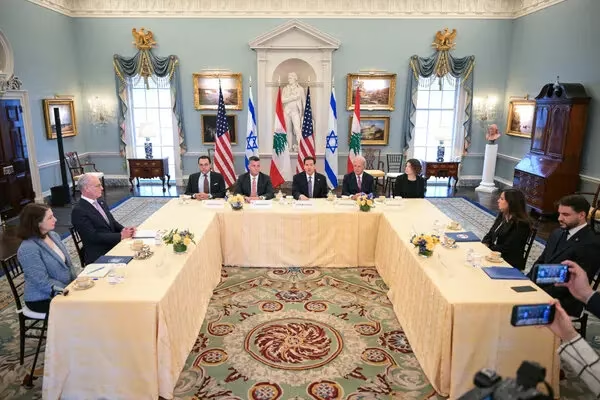
Washington, D.C- On Thursday, May 14, the Lebanese and Israeli ambassadors to Washington are scheduled to meet for a third round of US-sponsored talks aimed at reducing tensions along the Lebanese-Israeli frontier. So far, the previous meetings have been largely ceremonial, producing little beyond cautious statements about de-escalation and continued dialogue. Yet even if these encounters remain symbolic for now, the political trajectory they represent carries profound risks for Lebanon.


Lebanon’s possible entry into direct negotiations with Israel would not simply mark a diplomatic adjustment. It would represent a strategic transformation capable of reshaping the nature of the conflict itself. The central issue is not whether talks can temporarily calm the border or prevent another war. The deeper danger lies in the imbalance of power between the two sides and in Israel’s long history of using negotiations to consolidate regional advantage rather than pursue equitable peace.


Israel enters any negotiations backed fully by the military, economic, and diplomatic power of the United States. Lebanon, by contrast, approaches the table weakened by economic collapse, political paralysis, and severe institutional fragility. Under such conditions, negotiations rarely become exercises in mutual compromise. More often, they evolve into mechanisms through which the stronger side gradually imposes its priorities on the weaker one.


This pattern has defined much of the region’s diplomatic history. Agreements presented internationally as frameworks for “stability” and “security” have frequently normalized Israeli power while leaving the core questions of sovereignty, occupation, and rights unresolved. Lebanon risks entering precisely such a process.


Supporters of direct talks argue that Lebanon desperately needs stability after years of financial devastation, social despair, and repeated military confrontation. Many Lebanese understandably seek any path that could spare the country another catastrophic war. But stability built on structural imbalance is inherently fragile. Negotiations conducted under economic desperation and external pressure rarely produce fair outcomes. Instead, they tend to institutionalize weakness while deepening dependency.


Lebanese skepticism toward direct talks is rooted not in abstraction, but in lived experience. During the recent war, Israel forcibly displaced more than 800,000 Lebanese civilians from towns and villages across the south. Entire residential neighborhoods, farms, shops, and businesses were systematically destroyed, leaving large areas resembling the devastation seen in Gaza. Streets were flattened, infrastructure shattered, and entire communities uprooted. For many Lebanese, entering direct negotiations after such destruction appears less like diplomacy than an attempt to normalize relations through coercion and exhaustion.


At the same time, direct negotiations would hand Israel an important political victory at a moment of growing international scrutiny over its conduct toward Palestinians. Israel faces mounting accusations of collective punishment, war crimes, and systematic violations of international law. Bringing another Arab state into direct political engagement serves a broader Israeli objective: reducing its regional isolation and reframing itself as a normal actor despite continuing conflict and occupation.


This is why even supposedly “technical” or “security-related” talks cannot be separated from their wider political implications. Border discussions evolve into security coordination; security coordination gradually becomes normalization; normalization eventually reshapes public consciousness until the original nature of the conflict itself is obscured. What begins as limited engagement can slowly evolve into long-term political accommodation.


For Lebanon, the danger extends beyond foreign policy. Direct negotiations with Israel could reopen dangerous internal fractures inside a country still shaped by sectarian distrust, unresolved memories of civil war, and competing regional loyalties. Any Lebanese leadership perceived as moving toward normalization would likely face fierce opposition from political and social forces that continue to view Israel as an occupying and expansionist power responsible for repeated destruction inside Lebanon.


In such a volatile environment, negotiations could quickly become a catalyst for domestic instability. Political disagreements over relations with Israel have historically carried existential implications in Lebanon. External pressure aimed at altering Lebanon’s strategic posture — especially regarding Hezbollah and resistance politics — could deepen sectarian polarization and destabilize the fragile balance that has prevented large-scale internal conflict in recent years.


Israel’s own strategic perspective reinforces these concerns. Israeli policy has long viewed Lebanon primarily through a security lens, focusing less on Lebanese sovereignty than on how Lebanon can be managed, pressured, or reshaped to fit Israeli security priorities. Any direct negotiations would therefore be unlikely to remain confined to border disputes alone.


Over time, talks could expand into demands concerning Hezbollah’s weapons, internal Lebanese political arrangements, security mechanisms, and broader regional alignments tied to American and Israeli interests. Under the language of “de-escalation,” Lebanon could gradually find itself pressured into concessions far beyond its original negotiating mandate.


The role of the United States further complicates matters. Washington presents itself as a mediator, yet it remains Israel’s closest strategic ally, providing military aid, diplomatic protection, and political backing across international institutions. This imbalance shapes outcomes. US-sponsored negotiations have repeatedly pressured weaker Arab actors toward “pragmatic compromises,” while Israeli demands are framed as legitimate security concerns.


In the end, the greatest danger of direct negotiations lies not only in what Lebanon may concede formally at the table, but in the political trajectory such talks could unleash inside Lebanon itself. In a country still haunted by the legacy of civil war, forcing a divisive realignment around Israel may not produce stability at all. It may instead deepen internal fractures and push Lebanon toward another dangerous era of rupture.

ARAB AND WORLD

Mon 11 May 2026 8:03 pm - Jerusalem Time

Trump attacks Iranian proposal, calls it 'stupid' and emphasizes fragility of ceasefire

US President Donald Trump issued strong statements against the Iranian leadership, considering the current ceasefire to be extremely fragile and unreliable. Trump explained during a meeting with media representatives at the White House that the proposals recently submitted by Tehran lack seriousness, describing them as 'stupid' and completely rejected by the American administration.

The White House chief accused the Iranian side of evasiveness in the ongoing negotiations, noting that Tehran has a history of agreeing to specific terms only to backtrack later. Trump revealed that the Iranians had reneged on previous promises regarding the delivery of enriched uranium, which he considered evidence of the other party's lack of credibility in reaching a sustainable settlement.

In a related context, the US President revealed intentions to reactivate what is known as 'Project Freedom', to be a key pillar within a broader strategic process aimed at dealing with the Iranian file. Trump affirmed in a separate television interview that this move comes within the framework of continuous pressure to ensure the achievement of American goals and the protection of vital interests in the region.

Despite the escalating tone, Trump expressed his conviction that the hardline leaders in Tehran will eventually find themselves forced to submit under the weight of pressure. He stressed his determination to continue dealing with the Iranian file strictly until a comprehensive agreement is reached that ensures the complete and final cessation of nuclear threats.

The US President also revealed technical details related to an Iranian request to recover 'nuclear dust' from facilities that were previously destroyed, justifying this by Tehran's lack of necessary technologies to deal with these materials. These developments come at a time when relations between Washington and Tehran are witnessing escalating tension, casting a shadow over the stability of the Middle East.

The Iranians presented a stupid proposal that we cannot accept, and they agree with us on things then backtrack.

PALESTINE

Mon 11 May 2026 8:03 pm - Jerusalem Time

Four Years Since the Loss of Shireen Abu Akleh: Blood in Jenin and Unanswered Questions of Justice Haunt the Killer

The fourth anniversary of the assassination of the journalistic icon Shireen Abu Akleh arrives, bringing back memories of that harsh moment on May 11, 2022, when her voice fell silent in the Jenin camp. Shireen was not just a passerby in the field; she was a witness to decades of conflict, before her blood-soaked body became a global symbol embodying the suffering of journalists under occupation.

Born in Jerusalem in 1971, Shireen carved out her professional path with determination after leaving architectural studies to enroll at Yarmouk University and study media. She moved between international and local institutions such as UNRWA and Monte Carlo, until she settled at the 'Masader' office in 1997, becoming a familiar face in every Palestinian and Arab home following the details of the Intifada and invasions.

Shireen was distinguished by her calm and composed style, skillfully balancing the sanctity of the news with a humanitarian bias towards the victim without exaggeration or showmanship. Her reports walked a fine line combining the intensity of the field with the discipline of language, earning her the trust of the public and the respect of colleagues worldwide.

On the morning of the assassination, Shireen was wearing full safety gear, including a helmet and a protective vest clearly marked 'PRESS'. Despite the absence of any armed confrontations at that point, an Israeli sniper targeted her with a fatal bullet, a crime documented by camera lenses and the testimonies of colleagues who were beside her under the tree.

Initially, the official occupation narrative attempted to blame Palestinian militants, but international pressure and independent investigations forced it to retract and admit the high probability of its soldiers' responsibility. Investigations by major international newspapers such as 'The New York Times' and 'The Washington Post' concluded that the targeting was precise and came from Israeli forces stationed in the area.

A recent documentary produced by the 'Zaytoun' platform in 2025 revealed the name of the sniper responsible for the shooting, 'Alon Skagio' from the elite 'Duvdevan' unit. The investigation indicated that the army later transferred him from his unit to protect him from prosecution, before he was killed by an explosive device during a military operation in Jenin in 2024.

The biggest surprise revealed by the documentary was that officials in former US President Joe Biden's administration knew of Israel's responsibility for the killing from the very first hours. Reports confirmed that an Israeli general informed the American side of the truth immediately after the incident, raising major questions about the reasons for the delay in justice and accountability.

The Committee to Protect Journalists is currently criticizing what it describes as the 'stagnation' in the FBI investigation announced in late 2022. The committee asserts that there are no public updates or a clear timeline for the investigation, despite the willingness of Palestinian witnesses to cooperate fully and provide their official testimonies to the American authorities.

The occupation authorities strongly opposed external investigations, with then-Defense Minister Benny Gantz describing the American investigation as a 'grave mistake'. This refusal to cooperate reflects Israel's policy of impunity, which observers believe has encouraged the continued targeting of media personnel in the occupied territories.

Shireen's assassination opened the door to a more brutal pattern of targeting journalists, with statistics indicating the killing of approximately 240 journalists in Gaza during the recent war. The protection provided by international law is no longer sufficient against bullets that target the camera as an inconvenient witness to field crimes.

Journalist Shatha Hanaysha, who was accompanying Shireen at the moment of her death, recounts how that moment changed her life forever and caused her deep psychological trauma. Shatha emphasizes that targeting a journalist not only kills them physically but aims to terrorize the entire professional environment and push journalists away from documenting the truth in hot zones.

Shireen's case has become an international human rights file, with the 'Masader' network and the martyr's family submitting comprehensive files to the International Criminal Court in The Hague. These files are based on forensic evidence and video materials proving deliberate sniping, in an attempt to break the wall of international silence and impose sanctions on perpetrators of crimes against journalists.

International organizations such as 'Reporters Without Borders' stand in solidarity with these efforts, warning that closing Shireen's case without accountability means giving a green light to target more journalists. The ongoing legal battle aims to make Shireen's case a turning point in protecting journalistic work globally, not just in Palestine.

Despite four years passing, Shireen Abu Akleh's image remains present in every field, and her voice echoes in the memory of generations as an icon of truth and professionalism. The case remains a true test of the world's conscience and the ability of international institutions to uphold justice, far from narrow political calculations that protect killers.

Shireen was not just a correspondent; she was a calm voice in the heart of the storm, transformed by a treacherous bullet from a news carrier into the news itself.

ARAB AND WORLD

Mon 11 May 2026 8:03 pm - Jerusalem Time

Trump Threatens to Strike Iranian 'Nuclear Dust': Space Threats and Warnings of Bombing Repercussions

US President Donald Trump escalated his warning tone towards Tehran, threatening to use advanced 'space force' technologies to pursue what he described as Iranian 'nuclear dust'. Trump clarified that Washington is closely monitoring 60% enriched uranium, emphasizing that any Iranian approach to the brink of military manufacturing would be met with a direct military strike targeting underground facilities.

In a scientific interpretation of these threats, nuclear security and radiation safety expert Dr. Abdul Wali Al-Ajlouni stated that the term 'nuclear dust' used by Trump often refers to enriched uranium found in solid or gaseous states. Al-Ajlouni affirmed that fears of a major radiation disaster if these sites are bombed are exaggerated and not based on accurate physical facts.

Technical sources explained that the space surveillance mentioned by the US President is not new, as Washington has had the capability to monitor surface activities for many years. However, experts pointed out that satellites are unable to directly detect enriched uranium stored deep underground, due to the nature of the radiation emitted from it, which does not penetrate dense rock layers.

According to technical analyses, enriched uranium emits 'alpha' particles which have a very short range of travel in the air, making their detection impossible from outer space. Accurate detection operations rely exclusively on ground sensors placed at very close points, such as border crossings or within the facilities themselves, which weakens the hypothesis of space monitoring of the material itself.

Regarding the potential repercussions of any military attack, Dr. Al-Ajlouni explained that bombing uranium storage facilities would inevitably destroy the material, but it would not cause a nuclear explosion as is rumored in non-specialized circles. He added that enriched uranium has low radioactivity, which limits the risk of its spread in the atmosphere and does not pose a widespread regional threat.

Experts drew attention to the fact that the real danger inherent in these materials is primarily chemical, not radiological, as the toxicity of uranium as a heavy metal outweighs its radiological risks upon decay. Informed sources considered that a large part of the current American statements falls within the scope of psychological warfare and raising the ceiling of political pressure on the Iranian regime to deter it from continuing enrichment.

Reports concluded that the lack of scientific awareness of the nature of nuclear materials contributes to exaggerating public anxiety about military threats, while facts indicate that the fear stems from the ambiguity of the terms used. The region remains hostage to political tensions between Washington and Tehran, at a time when international agencies continue to monitor enrichment levels that have reached critical levels.

If they approach a nuclear weapon, we will strike it, and the United States is closely monitoring all movements related to this program.

ARAB AND WORLD

Mon 11 May 2026 8:03 pm - Jerusalem Time

Iran responds to Trump's rejection of its negotiating proposal: "His satisfaction is not our goal"

Informed Iranian sources confirmed that the position expressed by US President Donald Trump regarding the latest Iranian proposals is not important to decision-makers in Tehran. The sources clarified that Iranian policy is not based on formulating initiatives aimed at gaining the satisfaction of the American administration, but rather on national interests and the strategic vision of the state.

The sources indicated that Trump's dissatisfaction is considered, from an Iranian perspective, evidence of the strength and quality of the proposed plan, as American criticism is seen as a testament to Tehran's adherence to its rights. They stressed that any attempt to pressure through media statements will not change the essence of the Iranian position regarding the ongoing negotiations.

In contrast, the US President had explicitly announced his rejection of the response Washington received from Tehran via the Pakistani mediator, describing it as completely unacceptable. Trump stated on his social media platform that he had reviewed the terms of the response provided by those he described as representatives of Iran, confirming that what was stated in it does not meet American expectations for ending the conflict.

Regarding coordination with allies, Trump revealed that he had held telephone conversations with Israeli Prime Minister Benjamin Netanyahu, which he described as very positive and discussed the Iranian response in detail. Trump clarified in press statements that coordination with the Israeli side remains a fundamental pillar in dealing with the Iranian file and developments in the region.

The US President concluded his statements by emphasizing that the negotiation file with Iran falls within his direct and exclusive responsibilities, indicating that he will not allow his powers to be overstepped in this regard. This debate comes at a sensitive time when the region is witnessing intensive diplomatic movements led by international and regional parties to bring viewpoints closer and prevent a wider escalation of the situation.

When Trump expresses his dissatisfaction with a plan, it is often an indication that the plan is better.

PALESTINE

Mon 11 May 2026 8:02 pm - Jerusalem Time

EU Nears Approval of Sanctions Against Violent West Bank Settlers

The European Union's foreign policy chief, Kaja Kallas, expressed optimism that the bloc's foreign ministers could reach a formal agreement on Monday to impose sanctions on settlers involved in violence in the occupied West Bank. Kallas indicated, ahead of the anticipated meeting in Brussels, that consultations are ongoing to ensure the necessary majority for approving these proposals, emphasizing her hope for a political consensus that would end the impunity enjoyed by these settlers.

These European moves come at a time when the West Bank has witnessed an unprecedented escalation in settler attacks since October 7, 2023, with these assaults becoming more organized and brutal. Human rights reports and field sources have documented horrific incidents that have drawn widespread international condemnation, the latest of which involved Palestinian families being forced to exhume the graves of their deceased under threat of arms and with the support of occupation forces.

In details of one of the field crimes, sources reported that settlers began digging up a grave inside the cemetery of Al-Asa'sa village in preparation for exhuming a body that had been buried on the same day, before the Israeli occupation army intervened to force the deceased's relatives to move the body and bury it in another location. Occupation authorities justified this arbitrary measure under the pretext of the cemetery's proximity to the 'Tirsa/Sanur' settlement, a step described by UN officials as a stark embodiment of the policy of dehumanizing Palestinians.

For his part, Ajith Sunghay, head of the Office of the High Commissioner for Human Rights, described these practices as 'horrific,' reflecting the extent of violations faced by the indigenous population in the West Bank. UN reports confirmed that these attacks are not merely isolated incidents but part of a broader strategy aimed at terrorizing Palestinians and forcing them to leave their lands for the benefit of illegal settlement expansion.

Regarding field statistics, official Palestinian data indicates that at least 1,155 Palestinians have been killed and approximately 11,750 others injured in the West Bank since the start of the latest aggression. Occupation forces have also launched widespread arrest campaigns targeting nearly 22,000 citizens, alongside systematic demolition operations of homes and vital facilities in various governorates.

Concerning forced displacement, settler attacks protected by the occupation army have led to the partial or complete displacement of at least 79 Palestinian communities, affecting more than 814 families comprising over 4,700 citizens. These attacks are concentrated in areas classified as 'C' to enhance Israeli control over natural resources and agricultural lands on which Palestinians depend for their livelihoods.

It is worth noting that Israel has continued its occupation of the West Bank since 1967, establishing approximately 192 settlements and 350 outposts inhabited by about 780,000 settlers, amidst an environment of racial discrimination against 3 million Palestinians. These settlements are considered illegal under international law, and the anticipated European sanctions are a step in the path of international pressure to halt settlement expansion and protect civilians.

I expect a political agreement on sanctions against violent settlers, and I hope we can reach that during the foreign ministers' meeting.

PALESTINE

Mon 11 May 2026 8:01 pm - Jerusalem Time

Palestinian youth killed by occupation bullets in Qalandia camp north of Jerusalem

Large forces of the Israeli occupation army stormed Qalandia camp north of occupied Jerusalem in the early morning hours of Monday, leading to violent confrontations and armed clashes in the camp's alleys. Military operations focused on the Institute Street area, where snipers and infantry soldiers were deployed amidst heavy live fire and sound grenades directed at citizens and their homes.

Field sources reported that a Palestinian youth engaged in a clash with the invading force before being seriously wounded as a result of being directly targeted by live bullets from occupation soldiers. A state of extreme tension prevailed throughout the camp with the continued Israeli military reinforcements that closed the main entrances and completely prevented movement.

In a blatant violation of international norms, occupation vehicles surrounded the site where the young man was injured and prevented ambulance crews and paramedics from approaching to provide him with the necessary first aid. Ambulance vehicles were also subjected to direct gunfire from soldiers to obstruct their arrival, which led to the injured person bleeding for a long time at the scene without any medical intervention.

Medical sources later announced the martyrdom of the young man due to his serious injuries and severe bleeding that continued throughout the period when medical teams were prevented from reaching him. This crime comes in the context of the ongoing escalation witnessed in the areas of Jerusalem and the West Bank, where the occupation continues its policy of bloody incursions and tightening restrictions on the Palestinian population.

Occupation forces prevented ambulance crews from reaching the injured, targeting medical vehicles with gunfire to obstruct their humanitarian missions.

PALESTINE

Mon 11 May 2026 8:01 pm - Jerusalem Time

From Marginalization to Guardianship: A Reading of the Transformations in the UN's Engagement with the Palestinian Cause

The international organization took many decades before officially recognizing the Nakba of the Palestinian people, despite being the umbrella that granted legitimacy to the establishment of the Israeli entity on Palestinian land in 1948. This UN recognition came despite the occupation's non-compliance with the partition resolutions and the right of return, which contributed to entrenching the reality of the occupation under international cover.

The Palestinian cause experienced a period of deliberate marginalization within the corridors of the United Nations between 1951 and 1974, where the crisis was reduced to its humanitarian dimensions only. The annual discussion was limited to the refugee file and the 'UNRWA' agency without addressing the political roots of the conflict or the usurped national rights.

The issuance of Resolution 242 after the 1967 setback reflected the state of international marginalization, as the text contained no mention of Palestine or its people, merely referring to the need to find a just solution for refugees. This approach continued until the October 1973 war, which forcefully reasserted the Arab and Palestinian presence on the global stage through military and political means.

1974 witnessed a radical shift with the election of Abdelaziz Bouteflika as President of the General Assembly, where the Palestine item regained its place on the agenda after a 23-year absence. This phase culminated in the recognition of the Palestine Liberation Organization as the sole legitimate representative of the Palestinian people and granting it a seat in the international organization.

During that era, the General Assembly adopted historic resolutions, most notably Resolution 3236, which detailed Palestinian national rights to return and self-determination. The organization also took an advanced moral stance in 1975 when it described Zionism as a form of racism and racial discrimination.

Signs of regression began to reappear with the signing of the Camp David and Oslo agreements, leading to the fragmentation of the Arab position and weakening Palestinian momentum in the United Nations. This weakness was reflected in the annulment of the resolution condemning Zionism as racism in 1991, and the beginning of the 'Quartet' era, which imposed harsh conditions on the Palestinian resistance.

In 2022, Palestinian diplomacy achieved a symbolic breakthrough by adopting a resolution commemorating the seventy-fifth anniversary of the Nakba for the first time in the history of the United Nations. Despite immense American and Israeli pressure to thwart the resolution, the session was held in May 2023, constituting a belated international recognition of the Palestinian tragedy.

The 'Al-Aqsa Flood' operation in October 2023 caused an earthquake in the international system, with Palestine returning to dominate discussions in the Security Council and the International Court of Justice. However, new dangers emerged in attempts to impose political solutions that undermine Palestinian sovereignty under the guise of stability and security.

Resolution 2803, issued in November 2025, is considered one of the most dangerous turning points in the history of international engagement with the Gaza Strip, as it adopts a vision aimed at imposing international guardianship. This resolution treats Palestinians as an unqualified party for self-governance, bypassing the role of the Palestinian Authority and national institutions.

This latest resolution established a so-called 'Peace Council' with independent legal personality and international legal protection, making it above local accountability. This council aims to administer the Gaza Strip through a transitional government and international stabilization forces, a step observers see as entrenching the separation of the Strip from the West Bank.

New international conditions make the disarmament of the resistance a prerequisite for any Israeli withdrawal or future peace talks. This path gives the occupation a green light to continue its military operations, while restricting Palestinian options for self-defense or claiming legitimate rights.

The task of implementing this international plan was entrusted to figures associated with the biased American vision, led by Jared Kushner and Tony Blair. Analysts believe that this team seeks to liquidate the Palestinian entity and transform the issue from a national liberation struggle into an administrative and security file under external guardianship.

Despite all these challenges and international decisions that attempt to circumvent constants, the reliance remains on the steadfastness of the Palestinian people in their land. History proves that attempts at marginalization and annulment always clash with the will of resistance and adherence to national identity that cannot be erased by paper resolutions.

The Nakba that began in 1948 and the subsequent setbacks and incomplete agreements have not succeeded in ending the Palestinian presence or breaking the will for liberation. Ultimately, the international powers that try to shape the future of Gaza away from the aspirations of its people will face a reality imposed by the true owners of the land.

Resolution 2803 puts the final seal on the issue of Palestinian statehood and the right to self-determination if the Palestinian people are not mobilized against it.

OPINIONS

Mon 11 May 2026 11:15 am - Jerusalem Time

From Dangerous Fantasies to Promising Reality


What both peoples need to understand is that the other side is not disappearing. Not through war, not through terrorism, not through occupation, not through annexation, not through settlements, not through rockets, not through starvation, not through slogans, and not through prayers for the destruction of the other.

There are today roughly equal numbers of Jews and Palestinians living between the river and the sea. Neither people is leaving. Neither people can defeat the national identity of the other. We are locked together by geography, history, religion, memory, trauma and blood. The question is not whether we will live together in this land. The only real question is whether we will continue to die together for it.

For decades, both national movements have nourished themselves on fantasies. Palestinians were taught that armed struggle would eventually liberate all of Palestine. Israelis were taught that military superiority could permanently suppress Palestinian national aspirations. Both ideas have failed. Spectacularly and tragically.

October 7 and the war that followed should have buried these illusions forever. Hamas did not liberate Palestine. It brought unimaginable destruction upon Gaza and trauma upon Israelis and Palestinians alike. Israel did not destroy Palestinian nationalism through overwhelming military force. After tens of thousands dead, entire neighborhoods erased, and generations traumatized, the Palestinian people are still there, demanding freedom, dignity and statehood.

The lesson should be obvious. Violence can kill people. It cannot kill national identity.

Too many leaders on both sides remain prisoners of slogans that no longer correspond to reality. On the Palestinian side, there are still those who speak as if Jews are foreign colonialists with no legitimate connection to this land. On the Israeli side, there are ministers and rabbis who speak openly about expelling Palestinians and permanently controlling all of the territories. Both camps are detached from reality. Both are leading their people toward endless catastrophe.

The hardest truth for Palestinians is that Israel is not a temporary phenomenon. It is a deeply rooted society with millions of people who were born there, built their lives there, buried their parents there and have nowhere else to go. The hardest truth for Israelis is that Palestinians are not a demographic problem to be managed or removed. They are a people with national rights, collective memory and a profound attachment to their homeland.

The future will not belong to those who dream of exclusive ownership of the land. It will belong to those who understand that two peoples are destined to share it.

For me, this still means two states for two peoples. Not because it is perfect, but because every other option leads either to permanent war, apartheid-like reality, ethnic cleansing, or the destruction of the national aspirations of one people by the other. None of those outcomes is moral, sustainable or realistic.

But if two states are ever to emerge, something even more important must happen first: both peoples must abandon the idea that justice can only come through the defeat and humiliation of the other side.

Peace will require Palestinians to give up the fantasy of destroying Israel. Peace will require Israelis to give up the fantasy of permanent domination over Palestinians. Peace will require moral courage greater than the courage required for war.

It will also require new leadership. Leadership that speaks honestly to its own people instead of feeding them comforting lies. Leadership that prepares both societies psychologically for compromise instead of permanent mobilization against eternal enemies.

The international community also has to stop indulging fantasies. Empty declarations, selective outrage, performative diplomacy and endless management of the conflict have all failed. The world should stop financing the continuation of the conflict and begin investing seriously in ending it.

And yes, there must be accountability for crimes committed by all sides. But accountability without a political horizon simply becomes another weapon in the continuation of the conflict.

What is needed now is not more revenge, but political imagination grounded in reality.

The reality is simple: neither people is going anywhere.

It is time to stop teaching our children that the highest form of patriotism is dying for the land. The highest form of patriotism should be building a future in which children on both sides can live normal lives without fear, hatred and endless war.

That will not happen through military victory.

It will happen only when both peoples finally understand that their freedom, security and future are inseparably linked to one another.


OPINIONS

Mon 11 May 2026 11:07 am - Jerusalem Time

Between a Fragile Truce and Open Attrition: The Gulf on the Brink of a Long US-Iranian Confrontation

Washington's Message\n\nWashington - Said Arikat - 5/11/2026\n\nNews Analysis\n\nDespite the fragile truce reached through Pakistani mediation between the United States and Iran, the course of events in the Gulf does not reflect a trend towards de-escalation as much as it reveals the conflict's transition to a long phase of attrition, where diplomatic tools intertwine with military and economic realities on the ground. Naval escalation, drone attacks, and persistent tension around the Strait of Hormuz all indicate that the region remains trapped in an undeclared confrontation, managed within precise limits but capable of exploding at any moment, in the absence of mutual trust between Washington and Tehran.\n\nIn this context, Iran's response to the latest American proposal, conveyed through Pakistani mediation, came without details being announced, after Washington had put forward a negotiating framework that included a plan for reopening talks on the nuclear program, along with arrangements related to navigation lanes in the Strait of Hormuz. However, this political path seemed detached from the field reality, which is heading towards further complexity, as security incidents and indirect clashes continue, reflecting a growing gap between diplomacy and military reality.\n\nFor his part, US President Donald Trump dealt with the Iranian response with clear severity, declaring his "complete rejection" of it, as he put it, considering that Tehran had not offered anything that could be built upon in any serious negotiation process. This stance reflects an American view that Iran is trying to impose facts on the ground before entering into any political settlement. However, this rigidity in rhetoric does not, in turn, conceal the limited American options, given the understanding that any widespread escalation could turn into a complex regional war whose course or outcomes would be difficult to control.\n\nConcurrently, the region witnessed a series of field developments that reinforced the fragility of the existing truce. Drones were intercepted in more than one Gulf country, a ship near the Qatari coast was subjected to a limited attack, and a target was struck in the vicinity of Erbil linked to Iranian opposition groups. These events, despite their limited nature, reflect the continued use of low-intensity military pressure tools, making the current ceasefire closer to a temporary management of escalation than to an actual settlement.\n\n The United States was unable to impose a new deterrence equation through "Operation Freedom Project," as the operation encountered clear regional obstacles, most notably Saudi Arabia's refusal to allow the use of its bases or airspace to support these efforts to open and secure the Strait of Hormuz. This refusal constituted an important indicator of increasing regional caution about engaging in an open confrontation with Iran, and a shift in the calculations of Gulf states, which have become more inclined to avoid being drawn into a war whose outcomes cannot be predicted.\n\nIn contrast, Iran continued to strengthen its position in the pressure equation via the Strait, seeking to transform it into a strategic card against the United States. Tehran treats Hormuz not only as an international shipping lane but as a sovereign tool capable of directly influencing the global economy, by controlling ship movements and imposing new field arrangements. This development, along with parallel American measures to intercept ships bound for Iran, led to a dual pressure situation that affected trade and energy traffic.\n\n The decline in navigation in the Strait of Hormuz was not merely a technical development, but transformed into a silent global economic crisis, as shipping and insurance costs rose significantly, oil tanker traffic declined, while hundreds of ships remained stranded inside the Gulf. This situation once again revealed the fragility of the global economic system and its reliance on limited maritime corridors that can easily turn into strategic choke points if escalation continues.\n\nMeanwhile, the Iranian nuclear file remains the central knot that reproduces the crisis. Washington insists on halting enrichment and dismantling the highly enriched uranium stockpile, while Tehran considers this stockpile a strategic guarantee to deter any attempt to impose political conditions on it by force. Thus, the dispute transforms from a technical issue into a struggle over the regional deterrence balance, where the future of negotiations is directly linked to power balances, not technical understandings.\n\nIt is worth noting that Israeli Prime Minister Benjamin Netanyahu, on the CBS News program "60 Minutes" on Sunday, demanded that the United States forcibly extract enriched uranium from Iran using its special forces.\n\nEstimates within Washington indicate the existence of potential military plans to target Iran's nuclear infrastructure, but the military establishment realizes that any such operation may require extensive ground intervention, with high probabilities of the war expanding to Iraq, Lebanon, and the Gulf. This understanding explains American caution in moving from threat to implementation, despite the administration's continued escalatory rhetoric.\n\nAt the regional level, the repercussions of the crisis extended to other fronts, especially Lebanon, where tensions continued despite Trump's announcement that the ceasefire should include the Lebanese arena. However, the continuation of Israeli raids clarifies that the conflict is no longer confined to the Gulf, but has become an interconnected network of arenas capable of simultaneous ignition.\n\nInternationally, Britain and France began moves to enhance navigation protection in the Gulf, amid a growing realization that the continuation of the crisis could threaten the global economy. However, these moves remain limited, as they address symptoms more than they address the roots of the conflict.\n\nIn conclusion, the region appears to be facing a long phase of attrition, where there is no quick settlement or clear military decisive action, but rather a management of a low-intensity conflict that may be prolonged. While Washington bets on pressure, and Tehran bets on steadfastness, the entire region remains in a state of fragile balance capable of collapsing at any moment.\n\nThe current crisis reveals that the conflict between the United States and Iran is no longer just a dispute over the nuclear program, but has transformed into a comprehensive confrontation over the shape of the regional order in the Middle East. Iran seeks to establish a deterrence equation based on controlling maritime passages and raising the cost of any military confrontation against it, while Washington tries to prevent this transformation because it threatens the foundations of its traditional influence in the Gulf. This overlap between geography and politics makes any technical settlement insufficient unless the issue of power distribution in the region is addressed more deeply.\n\nSaudi Arabia's refusal to use its bases in "Operation Freedom Project" reflects a significant shift in regional calculations, as Gulf states have become more inclined to avoid direct involvement in major conflicts whose outcomes cannot be controlled. This change does not mean moving away from traditional alliances, but rather reflects a reassessment of the risks of escalation, especially given the understanding that any widespread confrontation in the Gulf could quickly turn into a direct threat to the economic and internal security stability of the Gulf states themselves, and not just an arena for major power struggles.\n\nPerhaps the most dangerous aspect of the current phase is that all parties are operating on the assumption of being able to control escalation and prevent a full-scale explosion, while historical experiences indicate that major wars often begin with limited incidents and mutual miscalculation. The tension around the Strait of Hormuz, indirect clashes, and escalatory statements are all elements that raise the probability of miscalculation. With the absence of a stable and effective negotiating channel, the possibility of sliding into a wider confrontation exists, even without a direct political decision from any party.

ARAB AND WORLD

Mon 11 May 2026 11:07 am - Jerusalem Time

US warnings to Baghdad not to enter the Najaf desert amid reports of a secret Israeli base

Security sources revealed that Iraqi authorities received direct warnings from the United States of America, demanding them to refrain from approaching specific areas in the Najaf desert. The sources explained that these warnings came under the pretext of security concerns, at a time when Baghdad's intelligence agencies are unable to identify the military force stationed in that area for about two months, which has created a state of ambiguity and security tension.

Despite the Iraqi forces carrying out a series of aerial and ground reconnaissance operations deep in the Najaf desert, field results did not show the presence of traditional military bases or visible installations. This Iraqi move comes in an attempt to unravel the mystery of the unknown military activity detected by local reports, amid American pressure aimed at keeping the area away from any direct military friction with national forces.

In a related context, international press reports quoted American officials and informed sources as saying that Israel succeeded in establishing a secret military site in the western region of Iraq with the approval and coordination of Washington. According to these sources, the site serves as an advanced logistical center to support Israeli air force operations, and provides a vital foothold for managing the intensive air campaigns that targeted the region in recent weeks.

The leaked data indicates that the secret base is used for the stationing of special forces units and elite search and rescue teams belonging to the occupation army. This military presence aims to ensure rapid intervention if Israeli fighters are exposed to any incidents or fall inside Iranian territory or in adjacent border areas, which gives Tel Aviv greater aerial maneuverability away from traditional monitoring.

For his part, the head of the Security Media Cell, Lieutenant General Saad Maan, recalled a security incident that occurred last March, where a force from the Karbala Operations Command was subjected to unknown aerial bombardment during an inspection mission in the desert area linking Karbala and Najaf. That attack resulted in the martyrdom of a soldier and the injury of two others, after receiving reports of unidentified helicopters flying in the skies of the area believed to contain the secret activity.

Following that incident, the Iraqi government filed an official complaint with the United Nations, pointing fingers at American forces for carrying out the airstrike that targeted its soldiers. In contrast, the US Central Command (CENTCOM) denied responsibility for the attack, which reinforces the hypotheses that speak of the presence of other military parties operating in the region under American protection and carrying out their operations independently of official coordination channels with Baghdad.

The United States informed the Iraqi side of the necessity of not approaching the area for security reasons, at a time when Baghdad was unable to identify the forces present there.

OPINIONS

Mon 11 May 2026 11:07 am - Jerusalem Time

Israel's Secret Base in Iraq: How the American Invasion Became a Gateway to Regional Chaos

Washington Message

Saeed Arikat – 10/5/2026

News Analysis

The revelation published by The Wall Street Journal on Sunday, about Israel establishing a secret military base inside Iraqi territory during the war on Iran, was not just a fleeting security detail. Rather, it appeared to be a concentrated summary of a long trajectory of strategic collapse that has afflicted the region since the American invasion of Iraq in 2003. The report, which spoke of the base being used as a logistical and operational support point for Israeli aviation deep inside Iraqi territory, reveals the extent to which Iraq's sovereignty has become a violated space where projects of hegemony, intelligence wars, and regional liquidation intersect.

According to the report, Israel established the base in the desert of western Iraq before the outbreak of the war, and used it to support its air operations against Iran, in addition to deploying special teams whose mission was to rescue pilots and secure military supplies. The most dangerous part of the narrative is that Israeli forces shelled Iraqi soldiers who approached the site after suspecting unusual activity, resulting in deaths and injuries. If this information is true, it means that Iraq is no longer just a proxy battleground, but has actually become an open field for direct Israeli military operations, amid the Iraqi state's impotence and the collapse of the concept of national sovereignty.

The report also sheds light on a deeper truth: that the recent war on Iran was not just a confrontation between two states, but an extension of a regional structure generated by the American invasion of Iraq. Since the overthrow of Saddam Hussein's regime, Iraq has entered a spiral of systematic dismantling of state institutions, and a reshaping of the security and political map on sectarian and militia bases, which opened the door to unprecedented regional and international interventions. The United States presented the invasion at the time as a project to spread democracy, but the actual result was the creation of a huge vacuum that turned into a permanent platform for cross-border wars and conflicts.

The presence of a secret Israeli base inside Iraq cannot be separated from this context. Israel, which previously saw Iraq as a central confrontation state with military weight, now deals with it as a fragile security space that can be penetrated and used in its war with Iran. This transformation would not have been possible without the structural destruction that befell the Iraqi state after the American occupation. Iraqi borders eroded, security institutions divided, and external influence expanded to unprecedented levels, while the Iraqi citizen continued to pay the price with their security, stability, and future.

Since the American invasion of Iraq in 2003, the Middle East has entered a phase of strategic collapse that has not stopped to this day. The United States did not content itself with overthrowing a political regime, but contributed to the dismantling of an entire state and its military and security institutions, which opened the door to chaos, sectarianism, and the rise of militias and extremist organizations. This collapse created an ideal environment for external interventions, from Iran to Israel, and turned Iraq into an open battleground. What is happening today with secret bases and intertwined wars is not an isolated event, but a direct result of a long trajectory of American policies that reshaped the region by force, without any real vision for stability or sovereignty.

The war on Iran also showed that Israel is now acting as a cross-border regional power, moving militarily and intelligently within several Arab countries, taking advantage of the state of Arab disintegration and regional collapse. Instead of containing conflicts, the region moved towards more militarization of politics, where airstrikes, assassinations, and covert operations became ordinary tools for managing balances. In this climate, international law is completely absent, while the ability of Arab states to impose their sovereignty or protect their territories from penetration declines.

The report also reveals the extent of the interconnectedness between the American and Israeli projects in the region. Even when Israel appears to be acting independently, the environment that allows it to do so is essentially a product of long-standing American hegemony. The United States, which occupied Iraq for a full decade and reshaped its security structure, effectively created the pathways that Israel now uses in its regional confrontations. Therefore, talking about an Israeli base in Iraq is not only about Israel, but also about the heavy American legacy for which the region is still paying the price.

Moreover, the damage inflicted by the United States and Israel on the region was not only military, but also affected the very idea of the nation-state. After 2003, Arab borders became porous, armies exhausted, and political decisions hostage to external balances. Iraq was the most tragic example, but it was not the only one. The successive wars in Syria, Lebanon, Gaza, and Yemen reflected how the region transformed into a network of interconnected crises that feed each other. Israel benefited from this disintegration to expand its security influence, while Washington used the rhetoric of the "war on terror" to justify a permanent military presence. The result was a more divided, more fragile Middle East, less capable of producing stability.

In the end, it does not seem to be just a secret military operation, but a symbol of an entire trajectory of regional collapse. When an Arab land becomes a stage for foreign bases, undeclared wars, and mutual bombing operations, it means that the regional order that the region has known for decades has effectively disintegrated. Iraq, which was once one of the pillars of Arab balance, transformed after the American occupation into an open arena where major and regional powers clash, while the state recedes into the background. What the American newspaper revealed is just a new chapter in this long decline.

It is worth noting that Israel and the United States have always presented their intervention in the region under the slogans of security, stability, and self-defense, but the actual outcome has been quite the opposite. Millions of dead and displaced, destroyed cities, collapsed economies, and a political environment based on fear, polarization, and permanent wars. The most dangerous aspect is that these policies have emptied the concepts of sovereignty and international law of their meaning, as military strikes, assassinations, and covert interventions have become ordinary matters that do not face real accountability. The secret Israeli base in Iraq is not an isolated incident, but a clear expression of a Middle East reshaped by force, where open wars have become the norm, not the exception.

PALESTINE

Mon 11 May 2026 11:05 am - Jerusalem Time

Assassination of Khan Yunis Investigations Director and Martyrs in a Series of Israeli Violations in the Gaza Strip

Israeli occupation forces escalated their field violations in the Gaza Strip early this Sunday morning, carrying out a series of aerial and artillery attacks that resulted in the martyrdom of three individuals and the injury of several citizens with varying degrees of wounds. These developments come in the context of continuous breaches of the ceasefire agreement that came into effect on October 10, 2025, threatening the stability of the fragile situation in the region.

In a direct assassination operation, occupation aircraft targeted a civilian vehicle in the Al-Amal neighborhood, west of Khan Yunis city in the southern Strip, leading to the martyrdom of the city's police investigations director, Wissam Fayez Abdel Hadi. The General Directorate of Police confirmed that the raid also resulted in the martyrdom of Sergeant Fadi Abdel Moati Heikal, who was accompanying the investigations director, describing the operation as a direct targeting of police personnel performing their service duties.

The attacks did not stop there, as field sources reported that the occupation army's artillery launched intense shelling targeting the outskirts of Al-Qarara town, north of Khan Yunis city, causing panic among local residents. This shelling coincided with military movements in border areas, even though these areas are outside the scope of deployment and control of Israeli forces agreed upon in the recent truce terms.

In the central Gaza Strip, an Israeli drone targeted a gathering of citizens in the Al-Maghazi refugee camp, leading to the martyrdom of one Palestinian and the injury of others who were transferred to nearby hospitals for treatment. These repeated targeting of civilians in populated areas confirm the occupation's continued transgression of internationally and locally agreed-upon red lines to ensure the safety of residents.

In Gaza City, Israeli warships continued to pursue fishermen at sea, firing their machine guns and shells towards fishing boats off the coast. This aggression resulted in the injury of two fishermen while they were working, in a continuous attempt to restrict the livelihoods of Palestinians and prevent them from accessing their sources of income at sea.

On the ground east of Gaza City, the occupation army carried out widespread demolition operations that affected a number of buildings and residential facilities within the areas where it is deployed. Huge explosions were heard throughout the city resulting from the destruction of residential blocks, which falls within the systematic destruction policy of infrastructure and housing followed by the army in its areas of incursion.

In a related context, the Ministry of Health revealed in its latest reports a bloody toll since the start of the ceasefire agreement, documenting the killing of approximately 850 Palestinians and the injury of 2433 others due to ongoing Israeli aggressions. These figures reflect the scale of the humanitarian tragedy and the continued bloodshed in the Strip despite international promises of calm, placing the international community before its responsibilities towards protecting civilians.

The occupation targeted the vehicle of the Khan Yunis investigations director in the Al-Amal neighborhood, leading to his martyrdom along with one of his assistants in a clear violation of existing understandings.

OPINIONS

Mon 11 May 2026 11:04 am - Jerusalem Time

Between Leadership Crisis and Crisis Leadership: A Reading on Obstacles to Change and the Outcomes of Revolutions

Ramallah - “Alquds ” dot com

Ramallah - “Alquds ” dot com

Opinion Writer

Concepts have been intertwined for many years in the aftermath of revolutionary attempts in Arab Spring countries, raising the question of the delay in the desired change. Change requires essential prerequisites that begin within those who desire it, and are represented by possessing the elements of swift action that complement a long process of serious deeds, with the necessity of sincerity, patience, and persistence in defending achievements.

The ability to confront external challenges and the suitability of internal conditions are fundamental pillars for the success of any reform movement. In the absence of this ability, it becomes imperative for peoples to endure more difficulties with sufficient awareness to distinguish between wise and mistaken actions, which becomes more difficult in the absence of wise leadership that prioritizes the nation's interest over its own.

Many believe that revolutions may be stifled or suffocated under the weight of devastating blows, but a close look at modern Egyptian history proves otherwise. The revolution remains a latent fire under the ashes of oppression, awaiting the opportune moment to erupt again, which explains the persistence of the revolutionary spirit despite repeated attempts to extinguish it.

In January 1977, Egyptians protested against price increases in what became known as the Bread Uprising, which the late President Anwar Sadat described as the 'Uprising of Thieves'. Although the regime at the time managed to paralyze the movement, the flames continued to burn in people's souls for more than thirty years until the illuminating January 2011 revolution erupted.

History tells us that great leaders are not necessarily free from human flaws; what matters is their ability to lead and sacrifice. Leader Saad Zaghloul, who led the 1919 revolution against the British occupation, admitted in his memoirs to some of his personal flaws, yet he succeeded in mobilizing the Egyptian street and shaking the foundations of the monarchy and occupation.

Similarly, global figures like Gandhi in India had major shortcomings, which confirms that great personalities can make mistakes commensurate with the scale of their influence. The lesson lies in the extent of these personalities' connection to their nation's issues and their ability to overcome human shortcomings for the sake of the supreme goal of liberation and reform.

The mind acknowledges that perfection belongs to God alone, but the dilemma lies in preferring fleeting pleasures over the lasting interest of the homeland. With the passage of time, the falsehood of those who claim a desire for reform is revealed, while their souls pursue their own desires, leading to the disappointment of nations' endeavors and the decline of the spirit of virtue in the process of change.

Human nature's refusal to retreat from the spirit of virtue is one of the biggest dilemmas facing reform movements. While some maintain an outward stance of loving reform, inwardly, love for worldly things and the desire to monopolize blessings grow, confirming the poet's saying that generosity impoverishes and daring kills.

The claim of idealism is one of the most bitter diseases in the body of the nation, where eloquent speakers emerge who convince the masses of the correctness of their decisions by tongue only. Upon practical examination, one finds no trace of that idealism on the ground, making silence about these painful examples sometimes better than delving into them.

Humanity always needs a practical role model and a human biography that embodies noble principles, as were the prophets, peace be upon them. People need to see values walking before them in the conduct of leaders, which was embodied by the Prophet Muhammad, peace be upon him, whose character was the Quran, to be a role model in leadership and reform.

Some movements prepared themselves for a traditional reform process lacking a revolutionary spirit, which made them surprised by the rebellious youth under their umbrella. This oscillation between absolute peaceful reform and the requirements of revolution led to an irresolvable confusion except through comprehensive reviews and efforts to align theory with reality.

The personality in our nation is born with a sound nature and automatically seeks a pioneer to lead it; if it does not find one, it pursues paths of private benefit. Sheikh Al-Ghazali previously warned against those who found no place in the world and thus entered into advocacy, harming it and seeking worldly gains through it, causing great pain to the reform process.

The fundamental question remains about the sincerity of demands and the reconciliation of souls with themselves. Why do some inject their private interests into issues of the public future? Protecting personal interests under the guise of reform delays the improvement of conditions and increases the burden on those on the path of change, and even harms generations that have not yet begun their journey.

Ultimately, when God wills, He prepares the causes and the appropriate leadership for reform and change, where the will of the people meets a leader who possesses scientific vision and sincerity. Only then will the vehicle of revolution be guided forward, surrounded by a group of loyalists who envision a better future, and indeed, tomorrow is near for those who await it.

The revolution is a fire simmering under the ashes of tyrants, and even if temporarily stifled, it ignites in noble souls for another day soon.

PALESTINE

Mon 11 May 2026 11:04 am - Jerusalem Time

Escalation of settlement activities in the West Bank: Demolition of structures in Qalqilya and notices to remove 50 commercial shops east of Jerusalem

The pace of attacks by settlers and occupation forces has escalated in various areas of the West Bank, where groups of settlers destroyed about 50 Palestinian structures in the town of Kafr Thulth, south of Qalqilya. The demolition operations included citizens' homes and pens for raising sheep and cows, leading to the displacement of families and the loss of their primary sources of livelihood in that northern region.

In a related context, the occupation authorities issued a military order to seize 7 dunams of citizens' land in the Al-Jabriyat area overlooking Jenin refugee camp, under the pretext of using it for military and security purposes. The danger of this decision lies in the fact that the targeted lands are classified as (A) according to the Oslo Accords, which are areas that are supposed to be under full Palestinian sovereignty and control.

As for Ramallah Governorate, settlers carried out a series of violations targeting Bedouin communities and farmers, where about 80 sheep were stolen from a private farm in the village of Kafr Malik. This incident comes under the security cover provided by the occupation forces to settlers who have been directly targeting the livestock of Palestinians to displace them from their lands.

In the Abu Faza Bedouin community, east of Ramallah, residents faced a severe humanitarian crisis after settlers cut off the main water lines to the community, which is inhabited by about 120 people. These restrictive practices aim to forcibly push residents to leave the area, as part of a systematic policy to empty the lands of their original owners in favor of pastoral settlement projects.

Moving to Hebron Governorate, the occupation forces launched a wide-ranging raid and search campaign that affected the towns of Sa'ir and Al-Dhahiriya, resulting in the arrest of four Palestinian citizens from their homes. These incursions included acts of vandalism of household contents and terrorizing residents, as part of the continuous pressure exerted by the Israeli security services on Palestinian villages and towns.

In occupied Jerusalem, owners of commercial shops in the town of Al-Eizariya began dismantling their structures themselves after receiving official demolition notices from the occupation authorities. These notices included about 50 commercial shops located at the eastern entrance to the town, where the authorities gave them a short period to comply or bear the exorbitant costs if the occupation bulldozers carried out the demolition.

Field sources reported that some of these commercial shops have been established for decades and are considered the economic lifeline for dozens of families in Al-Eizariya, who today face the risk of displacement and loss of livelihood. This Israeli step aims to expand the influence of the 'Ma'ale Adumim' settlement, which is one of the largest settlement blocs built on the lands of occupied East Jerusalem.

Data indicates that the demolition operations in Al-Eizariya fall within the settlement plan known as 'E1', which aims to geographically connect the Ma'ale Adumim settlement with the city of Jerusalem. This project seeks to create a Jewish urban continuum that severs the West Bank and separates its north from its south, in what is known in Israel as the 'Greater Jerusalem' project that devours the lands of Abu Dis and Al-Eizariya.

Observers confirm that the acceleration of demolition and confiscation operations in the West Bank reflects an Israeli government trend to impose new facts on the ground before any potential international moves. These measures coincide with the escalation of settler violence, which has taken on an organized character targeting the infrastructure and basic services of Palestinian citizens in areas classified as (C) and areas adjacent to settlements.

These notices aim to expand settlement in the area near the Ma'ale Adumim settlement, as part of the so-called E1 settlement plan.

PALESTINE

Mon 11 May 2026 11:03 am - Jerusalem Time

Political and Constitutional Controversy in Egypt Following Disclosure of Fighter Jet Deployment in UAE

The intensity of political debate in the Egyptian capital, Cairo, escalated following the official disclosure of the presence of Egyptian Air Force units stationed in the United Arab Emirates. This announcement came during an inspection visit by President Abdel Fattah El-Sisi, accompanied by his Emirati counterpart Sheikh Mohammed bin Zayed, to the Egyptian fighter jet detachment, aimed at assessing its combat readiness and enhancing joint operational capabilities.

This announcement sparked angry reactions from opposition forces, with the 'Popular Front for Social Justice,' an alliance of nationalist and leftist parties, declaring its categorical rejection of this military presence. In an official statement, the Front expressed its dismay at what it described as 'secrecy' surrounding the presence of these forces, warning against the grave consequences of involving the Egyptian army in regional conflicts that do not serve the country's supreme strategic interests.

Opposition forces stressed that sending military forces abroad constitutes a clear violation of Article 152 of the Egyptian Constitution, which prohibits sending armed forces on combat missions outside the borders unless the opinion of the National Defense Council is taken and two-thirds of the House of Representatives approve. The parties considered that bypassing these procedures undermines the constitutional guarantees that protect the army from unilateral decisions on fateful matters.

For its part, the 'Popular Socialist Alliance' party warned that any involvement of the army in external combat missions requires comprehensive national consensus, which is absent in the current situation. The party's political advisor pointed out that legal controls were specifically put in place to prevent the depletion of the armed forces' capabilities in conflicts that could harm Egyptian national security in the long run.

In a related context, the youth office of the Nasserist Karama Party directed scathing criticism at current regional alliances, considering that coordination with parties supporting the 'Rapid Support Forces' militias in Sudan poses a direct threat to the southern borders. The party affirmed that those who fund chaos in neighboring countries or exert pressure on the Grand Ethiopian Renaissance Dam issue cannot be considered allies worthy of sending Egyptian soldiers to defend them.

Political forces also pointed out that the Egyptian military presence in the Gulf might end Cairo's role as a neutral mediator in regional crises, especially in light of escalating tensions between Iran and international powers. Sources explained that this deployment could expose Egyptian interests, including the Suez Canal and the Bab al-Mandab Strait, to direct threats as a result of siding with one party over another.

The liberal 'Al-Dostour' (Constitution) Party also entered the crisis, expressing its deep concern over the lack of transparency regarding the nature and objectives of these forces' presence. The party demanded that official bodies immediately disclose the truth about the missions assigned to the air detachment, emphasizing the citizens' right to know and be informed about decisions affecting the lives of armed forces personnel.

The party called on the Egyptian House of Representatives to activate its oversight role and verify the legality of this military action, stressing that preserving the lives of soldiers must remain the state's top priority. It considered that sliding into military axes could lead to disastrous losses in light of the complex economic and political circumstances the region is experiencing.

Party reports indicated that Egyptian public opinion tends to reject participation in any proxy wars, especially those that might serve external agendas. The Popular Front stated that Egyptians realize the danger of weakening central states in the region, and that any targeting of major regional states might be followed by direct targeting of Egypt and other Arab countries according to declared plans.

Parties criticized what they described as 'imbalance' in Egyptian foreign policy towards current crises, considering that the military presence in the UAE undermines any basis for neutrality. They affirmed that protecting national security begins with securing the internal front and protecting water rights and direct borders, instead of expanding external military deployments that raise constitutional controversy.

In light of the official bodies' silence in responding to these constitutional criticisms, questions have increased about whether there is a similar military presence in other Gulf countries that has not yet been announced. Political forces are demanding a broad national discussion under the parliament's dome to clarify the strategy of Egyptian military deployment abroad and its compatibility with constitutional obligations.

Observers believe that this crisis puts the relationship between the executive authority and parliament to the test, especially in light of repeated demands to respect the provisions of the constitution. The opposition believes that military authorizations must be specific in duration and objective, and should not turn into permanent deployments without clear legislative and legal cover that guarantees the protection of national sovereignty.

Parties also warned that tampering with the region's capabilities for the benefit of international projects could stifle Egyptian influence in the Red Sea, which represents a strategic threat that cannot be overlooked. They stressed the need to review all alliances that could negatively affect economic interests related to international shipping lanes managed by Egypt.

In conclusion, the issue of Egyptian forces abroad remains one of the most sensitive issues in the Egyptian street, where national sentiments intertwine with legal controls. Political forces await an official response clarifying the nature of the military agreements signed with the Emirati side, and the extent of their subjection to the constitutionally mandated parliamentary oversight to ensure that decisions of war and peace are not made unilaterally.

Sending Egyptian armed forces on a military mission abroad is considered a new violation of the text of Article 152 of the Constitution, which requires the approval of two-thirds of parliament.

PALESTINE

Mon 11 May 2026 11:03 am - Jerusalem Time

Wave of Political Assassinations Strikes Aden: Implications of Timing and Risks of Security Chaos

A wave of political assassinations has once again struck the city of Aden, targeting prominent figures with significant academic and developmental influence in Yemeni society. Within a few days, the city was shocked by the deaths of Dr. Abdul Rahman, a distinguished academic and poet, and Engineer Sami Qaed, Executive Director of the Social Development Fund, in operations that reflect a dangerous security deterioration.

These crimes occur at a sensitive time, indicating a repositioning of regional powers through various local tools, aimed at obstructing any positive transformation in the Yemeni arena. Observers believe that the continued flow of funding and logistical support for these operations serves agendas seeking to inflict the greatest possible damage on the stability that Riyadh is trying to establish in the south.

This deterioration can be attributed to the volatile security environment that has prevailed in the interim capital, Aden, for years, where security agencies and armed formations were established with a vengeful ideology. These formations enthusiastically carried out tasks to liquidate the state's legacy, turning the city into an open arena for settling political scores away from the rule of law.

Continuous incitement against symbols of the Yemeni state and its political carriers has created a climate of insecurity and uncertainty, making Aden an environment that repels national competencies. This vengeful trend is exacerbated by the continuous collapse of the institutions of the separatist project, whose security apparatuses have become a decisive factor in escalating acts of violence.

There are serious concerns that this chaos will lead to renewed alliances between the Imamate project in the north and the separatist project in the south, alliances that find their roots in the southern suburbs of Beirut. This rapprochement aims to revive the foundational agendas supervised by the Iranian Revolutionary Guard to destabilize the entire region.

The risks of security deterioration in Aden are not limited to the failure of the legitimate authority to manage the liberated areas, but extend to affect the decisive political and military battle against the Houthi coup. Weakening the sovereign status of legitimacy paves the way for the maturation of suspicious settlements with the forces controlling the ground in Sana'a.

In a related context, grim possibilities emerge from international tug-of-war, especially concerning potential agreements with Iran that might grant it geopolitical immunity in the Strait of Hormuz. This growing Iranian influence will serve as a pressure card to ensure the sustainability of its destructive proxies' influence in Yemen and the Arab region in general.

On the other hand, Israel's utilization of American policies stands out as a factor in restricting broad Arab political currents through the weapon of sanctions and terrorist classifications. This policy grants totalitarian regimes an opportunity to control and blackmail their peoples, although these sanctions will not succeed in transforming the vital components of the nation into mere inert tools.

The painful collapse of the peaceful transition model in Yemen is the result of a broad alliance that rejects democracy and political pluralism, which had generated widespread popular participation. This rejection led to the violation of social peace and the imposition of militia alternatives and divisive projects that tear apart the Yemeni national fabric.

While Aden witnesses organized killings that disrupt public tranquility, the Houthis in the north exercise a complete monopoly on violence, repression, and persecution against opponents. This synchronicity between chaos in the south and repression in the north reflects indirect coordination aimed at ending political diversity and eradicating party work.

The recent American classification enters the crisis to further complicate the scene, as it is seen as a tool to target political diversity rather than a means to achieve justice. Targeting vibrant political forces ultimately serves sectarian and separatist projects that thrive on the absence of a strong central state.

What is happening today in Aden is not just fleeting criminal incidents, but a systematic targeting of the pillars of the modern Yemeni state and its loyal men. The absence of accountability and impunity has encouraged killers to continue their destructive approach, which affects everyone who carries a unifying national project.

The current situation requires a serious stand from all Yemeni national forces to regain the initiative and protect what remains of state institutions. Silence on the liquidation of academic and developmental cadres means accepting a dark future ruled by militias and managed by external forces, far from the aspirations of the Yemeni people.

In conclusion, the bet remains on the awareness of Yemeni society and its ability to overcome these hardships, despite all attempts at domestication and intimidation practiced by the parties to the conflict. Yemen, with its political diversity and vitality, is capable of producing national alternatives that transcend narrow projects and restore the state's stolen sovereignty and position.

The city of Aden has turned into an open stage for assassinations, producing a tragic, bleak situation, a climate of distrust, and an environment that is eminently repellent.

PALESTINE

Mon 11 May 2026 11:03 am - Jerusalem Time

Silent Death Threatens Thalassemia Patients in Gaza: Severe Blood Shortage and Absence of Life-Saving Medications

In the corridors of Al-Shifa Medical Complex in Gaza City, the tragedy of hundreds of Palestinians suffering from thalassemia unfolds, as they struggle to survive under extremely complex health conditions. Patient Sadiqa Abu Jarad, 32 years old, suffers from the consequences of this genetic disease, which has left her unable to move, finding herself confined to a wheelchair inside a hospital lacking the most basic elements of adequate care.

International solidarity events for thalassemia patients this year weigh heavily on the residents of the Strip, as the pain is no longer limited to the physical symptoms of the chronic disease, but has extended to a difficult treatment journey characterized by long waiting hours and a severe shortage of essential medical supplies. Medical sources confirm that the absence of vacant beds and suitable resting places increases the suffering of patients who are forced to stay for long periods to complete blood transfusion sessions.

Thalassemia is known as a chronic genetic disorder that requires affected individuals to undergo regular blood transfusions every two to three weeks to maintain hemoglobin levels. This vital process aims to prevent serious complications that could lead to death, but its continuation without complementary medications poses other health challenges related to the accumulation of minerals in the body.

Sources explain that repeated blood transfusions necessarily lead to the accumulation of iron within vital organs, making patients in urgent and constant need of iron-chelating drugs. These medications are essential to prevent damage to the heart, liver, and endocrine glands, and they have been almost completely unavailable in pharmacies and hospitals in the Gaza Strip for long periods.

Doctors in the Strip warn that any delay in blood transfusions or interruption in complementary treatment can immediately lead to heart failure, liver damage, and general immune deficiency. Patients also show signs of severe fatigue and deformities in bones and joints, making movement and performing simple daily activities almost impossible.

For many patients, the crisis is no longer limited to the availability of medication, but has extended to the inability to conduct regular laboratory tests. For about three years, government hospitals have lacked the capacity to perform complete analyses, forcing patients to resort to private laboratories at exorbitant costs that exceed their purchasing power amid the collapsed economic conditions.

Mohammed Yassin, a 30-year-old thalassemia patient, describes the current situation as catastrophic in every sense of the word, noting that patients are fighting a daily battle for survival. Yassin confirms that the severe shortage of blood units threatens the lives of hundreds, especially with the spread of malnutrition, which has weakened the body's immunity and made it unable to resist the disease.

Field reports indicate that some patients have been forced to wait up to three months to receive a single unit of blood, which has led to a drop in blood levels to critical levels. These levels reached less than 5 grams for some, a dangerous medical stage that requires immediate intervention to prevent cardiac arrest or falling into a coma.

According to data from the Thalassemia Patients Friends Society, the number of patients in the Gaza Strip has decreased to only 237 patients, after dozens of deaths were recorded in recent months. Ibrahim Abdullah, the society's coordinator, stated that at least 38 patients have died due to the shortage of blood units, severe malnutrition, and the deterioration of the overall health system.

In addition to the blood shortage, the society suffers from the loss of filters for transfusion operations and daily iron-chelating drugs, which has led to a continuous and unprecedented deterioration in the health condition of the remaining patients. Despite repeated attempts to transfer critical cases for treatment abroad, most of these requests are rejected by the occupation authorities under the pretext of local treatment availability.

For his part, Dr. Mohammed Abu Nada, director of the Gaza Cancer Center, confirmed that medical teams are making strenuous efforts to provide what can be provided of blood units, but the available quantities do not cover the actual need. He pointed out that the quality of available blood sometimes does not meet the required standards for some complex cases, which increases the risks of allergies or non-responsiveness.

Abu Nada stressed that the top priority now must be to urgently introduce specialized medicines through international crossings, or to allow patients to travel immediately. He explained that there are cases requiring urgent bone marrow transplantation, a process that could give patients a real chance for complete recovery and end their suffering with continuous blood transfusions.

On May 8th of each year, the world observes International Thalassemia Day to raise awareness and support patients, but this day passes in Gaza as a cry for help that has not yet found sufficient resonance. Patients demand their basic rights to regular medication and safe blood units, away from political disputes for which they pay with their lives and exhausted bodies.

The fate of hundreds of patients in Gaza remains dependent on the response of the international community and global health organizations to provide urgent medical supplies. With the continued blockade and the collapse of medical infrastructure, the risk of death continues to haunt everyone suffering from this genetic disease, in the absence of any immediate prospect of ending this escalating humanitarian suffering.

A unit of blood for us is not just a temporary treatment, but a continuous necessity for survival that cannot be dispensed with.

PALESTINE

Mon 11 May 2026 11:03 am - Jerusalem Time

3 Martyrs, Including a Security Official, in a Series of Israeli Violations of the Gaza Ceasefire Agreement

The Israeli occupation army escalated its field violations of the ceasefire agreement in the Gaza Strip, where three Palestinians were martyred and five others were injured today, Sunday, in a series of attacks targeting various areas. Medical and security sources confirmed that the attacks included airstrikes, artillery shelling, and direct sniping operations, raising the death toll since the agreement was signed to record numbers.

In Khan Yunis city, south of the Strip, the General Directorate of Police mourned the director of the city's investigations, Wissam Fayez Abdel Hadi, and Sergeant Fadi Abdel Moati Heikal. They were martyred as a result of an airstrike carried out by an occupation aircraft that directly targeted their vehicle while it was moving in the Al-Amal neighborhood, which observers considered a dangerous escalation targeting police and service personnel.

Coinciding with the assassination operation, Israeli artillery launched intense shelling targeting the town of Al-Qarara, north of Khan Yunis city. Eyewitnesses reported that shells fell in populated areas, causing a state of panic among citizens who are trying to return to their normal lives under the fragile truce, which entered its two hundred and thirteenth day.

In the central Strip, medical sources reported the arrival of one martyr and two injured to Al-Aqsa Martyrs Hospital in Deir al-Balah city. This came after an Israeli drone targeted a group of citizens in Al-Maghazi camp, where reports confirmed that the targeting occurred in an area outside the scope of the Israeli army's deployment and control as specified by the agreement.

As for Gaza City, the Israeli navy continued to pursue fishermen at sea, where two fishermen were injured by bullets from warships while carrying out their work. The warships fired their shells and machine gun fire towards the coast, forcing the fishermen to withdraw and leave their equipment under the constant shelling.

Also in the field, Israeli military vehicles advanced hundreds of meters into the Netzarim area south of Gaza City, accompanied by intense artillery shelling targeting the Gaza Valley area near Salah al-Din Street. These incursions occur almost daily, lasting for hours before the vehicles return to their internationally agreed-upon deployment sites.

In another development east of Gaza City, occupation forces carried out extensive demolition operations of buildings and residential facilities within their deployment areas. Residents of neighboring areas heard massive explosions resulting from the destruction of residential blocks, in a move apparently aimed at changing the geographical features of the border area and preventing residents from returning to it.

The northern Strip was not immune to these attacks, as a Palestinian child was injured by bullets from occupation snipers in the Tal al-Dahab area of Beit Lahia town. Local sources explained that the child was in an area presumed to be safe and outside the scope of military operations, reflecting a direct targeting of civilians without discrimination.

Official data issued by the Ministry of Health indicates that the occupation army has killed approximately 850 Palestinians and injured 2,433 others since the agreement came into effect in October 2025. These figures add to the bloody record of the war of extermination that began in 2023, which has so far left more than 72,000 martyrs and destroyed 90% of the infrastructure.

In a related context, rescue teams continue attempts to retrieve the bodies of martyrs from under the rubble, with 770 bodies retrieved since the agreement came into effect. These efforts face severe difficulties due to a lack of equipment and continuous security threats, while the United Nations estimates the cost of rebuilding what the occupation destroyed at approximately $70 billion.

Israeli targeting in the southern and central parts of the Strip was carried out in areas outside the scope of the army's deployment and control according to the signed ceasefire agreement.

PALESTINE

Mon 11 May 2026 11:03 am - Jerusalem Time

Escalation of International Boycott Calls for 'Eurovision' 2026 Protesting Occupation's Participation

International pressure and popular demands to boycott the 'Eurovision' Song Contest for 2026, scheduled to be held in the Austrian capital Vienna, have intensified. These movements come in protest of the European Broadcasting Union's decision to allow the Israeli occupation state to participate, despite the ongoing genocide it has been waging on the Gaza Strip since October 2023.

Media sources reported that the contest organizers are trying to adhere to the slogan of separating art from politics, but historical and current reality proves the exact opposite. Throughout its history, the contest has witnessed prominent political milestones, from the Carnation Revolution in Portugal to Russia's expulsion from the competitions after the outbreak of the war in Ukraine in 2022.

In an escalating move, official broadcasting bodies in Ireland, Spain, Iceland, Slovenia, and the Netherlands announced their formal withdrawal from next year's edition. Spain is the first of the 'Big Four' countries to take this bold stance, putting additional pressure on the remaining countries funding the contest and the organizing union.

Danish singer Emmelie de Forest, winner of the 2013 title, joined the list of opposing artists, emphasizing that the silence of cultural institutions in the face of the humanitarian catastrophe in Gaza is unacceptable. De Forest pointed out that attempting to isolate music from political reality is, in itself, a political decision that serves the aggressor at the expense of the victims.

De Forest, along with more than a thousand international artists, signed a petition titled 'No Music for Genocide,' demanding artistic sanctions against the occupation. The list included prominent names in the world of art and music such as Peter Gabriel, Björk, and Brian Eno, in addition to famous musical groups such as 'Massive Attack' and 'Mogwai'.

For its part, the Swiss band 'Nemo', winner of the 2024 edition, announced its intention to return its material and moral prize in protest of the European Broadcasting Union's policies. The band considered that the continued participation of the occupation blatantly contradicts the values of unity, inclusion, and human dignity that the contest claims to promote annually.

In the same context, Irish artist Charlie McGettigan, winner of the 1994 title, revealed his participation in submitting an official petition to the Irish Broadcasting Corporation demanding withdrawal. McGettigan stressed that the scenes of genocide in Gaza, and the fall of tens of thousands of martyrs, made silence a crime whose moral consequences artists cannot bear.

The Irish artist recalled the events of 2018, when the occupation's celebrations of winning the contest coincided with the perpetration of a massacre against demonstrators in the Great March of Return in Gaza. He explained that the killing of 62 Palestinians in one day, including children, should have been enough to exclude the occupation from any international entertainment or artistic forum since then.

On the security front, Austrian authorities are preparing to face a wave of massive protests coinciding with the start of the contest's activities in Vienna next Tuesday. Local police expected the participation of thousands of demonstrators supporting the Palestinian cause, who plan to disrupt the events and convey the voice of the victims in Gaza to the European public.

Austrian authorities announced strict security measures, including a ban on drone flights around the concert venues within a radius of 1.5 kilometers. The US Federal Bureau of Investigation (FBI) also joined the security coordination, by forming a task force in New York to monitor potential cyber threats that might target the live broadcast.

Adding to the sensitivity of the situation is the coincidence of the contest's final ceremony with the anniversary of the Palestinian Nakba Day on May 15th. This timing represents a painful symbolism for Palestinians, as they commemorate their forced displacement and the massacres committed by Zionist gangs in 1948 to establish their state on the ruins of Palestinian villages and cities.

Despite the financial and professional pressures that artists may face due to their stances, De Forest affirmed that 'integrity sometimes has a price to pay.' She explained that she lost some of her personal relationships and sources of income, but she refuses to be part of a platform that contributes to whitewashing the image of a regime committing documented war crimes.

Participants in the boycott campaigns criticized the double standards followed by the European Broadcasting Union, which quickly excluded Russia immediately after its intervention in Ukraine while procrastinating in taking similar action against Israel. Activists believe that this discrimination undermines the Union's credibility and makes the contest a political tool par excellence instead of being a bridge for communication between peoples.

Popular calls continue across social media platforms urging the public not to watch the live broadcast or vote for participants, with the aim of reducing viewership and affecting commercial sponsors. The organizers of these campaigns hope that this edition will be a turning point in the history of 'Eurovision', forcing it to respect human rights and adhere to international laws.

It's about the devastating humanitarian catastrophe in Gaza, and I don't believe music can exist in isolation from the bitter reality that surrounds us.

PALESTINE

Mon 11 May 2026 11:03 am - Jerusalem Time

Hamas: Occupation's targeting of police in Gaza is a systematic attempt to spread chaos

The Islamic Resistance Movement, Hamas, affirmed that the escalation of Israeli attacks against police personnel in the Gaza Strip represents an organized terrorist crime aimed at undermining civil peace. The movement clarified in a press statement that the recent assassination of the director of detective police in Khan Yunis city comes within the context of the occupation's continuous attempts to undermine the pillars of internal stability.

The movement stressed that this criminal behavior directly seeks to perpetuate the state of security chaos and spread disorder among citizens in various areas of the Strip. It also indicated that the occupation aims through these targeting to obstruct any national efforts aimed at restoring normal life or facilitating relief and recovery operations from the effects of the ongoing aggression.

In field details, local sources reported the martyrdom of three members of the police force, including the director of Khan Yunis investigations, following an airstrike that targeted their vehicle on Sunday. The strike occurred in the Al-Amal neighborhood, west of Khan Yunis city, also resulting in eight injuries of varying severity among passersby and those present in the vicinity of the targeting.

This incident comes within a long series of operations targeting security and police officers who work to secure aid and organize the daily lives of residents. Observers believe that the pursuit of civilian security elements falls under the 'emptying the Strip of administration' policy pursued by the Israeli army for months to deepen the humanitarian crisis.

Hamas reiterated its demand for the international community and the guarantors of ceasefire agreements to urgently intervene to curb these repeated daily violations. The movement pointed out that international silence gives the occupation a green light to continue liquidating service and security personnel who represent the remaining lifeline for besieged civilians.

Official statistics contained in the statement revealed the martyrdom of more than 850 people since the understandings came into effect last October, reflecting the occupation's non-compliance with the truce. The movement concluded by emphasizing the need to provide immediate international protection for the Palestinian people and ensure the continued operation of relief and security institutions without military threat.

Continued targeting of the police system aims to perpetuate the state of security chaos and spread disorder, and to obstruct any efforts for recovery and the restoration of normal life to the Gaza Strip.

PALESTINE

Mon 11 May 2026 11:02 am - Jerusalem Time

Colombian President attacks Netanyahu, likens him to 'butcher' of Spanish colonialism Hernán Cortés

Colombian President Gustavo Petro launched a new diplomatic attack on Israeli Prime Minister Benjamin Netanyahu, placing him in a historical context with figures who committed major massacres. Petro stated in a post that Netanyahu represents a contemporary model of genocide, likening him to the Spanish explorer Hernán Cortés, who led the Spanish conquest of the Americas.

The Colombian President clarified that the historical record of victims of systematic killing who fell at the hands of Nazi leader Adolf Hitler and Hernán Cortés is estimated in the millions, which places them on the same level in terms of criminality. These statements come within the framework of Colombia's firm stance towards Israeli policies in the occupied Palestinian territories, especially since the outbreak of the recent war.

These responses came in reaction to a political debate that erupted between Mexico and Spain, after the president of the Madrid region, Isabel Díaz Ayuso, defended the legacy of the Spanish conquest and the figure of Cortés. Petro exploited this controversy to highlight what he described as the 'crimes of extermination' committed by the Israeli occupation in the Gaza Strip, linking the old colonial mentality with the current reality.

Historical data indicates that the Central American region witnessed a demographic catastrophe after Cortés's arrival in 1519, where the indigenous population declined from about 30 million to less than two million people. Historical sources attribute this collapse to a series of brutal massacres and epidemics that accompanied the 'Conquista' or Spanish conquest, which Petro evoked in his comparison.

On the diplomatic front, the repercussions of the colonial past continue to cast a shadow over relations between Madrid and Latin American countries, despite Spanish Prime Minister Pedro Sánchez's attempts to normalize relations. Former Mexican President Andrés Manuel López Obrador had explicitly demanded a Spanish royal apology for the abuses of the conquest, a request that was met with rejection and silence from the royal palace.

In the Palestinian context, reports linked these political statements to the reality on the ground in the Gaza Strip, where occupation forces have continued to wage a devastating war since October 2023. These ongoing military operations have resulted in the martyrdom of more than 72,000 Palestinians and the injury of over 172,000 others, a toll that shows the scale of the unprecedented humanitarian catastrophe.

Field statistics confirm that the Israeli aggression was not limited to human losses but also extended to systematic destruction of civilian infrastructure, reaching 90%. Countries like Colombia consider these practices to amount to war crimes and genocide, which has prompted them to take strong international stances demanding accountability for the occupation leaders before international courts.

Hernán Cortés was a genocidal figure comparable to Israeli Prime Minister Benjamin Netanyahu, and even worse.

PALESTINE

Mon 11 May 2026 11:02 am - Jerusalem Time

Israa Jaabis Responds to 'New York Post': I Am Not a Terrorist, and the Distortion of My Features Resembles the Distortion of the Palestinian Narrative

With features that encapsulate years of oppression and physical pain, the released Palestinian prisoner Israa Jaabis appeared in a video message addressed to students at Berkeley University in the United States of America. Through her calm words, Jaabis tried to convey a Palestinian voice that believes in justice and humanity, far from the language of pain that has clung to her body since she sustained severe burns years before her long imprisonment in the occupation's jails.

Hours after her message of gratitude to those who stand in solidarity with the Palestinian cause, the American newspaper 'New York Post' launched a fierce attack on her, describing her as a 'failed suicide bomber.' This description sparked a massive wave of anger and criticism, with many considering that the newspaper was engaging in media deception that lacked the lowest standards of professionalism and humanity towards a woman who had suffered greatly behind bars.

In statements to media sources, Jaabis expressed her bitterness at the reduction of her human story to harsh newspaper headlines devoid of truth. She affirmed that what the American newspaper published lacked credibility, pointing out that the Palestinian narrative is subjected to deliberate and systematic marginalization, just as the suffering of thousands of Palestinians has been marginalized behind international narratives biased towards the occupation.

Jaabis stressed that the parties attacking her today ignore the primary party responsible for all the physical and psychological harm she has endured. She categorically rejected being described as a 'terrorist,' affirming that she is a person with a right and a just cause, and that the disfigurement of her physical features is merely a reflection of what all of Palestine is subjected to in terms of attempts to erase identity and falsify facts.

The released prisoner considered that the burns that changed her facial features are very similar to what the biased media tries to do to the Palestinian narrative. She said with a confident tone: 'Just as they disfigured my features, they also tried to distort the Palestinian narrative,' indicating that defending her personal image is an integral part of defending the image of the Palestinian people before the world.

Despite the harsh media attack, Jaabis saw a glimmer of hope in the student movement within American universities for the restoration of stolen rights. She expressed her profound impact by the extent of interaction her message received, affirming that this global solidarity restored her faith that human conscience is beginning to awaken, and that a new generation is now seeing the truth away from ready-made molds.

Jaabis called on international and Israeli media to verify accuracy and credibility before making unjust judgments against victims. She asked bitterly: 'When you describe someone as a terrorist, have you really looked into their story? Have you known whether they were an oppressor or oppressed?' pointing out that the era of blackout has ended and that the world today is more capable of clearly seeing the crimes committed in Palestine.

Jaabis concluded her speech by emphasizing her personal victory in her ability to stand up again and regain her strength after years of imprisonment and bitter treatment. She affirmed that she will continue her life carrying her scars as badges of honor, grateful to everyone who contributed to conveying her voice and the voice of her cause to international forums, saying that 'those who did not see, now see today.'

Just as they disfigured my features, they also tried to distort the Palestinian narrative; I am a person with a right and a principle, not a terrorist.

PALESTINE

Mon 11 May 2026 11:02 am - Jerusalem Time

Rubio's Statements... Pressure on Iran or Paving the Way for New Escalation?

Dr. Saad Nimer: It might be an attempt to elicit a diplomatic Iranian response to reveal its position, but Tehran is adhering to its stance of studying the proposal without pressure. Khalil Shaheen: His statements come in the context of pressuring Iranian decision-making circles, especially those surrounding the Supreme Leader, to push them towards positions closer to American demands. Dr. Tamara Haddad: Rubio's statements are closer to announcing the entry of US-Iranian relations into a new phase of mutual pressure rather than a final declaration of diplomatic failure. Dr. Hussein Al-Deek: They reflect the negotiation path reaching a dead end and may open the door to more complex and intertwined options in the coming period. Dr. Saeed Shaheen: Rubio's statements reflect the extent of frustration within the Trump administration and fears of Iran targeting American assets and military bases, and the possibility of the crisis escalating. Mohammed Al-Rajoub: The American talk about Iran rejecting the agreement might be a prelude to justifying a new escalation phase, especially with increasing military movements in the Gulf. Ramallah - Exclusive to "Al-Quds" - Recent statements by US Secretary of State Marco Rubio, in which he talks about Iran's rejection of the proposed agreement, open a wide door to questions about their motives and repercussions, despite assessments that Tehran has not yet finalized its position and is studying the American proposal with a clear refusal to deal with it under pressure. Writers, political analysts, specialists, and university professors, in interviews with "Al-Quds," believe that American discourse, especially Rubio's statements, carries dimensions beyond describing the negotiating reality, towards an attempt to push Iran to reveal its position or to preemptively hold it responsible for the failure of the diplomatic path, and Washington's desire to increase pressure on Iranian decision-making circles. Tehran has not rejected the American proposal yet. Dr. Saad Nimer, Professor of Political Science at Birzeit University, believes that US Secretary of State Marco Rubio's statements regarding Iran's rejection of the agreement do not reflect the actual reality of the negotiation path, stressing that Tehran has not rejected the American proposal yet, but is still in the process of studying the American paper and has not provided an official response to it. Nimer explained that the delay in the Iranian response is linked to Tehran's desire to confirm that it is not operating under any kind of American pressure, whether political, military, or media pressure, pointing out that US President Donald Trump had spoken of a short deadline for Iran to respond to the American proposal, but the Iranian leadership chose to take more time to study the paper, to send a message that it does not respond to dictates or imposed deadlines. Nimer indicates that Iran also linked the postponement of its response to the recent military escalation, after the United States moved some destroyers towards the Strait of Hormuz, and the subsequent Iranian response through its naval forces, which Tehran considered an unacceptable military pressure attempt that prompted it to postpone the response and not appear as the party negotiating under threat. Nimer points out the possibility that Iran may delay its final position until after the anticipated meeting between Trump and the Chinese President, hoping that Beijing will contribute to pushing towards positions or understandings that may help address some outstanding issues within the American paper. Nimer believes that Rubio's statements about "Iran rejecting the agreement" may be an attempt to elicit a diplomatic Iranian response or push Tehran to reveal its position, but the Iranians have adhered to their declared position of continuing to study the proposal without pressure before providing an official response. The Internal American Position Regarding potential scenarios, Nimer largely rules out going towards a new American war against Iran, based on a set of internal American factors, including rising prices and declining public support for war, pointing out that opinion polls show more than half of Americans oppose any new military escalation. Nimer points to additional political and logistical considerations, including the United States' readiness to host major international events such as the World Cup, as well as legal restrictions related to the need for congressional approval if military operations continue for a longer period. Israel is the biggest beneficiary of any escalation. On the military level, Nimer believes that the chances of success of any American attempt to forcibly open the Strait of Hormuz appear limited, due to field complexities related to implementation capabilities and the shortage of American ammunition and missile stockpiles compared to the size of the potential confrontation. Nimer indicates that the biggest beneficiary of any new military escalation may be Israel, which may exploit the confrontation to target vital Iranian sites and facilities with the aim of weakening the Iranian regime and disrupting its ability to rebuild itself, and perhaps pushing internal conditions towards protest. Nimer believes that the possibility of war still exists in theory, but it seems distant at the current stage, while acknowledging that the nature of Trump's decisions makes it impossible to completely rule out any sudden shift. War of Attrition Political writer and analyst Khalil Shaheen explains that the scene related to the escalating crisis in the Strait of Hormuz and the US-Israeli conflict with Iran remains open to converging possibilities, given the difficulty of predicting the course of events, between the possibility of US President Donald Trump making a political turn leading to an agreement with Tehran, or going towards further military escalation that may open the door to a wider and more complex war in the region. Shaheen points out that the current situation has become very similar to a "war of attrition" that many within the United States warned against, noting that the so-called "Freedom Project" that the American administration tried to use to forcibly open the Strait of Hormuz with the aim of pressuring Iran, ended in deep failure as a result of Iranian readiness and the harsh response that targeted American naval forces in recent days. Crisis Management through Pressure Shaheen notes that the current stage does not reflect a decisive resolution of the conflict as much as it reflects a pattern of "crisis management" through generating more political and military pressure on Tehran, whether through threatening to reuse force to open the Strait of Hormuz with more violent methods, or through continued naval blockade. According to Shaheen, these pressures do not only affect Iran, but also rebound on the United States and global energy markets, with rising fuel prices and the widening economic confusion related to the security of energy supplies. Shaheen points to the existence of Israeli security assessments, especially within the Israeli Mossad, pushing towards the military option as the most effective, by targeting Iranian energy facilities and infrastructure with the aim of weakening Iran in the long term and creating internal conditions that may lead to political and social unrest threatening the stability of the Iranian regime. The Logic of American Interests Despite this, Shaheen suggests that Trump will ultimately prioritize the logic of American interests, by seeking an "interim agreement" that gives him a political exit that can be marketed domestically as an achievement. According to this scenario, as Shaheen sees it, the agreement may begin with reopening the Strait of Hormuz in exchange for lifting the blockade on Iranian ports and a ceasefire, followed by entering into negotiations extending for a month or more on more complex issues, most notably the nuclear program and the fate of enriched uranium, within a transitional formula that gives both parties an opportunity to cool down the crisis. Shaheen explains that the American administration also faces increasing time and political pressures, including Trump's anticipated meeting with the Chinese President, as Washington does not want to go to this meeting while the Gulf front is inflamed, especially since China is the largest importer of Iranian energy and its interests are directly affected by any blockade or disturbance in the Strait of Hormuz. America Hosting the World Cup Shaheen points out that the approaching US hosting of the World Cup, in addition to the potential decline in Republican popularity as the midterm elections approach, represents additional pressure factors on Trump, especially in light of the significant rise in fuel prices and the economic repercussions of the economic war on the American citizen. Shaheen stresses that Trump's personality and his decision-making style make it difficult to predict his political behavior, as he may agree to a temporary transitional agreement, but he may also rush towards a "crazy" escalation based on a policy of playing on the edge of the abyss by repeating attempts to exert military pressure on Iran, which could lead to an all-out war that includes Iranian targeting of American, Gulf, and Israeli interests. Pressure on Iranian Decision-Making Circles Shaheen explains that some American statements, including Rubio's statements regarding Iran's rejection of the potential agreement, come in the context of pressuring Iranian decision-making circles, especially those surrounding the Iranian Supreme Leader, to push them towards positions closer to American demands, at a time when Iran faces difficulty in accepting conditions it considers a violation of its sovereignty, despite the significant losses incurred by Iranian infrastructure, energy, and economy during the previous round of escalation. Shaheen indicates that the proposed scenarios range between an interim agreement that reduces tension, or the continuation of a state of "no war, no peace" resembling a long war of attrition, or sliding into an open confrontation that may have serious repercussions for the Gulf and the global economy, stressing that the region has effectively entered a phase of "finger-biting," where the loser will be the party that screams first. The Possibility of Preparing Public Opinion for a Potentially More Tense Phase Political writer and researcher Dr. Tamara Haddad believes that Rubio's statements about the rejection, by promoting Iran's rejection of the agreement, inherently carry indications of the continuation of the US "maximum pressure" policy towards Tehran, in addition to attempts to reposition politically and prepare internal and external public opinion for a potentially more tense phase in the relationship between the two sides. According to Haddad, the region is currently experiencing a state of "fragile and undeclared tactical calm" between the United States and Iran, a calm characterized by a high degree of fragility amidst the intertwining of military calculations with political and regional interests, which makes any political or field development capable of returning the scene to the circle of escalation. Haddad explains that Rubio's statements that Iran rejected the agreement indicate the US administration's endeavor to hold Tehran responsible for the failure of the diplomatic path, especially after weeks of talk about a temporary calm and attempts to open indirect negotiation channels through regional and international mediators, who sought to bridge viewpoints and try to reach a framework agreement between the two parties. Reshaping the Political Narrative Haddad explains that this type of statement is usually used to reshape the political narrative for the American domestic audience and Washington's European allies, allowing the American administration to present itself as a party that gave diplomacy a chance, while Iran bears responsibility for closing the door to understanding. Haddad indicates that Tehran's rejection does not seem final or categorical towards any future settlement, but rather may fall within an attempt to improve negotiation terms, especially since the latest American proposal, which included 14 points, does not meet - according to Iranian estimates - the minimum demands related to lifting sanctions or providing political and security guarantees that prevent Washington from backtracking on any future agreement. Haddad explains that the mutual escalation in political rhetoric reflects a noticeable decline in the level of trust between the two parties, and the gradual transition of the relationship from a phase of "managing engagement" to "managing escalation," amidst American attempts to pressure Iran and prevent it from gaining time until the US midterm elections, in contrast to Tehran's endeavor to show that it still possesses cards of strength that allow it to resist pressures and not make strategic concessions. The Battle of Psychological and Strategic Deterrence Haddad stresses that political discourse has become part of the "battle of psychological and strategic deterrence," at a time when the region is witnessing high levels of tension, which increases the possibilities of sliding into wider confrontations. Regarding potential scenarios, Haddad suggests the continuation of "limited escalation" through mutual strikes and security or military operations, with continued tension in the Strait of Hormuz without reaching an all-out war, considering this scenario the most likely, given both parties' awareness of the high political, economic, and military costs of any open confrontation. Haddad points to the possibility of the current fragile truce continuing with indirect communication channels remaining, while the most dangerous scenario remains the collapse of the calm due to a major field incident that could ignite multiple fronts whose repercussions extend to Gaza, Lebanon, Iraq, and international navigation. Haddad believes that Rubio's statements seem closer to announcing the entry of US-Iranian relations into a new phase of mutual pressure, rather than a final declaration of diplomatic failure, warning that the shrinking margin of maneuver and the rising level of tension place the region on "highly flammable ground" that could explode due to any miscalculation in political or military calculations. Prioritizing Escalation over Opportunities for Calm Dr. Hussein Al-Deek, Professor of Political Science and specialist in American affairs and international relations, believes that Rubio's statements regarding Iran's rejection of the agreement were not surprising, but rather come in the context of accumulated indicators that were pushing towards prioritizing the escalation scenario over opportunities for calm and reaching an agreement between Washington and Tehran. According to Al-Deek, the current scene is gradually moving away from the possibilities of signing a political agreement, in favor of approaching the option of military confrontation or entering the "gray zone" based on the equation of "no war, no peace" between the United States and Israel on the one hand, and Iran on the other. A Strong Current in Iran Rejects Concessions Al-Deek explains that one of the most prominent reasons for the failure of the agreement is the existence of a strong current within Iran, led by leaders in the Iranian Revolutionary Guard, that rejects making any fundamental concessions to the United States. According to Al-Deek, this current looks with concern at the "day after" any potential agreement, fearing that it might open the door to internal demands for radical political, economic, and social reforms, which could push Iranian citizens to the streets to demand a redefinition of the relationship between the state and society, and to bring about changes in the nature of the ruling system. Al-Deek indicates that Rubio's statements reflect the negotiation path reaching a "dead end," and may open the door to more complex and intertwined options in the coming period. Executing a Limited Military Operation Al-Deek suggests that the most likely scenario is the execution of a limited military operation that has been agreed upon between the American and Israeli leaderships, with a clear target bank that includes vital facilities related to Iranian infrastructure, energy, and economic facilities, with the aim of paralyzing the Iranian economy and reducing the influence of the Revolutionary Guard. Al-Deek points out that another scenario is the continuation of the American naval blockade and economic pressures to force Iran to make concessions, in parallel with the continuation of mediations, but the chances of this scenario seem weaker compared to the option of a limited strike. A Wide American Operation to Open the Strait of Hormuz Al-Deek proposes a third possibility, which is the United States carrying out a wide military operation to forcibly open the Strait of Hormuz and control strategic Iranian sites and islands in the Gulf, within the framework of what is known as "Operation Freedom 2," considering it a viable option but less likely than the scenario of a limited military strike. Al-Deek believes that Washington and Tel Aviv are currently seeking to break the political and military stalemate through a "quick and decisive" strike aimed at achieving a field breakthrough that forces Iran to make concessions, thereby strengthening the position of the moderate Iranian current led by the Iranian President, while reducing the influence of the Supreme Leader and the Revolutionary Guard. A Conflict of Wills Al-Deek believes that the current crisis has become a "conflict of wills" on two levels; internally between the conservative and moderate currents in Iran, and externally between the American-Israeli will seeking to impose the terms of a new agreement, and the Iranian position rejecting what it considers an "agreement of submission," considering that the United States is acting as a power seeking to impose the terms of the victor, while the course of events remains dependent on the results of any potential field confrontation that may redraw the features of the next political agreement. The Extent of Frustration within the Trump Administration Dr. Saeed Shaheen, Professor of Political Communication at Hebron University, believes that Rubio's statements about Iran's rejection of the latest American proposal reflect the extent of the dictates and conditions it contains, considering that these conditions are close to achieving the American-Israeli goal of imposing something akin to a "declaration of surrender" on Tehran, which is unattainable given the nature of the Iranian position and the complexities of the ongoing conflict. According to Shaheen, the current Iranian position cannot be separated from previous experiences in the relationship with the United States, pointing out that Iran had previously signed an agreement with Washington in 2015, and also engaged in other rounds of negotiations after withdrawing from the nuclear agreement, and was on the verge of reaching a new agreement hours before the outbreak of war, but the pressures of Israeli Prime Minister Benjamin Netanyahu pushed towards starting a new round of military escalation, hoping to overthrow the Iranian regime and end its military capabilities related to the missile and nuclear programs. Shaheen indicates that US Secretary of State Marco Rubio's statements regarding Iran's rejection of the proposal reflect, in part, the extent of frustration within the Trump administration, in light of increasing international and Gulf pressures, and growing fears of Iran potentially targeting American assets and military bases deployed in Gulf countries, which could exacerbate the global economic crisis and create a state of rejection within American society for war, especially with rising fuel prices and their economic repercussions. Throwing the Ball into Tehran's Court Shaheen believes that Rubio's statements carry a political dimension aimed at holding Iran responsible for any potential escalation or new wave of fighting, by throwing the ball into Tehran's court and portraying it as a party that rejects the proposed solutions. Despite his assessment that Trump currently does not wish to go towards a wide military escalation and prefers to maintain economic pressures, especially the naval blockade imposed on Iran, Shaheen warns that the region is on "hot coals" that could indeed lead to a wider regional war, considering that this scenario intersects with the Israeli vision seeking to complete what it considers the mission of eliminating the Iranian regime and reshaping a Middle East dominated by Israel. Shaheen believes that the "maximum pressure" policy pursued by the Trump administration, along with Netanyahu's efforts to resume the war, creates a political and security environment that could push the region towards further destruction and instability, should efforts to contain the escalation fail. The Possibility of Going Towards an Open Military Confrontation According to Shaheen, Iran's rejection of the American proposal opens the door to several potential scenarios, the first of which is going to an open military confrontation between the United States and Israel on the one hand, and Iran on the other, targeting what remains of the second tier of the Iranian leadership, in addition to re-targeting security and military sites and oil facilities. Shaheen indicates that the second scenario is the involvement of other parties alongside Washington and Tel Aviv, under the pretext of self-defense in the face of Iranian attacks that may target Gulf countries and the American bases deployed there. As for the third scenario, according to Shaheen, it is based on completely closing the Strait of Hormuz, in parallel with tightening the American blockade with the aim of suffocating the Iranian economy and pressuring the Iranian street to move against the regime. Towards the Edge of Controlled Explosion Academic and researcher in public administration and political science, Mohammed Al-Rajoub, believes that Rubio's statements regarding Iran's rejection of the agreement indicate a shift in the relationship between the two parties from a phase of "tension management" to a phase of "the edge of controlled explosion." Al-Rajoub indicates that Rubio's statements reflect a new negotiating setback, and reveal the depth of the structural crisis governing the relationship between the United States and Iran, explaining that the crisis is no longer linked to the Iranian nuclear file alone, but has become connected to the nature of the entire Iranian regional project, including its political and military influence and regional alliance networks. Al-Rajoub explains that recent American statements, whether from Rubio or US President Donald Trump, did not come in a normal negotiating context, but rather reflect a political and security environment characterized by escalating indirect military engagement, especially in the Strait of Hormuz region, amidst mutual threats and rising tension in the Gulf, in addition to continued disagreements related to the Iranian nuclear program and the network of influence that Tehran has built over the past two decades. A Qualitative Shift in the American Approach According to Al-Rajoub, Rubio's statements reveal a qualitative shift in the American approach, as Washington no longer views the nuclear file as a technical issue related to preventing uranium enrichment or producing a nuclear weapon only, but rather considers it part of an integrated regional power project. Al-Rajoub indicates that the American administration links any future agreement to other files including ballistic missiles, Iranian military influence in Iraq, Syria, Lebanon, and Yemen, as well as the network of regional allies whom Washington considers Iranian pressure tools. Al-Rajoub believes that this shift means the United States moving from a policy of "containing the nuclear program" to a policy of "re-engineering Iranian behavior," by attempting to reduce Tehran's regional influence and readjust its political and military trajectory. For These Reasons, Iran May Reject the Agreement In contrast, Iran understands, according to Al-Rajoub, that accepting American conditions does not merely mean making technical concessions, but could lead to dismantling the deterrence tools on which it built its regional project over the years, which explains its rejection of the agreement and its insistence on separating its nuclear file from other military and political developments. Al-Rajoub indicates that the American rhetorical escalation also reflects the existence of an influential current within the American administration that believes that economic and military pressure is the only way to push Iran towards strategic concessions. Justifying a New Phase of Escalation Al-Rajoub believes that talk of rejecting the agreement may be a political and media prelude to justifying a new phase of escalation, especially in light of continued American sanctions and increasing military movements in the Gulf, while keeping a negotiation window open under strict American conditions. Al-Rajoub believes that the most dangerous aspect of the current scene is the region entering a state of "fragile mutual deterrence," where Iran has the ability to threaten global navigation and energy through the Strait of Hormuz, while the United States and its allies have military superiority capable of inflicting widespread damage on Iranian military and economic infrastructure, making the existing balance closer to a temporary truce that could collapse at any moment. A Message Directed to the International Community Al-Rajoub explains that Rubio's statements also carry a message directed to the international community, especially Europe, Gulf countries, and American public opinion, with the aim of holding Iran responsible for the failure of the negotiation process and portraying Washington as a party that offered an opportunity for a diplomatic solution, while Tehran refused to respond, which provides political and moral cover for any potential military escalation or additional sanctions. Al-Rajoub indicates that the region appears to be facing three potential scenarios, the first of which is a return to indirect negotiations through regional mediators to reach temporary understandings, the second is the continuation of the "gray war" through sanctions, limited strikes, and naval attacks, while the most dangerous scenario is an uncalculated slide towards a wide regional confrontation as a result of a military error or strategic miscalculation.