ARAB AND WORLD

Thu 01 Jan 2026 2:08 pm - Jerusalem Time

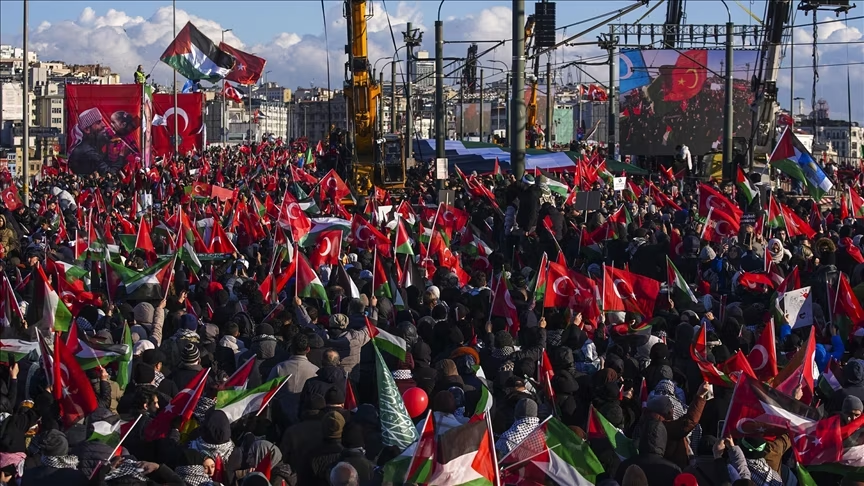
Conclusion of a massive march in Istanbul supporting Palestine with participation of over half a million people

The popular march on the Galata Bridge in Istanbul in support of Palestine concluded, with participation of more than 500 thousand people.

The march started Thursday morning, organized by "Humanity Alliance" and "National Will Platform", with participation of more than 400 civil society associations and organizations, and sponsorship of "Turkish Youth Foundation" under the slogan "We will not submit, we will not be silent, and we will not forget Palestine", to demand stopping the Israeli massacres in Palestine.

Some participants arrived at the event site on foot or by boats, after closing the roads leading to the bridge to traffic, while ships anchored around the bridge were decorated with Turkish and Palestinian flags.

The event witnessed the raising of a large banner with the phrase in Turkish and English "Justice for Gaza", alongside the flags of Turkey and Palestine, while another banner was hung on the side of the bridge bearing the phrase "Long live Palestine".

The participants chanted anti-Israel slogans, said Allahu Akbar, and raised flags of Turkey, Palestine, and the self-governing region of East Turkestan in China.

Artists participated in the event by performing hymns and songs that the audience interacted with, while a large number of local and international media followed the event.

The event witnessed participation of several ministers, officials, parliament deputies, heads of civil organizations, and political figures.

It also witnessed wide attendance from the Turkish sports community, including Minister of Youth and Sports Osman Aşkın Bak, presidents of the Wrestling Federation Taha Akgül, Karate Federation Arjoment Taşdemir, and Beşiktaş Club Serdal Adalı.

Alongside members of the Fenerbahçe Club board, Abdullah Kavakcı deputy president of Galatasaray, the technical director of the football team in Galatasaray Okan Buruk, the international wrestler Rıza Kayaalp, in addition to officials and athletes from various federations and clubs.

The number of participants in the event reached 520 thousand people, as it ended after delivering several speeches and reciting prayers for the martyrs and the Palestinian people.

PALESTINE

Thu 01 Jan 2026 1:56 pm - Jerusalem Time

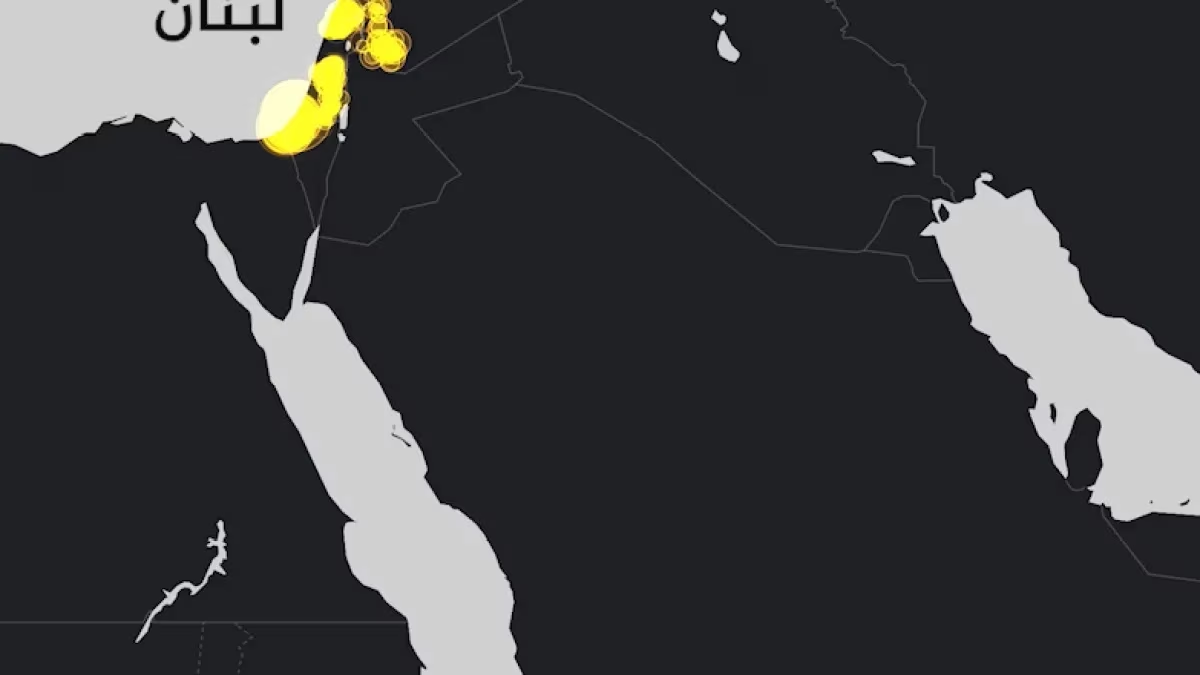
Israel attacked six countries and 10,631 times in 2025

In 2025, Israel attacked six countries: Palestine, Iran, Lebanon, Qatar, Syria, and Yemen.

It also carried out strikes in the territorial waters of Tunisia, Malta, and Greece on aid fleets heading to Gaza.

According to the Armed Conflict Location & Event Data Project (ACLED), an independent conflict monitoring organization, Israel carried out at least 10,631 attacks between January 1 and December 5, making it one of the most geographically extensive military operations in a single year.

ACLED collects and records reported information on political violence, demonstrations, and other politically significant non-violent events from local, national, and international news sources and international bodies.

To map Israeli attacks during this year, violent events such as airstrikes, drone attacks, shelling and missile attacks, remote explosives, and other armed attacks were filtered.

These events include violent attacks by Israeli forces; however, they exclude the significant increase in attacks by Israeli settlers against Palestinians in the occupied West Bank. In addition, they do not include other Israeli attacks, such as house demolitions and nightly raids that occur daily.

Gaza remains the bloodiest area, where Israel killed more than 25,000 people this year and injured at least 62,000.

Israel violated the ceasefire in Gaza that came into effect at noon on October 10, 2025, hundreds of times, resulting in the deaths of at least 400 Palestinians and the injury of 1,100.

Israel also violated the first ceasefire earlier in 2025, which ultimately led to its end.

According to ACLED, in 2025, until December 5, 2025, Israel attacked:

These statistics are based on confirmed reports, and are likely to be lower than the actual number of attacks due to reporting gaps in conflict areas.

Throughout the year, Israel launched at least 8,332 attacks on Palestine, averaging 25 attacks per day.

This includes at least 7,024 attacks on Gaza and 1,308 on the occupied West Bank.

Despite the previous ceasefire that began on January 19, which Israel also violated on March 18, it continued attacks on Gaza, including those seeking food aid.

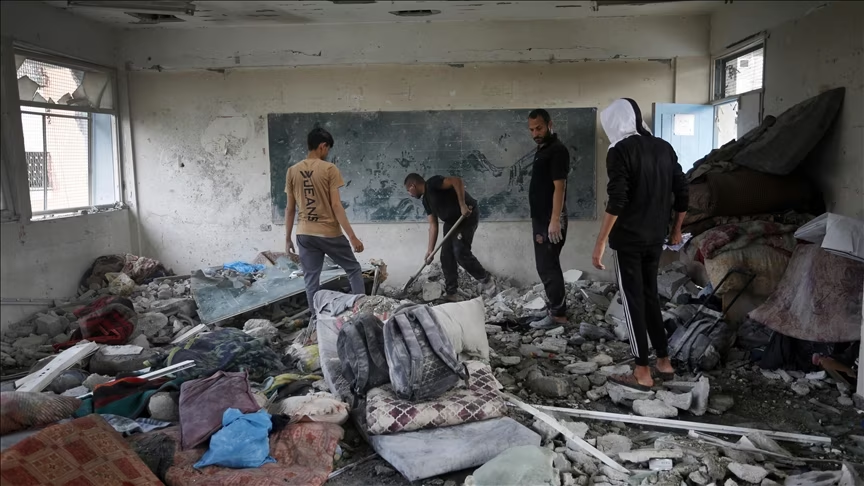
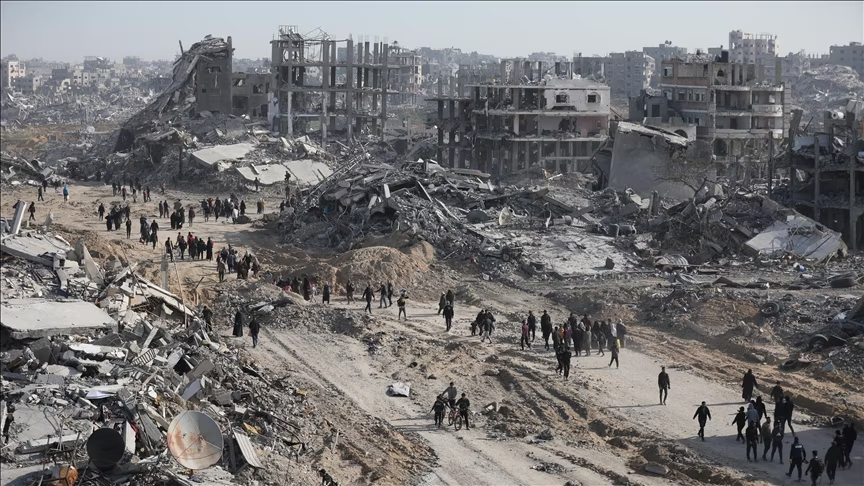
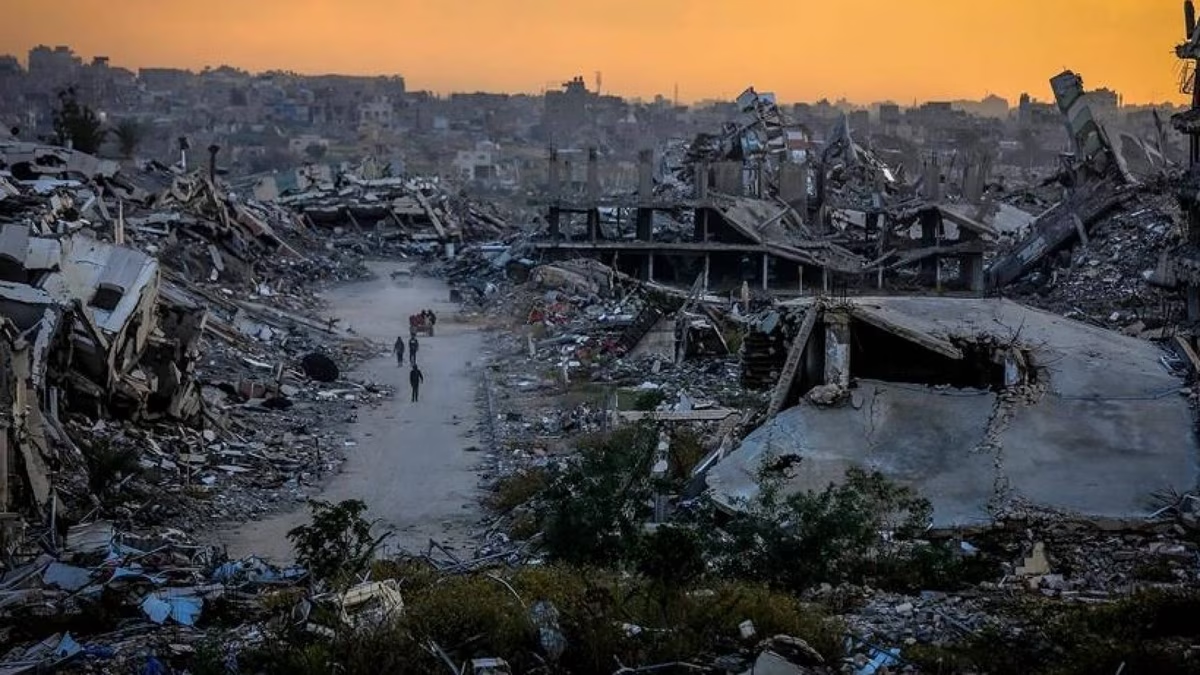
Israel turned Gaza into rubble and forced nearly two million people to flee. Satellite images from March 18 to May 22 show an area in Gaza City crowded with thousands of displaced people.

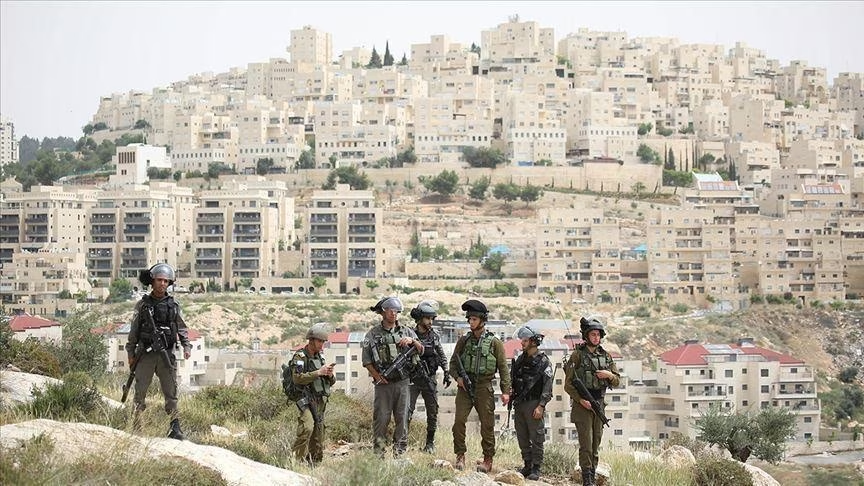
Israel also intensified its attacks on the West Bank, launching the largest military operation in decades in an attempt to suppress resistance and tighten control in areas including Jenin, Tulkarm, and their refugee camps.

In addition, despite not being included in the statistics, settler violence incidents escalated this year.

In 2025, the Office for the Coordination of Humanitarian Affairs (OCHA) documented a record number of 1,680 settler attacks on more than 270 communities, averaging five attacks per day.

Despite the ceasefire with Hezbollah, Israel launched more than 1,653 attacks on Lebanon this year, at a rate approaching five attacks per day.

Even after the ceasefire began in November 2024, Israel carried out repeated strikes, primarily focused in southern Lebanon but extending to the Bekaa Valley and the suburbs of the capital Beirut.

The Israeli army continues to deploy soldiers on five hilltops in southern Lebanon despite the official commitment to withdraw from the area.

On June 13, Israel launched a wave of strikes using 200 aircraft, targeting dozens of nuclear, military, and infrastructure sites in Iran, including the main nuclear facility in Natanz.

During the 12-day conflict, Israel also attacked residential neighborhoods and killed many nuclear scientists and military leaders.

On June 22, the United States joined the attacks and bombed three nuclear facilities in Fordo, Natanz, and Isfahan.

Iran responded by launching hundreds of ballistic missiles at Israeli cities.

According to ACLED statistics, Israel launched at least 379 attacks on 28 out of 31 provinces in Iran using airstrikes or drones during that period.

Over the past year, Israel launched more than 200 attacks on Syria, most concentrated in southern provinces such as Quneitra, Daraa, and Damascus.

Israeli airstrikes escalated last year; Syria has been subject to Israeli aggressions for years, justifying its actions by claiming to eliminate Iranian military facilities.

Since the fall of the Assad regime in December 2024, Israel claims it is trying to prevent weapons from falling into the hands of "extremists" - a term it applies to a changing list of groups, including Hayat Tahrir al-Sham; the main Syrian group that led the overthrow of Bashar al-Assad's regime.

On July 16, Israel struck the headquarters of the Syrian Ministry of Defense and the vicinity of the presidential palace in the capital Damascus, leading to a dramatic escalation on another military front in the region. The damage from the attack can be seen in this before/after image.

According to ACLED, Israel launched at least 48 attacks on the Ansar Allah Houthi group over the past year in Yemen, which is about 1,200 kilometers (750 miles) away.

On August 28, 2025, Israeli airstrikes targeted a government meeting of the Houthis in the capital Sana'a, resulting in the death of the Houthi Prime Minister Ahmed al-Rahawi and many other senior officials.

Israel also targeted infrastructure controlled by the Houthis in Yemen, including Sana'a International Airport, Hodeidah Port, and many power stations.

On May 6, 2025, the United States and the Houthis agreed to halt mutual attacks. However, this did not include halting operations against Israel, which the Houthis were attacking with drones and missiles in solidarity with Palestinians in Gaza.

On September 9, Israel targeted the Qatari capital, Doha, during a meeting of Hamas leadership to discuss the proposed ceasefire in Gaza by the United States.

The attack occurred in the West Bay area in Doha, which includes many embassies, schools, supermarkets, and residential complexes inhabited by Qataris and foreign residents in Doha.

Six people were killed in the strike, including the son of prominent Hamas leader Khalil al-Hayya, the director of al-Hayya's office, three of his personal guards, and a Qatari security officer. However, it is rumored that prominent movement leaders survived the attack.

Following Israel's attack, US President Donald Trump signed an executive order granting Qatar an explicit security guarantee in the event of an "external attack".

In 2025, several international freedom fleets sailed towards Gaza to provide aid to those besieged there and challenge Israel's illegal blockade on the sector.

While preparing to sail towards Gaza on May 2,

ISRAELI AFFAIRS

Thu 01 Jan 2026 1:54 pm - Jerusalem Time

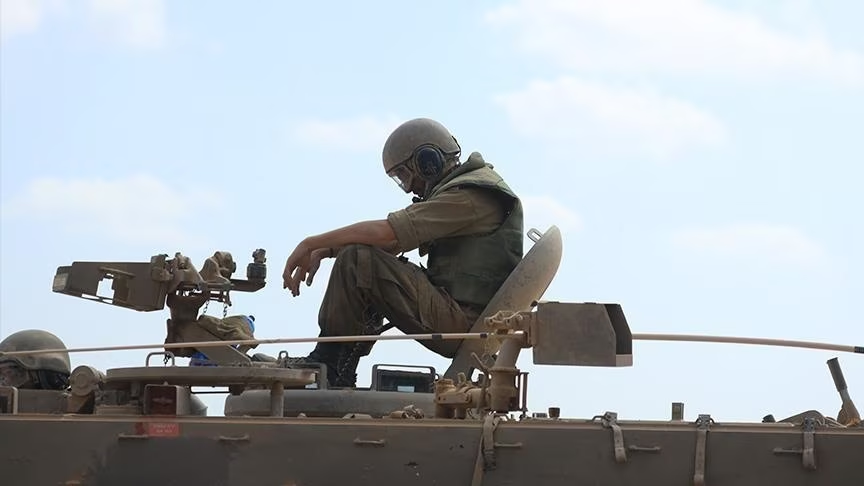
Suicide of 22 Israeli Soldiers in 2025, the Highest in 15 Years

Hebrew media reported on Thursday the suicide of an Israeli soldier, raising the number of military personnel who committed suicide in 2025 to 22, the highest in 15 years.
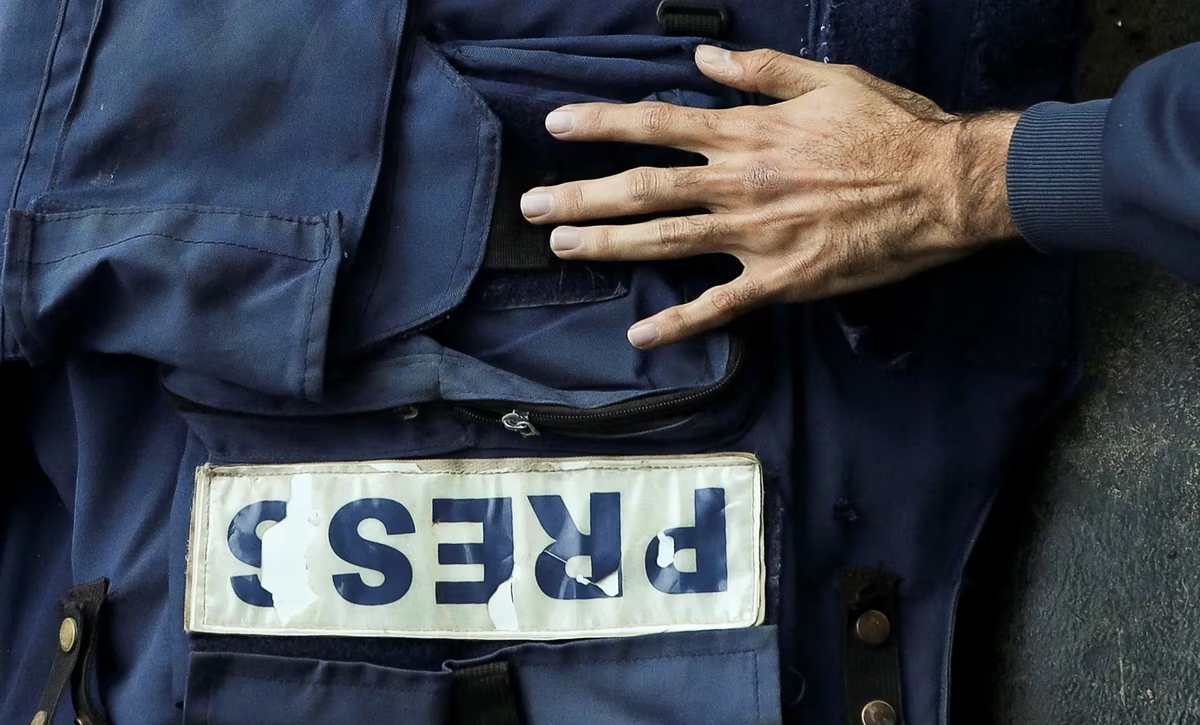
A Hebrew newspaper reported on Thursday that "a soldier from the combat engineering corps in the army committed suicide south of Israel on Wednesday, becoming the 22nd soldier in active service to commit suicide in 2025".

It added: "The number of suicides in the Israeli army in 2025 reached its highest level in 15 years, and was only surpassed by the number of suicides in 2010, where 28 soldiers committed suicide".

The newspaper noted that "according to Israeli army data, 12 of the soldiers who committed suicide in 2025 were regular conscripts, 9 were reservists, and one was a professional soldier".

It said that "the data also shows that 14 suicide cases occurred outside Israeli army bases, and 8 inside them".

The newspaper added: "5 of the soldiers were known to mental health officers and were receiving treatment, including a high-level drone operator who ended his life after testifying that he could no longer bear the effects of combat".

Israeli military personnel usually suffer from severe psychological disorders after participating in genocide crimes in Gaza, where about 2.4 million Palestinians live.

With American support, the Israeli genocide in Gaza has left more than 71,000 Palestinian dead and 171,000 injured, mostly children and women, and massive destruction, with the United States estimating the cost of reconstruction at about 70 billion dollars.

Since October 10, a ceasefire agreement has prevailed between "Hamas" and Israel, which the latter violates daily, resulting in the killing of 418 and injuring 1,141 Palestinians, according to the government media office in the sector.

OPINIONS

Thu 01 Jan 2026 11:46 am - Jerusalem Time

Feeling of Helplessness Despite Apparent Strength: Israel Between Military Stability and Existential Threats

Dr. Ibrahim Na'irat

Dr. Ibrahim Na'irat

Opinion Writer

Despite the immense military and economic power that Israel possesses, the feeling of helplessness remains present in the minds of Israeli leaders and citizens alike. Israel, which was founded on the idea of a "Jewish national homeland," faces an existential dilemma that cannot be ignored. While it continues to build strong alliances and military superiority in the region, it still finds itself stuck in an ongoing conflict on multiple fronts, making the feeling of helplessness despite its apparent strength an undeniable reality.

Israel is not just a modern state established in the 20th century, but an entity that emerged amidst a continuous struggle over its legitimacy in the heart of a volatile region. The Israeli state, despite its great military success and obtaining international recognition, always feels existential threats stemming from the foundation upon which it was built. Israel established itself on religious and historical grounds, through claiming ancient biblical rights in a land that was inhabited by another people, the Palestinian people. This reality, despite the apparent strength, leaves Israel in a constant defensive position, where there remains a deep feeling in the collective Palestinian and Arab consciousness that Israel should not exist.

One of the biggest dilemmas facing Israel is the continuation of the conflict with the Palestinians. Despite all the military and political gains, the Israeli-Palestinian conflict remains unresolved, which reinforces the feeling of helplessness. Israel fails to find a final peaceful settlement, and violence and military escalation remain part of the daily equation. This conflict not only poses a security threat but also undermines Israel's credibility on the international stage and increases its political isolation. The conflict with the Palestinians also reflects the internal division within Israeli society, which ranges between those who advocate for peaceful solutions and political concessions, and those who demand military expansion and occupation. This division complicates Israel's political image, making it appear as if it is stuck between its military power and its desire to achieve lasting peace.

Israel, despite its military strength, faces demographic challenges that may threaten its long-term stability. With the increasing number of Palestinians in the occupied territories, whether in the West Bank or Gaza Strip, Israel feels threatened by a shift in the demographic balance in favor of the Palestinian Arabs. This demographic threat could lead to the erosion of Israel's "Jewish identity," and enhance the feeling of helplessness in the state's ability to maintain a stable internal balance in the future.

Israel may militarily surpass its neighbors in the region, but it fully realizes that military power does not guarantee political or psychological stability. Repeated military operations against Palestinians or neighboring countries may lead to increased international hostility and political isolation, deepening the feeling of internal instability. Those operations may be beneficial in the short term, but they leave negative long-term effects, where anti-Israel sentiments increase and tensions within Israeli society itself intensify.

Despite the strong alliances that link Israel to major powers, such as the United States, it is not free from continuous international pressure due to its practices in the Palestinian territories. The ongoing settlement expansion in the West Bank and the blockade on Gaza expose it to widespread criticism from the international community. Even if Israel enjoys support from some major powers, that support does not necessarily mean the absence of pressure on its policies, especially with the growing international awareness of human rights issues in the occupied territories.

Within Israel, there is a continuous struggle over its national identity and the nature of its domestic and foreign policies. This struggle includes not only disagreements between the left and right, but also tensions between Jews and Arabs within Israel itself. Palestinians in Israel, who make up about 20% of the population, suffer from discrimination and inequality, which increases internal tensions. This struggle contributes to reinforcing the feeling of helplessness in Israel, as it faces challenges in building a unified and stable internal society, despite its military strength.

Despite all these challenges, it can be said that Israel is seeking solutions in the wrong places. While it continues to strengthen its military power and international alliances, it does not seem to realize that the solution lies in reconciliation with the Palestinian people. This solution, which may seem simple on the surface, represents the essential point that could lead to radical transformations in Israel's future. Looking at Palestinians as an inescapable reality, and recognizing their right to live in peace and dignity, is the solution that can make a real difference. Military power and strategic alliances cannot resolve a long-standing conflict, while recognition of Palestinians and Israel's pursuit of peaceful coexistence with them could form a weapon stronger than any military force, ensuring long-term stability and legitimacy on the international stage.

Interestingly, many local and international political forces, even in the United States, believe that this vision is the safest for Israel. This belief does not necessarily stem from love for Palestinians or recognition of their rights alone, but from the conviction that a fair and sustainable solution with Palestinians is the greatest guarantee for Israel's long-term stability. Because continuing military policies and settlement expansion may lead to escalation of internal and external crises, reconciliation with Palestinians may represent the safest option not only for justice, but also for preserving Israel's security and ensuring its continuity as a safe and stable state.

In my personal opinion, the scales tip in favor of the Palestinians, a matter that Israelis are well aware of. If Israelis reach conviction in this reality, it could represent a fundamental turning point in the conflict. The existence of a true balance of power between the two sides could open the way to finding common ground leading to permanent solutions. From this perspective, reconciliation and mutual recognition could be the first step towards creating a new reality in the region, transcending the logic of military power and occupation, and ultimately achieving the interest of everyone.

In the end, perhaps the solution for Israel lies in its ability to politically adapt to changes in the region, and strive for a fair political solution that ensures the rights of Palestinians and Israelis alike. In a contemporary world striving for justice and peace, military power alone is not enough to maintain permanent stability, but it requires political settlements that put an end to a long-standing conflict.


PALESTINE

Thu 01 Jan 2026 1:56 am - Jerusalem Time

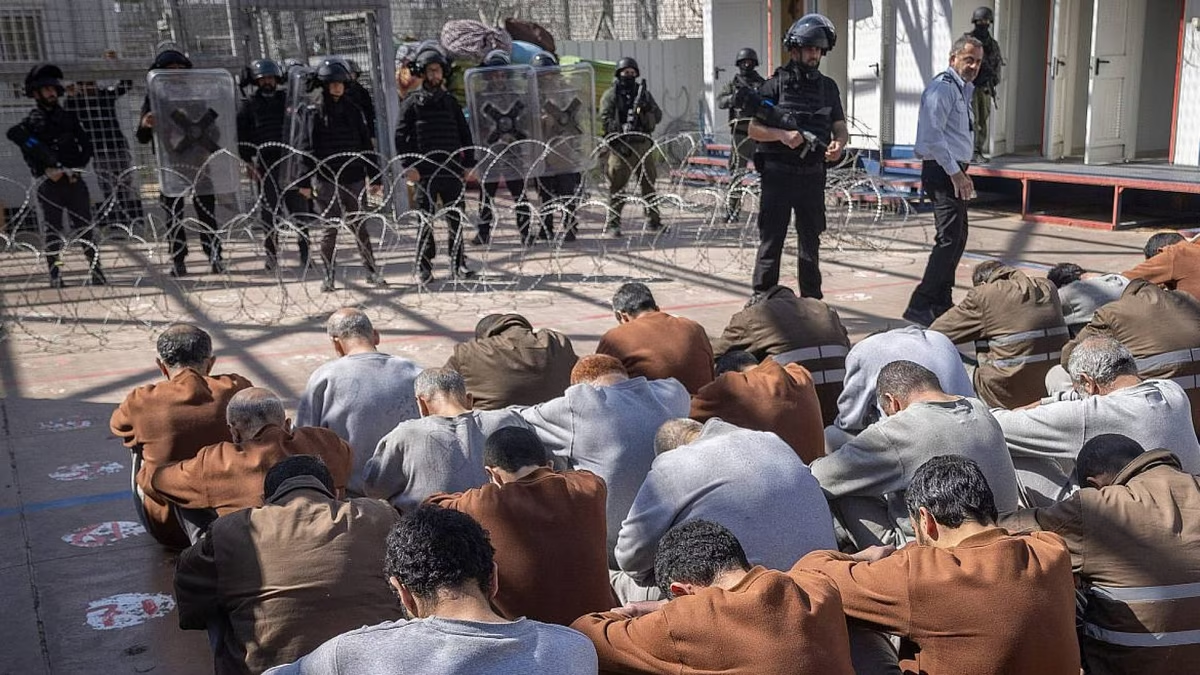
Israeli reports reveal deprivation of Palestinian prisoners from water as "collective punishment" during the war on Gaza

The documents were based on 3 field visits conducted by representatives of the military prosecution to the "Ktzi'ot" prison.

Official reports prepared by the military prosecution of the Israeli occupation revealed serious violations against Palestinian prisoners, consisting of depriving them of regular access to drinking water for long hours, described by the reports as "collective punishment" imposed during the war period.

The Ministry of Justice of the Israeli occupation handed over six reports to the Association for Civil Rights, after a judicial petition forced the state to publish them after it had refrained from doing so under the pretext of protecting "national security".

These documents were based on three field visits conducted by representatives of the military prosecution to the "Ktzi'ot" prison in the Negev during the months of May, June, and September 2024.

One of the reports confirmed that the results of the first two visits showed the imposition of a policy that prevents providing continuous drinking water during part of the day.

The prosecution conveyed from the prisoners' testimonies that the water ban was sometimes implemented as part of collective punishment, and in other sections it was adopted as a fixed measure for about half of the day's hours, despite the reduction of this policy before the September visit.

In contrast, the Israeli Prison Service denied these allegations in an official statement, claiming that the apparatus operates according to the law and provides basic needs for all detainees.

However, this information comes in the context of a broad tightening of detention conditions since October 7, 2023, where previous reports acknowledged cases of severe hunger leading to significant weight loss and fainting among prisoners, in addition to suffocating overcrowding where 90% of prisoners are held in spaces less than 3 square meters, with thousands deprived of beds and increasing complaints of violence.

On a related level, Palestinian human rights institutions monitored a dangerous escalation in violations during 2025, recording nearly 7,000 arrest cases, and the killing of 32 Palestinian prisoners inside prisons in the same year.

The institutions indicated that the total number of martyrs of the prisoner movement since the start of the war reached 100 prisoners, most of whom died as a result of systematic torture and medical neglect, despite the decision of the Israeli High Court in September last year that obligated the state to correct living conditions, which has not been achieved on the ground according to subsequent reports.

PALESTINE

Thu 01 Jan 2026 1:32 am - Jerusalem Time

Chief of Staff of the Occupation Army: 2026 is decisive for disarming Hamas

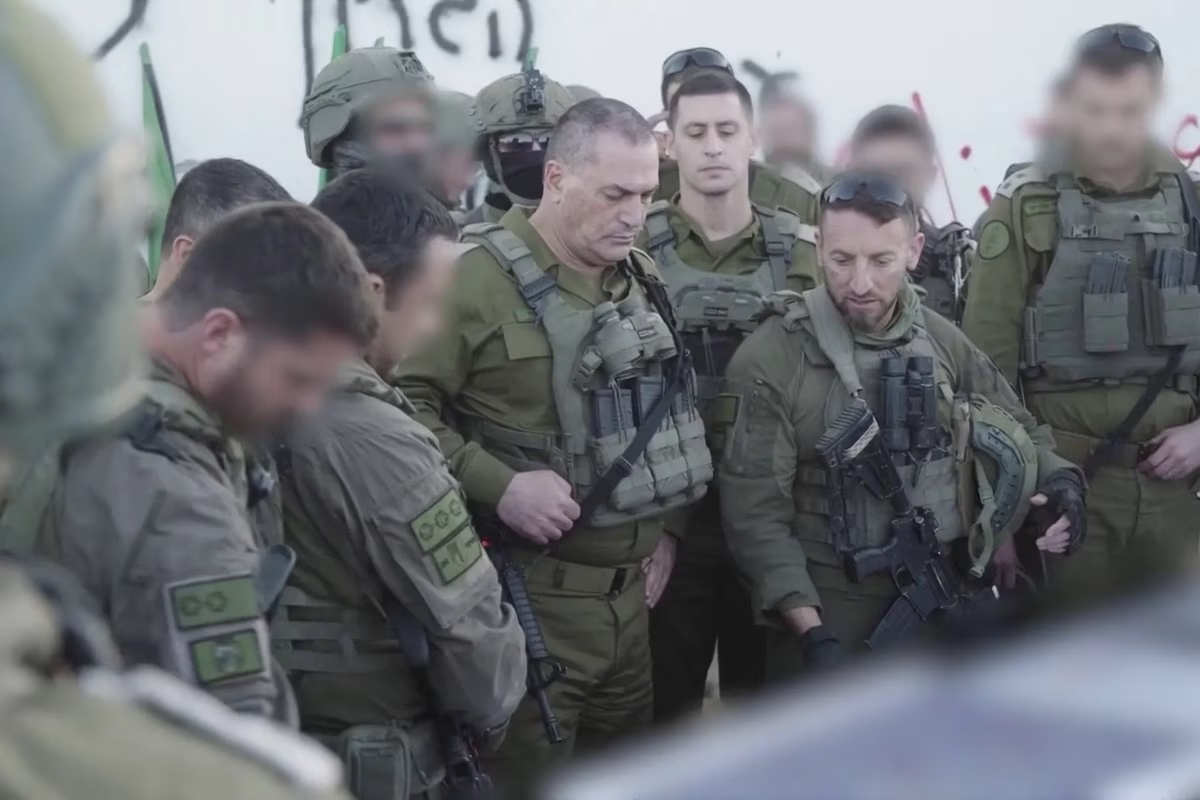
The Chief of Staff of the Israeli Occupation Army, Eyal Zamir, said that 2026 will be decisive regarding shaping Israel's security reality, and that he is determined to disarm the Palestinian Hamas movement.

He added that the army carried out offensive operations in response to Hamas's breach of the agreement in the Gaza Strip, according to his expression, and during a field tour he conducted on Wednesday in the south of the sector, he stated that the army is present on the yellow line overlooking the sector, which constitutes new security borders, and is considered a reinforced defensive line and a military base for executing rapid attacks.

Zamir confirmed "We are fully determined to disarm Hamas and the rest of the terrorist organizations. We will not allow the terrorist Hamas movement to rebuild its capabilities and threaten us".

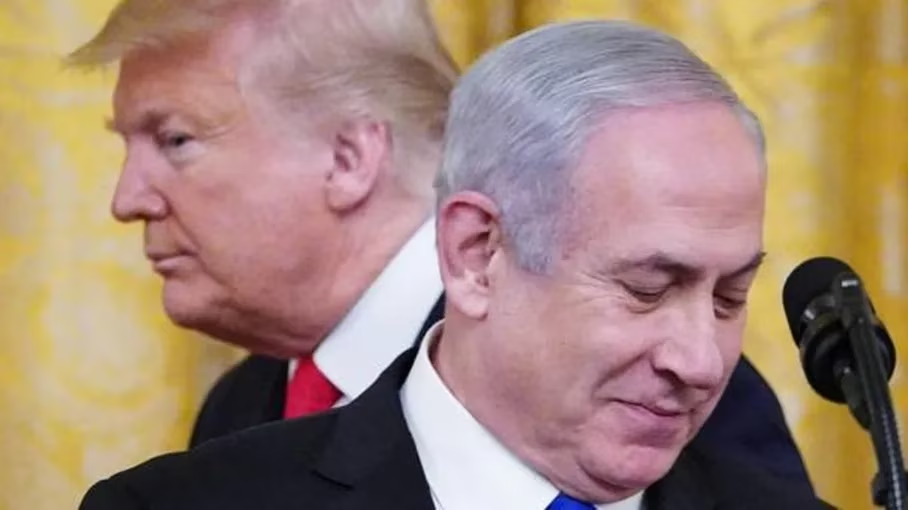
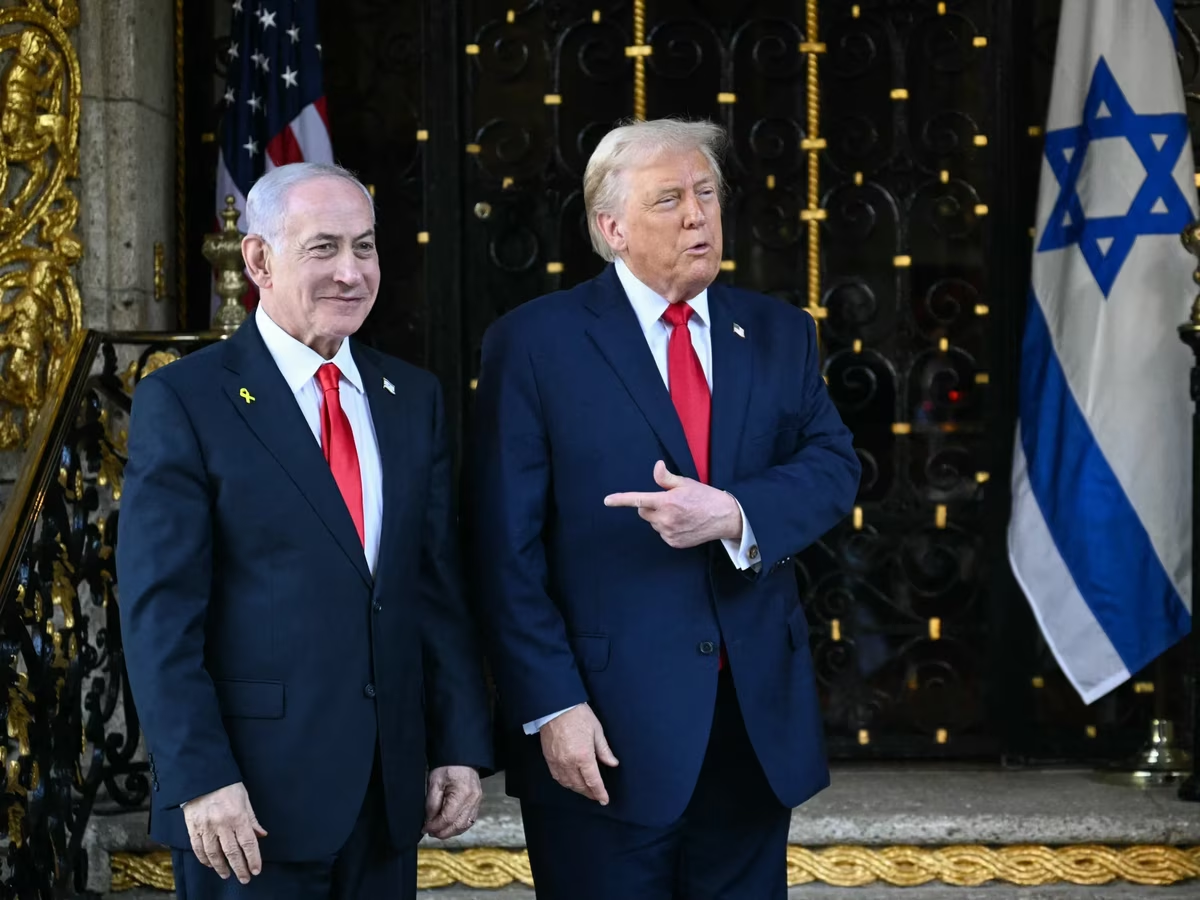
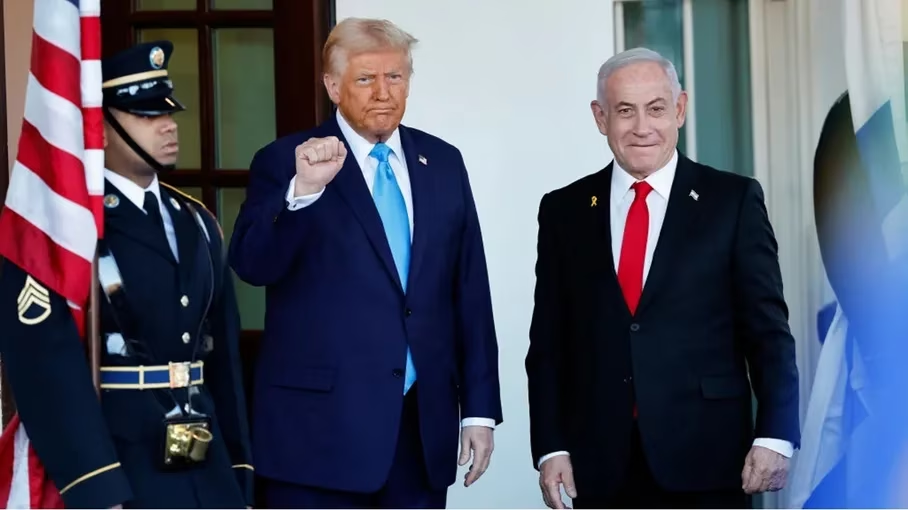
Zamir's statements come a few days after Israeli Prime Minister Benjamin Netanyahu - wanted by the International Criminal Court on charges of committing war crimes in Gaza - raised this issue during his meeting with US President Donald Trump in Florida.

Sources reported that the United States and Israel have set a final deadline of two months to dismantle Hamas's weapons, during the meeting that brought Netanyahu together with Trump.

It added that it was also agreed that disarming Hamas includes destroying the tunnels.

The sources said that if Hamas's weapons are not disarmed, the ball will return to Israel and the army.

American officials were quoted as saying that Washington plans to begin rebuilding Gaza within weeks, while it is expected that the process of disarming Hamas will take much longer.

An American official and an informed source were quoted as saying that Netanyahu agreed to proceed with the second phase of the Gaza agreement, despite differences with Trump's team regarding its implementation.

Trump had expressed his hope to quickly reach the second phase of the agreement, and said after his meeting with Netanyahu that Hamas will be given a short period to relinquish its weapons, and if it does not relinquish its weapons, it will pay a heavy price.

PALESTINE

Thu 01 Jan 2026 1:32 am - Jerusalem Time

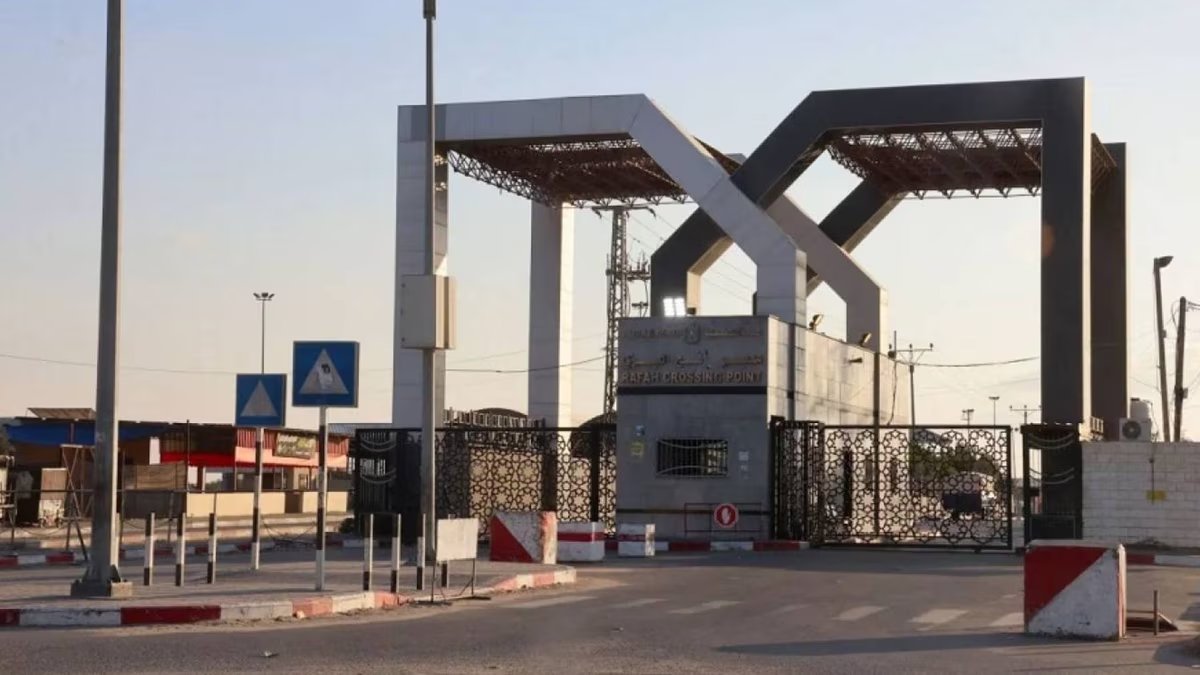
Israel Prepares to Open Rafah Crossing According to Netanyahu and Trump Agreement

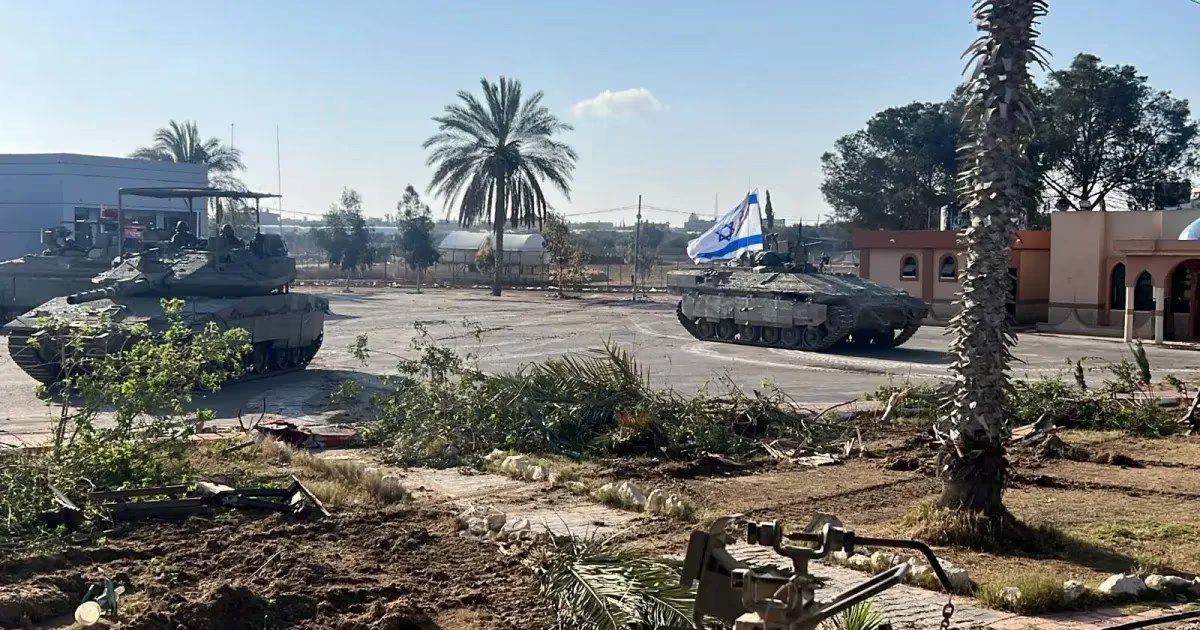
Israeli sources said that the relevant authorities in Israel have begun preparations to open the Rafah crossing according to an agreement between Israeli Prime Minister Benjamin Netanyahu and US President Donald Trump, which stipulates opening the crossing from both sides following Netanyahu's return from Washington.

Israeli Broadcasting Corporation reported that American pressure to open the crossing continued in recent days, noting that the official announcement of its opening may be issued in the coming days.

It clarified that this step was planned as part of the first phase of the ceasefire agreement signed in October 2025, but it was postponed due to Israel's non-compliance at the time.

Israeli sources previously clarified that Netanyahu and Trump agreed during their meeting in Florida to open the crossing as part of a meeting that addressed issues in the Gaza Strip, West Bank, Syria, Lebanon, and Iran.

The website had reported, citing officials, that Netanyahu agreed during his meeting with Trump to move to the second phase of the ceasefire agreement in Gaza, which includes disarming Hamas, while Trump pledged to allow Israel to take military action if the movement "fails to comply with the agreement".

Since May 2024, Israel has occupied the Palestinian side of the Rafah crossing, after destroying its buildings and preventing travel, causing a severe humanitarian crisis, especially for patients, particularly amid the genocide war it waged on the sector over two years.

For his part, Israeli Chief of Staff Eyal Zamir said during a tour in the Gaza Strip that his army is currently positioned on the "yellow line" which he considered new security borders and a base for launching rapid offensive operations, emphasizing that Israel "will not allow Hamas to rebuild its military capabilities".

PALESTINE

Thu 01 Jan 2026 12:54 am - Jerusalem Time

Israeli assessment: Collapse of the Palestinian deportation plan due to Trump's retreat and their insistence on staying

After the Israeli admission that plans to relocate the population of the Gaza Strip to other countries have been frozen due to international rejection, and after US President Donald Trump himself withdrew from them, the peace plan he proposed actually talks about encouraging them to stay. Shalom Yerushalmi, the political analyst for the Zman Israel website, mentioned that "the voluntary migration plan for the residents of the Gaza Strip, which resonated widely in the occupying state and around the world since the beginning of the war, is fading, and it acknowledges that the plan, which Prime Minister Benjamin Netanyahu described in the Knesset as a 'post-war plan,' has been frozen, and all senior officials who dealt with it now acknowledge that it is not feasible, and the 'voluntary resettlement administration' announced by Defense Minister Yoav Gallant still exists on paper, but it is clear to everyone that it is ineffective, and will be closed sooner or later." He added in an article translated by "Arabi21" that "the main reasons for the plan's failure lie in Trump's gradual retreat from the idea he proposed in February, and at the same time, the world's refusal to absorb Palestinians coming from Gaza, and to this day, Indonesia is the only country willing to host them, and some say it will host all of them." He quoted a high-ranking Israeli political source as saying that "this matter is contingent on the compensations that the United States will provide, as the Indonesians are ready for a deal at a symbolic cost, and everything is still dependent on Trump, who seriously proposed the idea of voluntary migration, and it is clear that it also depends on the desire of Gaza residents to migrate." He pointed out that "the issue of encouraging the voluntary migration of Gaza residents was a winning political card at the beginning of the war on it, and Netanyahu spoke about it in the Likud bloc, and Minister Gila Gamliel wrote an action plan, then distributed video clips depicting life in Gaza after this mass migration, and Israel tried, through the Foreign Ministry and the Mossad, to find migration destinations, and conducted talks with developing countries in Africa to absorb Gaza residents, but countries like Congo, Somalia, Rwanda, Ethiopia, and others rejected the offers, and to this day, efforts continue with various countries without tangible results." The same high-ranking political source confirmed that "most Palestinians in Gaza want to leave the Strip, but to Western countries and Australia, not to Africa, where 2.1 million Palestinians live today, and the Netanyahu government claims that a third of them still support Hamas, a third support Fatah, and the rest are neutral, and their options for leaving the Strip are also limited, after Egypt announced its categorical refusal to allow large numbers of them to leave the Strip through the Rafah crossing." He explained that "Trump, who officially announced the idea of voluntary migration during Netanyahu's visit to Washington in February, retreated from it after receiving sharp criticism from the world, even from his close associates, because the plan was interpreted internationally as forced deportation, not migration, and in the meantime, the war ended, and Trump's 20-point plan for a peace agreement in Gaza talks about smart cities and economic reconstruction along the Strip, but it does not address migration; on the contrary, Gaza residents will be able to leave in exchange for economic benefits and return to Gaza whenever they want, after its reconstruction." He concluded by saying that "Article 12 of Trump's plan stipulates that no one will be forced to leave Gaza, but those who choose to leave will be allowed to return, in addition to that, the focus will be on encouraging Gaza residents to stay in the Strip, and giving them the opportunity to build a better future there, although Israel does not really believe in this utopia, nor in the full implementation of the 20-point plan, which includes disarming Hamas through international stabilization forces that Trump wants to send to the Strip as part of the second phase".

PALESTINE

Thu 01 Jan 2026 12:52 am - Jerusalem Time

The Israeli Army Killed 7903 Students and Educational Staff and Injured 11469 During 2025

Ramallah/ Awad Al-Rajoub/

The Palestinian Ministry of Education and Higher Education announced on Wednesday that the Israeli army killed 7,903 students and educational staff in schools and universities, and injured 11,469 others, during 2025.

This came in a statement issued by the ministry, documenting the toll of Israeli violations against educational institutions in the West Bank and Gaza Strip, from the beginning of the current year until December 31.

The ministry clarified that the toll of fatalities among school students reached 6,910, the majority in Gaza Strip, with 6,876 male and female students, in addition to 34 in the West Bank.

The number of injured school students during the same period reached 9,138, including 8,846 in Gaza, and 292 in the West Bank.

On the higher education front, Israel killed 578 university students (574 in Gaza and 4 in the West Bank), while injuring more than 1,419 others with varying injuries, and arrested 204 students in the West Bank.

The educational and academic staff were not spared from targeting, where the Israeli army killed 302 teachers and school administrators in Gaza and injured 658 others, and killed two, wounded 7, and arrested 30 others in the West Bank.

The death toll included 111 academics and workers in the sector's universities, in addition to injuring 247 others, while the ministry recorded the arrest of 18 academics from West Bank universities, and 120 students from its schools.

On October 8, 2023, Israel began a genocide in Gaza that lasted two years, with its victims' toll exceeding 71,000 killed and 171,000 injured Palestinians, alongside massive destruction that affected 90% of the civilian infrastructure, with reconstruction costs estimated by the United Nations at about 70 billion dollars.

Since the start of the genocide war in Gaza, the Israeli army and settlers in the West Bank, including East Jerusalem, killed more than 1,104 Palestinians, injured about 11,000, in addition to arresting more than 21,000.

ARAB AND WORLD

Thu 01 Jan 2026 12:36 am - Jerusalem Time

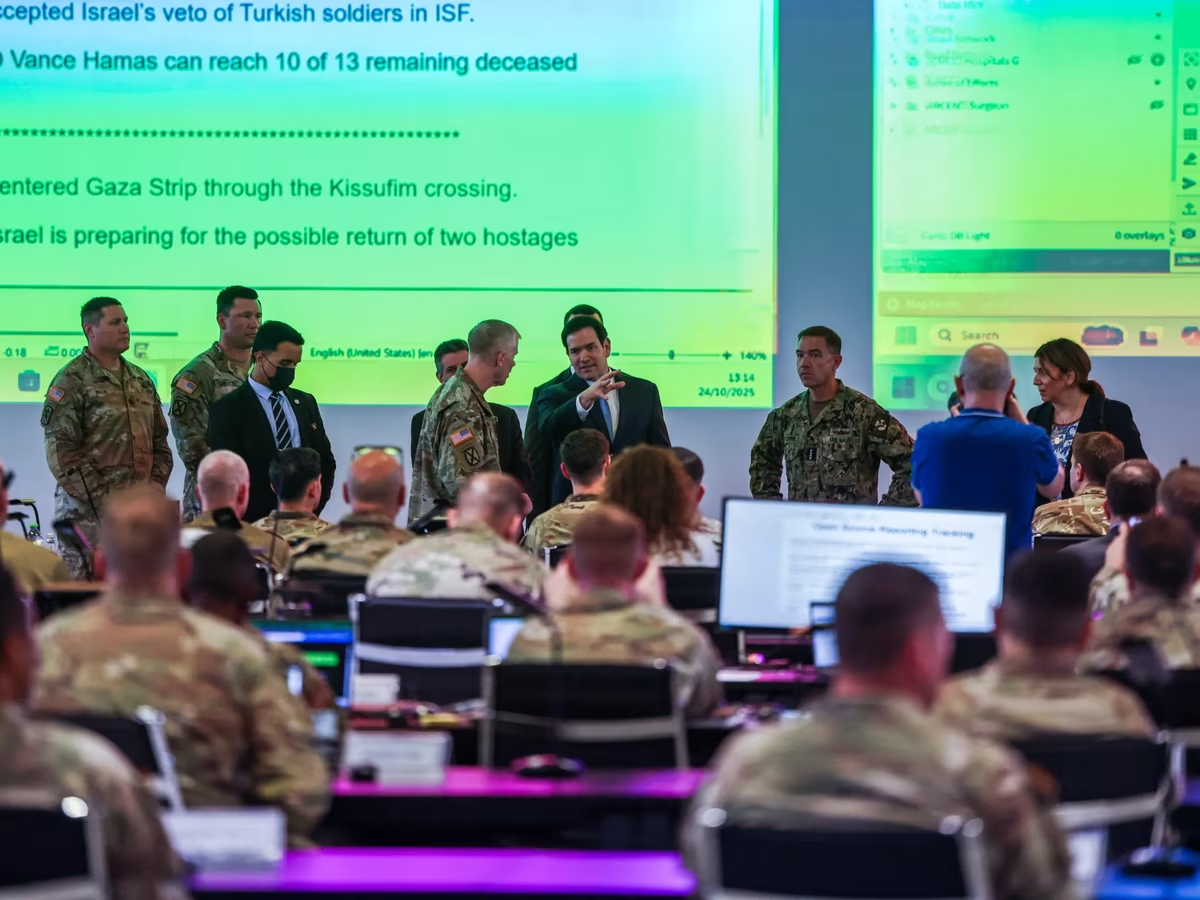
Protests between the Israeli army and American command in Kiryat Gat

An Israeli channel revealed on Wednesday evening that clashes were recorded between the Israeli army and officers at the headquarters of the American command in Kiryat Gat (south), near the Gaza Strip.

On October 21 last year, the US Central Command (CENTCOM) announced the opening in Israel of the Civil-Military Coordination Center, aimed at monitoring the implementation of the Sharm El-Sheikh agreement to cease fire in the Gaza Strip, which is part of a comprehensive plan proposed by US President Donald Trump to end the war in the sector.

CENTCOM stated in a statement at the time that the center was designed to support stabilization efforts and that US military forces would not be deployed inside the Gaza Strip, but would contribute to facilitating the flow of humanitarian, logistical, and security aid from international partners into the sector.

Recently, clashes were recorded between the Israeli army and officers from the American command, after Israel refused their request to hold a series of security discussions on operational and sensitive issues.

Quoted from unnamed senior Israeli officials: These are sensitive issues discussed since the beginning of the war. Israel does not need the United States to start discussing them.

The officials said that the American command headquarters sometimes interferes excessively in security issues that Israel handles independently and well, and its policy is clear on them, without further details.

However, at the beginning of December last year, a British newspaper reported that intelligence agencies in Israel carried out surveillance and eavesdropping operations on American forces and forces from allied countries within the Civil-Military Coordination Center in Kiryat Gat.

According to the newspaper, the volume of public and secret eavesdropping operations during discussions in the center prompted the commander of the American base, Patrick Frank, to summon a senior Israeli official and demand an immediate stop to the recordings.

In October last year, CENTCOM commander Brad Cooper said that the Civil-Military Coordination Center would oversee the implementation of the ceasefire agreement, through an operations room that allows the crew to assess developments in Gaza moment by moment, according to the same statement.

A stabilization force supported by the US, headquartered at the aforementioned center, is supposed to ensure security in the Gaza Strip, as part of US President Donald Trump's plan.

It is worth noting that on September 29 last year, Trump announced a peace plan and ceasefire in Gaza consisting of 20 points, including: the release of Israeli prisoners, ceasefire, disarmament of Hamas, Israeli withdrawal from the sector, formation of a technocratic government, and deployment of an international stabilization force.

On October 8, 2023, Israel began a genocide in Gaza that lasted two years, with casualties exceeding 71,000 martyrs and 171,000 injured Palestinians, alongside massive destruction affecting 90% of the civilian infrastructure, with reconstruction costs estimated by the United Nations at about 70 billion dollars.

PALESTINE

Wed 31 Dec 2025 10:44 pm - Jerusalem Time

UN Warning of Continued War in Gaza in Another Way Despite Ceasefire

The media advisor for the United Nations Relief and Works Agency for Palestine Refugees in the Near East (UNRWA), Adnan Abu Hasna, warned that the war in the Gaza Strip has continued in another way despite the ceasefire, through the ongoing humanitarian suffering, the spread of diseases, and the widespread destruction of infrastructure.

Abu Hasna confirmed that Gaza may return to square one if this situation continues, especially with the lack of dramatic improvement in conditions as expected after the ceasefire.

The UN official viewed that the statement issued by some European countries and Japan regarding the deteriorating humanitarian situation expresses the reality of what is happening on the ground in Gaza.

He pointed out that everyone expected a dramatic improvement after the ceasefire, but this did not happen at all; rather, the situation is extremely dangerous despite the partial cessation of direct bombing.

Abu Hasna highlighted that Israel will not be satisfied with preventing UNRWA from importing 6,000 trucks loaded with food and humanitarian materials, but will add dozens of international non-governmental organizations to the ban list.

He explained that these organizations are active in the relief and medical sectors, and their absence from the scene would exacerbate the situation and make it more dangerous.

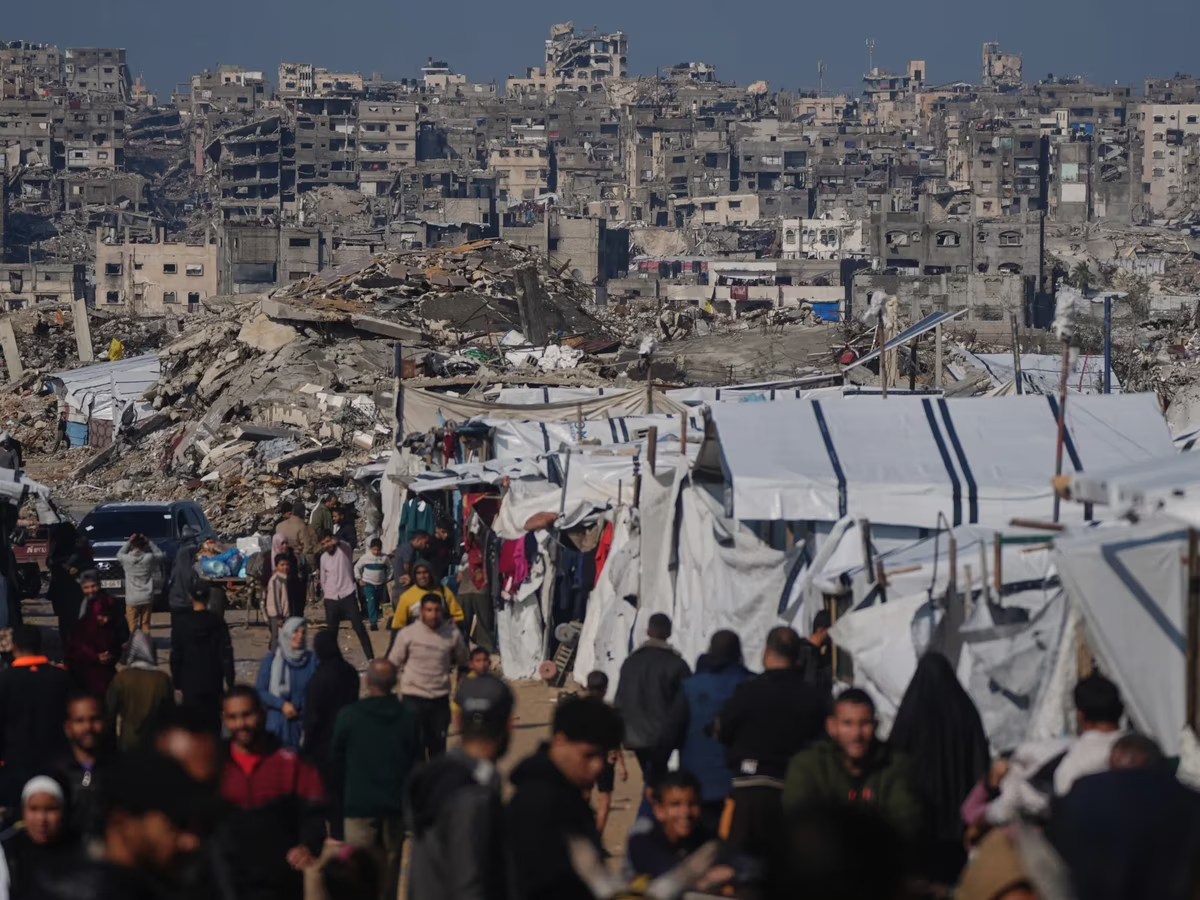
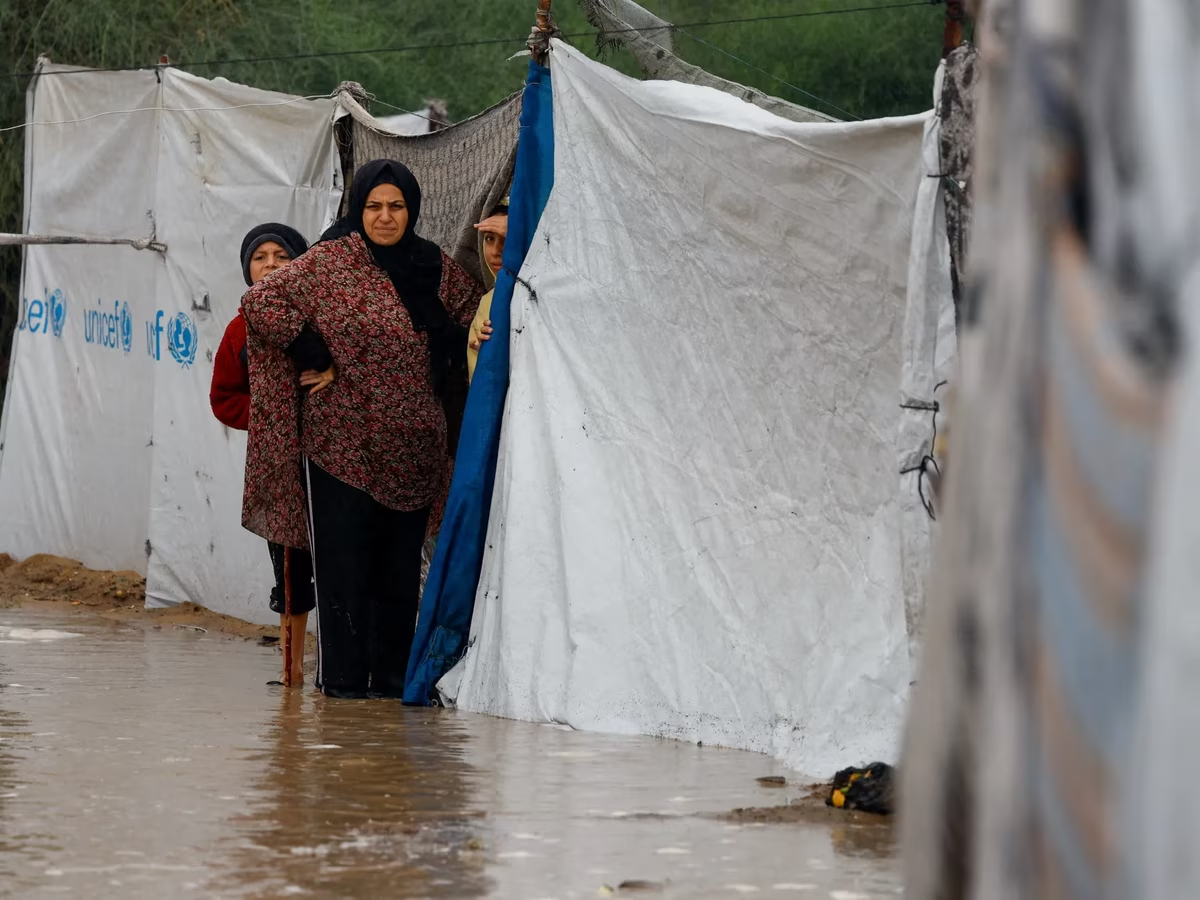
In a related context to the crisis of tents and shelter, the UN official raised a question about the reason for preventing the entry of hundreds of thousands of tents that UNRWA and others purchased for hundreds of millions of dollars and are standing at the gates of the sector, while Israel has only allowed the entry of tens of thousands of tents despite the actual need for hundreds of thousands of them.

On the health and environmental challenges, Abu Hasna pointed out that the issue during weather depressions is not just the rains, but the sewage water that mixes with the rains and floods the displacement camps.

This catastrophic situation leads to the spread of serious diseases in various areas of the sector, especially with the ongoing collapse of the health sector and the destruction of water and sewage systems.

The UNRWA media advisor emphasized that no place in the world without an organized health sector can face a humanitarian disaster of this magnitude, and considered the collapse of the health sector to make it almost impossible to deal with the escalating crisis, especially with the spread of diseases resulting from water pollution and poor sewage.

Regarding the new Israeli law, Abu Hasna explained that the European Commission for Humanitarian Aid announced the impossibility of implementing the law for registering non-governmental organizations in its current form.

This law requires lists of Palestinian employees for security checks, without knowing what happens in this process, where 80% to 90% of employees can be rejected for undisclosed reasons.

In the context of reactions from international organizations, the UN official explained that humanitarian organizations are wary of this issue because it will impose strict restrictions on their operations, and these organizations may find themselves without trained manpower capable of performing vital tasks, which means a complete paralysis of humanitarian work in the besieged sector.

Abu Hasna explained that UNRWA has contacted the Israeli side dozens of times through the regional and international United Nations system regarding the hundreds of thousands of detained tents, but there are no reasonable and clear responses so far.

He emphasized that these materials are not of dual use, and that Israel monitors them and knows how they are used, and that UNRWA is ready to provide detailed reports on the use of spare parts, medical devices, food materials, and tents, but there are no real responses to the systematic blockade that is happening.

PALESTINE

Wed 31 Dec 2025 10:24 pm - Jerusalem Time

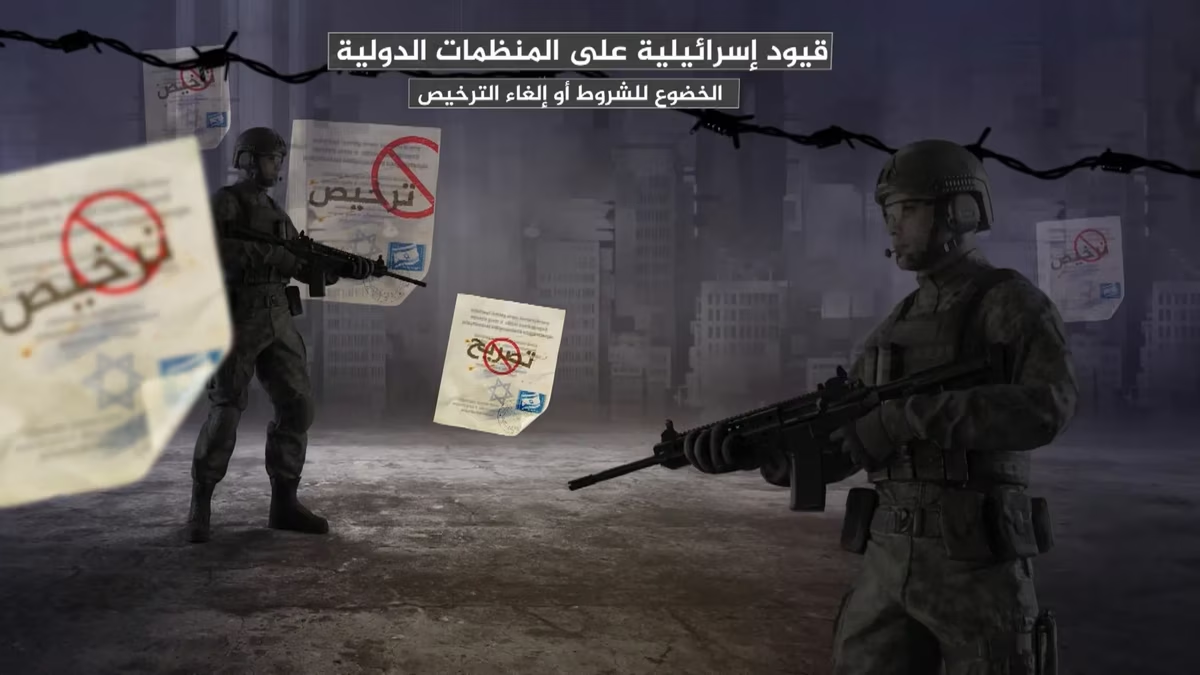
Israel Puts International Humanitarian Organizations Before Two Choices: Submit to Its Conditions or Cancel Their Licenses

Israel has begun a large-scale escalation targeting the work of dozens of international non-governmental humanitarian organizations operating in Jerusalem, the West Bank, and the Gaza Strip, after the Israeli government placed them before two choices with no third option:

Submit to new strict conditions and restrictions.

Cancel their licenses and prevent them from continuing their humanitarian activities in the occupied Palestinian territories.

The Israeli government has granted these organizations a time period extending until the end of 2025 to renew their work licenses, provided they comply with a package of new conditions, topped by submitting detailed lists of the names of Palestinian employees working for them, to subject them to what the Israeli authorities describe as "security screening".

These measures include verifying whether any of the Palestinian employees have advocated or participated in activities related to boycotting Israel, which humanitarian organizations considered a direct interference in the nature of their work and a transformation of humanitarian work into a security surveillance tool.

A group of international organizations has refused to comply with these conditions, expressing serious concerns that submitting Palestinian employees' data could expose them to security prosecution, posing a direct threat to their lives and the safety of their families, while at the same time undermining the fundamental principles of humanitarian work based on neutrality and independence.

These organizations considered that the new Israeli conditions are not limited to administrative aspects, but touch the core of humanitarian work, and impose security guardianship over institutions that are supposed to operate in accordance with international humanitarian law, away from political and security pressures.

Following the refusal of some organizations to these conditions, the Israeli government began taking practical steps to cancel their work licenses, justifying this by not completing the legal registration requirements according to the new rules.

According to human rights reports, these measures, despite appearing in an administrative and legal framework, represent in reality an existential threat to dozens of international non-governmental humanitarian organizations that have been working for decades in the Palestinian territories, contributing to improving the living conditions of Palestinians under occupation.

The reports warned that proceeding with the implementation of these decisions will lead to depriving hundreds of thousands of Palestinians, especially in the Gaza Strip, of basic humanitarian aid, including life-saving health services, at a time when the humanitarian situation is witnessing unprecedented deterioration.

PALESTINE

Wed 31 Dec 2025 9:58 pm - Jerusalem Time

Netanyahu succeeds in creating new complications for the Gaza agreement during his visit to Washington

Despite talk of Israeli Prime Minister Benjamin Netanyahu accepting the transition to the second phase of the Gaza agreement, he practically succeeded in creating new complications during his visit to the United States, analysts say these are mainly related to his election plans and his efforts to close files that must be closed before Donald Trump leaves the White House.

An American website reported from sources that Netanyahu -wanted by the International Criminal Court- agreed to move to the second phase of the Gaza agreement, with a US commitment to allow him military action if the Islamic Resistance Movement (Hamas) refuses to relinquish its weapons.

Channel 12 also reported from sources that Israeli authorities are preparing to open the Rafah border crossing with Egypt from both sides in implementation of the Trump-Netanyahu agreement.

However, this step and others are merely a solution to crises fabricated by Netanyahu and which he was obligated to in the agreement, so that his commitment to it becomes a kind of concession, as said by Dr. Laqaa Makki, senior researcher at a research center.

According to what Makki said in the program "Beyond the News," Netanyahu wanted to enter his election year crowned with American support for his person and behavior, which he actually obtained during his meeting with Trump.

The question, as Makki says, revolves around what Netanyahu got in return for making concessions in the Gaza file, in which he showed great rigidity since the agreement took effect, which indicates that what was revealed after the meeting is much more than what was actually discussed.

While the Israeli Prime Minister narrowed the gaps between him and Trump in several files, he succeeded in creating new complications for the Gaza agreement, in the view of Dr. Ibrahim Al-Madhoun, director of the Palestinian Media Foundation, who confirms that Hamas knows there are problems "bigger than those raised by the media."

These complications -in Al-Madhoun's view- lie in not answering the necessary questions related to the form of the committee that will administer the sector and the international force that will ensure stability in it, which places many obstacles in the way of implementing the agreement.

These complications stem from Netanyahu's desire to sabotage the agreement and the resistance's desire to implement it, while the United States is completely biased towards Israel and the mediators are unable to exert any pressure, according to Al-Madhoun.

However, what is being talked about in the Israeli media suggests that what came out of the statements contradicts what happened in the closed rooms between Netanyahu and Trump, as said by Dr. Adel Shadid, researcher on Israeli affairs.

Washington does not want to return to war despite Trump's statements about the possibility of allowing Israel to do so, and it has not been convinced by Netanyahu's position on Turkey's participation in the international force to be formed, in Shadid's view, who expected more escalation in Lebanon.

The talk in Israeli media also indicates Trump's rejection of opening the Rafah crossing unilaterally to displace the population, in response to the Egyptian position, which Shadid says appears firm on this issue to the extent that it prompted the Americans to rethink it.

Makki agreed with this talk by saying there will be no war again in Gaza, and that the real green light that Netanyahu obtained during the visit may be in Lebanon, because Hezbollah represents an urgent matter for Israel.

Makki concluded that there is a lot of harmony between the United States and Israel in most files, and that "Netanyahu achieved everything he wanted in Gaza while files such as relations with Turkey, Iran, Yemen, Iraq, and Lebanon still need to be closed before the end of Trump's rule, which represents an irreplaceable opportunity for Israel."

PALESTINE

Wed 31 Dec 2025 9:22 pm - Jerusalem Time

Hebrew media: Agreement between Netanyahu and Trump to reopen the Rafah crossing on both sides

The Hebrew Channel 12, citing informed sources, revealed that Israeli Prime Minister Benjamin Netanyahu and US President Donald Trump have reached an agreement to reopen the Rafah border crossing on both its Palestinian and Egyptian sides.

The sources clarified that the implementation of this agreement will begin immediately upon Netanyahu's return from his current visit to the United States, indicating a new shift in the course of regional and international understandings related to managing the border crossings of the Gaza Strip.

According to what the Hebrew channel reported, the relevant authorities in Tel Aviv have begun making the necessary preparations and field arrangements to activate this decision, in line with the understandings reached between the two parties.

These developments come amid the new US administration's search for formulas to calm the situation and regulate the movement of people and goods, where the Rafah crossing is viewed as a vital artery requiring high-level security and political coordination to ensure the stability of operations there.

ARAB AND WORLD

Wed 31 Dec 2025 8:26 pm - Jerusalem Time

The End of the American Deadline for Disarming Hezbollah.. Did Netanyahu Get a Green Light from America?

Tonight marks the end of the American deadline granted to the Lebanese government to disarm Hezbollah by the end of 2025, amid Israeli occupation state estimates of the possibility of the region entering combat days, and anticipation of final political directives from Netanyahu after his meeting this week with US President Donald Trump.

It cited data from the Israeli army, claiming that Hezbollah "violated the ceasefire 2,024 times", while "the Lebanese army" implemented measures on "593" of those violations.

It added that "863" requests were referred to the Lebanese army for enforcement, and that the Israeli army itself carried out about "90" measures, while "145" remained classified as "open" targets against which no measures have been taken yet.

The end of the deadline coincides with the continuation of field tensions, as media reports spoke of the intensification of the occupation army's aircraft raids in southern Lebanon as the final date approaches, while Lebanese authorities say they have made significant progress in their steps south of the Litani.

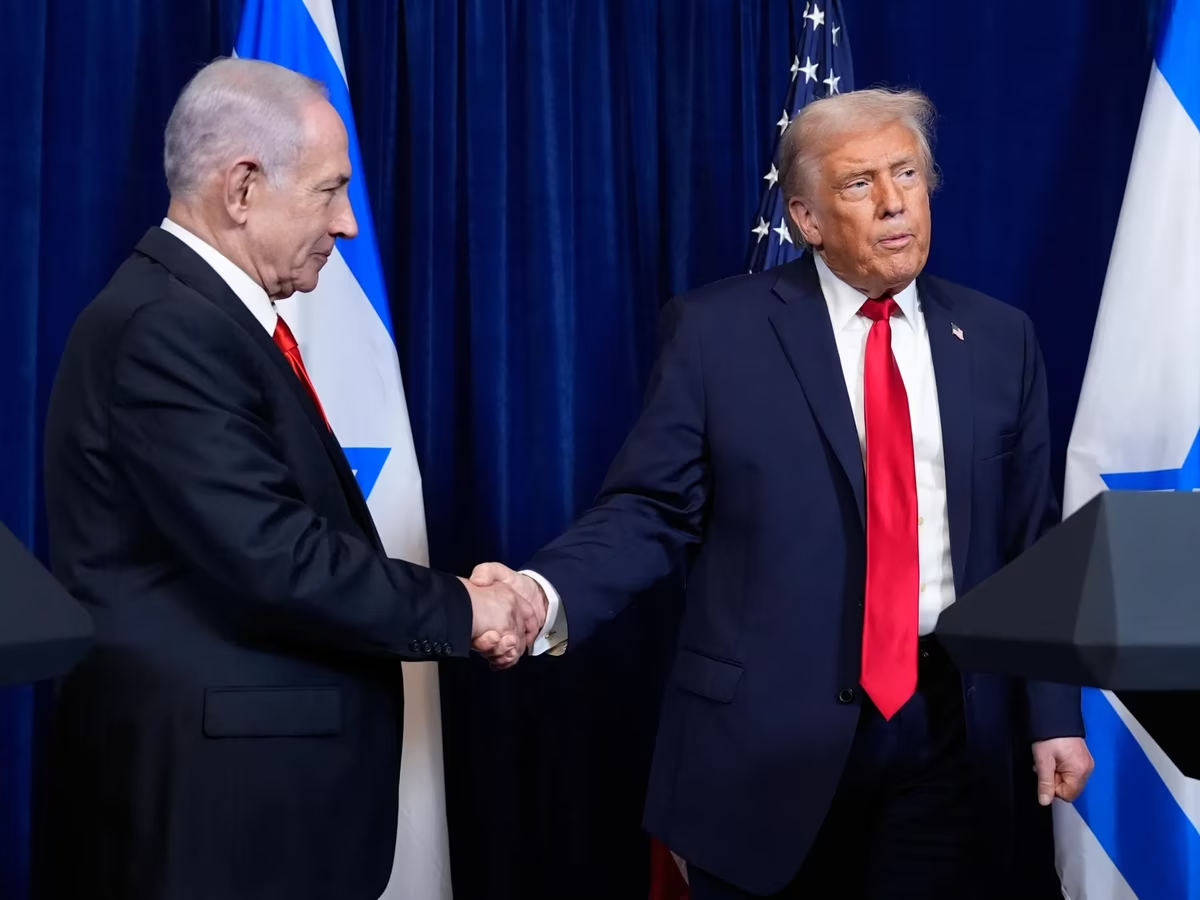
Donald Trump recently confirmed, alongside Israeli occupation government Prime Minister Benjamin Netanyahu, during their meeting at Mar-a-Lago resort in Florida that the Lebanese government is in an uncomfortable situation, considering that Hezbollah is behaving badly, and added: "We will see what Lebanon's efforts to disarm it will yield".

Trump evaded answering questions about whether Israel should launch an attack if Hezbollah does not disarm by 2026, saying: "We will see what happens". According to sources who conducted interviews, the lack of clarity in the leaders' meeting results is what raises concern, and the sources added: "It is impossible to predict the consequences for Lebanon, but it is possible to expect many changes at the beginning of the year".

On a parallel line, a website quoted an American official as saying that Netanyahu raised during his meeting with President Trump the file of "Hezbollah's efforts to rebuild its long-range missile arsenal in Lebanon", within a broader discussion that included Iran and possibilities of escalation in 2026.

Israeli occupation state War Minister "Israel Katz" had announced in November last year a deadline ending at the end of this year, for Hezbollah to hand over its weapons to the Lebanese army, otherwise Israel will intervene by force.

Hebrew media outlets have leaked information throughout the past period about the occupation army completing preparations for plans to launch a large-scale military operation in Lebanon, awaiting the political decision, which is supposed to be decided during Netanyahu and Trump's meeting, which does not seem clear yet.

Despite the ceasefire with "Hezbollah" that began on November 27, 2024, the occupation continues its violations, which have left hundreds of victims in southern Lebanon, as Israel continues to occupy 5 Lebanese hills in addition to other areas it has occupied for decades.

Since the agreement came into effect, Tel Aviv and Washington have been pressuring the Lebanese government to confine arms to the state, while "Hezbollah" refuses to disarm, and calls for Israel's withdrawal from Lebanese territories, and the pressures and debate coincide with diplomatic moves and indirect negotiations, within the "Mechanism", amid differences in interpreting what has been achieved and what is required later.

The "Mechanism" is a committee that brings together Lebanon, Israel, and the United Nations Interim Forces (UNIFIL), under American-French sponsorship, to monitor the implementation of the agreement to cease hostilities.

Last week, Lebanese Prime Minister Najib Mikati announced the near completion of the first phase of the army's plan to implement the government's decision to confine arms to the state, including "Hezbollah's" weapons, and Mikati expressed the state's readiness to start the second phase, north of the Litani River and up to the Awali River, calling for full support to enable the army to perform its required tasks to complete the implementation of the plan.

PALESTINE

Wed 31 Dec 2025 8:08 pm - Jerusalem Time

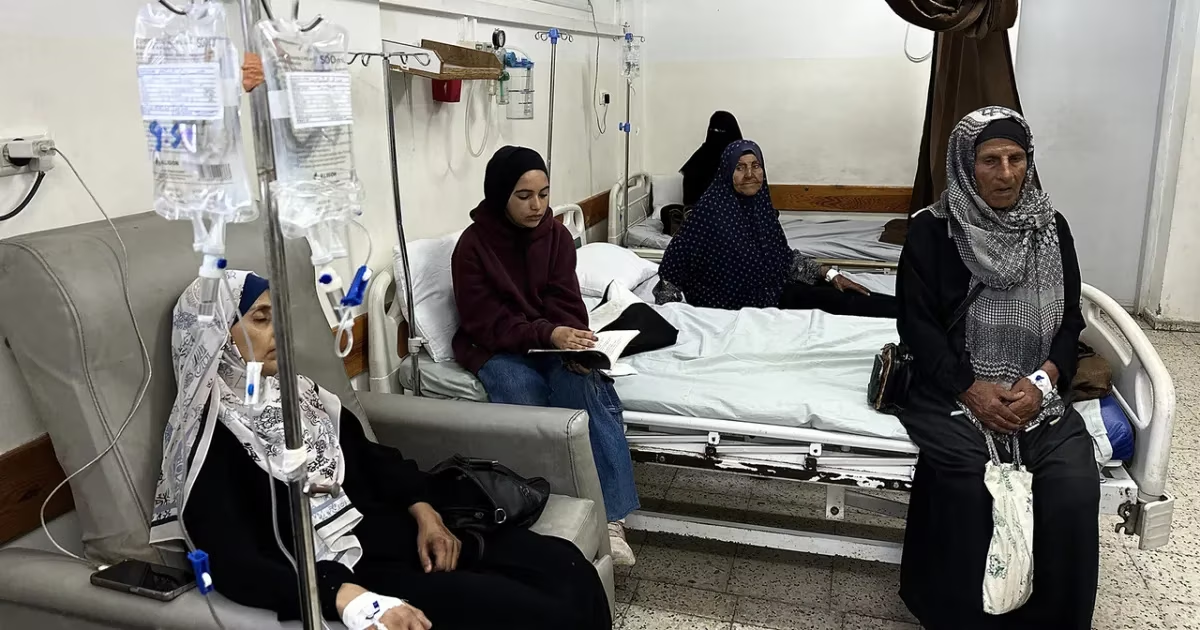
Director of Gaza Cancer Center: 70% of Cancer Drugs Unavailable in the Sector

Dr. Muhammad Abu Nada, director of the Gaza Cancer Center, said that cancer patients in the sector suffer greatly.

Dr. Abu Nada added that approximately 70% of cancer drugs are unavailable inside the Gaza Strip, and there is no chemotherapy either, while the Israeli occupation prevents patients from traveling outside the sector to receive the necessary treatment.

He explained that doctors face immense difficulties in diagnosing patients due to the acute shortage of necessary materials and equipment, noting that the occupation destroyed the "Turkish-Palestinian Friendship Hospital," which was the main hospital for diagnosing the disease in the sector.

Dr. Abu Nada said there are about 11,000 cancer patients in the Gaza Strip, of whom about 3,000 have referrals to travel outside the Gaza Strip for diagnosis and to obtain the necessary treatment.

He pointed out that there is an increase in mortality rates among cancer patients due to the deterioration of their psychological condition and lack of treatment.

Dr. Abu Nada warned that if a cancer patient is not treated as early as possible, the disease will spread throughout the body, and thus the natural result that the whole world expects is that cancer patients in the Gaza Strip will die either from the disease or from despair over what is happening to them.

He called on mediators and guarantors of the ceasefire agreement to pressure the occupation to allow cancer patients to travel outside the Gaza Strip to receive treatment and then return to the sector to resume their lives again.

He explained that a cancer patient's body needs a strong immune system, but after two years of war, starvation, and living in tents, it has greatly contributed to the deterioration of patients' conditions, especially since most of them are poor people who cannot obtain proper nutrition, let alone buy the available expensive drugs.

Dr. Abu Nada pointed to the catastrophic results of the deteriorating health situation in the Gaza Strip and the acute shortage of cancer treatment drugs, as there are not enough places in the remaining operational hospitals to treat them from infections, for example, or from dehydration, which forces doctors not to admit them to hospitals due to lack of space and to treat them at home.

He added, "Of course, there is no treatment at home, which means that the inevitable result awaiting these patients is a quick death, not a slow death as before."

He also referred to breast cancer patients, saying that the usual procedure was to remove the tumor only in hopes of giving the patient radiation therapy, but now doctors perform a complete mastectomy.

He explained that the reason they perform a complete removal of the breast is that the patients will not be able to travel abroad to receive the necessary treatment, saying that it is extremely cruel psychologically on the patient and on the family.

ARAB AND WORLD

Wed 31 Dec 2025 4:50 pm - Jerusalem Time

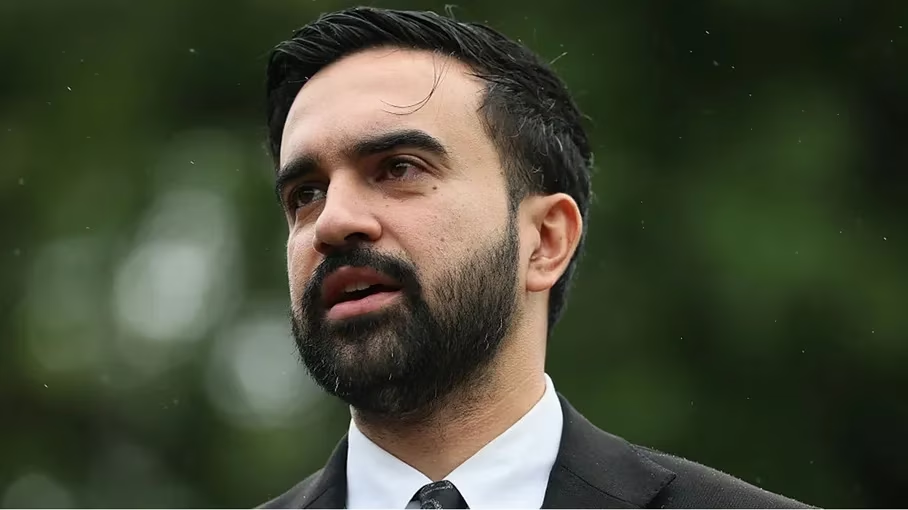
Newly Elected Mayor of New York Sparks Controversy with New Appointments and Pro-Palestinian Stances

The newly elected Mayor of New York, Zohran Mamdani, began outlining his new administration with steps that sparked widespread controversy within political and media circles, coinciding with the city's preparations for an inauguration ceremony described as unprecedented in its history, amid clear divisions in reactions, especially within the Jewish community in the United States.

The administration of the newly elected Mayor of New York confirmed the appointment of the American lawyer and legal scholar of Syrian origin, Ramzi Kassem, to the position of chief legal counsel within the new municipal team, a step described by American media as carrying significant political and legal implications in the orientations of the upcoming administration.

Media reports indicated that Ramzi Kassem is one of the most prominent legal academics at the City University of New York, where he has led legal projects over the years focused on defending the rights of immigrants and Muslims, in addition to those affected by American national security policies following the September 11 attacks. His name has also been linked to several politically and legally sensitive cases.

American media outlets explained that the announcement of the appointment was met with sharp criticism from conservative media platforms, focusing on Kassem's record in defending accused individuals in cases related to Al-Qaeda, including Ahmed al-Darbi, convicted of participating in the attack on a French oil tanker off the Yemeni coast. These outlets also pointed to his defense of activists who participated in pro-Palestinian demonstrations within American universities, including the Palestinian activist Mahmoud Khalil.

In contrast, other media outlets reported that Kassem's appointment comes within Mamdani's vision to restore dignity to those he described as "those abandoned by the judicial system," considering that the step reflects the upcoming administration's commitment to criminal justice files and minority rights, especially in a multi-ethnic city like New York.

It is noteworthy that Ramzi Kassem is of Syrian origin, born in Beirut, and moved during his childhood between several Arab capitals, including Baghdad, Damascus, and Amman, before moving to Switzerland to complete his secondary education, then to the United States where he continued his legal studies and later obtained American citizenship.

In a related context, a Hebrew newspaper published an extensive report covering the preparations for Zohran Mamdani's inauguration, describing the upcoming celebrations as unprecedented in the history of New York City, noting the participation of tens of thousands in massive public events in Manhattan, and that Mamdani will take the constitutional oath on the Holy Quran, in the presence of prominent political figures from the progressive stream, including Senator Bernie Sanders.

The newspaper indicated that Mamdani's inauguration is being closely followed within Israel, given his previous positions criticizing Israeli policies, and his connections to individuals and organizations classified as pro-Palestinian. It also noted the absence of the outgoing Mayor Eric Adams from the ceremony, in an unconventional step, after a term marked by a series of political and administrative scandals.

The newspaper added that the composition of Mamdani's inauguration committee has raised concern in some circles of the Jewish community, due to its inclusion of artists and activists known for their anti-Israel positions, alongside progressive Jewish organizations opposed to Zionism, considering that this formation reflects the deep political transformations witnessed by New York with the arrival of a young mayor belonging to the progressive stream.

The newspaper confirmed that Mamdani's victory represents, for his supporters, the beginning of a "new era" in the city's administration, while his critics see it as a worrying shift in New York's traditional positions, especially regarding the relationship with Israel and the Jewish community, in a city that hosts one of the largest Jewish communities in the world.

PALESTINE

Wed 31 Dec 2025 4:40 pm - Jerusalem Time

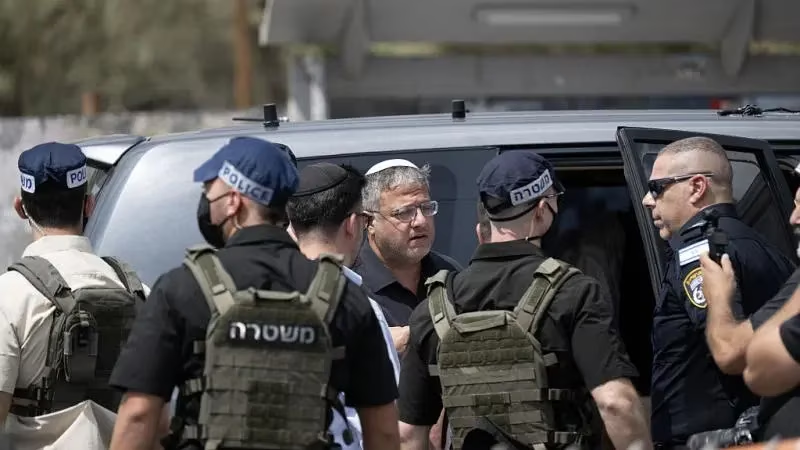
Ben Gvir storms the town of Tarabin in the Negev for the third time in a week

For the third time in a week, the far-right Israeli National Security Minister Itamar Ben Gvir stormed the town of Tarabin in the Negev on Wednesday.

The raid was accompanied by the continuation of an operation in the town by hundreds of Israeli police officers, which began days ago and was named "New Order".

Ben Gvir posted a photo of himself on his Telegram account storming the town again under police protection.

He wrote: "Tarabin this morning, with the National Guard and police forces."

He added, threatening the Palestinians in the town: "For the third time this week, and the twenty-eighth time in the Negev over the past two months. We will not retreat - whoever violates the rules, we will finish him off, the police will deal with him, and the National Guard will crush him."

On Sunday, Ben Gvir stormed the town and conducted a provocative tour through its streets, leading to stone-throwing clashes between Palestinians and the police.

Palestinian citizens pelted Ben Gvir with stones, and he appeared running, while police forces responded by firing tear gas.

Ben Gvir returned to storm the town on Tuesday after the Israeli police announced on Monday sending hundreds of its officers to besiege the town as part of what they called the "New Order" campaign.

The Israeli police stated in a statement on Tuesday evening: "Based on the directives of the National Security Minister and the Police Commissioner, the National Guard of the Border Guard has taken responsibility for the village of Tarabin."

It continued: "24 suspects have been arrested so far, 87 traffic violations have been recorded, and 23 demolition orders have been issued.

The police claimed on Monday that what they called "riots" occurred during the raid, and added: "This prompted our forces to respond with dispersal means, while conducting searches and imposing a full security cordon on the town to ensure the safety of law-abiding residents."

Meanwhile, residents of the town described the operation as "collective punishment," with one of them noting that "the police used tear gas and stun grenades on children, trying to justify the unjustified use of force," describing it as "provocation."

Tens of thousands of Bedouins live in dozens of unrecognized towns by Israel, depriving their residents of access to water, electricity, infrastructure, schools, and medical clinics.

ARAB AND WORLD

Wed 31 Dec 2025 4:04 pm - Jerusalem Time

More than 69,000 residents left Israel during 2025

An official Israeli statistic, on Wednesday, showed that more than 69,000 Israeli residents left the country during the year 2025.

The Central Bureau of Statistics (government) stated in a statement: "In 2025, 69.3 thousand Israeli residents left, and 19 thousand residents returned."

It added: "Thus, the net Israeli emigration from Israel at the end of 2025 was negative, reaching negative 50.3 thousand."

It indicated that Israel's population reached approximately 10.1 million people by the end of 2025.

It explained that 76.3 percent of the population (7.7 million) are Jews, 21.1 percent (2.1 million) are Arabs, and 2.6 percent (260 thousand) are foreigners.

It noted that during the year, approximately 182 thousand children were born, 76 percent to Jewish and non-Jewish mothers, and 24 percent to Arab mothers.

It continued: "During 2025, nearly 50 thousand residents died, which is about 2,000 fewer deaths than in 2024."

Israeli media reports attributed the increase in the number of emigrants from Israel to the continuation of the war.

On Wednesday, the "State of the Nation 2025" report issued by the Taub Center for Policy Studies revealed an unprecedented decline in the population growth rate within Israel, due to the continuation of negative migration and declining fertility rates, in a demographic development recorded for the first time since the declaration of the state's establishment on the occupied Palestinian territories in 1948.

The report indicated that Israel incurred a net loss estimated at about 37 thousand people, as a result of the departure of numbers of residents exceeding those coming and returning to it, for the second year in a row.

It pointed to the escalation of what the report described as "reverse migration" of previous immigrants, alongside the increasing departure of Israelis themselves.

The report showed that this decline coincides with a clear decrease in the fertility rate. "Despite the annual number of births appearing relatively stable during the past decade."

These transformations gain particular importance in the context of the Israeli-Palestinian conflict, where demography has been one of the pillars of Israeli policies, whether by encouraging Jewish immigration or imposing deportation and restriction policies on Palestinians, in an attempt to maintain a Jewish majority.

In October last month, a Hebrew newspaper quoted a special report for the Knesset (Israeli Parliament) that most of the leavers are educated youth aged between 20 and 39 years, some of whom are immigrants (to Israel) who left shortly after their immigration.

It quoted data from the Central Bureau of Statistics (government) that an average of about 36 thousand people left Israel annually during the period 2009-2021.

ARAB AND WORLD

Wed 31 Dec 2025 4:00 pm - Jerusalem Time

New details about Trump and Netanyahu's meeting

An American website revealed new details about the meeting between US President Donald Trump and Israeli Prime Minister Benjamin Netanyahu yesterday Tuesday in Miami, Florida.

It quoted American officials as saying that Trump and Netanyahu agreed to move to the second phase of the Gaza ceasefire agreement, and the US President pledged to Netanyahu to allow military action against the Islamic Resistance Movement (Hamas) if it does not begin to disarm.

Regarding the Iranian file, it added that they did not agree on a timeline or understandings regarding future military action against Tehran, but Netanyahu raised Israel's concerns about its missile program and Hezbollah's efforts to rebuild its long-range missile arsenal in Lebanon.

PALESTINE

Wed 31 Dec 2025 3:48 pm - Jerusalem Time

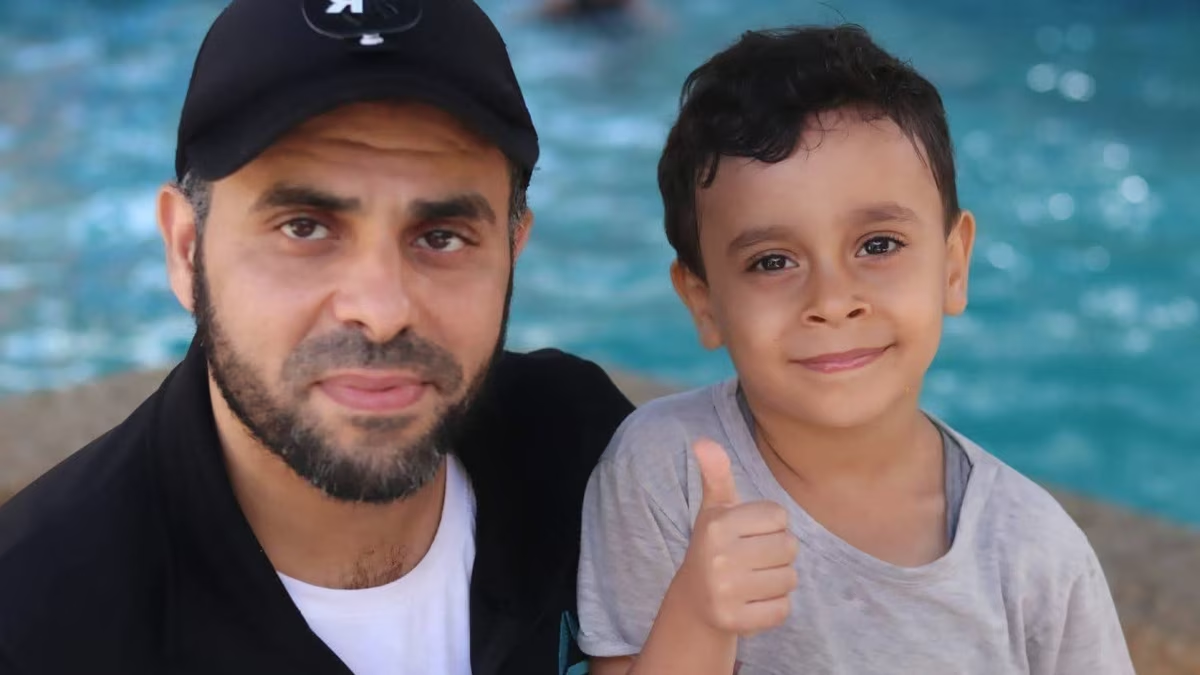
For the first time without a mask.. A picture gathering 'Abu Ubaida' with his martyred son 'Yaman' ignites social media platforms

In a moment where feelings of loss and consolation manifested, Ibrahim, the sole survivor of the targeting, son of the military spokesman for Al-Qassam Brigades "Abu Ubaida" Hudayfa Al-Kahlout, chose to draw the curtain on his father's life in a different way, publishing a picture unseen by the world before, gathering "The Voice General" with his beloved son Yaman.

The picture published by the eldest son on his account showed "Abu Ubaida" for the first time liberated from his red mask and military attire, with his real face and calm features, embracing his martyred son in a warm family photo, which seemed like a summary of a father's journey bidding farewell to his son as a martyr.

This picture carries deep connotations for the Palestinian street; it documents the human side of a personality that remained for years a symbol of strength and mystery, showing that behind the fiery statements was a father's heart bearing the pain of his son's martyrdom in silence, to be the end with their meeting together in one picture that immortalized their memory forever.

For many years, the identity of "Abu Ubaida" remained a puzzle baffling intelligence agencies, and a winning media bet for the resistance, and today, while Gaza bids farewell to its generals, the final scene for this man is not on a speech podium, but in his family's embrace, leaving behind a legacy of words and a single picture that will remain a witness to the true face of the battle.

PALESTINE

Wed 31 Dec 2025 3:40 pm - Jerusalem Time

Gaza Government Estimates Initial Direct Losses in 15 Vital Sectors at More Than $33 Billion During 2025

The Gaza government estimated the initial direct losses in 15 vital sectors during the year 2025 at more than $33 billion, amid the ongoing repercussions of Israel's genocide war against the Palestinians.

The government media office said on Wednesday, during the "Comprehensive Annual Update of Statistics for 2025," that "the initial direct losses in 15 vital sectors are estimated at more than $33 billion during 2025 amid the ongoing repercussions of the crime of genocide against our Palestinian people."

In the agriculture, livestock, and fisheries sector, it indicated that the maritime fishing sector was damaged 100 percent, alongside the destruction of more than 80 percent of agricultural lands out of 178,000 dunams.

It also noted the decline in areas planted with vegetables from 93,000 dunams to 4,000 dunams, the destruction of 1,000 agricultural wells, and 500 farms for cattle, sheep, and poultry.

In infrastructure and public facilities losses, the office spoke of the destruction of more than 700 water wells, 3,080 km of electricity networks, 400,000 linear meters of water networks, and 400,000 linear meters of sewage networks.

The Israeli army also destroyed more than two million linear meters of roads, 150 government headquarters, 250 sports and cultural facilities, and targeted 208 archaeological and historical sites.

The office noted that the Israeli army dropped more than 112,000 tons of explosives on the sector during 2025, alongside destroying nearly 90 percent of the urban infrastructure and seizing about 55 percent of the sector's area by military force.

In the health sector, 22 hospitals went out of service during 2025, and 211 ambulances were attacked by the Israeli army, in addition to destroying 23 vehicles belonging to civil defense.

Educationally, the Israeli army completely destroyed 30 educational institutions and partially destroyed 39, with 95 percent of the sector's schools damaged, and killed more than 1,000 students, 88 teachers, and 45 academics and researchers.

The Israeli aggression led to the complete destruction of 34 mosques, partial destruction of 100 mosques, targeting 3 churches multiple times, and destroying 21 cemeteries out of 60.

The Israeli army destroyed 106,400 residential units completely, 66,000 units severely unfit for habitation, and 41,000 units partially.

This resulted in the displacement of more than 213,000 families and forced displacement affecting nearly two million people, and targeting 87 shelter centers, according to the same source.

These massive losses occurred during 2025, amid continued Israeli violations of the ceasefire that came into effect on October 10, resulting in the killing of 415 Palestinians and injuring 1,152 others.

On October 8, 2023, Israel began a genocide in Gaza that lasted two years, with its death toll exceeding 71,000 killed and 171,000 injured Palestinians, alongside massive destruction with a reconstruction cost estimated by the United Nations at about $70 billion.

PALESTINE

Wed 31 Dec 2025 3:26 pm - Jerusalem Time

Palestinian Statistics Report Paints a Grim Picture of Palestinians' Conditions at the End of 2025

A report by the Palestinian Central Bureau of Statistics paints a grim picture of the Palestinians' conditions at the end of 2025, documenting tens of thousands of martyrs and millions of displaced people in Gaza, a sharp decline in the sector's population, a near-total collapse of the health and education systems, alongside unprecedented economic contraction and record-high unemployment rates.

Based on data from the Ministry of Health, the number of martyrs in Palestine exceeded 72,000 martyrs since the start of the Israeli war on October 7, 2023, 98% of them in the Gaza Strip.

By the end of December 2025, the number of martyrs in the Gaza Strip reached 70,942 martyrs, including 18,592 children and about 12,400 women, while about 11,000 people remain missing, and the number of injured rose to 171,195.

Since the start of the war on Gaza, about 100,000 Palestinians were forced to leave the sector, and about two million citizens were displaced from their homes out of about 2.2 million who resided in Gaza before the aggression.

In the West Bank, the escalation of the occupation's aggression and settler attacks resulted in the martyrdom of 1,102 Palestinians and the injury of 9,034 others.

The human losses and forced displacement movements directly impacted the population size, as estimates indicate that the population of the State of Palestine reached about 5.56 million people at the end of 2025, including 3.43 million in the West Bank.

The Gaza Strip witnessed a sharp and unprecedented decline in population by about 254,000 people, a decrease rate of 10.6% compared to population estimates before the aggression.

The sector's population is currently estimated at 2.13 million people, described by the Central Bureau of Statistics as a "sharp demographic hemorrhage" resulting from killing, displacement, and deteriorating living conditions.

The estimates showed that the number of Palestinians worldwide reached about 15.49 million people by the end of 2025, including 5.56 million residing in the West Bank and Gaza, and 1.86 million in the 1948 territories.

The Bureau also estimated the number of Palestinians in the diaspora at about 8.82 million, with 6.82 million concentrated in Arab countries, while the rest are distributed in other countries around the world, reflecting the expansion of the population dispersion due to prolonged political and historical coercive factors.

Despite the huge human losses, the Palestinian society remains young in terms of age structure. The population estimates for the end of 2025 indicated that children in the age group (0-4 years) constitute about 13% of the total population in the State of Palestine, at 12% in the West Bank and 14% in the Gaza Strip.

The proportion of those under 15 years reached about 36% of the total population (35% in the West Bank compared to 39% in Gaza), while those under 30 years constituted about 64% of the population.

In contrast, the proportion of the elderly (65 years and over) did not exceed 4% of the total population.

The Israeli war on the Gaza Strip since October 7, 2023, led to a near-total collapse in the health care system.

According to data from the World Health Organization, about 94% of health care facilities and hospitals in the sector were damaged or destroyed, and only 19 hospitals out of 36 operate partially with severely limited capacities, amid a severe shortage of medicines and medical supplies, depletion of health personnel, and repeated interruptions in fuel supplies needed to operate electrical generators.

The number of available beds in Gaza Strip hospitals is about 2,000 beds for a population exceeding two million people, which is an extremely low rate that does not meet the minimum health needs, especially with the significant increase in the number of injured and patients.

Health Ministry data reveal severe humanitarian repercussions, as there are about 60,000 pregnant women in the Gaza Strip, all of whom are exposed to serious health risks due to the absence or severe limitation of care services, and about 155,000 pregnant and nursing women face acute difficulties in accessing pre- and post-natal care services.

More than 70% of the sector's residents rely on contaminated or unsafe drinking water. By July 2025, 95% of households were unable to obtain safe drinking water.

The data indicate that 96% of households suffer from water insecurity, and 90% of them reported a sharp deterioration in water quality, which contributes to the widespread spread of gastrointestinal diseases, especially among children.

The education sector also suffered unprecedented destruction, especially in the Gaza Strip. By early December 2025, more than 179 government schools were completely destroyed, while 218 other schools were bombed or vandalized, including 118 government schools and 100 schools affiliated with the United Nations Relief and Works Agency for Palestine Refugees (UNRWA).

In the West Bank, Palestinian schools faced repeated raids and demolition orders, including the demolition of the "Khalat Amira" primary school in the Yatta Directorate on December 1 of this year.

In higher education, 63 university buildings in the Gaza Strip were completely destroyed, while 8 universities in the West Bank were subjected to repeated raids and vandalism.

The Central Bureau of Statistics indicated that the human losses in the education sector are "horrifying," with 18,979 students martyred, including 18,863 in the Gaza Strip, in addition to the martyrdom of 1,399 university students, 797 teachers and administrators, and 241 employees in higher education, in the context of what it described as direct targeting of the education structure and its cadres.

The economic indicators for 2025 reveal an unprecedented collapse in the Palestinian economy. The gross domestic product of the Gaza Strip contracted by 84% compared to 2023, indicating near-total economic paralysis. In the West Bank, the gross domestic product decreased by 13% despite recording slight growth of 4.4% compared to 2024.

The contraction of Gaza's economy continued during 2025, recording an additional decline of 8.7%. Unemployment reached "catastrophic" levels, reaching 46% of the total Palestinian labor force (28% in the West Bank and 78% in the Gaza Strip), which is among the highest rates globally, and the number of unemployed rose to about 650,000 people, indicating the depth of the economic and social crisis faced by Palestinians.

PALESTINE

Wed 31 Dec 2025 3:22 pm - Jerusalem Time

Rise in the toll of Palestinian casualties due to the Israeli genocide to 71,269 martyrs and 171,232 injured

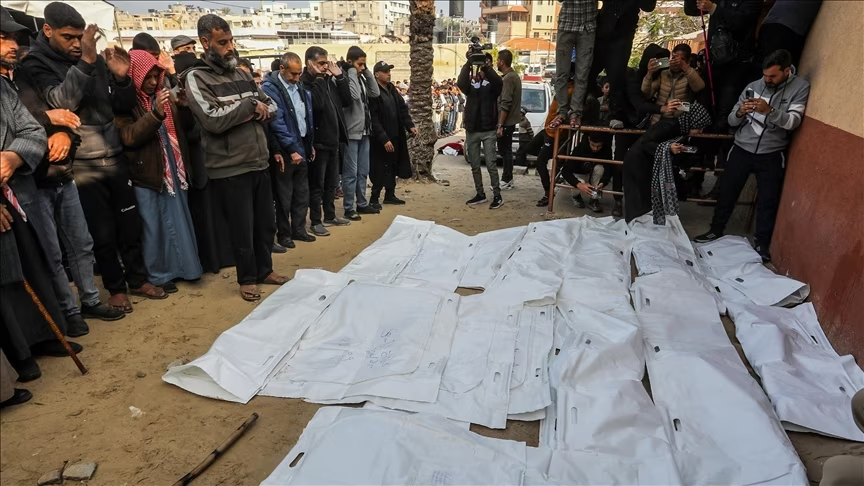
The Gaza Health Ministry announced on Wednesday that the toll of Palestinian casualties resulting from the Israeli genocide since October 2023 has risen to "71,269 martyrs and 171,232 injured".

The ministry added in a statement that the sector's hospitals received within 48 hours "3 martyrs, including one new, and 2 recovered, in addition to 10 injuries".

The statement did not provide additional details regarding the circumstances of the fall of the killed and injured, while Israel continues to violate the ceasefire agreement in effect since October 10, 2025, by carrying out bombing operations and firing at Palestinians.

According to the statement, Israel has killed 415 Palestinians and injured 1,152 others as part of its violations of the agreement since October 11 last.

In addition to the victims, the genocide launched by Israel on October 8, 2023, with American support, and lasted two years, left massive destruction affecting 90 percent of the civilian infrastructure in the sector, with reconstruction costs estimated by the United Nations at about 70 billion dollars.

PALESTINE

Wed 31 Dec 2025 3:20 pm - Jerusalem Time

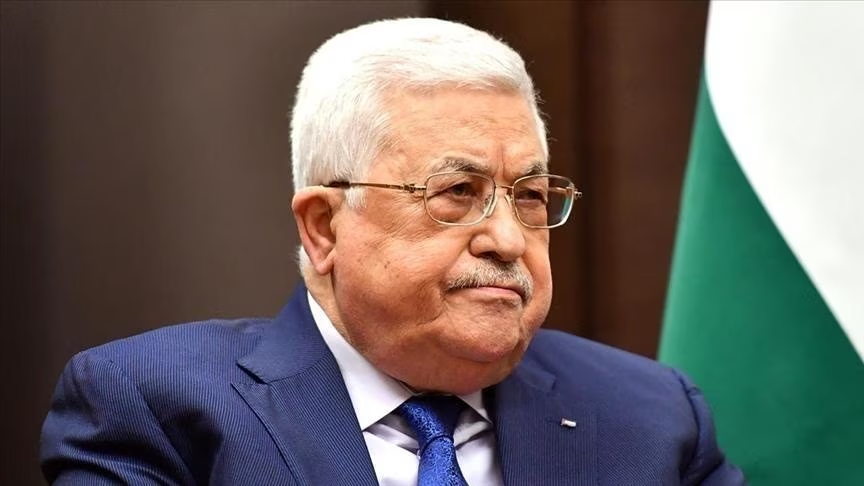
The Palestinian President: Israel's Genocide War Will Not Achieve Its Goals

Ramallah / Qais Abu Samra

The Palestinian President Mahmoud Abbas emphasized on Wednesday that Israel's genocide war against the Palestinian people will not achieve its political or security objectives.

This came in a statement on the occasion of the 61st anniversary of the launch of the Palestinian National Liberation Movement "Fatah" in 1965, which coincides annually with January 1.

Abbas said that "the Palestinian people in the Gaza Strip and the West Bank, including East Jerusalem, are facing an unprecedented war of genocide and ethnic cleansing carried out by Israel in a blatant challenge to international laws and legitimacy."

Since October 8, 2023, Israel's genocide in Gaza has left more than 71,000 Palestinian dead and 171,000 injured, along with widespread destruction, with the United Nations estimating the cost of reconstruction at around $70 billion.

Meanwhile, the Israeli army and settlers in the West Bank, including East Jerusalem, have killed at least 1,104 Palestinians, injured about 11,000, in addition to arresting more than 21,000 and displacing tens of thousands.

Abbas added that "despite the enormity of the sacrifices, the Palestinian people will continue their steadfastness and rooting in their homeland's land, and will confront plans of annexation and displacement."

Since the start of the Gaza genocide war, Israel has been paving the way for the official annexation of the West Bank through escalating crimes, including assaults on Palestinians, their displacement from their homes, seizure of their lands, and expansion of settlements.

The Palestinian Authority has been demanding for decades that the international community pressure Israel to end settlement in the occupied territories, which the United Nations considers "illegal," and undermines the possibility of establishing a Palestinian state.

The Palestinian President further stated that "this war will not succeed in achieving its political or security objectives."

** Establishment of the State

Abbas emphasized adherence to "the establishment of an independent Palestinian state with full sovereignty on the 1967 borders with East Jerusalem as its capital, alongside the return of refugees in accordance with international legitimacy resolutions and the Arab Peace Initiative."

He added that the establishment of the state is "an inevitable reality" embodied by the steadfastness of the Palestinian people, and no force will be able to prevent its realization.

Regarding the anniversary of the launch of the "Fatah" movement, Abbas said that "this anniversary recalls the sacrifices of the founding leaders of the Palestinian revolution."

He continued: "Foremost among them is the late leader Yasser Arafat (1929 - 2004), alongside thousands of martyrs, prisoners, and wounded who offered their lives for freedom and independence."

Abbas called for "national unity in this sensitive stage, and preserving the national achievements realized through decades of struggle, under the umbrella of the Palestine Liberation Organization."

He said that "any projects targeting the singularity of Palestinian representation are doomed to failure."

He added: "No Palestinian state in Gaza and no Palestinian state without Gaza, and the unity of the land, people, and political decision forms the basis of the Palestinian national project."

** Reforming the Authority

Regarding reforming the Palestinian Authority institutions, which is an American demand, Abbas emphasized "proceeding with the implementation of political and administrative reform plans for the Palestinian state institutions, considering them a fundamental lever to enhance the steadfastness of the Palestinian people."

He extended greetings to "Palestinians in the homeland and diaspora, especially in the Gaza Strip, and stressed the reconstruction of the sector and its return to the embrace of national legitimacy."

Arafat founded "Fatah" with a number of his comrades, most notably Khalil al-Wazir, Salah Khalaf, Khalid al-Hasan, and Farouk al-Qaddoumi.

One day before its official announcement, the movement launched "armed struggle" against the Israeli occupation by detonating the "Eilabun" tunnel in the Jordan Valley area east of the West Bank, resulting in the injury of two soldiers.

Israel was established in 1948 on lands occupied by armed Zionist gangs that committed massacres and displaced hundreds of thousands of Palestinians, then occupied the rest of the Palestinian lands, and refuses to withdraw and allow the establishment of a Palestinian state.

PALESTINE

Wed 31 Dec 2025 3:16 pm - Jerusalem Time

A new disease threatens the lives of displaced people in Gaza.. What is it?

While residents of the Gaza Strip are struggling to survive amidst a suffocating siege and worsening famine, displaced people living in crowded tents face the danger of "Leptospirosis" disease, which is transmitted through the urine of rats and rodents that are densely spread in the camps.

The emergence of the disease comes amid difficult living conditions, including overcrowding in the camps, lack of clean water, and absence of basic health infrastructure, which increases the population's vulnerability to infectious diseases.

The director of medical relief in the Gaza Strip, Bassam Zaqout, warned of fears of the disease spreading among the displaced, after diagnosing 5 infection cases, 4 of which are still in intensive care units, according to what local Palestinian media reported.

He pointed out that the flood wave that hit the sector last month contributed to the bacteria transferring to running waters through the urine of infected rats, and the disease spread to children, women, and the elderly through wounds and skin cracks.

He explained that the most important symptoms of the disease include sudden severe fever with a sharp rise in temperature, bone fatigue, and inflammation in the sclera of the eye, and when the disease progresses, yellowing appears on the skin.

Zaqout confirmed that the disease does not spread from person to person, but it becomes dangerous in the environmental conditions in Gaza, especially with the spread of rats and the mixing of sewage water with rainwater and the occurrence of floods.

Several bloggers interacted with the "Leptospirosis" disease on social media platforms, expressing their fears of its worsening spread amid a fragile health reality and the absence of necessary medicines to combat it.

Bloggers pointed out that displaced people are greatly exposed to diseases during the winter season, amid dilapidated tents and the absence of basic infrastructure, confirming that the situation becomes more dangerous due to the occupation's prevention of importing necessary medical devices and equipment, which hinders the medical staff's ability to detect and diagnose diseases in time and increases the likelihood of infectious diseases spreading.

One activist wrote that "The health situation in the camps is catastrophic, children are in severe danger!".

Another activist added that "The diseases facing the displaced are the war after the war".

Others wondered sorrowfully, "We do not know which alarm bell to ring first.. Is it hunger, or disease, or polluted water?".

Activists called on international human rights and health organizations to intervene urgently to curb the spread of diseases and epidemics among the displaced.

They also warned that the continuation of these conditions exacerbates the spread of epidemics and infectious viruses, making the population more susceptible to dangerous diseases that could lead to additional deaths if urgent measures are not taken for prevention and medical care.

Despite the end of the genocide war with the entry of the ceasefire agreement into force on October 10, 2025, the living conditions have not seen significant improvement, due to Israel's evasion of fulfilling its obligations stipulated in the agreement, including importing the agreed quantities of food, relief, and medical materials, and mobile homes.

PALESTINE

Wed 31 Dec 2025 2:06 pm - Jerusalem Time

2025.. 'Year of Genocide' Closes Its Harshest Chapter in Gaza.. Fears of Displacement and 'International Trusteeship' Shape the Scene

The destruction rate of Gaza City's infrastructure has reached approximately 90%. The year 2025 draws its bloody curtain on the Gaza Strip, leaving behind an unprecedented chapter in the chapters of the Palestinian Nakba, where it was not just another year in the calendar of conflict, but transformed into a stark model of the collapse of the international system and its inability to stop the cycles of genocide and destruction that affected both humans and stones alike.

With the end of this year, Gazans find themselves facing a highly complex geopolitical and humanitarian reality, oscillating between displacement projects and plans for 'international trusteeship'.

The sector entered this year burdened by the effects of an ongoing genocide war, officially turning it into a 'disaster zone' according to UN classifications, and although the year began with a fragile glimmer of hope represented by the ceasefire agreement in January, that truce was nothing but a 'temporary respite' over the ruins of cities, which quickly dissipated on March 18, when the occupation army resumed its aggression, disregarding its commitments, and confirming the fragility of any path that does not rely on deterrent international guarantees.

The following months witnessed a systematic escalation in policies of killing and destruction, where the occupation employed the weapon of starvation to its maximum extent, prompting the 'Integrated Food Security Phase Classification' to officially declare the outbreak of famine in Gaza City during August.

The alarming statistics indicate the martyrdom of more than 77,500 martyrs and missing persons, including more than 20,000 children, while the destruction rate of civilian infrastructure reached approximately 90%, with reconstruction costs approaching 70 billion dollars.

On the political front, September marked a dangerous turning point with the announcement by US President Donald Trump of a plan consisting of 20 points, which, pursuant to UN Resolution 2803, led to the imposition of something resembling 'international trusteeship' on the sector for two years, a step that raised widespread fears of circumventing the right to self-determination.

Despite reaching another ceasefire agreement in October, the occupation's ongoing violations emptied it of its content, with the continued closure of crossings and prevention of aid entry.

On the ground, the year recorded intensive targeting of leadership symbols and opinion holders, as the resistance bid farewell to a elite of its military leaders, including Muhammad al-Sinwar, Muhammad Shabana, and the military spokesperson 'Abu Ubaida', in strikes that Hamas considered fuel for continuing the confrontation, and the journalistic body paid a heavy price with the martyrdom of 56 journalists during this year alone, raising the total number of truth martyrs to 257 since the start of the aggression.

Before the year 2025 closes its final page, the Palestinian street and supporters of the resistance received a heavy shock with the announcement by the Qassam Brigades of the martyrdom of a group of its most prominent military leaders, in a strike described by observers as the harshest since the start of the 'Al-Aqsa Flood' battle, targeting heads directing military operations and an 'iconic' media figure who always formed the face of psychological warfare.

Perhaps the most prominent news that topped the media was the official announcement of the martyrdom of the military spokesperson on behalf of the Brigades, 'Abu Ubaida', and the revelation for the first time of his real identity, Hudhaifa al-Kahlout.

'Abu Ubaida' was not just a media spokesperson, but during the war years, he became an international symbol of resistance, known for his red keffiyeh and the niqab that never left him. With his departure, the resistance's media front lost the 'commander of the military media weapon', who managed the psychological battle professionally, and whose voice in the minds of millions was associated with victory statements and threats, drawing the curtain on the journey of a man who remained a mystery that baffled the occupation's intelligence for years.

On the strategic operational level, the martyrdom of Muhammad al-Sinwar constituted a severe loss for the military council, as the man who held the position of Chief of Staff, and succeeded the former General Commander Muhammad al-Deif, was considered one of the most prominent 'shadow generals' and the mastermind behind the offensive tunnel network, and he had survived more than six assassination attempts previously, to meet his end at the end of this year after a long journey of preparation and equipping.

Fears did not stop at the boundaries of killing and destruction, but extended to include plans for forced displacement, reinforced by the recent Israeli moves and talk of 'Somalia land' as a potential destination, which was met with absolute Palestinian rejection.

In conclusion, the year 2025 ends with the occupation living unprecedented international isolation, besieged by genocide charges in international courts and boycott waves, and while Gazans lick their wounds, the fateful question remains open about whether this year was the peak of collapse, or the beginning of an international path that restores consideration to the usurped Palestinian rights.

PALESTINE

Wed 31 Dec 2025 12:42 pm - Jerusalem Time

Israel approved the construction of more than 28,000 new settlement units in the West Bank during 2025

Israel approved during 2025 the construction of more than 28,000 new settlement units in the occupied West Bank, and is discussing on Wednesday plans to establish more than a thousand additional units.

This came according to a report issued on Wednesday by the left-wing Israeli movement "Peace Now" specializing in monitoring settlements.

The movement said that "since the beginning of 2025, the Higher Planning Council affiliated with the Israeli Civil Administration approved 28,163 housing units, which is an unprecedented record for the number of units in one year".

It reported that the Council is discussing today "plans to build 1,033 housing units in various parts of the West Bank".

"The plans include building 126 units in the evacuated settlement of Sanur, but the Security Cabinet approved in May 2025 the re-establishment of it", according to the movement.

It noted that Sanur (in the West Bank) had been evacuated as part of the 2005 disengagement plan to withdraw the Israeli army and dismantle settlements in the Gaza Strip.

"The re-establishment of the settlement was made possible thanks to amendments introduced by the current government to the disengagement law, lifting the ban on Israeli presence in parts of northern West Bank", according to the movement.

It reported that this step "represents a return to settlement activity deep in the northern West Bank, in areas with high Palestinian population density, where there was no previous settlement presence".

The plans also include, according to the movement, building 398 settlement units in the "Yitzhar" settlement near Nablus (north) and 509 units in the "Esfer" settlement (south).

About 750,000 Israeli settlers live in hundreds of settlements in the occupied West Bank, including 250,000 in East Jerusalem, and they commit daily assaults against Palestinian citizens with the aim of forcibly displacing them.

Since the genocide war in Gaza began more than two years ago, Israel is paving the way to formally annex the West Bank through escalating crimes, including assaults on Palestinians, displacing them from their homes, confiscating their lands, and expanding settlements.

The Palestinian Authority has been demanding for decades that the international community pressure Israel to end settlements in the occupied territories, which the United Nations considers "illegal", and undermines the possibility of establishing a Palestinian state.

In 1948, Israel was established on lands occupied by armed Zionist gangs that committed massacres and displaced hundreds of thousands of Palestinians, then Tel Aviv occupied the rest of the Palestinian lands, and refuses to withdraw and establish a Palestinian state.

PALESTINE

Wed 31 Dec 2025 12:28 pm - Jerusalem Time

New Israeli Conditions for Transitioning to the Second Phase of the Gaza Agreement

After Hebrew media spoke about Israeli conditions for transitioning to the second phase of the ceasefire agreement in Gaza, it revealed undisclosed Israeli-American understandings.

These undisclosed conditions were discussed during a meeting between Israeli Prime Minister Benjamin Netanyahu and US President Donald Trump at Mar-a-Lago resort in Florida on Monday, according to Hebrew media.

While Israel refuses to move directly to the second phase, Ahmed Jaradat pointed to some of the new Israeli conditions.

He explained that the Israeli occupation requires, in addition to disarming the Islamic Resistance Movement "Hamas" and the tunnel weapons in Gaza, the withdrawal and collection of 60,000 pieces of Kalashnikov-type weapons, according to Israeli Channel 13.

This new Israeli condition comes after Netanyahu briefed Trump on claims by the Shin Bet and Military Intelligence (Aman) agencies about gathering information on weapons in the Gaza Strip, according to the same channel.

He noted what Israeli media reported from sources described as "well-informed" that Trump informed Netanyahu that he would start the second phase in mid-January, including "forming a technocratic government and an international stabilization force."

According to the Israeli leaks, it was clear that Trump informed Netanyahu and did not consult with him on these matters.

He added that Israeli media focused on issues related to reconstruction in Gaza, specifically in areas controlled by the Israeli occupation army in Rafah city, outside the red line.

The Israeli occupation may begin implementing the American model by rebuilding Rafah, then moving to rebuild other areas in the sector, and this will not include all areas of Gaza.

It quoted the Hebrew "Channel 13" that Israel may open the Rafah border crossing under pressure from Trump's advisors on Netanyahu to complete this step.

The Israeli occupation was supposed to complete this step during the first phase of the Gaza agreement, just days after the prisoner exchange operation, but reopening the crossing was not accomplished.

All these discussions remain confined to the corridors of negotiations and may not move to implementation smoothly, especially since Netanyahu has proven his skill on more than one occasion in delaying and obstructing agreements since Israel began its war of genocide on the Gaza Strip more than two years ago.

PALESTINE

Wed 31 Dec 2025 12:16 pm - Jerusalem Time

Palestinian Journalists.. The First Line of Defense for Truth and Witnesses to Israeli Massacres

The Government Media Office in the Gaza Strip stated that Palestinian journalists formed the first line of defense for truth in 2025, as they were witnesses to the Israeli massacres in the sector and conveyors of facts from the heart of the event, paying a heavy price in their blood, lives, and personal security.

The office documented in a statement on the occasion of the Day of Loyalty to the Palestinian Journalist (31 December/January) the sacrifices of Palestinian journalists, through numbers that reflected the scale of the systematic targeting faced by Palestinian journalism.

It stated that Israeli crimes against the Palestinian journalistic family resulted in 2025:


  • The martyrdom of 56 journalists while performing their professional duty.
  • The disappearance of 3 journalists whose fate remains unknown since the start of the genocide until now.
  • The injury of more than 420 journalists with varying wounds.
  • The exposure of 50 journalists to arrest and torture in a blatant violation of all international laws and covenants.


To date, the Government Media Office in Gaza has recorded the martyrdom of 257 journalists due to direct Israeli targeting to besiege and silence the Palestinian narrative, and to obscure the truth and the occupation's crimes before the global public opinion.

The office stated that Palestinian journalists were and remain partners in the battle of awareness and dignity, creators of the truthful narrative that broke the falsehood of Israeli propaganda and its false narrative, and exposed war crimes to the entire world, despite attempts at blackout and deception.

It added "We renew our pledge to the souls of the martyrs of Palestinian journalism that their message will remain alive, and we affirm our continuation in defending journalists' rights, and legally and media-wise pursuing the occupation for its crimes against them, until the perpetrators receive their just punishment".

The targeting of Palestinian journalists did not stop at direct killing, injury, arrest, or prevention from coverage, according to the Palestinian Journalists Syndicate, as it took a more dangerous and brutal dimension represented in targeting journalists' families and relatives, in persistent Israeli efforts to turn journalistic work into an existential burden paid for by children, wives, fathers, and mothers.

The Israeli occupation army killed 706 people from journalists' families in the Gaza Strip since the start of the genocide war on October 7, 2023, according to monitoring and documentation by the Freedoms Committee in the Syndicate.

Since launching the genocide war on the sector, Israel has prevented international journalists from entering Gaza independently, leaving Palestinian journalists with the task of documenting the war's developments and bearing the burden of coverage from the front lines under difficult and life-threatening conditions.

The Palestinian Journalists Protection Center considered the continued prevention of foreign journalists from entering the sector as an unprecedented measure that contributed to the media isolation of Gaza, and hindered independent field verification of facts and conveying a comprehensive picture of what is happening on the ground.

The martyrdom of journalists in Gaza was described as the worst historically, as their number exceeded the total killed from journalists in the American Civil War, the First and Second World Wars, the Korean War, Vietnam, Yugoslavia, and Afghanistan, according to what the "Costs of War" project affiliated with Brown University in the United States concluded.

During the Israeli war on Gaza, 12 journalists from its staff were martyred in the pursuit of continuing journalistic coverage in the sector, despite the impossible conditions of genocide, starvation, and displacement, and a number of journalists were seriously injured by direct Israeli fire.