ARAB AND WORLD

Sat 03 Jan 2026 12:10 pm - Jerusalem Time

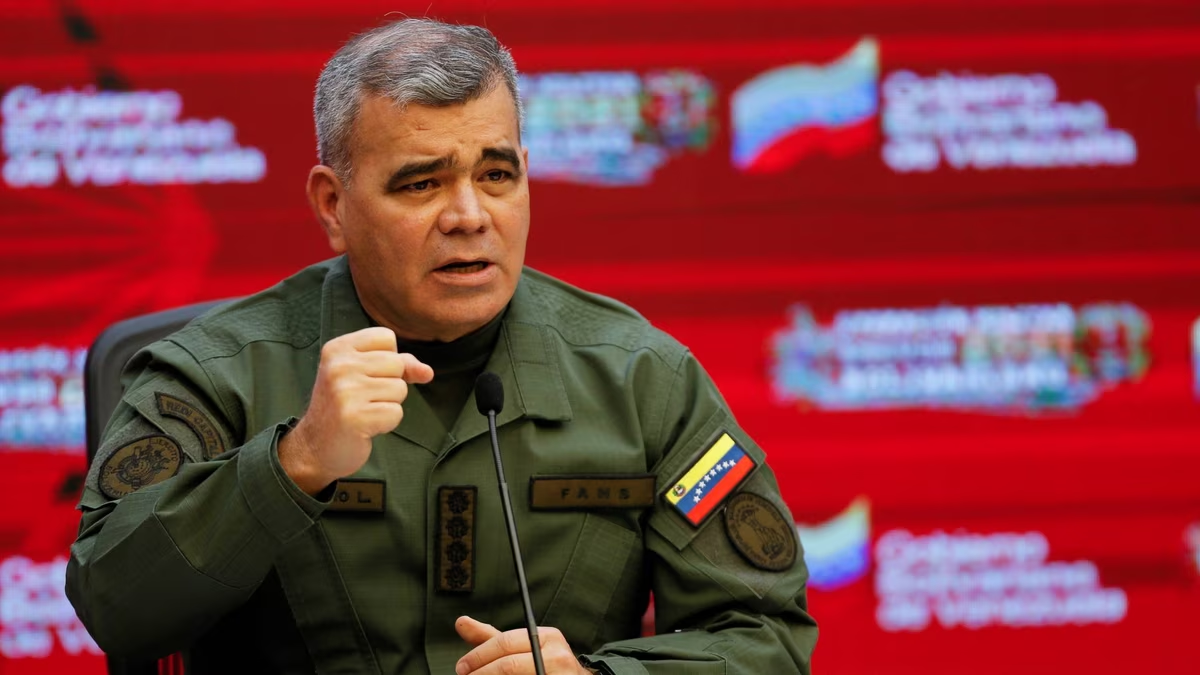
Venezuelan Defense Minister Announces General Mobilization to Confront the 'Greatest Aggression' by the United States on the Country

The Venezuelan Defense Minister, General Vladimir Padrino López, described the military attack launched by the United States against his country as the 'greatest aggression' faced by the Republic in its modern history, while simultaneously declaring a state of general mobilization within the ranks of the Bolivarian National Armed Forces to respond to this direct targeting.

The Minister Padrino López confirmed in an urgent military statement that all army units and security forces have already begun implementing the instructions of the Commander-in-Chief of the Armed Forces, President Nicolás Maduro, emphasizing that the primary objective at this stage is to 'confront the imperialist threat' and protect Venezuelan sovereignty through comprehensive field coordination to defend all national territories, and confirming that the Armed Forces will work at full capacity to deter any infringement on the country's security.

In a firm tone reflecting Caracas's categorical rejection of any external pressures or impositions, the Defense Minister stated that 'there is no bargaining on Venezuela's freedom and independence,' and continued by saying: 'We will not negotiate and we will not yield, and we will triumph in the end.'

He explained that the official position of the military leadership is based on protecting national achievements, responding to threats by adhering to the legitimate rights of the nation to determine its destiny away from foreign interventions.

The Minister also indicated that the American attempts primarily aim to instill panic and chaos among citizens to destabilize internal stability, calling on the Venezuelan people to 'not fall into the chaos' that the enemy seeks to impose, and to maintain unity and cohesion to overcome these critical moments.

López emphasized that popular awareness and national unity are the strongest weapon in facing what he described as the 'heinous aggression.'

Padrino López concluded his statements by affirming the combat capability and high morale enjoyed by the Venezuelan forces, noting that the Venezuelan nation will continue to defend its people and resources with an 'unyielding will.'

He said emphatically: 'We will prevail in this struggle, and the nation is the one that will triumph in the end,' in a clear indication of his confidence in the country's ability to repel the attack and preserve the unity of its territories.

PALESTINE

Sat 03 Jan 2026 7:12 am - Jerusalem Time

Injury to a Palestinian and Settlers Attack Village in the West Bank

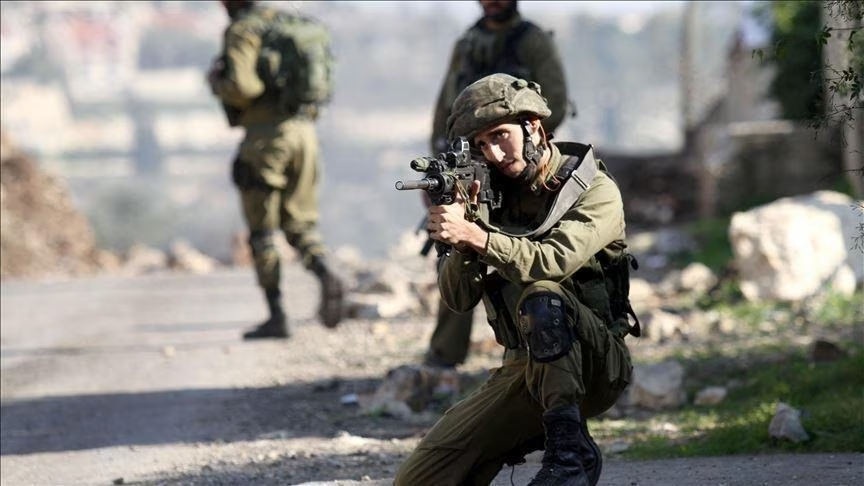
On Friday evening, the Israeli army injured a Palestinian, while settlers attacked a village in the occupied West Bank and fired shots in the air, causing panic among the residents.

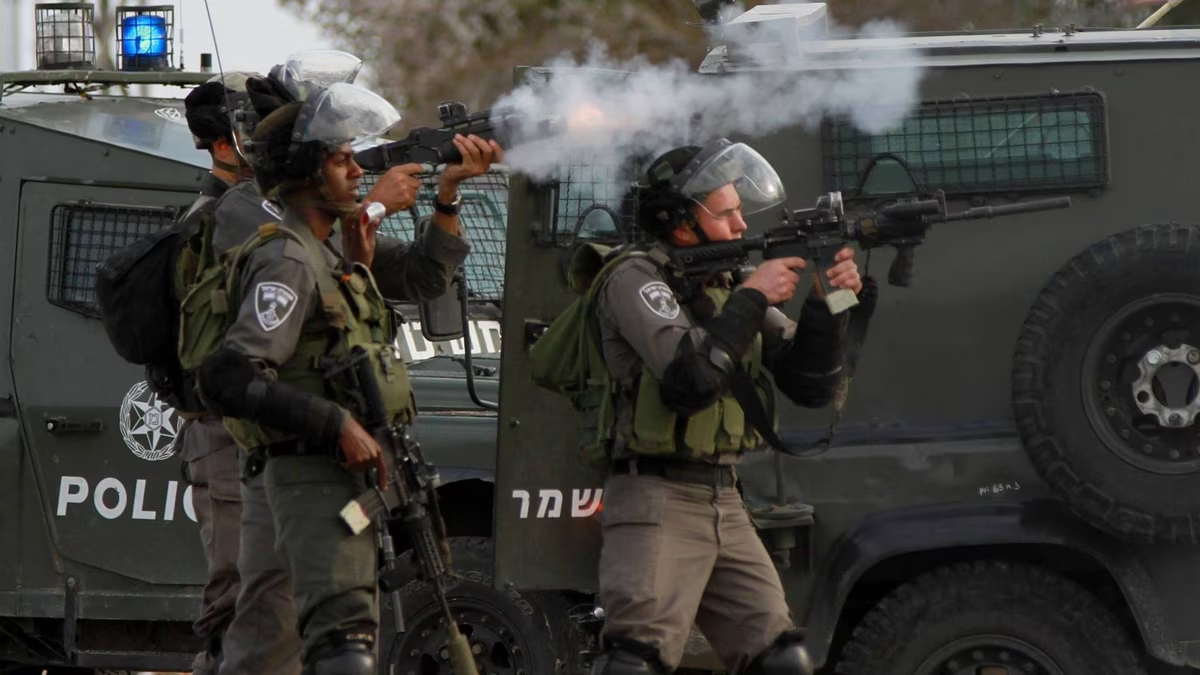
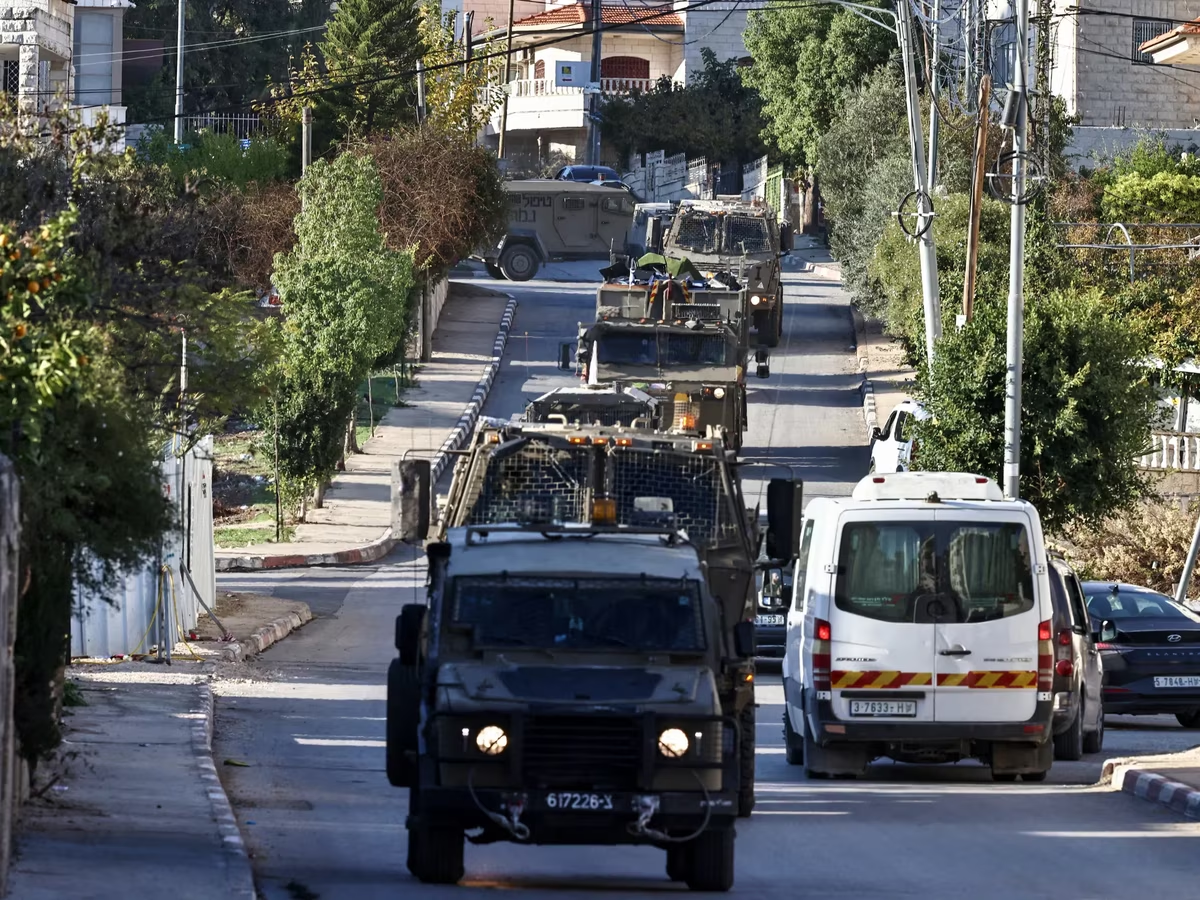
In the town of Idna, west of Hebron city in the south of the West Bank, a Palestinian was slightly injured after Israeli army forces stormed the town, firing live ammunition and sound grenades.

Israeli settlers also attacked the outskirts of the village of "Furqah" west of Salfit governorate in the north of the West Bank, and fired live ammunition in the air.

Member of the Furqah village council, Mustafa Bakr, said that about 50 settlers attacked the northern outskirts of the village and fired live ammunition in the air, causing terror among the residents.

Bakr added that the Israeli army stormed the village to secure and protect the settlers, without reporting any injuries.

Since the start of the genocide war in Gaza on October 8, 2023, the Israeli army and settlers in the West Bank, including East Jerusalem, have killed at least 1105 Palestinians, injured about 11,000, in addition to arresting more than 21,000.

Meanwhile, the Israeli genocide with American support in Gaza has left more than 71,000 Palestinian dead and 171,000 injured, mostly children and women, and destruction affecting about 90% of the civilian infrastructure, with the UN estimating the reconstruction cost at about 70 billion dollars

PALESTINE

Sat 03 Jan 2026 6:43 am - Jerusalem Time

UN Secretary-General Calls for Lifting Ban on Humanitarian Agencies in Gaza

Washington – Saeed Arikat 

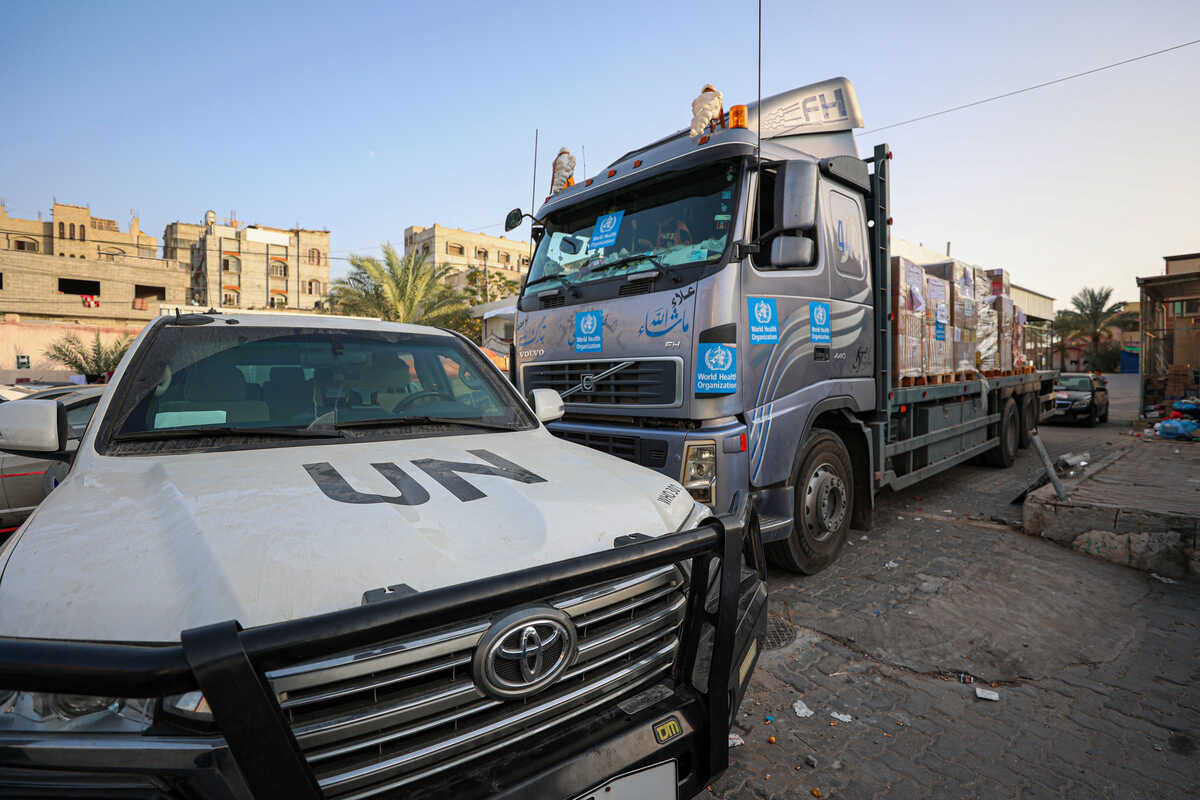
The UN Secretary-General, António Guterres, called on Israel to end the ban imposed on 37 international humanitarian agencies that were providing vital aid to the residents of the Gaza Strip, expressing his deep concern over the serious humanitarian repercussions of this decision. This call comes amid highly complex humanitarian conditions in the sector, where residents suffer from acute shortages of food, medicine, and basic services, due to the ongoing restrictions on the movement of aid.

The official spokesperson for the Secretary-General, Stéphane Dujarric, stated in an official statement that Guterres demanded an immediate reversal of this measure, emphasizing that international non-governmental organizations are an indispensable element in life-saving relief operations. He added that suspending the work of these organizations threatens to undermine the limited and fragile progress achieved during periods of ceasefire, and undermines international efforts aimed at alleviating the suffering of civilians.

The statement indicated that this decision does not come in isolation from a broader context of previously imposed restrictions, which have already led to delays in the entry of vital shipments of food, medicines, hygiene supplies, and shelter materials. According to the United Nations, the recent measure is likely to exacerbate the existing humanitarian crisis and increase the fragility of the health and living conditions for hundreds of thousands of Palestinians in Gaza.

The Gaza Strip, home to more than two million people, heavily relies on external humanitarian aid to meet its basic needs, amid deteriorating infrastructure, rising poverty and unemployment rates, and recurring military operations. International humanitarian agencies have played a pivotal role in providing healthcare services, distributing food, supporting water and sanitation networks, in addition to providing shelter for the displaced.

Relief organizations warn that reducing their presence or suspending their operations will lead to a dangerous humanitarian vacuum, which could have long-term consequences, especially for the most vulnerable groups such as children, women, the elderly, and people with disabilities. Moreover, the deterioration of humanitarian conditions may contribute to increased tension and instability, which negatively impacts opportunities for calm and peace.

Guterres' call reflects a growing international awareness that the crisis in Gaza is no longer just a political or security issue, but a compounded humanitarian catastrophe. The ban on humanitarian agencies does not target institutions as much as it directly affects civilians. From the perspective of international humanitarian law, ensuring access to aid is a fundamental duty, and any arbitrary restrictions on it undermine the credibility of international commitments to protect civilians in conflicts.


The United Nations affirms that the continuation of restrictions on humanitarian work contradicts the principles of neutrality and independence upon which international relief operations are based. UN officials also emphasized that humanitarian organizations do not participate in the conflict, but work exclusively to alleviate human suffering, and targeting or restricting them creates a dangerous precedent in other conflict zones around the world.

Human rights organizations, for their part, urge the international community to exert effective political and diplomatic pressure to ensure the lifting of the ban and allow the resumption of humanitarian work without obstacles. These organizations believe that international silence or mere statements of concern may encourage further measures that violate the basic rights of civilians.

The danger of the decision lies in its timing, as it comes at a stage that should witness the strengthening of humanitarian efforts, not their reduction. Ceasefires, if not translated into tangible improvements in people's lives, lose their practical meaning. Suspending the agencies' work drains any calm of its humanitarian content, turning it into a mere temporary security measure that does not address the roots of the daily suffering of the residents.

In this context, the future of humanitarian work in Gaza remains contingent on the extent to which the concerned parties respond to international appeals. Guterres affirms that the United Nations will continue to use all available channels to defend the right of civilians to receive assistance and protection, stressing that respect for international humanitarian law is not an option, but a legal and ethical commitment.

This crisis highlights a deeper issue related to the politicization of humanitarian work. When aid is used as a pressure tool, civilians become hostages to conflicts. Protecting the independent humanitarian space is essential to maintain the minimum of human dignity in conflict zones, and any breach of that threatens the entire international humanitarian system, not just the Gaza case.

PALESTINE

Sat 03 Jan 2026 6:23 am - Jerusalem Time

A million people in Gaza urgently need shelter assistance

The spokesperson's office for the UN Secretary-General said on Friday that approximately one million people, or half the population of the Gaza Strip, still urgently need shelter assistance.

The office added in a statement that the need for shelter assistance continues, despite humanitarian workers distributing thousands of tents and hundreds of thousands of tarpaulin and other materials throughout the sector since the ceasefire.

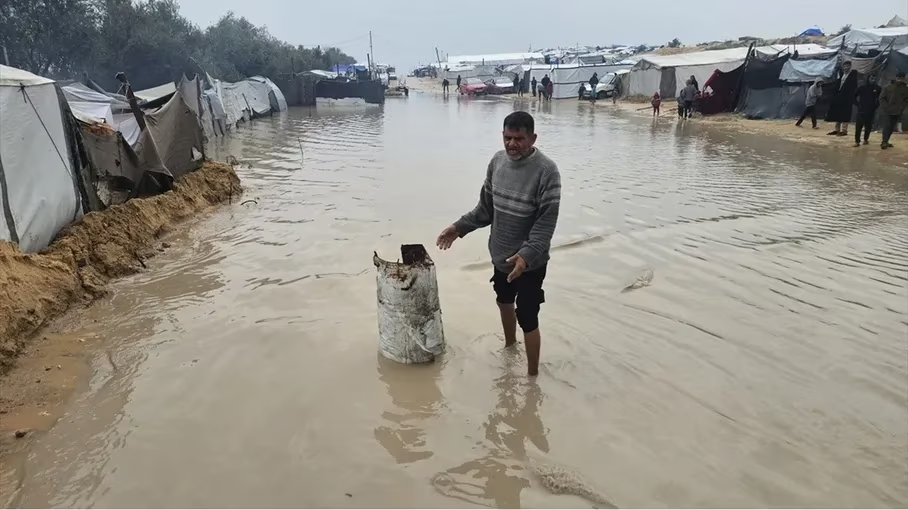
The UN Office for the Coordination of Humanitarian Affairs was quoted as saying that humanitarian workers in Gaza continue to assist the most vulnerable families, as harsh winter conditions leave hundreds of thousands of Palestinians struggling in temporary tents damaged by rain, wind, and sea waves.

On Thursday, a Palestinian woman and her child were martyred due to a fire that engulfed their tent in the Yarmouk area in the center of Gaza City, while trying to get warm in the bitter cold.

The Civil Defense Department said in a statement that a fire broke out in tents sheltering displaced people in the Yarmouk area in the center of Gaza City, and it was dealt with, with the bodies of a woman and her young child recovered, while another person injured with burns was rescued.

The statement added that the relevant authorities are still working on following up the details and circumstances of the incident.

In the absence of heating means, thousands of displaced people in the tents spread across the sector are forced to use primitive means for heating, by lighting fires or candles, which may be the cause of the fire outbreak.

Moreover, medical sources said that the child Malak Ghanem was martyred due to the bitter cold, inside her family's tent in the Nuseirat camp in the center of the Gaza Strip.

The Gaza Strip has been witnessing two waves of severe weather depressions since last week, resulting in the martyrdom of dozens of children, in addition to flooding and damage to about 53,000 tents sheltering displaced people in various areas of the sector.

This humanitarian catastrophe is worsening amid the occupation's failure to comply with the ceasefire agreement and the humanitarian protocol, especially regarding the entry of shelter materials, tents, and mobile homes necessary to protect the population from harsh weather conditions.

PALESTINE

Sat 03 Jan 2026 3:55 am - Jerusalem Time

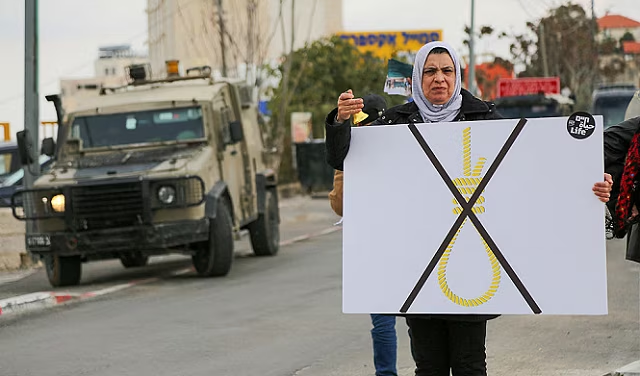
United Nations Calls on Israel to Abandon Bill for Executing Palestinian Prisoners

The United Nations High Commissioner for Human Rights, Volker Türk, called on the Israeli authorities to abandon a new bill that imposes the death penalty on Palestinian prisoners.

In a statement issued on Friday, Türk urged the Israeli authorities to abandon their plans to propose new legislation imposing mandatory death sentences applied exclusively to Palestinians.

He warned that Israel "challenges international law on several levels."

Turk added that the drafting of these legislations, along with statements by Israeli politicians, indicates that the goal is for them to apply only to Palestinians, who are often convicted after unfair trials.

He emphasized that this raises serious concerns regarding discrimination against Palestinians and violations of their rights to fair trials, in addition to other violations of international human rights law and international humanitarian law.

The High Commissioner said that these proposals also violate standards of international humanitarian law related to criminal procedures and imposing the death penalty on inhabitants of occupied territory.

He recalled that depriving any Palestinian from the West Bank and Gaza Strip of the fair trial guarantees stipulated in the Fourth Geneva Convention "constitutes a war crime."

He noted that the United Nations clearly opposes the death penalty in all circumstances, as it "is difficult to reconcile with human dignity, and it poses the risk of executing innocents, which is unacceptable."

Turk confirmed that the Israeli proposals to introduce mandatory death sentences leave no discretionary authority for the courts and violate the right to life.

The statement comes in response to a series of proposals presented before the Knesset, including amending the military law applied in the occupied West Bank, which obliges military courts to impose the death penalty mandatorily on all those convicted of intentional murder.

The proposals include amending the Israeli Penal Code to introduce the death penalty for those convicted of carrying out operations and intentionally killing Israelis, retroactively applying to those convicted in relation to the October 7, 2023 attacks.

In addition, there is a proposal to use the death penalty for acts of "terrorism or racism or hostility towards the public," which are terms defined in a vague and overly broad manner, according to the United Nations Human Rights Office.

Read also | 32 Prisoners Executed in 2025 Inside Occupation Prisons

ARAB AND WORLD

Fri 02 Jan 2026 10:35 pm - Jerusalem Time

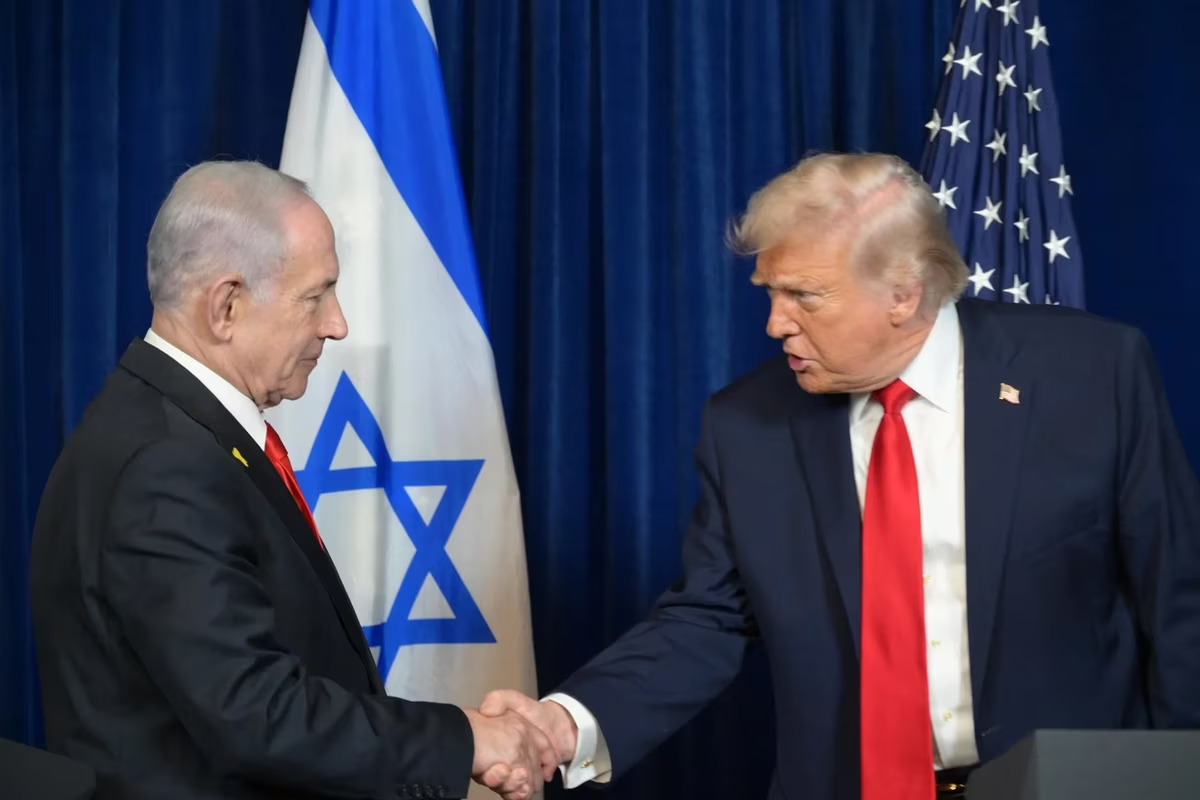
"Hebrew Broadcasting": Tel Aviv Studies Launching a Large-Scale Military Operation in Lebanon and Netanyahu Discussed the File with Trump

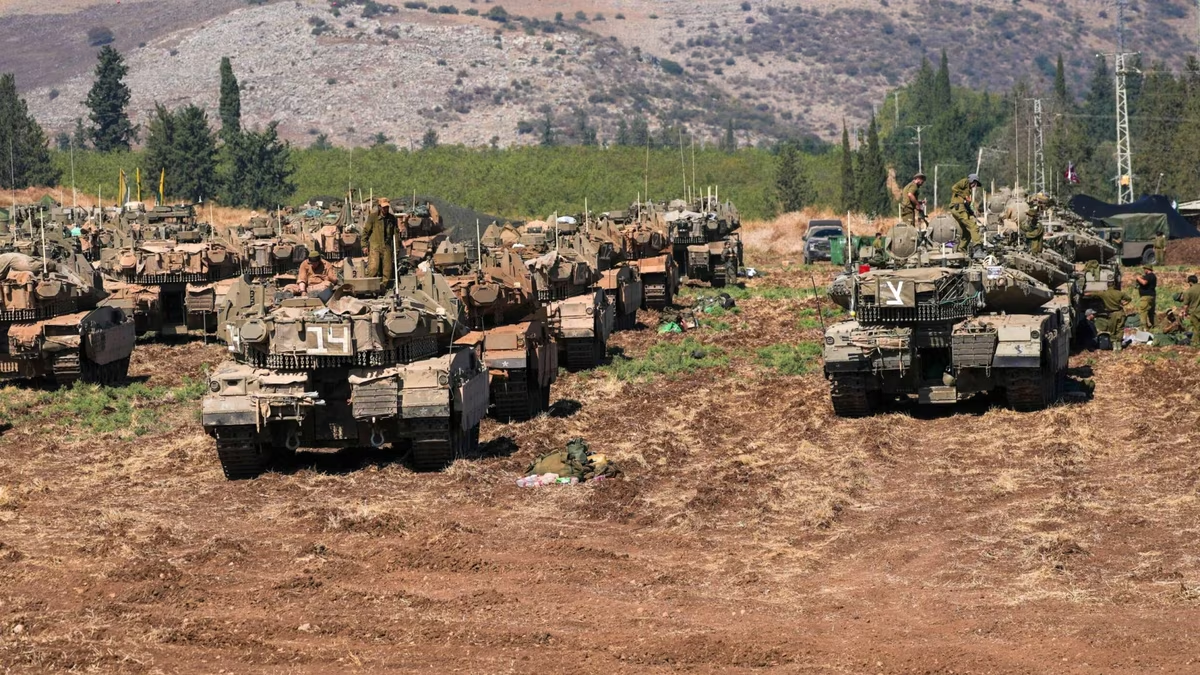
The Hebrew Broadcasting Corporation revealed this Friday evening, quoting informed sources, that Tel Aviv is seriously studying launching a large-scale military operation in Lebanon; aimed at eliminating what it called the "Hezbollah threat".

The Hebrew Broadcasting Corporation reported that Prime Minister Benjamin Netanyahu discussed the issue of expanding Israeli occupation attacks with US President Donald Trump during their recent meeting in Florida earlier this week.

According to what was published by the Hebrew Broadcasting Corporation, Israeli occupation estimates indicate that "Hezbollah" has managed, under the current ceasefire agreement, to somewhat rehabilitate its organizational and military capabilities.

Israeli officials claimed that the Lebanese government is completely "helpless" in the face of the party's movements, which prompted Tel Aviv to hint at the direct military option.

Although the Trump administration does not rule out the possibility of Tel Aviv carrying out an operation against Hezbollah, the sources confirmed that Netanyahu received a request to delay making the final decision; in order to allow more room for dialogue with the Lebanese government.

This escalation comes amid internal reports of the Israeli occupation talking about the failure of political and diplomatic paths to impose disarmament on the party, which opens the door to new military calculations.

In contrast, Lebanese Prime Minister Nawaf Salam renewed his affirmation of the state's seriousness in extending its authority, stating that the second phase of the army's plan to confine weapons will begin, covering the area between the two banks of the Litani River to the south and the Awali River to the north.

Salam explained that this phase requires careful follow-up due to its vast area, confirming the success of the military institution so far in fully controlling south of the Litani up to the borders, except for the points still occupied by Israel.

Salam announced that the Council of Ministers will hold a meeting at the beginning of the new year to evaluate the results of the first phase, demanding reciprocal steps from the Israeli side, represented by stopping aggressions and violations of the ceasefire resolution.

He indicated that Beirut is proceeding with its timeline, which includes subsequent phases covering Beirut, Mount Lebanon, and the Bekaa, despite Israeli threats that seek to obstruct this national path.

ARAB AND WORLD

Fri 02 Jan 2026 7:33 pm - Jerusalem Time

Israel renews its attack on the new mayor of New York after his decisions regarding Tel Aviv

Israel renewed its attack on Friday on the mayor of New York City, Zahran Mamdani, just one day after he officially assumed his duties, in the wake of decisions he made to end restrictions that were imposed on boycotting Tel Aviv, and to cancel the accreditation of a controversial definition of "antisemitism".

The Israeli Ministry of Foreign Affairs stated in a statement that "Mamdani, on his first day as mayor of New York, revealed his true face, as he lifted the restrictions imposed on boycotting Israel and canceled the International Holocaust Remembrance Alliance (IHRA) definition of antisemitism."

The Israeli Foreign Ministry described these decisions as "pouring oil on the fire of antisemitism," according to its expression.

Mamdani repeatedly rejected accusations of antisemitism, affirming that his criticism of Israel is based on considerations related to human rights. He pledged to protect the Jewish community in New York, while at the same time adhering to his positions regarding Middle East policies.

In the context of this controversy, Mamdani took another notable step by appointing lawyer Ramzi Kassem as the general legal advisor for New York City, praising what he described as "extensive legal expertise" and "commitment to defending marginalized groups," considering that his choice aligns with his vision for building a city that is "more just and prosperous."

However, this appointment sparked criticism in circles supportive of Israel, based on Kassem's professional record, including his work as an advisor on immigration policies in the White House during Joe Biden's administration, his defense of defendants in cases related to terrorism and detainees in Guantanamo, and his representation of student activists who participated in protests against Israel within American universities.

In November last year, Israeli Minister of Diaspora Affairs Amichai Chikli launched a sharp attack on Mamdani following his victory, claiming in a post on the "X" platform that "New York has handed its keys to a Hamas supporter," a description that Israeli officials have persistently used against anyone who criticizes Tel Aviv's policies and the genocide war it waged on Gaza.

Chikli added that "New York's choice (Mamdani) undermines the foundations of the city, which has provided freedom and opportunities for success to Jewish refugees since the late 19th century, and has become a stronghold for the largest Jewish community in the world," according to his claim.

Sharren Haskel, Deputy Minister of Foreign Affairs, also described in November last year the result of Mamdani's victory as "very worrying," referring to his previous activities and political discourse.

Mamdani, a democratic socialist, won the New York mayoral elections in November 2025, becoming the first Muslim to hold this position in a city that includes one of the largest Jewish communities in the world.

Mamdani had previously pledged in public statements to arrest Israeli Prime Minister Benjamin Netanyahu if he arrives in New York, where the United Nations is headquartered.

PALESTINE

Fri 02 Jan 2026 6:49 pm - Jerusalem Time

Angelina Jolie visits Rafah crossing and inspects injured Palestinians

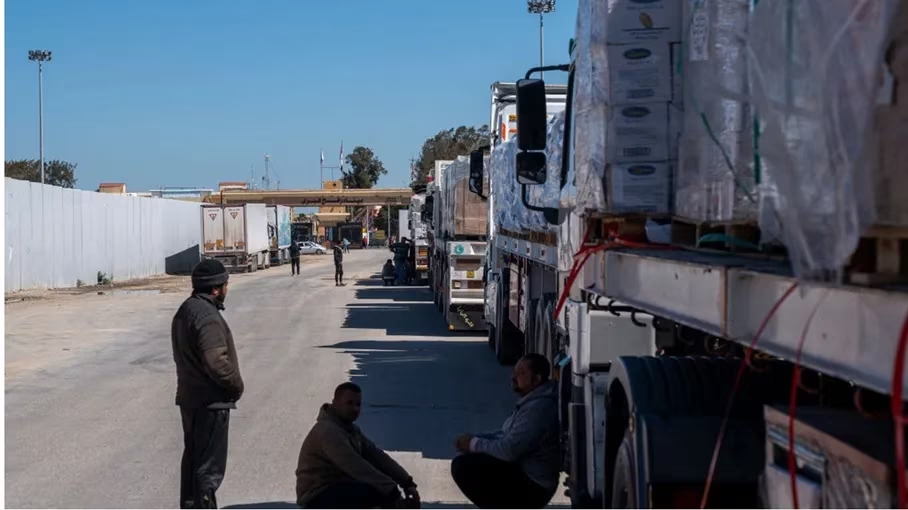
The American global star and former UN Special Envoy for Refugees, Angelina Jolie, visited the Rafah crossing from the Egyptian side east of the country on Friday.

She also inspected injured Palestinians receiving treatment at Al-Arish General Hospital in the border governorate of North Sinai, Egypt.

Egyptian official sources reported that Jolie arrived at the Rafah crossing from the Egyptian side, where she was received by North Sinai Governor Khaled Majdi, and Ambassador Nabiela Makram, former Minister of State for Immigration and head of the Technical Secretariat of the National Alliance for Civil Development Work.

They noted that Jolie's visit included inspecting the logistical warehouses belonging to the Egyptian Red Crescent, which are used to secure humanitarian supplies directed to the Palestinian people in the Gaza Strip.

Jolie also visited Al-Arish General Hospital accompanied by Aroua Jayer, representative of the US Department of State, and in the presence of the North Sinai Governor.

During the visit, she reviewed the conditions of the injured Palestinians, reassured herself about their health status and the level of medical care provided to them.

Jolie praised the efforts of the Egyptian Ministry of Health in receiving the injured and sick Palestinians and providing treatment to them in Egyptian hospitals.

On October 8, 2023, Israel began a war of collective genocide on the Gaza Strip that lasted two years, resulting in more than 71,000 Palestinian deaths and 171,000 injuries, in addition to widespread destruction affecting nearly 90% of the civilian infrastructure, while the United Nations estimated the cost of reconstruction at around 70 billion dollars.

Despite the ceasefire agreement entering into force on October 10, 2025, the living conditions in Gaza have not seen tangible improvement, due to Israel's evasion of fulfilling its commitments stipulated in the agreement, including importing the agreed quantities of food, relief, and medical materials, prefabricated homes, and opening the crossings.

ARAB AND WORLD

Fri 02 Jan 2026 5:58 pm - Jerusalem Time

Iran Protests: Deaths and US-Israeli Intervention and Judicial Escalation

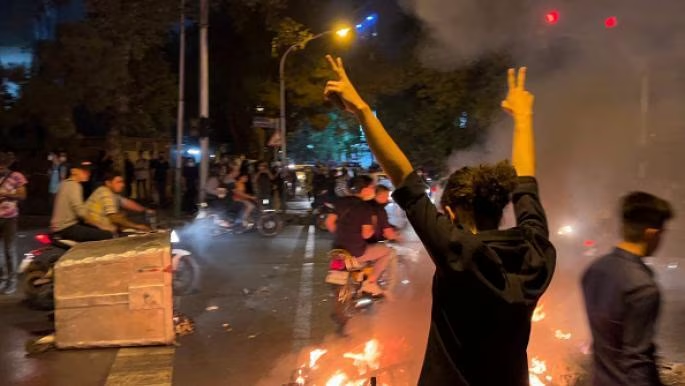
Iran has been witnessing protests since last Sunday due to the deteriorating living conditions and worsening economic crisis, starting from the Grand Bazaar of Tehran through a strike by several commercial shops, then extending to other cities, while Israel and America entered the scene by announcing support for the protesters and urging them to continue the protest and strengthen its momentum.

The protests have so far resulted in six deaths, one of them from the Basij Popular Forces affiliated with the Iranian Revolutionary Guard in Kuhdasht in Lorestan province in western Iran, and three protesters in the city of Azna in the province during an attack on a police headquarters, in addition to two protesters in the city of Lordegan in Chaharmahal and Bakhtiari province in central Iran.

During the protests, chants supporting the monarchy and its leader Reza Pahlavi, residing in the United States, emerged. There has also been limited participation so far from Tehran university students, who organized protest gatherings last Tuesday, and a number of them were arrested before being released later, while the Iranian Minister of Science, Research and Technology (Higher Education) Hossein Simayi Sarraf isolated security officials in three universities in an attempt to calm the students, noting that Iranian universities are on the verge of semester exams, where student attendance is disrupted, which could negatively affect students' involvement in the protests.

Meanwhile, while the reformist Iranian government and its president Masoud Pezeshkian tried to contain the crisis by acknowledging the right to demonstrate and dialogue with representatives of the bazaar and markets, traditional rhetoric in dealing with protests did not disappear, describing them in conservative media and figures as "riots", in addition to turning them into violent events in some cities, attacking government headquarters, institutions, and banks, resulting in at least six deaths and about 40 injuries according to media reports, and arresting dozens, 20 of them in the city of Lordegan and seven in the city of Kermanshah, on charges of links to opposition groups abroad, but no official figures yet on the number of deaths, injuries, and detainees.

The Iranian Attorney General Mohammad Mohammadi Asad threatened on Wednesday to confront "the diversion of protests", saying that "any attempt to turn economic protests into a tool for undermining security, or sabotaging public property, or executing pre-prepared foreign scenarios, will certainly be met with a proportionate and decisive legal response".

Furthermore, Ali Hasanzand, the Attorney General of Lorestan province in western Iran, which is witnessing protests, warned today, Friday, that the judiciary will deal firmly and without any leniency with those he described as "instigators of riots and anyone who harms public security", confirming that "participation in illegal gatherings and acts of disrupting order, sabotage, incitement, or threats are crimes that require judicial prosecution". He called on families to prevent their children from engaging in these gatherings.

The Iranian writer Salahuddin Khodiyu says that the map of protests reflects the integration of economic pressures with class transformations, adding that "it is still too early to reach a final conclusion regarding the composition of the ongoing protests in Iran, in terms of the social classes participating in them or their geographical scope", considering that the protests are still ongoing, making any definitive conclusion premature.

Khodiyu explained that the general pattern of participation in the current protests can be understood as a mix between the November 2019 protests over fuel price hikes, and the "Mahsa Amini" movement in 2022 over the hijab issue, noting the difficulty in formulating a precise sociological model that definitively determines the nature of participation, or the social classes, or the class backgrounds of the protesters. He added that the Mahsa Amini protests, which occurred after her death days after her arrest on the street for not complying with hijab rules, although initially classified as a middle-class movement due to the nature of its demands, especially regarding freedom of dress and women's rights and general freedoms, but when it expanded geographically and turned into mass protests in some cities, it acquired a protest character closer to a popular uprising, with a noticeable increase in the participation of lower social classes and the involvement of poor areas.

Khodiyu pointed out that the 2019 protests, which erupted over fuel price increases, were in turn of deeper economic and labor roots compared to previous protest movements, such as 1999 (student) and 2009 (protests over presidential election results), considering that the general path of protests since 2009 reflects a gradual deterioration in the economic structure of Iranian society.

Khodiyu explained that the disintegration of families' financial capacity, amid the ongoing economic crisis, led to a gradual fall of the middle class, where broad segments of this class, and even higher-income segments, slid towards lower classes. He pointed to the emergence of a new social phenomenon that can be called "the poor middle class", a category that includes individuals with higher education, carrying the culture and values of the middle class, who previously enjoyed a better standard of living, but today have regressed to the lowest economic ladder. The same speaker considered that the social base of each of the protests of the past years, and the current ongoing protests, can be interpreted as a mixture of the regressing middle class, and the poor segments, with hybrid categories such as "the poor middle class".

The Iranian expert clarified that the essential difference between the current protests and the 2022 protests lies in the fact that the main driver of the demonstrations in recent days is inflation and high cost of living and the economic crisis, confirming that the government's hand appears "completely tied", and it does not seem capable of providing quick and convincing solutions to calm the street.

Regarding the future of the protests, Khodiyu said that their continuation or retreat is linked to the extent of the disappearance or persistence of the structural drivers that produced them, predicting the persistence of these factors. He added that the United States and Israel have provided unprecedented support to the protesters compared to the past, considering that "the current economic pressures are the fruit of a maximum economic, political, and diplomatic pressure campaign, aimed at pushing Iran to change its behavior, or reaching, in case of failure, a regime change scenario".

He confirmed that the Iranian government faces an extremely difficult task in containing these protests, explaining that "even if their intensity temporarily subsides, they are likely to erupt again in the coming months, because their structural causes are deep and insoluble in the face of continuing sanctions and the absence of foreign investments, which seems unlikely given the internal and external political deadlock".

US President Donald Trump entered the line of demonstrations in Iran in an unprecedented way today, Friday, saying in a post on his social media platform "Truth Social": "If Iran shoots at peaceful protesters and kills them, the United States will intervene to save them", adding: "We are on alert and ready to launch".

The writer and political analyst Ahmad Zeidabadi said that "Trump's statements always need to be decoded, as he often takes positions then returns to soften them, or even reverses them sometimes". Zeidabadi wondered whether Trump's latest statement "is just an empty threat, or falls within the framework of psychological warfare, or if Trump actually carries a plan and program for intervention in Iranian affairs".

The Iranian writer also considered that military intervention aimed at "regime change" is the last thing Trump could think of, noting that the US National Security Strategy document classifies any action aimed at changing regimes as costly, ineffective, and rejected. He recalled that Trump emphasized, during his recent press conference with Benjamin Netanyahu in Florida, that "regime change in Iran is not something he should talk about, let alone that the spread of US forces in the region does not indicate readiness for rapid and imminent intervention in Iran". Based on that, Zeidabadi considered that military intervention in the short term is unlikely.

The same speaker explained that Trump's current policy is based on exercising "maximum pressure" on Iran to change its behavior, considering that "Trump views the ongoing protests as an opportunity to escalate pressure and threats, and may proceed in this path, in stages, to the point of attempting to delegitimize the regime". He pointed out that the impact of Trump's statements on the ongoing protests in Iran is of great importance, wondering whether US threats of intervention will lead to escalation of the protests or their retreat. He saw that these threats have a dual effect, as they may push a segment of protesters to caution and withdraw from the scene, while they may encourage other categories to continue the movement.

Following Trump's statements on Iran, Iranian authorities warned against any foreign interference in the country's internal affairs, confirming that they distinguish between demand protests and attempts to exploit them for destructive goals, emphasizing that any US move in this framework will contribute to escalating tension and threatening regional stability.

In the context, Ali Larijani, Secretary of the Supreme National Security Council of Iran, warned that any US intervention in internal protests will lead to destabilizing the region and destroying US interests, noting that US statements accompanied by Israeli positions reveal the backgrounds of what is happening.

For his part, Ali Shamkhani, political advisor to the Iranian Supreme Leader, emphasized that Iran's national security is a red line, warning that "any interfering hand approaching Iran's security will be met with a painful response", considering that US threats are nothing but "adventures".

In turn, Ismail Baghaei, spokesperson for the Iranian Ministry of Foreign Affairs, said that the US record exposes the falsity of its claims of sympathy with the Iranian people, reminding of the 1953 coup, the downing of a civilian plane in 1988, support for Iraq in the war, and maximum sanctions, considering that Washington's threats represent a blatant violation of international law, and confirming that "Iranians will not allow any foreign interference".


ARAB AND WORLD

Fri 02 Jan 2026 4:51 pm - Jerusalem Time

Israeli Occupation Army Studies Options for Military Action Against Hezbollah in Lebanon

The Israeli Occupation Army is preparing options for military action against Hezbollah in Lebanon, attempting to avoid a long attrition war, and limiting the aggression to "just a few days," in order to "not violate the ceasefire understandings reached between Israel and Lebanon, about a year and a month ago." The newspaper added that the leaders of the security system will hear from the Prime Minister of the Occupation, Benjamin Netanyahu, who returned to Tel Aviv today, details about the understandings and agreements he reached with the American President Donald Trump, and senior officials of the American administration, amid estimates that the United States will allow Israel to launch a military operation in Lebanon, under the pretext of "Hezbollah not abandoning its weapons, and the Lebanese government not taking practical steps to disarm the party, even in areas far from the Israeli borders, as it committed to Trump on the eve of signing the ceasefire agreement."

This reality pushes the Americans to stand by Israel's side in the anticipated military step. The Israeli security system intends to present a set of options to Netanyahu, to deal with what it describes as Hezbollah's ongoing attempts to rearm, and the Occupation Army estimates that strong military movements may push the Lebanese government again to take steps to "impose its sovereignty" against Hezbollah.

Israeli officials claim that France is refraining at this stage from using its weight to push for the disarmament of Hezbollah. They point out that France "is a central player in Lebanon," and had committed to overseeing the Lebanese government's implementation of the ceasefire agreement, but it is not acting as expected.

The same newspaper had previously revealed earlier this week the intention of the security institution to present a plan to Netanyahu for implementing a major operation soon. Officials in the security institution claim that "the movements in Lebanon do not meet the conditions of the ceasefire, and they are working to raise the readiness of the Israeli army to carry out an operation against Hezbollah if necessary, while emphasizing the necessity of implementing such an operation."

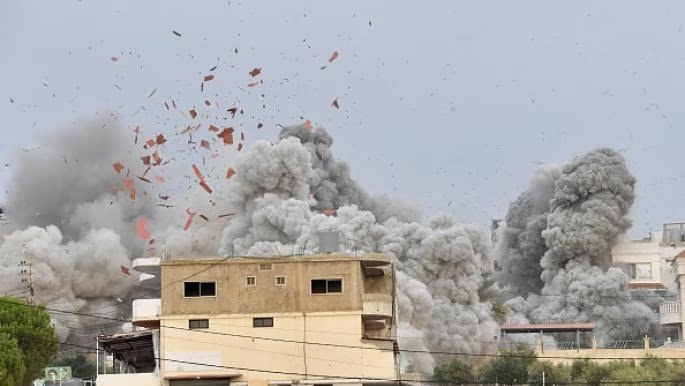
Meanwhile, the Israeli Occupation Army continues to violate the ceasefire agreement, through continuous attacks on Lebanese territories, as it launched, today Friday, a series of raids on several areas south of Lebanon, claiming that it targeted infrastructure belonging to Hezbollah, including "a training complex used by the Radwan unit, where members of the organization were trained in planning and executing operations against Israeli army forces and citizens of the state of Israel," according to its claim.

PALESTINE

Fri 02 Jan 2026 4:19 pm - Jerusalem Time

Ministry of Endowments: Settlers stormed a mosque and desecrated its sanctity in Salfit

The Palestinian Ministry of Endowments and Religious Affairs stated that Israeli settlers stormed a mosque on Friday in Salfit Governorate, north of the occupied West Bank, and desecrated its sanctity.

The ministry explained in a statement that settlers stormed the "Al-Salam Mosque" in the town of Deir Ballut in the morning, took group photos inside its mihrab, and entered it with their shoes on, considering this "a violation of the sanctity of the place and a deliberate assault on mosques".

It confirmed that this incident comes in the context of the escalation of Israeli violations against Islamic holy sites in the West Bank.

The ministry called on international and human rights institutions "to assume their responsibilities in protecting places of worship and stopping the repeated assaults on them".

Since the start of the genocide war in Gaza on October 8, 2023, the Israeli army and settlers in the West Bank, including East Jerusalem, have killed at least 1,105 Palestinians, injured about 11,000, in addition to arresting more than 21,000.

Meanwhile, the Israeli genocide with American support in Gaza has left more than 71,000 Palestinian dead and 171,000 injured, mostly children and women, and destruction affecting about 90% of the civilian infrastructure, with the United Nations estimating the reconstruction cost at about 70 billion dollars.

ARAB AND WORLD

Fri 02 Jan 2026 3:58 pm - Jerusalem Time

Leaks reveal conspiracy by former Syrian regime officials with Israel to overthrow the current government

The leaks, which began broadcasting starting from last night, reveal the plans and intentions of some former officials in the Syrian regime to conspire against the current Syrian government, and their readiness to cooperate even with Israel to overthrow this government. The most prominent figures appearing in these leaks are Suheil al-Hasan, a former officer in the Assad regime's army, another prominent officer Ghiyath Dalla, in addition to Rami Makhlouf, the businessman and relative of the former regime president Bashar al-Assad.

Suheil al-Hasan emphasized that Rami Makhlouf stands behind the financing operations of the remnants of the Assad regime on the Syrian coast, and coordinating support for these operations, before moving on to attacking Hamas and the Al-Aqsa Flood operation, thinking he was speaking to an Israeli officer, calling for the extermination of Gaza's residents, and for killing operations that extend to the sons of both the Sunni and Shia sects alike, considering them enemies of Israel. Ghiyath Dalla appeared in the leaks, who agreed in the audio recording with Suheil al-Hasan about what he said regarding the movement in Syria.

The recordings are interconnected with the latest recording of Rami Makhlouf, who called on the sons of the Alawite sect to stay away from the calls of Ghazal Ghazal, and adhere to the Russian vision in Syria, in reference to a state of competition between currents within the Alawite sect, as it indicated that it obtained more than 600 documents revealing attempts by the remnants of the former regime to organize their ranks, and coordinate roles between military and security figures in the former regime.

In this context, the academic and researcher specialized in Islamic movements, Abdul Rahman al-Haj, pointed to the existence of competition for leadership of the Alawite sect in Syria between three parties: "The first is led by Rami Makhlouf and Khadr Ali Tahir nicknamed 'Abu Ali Khadr' and Suheil Hasan and Ghiyath Dalla, the second is led by Maher al-Assad and Kamal al-Hasan, and these two parties seek to communicate with Israel and coordinate with the Syrian Democratic Forces (SDF), while the third party is a front led by Ghazal Ghazal and Muhammad Jaber, and it works in coordination with Iran and SDF."

Al-Haj indicates that the first team, which is the largest and most important among the competing parties, has the ability to control the sect due to its direct field connections with the remnants of the Assad regime on one hand, in addition to a state of frustration after the fall of the regime, where they were left to their fate unexpectedly.

Al-Haj believes that "the recent leaks relied upon by the team are based on direct Israeli support to establish a federal state, and that betting on an inevitable battle between SDF and the Syrian government constitutes a suitable opportunity to achieve this plan." He said: "In addition to this, the penetration that occurred to this depth, dozens of hours and hundreds of documents, was done through intelligence work, meaning that the operation revealed the plans, preparations, people, weapons, connections, and funding completely."

Al-Haj speculated that the Russian government is fully aware of the contacts of Suheil al-Hasan and Rami Makhlouf, and said in this regard: "I believe that the visits of Foreign Minister Asaad al-Shibani to Moscow and the presence of security and military figures in the delegation may be for this purpose." He continued: "Syria TV published, quoting a Western official, two days ago, part of the activity and contacts with the Israelis." He added, saying "The retreat of the Russian position in the level of commitment to providing protection or political cover for some projects that the remnants of the regime seek to promote after its fall, coinciding with the existing rapprochement between Damascus and Moscow."

Al-Haj pointed out that the Makhlouf current is completely exposed to the government. He continued "I do not expect it to receive Israeli support at the present time, despite the leaks saying that actual contacts occurred and Makhlouf met with an Israeli ambassador at least to obtain support," adding: "I believe that Israel is monitoring the situation on the Syrian coast amid this competition and division, and is trying to open communication lines between all parties, and perhaps SDF represents an important and common link between them, and it may be the candidate to facilitate and coordinate this contact between the Israelis and the Alawites with their competing factions."

Military groups became active after the fall of the Assad regime, the most prominent of which are the Coast Shield Brigade, and the Jawad Brigades, which the Syrian Ministry of Interior previously announced targeting several groups affiliated with it, since the revelation of its formation in a video statement broadcast via the 'Facebook' platform on August 2 last year, as the group broadcast a video recording at the beginning of September last year, announcing its responsibility for targeting a vehicle belonging to Syrian security.

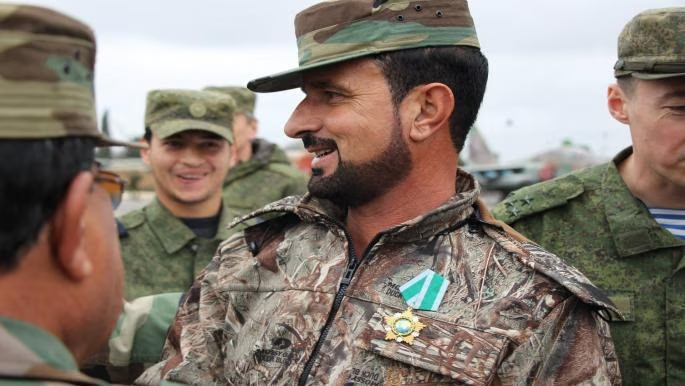
Suheil al-Hasan is a former officer in the Assad regime's army, born in the village of Beit Anna in the countryside of Latakia in 1970, graduated from the Air College in 1991, to serve in air defense units then in air intelligence. His name emerged with the beginning of the Syrian revolution, where he founded the 'Tiger Forces' that committed systematic repression operations against Syrians, and had a prominent role in bombing and invading areas in Aleppo, Hama, and Idlib, with direct Russian military support. He was imposed American and European sanctions due to serious human rights violations, including mass killings and bombing civilians, carried out by his forces. In 2024, he was appointed commander of the special forces in the Syrian army, as part of broad structural changes within the army.

As for Ghiyath Dalla, he comes from the town of Beit Yashout in the countryside of Latakia, and joined the 42nd Brigade in the 'Fourth Division' with the rise of Maher al-Assad's star, and Dalla rose quickly in the military ladder to take the position of Chief of Staff of the Fourth Division in 2004. He became one of the most prominent executive arms of Maher in the regime's suppression of the Syrian revolution that started in March 2011, and acquired the nickname of Maher's striking arm thanks to his brutal tactics that targeted civilians.

Over 13 years of military confrontations with Syrians, Ghiyath Dalla became a symbol of repression in Syria. He led in August 2012 an attack on the city of Daraya in the countryside of Damascus that claimed the lives of 700 civilians, including entire families. After Assad's escape, in December 2024, Ghiyath Dalla disappeared from sight like dozens of security leaders. But he returned to appear through a statement issued by what he called the 'Military Council for the Liberation of Syria', declaring the determination to 'liberate' Syria from the 'occupiers' and 'overthrow the new regime'.

PALESTINE

Fri 02 Jan 2026 12:15 pm - Jerusalem Time

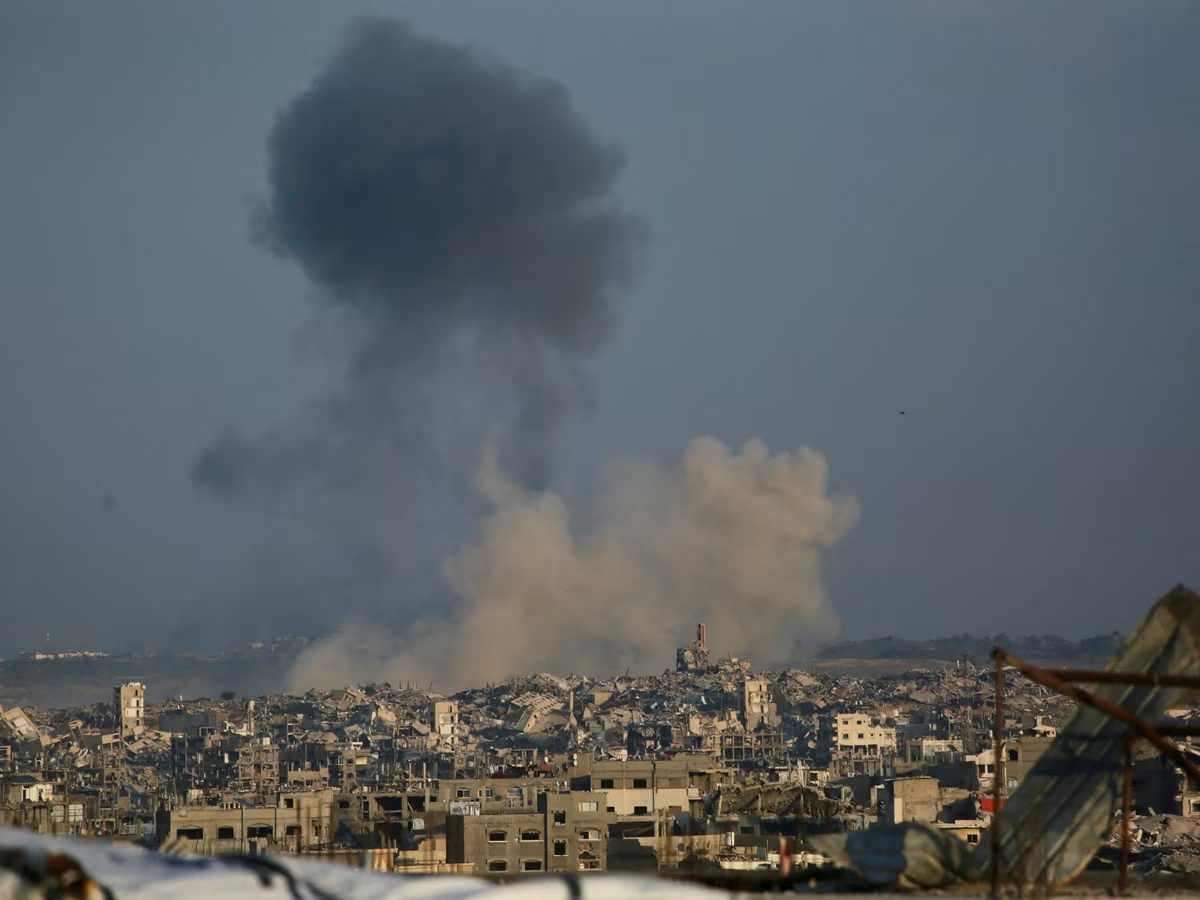
Gaza under fire again.. Intense raids and bombing strike various parts of the sector

The eastern areas of Khan Yunis city were subjected to artillery bombardment and intense gunfire. The occupation army, on Friday, launched a series of air raids and intense artillery bombardment targeting scattered areas of the Gaza Strip, in a new and dangerous field escalation that affected areas still under its direct military control, where loud explosions shook the targeted areas.

Eyewitnesses reported that the bombardment was concentrated simultaneously on three main axes, starting from the north where artillery pounded the eastern areas of Gaza City, especially the Zaytoun and Shujaiya neighborhoods, passing through the center of the sector which witnessed air raids east of Al-Bureij camp, and reaching the south where the eastern areas of Khan Yunis city were subjected to artillery bombardment and intense gunfire.

No accurate toll of injuries or human losses has been recorded so far, due to these attacks occurring within occupation-controlled areas and the difficulty of medical teams reaching them, amid the continued control of the occupation army over the southern and eastern strips of the sector, in addition to large parts of the north, equivalent to about 50% of the total area of Gaza.

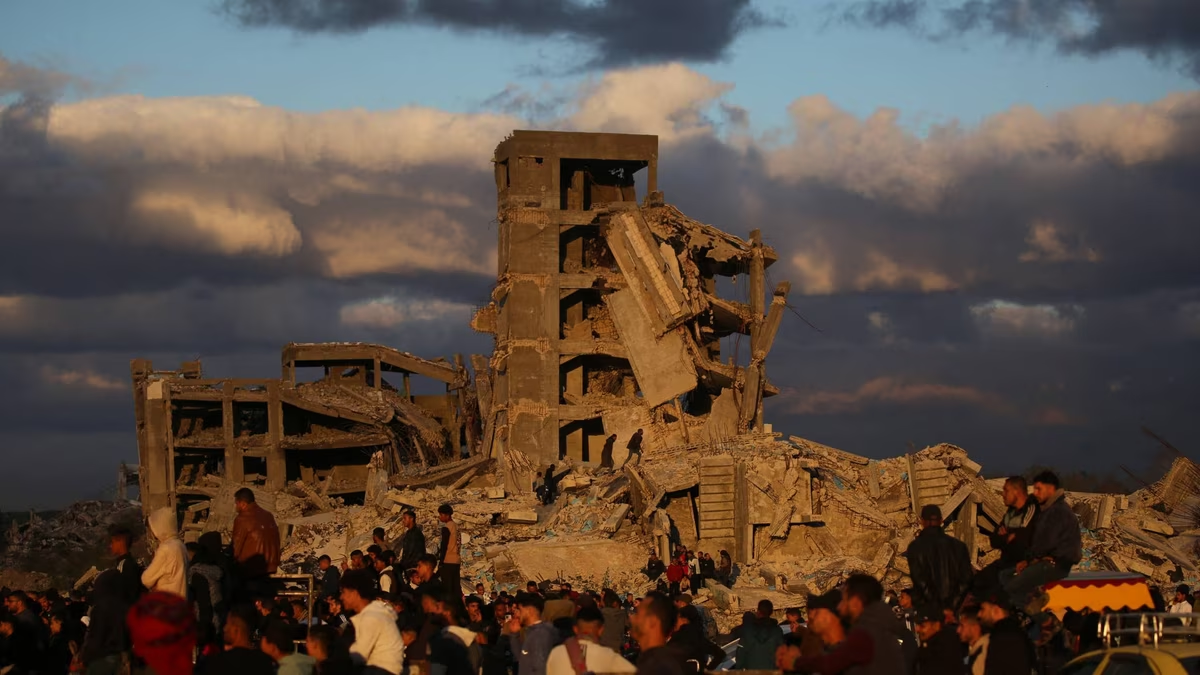
These developments come at a time when the occupation continues to violate the ceasefire agreement announced since October 10, 2025; where hundreds of violations have been recorded, resulting in the martyrdom of hundreds of victims, as part of a bloody war ongoing for two years that has left more than 71,000 martyrs and massive destruction estimated to cost billions of dollars to rebuild.

PALESTINE

Fri 02 Jan 2026 12:15 pm - Jerusalem Time

Jerusalem between 2021 and 2025.. A heavy blood toll and settler encroachment besieging the holy city

The occupation's relentless pursuit to decide the battle for Jerusalem demographically and geographically

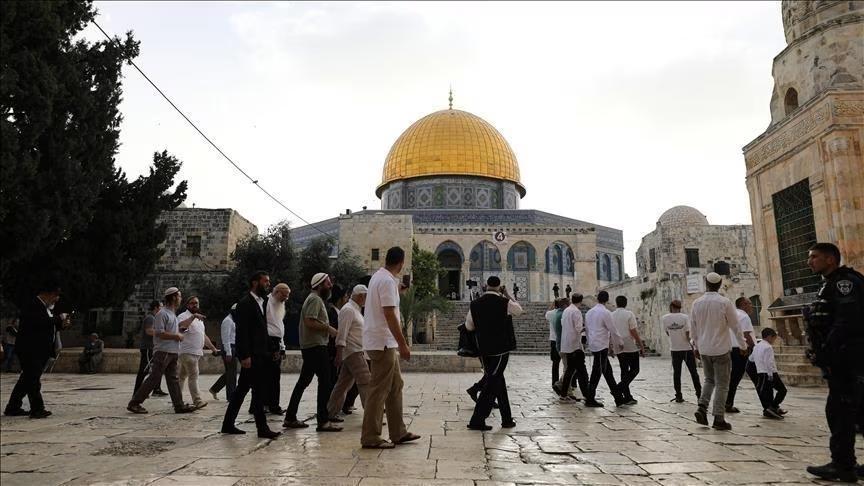
Recent official data revealed a heavy toll of Israeli violations in the occupied city of Jerusalem over the past five years, where a report issued by the Jerusalem Governorate painted a bleak picture of the field situation, documenting the martyrdom of 144 martyrs and recording unprecedented numbers in the settlers storming the blessed Al-Aqsa Mosque, indicating a systematic escalation in Judaization and repression policies.

These figures come at a time when the holy city is witnessing a fierce campaign targeting the Palestinian presence since the beginning of 2021 until the end of 2025. Indeed, the occupation authorities did not suffice with field killings, but resorted to doubling the pace of corpse detention as a tool for collective punishment and psychological deterrence, where 51 corpses remain hidden in morgues and in what is known as "number cemeteries," depriving families of their human right to bid farewell to their sons.

On the human losses front, the document indicated that 6528 Jerusalemites were injured with varying wounds due to assaults by occupation soldiers and settler gangs, who alone carried out about 1467 assaults targeting citizens and their property, including 484 attacks recorded in the past year alone.

Regarding Al-Aqsa Mosque, the data showed a dangerous leap in the number of intruders, where more than 289 thousand settlers desecrated the Haram courtyards during the mentioned period, in an attempt to impose a new reality. This coincided with widespread arrest campaigns that affected 11,555 Jerusalemites from all segments, including children, women, journalists, and mosque guards.

The occupation also resorted to the weapon of "banishment," issuing 2386 decisions, with Al-Aqsa having the lion's share at 1499 decisions, in addition to imposing house arrest on 821 citizens.

The city's stones were not spared from this war, as the governorate monitored 1732 demolition and bulldozing operations for homes and facilities, against distributing 1439 notices to stop construction. In contrast, the settlement wheel accelerated madly; where the report, in cooperation with "Association of Studies/East House," revealed the deposit of plans to build more than 35 thousand settlement units, and the final approval of about 28,700 other units, while more than 8300 units entered the tenders stage in preparation for actual implementation.

These data reflect, without a doubt, the occupation's relentless pursuit to decide the battle for Jerusalem demographically and geographically, by besieging the Arab presence with killing, arrest, and demolition, and in contrast, flooding the city with settlement blocs to create a reality that makes any future political solution impossible that restores rights to their owners.

PALESTINE

Fri 02 Jan 2026 11:00 am - Jerusalem Time

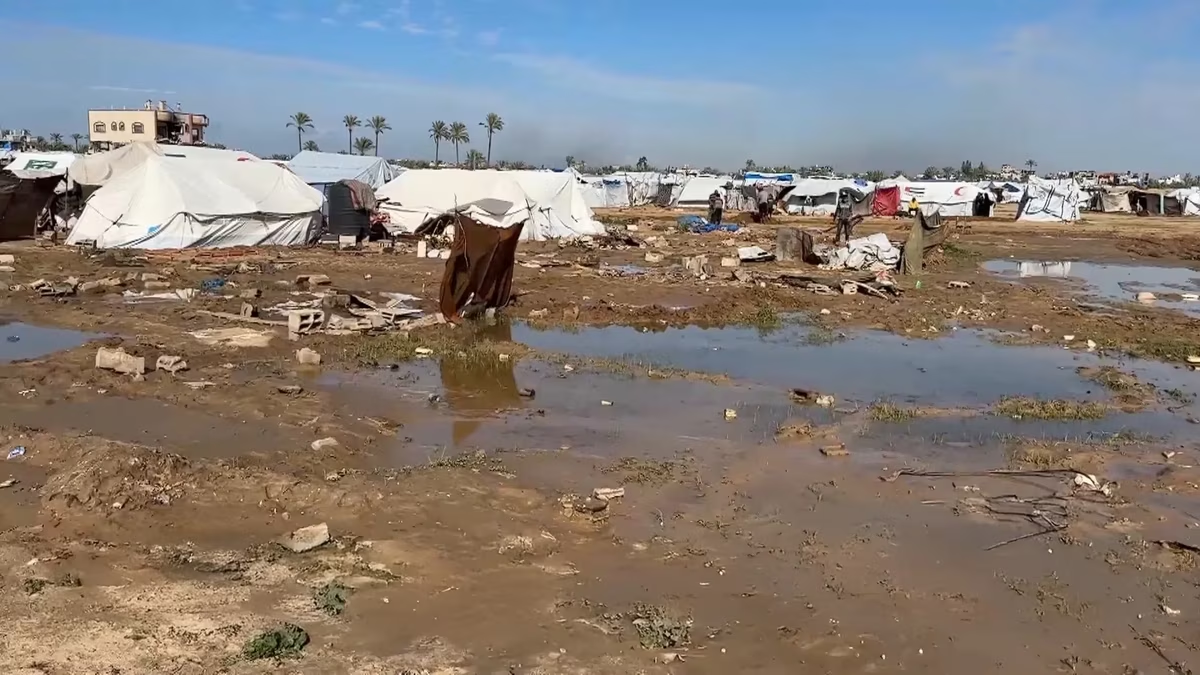
Israeli artillery bombardment east of Khan Yunis and flooding of displaced people's tents in Al-Mawasi

Israeli occupation forces carried out artillery bombardment and tank fire within their deployment areas east of Khan Yunis city. Meanwhile, rains resulting from the weather low caused the flooding of a large number of displaced people's tents in the Al-Mawasi area, which is one of the most densely populated areas with displaced people.

The Murad axis, which separates Rafah city from the rest of Gaza Strip cities, has become a launch point for military operations targeting Rafah city and adjacent areas, such as the southern and eastern borders of Khan Yunis city.

Israeli artillery stationed within this axis fired its shells on the southern and eastern areas of Khan Yunis city, where explosions from these shells were heard.

It also clarified that gunshots fired yesterday from military barracks established inside the remaining residential buildings north of Rafah city led to the injury of 4 residents of adjacent displaced people's tents.

On the other hand, Israeli occupation vehicles carried out incursions in the eastern area of Khan Yunis, which is the hottest front due to the presence of 6 towns occupied by Israel, constituting more than 50% of the city's area and inhabited by about 150,000 people.

Occupation soldiers built earthen barriers and placed yellow cubes east of Salah al-Din Street in an expansion of the blue line.

Flooding of tents

It also reported that rains resulting from the weather low caused the flooding of a large number of displaced people's tents in the Al-Mawasi area, which is one of the most densely populated areas with displaced people.

It explained that the accumulation of large amounts of rainwater led to the formation of pools and swamps, amid the municipalities' inability to provide any services.

Although the current weather low was less severe than previous lows, the abundance of rain was sufficient to flood roads and displaced people's tents, especially in the Al-Mawasi area.

Israel prevents the entry of materials needed by Gaza Strip residents to protect against winter rains or repair their homes that were bombed, amid uncertainty about the timing and mechanism for starting reconstruction.

The Israeli genocide war in Gaza, which began on October 7, 2023, and lasted two years, left more than 71,000 martyrs and more than 171,000 injured Palestinians, mostly children and women, and immense destruction with reconstruction costs estimated by the United Nations at about 70 billion dollars.

ARAB AND WORLD

Fri 02 Jan 2026 11:00 am - Jerusalem Time

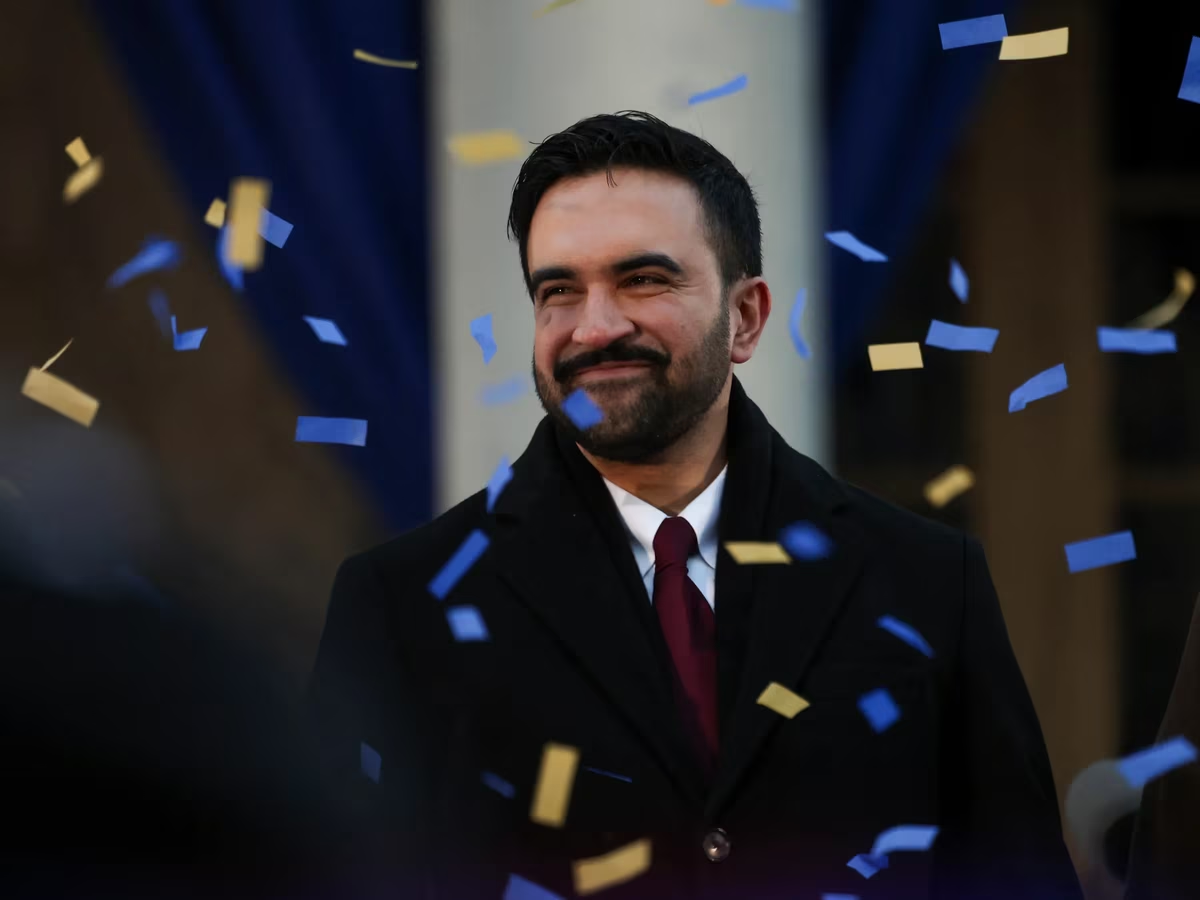
New York City's New Mayor Faces Complex Challenges After Taking the Constitutional Oath

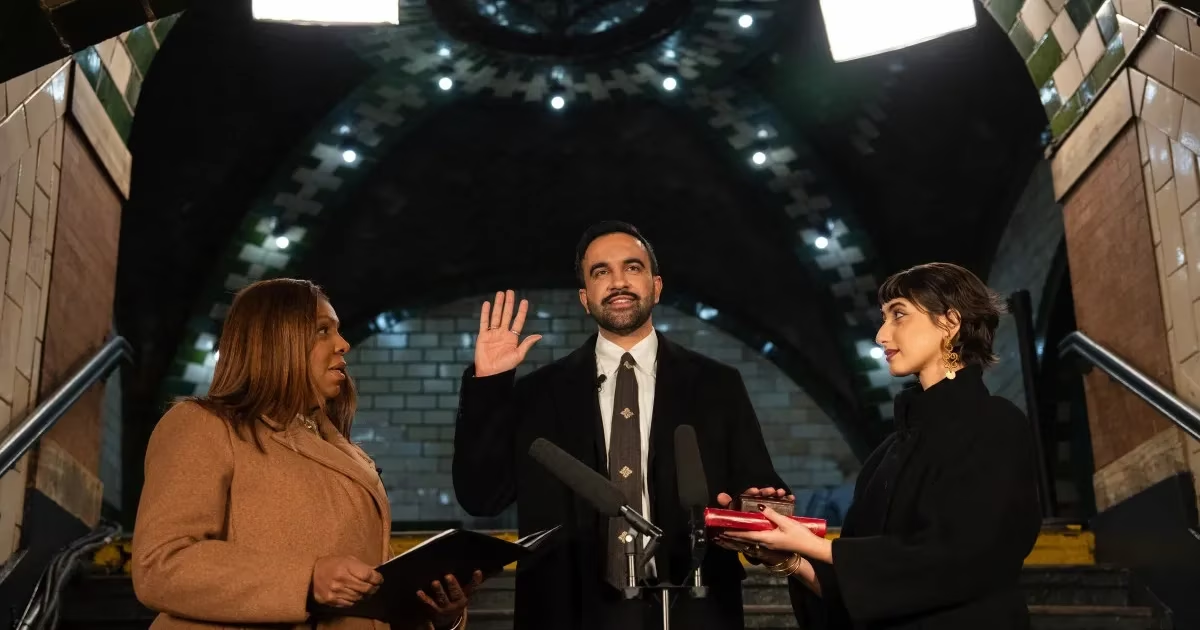
New York City's new mayor, Zohran Mamdani, faces a series of complex challenges following his taking of the constitutional oath in a city considered one of the largest, most diverse, and most influential in the world.

New York City, home to approximately 8.5 million people, is one of the world's most important cities, hosting the largest Jewish community outside Israel, and boasts extensive demographic and cultural diversity, alongside a massive annual budget approaching $100 billion, a budget that exceeds those of many countries.

Zohran Mamdani's election program primarily focused on addressing the living concerns of New York residents, including clear promises to reduce living costs, such as providing free public buses, intervening to prevent rent increases for city-supervised housing units, in addition to launching programs to support childcare, and establishing municipal grocery stores that offer food at reduced prices.

New York residents are eagerly awaiting the implementation of these promises, but achieving them will not be an easy task, as the cost of this program alone could reach about $7 billion additional to the city's budget, and some of these items require approvals that are not within the mayor's jurisdiction, such as the decision to make public buses free, which falls under the governor's authority, not the mayor's.

Mamdani faces these challenges amid ongoing smear campaigns and criticisms that began during his election campaign and continue to this day, as the celebratory atmosphere of his inauguration coincided with the organization of protest rallies against him, primarily attended by supporters of Israel.

These protests are linked to Mamdani's political positions, particularly his criticism of Israeli Prime Minister Benjamin Netanyahu and his extremist government, and his rejection of the genocide that occurred in Gaza, which has put him in confrontation with multiple adversaries.

It is worth noting that Zohran Mamdani is entering a phase full of challenges, facing parties that reject his democratic socialist-oriented programs, other parties that oppose his positions on the Israeli occupation government, in addition to extremist currents that fundamentally reject a Muslim person holding the position of mayor of a city considered one of the world's most important, not just in the United States.

Zohran Mamdani, the first elected Muslim mayor of American New York City, took the constitutional oath on the Holy Quran in the early hours of the new year 2026, in a special ceremony.

It is recalled that Zohran Mamdani won the New York City mayoral elections held on November 4th last month.

PALESTINE

Fri 02 Jan 2026 10:59 am - Jerusalem Time

Gaza Welcomes the New Year with Worsening Humanitarian Tragedies

"After only 3 days of their marriage, the dream turned into a painful tragedy, after strong winds knocked down a dilapidated wall onto the couple's tent, which was not a choice, but a fate imposed by the occupation", with these words, the Palestinian journalist Huda Na'im recounted a part of the worsening humanitarian suffering in the Gaza Strip at the beginning of the new year.

And Na'im adds in a tweet on the X platform "The bride Yafa Akkar ascended in a cruel moment, because the Israeli occupation prevents the entry of reconstruction materials, and does not even allow temporary caravans to protect people from winds and death, as for the groom, he remained alive to bear alone the weight of the tragedy: a wife who departed before life began".

And the story of the bride Yafa is not an isolated incident, it is part of a "miserable human reality" according to the United Nations Office for the Coordination of Humanitarian Affairs (OCHA), which described the situation in Gaza saying: that "the humanitarian conditions in Gaza remain miserable, and the needs far exceed the capacity of the humanitarian community to respond".

In the meantime, the media advisor for the United Nations Relief and Works Agency for Palestine Refugees (UNRWA) Adnan Abu Hasna warned that Gaza may return to square one if this situation continues, especially with no dramatic improvement in conditions as expected after the ceasefire.

And while the world celebrates the beginning of 2026 amid atmospheres of joy, merriment, and delight, Gaza entered its new year amid atmospheres of sorrow, misery, and worries, as a mother and her child were martyred due to a tent burning in an accommodation center in the middle of Gaza City, and a girl was martyred in the Nuseirat camp in the middle of the sector due to the bitter cold inside the tents, in addition to the injury of a number of people by occupation fire due to scattered targeting in the south of the Gaza Strip.

And amid the massive destruction left by the genocide war, hundreds of thousands of Gaza residents and their children face the cold, rain, and frost, and find nothing but dilapidated tents to shelter from the cold, while occupation forces continue to besiege the sector and prevent the entry of medicine, food, fuel, tents, and building materials, in a clear violation of the ceasefire agreement, amid international silence and neglect.

And in his comment on the situation, the director of the governmental media office in Gaza Ismail Al-Thawabta says: that "The Palestinian people in the Gaza Strip welcome 2026 while suffering under the weight of deep wounds and accumulated pains, left by one of the ugliest crimes of genocide in modern history, committed by the Israeli occupation over two continuous years, amid widespread aggression, suffocating siege, systematic starvation, and comprehensive destruction of the means of life".
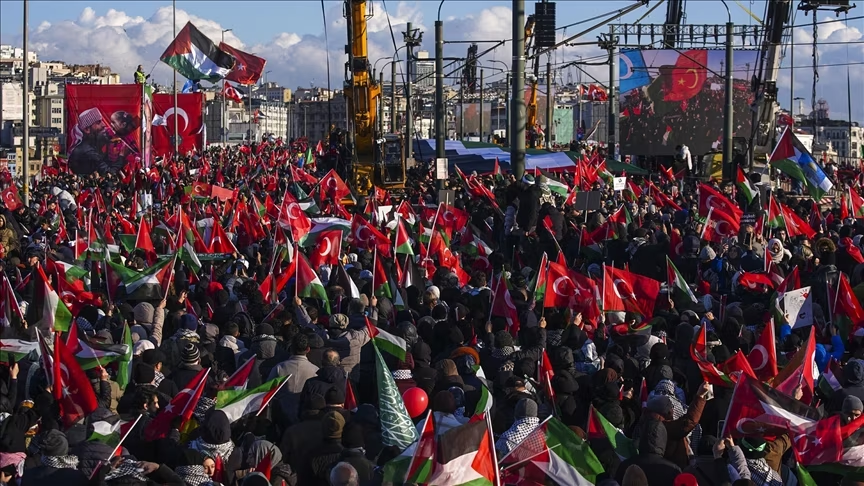
And Al-Thawabta adds, in a press conference that 2025 was one of the harshest years on the sector's residents, where more than 2.4 million people were subjected to policies of systematic killing, ethnic cleansing, and starvation, while the occupation turned Gaza's cities and towns into rubble, destroyed the infrastructure at an unprecedented rate, and razed entire residential neighborhoods to the ground, leading to the forced displacement of more than two million Palestinians.

And according to Al-Thawabta, the past year witnessed a near-total collapse of the humanitarian system in the Gaza Strip, as a result of the direct and deliberate targeting of hospitals and medical staff, educational institutions, places of worship, accommodation centers, ambulance and civil defense teams, and journalists, in addition to systematic policies to prevent the entry of food, medicine, and fuel, which led to the martyrdom of thousands of children, women, and the elderly, and the threat of hundreds of thousands with hunger and epidemics.

And he added saying: "We hope that 2026 will constitute a real turning point, through the complete cessation of aggression and the end of genocide, and the transition to a path of comprehensive humanitarian recovery, and the beginning of rebuilding the Gaza Strip on fair and sustainable foundations, ensuring the dignity of the Palestinian human being and his right to a safe and dignified life".

And Al-Thawabta confirms that the urgent priorities are represented in an immediate and permanent cessation of Israeli aggression, the complete lifting of the siege, the comprehensive withdrawal of occupation forces from the sector, the permanent opening of all crossings for humanitarian aid, relief, fuel, and medical supplies, and ensuring the free movement of citizens without restrictions.

And the office called for launching a serious path for reconstruction that includes rebuilding homes, infrastructure, health, educational, and service facilities, supporting the exhausted health sector, enabling relief institutions to perform their duties, securing the basic needs of the displaced, and ensuring their safe and dignified return to their areas.

And despite the deterioration of humanitarian conditions, Israel imposed at the beginning of the new year a series of illegal restrictions on the access of humanitarian aid, where 37 humanitarian organizations face a threat of banning activities in the Gaza Strip, including "Doctors Without Borders, the Norwegian Refugee Council, CARE Organization, World Vision, and Oxfam", in addition to a complete ban on the work of UNRWA.

And the Israeli occupation authorities placed dozens of international non-governmental humanitarian organizations before two options with no third: either submit to their conditions or cancel their license and prevent them from working in Jerusalem, the West Bank, and the Gaza Strip.

And the Israeli conditions require the organizations to submit complete lists of their Palestinian employees for security checks, and to ensure that none of them has called for boycotting Israel, which some international organizations refused out of fear of exposing their Palestinian employees to persecution that endangers their lives and threatens the safety of their families.

The targeting of humanitarian work organizations prompted the Euro-Mediterranean Human Rights Monitor to call on the international community, the United Nations, and its member states, especially the High Contracting Parties to the Geneva Conventions, to take all necessary measures to pressure Israel to lift the ban on entering temporary housing (caravans) and basic shelter supplies into the Gaza Strip, and to ensure their entry and distribution without restrictions and without linking them to any political or security considerations.

And the Euro-Mediterranean Monitor said in a statement that Israel uses the siege as an executive tool for the ongoing crime of genocide and producing a lethal living reality, by preventing and disrupting repair and reconstruction and preventing the entry of necessary materials and equipment to remove rubble and repair homes, water and sewage networks, and electricity, in addition to obstructing the humanitarian response and undermining the ability of relief parties to provide the minimum protection.

And it clarified that the policy of "denying shelter" pursued by Israel targets the destruction of the residential environment for Palestinians in the Gaza Strip and depriving them of their right to housing and safe living, as it is impossible to understand the destruction of entire cities and neighborhoods, preventing their repair and reconstruction, and preventing the entry of any temporary alternatives to shelter their residents, as a side effect of military operations, but as a deliberate pattern aimed at emptying the place of its original inhabitants by turning housing into a practical impossibility and pushing families into continuous forced uprooting.

And the Euro-Mediterranean Monitor emphasized that the continuation of these catastrophic conditions in the absence of any serious movement to find urgent solutions to the crisis multiplies health and humanitarian risks and takes a toll on the most vulnerable groups, especially children, the elderly, and the sick, and at the same time raises the possibilities of collapsing homes and destroying tents, exposing the displaced to multiple dangers including floods and the spread of diseases related to water pollution and sewage overflow, which turns daily life into a continuous suffering that threatens their dignity and lives together.

And it confirmed that it is not permissible, under any pretext, to subject the basic humanitarian needs of civilians to any security conditions or political bargains, as protecting the right to life and personal safety and providing adequate shelter are binding legal obligations under the rules of international humanitarian law and the Universal Declaration of Human Rights, and do not accept suspension or derogation or use as a pressure card, noting that any deliberate restrictions on entering and providing basic shelter supplies represent a serious violation of these obligations, and directly contribute to deepening the harm inflicted on residents who are already living under conditions that continuously threaten their lives and dignity.

PALESTINE

Fri 02 Jan 2026 10:59 am - Jerusalem Time

Hamas Welcomes International Forces to Protect Palestinians and Rejects Disarming the Resistance

The leader in the Islamic Resistance Movement (Hamas), Taysir Suleiman, revealed the movement's position on the issue of Turkish or Islamic forces participating in any potential security force in the Gaza Strip, confirming that the movement welcomes any international presence aimed at protecting the Palestinian people, and categorically rejects any forces whose goal is to fight the resistance or disarm it.

Suleiman explained that the Palestinian people in the West Bank, Gaza Strip, Jerusalem, and the territories occupied in 1967 are subjected to continuous aggressions by the Israeli occupation, noting that what is happening in the West Bank and Jerusalem, and what the Gaza Strip witnessed in the recent period of direct killings and genocide, confirms the need for real protection for Palestinians.

He added that any international talk about introducing forces into Gaza must start from a clear objective, saying that the mission of these forces, as expressed by Hamas and Palestinian factions, is to stand at the border areas and protect the Palestinian people from Israeli aggressions and prevent any infiltrations, confirming that any agreement that achieves this goal is welcomed and called for.

Suleiman emphasized that the movement clearly rejects any military or security presence whose goal is to fight the resistance or disarm it, saying that Hamas considers any such action a deviation from what is agreed upon, and constitutes a breach of a path that is supposed to lead to protecting the Palestinian people, not targeting them.

Regarding the Israeli rejection of Turkish or Islamic forces participating, the Hamas leader considered that the occupation always seeks to empty any initiative of its content, explaining that Israel only wants forces that work to serve its interests and do not stand against its aggressions.

Suleiman said that the occupation well understands that Turkish or Islamic forces will not be on the side of Israeli aggressions, and will not participate in fighting Hamas or Palestinian factions or the resistance in the Gaza Strip, predicting that the coming days will witness an escalation in Israeli opposition to any Turkish presence in this context.

The Hamas leader warned that the scenario sought by the occupation is to form forces similar to UNIFIL forces in southern Lebanon, which allows Israel to move freely without any real intervention or genuine restrictions from the United Nations or the Security Council.

Suleiman pointed to what he described as the contradiction in the Israeli and American proposal, noting the American administration's talk about the desire of more than 50 countries to participate, confirming that this large number of countries will not accept working according to the Israeli vision that targets the resistance or imposes inspections or pursuit of Palestinian fighters.

The Hamas leader concluded by emphasizing that any security or political arrangements that impose a government or authority that obeys the occupation's orders and implements its policies are rejected Arabically and Palestinianly, stressing that Hamas and the Palestinian resistance will not accept any formula that diminishes the Palestinian people's right to resistance or affects their security and dignity.

PALESTINE

Fri 02 Jan 2026 10:38 am - Jerusalem Time

Warnings from the Occupation Army to Netanyahu Regarding the Resistance's Weapons in the Gaza Strip

Warnings from the Occupation Army to Netanyahu: Absence of a political vision for Gaza brings Hamas back to expansion.

Yedioth Ahronoth newspaper revealed a sharp disagreement that erupted within the Israeli Occupation's Security Cabinet regarding the future of the Gaza Strip, where the Chief of Staff of the Israeli Occupation Army "Ayal Zamir" issued a direct warning to Prime Minister Benjamin Netanyahu during a security meeting held last week.

Military fears of "power vacuum"

Zamir called on the Prime Minister to make a clear decision regarding the entity that will manage the sector in case the International Stabilization Force "ISF" fails, which is promoted by Washington as part of US President Donald Trump's plan to dismantle the Hamas movement.

The Chief of Staff warned that the absence of a political vision will inevitably lead to Hamas expanding again, noting that the army refuses to enter a new military adventure without clear political cover.

Trump's plan and intelligence skepticism

The Israeli army expresses deep skepticism about the International Force's ability to disarm Hamas, despite American pressures to implement Trump's 20-point plan, which stipulates the creation of a "Peace Council" that oversees the appointment of a technocratic government.

In this regard, intelligence agencies confirmed before the Knesset that Hamas is working to strengthen its military and organizational capabilities and develop its combat tactics significantly since the end of the last war.

Proposals for "Green Rafah" and phased division

Tel Aviv is heading to apply the "Green Rafah" experiment, which involves returning residents to rebuilt areas after undergoing strict security vetting. But this step faces internal opposition from ministers like "Bezalel Smotrich".

At the same time, officials warn against the "phased division" approach (Brosot) that Washington may push towards, which could give Hamas an opportunity to exploit the security vacuum in areas that have not been rehabilitated yet.

PALESTINE

Fri 02 Jan 2026 10:03 am - Jerusalem Time

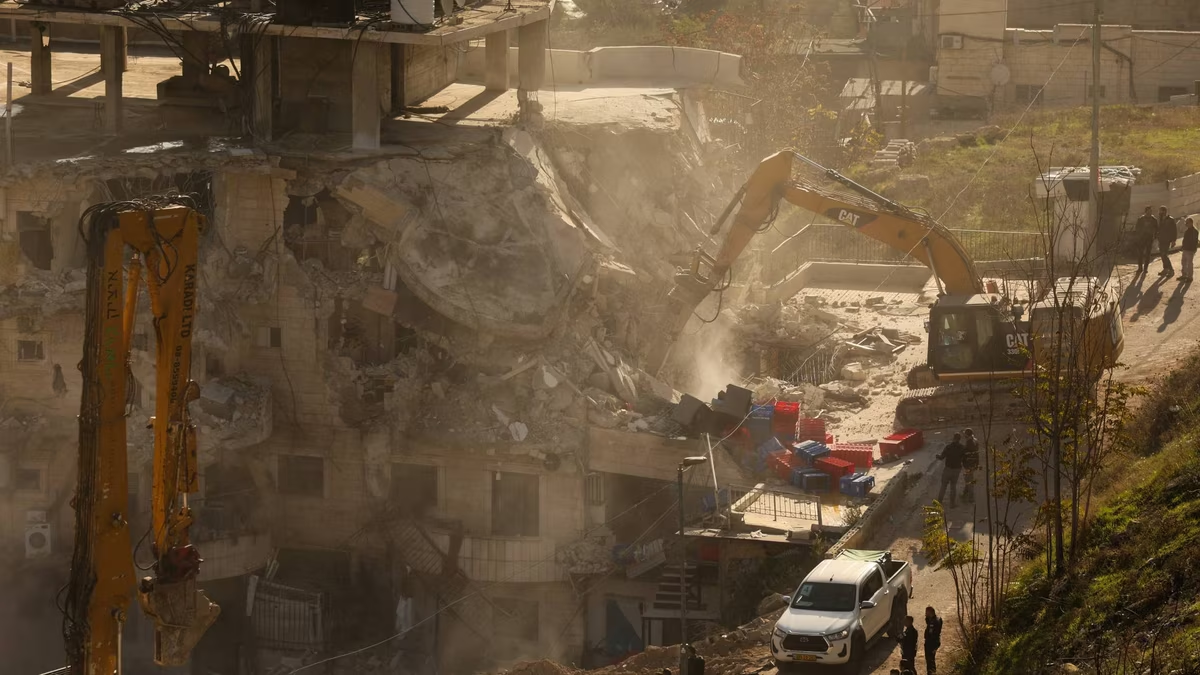
The occupation continues to demolish homes in Nour Shams camp in Tulkarm

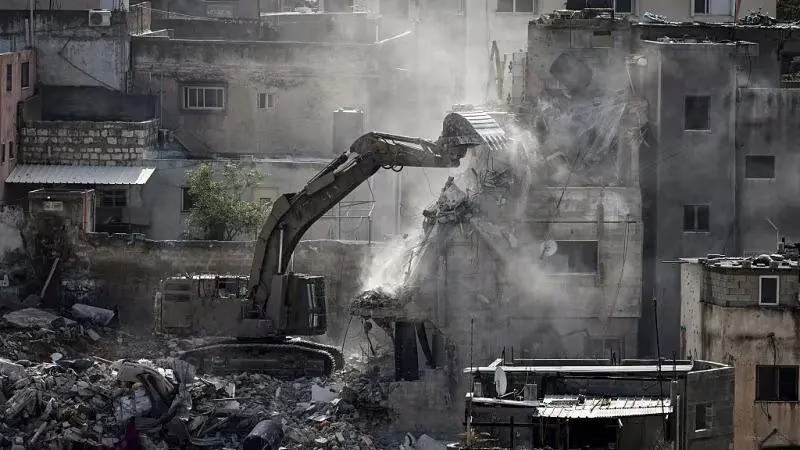
Israeli occupation forces continue to carry out demolition operations in Nour Shams camp in Tulkarm in the West Bank, where about 25 buildings housing more than 100 homes are being targeted.

Amjad Shhada clarified that the demolition operation began in the western area of the camp, known as the "Slaughterhouse" neighborhood, then the bulldozers moved to the eastern area, specifically in the "Manshiya" neighborhood, as part of a new wave of demolitions.

He added that the demolition of these homes is part of a series of operations including 3 camps that the occupation has been raiding for about 11 months in the northern West Bank, where the total number of homes demolished since the beginning of the incursions has reached about 500, according to the Popular Committee for Nour Shams Camp Services.

Shhada indicated that the ongoing demolition operations have led to the destruction of half the homes and more than a quarter partially, making only a quarter of the homes habitable in the camp in the event of the occupation's withdrawal.

He added that the demolition operations come as part of a strategy aimed at displacing and weakening the camp residents, who number more than 40,000 Palestinians, alongside the continuation of daily incursions, raids, and arrests carried out by occupation forces in the West Bank.

Arrests and incursions

The latest incursions included scattered areas of the West Bank, including the town of Anabta and Kafr al-Labad east of Tulkarm, the town of Halhul and Dura north and south of Hebron, in addition to areas in Bethlehem such as Hussan and Beit Jala.

Israeli occupation forces arrested, on Friday, three Palestinians from Hebron governorate during extensive raids on citizens' homes.

These moves come amid the continuation of settler assaults on Palestinian citizens.

ARAB AND WORLD

Fri 02 Jan 2026 10:02 am - Jerusalem Time

World newspapers: Warnings that the calm in the region is temporary

World newspapers covered intertwined issues in the international scene, led by the Palestinian-Israeli issue, amid warnings that the prevailing calm in the region may be temporary, alongside developments extending from Ukraine to Latin America.

The British newspaper The Guardian revealed that Israel allows certain companies to import specific goods into the Gaza Strip, while preventing humanitarian organizations from importing the same materials.

The newspaper quoted military, diplomatic, and humanitarian sources that these goods are currently being sold in the open market inside Gaza, despite passing through 3 Israeli checkpoints under strict surveillance.

A diplomatic source expressed shock at the ability of commercial channels to import these goods, ruling out that this could happen without the knowledge of the Israeli authorities.

The newspaper considered that this disparity hinders the work of humanitarian organizations supporting Palestinians at a time when the need is increasing, while providing profitable opportunities for traders capable of obtaining import permits from Israel.

As for the Yedioth Ahronoth newspaper, it published an article forecasting the new year for Israel, which is supposed to be the first in 3 years without a state of war, but the newspaper warned that the current calm may be temporary, amid continued tension on the northern and southern fronts and across the seas.

The article indicated that Hezbollah has not disarmed, and Hamas is not ready to do so, while Iranian preparations continue for what it described as the upcoming battle with Israel, in addition to Israel's future expectation of dealing with the Houthi file in Yemen.

As for the director of the International Crisis Group, Comfort Ero, she considered in an article for Foreign Policy magazine that postponing details as an exit from the state of war is an approach whose success is doubtful.

Comfort Ero said that the ceasefire in Gaza shows the risks of short-term solutions, where Palestinians are crammed into less than half the sector's area, while Israel controls the rest of the areas, hinders reconstruction, and continues its strikes as a transitional phase.

In another file, the Washington Times reported that Azerbaijan and Armenia are gradually distancing themselves from Moscow and approaching Washington following the peace agreement brokered by US President Donald Trump.

The newspaper pointed to Azerbaijan's strategic importance, as it is the only country bordering Russia, Iran, and Turkey together, and Washington views it as a reliable partner that maintains relations with Israel.

The Washington Post said that Russia succeeded in provoking global anger regarding an alleged Ukrainian attack on one of the residences of Russian President Vladimir Putin, noting tension in Trump's position on supporting Kyiv.

For its part, the New York Times spoke in a report from the Ukrainian front about soldiers' doubts about the war's imminent end, with conviction that it will continue for at least another two years.

The Wall Street Journal concluded that China will not make concessions to the United States in Latin America, confirming that Beijing's ambitions have gone beyond the economy to the strategic dimension.

PALESTINE

Fri 02 Jan 2026 8:56 am - Jerusalem Time

Rafah Crossing Disrupts Netanyahu Government's Balances

The question of opening the Rafah Crossing remains one of the most complex and sensitive files in the Israeli political and security scene, as it intersects with direct American pressure and the internal coalition calculations of Israeli Prime Minister Benjamin Netanyahu, who is wanted by the International Criminal Court on charges of committing war crimes in Gaza.

While Washington insists on opening the crossing in both directions for humanitarian and political reasons, Netanyahu finds himself forced to maneuver between the requirements of his American ally and the threats from his partners in the ruling coalition, who see opening the crossing as an unacceptable concession.

Israeli political estimates indicate that Netanyahu is likely heading towards opening the Rafah Crossing, even if partially or intermittently, in an attempt to "grasp the stick from the middle." The man does not want to enter into direct confrontation with the American administration, especially President Donald Trump, and at the same time seeks to avoid the disintegration of his government coalition from within.

Based on understandings reached by Netanyahu and Trump during their last meeting at Mar-a-Lago resort in Florida, which stipulate opening the crossing after Netanyahu's return to Tel Aviv.

The main obstacle to implementing this step lies in the strong opposition expressed by far-right parties within the coalition, headed by the "Otzma Yehudit" party led by National Security Minister Itamar Ben-Gvir, and the "Religious Zionism" alliance led by Finance Minister Bezalel Smotrich.

Before Netanyahu's trip to America to meet Trump, Ben-Gvir and Smotrich explicitly threatened to withdraw from the government if Netanyahu proceeded to open the crossings, considering it an assault on what they call "Israeli security."

In contrast, American pressures escalated during Netanyahu's meetings in the United States, where officials in the Trump administration emphasized the necessity of opening the Rafah Crossing "in both directions," linking it to broader plans related to the humanitarian situation in Gaza and "Trump's plan" and post-war arrangements.

Opening the Rafah Crossing has become a "matter of time" after the step was postponed before Netanyahu's trip to Washington for internal political reasons, and an American official was quoted as saying that the announcement of opening the crossing may be issued within a few days directly after Netanyahu's return to Israel.

In the context, it was mentioned that clear understandings were achieved between Netanyahu and Trump, including not only opening the crossing but also starting reconstruction work in the Rafah area south of the Gaza Strip, in areas where the Israeli army claims it has ended most of the military infrastructure of the Palestinian resistance.

The most likely scenario is Netanyahu resorting to a policy of political and security compensation for his opposing partners. Instead of abandoning opening the crossing, he may offer them "prices" in other arenas, with the aim of keeping them within the coalition and avoiding early elections. This price could come in various forms, including:

A broader military escalation against Hamas in Gaza, to market opening the crossing as a "tactical measure" that does not affect deterrence.

More military and settlement encroachment in the West Bank as a reassurance message to right-wing parties and Smotrich, the sponsor of the "Decisive Plan" based on the vision of "Greater Israel" between the sea and the river in all historical Palestine.

Expanding the circle of regional confrontation, whether through strikes in Lebanon or operations against direct or indirect Iranian targets, within what Netanyahu calls a "multi-front battle."

In the end, according to Israeli estimates, Netanyahu's inclination to open the Rafah Crossing is not a conviction in itself, but a result of complex balances imposed on him by American pressures on one hand, and fears of coalition disintegration on the other.

According to Israeli analyses, opening the crossing—if it happens—will likely be a limited step accompanied by escalation or concessions in other arenas, in an attempt to maintain the government's survival and meet Washington's demands without losing his right-wing allies.

Retired Colonel Mikhail Milstein, former head of the Palestinian Affairs Department in the Military Intelligence Division of the Israeli Army (Aman), sees Hamas viewing the decision by Trump and Netanyahu to open the Rafah Crossing as a "major political and moral achievement in its favor."

In his comment, Milstein said that "reports talking about American-Israeli understandings to open the crossing in both directions are presented in Hamas's internal discourse as evidence of its success in imposing new equations after the war, and marketed as a step that restores the Gaza Strip to what it was before October 7."

Milstein says that "the essential question for Israel does not relate to symbolism only, but to the practical implications on the ground."

He wondered: "What will Israel do if it detects the entry or exit of elements it does not want to exist? And how can the movement of individuals be controlled in a crossing that is supposed to be open in both directions?"

In contrast, military correspondent for the Walla website Amir Buchbut expressed a great deal of caution regarding these reports, noting that there is no official and final confirmation yet regarding the opening of the Rafah Crossing, at least from the Israeli government, large circles of which oppose this step.

The military correspondent clarified that the picture may become clearer with Netanyahu's return to Israel, but what is happening "behind the scenes" in the corridors of the coalition parties remains surrounded by large question marks.

Buchbut raised a series of questions he described as essential, such as: Will opening the crossing be limited to pedestrians or will it include goods? Who will oversee security inspections? And how will Israel ensure the prevention of smuggling weapons or materials of military use into the Gaza Strip?

The military correspondent even went further, wondering how the Israeli government could agree to open the crossing amid the file of recovering the body of the last abducted soldier in Gaza, Major Ran Guili.

Between Milstein's reading, which sees opening the crossing as a direct gain for Hamas, and Buchbut's skepticism, which highlights the security and political ambiguity, it becomes clear that the Rafah Crossing remains an open file on complex possibilities that go beyond the decision to open itself to the strategic implications it carries for Israel and the region as a whole.

ARAB AND WORLD

Thu 01 Jan 2026 6:25 pm - Jerusalem Time

Historical Documents Reveal Jewish Efforts to Establish a State in Somalia 81 Years Ago

Amid the occupation's recognition of what is known as Somaliland, the secessionist region located in northern Somalia, which had maintained secret contacts with the occupation, historical documents resurfaced again, discussing the efforts of the Jewish Agency, with assistance from Britain and America, to establish a state for European Jews in that area about 81 years ago.

And accounts published a set of historical documents, which were reviewed and translated the most important parts of them, which included correspondences from the American Foreign Ministry to the Kingdom of Ethiopia, to arrange the establishment of a region under autonomous rule, special for European Jews, in addition to a booklet drafted by Herman Furberg, head of the Gildemeester Committee for Jewish Aid, which was founded in 1938 in the Netherlands, during the Nazi period.

Furberg was one of the most prominent workers on the file of European Jewish migration to Ethiopia, and those seeking to establish a state for them from land cut in the Harar region with parts of Ethiopia and Somalia, which was explicitly called Somaliland at the time.

And the head of the Jewish organization, in the correspondences included in his book, said, "I believe that there is only one region that combines in itself the four advantages I mentioned, and my proposal is to unify what is called the Harar region in Ethiopia with part of British Somalia, and establish a state for European Jews there."

And he added: "This region is wide enough as it will be easy to allocate between 60-70 thousand square miles for this purpose, and it is inhabited by a small number of agricultural residents, who are not expected to cause major difficulties, and nevertheless, it will be necessary to remember the lessons learned from the Palestine experience, that is, preventing the region from being flooded with people coming from other parts of Ethiopia, and preventing the entry of foreign agitators."

And Furberg emphasized that "the climate in the plateau is completely healthy and suitable for Europeans, as for those parts of the Somali coast that have a bad climate, they can be improved within a reasonable period of time through irrigation."

And he said that "the Harar region is particularly suitable for agriculture, and therefore for mass migration, as it will have ready markets for its agricultural products, and later industrial ones, within Africa, and in Arab countries, and in parts of India."

And he pointed out that "from a political point of view, these regions belong, as previously mentioned, to Great Britain and the Ethiopian Empire."

And Furberg mentioned, in his speech to the British, that the British government proposed in 1935 to the Emperor of Ethiopia that he hand over to him the port of Zeila and some other parts of British Somalia, if he was ready to make certain concessions to Italy."

And he continued: "Therefore, it is not unlikely that the British government today is ready to cede a relatively larger part of Somalia, with the port of Berbera, to the European Jewish state that we envision."

And Furberg said "that the Ethiopian Imperial House claims descent from the Jewish King David, and the Emperor bears the title Lion of Judah", adding "shouldn't that also mean a certain commitment to providing the needed help to these non-blood brothers in Europe, and receiving them with conditions befitting the twentieth century?"

And he indicated by saying: "As for the Jews, on their part, they should not have objection to recognizing the supreme sovereignty of the Ethiopian Emperor, with some guarantees from Great Britain and the United States of America.. Let the Lion of Judah prove that he combines the courage of David, the wisdom of Solomon, and the good management of the Queen of Sheba."

And the book, documented by the Holocaust Museum, without presenting it as an electronic copy, included a letter from Furberg to the King of Ethiopia Haile Selassie, which included the following text: "Your Majesty.. A group of Jewish men and women of European origin presents the following petition to Your Majesty, hoping that it will receive your kind attention and approval, and our group revolves around Mr. Herman Furberg, whose name and work in connection with the settlement project in Harar must be known to Your Majesty."

And the letter added: "In order to refer to our geographical and political goals, the group has adopted the temporary name The Council for an Autonomous Jewish Region in Harar, Harar Council, and we hope that Your Majesty will allow us to continue using this name or an alternative name that is more appropriate."

And the signatories said, "No doubt Your Majesty is aware that large numbers of innocent men and women in Europe have suffered severe persecution at the hands of the Nazis in recent years. And this persecution has fallen particularly hard on the Jewish people, who have reached suffering, and we seek the basic principles, and prepare a basis for an agreement negotiated with Your Majesty."

And the proposal included allocating what was described as the Harar region, of which Somaliland would be part, "under Your Majesty's sovereignty, for the migration of European Jews, and representations will be made to the British government regarding regional arrangements in British Somaliland, allowing free access to the sea through the ports of Berbera and Zeila."

And according to the letter: "The migration will take place in large and organized groups, heading to lands that have been carefully identified and allocated in advance, and all immigrants wishing to settle in the Harar region are required to take an oath of allegiance to Your Majesty, and after completing the migration procedures, they obtain full rights and duties of citizenship within the Harar region, and this citizenship does not entitle its holders to obtain citizenship in other parts of the Ethiopian Empire.

And it continued: "The autonomy of the region extends within its borders only. And all internal affairs are managed by a governing body elected by the region's inhabitants. And a royal governor or viceroy is appointed as Your Majesty's representative, and his rights and duties are defined in a special democratic constitution for the region, and English is the official language, and all education is in this language."

And the letter indicated that the King of Ethiopia has the right to obtain "an agreed fair share of some taxes imposed in the region, and this income will increase with the growth of industrial and cultural life in it, and the responsibility for loans contracted by the Harar region is limited to the citizens of that region, and does not impose any obligation on the Ethiopian government."

We are fully aware of the many difficulties involved in implementing this project, but the necessity …

And the documents reveal that Furberg was enthusiastic about establishing a Jewish state in Somaliland and Ethiopia, and abandoning the Balfour Declaration, in which Britain pledged to establish a "national home" for Jews in Palestine after occupying it.

And Furberg said in one of his correspondences: "Abandoning the Balfour Declaration will be a sacrifice offered by the Jews.. Abandoning independence in Palestine, and the national homeland in the Holy Land, is indeed a heroic sacrifice sacrificed on the altar of humanity, and this sacrifice will be justified if it contributes to shortening the duration of the war, even by a few days; and it will be justified doubly if it creates the possibility for millions of Jews to live in political and economic security and this possibility exists in fact; it exists here and now, and it means Somaliland."

And he wondered "Has the Jewish people throughout the world, and not only those persecuted by Hitler, looked for years with confidence to the peoples of England and the United States. Who can doubt that these two peoples will appreciate the greatness of the sacrifice represented in abandoning the Balfour Declaration?"

And Furberg said: "The benefits resulting from establishing such a state will be greater for non-Jews than for Jews, and it seems certain that abandoning the Balfour Declaration will remove the poison from Arab-Jewish relations, and make friendship and understanding between the two peoples possible, and I have already pointed to the benefits that will accrue to the British Empire and to the United Nations. And the whole world will be freed from a potential and permanent source of disturbance."

And he continued: "And for Jews in England and the Americas, establishing an autonomous Jewish state outside Palestine will be a great improvement in their own situation, and the idea of establishing a Jewish state outside Palestine is not new, and a not insignificant number of regions have been studied from this angle."

The original map reproduced and clarified by artificial intelligence

PALESTINE

Thu 01 Jan 2026 6:23 pm - Jerusalem Time

The occupation suspends the work of more than 20 international humanitarian organizations in Gaza

The occupation announced on Tuesday the suspension of the work of more than twenty international humanitarian organizations in the Gaza Strip, including Doctors Without Borders, claiming their non-compliance with new rules imposed by the occupation authorities to scrutinize the work of international organizations operating in the sector.

The Ministry of Diaspora Affairs of the occupation stated that about 25 humanitarian organizations, representing nearly 15 percent of the total non-governmental organizations operating in Gaza, will not renew their permits starting from January 1, 2026, on the pretext of not meeting new requirements related to disclosing employee data, funding, and operational mechanisms.

This decision comes in the context of the occupation's siege of the sector and obstruction of the work of international humanitarian organizations that are allowed to enter Gaza.

ARAB AND WORLD

Thu 01 Jan 2026 4:49 pm - Jerusalem Time

AIPAC Retreats from Its Aggressive Strategy in US Elections

The American Israel Public Affairs Committee (AIPAC) launched a broad public campaign to assert its dominance in the previous electoral cycle, spending more than $100 million on the 2024 elections to oust critics of "Israel" from Congress.

AIPAC spent more on elections in that cycle than any other single-issue lobbying group; it celebrated its affiliated political action committee, the United Democracy Project, as "one of the largest bipartisan political action committees in America"; and attributed to itself the credit for supporting 361 pro-"Israel" candidates who won in hundreds of electoral races.

This success was met with widespread public outrage over Israel's genocide in Gaza, leading to a violent backlash and igniting a growing movement to eliminate AIPAC's influence and support independent candidates for Congress committed to rejecting support from pro-Israel lobbying groups. Now, with the 2026 midterm elections approaching, AIPAC and its preferred candidates have retreated from the aggressive electoral strategy they pursued in previous elections.

This does not mean AIPAC intends to relinquish its influence. While the group has not officially endorsed any new candidates in this electoral cycle, there is still plenty of time, and it is working covertly to bolster its preferred candidates' campaigns. For example, AIPAC's board chairman held a fundraiser earlier this month for a congressional candidate in Illinois, who publicly stated she is not seeking the group's endorsement. In another district in the same state, AIPAC donors rallied support for a real estate mogul's bid for Congress.

These moves represent the latest in a series of strategic adjustments AIPAC has made in recent years amid the changing political landscape regarding Israel-related issues.

Former Democratic Representative Mary Newman from Illinois, whose ouster in 2022 was aided by pro-Israel donors, said: "They fully realize their image is at rock bottom."

At this point in the previous electoral cycle, AIPAC had already endorsed most of its candidates. But with an increasing number of candidates adopting the slogan of rejecting AIPAC money and attacking those who receive it, the group is returning to a quieter strategy it used for years to enhance its influence.

Newman added: "AIPAC has a bad reputation across the country. When they knock on doors and participate in campaigns and events here, they find ordinary centrist Democrats saying: 'No, no more AIPAC support and no more corporate political action committee support'".

Lara Friedman, president of the Foundation for Middle East Peace, said that merely refusing AIPAC money will not be enough to be the new standard for progressive candidates for long.

Friedman added that abstaining from receiving the group's money "means nothing" in itself. "What will matter is the candidates' positions, or incumbents seeking re-election, on the issues at hand. And as it becomes clear that AIPAC will bypass the 'people don't want our money' argument and find other ways to support candidates, the real question will be: what is people's stance on the issues that serve as a real litmus test for AIPAC?"

It seems California Governor Gavin Newsom has taken note of this anti-AIPAC trend. During a press tour amid rumors of his potential presidential run, Newsom stated earlier this month that he would not accept any money from this group. In October, Newsom said on the "Higher Learning" podcast: "I haven't thought about AIPAC in years, and it's interesting that it's the first thing they mention."

Despite Newsom's statements, his record on Israeli policy raises questions about his willingness to align with the Palestinian cause. He has celebrated accolades from far-right pro-Israel groups like the Anti-Defamation League, and in his last two public statements commemorating the October 7 attacks, he did not mention the Palestinians who were killed. Newsom did not call for a ceasefire in Gaza until March 2024, after both President Joe Biden and Vice President Kamala Harris had done so.

While some Palestine advocates praised Newsom for vetoing an online hate speech bill, which they said would target politically protected speech, Newsom did not cite these concerns among his reasons for the decision. California's powerful tech industry had also hoped he would veto the bill.

Newsom also faces criticism over a controversial bill he signed in October to address antisemitism in California schools, which a coalition of teachers' unions, civil rights organizations, and interfaith dialogue groups sees as restricting legitimate criticism of "Israel" and pro-Palestine voices. Opponents have filed a lawsuit to prevent the law from taking effect on January 1.

Anticipating criticism, other candidates have remained silent on their political stances toward Israel. George Hornedo, who is challenging Democratic Representative André Carson in Indiana, had created a pro-Israel secret page on his campaign website this summer, which was later removed. Hornedo has not publicly stated whether he would accept funding from AIPAC or not, but he declared that his campaign "rejects corporate political action committee funding".

Hornedo said in a statement: "I do not coordinate with any national organizations, nor do I rely on them or seek any financial intervention from them in these elections. This campaign focuses on rallying support directly here in Indianapolis, not on inviting national groups to shape or dictate the elections." He added: "My position on Gaza is clear. Gaza must be flooded with humanitarian aid, and the United States should not supply any country with offensive weapons unless their use complies with international humanitarian law."

Hamid Baig, communications director at the Policy Project of the Middle East Understanding Institute, said: "We are seeing an increase in the number of Democrats abstaining from AIPAC money because it has become an electoral liability." He added: "But it is unclear whether they will maintain this stance by rejecting support from other organizations - and foremost, though not exclusively, the Democratic Majority for Israel - which adopt political agendas similar to AIPAC's, especially regarding providing Israel with more weapons."

In its current approach, AIPAC has returned to a strategy it employed in previous elections, directing money to candidates through other channels to keep its name - and the growing criticisms it faces - out of the electoral race. AIPAC donors have supported their candidates by donating to other undisclosed funding groups that appear unrelated to Israeli politics, such as the "314 Action" political action committee, which helps elect scientists, and which pumped huge sums into the campaign of Democratic Representative Maxine Dexter from Oregon in the previous elections, whom AIPAC never officially endorsed.

Newman said: "We know that the American Israel Public Affairs Committee (AIPAC) fully realizes how bad its reputation is. To the extent that it removes its brand from electoral campaigns and directs its money through other political action committees and donors, such as 314 Science, the DMFI Foundation, and many small political action committees, and of course individual AIPAC members who donate, so that candidates can claim they received money from donors, not from AIPAC, to avoid linking their names to it."

This does not necessarily mean AIPAC is retreating under criticism, but rather returning to its previous modus operandi before it began direct spending on elections in the 2022 cycle.

Before launching its major political committee and affiliated political action committees, AIPAC had been active in politics for more than half a century, operating quietly in congressional halls and around Washington, D.C., to establish one of the most successful lobbying apparatuses in the country. AIPAC initially started as a mechanism to counter negative media coverage of Israel, and soon expanded its focus to include influencing U.S. policy toward Israel. The organization established itself as a primary source of information on Middle East issues for Congress members, created regional offices across the country, fueling a network of local pro-Israel activists. AIPAC exerted regular pressure on presidents and congressional offices, funded trips to Israel for Congress members, and hosted members to speak at its annual policy conference, thus expanding its influence in power corridors without delving into electoral politics.

This approach achieved resounding success, enabling AIPAC to maintain bipartisan consensus in favor of "Israel" in Congress for decades. The organization had long declared it would not launch a political action committee (PAC), but that changed with the increasing number of candidates launching campaigns criticizing unconditional U.S. military support for Israel in the late first decade of the millennium. AIPAC then began spending on campaigns, starting with funding ads from "Democratic Majority for Israel," attacking Bernie Sanders in Nevada during his 2020 presidential primary campaign.

In 2021, the organization launched the AIPAC PAC, allowing it to engage in congressional races. Shortly after, it officially launched its political committee, the United Democracy Project. This group drew attention during the 2022 elections for endorsing 37 Republicans who voted to overturn the 2020 presidential election results.

Osama Anderabi, spokesperson for Justice Democrats, said: "It is clear that the American Israel Public Affairs Committee (AIPAC) fully realizes how dangerous it is to Democratic voters who see it as a far-right lobbying group, adopting a right-wing agenda, funded by huge right-wing donors seeking to buy our votes in elections.. Voters don't care about politicians who say one thing to their voters and another to billionaire Republican donors, but AIPAC is adept at finding candidates willing to reject credibility and embrace moral cowardice if it means getting a seat in Congress."

ARAB AND WORLD

Thu 01 Jan 2026 4:36 pm - Jerusalem Time

The occupation army accelerates its preparations for the possibility of a "surprise war" on 3 fronts

Israeli media outlets reported today, Thursday, that the Israeli occupation army is accelerating its preparations for the possible outbreak of what it described as a "surprise war" on 3 fronts: Iran, Lebanon, and the occupied West Bank.

For some time, Israel has been threatening to wage a new war on Iran and carry out extensive attacks in Lebanon, while Israeli ministers are inciting the resumption of the genocide war in Gaza, amid ongoing escalation in the occupied West Bank.

The commander of the Central Command in the Israeli army, Avi Blot, considered yesterday, Wednesday, that Tel Aviv must prepare for a "surprise war" and "maintain a high level of readiness."

The Israeli Channel 12 private channel said that "in light of the events in Iran, the Israeli army is accelerating its preparations for the possible outbreak of a surprise war on 3 main fronts: Iran, Lebanon, and the West Bank."

It indicated that this comes within a multi-year plan extending until 2030, led by Chief of Staff Eyal Zamir, and includes, among other things, a major expansion of the Israeli army's activities and presence in outer space.

It added that the Chief of Staff "pointed to two main axes in the multi-year plan, namely caring for individuals and engaging in the field of outer space," and the Israeli army defines space as a dimension for developing defensive, offensive, and intelligence capabilities.

The channel indicated that the outlines of the plan are beginning to emerge after about two years of fierce fighting, and as part of it, alongside working on setting the plan, there is a process of preparing for war, even for the possibility of executing a surprise operation, with Iran at the forefront of this operation.

It claimed that Tel Aviv fears that Tehran will respond to the internal demonstrations in Iran by attacking Israel to prevent the fall of the regime, according to its claim.

According to the channel, "Prime Minister Benjamin Netanyahu conducted discussions and consultations yesterday, Wednesday, from Miami (in the United States, which he has been visiting for several days) regarding the protests in Iran."

It said that the Prime Minister's office refuses to comment specifically on what is happening in Iran, fearing that any statement from Netanyahu or a senior state official would push Iran to act against Israel to silence the protests.

It quoted a high-ranking Israeli official - whom it did not name - as saying "We are monitoring a serious internal event in Iran. It is premature to know its consequences."

Since Sunday, Iranian cities, including the capital Tehran, have witnessed protests in which thousands of people participated due to rising foreign currency prices and deteriorating economic conditions.

Before these protests, Israel had been waving for weeks its intention to wage a new war with Iran and launch a "wide attack" against what it claims are Hezbollah sites in Lebanon if Beirut fails to disarm the party before the end of 2025.

In June last year, Israel, with American support, waged a war on Iran that lasted 12 days, and Tehran responded with missile attacks, before the United States announced a ceasefire.

Both Israel and Iran consider each other their arch enemy, and they have exchanged accusations for years of responsibility for sabotage acts and cyber attacks.

PALESTINE

Thu 01 Jan 2026 2:40 pm - Jerusalem Time

Rise in the Palestinian death toll in Gaza to 71,271 martyrs and 171,233 injured

The Ministry of Health in the Gaza Strip announced on Thursday that the Palestinian death toll from the Israeli genocide since October 2023 has risen to "71,271 martyrs and 171,233 injured".

The ministry added in a statement that hospitals in the sector received during the past 24 hours "two martyrs, one new and the other recovered, in addition to an injury".

The statement did not provide additional details regarding the circumstances of the fall of the killed and the injured, while Israel continues to violate the ceasefire agreement in effect since October 10, 2025, by carrying out bombing operations and shooting towards Palestinians.

Israel has killed 416 Palestinians and injured 1,153 others as part of its violations of the agreement since October 11.

In addition to the victims, the genocide launched by Israel on October 8, 2023, with American support, and which lasted two years, has caused massive destruction affecting 90 percent of the civilian infrastructure in the sector, with reconstruction costs estimated by the United Nations at about 70 billion dollars.

PALESTINE

Thu 01 Jan 2026 2:28 pm - Jerusalem Time

A Palestinian killed and a serious injury from occupation bullets, and holding his body on the Nablus-Ramallah road

The village of "Al-Lubban Al-Sharqiya" south of Nablus woke up on Thursday to a new crime, as a result of which a young Palestinian man was martyred, while another is fighting for his life after a serious injury from bullets fired by occupation forces, in a bloody incident on the vital road connecting the governorates.

Ambush at the southern entrance. In the details, the village council mourned in an official statement the young man Khatab Muhammad Ismail Al-Sarhan Draghma (26 years old), who died as a result of his critical wounds he sustained near the southern entrance to the village, located on the (Nablus-Ramallah) road.

The council also indicated that another young man who was in the place was injured, his wounds described as serious, and he was urgently transferred to Salfit Government Hospital for treatment.

Holding the body. Occupation forces did not suffice with shooting; the General Authority for Civil Affairs - after officially informing the Palestinian Ministry of Health of the martyrdom news - confirmed that the occupation army detained the body of the martyr "Draghma", exacerbating the policy of punishment even after death, which aroused anger and sorrow among the people.

PALESTINE

Thu 01 Jan 2026 2:24 pm - Jerusalem Time

2025 was a heavy year on the West Bank.. Thousands of martyrs, wounded, detainees, and unprecedented settlement expansion

The year 2025 was heavy on the occupied West Bank, amid escalating aggression by the Israeli army and settler attacks, alongside the genocide war on the Gaza Strip, leading to a sharp deterioration in humanitarian, security, and economic conditions, and deepening the violation of Palestinians' rights and daily lives.

Official and rights data revealed a noticeable increase in the numbers of martyrs and wounded, extensive intensification of arrest campaigns, expansion of military operations and settlement, alongside declining economic indicators, in a scene reflecting the tightening of the Israeli grip on the West Bank during the year.

The Palestinian Central Bureau of Statistics recorded, citing the Ministry of Health, the martyrdom of 1102 Palestinians and the injury of 9034 others in the occupied West Bank since the start of the war on Gaza in October 2023, due to the aggression of the Israeli army and settler attacks.

The Bureau clarified that the population of the State of Palestine reached about 5.56 million people by the end of 2025, including 3.43 million in the West Bank.

It indicated that the continuation of human losses and restrictions on movement, work, and services directly affected demographic stability and the social reality.

In the file of arrests, Palestinian rights institutions stated that Israel escalated arrest campaigns and repressive measures in various areas of the West Bank during 2025.

These institutions documented about 7 thousand arrest cases during the year, including 600 children and 200 women, while the number of arrests since October 8, 2023, reached about 21 thousand cases, including 1655 children and 650 women, without counting detainees in Gaza and the occupied interior.

According to the data, the number of Palestinian prisoners in Israeli prisons exceeded 9300 prisoners, including 3350 administrative detainees, in addition to 1220 detainees classified by Israel as "illegal" fighters.

Rights institutions also documented the martyrdom of 32 Palestinian prisoners inside prisons during 2025, raising the toll of martyr prisoners since the start of the genocide war to 100 people, with the identities of 86 announced, including 83 who died as a result of torture and medical neglect.

The report confirmed that Israel continues to hold the bodies of a number of Palestinian martyrs, and has turned prisons and detention camps into arenas of systematic torture, in a flagrant violation of international law and Geneva Conventions.

Since January 21, 2025, the Israeli army has continued a wide military operation in northern West Bank, starting in Jenin camp and extending to Tulkarm and Nour Shams camps, resulting in the destruction of hundreds of homes and the displacement of more than 50 thousand Palestinians.

The operations led to the demolition of thousands of housing units and caused extensive changes in the geographical and demographic structure of the camps, through digging new roads and carrying out intensive demolition operations.

On the settlement front, Israeli authorities approved during 2025 the construction of more than 28 thousand new settlement units in the occupied West Bank.

The "Peace Now" movement, specialized in monitoring settlement, said that the Israeli Supreme Planning Council approved since the beginning of the year 28 thousand and 163 housing units, in an unprecedented record number.

The movement added that there are plans to discuss building 1033 additional units, including 126 units in the Sanur settlement, which had been evacuated previously, before Israel agreed to re-establish it in May 2025.

The number of settlers in the West Bank is estimated at about 750 thousand settlers, including 250 thousand in East Jerusalem, and they carry out almost daily attacks against Palestinians, in an effort to impose a reality of forced displacement.

The movement noted the escalation of settlement since the genocide war in Gaza, as Israel tightens its grip on the West Bank, raising fears of forced displacement of Palestinians.

In the education sector, West Bank schools witnessed repeated incursions and demolition orders, including the demolition of Khalat Umira Elementary School in the Yatta Directorate south of Hebron on December 1, 2025.

Eight universities in the West Bank were also subjected to raids and vandalism, according to the Palestinian Central Bureau of Statistics.

The Bureau indicated that human losses in the education sector at the Palestinian level reached 18 thousand and 979 students, in addition to 1399 university students, 797 teachers and administrators, and 241 employees in the higher education sector.

Economically, indicators for 2025 showed a sharp deterioration in the West Bank's economy, with the gross domestic product decreasing by 13%, despite recording a slight growth of 4.4% compared to 2024.

The unemployment rate in the West Bank reached about 28% of the total workforce, amid declining job opportunities and tightening Israeli restrictions and slowing economic activity, while the number of unemployed at the Palestinian level reached about 650 thousand people.

ARAB AND WORLD

Thu 01 Jan 2026 2:08 pm - Jerusalem Time

Conclusion of a massive march in Istanbul supporting Palestine with participation of over half a million people

The popular march on the Galata Bridge in Istanbul in support of Palestine concluded, with participation of more than 500 thousand people.

The march started Thursday morning, organized by "Humanity Alliance" and "National Will Platform", with participation of more than 400 civil society associations and organizations, and sponsorship of "Turkish Youth Foundation" under the slogan "We will not submit, we will not be silent, and we will not forget Palestine", to demand stopping the Israeli massacres in Palestine.

Some participants arrived at the event site on foot or by boats, after closing the roads leading to the bridge to traffic, while ships anchored around the bridge were decorated with Turkish and Palestinian flags.

The event witnessed the raising of a large banner with the phrase in Turkish and English "Justice for Gaza", alongside the flags of Turkey and Palestine, while another banner was hung on the side of the bridge bearing the phrase "Long live Palestine".

The participants chanted anti-Israel slogans, said Allahu Akbar, and raised flags of Turkey, Palestine, and the self-governing region of East Turkestan in China.

Artists participated in the event by performing hymns and songs that the audience interacted with, while a large number of local and international media followed the event.

The event witnessed participation of several ministers, officials, parliament deputies, heads of civil organizations, and political figures.

It also witnessed wide attendance from the Turkish sports community, including Minister of Youth and Sports Osman Aşkın Bak, presidents of the Wrestling Federation Taha Akgül, Karate Federation Arjoment Taşdemir, and Beşiktaş Club Serdal Adalı.

Alongside members of the Fenerbahçe Club board, Abdullah Kavakcı deputy president of Galatasaray, the technical director of the football team in Galatasaray Okan Buruk, the international wrestler Rıza Kayaalp, in addition to officials and athletes from various federations and clubs.

The number of participants in the event reached 520 thousand people, as it ended after delivering several speeches and reciting prayers for the martyrs and the Palestinian people.