ARAB AND WORLD

Sat 31 Jan 2026 9:36 am - Jerusalem Time

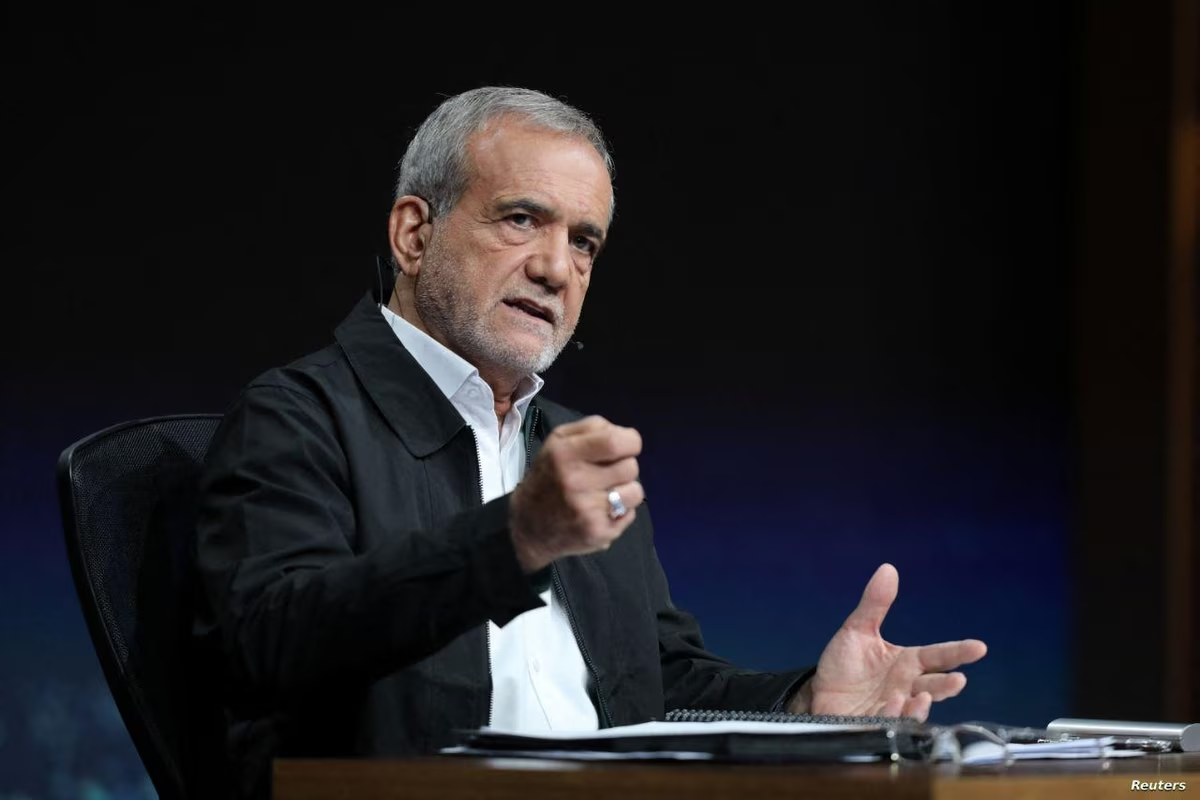
Pezeshkian: The enemy seeks to turn protests into civil war

Iranian President Masoud Pezeshkian delivered a speech on the occasion of "Ten Days of Dawn," the period preceding the anniversary of the victory of the Islamic Revolution, in which he affirmed that "the enemy seeks to turn protests into civil war" in Iran.

In his speech, Pezeshkian accused US President Donald Trump, Israeli Prime Minister Benjamin Netanyahu, and European countries of "arming some individuals" during recent developments.

He explained, saying: "Everyone knows that Trump, Netanyahu, and the Europeans armed people during the recent events."

He added that "in any social protest, weapons are not carried, military forces are not targeted, and ambulances or markets are not burned."

He stressed that "the enemy is working to turn protests into a civil war."

On the other hand, the Iranian President affirmed his government's readiness for dialogue, saying: "It is our duty to listen to the words and demands of the protesters and their concerns and work to resolve them; and we are ready to listen."

PALESTINE

Sat 31 Jan 2026 9:35 am - Jerusalem Time

"Israeli" shelling targets residential apartments outside areas of incursion in Gaza

"Israeli" helicopters launched a raid on an unknown target within the city's neighborhoods.

Ambulance and emergency crews in the Gaza Strip reported on Saturday morning that a number of martyrs and wounded fell as a result of a series of Israeli occupation airstrikes targeting residential apartments in populated areas located outside the scope of the occupation forces' deployment in Gaza City.

These attacks come amid a sudden field escalation that affected neighborhoods in the center and east of the city, leading to a state of panic among civilian residents.

According to medical sources, occupation aircraft carried out a direct raid on a residential apartment near "Al-Abbas Intersection" in the city center, resulting in martyrs and injuries who were transferred to Al-Ma'madani Hospital.

Concurrently, warplanes targeted another apartment near "Jabalia Bus Stop" east of Gaza City, leaving a number of wounded and extensive material damage to neighboring buildings.

On the ground, "Israeli" helicopters launched a raid on an unknown target within the city's neighborhoods, amid intense reconnaissance aircraft flights.

In the central sector, eyewitnesses observed Israeli warplanes firing two missiles towards sites located within what is known as the "Yellow Line" east of Al-Bureij and Al-Maghazi camps, without any reports of casualties in that area so far.

These raids, which targeted the residential depth of Gaza City, reinforce fears of a return to targeting civilian apartments away from direct engagement axes.

Civil defense teams continue search and evacuation operations for the injured from under the rubble of the targeted buildings, while human rights organizations warn of the consequences of this concentrated shelling on densely populated areas, which falls within a series of ongoing violations of the existing truce.

PALESTINE

Sat 31 Jan 2026 9:34 am - Jerusalem Time

Gaza 2023: The War That Exposed the Hypocrisy of Western Civilization and Reshaped the World

The coccyx of our planet! Let's assume a group of extraterrestrial beings wanted to survey the conditions of Earth and learn about the civilization and culture of its inhabitants. Their spaceship landed on the sands of our blue planet in early 2023, and using all their technology for research, monitoring, and investigation, they would form a complete picture of the lives of these humans, their world, their countries, their societies, their environment, their culture, and what they believe in.

Initially, they would be surprised by the extent of pollution, gas emissions, and chemical substances produced by human civilization, which have caused a significant disruption in their ecosystem, an imbalance in its components, and severe climate crises, in addition to the depletion of resources and wealth. They would discover that Earth's inhabitants are spread across six continents and 195 countries, whose borders and power were formed after two world wars in the mid-20th century. Two great empires gave way to two federal states, one of which fell in the ninth decade of the 20th century, leaving one state holding the reins of global politics, increasing its power and wealth through wars it ignites in regions rich in resources, energy sources, and wealth.

The number of these humans is nearly eight billion people, of whom only about 1.5% control approximately 48% of the total global wealth and much of its capabilities. One out of every six people does not believe in the existence of a creator and does not adhere to any religion. Meanwhile, the number of monotheistic believers in God does not exceed a quarter of these inhabitants, most of whom live in a state of weakness, fragmentation, and humiliation, in the most turbulent and conflict-ridden areas, many under oppressive, corrupt, and tyrannical regimes. The dominant civilization in world politics is a materialistic, capitalist, savage Western civilization, expanding across Europe and North America. A civilization that relies on technological advancement, invests in scientific progress, and military power that enables it to weaken other peoples, colonize their countries, exploit their natural resources, and plunder their wealth.

And we have a superpower that controls most international organizations and legal institutions, dominates media outlets, cultural channels, and entertainment tools, and owns major newspapers, news websites, drama production companies, screens, and satellite channels. Its policies are controlled by influential Zionist Jewish groups, who have the ability to place their politicians in all decision-making centers and institutions. A "Zionist lobby" controls the decisions of the world's most powerful countries, directs their affairs, and alone holds the keys to their formidable media system, using all of this to support their colonial entity and their state based on occupation and the theft of others' lands. In contrast, major countries are seen as rising political poles, with different civilizations and large populations. The human world appears scientifically and technologically advanced, but it is in its worst state environmentally, humanely, and socially, and in terms of civilization, ethics, and religion.

However, just a stone's throw away, a few months after this date, our land will witness a major event, an event that will change the balance of power and global politics, and create a new media landscape. It is the Al-Aqsa Flood war, which began with a military attack on October 7, 2023, launched by the resistance in Palestine. They attacked a number of Zionist settlements known as the Gaza envelope settlements, killing, injuring, and capturing a number of Zionist soldiers and settlers, accompanied by missile strikes deep into the occupied territories. The Israeli occupation state responded with a horrific war, described by international organizations as the most violent ethnic cleansing war in modern history, and its ceasefire, despite signed agreements, has not stopped to this day.

A war that researchers and historians will record as one of the pivotal events and major transformations in history. The features of a full-fledged world war, but exceptional in form and composition. An alliance comprising seven of the world's most powerful countries in terms of economy, armament, and influence, pledged full support to Israel with money, weapons, equipment, security and intelligence cooperation, and permission to send soldiers and fighters. On the other side, they are fighting a popular resistance of several thousand soldiers, who have been under a suffocating siege for 16 years, in a limited geographical area, neither a state nor a quasi-state, but a small city with an area of 360 square kilometers. It has no army, no fleet, no naval or air force, no aircraft, no airports, no military colleges, no tanks, but all it has are volunteer soldiers, and researchers who dedicated their knowledge to serving their country, and primitive weapon manufacturing workshops with self-efforts inside dark underground tunnels, producing light to medium weapons. But their greatest possession is a firm belief that life, souls, and blood are cheap in the face of one goal: liberating the land from colonialism.

A war that revealed the true face of Western civilization, and how it blatantly sided with a criminal Zionist entity, whose core consists of scattered Jewish groups gathered from the diaspora, to usurp land, falsify history, and erase the identity of the place, claiming false rights based on alleged religious promises. It shattered all international laws, treaties, and conventions that humanity had reached in the last two centuries. Suddenly, the world woke up to terrifying bloody scenes, disturbing the mind, shaking logic, and undermining the spirit. A Nazi holocaust, and massacres coming from the Middle Ages, whose chapters are unfolding in the age of technology, the internet, social media, and satellite channels, and whose horrifying scenes are broadcast around the clock and live.

A shock that forced all peoples of the Earth to rethink everything that had been absorbed over decades as facts, concepts, and self-evident truths: Western secularism, the age of modernity, international law, international organizations, human rights. A war that divided the world into two large teams: a team that upholds its humanity, rejects injustice, and supports the people of Gaza, mostly from peoples across the Earth, and another team that includes major political systems, client governments, tyrants, and despots, who supported the killers and colluded with Israel. As for the alliance that emerged between Europe and America to support Israel in its religious war - as clearly described by US Congressman Lindsey Graham - it soon collapsed at the doorstep of American greed to seize Greenland, which is under Danish rule. And we saw the highest political official in Canada, the Prime Minister, tell us about the collapse of the current world order, and that we will inevitably witness the birth of a new world order.

The world witnessed popular movements, protests, and demonstrations rejecting the war on Gaza, unprecedented in history. Universities in most countries of the world rose up in support of Gaza and Palestine. For two full years, discussions about the Gaza war dominated the streets and squares in dozens of countries, and it became the most prominent event around which the words of guests revolved in celebrations, tributes, and festivals. And for the first time, we saw international media daring to criticize Zionism and condemn Israel.

As for the great gift that Gaza presented to our miserable world, written with the blood of its innocent children, it is the epic of patience and certainty, which reintroduced the monotheistic religion on a clear path to millions, and we witnessed the largest global wave of embracing Islam. We saw celebrities, influencers, and activists from various countries of the world shock their followers by announcing their conversion to Islam, and they revealed the reason that prompted them to become Muslims, which was their admiration for the legendary patience of the people of Gaza in the face of the horrors and woes they endured. The anger of the Arab Muslim peoples in their afflicted region increased, the savage Syrian regime fell, and the fig leaf fell from many Arab regimes that failed the people of Gaza and colluded with Israel against them. It is as if Gaza revived souls, awakened consciences, paved the way, and rewrote history. It is as if God intended it to be the coccyx that revives our planet, that small greatness in human bodies, located at the base of their spine, which does not decay with death, nor is it consumed by the earth, but awaits God's will to sprout life anew from it. Our noble Prophet, peace and blessings be upon him, described it in his hadith in Sahih al-Bukhari, saying: (Between the two blasts there are forty, then Allah sends down water from the sky and they grow as vegetables grow. He said: There is nothing of a human being that does not decay except one bone, which is the coccyx, and from it the creation will be reassembled on the Day of Resurrection). So peace be upon you, people of Gaza, as you revived our land, changed our reality, and made history.

PALESTINE

Sat 31 Jan 2026 7:40 am - Jerusalem Time

Netanyahu's 'No's'... An Attempt to Perpetuate the Occupation and Thwart the Dream of a State

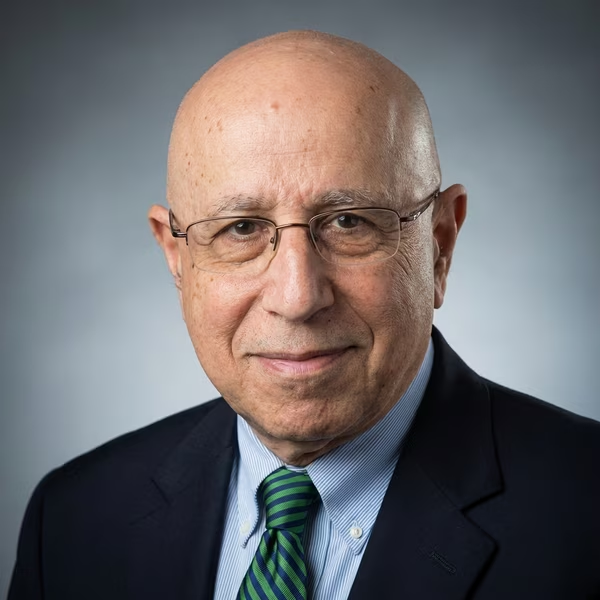
Dr. Ahmed Rafiq Awad: What is being put forward is not an electoral context, and at its core, it reflects a deeply rooted Israeli conviction to reject a Palestinian state and translate that practically.

Khalil Shaheen: The strategic convergence between Netanyahu and Trump is to block the empowerment of Palestinians to self-determination and establish their independent state.

Dr. Walaa Qudaimat: Netanyahu is politically committed to obstructing the establishment of a Palestinian state as part of a consistent strategy that views its establishment as a direct threat to the Israeli project.

Mohammed Al-Rajoub: Netanyahu's 'no's' constitute a tool to disrupt "political time," allowing Israel to impose facts on the ground and keep the international community preoccupied with crisis management.

Dr. Amjad Bashkar: Netanyahu's statements cannot be read as an inevitable roadmap, but rather as a pressure card and a deterrent message primarily directed at Palestinians.

Suleiman Basharat: Netanyahu seeks to present himself as the leader most committed to what is called "the Jewishness of the state" and rejecting any political concession to the Palestinians.


Ramallah - Exclusive to "Al-Quds" - The "no's" of the occupation government's prime minister, Benjamin Netanyahu, are once again at the forefront, serving as an intense expression of a deeply rooted Israeli stance that categorically rejects the establishment of a Palestinian state, whether in the West Bank or the Gaza Strip, coinciding with his raising the slogan "Israel from the River to the Sea."

Writers, political analysts, specialists, and university professors, in separate interviews with "Al-Quds," believe that Netanyahu's recent statements regarding the rejection of a Palestinian state and the affirmation of the occupation of all Palestinian territories do not appear to be mere fleeting political rhetoric, but rather reflect a deeply entrenched strategic direction that has become one of the pillars of Israeli consensus, extending beyond electoral squabbles to systematic policies translated on the ground.

A careful reading of these statements reveals that Netanyahu's "no's" are no longer limited to a specific Israeli current, but have transformed into a comprehensive conviction within the Israeli political establishment, strengthened in recent years, especially after October 7, 2023.

This shift, according to writers, analysts, specialists, and university professors, has been accompanied by a de facto erosion of the two-state solution path, in light of rapid settlement expansion in the West Bank, and imposed arrangements in the Gaza Strip aimed at managing the population without granting them any sovereign or political horizon, thereby emptying the idea of a Palestinian state of its content.

They believe that Netanyahu's "no's" serve multiple functions; they are a tool to unite the Israeli interior and ensure the cohesion of the right-wing coalition, a pressure and deterrent message directed at Palestinians, as well as a bargaining chip used externally depending on the balance of power, especially in relations with the United States, although these "no's" remain subject to erosion whenever a high political or international cost is imposed.


Strategy of "Israeli National Consensus"


Political writer and analyst Dr. Ahmed Rafiq Awad believes that the statements of the occupation government's prime minister, Benjamin Netanyahu, in which he stressed the non-establishment of a Palestinian state and that "Israel is from the River to the Sea," cannot be read as fleeting electoral positions, but rather represent a fundamental strategic vision that forms the core of what is known as "Israeli national consensus" that crystallized around 2004 with the end of Ariel Sharon's era.

Awad clarifies that the rejection of a Palestinian state is no longer a position exclusive to the Israeli right, but has become a broad consensus among various Israeli parties, including the left, and this consensus has been further strengthened after October 7, 2023.

Awad points out that Netanyahu has continuously expressed these positions since the 1990s, both in his writings and in his political stances, especially his explicit opposition to the Oslo Accords, and his practical behavior during his terms as prime minister until today.


A Conviction Translated on the Ground


Awad explains that what is being put forward today in political statements is happening in an electoral context, but at its core, it reflects a deeply rooted Israeli conviction to reject a Palestinian state, a conviction that is translated on the ground through the complete dismantling of the idea of establishing a state, through the extensive annexation of the West Bank, and the imposition of arrangements in the Gaza Strip that resemble international guardianship or disguised occupation, in addition to marginalizing the role of the Palestinian Authority and weakening it politically and economically.

Awad indicates that Israel has begun to propose new alternatives for managing Palestinian affairs, such as self-rule, tribal rule, or administrative rule, considering that the most dangerous aspect of this is the shift in the American position, as American administrations, including the current one, are no longer committed to the two-state solution as the only option.


American and European Abandonment of the Two-State Solution


Awad points out that the Trump administration explicitly stated that it does not see the two-state solution as the only scenario, which was reflected in its non-negotiation with the Palestinian Authority, its non-recognition of it, and the retention of the American embassy's relocation to Jerusalem after its annexation, in a step that reinforces the Israeli vision.

Awad indicates that this retreat is not limited to the United States, but extends to the European Union, which no longer sees the two-state solution as the optimal form of solution, and has begun to impose impossible conditions on the Palestinian Authority under the title of reform, and has also supported international resolutions that do not explicitly mention the establishment of a Palestinian state.

Awad believes that the two-state solution was practically abandoned after three decades of procrastination and delay since 1994, stressing that no one seriously worked to achieve it, whether internationally, Arab, or Islamic, which necessitated searching for other political options and solutions in light of the complete collapse of this path.


Deeply Rooted Ideological Convictions


Political writer and analyst Khalil Shaheen confirms that the statements of the occupation government's prime minister, Benjamin Netanyahu, rejecting the establishment of a Palestinian state do not represent a new position, but rather a re-affirmation of a historical position he has expressed repeatedly, and even previously boasted that he was instrumental in preventing the establishment of an independent Palestinian state. Shaheen explains that this rejection is not only linked to immediate electoral calculations, despite their presence, but is primarily based on deeply rooted ideological convictions adopted by Netanyahu since his opposition to the Oslo Accords and the plan for withdrawal and redeployment from the Gaza Strip.

Shaheen explains that Netanyahu relies on a broad Israeli base for this position, which has been particularly strengthened after October 7, 2023, noting that this trend has been practically translated into official decisions, most notably the Knesset's decision in July 2024, which was voted on by 68 members, and considered the establishment of a Palestinian state an "existential threat" to Israel, and rejected any political negotiation path related to the establishment of a Palestinian state.

Shaheen points out that this decision came during the Biden administration and before the return of US President Donald Trump to the White House, which reflects an Israeli consensus across the coalition and opposition.

Shaheen indicates that the danger of this decision lies not only in its content, but in the extent of support it received, as it was not limited to coalition parties, but was also supported by opposition forces, led by Gantz's party, while other parties such as "Yesh Atid" and "Labor" withdrew from the session, and most of them abstained from voting against the decision, while only nine Knesset members opposed it, which confirms the existence of a near-Israeli consensus on rejecting a Palestinian state.

Shaheen stresses that focusing solely on Netanyahu's statements overlooks the essence of the ongoing policies on the ground, which aim to undermine any opportunity for the establishment of a Palestinian state, and even work to weaken the Palestinian Authority and gradually transform it into something resembling a "union of municipalities" in the West Bank, at a time when Israel rejects the return of the Authority to the Gaza Strip in any form.


Fragmentation of the Palestinian Political Entity


Shaheen believes that the Israeli plan, which in some aspects aligns with American proposals, aims to fragment the Palestinian political entity, either by deepening the division between the West Bank and Gaza, or by dismantling the central authority in the West Bank itself.

Shaheen explains that Netanyahu has adopted a strategy for years based on strengthening the separation between the West Bank and the Gaza Strip, and he is continuing to deepen this separation, while seeking to weaken the Authority in the West Bank, and perhaps drawing inspiration from alternative governance models, such as technocratic committees or local administrations based on tribes and families, within the framework of projects that have been circulated in Israel, including what is known as the "Seven Emirates" plan in the West Bank.

Regarding the Gaza Strip, Shaheen believes that what is known as Trump's "Twenty-Point Plan" largely intersects with Netanyahu's vision, as it does not offer a clear commitment to the establishment of a Palestinian state, but rather treats it as a deferred possibility linked to long negotiations, after the completion of Gaza's reconstruction according to an economic investment model. Shaheen points out that this plan, like the economic plans discussed by American economists, ignores the right to self-determination, and seeks to transform Gaza into a long-term investment area, while obscuring the political and national dimension of the Palestinian issue.

Shaheen confirms that these proposals are based on the expropriation of private property, and opening the way for investments with long-term contracts that may extend for decades, with the displacement of large numbers of the Strip's residents, which some of the authors of these plans themselves described as having a colonial character.

Shaheen points out that these models were also proposed as applicable in the West Bank, through economic approaches that separate Palestinians from their national project.

Shaheen stresses that the strategic convergence between the Netanyahu government and the Trump administration is to block the empowerment of Palestinians to exercise their right to self-determination and establish their independent state, including East Jerusalem, even if there are tactical differences regarding the speed and pace of implementation, especially in the Gaza Strip.


Facts that Eliminate the Palestinian State Project


Shaheen explains that Netanyahu also uses this intransigence in the context of the Israeli electoral bazaar, seeking to maintain the cohesion of his coalition in light of internal crises related to the budget and the conscription law, and to avoid increasing pressure to form an investigation committee into the events of October 7, 2023.

Shaheen stresses that what is happening on the ground in terms of settlement expansion, demolition, settler attacks, and continuous security escalation, reflects a systematic policy that goes beyond rhetoric, and aims to impose final facts that practically eliminate the Palestinian state project.


Undermining the Possibility of a Palestinian State


Writer and political researcher Dr. Walaa Qudaimat stresses that the Palestinian state represents a political and historical entitlement for the Palestinian people and is not a grant from any party, considering that the recent statements of the occupation government's prime minister, Benjamin Netanyahu, come in the context of a practical translation of the policies pursued by successive Israeli governments aimed at undermining the possibility of establishing an independent Palestinian state.

Qudaimat explains that Netanyahu is politically and clearly committed to obstructing the establishment of a Palestinian state, and that his position is not temporary or linked to a specific stage, but rather falls within a consistent Israeli strategy that views the establishment of a Palestinian state as a direct threat to the Israeli project in the region, according to the ideological vision of his political current.

Qudaimat points out that this commitment is evident in various Israeli policies that work to weaken the foundations of the Palestinian state at the geographical, political, and economic levels.


Pushing Towards Normalization Without Political Costs


Qudaimat explains that Netanyahu employs all current developments on the regional and international arenas to push towards unconditional normalization, especially bypassing the condition of establishing a Palestinian state in exchange for normalization, noting that his continuous attempts to invest in regional changes reflect an Israeli endeavor to impose new political realities that ignore Palestinian national rights.


Creating Conditions for the Impossibility of a Palestinian State


Qudaimat explains that the Palestinian project is read within Israel as a direct undermining of the Zionist project, which drives Israeli governments to dedicate their efforts to creating conditions that make the establishment of a Palestinian state impossible, whether through the fragmentation of Palestinian geography or the weakening of the Palestinian political and institutional structure.

Qudaimat confirms that Israel also seeks to establish a Palestinian reality incapable of achieving the state project at the Palestinian, regional, and international levels, thereby preventing the attainment of full recognition and sovereignty.


The State and the Fruit of Long Struggle


Qudaimat stresses that Palestinians must realize that the Palestinian state is the fruit of a long struggle and immense sacrifices, and not a grant given in the context of political settlements.

Qudaimat emphasizes the need for the Palestinian leadership to be aware of the dangers threatening the state project, warning that any talk of establishing a state in the Gaza Strip separate from the rest of the Palestinian territories would constitute a serious undermining of the Palestinian people's entitlements and national unity.


Electoral Propaganda and Calculated Strategy


Academic and researcher in public administration and political science Mohammed Al-Rajoub explains that the repeated statements of the occupation government's prime minister, Benjamin Netanyahu, regarding the rejection of a Palestinian state, and his raising of the slogan "Israel from the River to the Sea," cannot be understood in a single framework, but rather combine electoral propaganda directed at the Israeli interior, and a calculated political strategy aimed at managing the conflict with Palestinians rather than resolving it.

Al-Rajoub explains that Netanyahu's discourse, which is based on repeating "no's" such as no Palestinian state and no withdrawal, outwardly appears as a definitive statement of position, but a reading of Netanyahu's political experience and the context of his statements reveals that it is not about a rigid doctrine as much as it is a functional political language used flexibly according to the balance of power, especially in relations with the United States.

Al-Rajoub points out that these statements cannot be separated from the Israeli internal environment, where Netanyahu leads a fragile coalition based on an alliance of the national and religious right and the most extremist currents.


Israeli Mobilization Discourse


Al-Rajoub points out that this political base does not demand political solutions as much as it demands continuous ideological reassurance, which Netanyahu is keen to provide through a mobilizing discourse that affirms the constants of the Zionist project and reproduces a sense of Israeli superiority and dominance.

Al-Rajoub explains that the slogan "Israel from the River to the Sea" is not put forward as a legal project or a constitutional vision for a single state, but rather as a mobilizing slogan aimed at charging the collective consciousness of the right, and closing the door to any theoretical discussion about the Palestinian state, even before delving into the details of political solutions.

Al-Rajoub confirms that the real danger in this discourse lies in the fact that it reflects a strategy of conflict management, not resolution, as Netanyahu, despite his long years in power, has not presented a comprehensive vision for a settlement, nor has he gone for full annexation, but has maintained a gray area that keeps Palestinians in a state of "no state and no sovereign rights," with security and economic management that prevents explosion without opening a political horizon.


A Tool to Disrupt "Political Time"


Al-Rajoub believes that Netanyahu's 'no's' constitute a tool to disrupt "political time," allowing Israel to expand settlements and impose new facts on the ground, geographically and demographically, while the international community remains preoccupied with managing the crisis instead of resolving it.

Al-Rajoub points to a fundamental contradiction in Netanyahu's behavior, represented by rhetorical rigidity versus practical flexibility when real American pressure is available, citing previous understandings of calm and security arrangements.

Al-Rajoub considers that this contradiction is not a weakness, but a style of governance that relies on publicly announcing rejection, and passing retreats in security or temporary forms.

Al-Rajoub confirms that Netanyahu's statements do not represent final positions as much as they are a moving negotiating ceiling, which turns into a de facto policy in the absence of American will, and is recycled as a tool for internal propaganda and a deeper strategy to prevent the establishment of a Palestinian state, despite its susceptibility to collapse whenever the balance of power changes.


Higher Political Load


Political science professor Dr. Amjad Bashkar believes that the statements of the occupation government's prime minister, Benjamin Netanyahu, rejecting the establishment of a Palestinian state, and his raising of the slogan "Israel from the River to the Sea," are not new in their content, but they carry a higher political load in the current circumstances, and can be understood within three main levels: internal, external, and ideological.

Bashkar explains that the first level is the Israeli internal level, where these statements fall within the framework of clear electoral propaganda, even if wrapped in ideological discourse.

Bashkar explains that through his statements, Netanyahu addresses his solid base of the Israeli right and settlers, in addition to his allies from extremist right-wing parties, led by Itamar Ben-Gvir and Bezalel Smotrich.

Bashkar believes that the slogan "Israel from the River to the Sea" does not constitute an executive plan as much as it is an affirmation of Netanyahu's political identity and a message in which he presents himself as "the true guarantor of the complete Zionist project."

Bashkar confirms that Netanyahu has accustomed, in times of political or judicial crises or during wars and protests, to resorting to intensifying ideological discourse in order to unite his base and prevent its erosion.


A Tool for Negotiation and Pressure


On the external level, Bashkar indicates that these statements represent a tool for negotiation and pressure, and not a final political declaration.

Bashkar points out that Netanyahu historically raises the ceiling of his ideological discourse and then begins a gradual retreat when a stronger balance of power is imposed on him, whether due to international or American pressure.

Based on this, Bashkar believes that Netanyahu's statements cannot be read as an inevitable roadmap, but rather as a pressure card and a deterrent message primarily directed at Palestinians.

As for the ideological level, Bashkar confirms that Netanyahu's recognition of a Palestinian state would practically mean the end of his political project, not only for him personally, but also for his allies within the Israeli right.

Bashkar stresses that Netanyahu, even if he accepts certain compromises on the ground, cannot explicitly announce them, because that would lead to the loss of his political alliances.


The Fall of the 'No's' Before American Will


Bashkar believes that the possibility of establishing a Palestinian state in the current stage is unrealistic, in light of the large settlement expansion since 2017, which has swallowed vast areas of West Bank lands, in addition to the escalating geographical division in the Gaza Strip.

Bashkar explains that Netanyahu's "no's" fall only when there is a clear American will or when the cost of continued rejection becomes high for Israel.

Bashkar confirms that Netanyahu always seeks a political way out that "saves face," noting that several sensitive issues, such as settlements, calm, security coordination, and taxes, have seen actual retreats despite the hardline rhetoric.

Bashkar points out that Netanyahu raises the ceiling of his rejectionist discourse when he feels that the balance of power temporarily favors him, but these "no's" quickly remain only in the media, and are emptied of their content on the ground if the American position changes.


Burying the Future Establishment of a Palestinian State


Political writer and analyst Suleiman Basharat explains that the recent statements of the occupation government's prime minister, Benjamin Netanyahu, especially those related to rejecting the establishment of a Palestinian state whether in the West Bank or the Gaza Strip, clearly express the essence of the strategic goal of Israeli behavior towards Palestinians, and reveal a deeply rooted mentality that works to bury any future possibility of establishing a Palestinian state on the 1967 borders.

Basharat points out that when Netanyahu said: "The establishment of a Palestinian state in the Gaza Strip has not happened and will not happen," he was not expressing a temporary or tactical position, but rather a comprehensive strategic vision based on solidifying an Israeli conviction that it is impossible to establish a Palestinian state in any part of the Palestinian land, whether in the West Bank or Gaza.

Basharat confirms that Israeli behavior on the ground and politically is consistent with this vision, through policies of encroachment, settlement, blockade, and the excessive use of force.


The Leader Most Committed to the "Jewishness of the State"


Basharat explains that Netanyahu invests this discourse in two main dimensions, the first being the Israeli internal dimension, where he seeks to present himself as the leader most committed to what is called "the Jewishness of the state" and rejecting any political concession to the Palestinians, in an attempt to win over the Israeli public and the extremist right-wing current, and to prepare the ground for his re-election in the event of early elections, likely in October.


Regional and International Messages


The second dimension, according to Basharat, relates to regional and international messages, as Netanyahu confirms through them that Israel is not prepared to trade the future of the Palestinian state for any other issues, including the normalization process and the "Abraham Accords."

Basharat believes that Netanyahu's talk about the possibility of new countries joining these agreements, specifically under the conditions put forward by the Kingdom of Saudi Arabia, aims to bypass the Palestinian issue, and establish a new regional phase in which Palestinian rights are marginalized.


American-Israeli Consensus on the Conflict


Regarding the American position, Basharat believes that there is an Israeli-American consensus on the essence and strategy of the conflict, where the United States provides political cover and military support for Israeli behavior, but differs with Tel Aviv on the nature of the tools.

Basharat points out that Washington prefers to use the political path and indirect pressures to push Palestinians to accept the existing reality, while Israel tends towards the option of decisive force and the excessive use of military power.

Basharat believes that this discrepancy is evident in issues such as Gaza's reconstruction, resistance weapons, and withdrawal from the Strip, where the American administration seeks to link political incentives and reconstruction with disarmament, while Israel believes that direct force is the most effective way to achieve its goals.

Basharat emphasizes the danger of American adoption of the Israeli vision, warning that the failure of the political path may push Washington to grant Israel broader authorization to use force, in light of strong Israeli influence within American decision-making circles, which means the continuation of the Israeli colonial project that began in 1948 and continues to this day.


ARAB AND WORLD

Sat 31 Jan 2026 7:33 am - Jerusalem Time

The Illusion of the Decisive Blow: How US Policy Reproduces Gulf Crises in the Iran File

Said Erikat

Opinion Writer

News Analysis

The pressure exerted by President Donald Trump's administration this week on Saudi Arabia to support military action against Iran demonstrates a renewed American insistence on a regional approach that has repeatedly proven to be a failure: transforming military superiority into a tool for re-engineering political balances. Instead of reading the profound shifts in the calculations of its Gulf allies, Washington treats the region as if it were still a malleable arena that can be managed by coercive deterrence and limited strikes.

The American approach stems from the assumption that Iran is experiencing a moment of structural weakness after the strikes it targeted in 2025, and that this moment represents a "strategic window" that should be exploited before Tehran rebuilds its capabilities. However, this thinking reflects a deficiency in understanding the nature of contemporary conflicts in the Middle East, where confrontations are not decided merely by destroying military targets, but by the ability of parties to absorb the shock and reproduce deterrence tools through less costly and more flexible means.

In this context, the visit of Saudi Defense Minister Prince Khalid bin Salman to Washington seemed more like an explicit test of the limits of American influence over its allies. The offers made by the Trump administration, represented by long-term "security guarantees," clashed with an American record burdened by unfulfilled promises. The experience of the Aramco attack in 2019 is still strongly present in Saudi consciousness, not only as a security failure, but as a pivotal point that revealed the limits of American response when strategic priorities conflict with the cost of direct confrontation.

What Washington ignores, or deliberately overlooks, is that the Gulf states no longer view Iran from a zero-sum conflict perspective. After years of attrition, these states have reached a practical balance equation that allows for managing the disagreement with Tehran without sliding into an open confrontation. This balance, despite its fragility, has enabled Gulf capitals to reduce risks to energy security and control indirect engagement arenas, especially in Yemen and maritime passages.

In contrast, the United States continues to invest in the logic of military force as an alternative to political strategy. Military buildups, from aircraft carriers to air defense systems and air deployments in Jordan, may give Washington high operational capability, but they do not provide an answer to the question of what comes after the strike. Rather, this buildup deepens Gulf fears that they will find themselves at the heart of a conflict in whose decision they were not a partner, but they will be the first to pay its price.

Iran, for its part, is adept at exploiting this contradiction. Announcements of military maneuvers in the Strait of Hormuz, and the brandishing of the proxy card in the Red Sea, are nothing but psychological and political deterrence tools targeting allies before adversaries. The Iranian message is clear: any American strike will translate into long-term instability, not a "clean end" as American rhetoric suggests.

The most dangerous aspect of the current American approach is that it assumes the controllability of escalation, as if the region has not previously experienced the logic of "unintended slide." Recent history, from Iraq to Afghanistan, provides striking examples of how "limited" operations turned into strategic quagmires. Nevertheless, Washington continues to deal with the Gulf as a margin whose stability can be sacrificed for short-term deterrent gains.

Ultimately, the disagreement between Washington and Riyadh does not lie in the degree of hostility towards Iran, but in the definition of security itself. While American policy reduces security to militarily weakening the adversary, the Gulf states link it to economic and social stability and state sustainability. This contradiction makes American pressure not only unrealistic, but fraught with the danger of reproducing the crises it claims to seek to resolve.

American policy towards Iran reflects a chronic tendency to prefer military tools over political solutions, even when facts demonstrate the limitations of this option. The insistence on testing strength, instead of investing in managing balances, reveals a short-sighted strategic mentality that ignores the cost of regional repercussions. In this context, the Gulf rejection of war does not appear to be a defensive stance, but a more realistic reading of the complexities of the conflict.

The danger of the American approach lies in the assumption that allies will automatically align behind military decisions. However, the Gulf states have become more independent in their calculations, and less willing to bear the cost of choices they were not partners in formulating. This shift places Washington in a strategic dilemma: either review its policy, or risk the erosion of its influence in the world's most sensitive regions.

PALESTINE

Sat 31 Jan 2026 7:31 am - Jerusalem Time

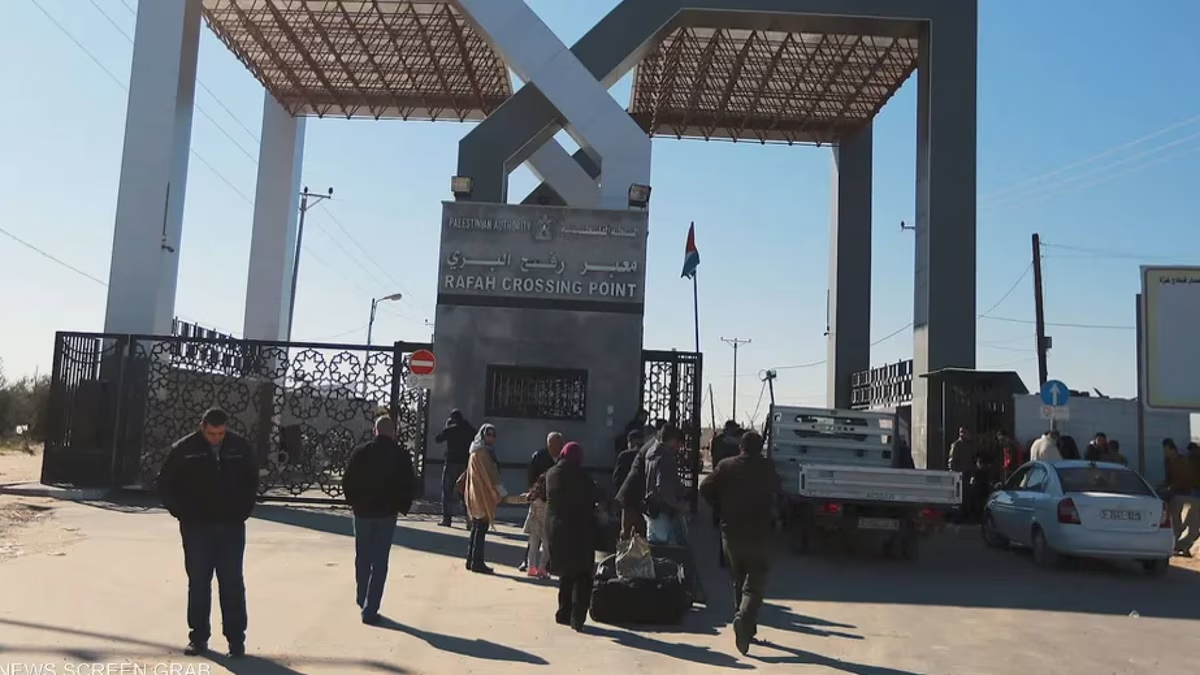
Reopening of Rafah Crossing: Conditional Humanitarian Breakthrough or Reproduction of Israeli Control?!

Said Erikat

Opinion Writer

News Analysis

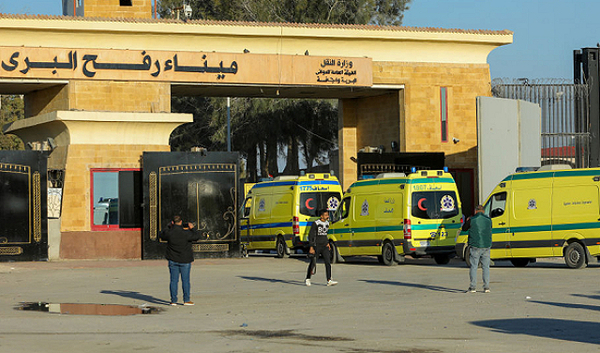
The Israeli occupation authorities, through the Coordinator of Government Activities, announced an agreement to reopen the Rafah border crossing starting Monday morning. This move initially appeared to be a response to accumulated humanitarian pressures, but upon closer inspection, it quickly revealed a familiar Israeli pattern of granting facilities with one hand and withdrawing their essence with the other. The announced reopening is nothing more than a partial and restricted opening, limited to the movement of people only, and subject to direct Israeli security oversight, which empties the measure of its sovereign and humanitarian content.

According to the announcement, entry and exit operations will be carried out according to a precise coordination mechanism with the Egyptian side, with the tasks of field supervision assigned to a European party. However, this "international" cover does not change the fact that the final decision remains in the hands of the occupation, which stipulated prior security approval for each crossing. Thus, the crossing transforms from a sovereign Palestinian-Egyptian gateway into an advanced security checkpoint subject to Israeli military will, even if mediated by third parties.

While the arrangements allow Palestinians to return from Egypt to the Gaza Strip, especially those who left during the war, this return is conditional on a series of strict "Israeli scrutiny" procedures. These procedures are presented, as usual, under the pretext of "preventing security threats," a vague pretext historically used by the occupation to perpetuate the policy of collective punishment, maintain control over the movement of residents, and transform the natural right to movement into a security privilege that can be granted or denied.

This step comes in the context of diplomatic pressures led by the US administration, where President Donald Trump's administration seeks to market what it calls "logistical solutions" to alleviate the humanitarian catastrophe in Gaza, without addressing the roots of the crisis or compromising the occupation's security superiority. What is required by the US is not an end to the siege, but its reorganization in a less blatant and more politically and media-marketable way.

Trump believes that subjecting Gaza's crossings to international, especially European, supervision is part of a broader deal aimed at reducing the influence of Palestinian factions and strengthening the monitoring system for the movement of individuals, thereby transforming the crossings into tools of security control rather than lifelines. In this context, Egyptian-American coordination is presented as a crucial factor in "extracting" the decision, but in essence, it reflects complex pressures exerted on Cairo to manage the file in a way that prioritizes Washington's and Tel Aviv's interests more than it responds to Palestinian rights.

In this context, the following five points must be highlighted:

1. Israeli Evasion in a Humanitarian Guise: The limited reopening of the Rafah crossing reflects a recurring Israeli pattern of circumventing international pressure through superficial steps. The occupation does not openly reject facilities, but redefines them in a way that keeps control in its hands. The use of humanitarian titles to conceal a security-military essence is part of this evasion, where the measure is marketed as a breakthrough, while practically it is established as a new tool for controlling the population and their movement.

2. Is European Supervision a Cover or a Partnership?: The involvement of a European party in field supervision does not mean a real internationalization of the crossing, as much as it provides political and moral cover for Israeli arrangements. Past experiences indicate that this role is often technical and supervisory, without the ability to challenge Israeli decisions. Instead of European supervision serving as a guarantee for Palestinians, it may turn into a silent partner in managing the siege in a "soft" manner.

3. Security Scrutiny as a Political Weapon: What is called "Israeli scrutiny" is not a neutral security measure, but a political tool par excellence. Through it, the occupation retains the right of veto over the return of individuals, and reclassifies Palestinians according to vague security criteria. This approach does not aim at security as much as it aims to re-engineer Palestinian society, control its demographic composition, and collectively punish Gaza under the banner of prevention.

4. The American Role: Crisis Management, Not Resolution: The American approach, as reflected in the pressures of the Trump administration, stems from the principle of managing the crisis instead of resolving it. What is required is to mitigate the humanitarian explosion to prevent political embarrassment, not to end the siege or address its structural causes. Thus, "logistical solutions" become temporary painkillers, keeping the essence of Israeli control intact, and postponing the explosion instead of addressing it.

5. Rafah Crossing Between Sovereignty and Security Function: The core issue is not opening or closing the crossing, but the question: who owns sovereignty over it? The proposed formula empties the Rafah crossing of its meaning as a sovereign outlet, and transforms it into a security function within a regional-international system for managing Gaza. Unless this link is broken, every opening will remain temporary, every breakthrough conditional, and every hope susceptible to setback.

The reopening of the Rafah crossing, in its current form, is not a breaking of the siege as much as it is a reorganization of it. Between American pressures, Israeli evasion, and limited international supervision, the Palestinian remains the weakest link, granted his natural right conditionally, and asked to be grateful for what is supposed to be a right, not a favor.


ARAB AND WORLD

Sat 31 Jan 2026 7:29 am - Jerusalem Time

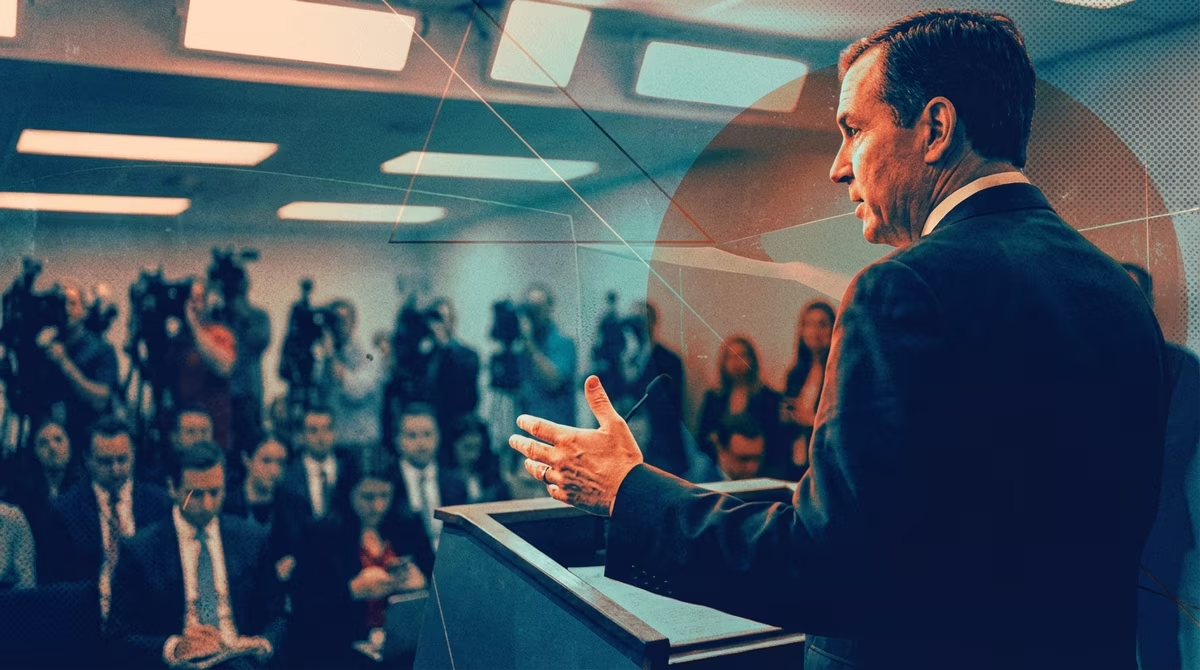
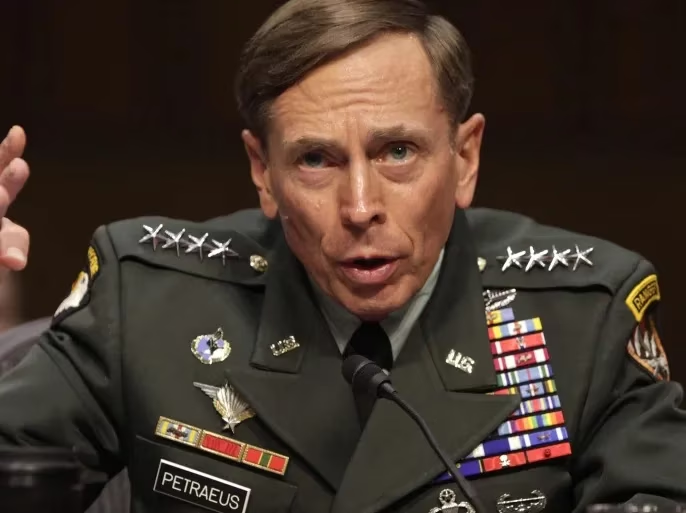
Petraeus Uses His Colonial Experience in Iraq to Turn the Gaza War into Millions of Dollars

Said Erikat

Opinion Writer

In a visit that raised deep political and ethical questions, former CIA Director General David Petraeus appeared at the Civil-Military Coordination Center (CMCC), run by the US Army in southern Israel, tasked with overseeing what is described as "ceasefire" arrangements in the Gaza Strip. The visit, revealed by diplomatic sources to "Drop Site," was not merely protocol but carried implications beyond security to the political, economic, and social re-engineering of Gaza.

Petraeus, one of the most prominent architects of the American "counter-insurgency" doctrine, praised in his speech the Israeli army's shift towards the "clear, hold, and build" model, the same model he applied in Iraq and Afghanistan, which involved dividing cities into "gated communities" subject to security surveillance and biometric identification systems. This praise came after his previous criticisms of Israel for not learning the lessons of the American occupation of Iraq.

Days before Petraeus's visit, the US Army had presented to the CMCC a vision for what was called the "first planned community for Gaza" in Rafah, a closed residential complex accommodating about 25,000 Palestinians, under full Israeli military control, and subject to a biometric entry system, "rehabilitation" programs, and strict control over aid and housing. According to informed sources, the project is seen as an experimental model for "New Gaza," funded by the UAE.

Petraeus's visit coincided with US President Donald Trump's announcement at the Davos Forum of a "Peace Council," where he presented Gaza not as a political or humanitarian issue, but as a "real estate" investment opportunity on the sea. His son-in-law Jared Kushner followed by announcing an economic development plan for Gaza, emphasizing "aligning security and governance frameworks" to attract investors, in a speech that clearly reveals the priority of capital over rights.

This scene recalls Petraeus's own history; the man led the "military surge" in Iraq in 2007, contributed to the militarization of society by arming militias, expanded secret night operations, and was a central player in America's hidden wars in the region. Today, the same logic returns, but with a facade of "reconstruction" and "governance."

Petraeus's interest in Gaza is inseparable from his current position as a partner and chairman of the Middle East Institute at "Kohlberg Kravis Roberts & Co. KKR," one of the largest American investment firms, with extensive investments in cybersecurity, digital identity, and defense, with direct ties to Israel. Here, security doctrine intersects with capital interests, and population control becomes a profit opportunity.

In his speech, Petraeus praised the CMCC's efforts in delivering aid, even though Israel still prevents essential materials and bans the work of dozens of organizations, which led European countries to withdraw their staff from the center. This contradiction reveals the center's function: managing the crisis, not solving it, and organizing the siege, not lifting it.

In the background, the Gaza gas file emerges as a potential financial lever for reconstruction, within a network of interests linking Israel, the UAE, and Western investment companies, within the broader framework of the Abraham Accords. Thus, Palestinian resources become a guarantee for projects over which Palestinians have no say.

Amjad Al-Shawa, head of the Palestinian NGO Network, criticized these proposals in a statement to "Drop Site," considering them a "beautiful image designed by artificial intelligence," which does not reflect reality and does not consult Palestinians, asking: Who will own the rebuilt Gaza? And who will serve whom?

Petraeus's visit – the general who quelled the resistance in Iraq – in this context, is not a fleeting event, but an indicator of the intersection of security and investment, where Gaza is redefined as a space for population control, an emerging market, and a laboratory for "soft war" doctrines, while Palestinians are reduced to a labor force or permanent residents in "gated communities."

According to many experts, what is proposed for Gaza is not reconstruction, but a forced reshaping of society under a single security-economic umbrella. The "gated communities" model does not address the roots of the conflict but transfers a failed experience from Iraq to a more fragile context. It is a project of mass control, managed by data and biometric cards, aiming to separate the population from politics, and transform rights into privileges conditioned by obedience.

Moreover, the discourse of US President Trump, his son-in-law, and Kushner reveals the new colonial mentality: land as an investment site, and population as a security variable. Political language is absent in favor of market language, and the national question is erased in favor of "governance" and "investment attractiveness." In this framework, Gaza becomes an experimental project for security capitalism, where profits take precedence over sovereignty, and forced stability over justice.

Human rights experts warn that the deeper danger in this approach lies in dressing up a prison as reconstruction. As Ghassan Abu-Sittah points out, Gaza is being transformed from an open-air prison into a high-tech closed prison, where the goal is not to liberate daily life but to manage and control it. It is an engineering of a future without a political horizon, where the body is managed instead of aspirations being protected, and suffering is transformed from a human wound into a resource for investment and control.

PALESTINE

Sat 31 Jan 2026 6:50 am - Jerusalem Time

Gaza Health Director Questions Source of Human Organs Held by Occupation, Reveals "Missing" Bodies

The Director-General of the Palestinian Ministry of Health in the Gaza Strip, Dr. Munir Al-Bursh, on Friday raised serious and legitimate questions about the "record numbers" announced by the Israeli occupation regarding organ donation, stressing that these huge statistics do not answer the fundamental and urgent question related to the sources of this large number of kidneys and human organs that are being transplanted.

Al-Bursh explained in a press statement that there is a stark paradox in the fact that the occupation, which detains the bodies of Palestinian martyrs for many years in "cemeteries of numbers" and refrigerators, is the same one that today boasts unprecedented donation figures, trying to present itself as an advanced humanitarian model in this field to the international community.

The health official pointed to documented cases of bodies returned to their families after long periods of detention that were "missing organs," especially kidneys, without attaching medical or autopsy reports explaining the reasons for this, and without allowing any legal right for accountability or investigation.

Dr. Al-Bursh stressed that these facts are not based on unsubstantiated claims, but rather on testimonies of doctors who examined the bodies and proven field cases of bodies returned with amputated organs after being stolen in occupation facilities.

He affirmed that Palestinians do not oppose medical science or the principle of organ donation as a supreme humanitarian value, but they categorically reject turning these values into a "propaganda facade" to cover up crimes of exploiting the Palestinian body, whether alive or martyred, to create suspicious medical achievements that are promoted globally while the tragic truth of the source of those organs is absent.

These statements come at a time when Palestinian and international human rights organizations are demanding the necessity of forming an independent international investigation committee to uncover the fate of missing organs from the bodies of detained martyrs, amid fears of the spread of the phenomenon of "organ theft" that has haunted the occupation's medical record for decades, in the absence of international oversight over Israeli hospitals and forensic centers that deal with Palestinian bodies.

PALESTINE

Sat 31 Jan 2026 4:35 am - Jerusalem Time

Burning, beating, and abuse.. a wave of attacks by the occupation army and settlers in the West Bank and Jerusalem

Attacks by Israeli occupation forces continue in the West Bank and occupied Jerusalem, including raiding homes and villages and firing sound bombs, while Israeli settlers attacked Palestinians with stones north of Jerusalem. Sources reported that occupation forces raided a house during an incursion into the village of Madama, south of Nablus, in the northern West Bank. Occupation forces also stormed the village of Al-Mughayyir, in the Ramallah district in the central West Bank, for the second time in hours. Sources reported that occupation forces fired sound and gas bombs, and arrested a citizen, a child, and a young woman, before withdrawing from the village. In the Huwara area of Masafer Yatta, south of Hebron, occupation forces arrested two Palestinian brothers. Sources reported that settlers raised Israeli flags inside Palestinian lands in the area, which prompted Palestinians to protest, coinciding with the presence of the occupation army in the area to protect the settlers. Occupation forces arrested two Palestinians in the Khallet al-Natsha area, in the Hebron city district in the southern West Bank, following an attack carried out by settlers on the area. Eyewitnesses said that a number of settlers attacked citizens' homes, under the protection of Israeli army forces, and carried out acts of sabotage.

Two Palestinians injured and north of Jerusalem, two Palestinians were injured on Friday evening, after Israeli settlers attacked them with stones. The Jerusalem Governorate said in a statement that settlers attacked two Palestinians in the Ma'azi Jaba' gathering north of the city, which resulted in them sustaining varying injuries. The governorate added that the attacking settlers set fire to one of the homes in the gathering before residents were able to extinguish it, and explained that the attack comes within a series of repeated attacks on the gathering by settlers, as part of attempts to restrict aimed at forcing residents to forcibly leave.

Since the start of the war of extermination on the Gaza Strip in October 2023, which lasted two years, the Israeli army and settlers have intensified their attacks in the West Bank, including killing, demolition, displacement, and settlement expansion. These attacks have resulted in the martyrdom of at least 1,110 Palestinians, the injury of more than 11,500 others, in addition to the arrest of more than 21,000 Palestinians, according to official data.

PALESTINE

Sat 31 Jan 2026 2:20 am - Jerusalem Time

Gaza Peace Council.. Does it reduce the Palestinian issue to a humanitarian file?

Palestinian and Arab analysts and politicians discussed what is known as the "Gaza Peace Council" in a space on the X platform, amid questions about whether it constitutes a beginning for reconstruction or a framework for imposing international guardianship. Speakers agreed that the future of Gaza cannot be separated from the broader political context of the Palestinian issue, and warned against attempts to confine the issue to humanitarian and economic dimensions, at the expense of ending the occupation and the Palestinians' right to self-determination. US President Donald Trump announced the establishment of the "Peace Council" on January 15, as part of his 20-point plan for a ceasefire in the Gaza Strip, which was adopted by the UN Security Council last November. On January 22, Trump officially launched the "Peace Council" by signing its charter during the Davos Forum in the presence of a number of world leaders who agreed to join this initiative, which is scheduled to focus on the reconstruction of Gaza.

During the discussion session on the X platform, Dr. Sami Al-Arian, Director of the Center for Islam and International Affairs Studies, said that the international discussion has witnessed a shift from a near-consensus on a comprehensive political solution to approaches focusing only on reconstruction. Al-Arian considered that what is being proposed today "is not a peace project," but rather an attempt to achieve political gains that the occupation failed to impose militarily. He also warned that turning Gaza into a humanitarian file separate from the context of national liberation "is a dangerous deviation in the nature of the conflict" with the occupation.

In turn, Palestinian writer and political analyst Moein Naim believed that the fundamental problem is not related to the Peace Council alone, but to the collapse of the international system and the inability of its institutions to enforce international law. He pointed out that the International Court of Justice itself "is being punished" when it tries to hold Israel accountable. He added that the Peace Council was built to serve Israel's interests and future projects, noting that the reconstruction of Gaza has turned into an arena of international economic interests, "shared by major players, while only the minimum reaches the Palestinians."

As for the spokesperson for the Palestinian National Liberation Movement (Fatah), Jamal Nazzal, he warned that the administrative models proposed for Gaza represent a broader Israeli vision, not limited to the Strip alone. He stressed that bypassing the Palestinian National Authority would lead to the dismantling of the unity of Palestinian land. Nazzal emphasized that the Palestine Liberation Organization represents the legitimate framework for Palestinian political existence, and that any attempt to create alternatives or temporary entities "will not stand the test of reality and history."

For his part, Osama Abu Irshaid, Executive Director of "Americans for Justice in Palestine," considered that the Peace Council "is entirely reduced to the United States, which in turn is reduced to Trump." He pointed to direct coordination between Washington and Israeli Prime Minister Benjamin Netanyahu regarding the Peace Council. He also warned against the overlap of politics with economic interests, explaining that companies linked to influential American circles may benefit from reconstruction projects, which turns Gaza into an "international testing ground" instead of being part of a national liberation issue.

In the intervention of former Egyptian Ambassador to Israel Hazem Khairat, he stressed that the Council suffers from a political problem, adding that the absence of genuine Palestinian representation places additional responsibility on the Arab role, especially the Egyptian one. He pointed out that any Arab involvement in these paths must be conditional on preventing the imposition of solutions that undermine Palestinian rights, and on seeking paths that stop Israeli violations and protect Palestinian civilians.

From Gaza, writer and political analyst Iyad Al-Qara affirmed that all economic proposals presented as solutions will fail, just as their predecessors failed, because the core of the crisis is political, linked to the continued occupation of the Strip's lands and Israeli policies. He stressed that the priority for Palestinians today is not councils or administrative structures, but rather ensuring the withdrawal of the Israeli army, the flow of aid, and preventing the return of war.

PALESTINE

Fri 30 Jan 2026 8:15 pm - Jerusalem Time

Due to security risks... "Doctors Without Borders" refuses to share its staff data in Gaza with Tel Aviv

Tel Aviv insisted on its position calling for data registration under the pretext of "preventing aid from reaching Hamas elements." The charity organization "Doctors Without Borders" announced on Friday its categorical refusal to provide lists of its staff names requested by Tel Aviv as a condition for its continued work in the Gaza Strip and the West Bank.

The international organization clarified that this decision came after failing to obtain real guarantees for the safety of its team, emphasizing that disclosing staff data under the current circumstances could expose their lives to direct danger, especially with hundreds of relief workers killed and injured during the two-year ongoing war.

This stance follows a deadline given by Israeli authorities to 37 international organizations, including "Doctors Without Borders," to comply with new rules that include sharing personal information of employees with the Occupation Ministry for Diaspora Affairs, otherwise their humanitarian activities in the Palestinian territories will be halted.

Despite the organization initially showing flexibility by offering to share a partial list of those who voluntarily agreed, its statement today confirmed that it was impossible to reach an understanding with the Israeli occupation authorities regarding the required protection for these employees.

For its part, Tel Aviv insisted on its position calling for data registration under the pretext of "preventing aid from reaching Hamas elements," which relief organizations denied outright, considering this measure aims to restrict humanitarian work.

In a related context, the Ministry of Health in Gaza supported this approach, announcing its complete refusal to share medical staff data with partner institutions, due to the threat this poses to their personal security and the safety of their families.

"Doctors Without Borders" warned that banning its work would have a "devastating impact" on the already dilapidated health system in Gaza and the West Bank, where the organization plays a pivotal role in supporting hospitals and providing urgent care to the injured.

It affirmed that insisting on these rejected conditions puts the fate of thousands of patients and injured people at risk, amidst a humanitarian crisis described as the worst globally.

PALESTINE

Fri 30 Jan 2026 7:02 pm - Jerusalem Time

"Remote" monitoring.. Hebrew media reveals details of the new mechanism for operating the Rafah crossing

Hebrew sources revealed on Friday the features of the proposed mechanism for re-operating the Rafah border crossing in both directions, which fundamentally relies on security coordination linked to advanced technical monitoring systems.

The new plan is based on a system that enables the Israeli side to verify travelers' identities and monitor movements without the need for direct field presence at all stages of crossing, while imposing strict controls on exit and entry movements to ensure that no wanted security personnel enter or leave the Strip.

According to published reports, exit procedures from the Gaza Strip will be subject to a series of organizational complexities; those wishing to leave must obtain prior Egyptian permission, while lists are automatically referred to the Israeli occupation's General Security Service (Shin Bet) for security approval.

Although the field management of the crossing will be entrusted to a European Union mission and local Palestinian employees to handle inspection procedures, Tel Aviv will retain "remote" monitoring through security operations rooms equipped with facial recognition technologies to ensure that travelers match authorized lists, with the Israeli side having the authority to digitally control the electronic closure of crossing barriers in the event of any breach.

In contrast, the mechanism for entering the Gaza Strip adopts more stringent and strict procedures; all returnees will be subject to direct "Israeli" monitoring, which includes their passage through a checkpoint belonging to the Israeli occupation army, equipped with advanced sensors and metal detectors.

The individual verification process will include the use of biometric technologies, and travelers will not be allowed to cross the "yellow line" towards the internal areas of the Strip until after successfully passing these precise examinations and crossing military checkpoints.

Observers believe that this mechanism reflects Tel Aviv's endeavor to impose a comprehensive technical security cordon around the crossing without engaging in direct field friction with civilians in the exit path, while insisting on a "tangible security grip" to secure returnees.

These leaks come amidst anticipation of the official Palestinian and Egyptian positions on these proposals, which are believed to form the cornerstone of the anticipated security arrangements for managing the Strip in the post-truce phase and shaping the features of the new border reality.

PALESTINE

Fri 30 Jan 2026 6:02 pm - Jerusalem Time

Military and Civilian Leaders of US Mission in Gaza Step Down

Sources reported on Friday that diplomats said the American military and civilian leaders responsible for Washington's mission in the Gaza Strip would step down from their positions. This move coincides with European countries reconsidering their participation in the initiative aimed at shaping the future of the Strip after the end of military operations, while their successors for these sensitive tasks have not yet been announced.

According to diplomatic sources, the senior military leader, a three-star lieutenant general in the civil-military command center, is expected to be replaced by a lower-ranking officer, while the civilian leader has left his post to return to his original position as the US Ambassador to Yemen.

This leadership change comes amidst what Western officials described as a state of field and political ambiguity regarding the future role of this center.

The civil-military command center was established last October as part of the first phase of US President Donald Trump's plan to end the war. The center's objectives focused on overseeing ceasefire agreements between Tel Aviv and the Islamic Resistance Movement (Hamas), in addition to facilitating the entry of humanitarian aid and formulating political frameworks for managing the Strip's affairs.

Observers view these changes as part of Trump's efforts to move forward with the next phase of his vision for peace, which includes forming a "peace council" composed of foreign delegations to take over the supervision of purely political aspects.

Lieutenant General Patrick Frank, the senior commander of US forces in the Middle East, had assumed his duties in leading the center in southern Israel since its inception, before his promotion last month to the position of Deputy Commander of US Central Command.

With the departure of the current leadership cadres, attention turns to Washington's ability to maintain the commitment of European partners to the initiative, as questions are increasing about the identity of the new leaders and the nature of the mandate granted to them, especially in light of the endeavor to transfer oversight tasks to members of the "Peace Council" on which the White House is betting for long-term stability.

PALESTINE

Fri 30 Jan 2026 4:17 pm - Jerusalem Time

The Occupation: Rafah Crossing to Open Next Sunday for Limited Movement of People Only, in Both Directions

An agreement has been reached to reopen the Rafah border crossing starting next Sunday.

The coordinator of the occupation government's activities announced on Friday that an agreement had been reached to reopen the Rafah border crossing starting next Sunday, for limited movement targeting people only and in both directions.

The coordinator clarified that entry and exit operations through the crossing would take place within a precise coordination mechanism with the Egyptian side, but they would remain subject to direct security approval from the occupation authorities. A European party will undertake the field supervision tasks for these arrangements, ensuring the implementation of the rules of engagement and control agreed upon by the concerned parties.

In the context of the new procedures, the coordinator of the occupation government's activities affirmed that Palestinian residents would be allowed to return from the Arab Republic of Egypt to the Gaza Strip, especially those who left during the war. However, this return will not be without restrictions; the decision stipulated that all returnees would undergo strict "Israeli scrutiny" to verify their security backgrounds. This scrutiny, according to the occupation authorities' claim, aims to prevent the entry of any elements that could pose a threat to security, making the crossing an advanced control point subject to the military will of the occupier.

This step comes amid diplomatic pressure led by America, as the administration of US President Donald Trump is pushing for "logistical solutions" to alleviate humanitarian tensions without compromising the occupation's security superiority.

Trump believes that controlling Gaza's borders and crossings under international (European) supervision is part of a broader deal aimed at reducing the influence of factions and enhancing control over the movement of individuals. The recent Egyptian-American coordination was crucial in securing this decision, which is a test of the ability of these parties to manage the security file away from the de facto authority in the Strip.

OPINIONS

Fri 30 Jan 2026 8:39 am - Jerusalem Time

“Shield of Jerusalem”… The Decisive Battle in the Heart of Jerusalem

With the war of extermination in Gaza moving into a new phase, less intense in bombing and more focused on siege, delegitimizing the resistance, and pushing Palestinian society towards internal conflict, the Israeli occupation has returned to dedicate itself more broadly to the open decisive front in Jerusalem, and alongside it, the annexation and displacement front in the West Bank. These two fronts will lead the occupation's strategy in the coming period, even if interrupted by a temporary escalation on the Lebanese, Syrian, or even Iranian fronts.

One of the most prominent goals of this path is to reach “final borders” for Jerusalem, by annexing the largest possible number of settlements and settlers, and swallowing the widest possible geographical area, in exchange for excluding the largest number of Jerusalemites from the city's demographic and political equation.

Within this context, the occupation launched a series of operations it called “Shield of Jerusalem.” Its first episodes began on December 23, 2025, targeting Kafr Aqab and Qalandia refugee camp, which were separated from Jerusalem by the wall. This was followed by a second episode on January 12, 2026, against Shuafat refugee camp, which lasted several days, and came as a prelude to the demolition of the UNRWA headquarters in Sheikh Jarrah neighborhood on January 20 of the same year.

On January 26, 2026, the occupation launched the third episode of these campaigns, directing its operations to the Qalandia Airport neighborhood inside the wall, and to the towns of Kafr Aqab and Hizma outside it. In just two days, more than forty properties were demolished in the vicinity of Qalandia Airport, and more than seventy properties in the three areas combined, according to the Jerusalem Governorate. This number is equivalent to approximately 28% of the total demolition operations witnessed in Jerusalem throughout 2025, which was already the most destructive year since the occupation of the city in 1967.

In short, we are facing a return of the center of the decisive battle to Jerusalem, at an unprecedented pace, which necessitates restoring the will to defend it in all possible forms, foremost among them restoring popular action in the post-extermination phase. Otherwise, the result will be more Zionist encroachment heading towards final liquidation.

As for the ongoing aggression in northern Jerusalem, it can be read as follows:

First, it constitutes a prelude to building a large settlement on the ruins of the Jerusalem International Airport in Qalandia, which was opened during the Jordanian era, and its lands, amounting to about 1200 dunams, are still registered in the name of the Jordanian State Treasury. Despite the Wadi Araba agreement, the occupation treats this land as its heir and plans to establish about 9400 settlement units, integrated with the “Atarot” industrial zone to the south, and with the Qalandia checkpoint to the north, thereby consecrating the separation of Kafr Aqab and Qalandia camp from Jerusalem not only by the wall, but by overlapping residential, industrial, and security layers.

Second, for years, the occupation deliberately left Kafr Aqab as the sole outlet for Jerusalemite construction, overlooking urban chaos, with the aim of turning it into a population magnet before its final separation from Jerusalem, thereby excluding the largest possible number of Jerusalemites. Thus, the town became a severely overcrowded area, with weak infrastructure, immersed in daily friction, to the extent that the people of Jerusalem began to call it sarcastic names like “Kafr Ajab” (Wonder Village) and “Kafr Ghadab” (Anger Village). Today, the occupation completes this path with security campaigns and selective demolitions that “re-engineer” the place according to its needs.

Third, the occupation is moving towards consecrating the final separation of Hizma from Jerusalem, and pushing it to become an isolated rural area without a civilian center. If this policy is placed alongside what is happening in Khan al-Ahmar and the Jerusalem wilderness, and in Mikhmas and the surrounding Bedouin communities, and along the eastern extension of Ramallah, the picture suggests not only geographical isolation, but a broader exclusionary vision aimed at emptying the eastern extension of Jerusalem and Ramallah, and linking it to the project of Judaizing the Jordan Valley and the areas leading to it, and pushing Palestinians towards urban centers that can in turn be eliminated later.

In conclusion, Jerusalem has always been the mirror of the conflict with the Zionist project, and from it, intifadas and revolutions began. What its realities today tell us is that what comes after the war of extermination is not a calming, but a transition of the war from one form to another, and from one front to another. The war of liquidation is no longer content with slow progress, and it will not stop except with one of two ends: either it is met with an equivalent force that defeats the occupation's bet on its continuation, or it is left to reach its catastrophic goal, God forbid.

Under the weight of extermination, part of the Arab and Palestinian consciousness returned to raising the question of “Al-Aqsa Flood” and its utility, and even blaming the resistance for the crime. However, the real question, before and after the flood, is the same: How do we prevent liquidation? And how do we thwart the ongoing project of elimination with American partnership and official Arab and Islamic complicity? The flood, like the stations that preceded it, was not a cause for liquidation, but an attempt to disrupt it, and it succeeded temporarily. The challenge today is how to continue the struggle until despair is instilled in the consciousness of the Zionist project and its supporters of the possibility of achieving this decisive outcome, because overcoming this threshold alone is sufficient to move the conflict to an unprecedented stage, a stage in which the occupation loses its belief in the possibility of achieving its ideological ceilings.

PALESTINE

Fri 30 Jan 2026 8:37 am - Jerusalem Time

Kushner's Plan.. Recycling the "Deal of the Century"

Dr. Dalal Erekat: Real fear of administratively and politically separating the Gaza Strip from the West Bank under the guise of technocratic committees or transitional arrangements

Dr. Suhail Diab: The proposed plan under the title "Reconstruction of Gaza" intersects with the "Deal of the Century" and reflects the essence of the American approach to the Palestinian issue

Dr. Aql Salah: One of the most dangerous dimensions of the plan is the engineering of the Strip in the American way by carving out areas from it and maintaining Israeli control

Dr. Tamara Haddad: Kushner's plan is a political illusion and a financial trap and will lead to the geographical and demographic restructuring of the Gaza Strip and the entrenchment of the occupation's control

Dr. Jamal Harfoush: Kushner's proposal is a political illusion wrapped in economic discourse, and any reconstruction without a political solution remains temporary on land susceptible to destruction

Dr. Saeed Shaheen: The plan clearly reflects Trump's aspirations to control the Strip and seize its natural resources through the so-called "Peace Council"

Ramallah – Exclusive to "Al-Quds"-

The proposals presented by Jared Kushner, advisor to US President Donald Trump and his son-in-law, regarding the future of the Gaza Strip, raise warnings that they do not constitute a real path to reconstruction or peace, but rather represent an old re-production of the philosophy of "economic peace" within what is known as the "Deal of the Century" which previously failed.

Writers, political analysts, specialists, and university professors, in separate interviews with "Al-Quds", believe that despite the attractive language with which Kushner's plan is presented, and the investment and urban promises it carries, it ignores the essence of the war of extermination on the Gaza Strip, and lacks any political approach that guarantees national rights and Palestinian sovereignty.

Writers, specialists, and university professors believe that the greatest danger in this plan lies in its attempt to re-engineer the Palestinian reality, especially by passing an administrative and political separation of the Gaza Strip from the West Bank, under the titles of technocratic committees or transitional arrangements that may turn into a permanent reality, while bypassing recognized Palestinian political representation, and legitimizing artificial alternatives managed economically and securely, at a moment of unprecedented national and humanitarian exhaustion, which opens the door to dangerous solutions by accepting partial solutions in exchange for stopping aggression or improving living conditions.

They point out that Kushner's plan clearly intersects with previous experiences, most notably the Manama conference and the Deal of the Century, in terms of prioritizing the economic dimension over the political, and using reconstruction as a tool of influence and guardianship, not as a humanitarian initiative. It also reveals a deep gap between the declared ideal vision and the reality on the ground in Gaza, represented by widespread destruction, continued Israeli security control, and the absence of any legal or political guarantees.

They affirm that, as such, the plan seems doomed to failure in advance, as it does not stem from ending the occupation or implementing international legitimacy, but rather perpetuates illusions of development and opens political and demographic traps that may deepen the crisis instead of solving it.

This reading comes as a report by NBC NEWS stated that Kushner's plan is unrealistic and seems to be from another world, given that a large part of the Gaza Strip is still destroyed due to more than two years of Israeli raids, and its residents often live in tents, and the occupation forces still occupy about half of the Strip.

Kushner had revealed plans to create a "new Gaza" filled with gleaming skyscrapers and crowded tourist beaches - a vision, according to the network, that is optimistic and starkly contrasts with the reality of a devastated region after two years of war.


An attempt to re-engineer the Palestinian reality


Dr. Dalal Erekat, Professor of Diplomacy and Conflict Resolution at the Arab American University, warns of the dangers of the proposal presented by Jared Kushner, the US President's envoy, regarding the Palestinian issue, considering that what has been presented since his dialogue at Harvard University goes beyond the concept of "economic peace" to a conscious attempt to re-engineer the Palestinian reality away from national political legitimacy and recognized Palestinian representation.

Erekat confirms that Kushner was "blunt and clear" in his direct targeting of the Palestinian Authority, as he does not view it as a political partner, but rather as a "functional obstacle" that must be overcome, which can be described as Kushner's political doctrine.


Legitimizing artificial alternatives


Erekat explains that Kushner's public criticisms of President Mahmoud Abbas and what he called the "old guard" are not part of normal political criticism, but rather constitute an entry point for demonizing the Palestinian leadership and legitimizing artificial alternatives, such as local "peace councils" or technocratic formulas directly linked to the proposed investment plan.

Erekat points out that Kushner used the discourse of "elite corruption" to link the expansion of settlements to what he described as the luxury of the Palestinian leadership, in an attempt to undermine the political ethics of the Palestinian negotiator, and to justify bypassing and circumventing the official leadership through direct communication with the private sector or technocratic figures, thereby emptying Palestinian political representation of its content.


A plan at a moment of unprecedented exhaustion


Erekat stresses that the greatest danger lies in what she called "de facto separation with Palestinian consent," considering that the proposal of what is known as "New Gaza" comes at a moment of unprecedented exhaustion experienced by Palestinians, which may push segments of them to accept any solution in exchange for stopping aggression.

Erekat explains that the real fear is the administrative and political separation of the Gaza Strip from the West Bank under the guise of technocratic committees or transitional arrangements, stressing that historical experience has proven that temporary solutions often turn into a permanent reality imposed on the ground.


The logic of the real estate developer


Erekat points out that Kushner deals with Gaza as an independent "real estate plot," using the logic of a real estate developer, with talk of investment projects and geographical connection with the West Bank in a purely economic formula, and with the participation of the private sector, without any sovereign or comprehensive national framework.

Regarding governance and property rights, Erekat confirms that the proposal ignores people and law, and does not address the rights of hundreds of thousands of owners of destroyed lands and homes, nor does it clarify how to organize the civil registry or protect the rights of citizens in the face of foreign investors. Erekat points out that the danger lies not only in Kushner's plan itself, but in the Palestinian drift, under the pressure of war and siege, towards solutions that divide geography and end unified political representation in exchange for promises of prosperity without legal or political guarantees.


The essence of the American approach to the Palestinian issue


Political science professor Dr. Suhail Diab confirms that Jared Kushner's plan, recently presented in Davos under the title "Reconstruction of Gaza," clearly intersects with the experience of the Manama conference in 2019 and what was then known as the "Deal of the Century," pointing to three essential common elements between the two proposals that reflect the essence of the American approach to the Palestinian issue.

Diab explains that the first of these elements is the almost complete reliance on the economic dimension, without presenting any clear political approach to the future of governance in the Gaza Strip, whether it concerns self-rule, Palestinian sovereignty, or an independent state, stressing that ignoring the political dimension was not a coincidence, which explains the continuous Palestinian rejection of these proposals from the Deal of the Century until today.

The second common element, according to Diab, is the re-production of a traditional American pattern based on considering economic development as a central solution to complex political crises, with complete disregard for the essential political elements of the conflict, including its historical roots and Palestinian national rights, which makes these plans detached from the real reality of the conflict.

Diab points out that the third element is the deep gap between the "ideal" vision promoted by these plans and the reality on the ground in the Gaza Strip, considering that this gap constitutes the primary incubator for the illusions and traps inherent in such projects.


Reconstruction of Gaza to deepen its political influence


Despite these commonalities, Diab believes that Kushner's plan in Davos reflects a clearer and more dangerous level compared to the Manama plan, as the United States is no longer content with proposing reconstruction as an economic path, but rather seeks to use the reconstruction of Gaza as a lever to deepen its political influence, leading to a kind of guardianship and control over the Strip.

Diab points out that what was absent in the Deal of the Century regarding a political vision for the administration of Gaza is now being formulated through talk of governance and direct American influence.

Diab affirms that the Davos project is not presented as a humanitarian initiative for reconstruction as much as it is used as a tool for regional and international political influence.


Possibility of the plan's success under conditions


Regarding the chances of the plan's success, Diab explains that it is theoretically possible only if four basic conditions are met: a permanent ceasefire, removal of rubble and mines, provision of massive financial capital, and establishment of a clear institutional structure for governance.

However, these conditions, according to Diab, are not currently available, and there are not even serious beginnings to achieve them, especially in the absence of a stable security reality controlled by Israel, and the absence of the necessary Palestinian legitimacy to involve the residents of the Gaza Strip in any such project, for which the United States bears political responsibility.

Diab emphasizes that the discussion is not only about economic illusions, but about political traps related to regional and international power balances, and dependent on the regional trajectory and escalation probabilities, and on the direction of the international system, whether towards renewed American hegemony or towards a multipolar world, which will directly reflect on how the Palestinian issue in general and the Gaza Strip in particular are dealt with.


A theoretical proposal that contradicts the reality on the ground


Writer, political researcher, and professor of comparative political systems, Dr. Aql Salah, considers Jared Kushner's plan for the Gaza Strip not a practical, implementable plan, but rather a theoretical proposal that fundamentally contradicts the existing reality on the ground, politically and security-wise, describing it as "false bourgeois promises" that serve American and Israeli goals and have no connection to a radical solution to the Palestinian issue.

Salah explains that the plan is directly linked to the agenda of US President Donald Trump, who views Gaza as an area for collecting billions and controlling gas wealth off its coast. Salah points out that the plan is marketed internationally as an incentive plan to attract support and investments, but at the level of the Gaza Strip, it is not feasible, because its proponents are driven by specific investment and financial goals, completely separate from the reality of the occupation and the requirements of a just political solution.


Replacing international references


Salah explains that the essence of the plan is to replace international references and resolutions of international legitimacy, which stipulate an end to the occupation and the establishment of a Palestinian state, with an economic approach aimed at covering up the continuation of the Israeli occupation and whitewashing its image before the international community.

Salah confirms that the plan has several overlapping goals, including an economic goal represented by American investment, a political goal represented by legitimizing the occupation, in addition to another goal of improving Israel's international image, leading to a goal related to saving the head of the occupation government, Benjamin Netanyahu, from prosecution and international pressure.


Engineering Gaza the American way


Salah points out that one of the most dangerous dimensions of the plan is the engineering of the Gaza Strip in the American way, by carving out large areas from it and maintaining Israeli control over them, which means transforming Gaza into a truncated entity, and depriving it of its agricultural areas that were an essential element in achieving self-sufficiency.

He affirms that Kushner's plan, old and renewed, is based on imposing an "economic solution" as an alternative to a political solution, and enabling the occupation of the West Bank and Gaza Strip, which constitutes the essence of the conspiracy against the sacrifices of the Palestinian people, especially in the Gaza Strip.

Salah refers to the experience of the "Manama Plan" in 2019, which Kushner promoted under the name "Peace to Prosperity" with a value of 50 billion dollars, and which practically aimed to end the two-state solution, noting that this plan did not achieve economic peace, prosperity, or a political solution. Salah confirms that Kushner returned in 2026 with the same logic, by proposing to transform Gaza into "Palestine's Dubai," in an attempt to transform the conflict from a national liberation issue into an issue of services and economic well-being.

Salah warns that the new plan seeks to replace the so-called "Peace Council," headed by Trump, with international law, the United Nations and its agencies, especially UNRWA, in a step aimed at liquidating the refugee issue and the right of return, and linking all of this to the Deal of the Century and the "Abraham Accords," by using economic and humanitarian pressure in Gaza to impose an economic solution that ends any prospect of a just political solution.


The philosophy of "economic peace"


Writer and political researcher Dr. Tamara Haddad warns of the danger of Jared Kushner's proposal regarding the future of the Gaza Strip, considering that it does not constitute a peace or reconstruction project as much as it is a re-production of the philosophy of "economic peace" previously put forward at the Manama conference, which proved its complete political and national failure.

According to Haddad, Kushner is re-marketing the Manama experience in a new language, combining urban development, investment, and financing, but without addressing the essence of the Palestinian-Israeli conflict, which is the occupation.

Haddad explains that the proposed vision deals with Gaza as an investment and real estate file, not as a matter of liberation and political rights, pointing out that transforming the Strip into a "real estate deal" serves the interests of companies and individuals with commercial backgrounds, led by Kushner and his partners, and does not respond to the rights or national aspirations of Palestinians.


Completely neutralizing the political dimension


Haddad explains that the most dangerous aspect of this plan is the complete neutralization of the political dimension, and the end of any talk about Palestinian sovereignty, geographical borders, or ending the occupation, in exchange for presenting economics as an alternative to rights.

Haddad confirms that this approach was the essence of the Manama conference, which did not produce peace, nor did it improve the living reality of Palestinians, but rather contributed to marginalizing their political rights and denying their national existence.

Regarding the reality on the ground, Haddad explains that Kushner's plan ignores the fact that the Gaza Strip is almost completely destroyed, and that the occupation controls more than half of its area, under a continuous siege, and the absence of any real political horizon.

Haddad points out that talk of transitional phases is not based on American guarantees or Israeli commitments, which practically means consecrating a temporary phase that turns into a permanent one, with continued Israeli military control.


Extremely dangerous demographic dimensions


Haddad notes that the plan includes extremely dangerous demographic dimensions, as it specifies the population numbers in the main cities of the Strip, such as Gaza City, Rafah, and Khan Yunis, which practically means reducing the Palestinian population and opening the door to large-scale displacement.

Haddad considers that this trend constitutes the essence of the plan, which aims to reduce Palestinian demography under the guise of reconstruction and investment.


Popular rejection of imposed structures


Haddad confirms that the Palestinian street in Gaza shows no satisfaction with the proposals related to the "Peace Council," the "Executive Council," or the "Administrative Committee," as they are viewed as structures imposed by American-Israeli pressure and with the support of regional parties, without real Palestinian consensus or representation.

Haddad explains that the state of popular doubt and rejection is increasing, amid a growing conviction that the ultimate goal is displacement, not reconstruction.

Haddad confirms that what Kushner is proposing is nothing but a mixture of political illusion and financial trap, based on collecting money from donors, especially Gulf countries, to transfer the burden of Gaza's destruction from the occupation to the international community, while Palestinians remain the victims, warning that the continuation of this path will lead to the geographical and demographic restructuring of Gaza, and the entrenchment of the occupation's control, instead of ending it.


Ignoring the essence of the conflict


Professor of Scientific Research Methods and Political Studies at the Academic Research Center University in Brazil, Dr. Jamal Harfoush, confirms that the position expressed by an American media outlet regarding the failure of Jared Kushner's experience in the Gaza Strip cannot be understood in isolation from Kushner's previous experience at the Manama conference in 2019, which formed the economic cornerstone of what was then known as the "Deal of the Century."

Harfoush explains that the most important implication in the current proposal lies in the re-production of the same approach that Kushner previously adopted, based on separating economics from politics, development from rights, and reconstruction from sovereignty.

Harfoush points out that the Manama conference offered billions of dollars as an alternative to ending the occupation, and dealt with the Palestinian issue as a living crisis that could be solved through investment, not a national liberation issue and inalienable rights, which led to political and moral failure and widespread Palestinian rejection, due to its disregard for the essence of the conflict, which is the occupation, land, sovereignty, and the right to self-determination.

Harfoush confirms that the current proposal for what is called "New Gaza" reflects the same logic, but with a different urban facade, explaining that in Manama, money without a state was promoted, and in Gaza, there is talk of towers without sovereignty, and in both cases, there is a deliberate absence of the real Palestinian actor. Harfoush considers that the danger lies in the fact that the new proposal is more abstract from reality than the Manama conference itself, especially since Gaza today is not only under occupation and siege, but destroyed, stripped of infrastructure, burdened with rubble and unexploded ordnance, and its people live in harsh humanitarian conditions in tents.


A political illusion wrapped in economic discourse


Harfoush confirms that what is being presented today can be described as a political illusion wrapped in attractive economic discourse, and it may turn into a double trap.

The first trap, according to Harfoush, is the illusion of feasibility, where there is talk of billions of dollars in GDP, ports, airports, and towers, while ignoring documented facts, most notably the presence of more than 60 million tons of rubble, and the need for years to remove debris and clear ordnance, in addition to the absence of Palestinian control over borders, sea, and air, and the continued occupation of large parts of the Strip.

The second trap, according to Harfoush, lies in financing without political guarantees, as Harfoush warns against attracting international funds without a clear commitment to ending the occupation and without guaranteeing Palestinian sovereignty over the land and projects, which transforms money from a rescue tool into a crisis management tool.

Harfoush points out that any reconstruction that is not preceded or accompanied by a real political solution remains temporary reconstruction on land susceptible to re-destruction.


Attractive media language without political content


Professor of Political Media at Hebron University, Dr. Saeed Shaheen, considers that the plan presented by Jared Kushner during the Davos forum last week appears "beautiful and ambitious" from a marketing and media perspective, but in its essence, it lacks any real political content that guarantees the future of the residents of the Gaza Strip and their national rights, warning that it is nothing more than ink on paper.

Shaheen explains that the plan was drafted in attractive media language that suggests to those who do not know the nature of the Palestinian-Israeli conflict that the residents of Gaza, who are facing a continuous war of extermination at varying rates, will be rewarded with a prosperous future full of opportunities and hope.


Ignoring the future of Palestinians


However, the plan, according to Shaheen, completely ignores the political future of Palestinians, and does not include any reference to their right to liberation, ending dependence on the occupation, or even international guardianship, but rather carries in its hidden details what deprives them of their rights and eliminates any national horizon.

Shaheen points out that the plan clearly reflects US President Donald Trump's aspirations to control the Gaza Strip and seize its natural resources, through the so-called "Peace Council," which has so far met only a small part of the Gaza Strip's humanitarian needs, while maintaining the main goal of the war, which is to eliminate any threat to Israel, and complete security control over the details of Palestinian life through a joint American-Israeli command room.

Shaheen explains that Israel seeks, through this plan, to impose permanent security control and keep large areas of the Strip empty, to ensure what it describes as the security of its southern borders, under international cover and UN resolutions, while the plan is promoted as a reconstruction project.


Investment profits under the guise of reconstruction


Shaheen explains that the financial aspect of the plan is based on collecting funds in the name of reconstruction, while in practice it aims to generate investment profits, especially in the real estate sector, owned primarily by Trump and his son-in-law, not by the residents of Gaza.

Shaheen warns that the plan aims to end any possibility of a viable Palestinian state or achieving geographical connection with the West Bank, where a parallel plan is being implemented to entrench Israeli control.

Shaheen stresses that any plan that does not start from ending the occupation in accordance with international legitimacy and its resolutions remains sterile, emphasizing that what is being promoted today is nothing but political illusions that pave the way for the completion of Israeli control over the entire Palestinian land and the imposition of a permanent fait accompli.

OPINIONS

Fri 30 Jan 2026 8:36 am - Jerusalem Time

The Inevitability of War... and Braking Trump's Impulses

The Middle East region these days stands on the brink of an abyss amidst the increasing American military buildup around Iran, and Iran's warnings of the repercussions of any aggression or war launched against it, regardless of its level, degree, and objectives. This brink is the most dangerous since the American-Israeli conflict with Iran began in 1979 after the victory of the Iranian Islamic Revolution, which brought about comprehensive changes in thought, politics, economy, culture, and social life. The forty-seven years of this conflict and animosity have witnessed constant tensions, continuous charging, and unceasing mobilization, reaching a shadow war between Israel and Iran, represented by drone attacks on commercial ships, explosions in ports, assassinations of scientists, and attacks on centers, targets, leaders, and figures in Iran, Syria, Lebanon, and elsewhere, and supporting opponents of Israel with money, training, and expertise, leading to Iran's completion of its peaceful nuclear project, which began during the time of the deposed Shah Mohammad Reza Pahlavi, and was frozen for a period before modern Iran resumed and completed it during the time of the late Iranian President Hashemi Rafsanjani, based on its right to obtain peaceful nuclear energy, like other countries seeking progress and development in accordance with international agreements and global conditions.

Iran's insistence on acquiring nuclear energy was and still is the biggest concern for Israel, the United States, and Western powers in general. This growing and escalating concern is due to the complex of annihilation that Jews suffered in World War II at the hands of Nazism. To illustrate the depth of this complex, it is enough to recall what Netanyahu did when he won the second elections in 1999, where he visited the Israeli army headquarters the next day to review plans to strike Iran, and then said a few days later in a speech to the Knesset that "he will not allow a second annihilation of the Jewish people," in addition to Israel's great concern about being surrounded by armed forces loyal to Iran in southern Lebanon, the Gaza Strip, Iraq, Yemen, and Syria before the fall of Bashar al-Assad's regime, and General Qassem Soleimani's project, which was working on a long-term strategic project to encircle Israel with a million missiles in Lebanon, Syria, Iran, Iraq, Yemen, and Gaza. What happened on October 7th contributes to the fears of the aforementioned complex, and the violent, harsh, and unprecedented Israeli reaction is nothing but a huge expression of fear of reaching a state that approximates and resembles the "annihilation" complex, even if on a smaller scale.

In light of this, the scope of the Israeli response to what happened on October 7th was wider than its geographical space in the Gaza Strip; rather, it expanded to include Lebanon, Yemen, Syria, Iraq, and Iran. The aggression against Iran on June 13th of last year, despite the security surprise that counts in Israel's favor, the twelve-day war map carried a clear indicator that Israel cannot continue this war for a longer period, because the attrition in it is more painful and agonizing for the Israeli side than it is for the Iranian side. Therefore, the United States intervened with a supporting strike, which involved raiding some important facilities in the nuclear project, and then retreated and withdrew Israel under the umbrella of a ceasefire.

Today, after seven months of this confrontation, during which the Iranian side worked to restore its internal security situation, and accelerate the filling of military gaps revealed by the war, by purchasing advanced warplanes, air defense systems, and developing and compensating ballistic and hypersonic missiles, rapidly and continuously, and maintaining the Iranian position rejecting all conditions diplomatically requested from it, which include zeroing enrichment, shortening the ranges of ballistic and hypersonic missiles, stopping support for resistance forces in the region, and not resolving the issue of the amount of enriched uranium it possesses except in the event of a comprehensive, balanced agreement, all these Iranian positions and others clashed with the new American approach seeking to implement Trump's electoral slogans with an expansive and urgent mechanism that does not wait for delay, the essence of which is the fear of the American administration, led by Trump, that the United States will lose its global position in the face of China's and Russia's growth and global expansion, and the emergence of blocs such as BRICS and the Shanghai Cooperation Organization that threaten the unipolarity of the United States economically and politically. Therefore, the approach towards Iran with mobilization, siege, and the threat of war and regime change does not allow the luxury of time for diplomacy to defuse the crisis, and thus the war will be faster than we imagine, and greater than politicians and analysts expect, because the list of programs that Trump seeks to achieve during his remaining three years in power is large and crowded, and faces visible living obstacles, and unexpected obstacles.

The goal of the war will be primarily to overthrow the regime, completing what happened with Venezuela and its president Maduro. This goal in Iran may require great force and wide stages of fire, and days, weeks, and months of fighting, beyond Trump's and Netanyahu's estimates, because this war is not intended for Iran only, but for China and Russia, as if Iran constitutes the knot that stands in Washington's way towards the South China Sea, and the borders of Russia and Croatia. Thus, the keys to the war cannot be controlled by the Americans and Israelis because the military ambiguity practiced by Iran makes both the American and Israeli sides, despite their insistence on getting rid of this Iranian regime as an urgent need, in anxiety and hesitation, and even a lack of clear foresight of the results of this war and its consequences.

The Americans, and behind them the Israelis and Westerners, have grown weary of the Iranian situation that has defied them throughout the past five decades, and the time has come, according to their estimates, to close this file completely, in light of this wave of changes the world is witnessing at the hands of Trump and his ambitions for control and dominance. But what Trump and Netanyahu behind him do not want to solve, or both are unable to solve, is the cipher of Iran's Islamic Revolution that enabled Iran to stand firm and challenge for almost five decades, despite the siege and sanctions that no one in history has been subjected to in such quantity and duration, and the level of progress and status that Tehran has reached at the regional and global levels, whether military, economic, or scientific. Therefore, with the inevitability of war, it is impossible to predict the endings, or control the mechanisms, threads, and scope of the coming military conflict, which in my opinion, Iran will control most, and utilize to thwart the war's objectives, and even brake the Trumpian impulse towards dominance and control and the re-establishment of the modern face of colonialism, dependency, and the plundering of peoples' resources.

ARAB AND WORLD

Fri 30 Jan 2026 8:22 am - Jerusalem Time

Trump: Hamas appears ready to disarm

Said Erikat

Opinion Writer

US President Donald Trump said on Thursday that current indications "appear to be leading to the disarmament of the Hamas movement," as the second phase of the US-brokered Gaza ceasefire agreement began. However, this statement was quickly met with opposing and explicit statements from the movement's leaders, who categorically denied any commitment or readiness to abandon their weapons, reflecting the fragility and political and security complexities of the upcoming phase.

Trump's remarks came during a cabinet meeting at the White House, where he spoke confidently about post-ceasefire developments, saying: "Many said they would never disarm, but it looks like they will." The US President praised what he described as "tangible cooperation" following the recovery of the remains of the last Israeli hostage held in Gaza, Ran Gvili, considering this step to be "the closure of a highly sensitive humanitarian file" and the opening of a new door in the path to settlement.

This statement coincided with the US administration's official announcement of transitioning to what it calls "Phase Two" of its Gaza plan, a phase that goes beyond solidifying the ceasefire to addressing the core issues of the conflict, primarily the disarmament of Hamas, restructuring the security situation in the Strip, and initiating a large-scale reconstruction process under international supervision.

According to American officials, Phase Two involves Hamas handing over its heavy and medium weapons under international supervision, followed by the deployment of a multinational security force to maintain security and prevent the return of armed factions to military action. The plan also includes the establishment of a Washington-backed transitional body, named the "Peace Council," to oversee the administration of Gaza, coordinate aid, and reconstruction, until a final governance formula is reached.

However, this American optimism did not find a similar echo within the Hamas movement. Prominent officials in the movement affirmed, in statements to regional media, that the issue of disarmament is "completely rejected" and "non-negotiable," stressing that weapons represent the "essence of resistance" and a fundamental guarantee in confronting Israel. They added that any talk of a political settlement cannot begin with disarming Palestinians of their means of defense, but rather with ending the occupation and achieving national rights.

Hamas accused the US administration of attempting to impose political and security realities by force and threats, instead of reaching balanced understandings. Its leaders considered that Washington is "confusing temporary calm with political surrender," which the movement will not accept, according to them.

In contrast, Trump and his special envoy to the Middle East, Steve Witkoff, have repeatedly hinted at harsh measures if Hamas refuses to comply with the disarmament demand. Witkoff had previously stated that the movement would face a "heavy price" if it violated the understandings, affirming the readiness of the United States and its allies to take direct steps to enforce disarmament by force if necessary.

Although the US administration has not revealed details of the implementation mechanisms or the nature of potential "punitive measures," observers suggest that these could include renewed military pressure, targeted strikes, and tightened economic sanctions, in coordination with Israel and regional partners. Washington believes that any post-war arrangements will remain fragile unless Hamas's military capabilities are fully dismantled.

The proposed "Peace Council," in turn, has raised Palestinian and regional reservations. While Washington says it will include international figures and technocratic experts to manage civil affairs, critics argue that excluding Hamas without a consensual political alternative could exacerbate Palestinian division and lack popular legitimacy within Gaza.

Regionally, Egypt and Qatar, two of the most prominent mediators, adopted a cautious stance, welcoming continued calm without confirming claims of disarmament. European diplomats also called for not anticipating results, stressing that political statements are not enough without verifiable practical steps on the ground.

So far, there have been no tangible indications that Hamas has begun to surrender its weapons or dismantle its military structure, despite relative progress in delivering humanitarian aid and initiating preliminary consultations on reconstruction.

Trump, however, affirmed that "the momentum is moving in the right direction," considering that Phase Two could constitute a historic turning point for Gaza and the entire region. But the gap between American rhetoric and Hamas's categorical denial leaves the scene open to multiple possibilities, ranging from a forced settlement to a new explosion of conflict.

According to experts, Trump's optimism about Hamas's disarmament reflects an American desire to market Phase Two as a political and security achievement, rather than an accurate description of reality. Previous experiences confirm that disarming ideological movements without a clear political horizon or national guarantees often ends in failure. Moreover, military pressure alone may reproduce a cycle of violence, instead of dismantling its root causes.

In contrast, others believe that Hamas is using public denial as a bargaining chip, to maintain its internal cohesion and avoid appearing defeated. But continued ambiguity may put the movement in difficult choices, especially if American pressure is accompanied by broader regional consensus. In the absence of a comprehensive political settlement, Hamas's weapons will remain a symbol of a conflict whose features have not yet been decided.


ARAB AND WORLD

Fri 30 Jan 2026 8:19 am - Jerusalem Time

US military preparations indicate the approaching of a new American aggression against Iran

Said Erikat

Opinion Writer

Special Report

Indications are increasing that a US military strike against Iran is approaching, amid a large US military buildup in the Middle East, escalating rhetoric from US President Donald Trump, and intensive security consultations with Israel and regional allies. Despite no official decision for an attack, data suggests that Washington is preparing the conditions for rapid military actions should the diplomatic path falter according to American priorities.

According to sources familiar with US defense planning, the Pentagon has prepared operational scenarios relying on strategic bombers and precision munitions (cruise missiles) to target Iranian command and control centers, especially in and around Tehran, with the aim of paralyzing Iran's ability to manage any potential military response.

This escalation reflects a broader shift in the Trump administration's approach to Iran, as the focus is no longer limited to the nuclear file, but now includes seeking to change Iranian political behavior internally and regionally. In this context, a source familiar with the US administration's thinking told Al-Quds correspondent in Washington: "The United States wants to see a radical change in Iran's political behavior."

The source explained that the US withdrawal from the nuclear agreement in 2018, which he was familiar with, came within a broader vision within the Trump administration, and said: "During Trump's first administration, it was not primarily about withdrawing from the nuclear agreement with Iran, or the Joint Comprehensive Plan of Action (the agreement reached in Vienna, Austria in 2015), but rather most of Trump's advisors, such as Bolton (National Security Advisor), Kelly (White House Chief of Staff), Pompeo (Secretary of State), McMaster (National Security Advisor) and others, aimed to change the regime in Tehran," adding: "The withdrawal from the nuclear agreement would have allowed the Trump administration at that time to implement a policy of maximum pressure, impose suffocating sanctions on Iran, and ban the sale of Iranian oil, leading to the collapse of the government."

Despite these tendencies, Washington in Trump's first term refrained from launching a direct military strike or strikes against Iran, for internal political reasons. The source said: "Essentially, Trump was focused on winning a second term in 2020, and military strikes or entering a new war were unpopular with his base of (MAGA) supporters, as well as with traditional conservatives in the Republican Party at the time."

However, these calculations, according to the source, have changed today. He added: "Now the situation is different; Trump is no longer, to some extent, constrained by his MAGA base. He struck Iran last June, and that did not lead to any major division within the party or within his base, despite their dissatisfaction with military adventures - recently, Trump attacked the Venezuelan capital Caracas, and arrested Venezuelan President Nicolas Maduro and imprisoned him in New York without divisions within the party."

Regarding the reasons for this renewed American obsession with Iran, the source explained to Al-Quds correspondent that the matter "is not part of a special obsession of President Donald Trump, as all successive US administrations since Jimmy Carter's administration in 1979 have been in a state of confrontation with Tehran, which since the Islamic Revolution has been a constant source of annoyance, and a thorn in the side of American presidents." He added that "the United States seeks to make the Middle East safe for Israel and its other allies; and to make it safe for the flow of oil without disturbances or obstacles." The source continued that "the thinking (within the administration) is that the war on Gaza and its regional repercussions have weakened Iran and its allies in the region, which leads Trump to believe that the moment is opportune to push the Iranian regime towards collapse."

Regionally, security assessments indicate that Israel will have a direct role in any confrontation led by the United States against Iran. Israeli officials have consistently affirmed that Iranian military and nuclear capabilities pose an existential threat, while security coordination between Washington and Tel Aviv has escalated in recent weeks. At the same time, sources reported that Jordan is preparing to participate in defensive missions, especially in intercepting potential Iranian missiles or drones directed at Israel, as happened in April 2024 and June 2025, amid increasing coordination with Washington. In this context, Israeli Prime Minister Benjamin Netanyahu held a high-level security meeting to discuss a file described in the Israeli media as "secret," focusing on Iran and the possibility of an American strike and its repercussions, especially a potential Iranian response.

This comes amid intense diplomatic activity involving Washington, Moscow, and Tehran, while Iran announced its readiness to display its naval power, warning of a broad response to any American attack. Trump has publicly linked the threat of military action to both Iran's nuclear program and the bloody suppression of recent protests, which, according to human rights organizations, resulted in thousands of deaths.

In this context, a senior American official told Israeli media that a presidential decision authorizing military strikes could be issued within days, once the deployment of American forces in the region is complete, which raises concerns about the American-Iranian confrontation approaching a very dangerous stage.

PALESTINE

Fri 30 Jan 2026 7:32 am - Jerusalem Time

Two dead and wounded in an Israeli raid on Al-Maghazi camp

Two Palestinians were martyred and others were injured, at dawn today, Friday, in an Israeli occupation air force shelling of a gathering of citizens in Al-Maghazi camp in the central Gaza Strip, according to a source at Al-Aqsa Martyrs Hospital.

Sources had reported the martyrdom of three Palestinians and the injury of others with varying injuries as a result of two separate Israeli occupation attacks on the Gaza Strip yesterday, Thursday, while the Israeli army said that it attacked a Hamas element who was planning an attack south of the Strip.

The Israeli occupation army carried out, on Thursday evening, shooting and demolition operations of residential buildings in the city of Rafah, in the southern Strip.

Local sources reported that the occupation vehicles fired heavily near the Morag axis north of the city of Rafah, simultaneously with heavy gunfire towards areas in the east of Khan Yunis city.

The occupation vehicles also opened fire east of Gaza City.

The occupation artillery had renewed its shelling of Palestinian homes in the town of Bani Suheila, east of Khan Yunis city. The shelling coincided with gunfire from vehicles stationed east of the city.

Meanwhile, the Ministry of Health in the Gaza Strip said that it had received the bodies of fifteen Palestinian martyrs released by the occupation authorities, which raises the number of bodies received to three hundred and sixty.

The bodies of the martyrs were transferred via the International Committee of the Red Cross to Al-Shifa Medical Complex in Gaza City.

A statement from the ministry indicated that medical teams are dealing with the bodies of the martyrs according to approved procedures and protocols in preparation for completing examination and documentation operations and handing over the bodies to their families.

It is worth noting that the occupation forces have killed 508 Palestinians and injured 1356 others since the ceasefire agreement came into effect on October 11 last year, according to the Palestinian Information Center.

PALESTINE

Fri 30 Jan 2026 3:47 am - Jerusalem Time

Restrictions targeting Palestinian content.. What happened to Bisan Owda's TikTok account?

The TikTok platform banned the account of Palestinian journalist and activist Bisan Owda from the Gaza Strip, despite being followed by more than 1.4 million people, without providing any official justifications, before the platform later reactivated the account with restrictions on its content and dissemination.

Owda said, in an interview with sources, that her account was initially permanently deleted, without providing any mechanism for appeal or communication with the platform's management, explaining that the ban message stated that the account could not be recovered or even data downloaded from it.

She added that the account was restored after widespread uproar on social media and the intervention of institutions concerned with protecting the digital rights of Palestinians.

Owda pointed out that her account, despite its return, is still subject to restrictions, including classifying the content as "sensitive" and preventing it from appearing in recommendations, considering that what happened falls within a broader pattern of restrictions affecting Palestinian content on digital platforms.

The ban on Bisan Owda's account comes at a time when users within the United States are complaining about the tightening of content policies on TikTok, since the platform's management transferred to new owners, amid escalating controversy over freedom of expression and content related to the Palestinian issue.

Owda confirmed that dozens of Palestinian accounts of journalists and activists were permanently deleted or restricted without being restored, stressing that social media platforms have become a central arena for influencing public opinion, especially among young people, which makes them a site of conflict over narratives.

Owda called for continued use of all available digital platforms to present the Palestinian narrative, with the importance of developing alternative platforms, considering that leaving any empty digital space contributes to solidifying opposing narratives, in light of what she described as the decline in the role of traditional media and the dominance of major platform policies over content.

ARAB AND WORLD

Thu 29 Jan 2026 5:07 pm - Jerusalem Time

Unprecedented Escalation: Trump Threatens Military Option Against Iran Amidst Bets on Changing the Political Equation

Washington – Said Arikat

News Analysis

US President Donald Trump on Wednesday launched one of his most threatening messages towards Iran since his return to the White House, warning that "time is running out" for Tehran to reach a new nuclear agreement, and announcing that a "massive military fleet" led by the aircraft carrier Abraham Lincoln is on its way to the region, in a clear indication of Washington's readiness to resort to force if diplomatic efforts fail.

In a post on his "Truth Social" platform on Wednesday, January 28, Trump called on the Iranian leadership to "immediately sit down at the negotiating table" to reach an agreement that prevents the acquisition of nuclear weapons, warning that any future American strike would be "more severe and widespread" than previous operations targeting Iranian facilities. His statements came at a highly sensitive regional and international moment, where nuclear issues intersect with escalating internal unrest in Iran, and security tensions threatening the stability of the entire Middle East.

Goals Beyond the Nuclear File

However, behind the public rhetoric focusing on preventing Iran from acquiring nuclear weapons, leaks from decision-making circles in Washington reveal a broader approach. According to informed American sources, Trump is considering limited military options aimed not only at deterrence, but at "creating internal political conditions that could lead to a change in the structure of Iranian rule," as the Al-Quds correspondent in Washington learned. These options include precise strikes targeting security units linked to the suppression of protests, in an attempt to weaken the regime's grip and fuel popular discontent.

This vision reflects a conviction among some hawks in the US administration that the Iranian regime is going through an unprecedented phase of fragility, due to the suffocating economic crisis, international isolation, and the widening scope of popular protests, making external pressure a catalyst for deeper internal fissures.

Iran Responds: No Negotiation Under Threat

In contrast, the Iranian response was swift and sharp. Tehran, through its Foreign Minister Abbas Araqchi, affirmed that any negotiation under threat is completely rejected, warning that the Iranian armed forces are "at the highest levels of readiness," and that any American attack will be met with an "immediate and harsh" response.

High-ranking Iranian officials stressed that any strike, no matter how limited, would be considered a declaration of war, and could lead to responses extending beyond the Iranian arena, to include American and allied interests in the region. This was accompanied by media escalation and political messages expressing Tehran's readiness to bear the cost of confrontation, rather than succumbing to what it describes as "the policy of dictates."

The Region on the Brink of Explosion

The American escalation against Iran has increased the pace of concern in the region. While both Israel and Saudi Arabia intensified their consultations with Washington regarding potential scenarios, other Gulf states expressed clear reservations about any military action that could drag the region into an open war, refusing the use of their territories or airspace in any potential attack.

At the same time, Russia warned of the risks of sliding into a comprehensive military confrontation, calling for diplomacy to be given a last chance, while European countries expressed concern about the repercussions of any escalation on global energy security and the stability of navigation in the Strait of Hormuz.

Economic and Security Repercussions

The signs of these repercussions have already begun to appear, as oil prices witnessed a significant rise, amidst fears of supply disruptions in the event of a military confrontation. International airlines have also rerouted their flights away from the Middle East airspace, indicating increasing concern about security risks.

As for financial markets, they recorded a state of volatility, with investors moving towards safe havens, given the geopolitical uncertainty.

Complex Calculations

Despite the escalation, the scene remains open to more than one possibility. The US administration is threatening force, but at the same time affirms that the door has not been completely closed to negotiation. As for Iran, it rejects the threat, but leaves a window ajar for an agreement "based on mutual respect," according to its officials.

The most prominent question remains: Do these mutual pressures constitute a prelude to a new political settlement, or do they lead the region towards one of the most dangerous confrontations in its modern history?

The American escalation towards Iran reflects a strategic shift that goes beyond the logic of traditional deterrence to an attempt to influence the internal balances of the Iranian regime. However, betting on "changing behavior" or "creating conditions for political change" through military pressure carries serious risks, as external threats often unite internal fronts instead of dismantling them. In contrast, Iran seems caught between refusing to submit and the need to alleviate suffocating economic pressures. Between these two options, the region stands on the brink of an explosion whose outcomes no one may be able to control, making diplomacy, despite its fragility, the best option according to experts.

PALESTINE

Thu 29 Jan 2026 1:23 pm - Jerusalem Time

Ahead of its opening on Sunday.. "Egyptian-Israeli" dispute over the number of travelers through the Rafah crossing

Sources reported a divergence in positions between the occupation and Egypt regarding the mechanism for operating the Rafah land crossing, particularly concerning the number of travelers expected to cross daily when it reopens to individuals starting next Sunday.

Sources stated that the Egyptian side adheres to the principle of balance between the number of arrivals and departures through the crossing, while the occupation seeks to allow a larger number of people to exit than enter, suggesting the crossing of about 150 departures versus 50 arrivals daily.

The Rafah crossing is a vital artery for the movement of individuals, in addition to being a pivotal point for the entry of humanitarian aid, including food, medicine, and fuel, into the besieged Gaza Strip.

For years, the crossing was the main outlet for Gaza residents wishing to travel, given the siege imposed since 2007, before Israeli forces took control of its Palestinian side during the war.

The crossing was briefly reopened during a temporary truce that began on January 19, 2025, allowing some authorized individuals to leave, and then later permitting the passage of aid trucks.

After the war ended, the crossing became a key point for introducing humanitarian relief into the devastated Strip, amidst repeated demands from the United Nations and international organizations for its permanent reopening.

Israel had announced its intention to open the crossing for pedestrian traffic only, subject to strict Israeli inspection procedures.

PALESTINE

Thu 29 Jan 2026 12:32 pm - Jerusalem Time

For the 111th day.. The occupation continues to violate the "truce" in Gaza and blows up buildings in Rafah

Occupation forces continued to violate the ceasefire agreement in the Gaza Strip for the 111th consecutive day, with three new violations recorded, including gunfire and targeting residential buildings.

Aerial bombardment and demolition of homes

Locals reported that an "Apache" helicopter fired shots east of Gaza City, with no injuries reported, while residential buildings were blown up in the city of Rafah, south of the Strip. Israeli military vehicles also intensified their firing near the "Morag" area north of Rafah.

Martyrs and injuries

On Wednesday, the Palestinian Ministry of Health in Gaza announced the arrival of five martyrs, including a child pulled from under the rubble, to hospitals, in addition to six injuries as a result of the ongoing Israeli aggressions against civilians.

Toll of violations since October 2025

It is worth noting that the ceasefire agreement that ended the aggression on Gaza came into effect on October 10, 2025, with Arab and American mediation, but it has since been subjected to continuous violations by the occupation forces, which has so far resulted in 492 martyrs and 1356 injuries.

OPINIONS

Thu 29 Jan 2026 12:11 pm - Jerusalem Time

Gaza without Sovereignty Today, Palestine without a State Tomorrow

Dr. Ibrahim Neirat

What is being prepared for the Gaza Strip today is not mismanagement, nor a failed international endeavor, nor even an “incomplete solution” imposed by circumstances. What is happening is a complete, integrated, and gradual political project, whose ultimate goal is not to end the war or alleviate suffering, but to redefine the Palestinian issue: from a national liberation cause to a long-term humanitarian file, and from a struggle for sovereignty to a matter of population management.

The danger here lies not in the declared intentions, but in the guaranteed outcomes. Every path begins with temporary administration and ends with a permanent arrangement. And all talk of “phased approaches,” “realism,” and “lack of alternatives” is merely linguistic cover for entrenching the model of Gaza without sovereignty as a starting point for re-engineering the entire Palestinian scene.

What makes matters worse is that this transformation does not occur through an explicit declaration, but through gradual arrangements framed in the language of “necessity,” “alleviation,” and “humanitarian urgency.”

What is called the “Trump Peace Council” (the council launched within the White House framework and promoting alternative arrangements that address the “cost” instead of the “occupation”) does not represent a fleeting deviation in American policy, but rather the culmination of a long process that considers the problem not to be the occupation, but the cost of the occupation. And when the goal becomes reducing the cost, not ending the cause, the natural result is to search for arrangements that maintain control and reduce responsibility. Gaza, besieged, exhausted, and divided, is presented today as the ideal testing ground for this model.

More dangerous than the project itself is the silent adaptation to it. History is not liquidated by force alone, but by gradualism, by implicit acceptance, and by surrender called rationality. When the Palestinian leadership does not openly reject, does not set clear limits, and does not take political initiative, it is not “buying time,” but letting time work against it.

The Palestinian leadership might say it lacks the ability to confront. This is true. But it undoubtedly possesses the ability to prevent, to obstruct, to raise the cost, and to refuse to be a false witness to the liquidation of its cause. The inability to impose a solution does not justify accepting the cancellation of a solution. And the difference between political realism and political suicide is a difference of will, not a difference of power.

The most dangerous thing that can happen now is the transformation of Gaza into an entity managed with a separate budget, special legal rules, independent security arrangements, and long-term reconstruction contracts that do not pass through the Palestinian authority (the Palestinian government, the executive authority, and accredited official bodies). This is not a “solution for Gaza,” but a final separation for it. And anyone who thinks that this separation will stop at Gaza is either deluded or complicit in deception. The West Bank is simultaneously left to settlement and creeping annexation, while the Palestinian Authority is emptied of its political content and reduced to an administrative function without sovereignty or horizon.

Acquiescence to what the United States is leading at this stage is not pragmatism, but an open mandate to liquidate the Palestinian issue with soft tools. Washington is not looking for a just solution, nor even a balanced solution, but for a stable arrangement at the lowest possible cost to itself and to Israel. The more Palestinians accept this logic, the more they become the cost that must be reduced.

What is needed is not angry statements, nor high-flown speeches, but decisive and clear political actions. Any talk of reconstruction must be immediately linked to a written legal definition of the status of the Gaza Strip. Any administration must be time-bound and have a clear termination mechanism. Any party that takes over the administration of the Strip outside the Palestinian framework must bear full legal and humanitarian responsibility, without Palestinian cover, and without a formal partnership that is later used to blame Palestinians for failure.

It must also be stated clearly: contracts concluded outside the Palestinian authority will not be binding in the future. Not out of revenge, but in defense of the idea of a state. For reconstruction built upon the denial of sovereignty does not restore life, but entrenches defeat.

Internally, the most dangerous thing that can be allowed is the emergence of alternative legitimacies managed in the name of “reality.” Any circumvention of the national authority opens the door to the collapse of what remains of the Palestinian political system. And division, however deep, does not grant anyone the right to redefine Palestinian representation or bypass it. Silence here is not neutrality, but participation in dismantling.

Time, which some are betting on to overcome this stage, is not neutral. Time is either managed, or it turns into a slow crushing tool. And every day that passes without legal and procedural control over what is being prepared for Gaza brings us one step closer to a reality where statements of regret or speeches of “if only we had known” will be of no use.

This is not an ordinary moment, nor one of the repeated failures. This is a moment of final redefinition. Gaza without sovereignty today means Palestine without a state tomorrow. And whoever thinks that history will exempt the silent has not read the history of this issue.

The question is no longer: Do we have the ability to win?

The real question is: Do we have the will to prevent defeat before it becomes a fait accompli?

From Diagnosis to Plan: Decisive Steps for the Palestinian Authority

If this reading is accurate, the Palestinian Authority does not have the luxury of “monitoring” or “waiting.” An immediate action plan is required to prevent the establishment of the Gaza without sovereignty model, as follows:

  • Conditional Acceptance of Reconstruction and Stability
  • The Authority does not reject reconstruction, but it rejects its transformation into an alternative to sovereignty.
    Acceptance is only under clear conditions:
    • A written legal definition of Gaza's status,
    • Identification of the administering body and responsibilities,
    • A timeframe for ending any temporary administration.
  • Establishing Red Lines That Cannot Be Crossed

Without declaring a confrontation, the Authority must establish:• Non-acceptance of permanent or open-ended administration outside Palestinian sovereignty.• Rejection of independent budgets or financial systems.• Rejection of any reconstruction or investment contracts that do not pass through the Palestinian government.• Rejection of using the Authority as legal cover.

  • Preventing Illegitimate Administrative and Financial Cooperation

• Stopping any official dealings with projects or entities operating outside the government.• Non-acceptance of funding that goes directly to Gaza without passing through accredited frameworks.

  • Activating Legal Prevention

Sending legal memoranda to the United Nations and donors confirming that:• Any administration outside Palestinian sovereignty bears international legal responsibility.• Any contracts outside the Palestinian framework are not binding in the future.

  • Preserving the Unity of the Palestinian System

Preventing structural separation through:• A single budget,• A unified civil registry,• A unified legal and financial system.

  • Managing the Relationship with Washington with a Logic of Cost, Not Confrontation

The Authority is not an adversary, but a less costly option.A clear message must be sent: bypassing the Authority does not accelerate the solution, but makes Gaza a long-term American burden.

  • Preventing the Emergence of Alternative Legitimacies within Gaza

Non-recognition of any transitional structures or “local administration” outside the national framework.Division is not a justification for bypassing the Palestinian authority.

  • Managing Time as a Pressure Tool

The Authority does not rush into full engagement if the conditions for sovereignty are not met, and keeps the door open to raise the cost on the bypassing parties over time.

If these steps are not taken now, Gaza will become the model upon which “Palestine without a state” is built.And this is not a warning but a reality about to be imposed.

The question is not: Can we win?The question is: Do we have the will to prevent defeat before it turns into reality?


PALESTINE

Thu 29 Jan 2026 10:39 am - Jerusalem Time

Warships rush to the region.. Has the strike approached?

Dr. Ammar Qana: From a military technical perspective, there are preparations and data indicating that a strike is almost inevitable, but it is more likely that threats and warnings will continue without implementation.
Dr. Kholoud Al-Obaidi: Several indicators point to the inevitability and proximity of a US strike against Iran, and there are a number of factors that reinforce and support this scenario.
Dr. Sinan Shaqdih: As the American military presence approaches completion, the risk of confrontation increases, but it is not imminent or inevitable, and its development is linked to the Iranian response.
Moain Odeh: A strike is likely, but it will be in Trump's style, who does not want a long or even medium-term war, but rather quick and limited operations.
Dr. Muhammad Mehran: The unprecedented American military movements we are witnessing in the Gulf raise serious questions about Washington's true intentions towards Iran.
Imad Abu Awad: The strike is gradually approaching, and America is concerned with directing it, and the Israeli handling of the Iranian file indicates a high probability of its implementation.


Exclusive to "Al-Quds"-

The United States' deployment of more military force to the Middle East and the Gulf region raises fears that a military strike against Iran has become almost inevitable and is gradually approaching, amid American efforts to exploit the opportunity of internal protests in Iran to change the regime, driven by American fears fueled by Israel regarding Iran's nuclear and missile program.
Writers and analysts for "ye" believe that forecasts indicate the possibility of a strike within a month, but they questioned the repercussions and political goals that the United States could achieve from such a strike, and whether it would be an operation to weaken the political system in Iran and eliminate the Iranian nuclear project, or merely a show of force to demonstrate new American power to impose an international political situation that re-establishes unipolarity, despite the geographical and political isolation Washington faces in the current international scene.


Possibility of a strike within a month

Dr. Ammar Qana, Director of the Center for Strategic Studies and Political Forecasting in Moscow, says: If we look from a military technical perspective, there are preparations and data indicating that the strike has become almost inevitable, noting that the timing will not depend on military data alone, but on political data first, from within the Middle Eastern system, and secondly on the partially confused internal American situation, in addition to the international situation on the other hand.
Qana adds that forecasts indicate the possibility of a strike within a month, but he questioned the repercussions and political goals that the United States could achieve from such a strike, and whether it would be an operation to weaken the political system in Iran and eliminate the Iranian nuclear project, or merely a show of force to demonstrate new American power to impose an international political situation that re-establishes unipolarity, despite the geographical and political isolation Washington faces in the current international scene.
Qana indicates that the most likely scenario is the continuation of threats and warnings without implementing the strike, a pattern that President Trump's foreign policy has become accustomed to, which keeps the Middle East in a state of instability.
Regarding the second scenario, Qana believes that the implementation of a military strike is the worst, as its repercussions will be completely different from the previous strike and the twelve-day war, expecting it to lead to a direct response against Israel and an expansion of the military conflict, which will affect international peace and security, especially in the Middle East, in addition to economic repercussions on energy supply chains and oil prices.

Clear goals to overthrow the Iranian regime

Regarding the overthrow of the Iranian regime, Qana confirms that the United States and Israel have clear goals in this direction, but he considered that overthrowing any regime without a direct military presence on the ground is almost impossible, especially since Iran is not a weak or marginal state, but an influential regional player in the Middle East and a state of institutions, which makes assassinations or security operations insufficient to bring about radical change.Qana indicates that economic pressures are being used in an unprecedented way, but he stressed that overthrowing the Iranian regime through a military or security strike is not likely to be that easy.

Trump seeks to provide international legitimacy for his foreign interventions

Dr. Kholoud Al-Obaidi, a specialist in political science and international law, says: There are many indicators that point to the proximity and inevitability of a US strike against Iran, noting that a set of factors support this scenario.
She points to "an internal reason, as we see media portraying the United States in an internal crisis, and that an opposition will soon eliminate Trump. However, anyone who heard President Trump's speech at the recent Davos conference realizes that Trump feels after a year in office that he has achieved great accomplishments. Therefore, he is moving forward with his policies, and does not feel that they will be an obstacle or that there will be internal opposition that will stand in his way."
Al-Obaidi adds: "Trump seeks to provide international legitimacy for his foreign interventions, contrary to what is published about him, and that the arrest of former Venezuelan President Nicolas Maduro, for example, used a US court decision to arrest him as a defendant in drug crimes. And about the legitimacy of the justifications for striking Iran, there is no end to it. Iran is a fundamental threat to Trump. Therefore, there will be no legal impediment to a strike on Iran."
She points out that "Trump's policy can be understood through his writings. Trump published books on foreign policy since the end of the last century. In his book 'The America We Deserve' published in 2000, he wrote that Iran is a terrorist threat to the United States because of its capabilities and has called it a rogue state ever since."
She adds: Also, there is a second reason, which is that Trump sees Iran as threatening Israel's security, while Trump considers protecting Israel a duty of the United States. Since then, he has not backed down on the issue of the necessity of eliminating Iran, noting that the idea of hostility towards Iran is part of his foreign policies, and that getting rid of the Iranian regime may weaken Russia and achieve stability in the Arab region, and secure his interests in the Arabian Gulf.
Al-Obaidi confirms that Iran itself has chosen the path of direct and indirect confrontation, and has no intention of abandoning its nuclear program, missile industry, and its relationship with Russia and China. 
She also indicates that Iran still constitutes a state of instability and a threat to security in the region, adding that in Iraq it is still interfering in the selection of the next prime minister, there is tension on the border with Syria pushed by the Popular Mobilization Forces, then Masoud Barzani sends brigades to help the separatist QSD forces in Syria and announces it, in addition to the possibilities of igniting areas in Lebanon and Yemen and the continuation of tension in the region.

Three possible scenarios

Regarding the possible scenarios, Al-Obaidi indicated that there are three expected scenarios:
The first scenario is the continuation of threats without military action, and reliance on internal change carried out by the people. This option from previous attempts and the current attempt is ruled out, as it will take longer than the situation can bear, adding that this scenario is unlikely due to the damage caused by Iranian provocations, as it uses violence against demonstrators, and regionally it is still waiting for an opportunity to restore its old influence, and the region will not feel safe in light of the threats and tensions and the presence of American aircraft carriers.
Al-Obaidi indicates that the second scenario is a sweeping attack by the United States of America similar to the invasion of Iraq. This is difficult and costly, and it is a danger internally for Iran to become a hotbed of instability in an important region. And it threatens the security of the Arabian Gulf. The Gulf Arab states have expressed their unwillingness to allow their airspace to be used to strike Iran. In my opinion, this is a wise and far-sighted policy because Iran is a neighbor, and good neighborliness must be maintained.
She explains that the third scenario is a limited strike by the United States targeting the Supreme Leader and bringing about a change in the regime, as happened in Venezuela, and the destruction of facilities. This scenario is plausible because Iran is infiltrated and does not need an army to overthrow the regime.
Al-Obaidi confirms that "the issue concerns our Arab security, our policy must be non-interference, demanding the preservation of freedom of navigation in the Arabian Gulf and the Strait of Hormuz, and supporting the independence of the Arab state of Ahwaz. Iran is a Persian state, without Ahwaz it will not pose a threat to the region."

The likely scenario: a limited and symbolic strike

Dr. Sinan Shaqdih, a specialist in American affairs, confirms that with the approach of the American aircraft carrier "USS Abraham Lincoln" to the Gulf and other American military reinforcements, the indicator of a possible American military strike on Iran rises.
He points out that the background of these movements came in the context of American efforts to exploit the opportunity of internal protests in Iran to change the regime, driven by American fears fueled by Israel regarding Iran's nuclear and missile program.
Shaqdih adds: In response to the American build-up, there is an escalation in Iran's rhetoric through its warning that any attack will be met with "all-out war," and it even went so far as to threaten American carriers with its missiles.
Shaqdih says: Away from the language of escalation, the facts indicate that a strike is possible, but it is not inevitable and not immediately imminent, and even if there is an American decision to launch this strike, the final preparations for it will take at least a week.
He explains that there are estimates (such as the Eurasia Group's estimate) that put a 65% probability of American or Israeli strikes on Iran before April 2026, especially if nuclear negotiations fail.
Shaqdih believes that within the escalation scenario, and although it was reported that Trump is pressuring his war department to submit proposals for a decisive strike - meaning one that succeeds in changing the regime - the likely scenario, if a strike occurs, is that it will be in the form of limited and symbolic strikes targeting nuclear or missile facilities to weaken Iran without an all-out war, but it may extend for weeks or months with the possibility of an escalation leading to a comprehensive regional war if Iran responds strongly, such as striking American or Israeli bases, or closing the Strait of Hormuz, which could lead to a large-scale war with potential nuclear risks. This includes a strong Iranian response through missile attacks on American assets in the region, which could cause significant losses and affect the prestige of the United States.
Shaqdih adds: As for a full American military intervention, it is the least likely because it involves a ground invasion or extensive support for the opposition, which is a scenario full of risks and significant consequences, and it is clear that the internal American situation does not allow for this, especially in Trump's isolationist electoral base that rejects foreign wars.
Shaqdih concluded that with the approaching completion of the American military presence, the risk of confrontation increases, but the strike is not imminent or inevitable. The decision for war depends on American political calculations. As for the possibility of its development, it is linked to the Iranian response. And here specifically, both the American and Iranian sides realize the great risks of escalation that could lead to a wide regional conflict that could develop rapidly.

Multiple scenarios

As for the American affairs specialist, lawyer Moain Odeh, he indicates that there is more than one scenario proposed for an attack on Iran. The first scenario is the continuation of the maximum pressure policy on Iran.
He confirms that the situation on the ground shows that Iranian forces are on high alert, and that this attrition is very exhausting for Iran, and may push it to a stage where it requests negotiations before any actual attack occurs.
Odeh explains that the threats emanating from Iran are very significant, but they are essentially, in his opinion, threats aimed at negotiation rather than a desire for conflict, citing the common saying: He who intends to act does not threaten.
He believes that the continuation of statements about a devastating, rapid, and comprehensive response reflects a state of fear and extreme confusion within the current Iranian regime, in addition to a desire to try to reach a compromise, and perhaps the existence of back channels between the American administration and Iran, likely between Jared Kushner and Iranian Foreign Minister Abbas Araghchi. Therefore, the first scenario may be a return to negotiations.
As for the second hypothesis, as Odeh says, it is difficult to believe that all this American military build-up is merely a show. He asks: Why all this size of forces and these huge costs if there is no intention for a real strike?
Odeh suggests that there will be some kind of strike, but in Trump's style, who does not want a long or even medium-term war, but prefers quick and limited operations, as happened in Venezuela when the strike targeted the head of the regime, and the forces quickly returned to their bases.
 He believes that the same scenario may be repeated if Washington decides to launch a strike against Iran, despite the unclear ability of the American and Israeli armies to achieve their goals, especially with American bases within range of Iranian missiles, as well as Israel.
He points out that Iran has proven its great ability to launch missiles, and its ability to withstand a strong first strike, and to launch a second strike, but the matter will depend on the size and strength of the first strike and its accuracy, especially after intensive intelligence activity to identify additional targets inside Iran.
Odeh also confirms that the internal situation in Iran is completely unstable, with talk of tens of thousands killed during the recent protests, in addition to a significant deterioration of the economic situation.

War on Iran could be Trump's last resort

Odeh believes that a war on Iran could be Trump's last resort, and he may wait until the last moment before making a decision, especially with Iran's ability to respond and target wide areas in the region, and some surrounding countries have informed Washington that they do not wish to be part of this confrontation.
Odeh adds: The global situation cannot tolerate an additional war, and the internal American situation is unstable due to the events in Minnesota and the immigration file, which makes the option of a long or medium-term war currently out of the question, but Trump's unpredictable nature leaves all options open.

The danger of American military escalation in the Gulf

For his part, Dr. Muhammad Mehran, Professor of Public International Law and member of the American and European Societies of International Law, warns of the danger of American military escalation in the Arabian Gulf region, which was manifested in the completion of the arrival of American aircraft carriers to the region, considering that this massive military build-up represents a blatant violation of the principles of international law and a direct threat to regional and international peace and security.
Mehran says: The unprecedented American military movements we are witnessing in the Gulf raise serious questions about Washington's true intentions towards Iran, adding: According to the United Nations Charter, specifically Article Two, Paragraph Four, the threat or use of force against the sovereignty or political independence of any state is internationally prohibited, unless it is in self-defense under Article 51 or authorized by the UN Security Council.
The international legal expert explains that the current American military build-up is not based on either of these two legal bases, noting that Iran has not directly attacked the United States or its allies in a way that justifies the application of the right of self-defense, and the UN Security Council has not issued any resolution authorizing military action against Tehran, and therefore, any American military strike against Iran would be a clear aggression under international law.
Dr. Mehran indicates that the potential scenarios for escalation range from limited air strikes targeting Iranian nuclear or military facilities, to large-scale military operations that may include intensive bombing of Iran's infrastructure, explaining that both scenarios carry catastrophic consequences for the entire region.
The professor of international law points out that historical experience confirms that American wars in the region have never been to protect democracy or human rights, as Washington claims, but have always been to achieve strategic and economic interests related to controlling vital resources and passages, noting that what happened in Iraq, Afghanistan, Libya, and Syria proves that the declared goals of American military interventions differ fundamentally from the real goals.
He points out that Iran has a vital strategic location that controls the Strait of Hormuz, through which about 20% of global oil supplies pass, in addition to its enormous oil and gas wealth, considering that these factors make it a constant target for American ambitions, especially under the Trump administration, which adopts a policy of maximum pressure and military threats.
Mehran warns that any military strike against Iran will open the gates of hell in the region, noting that Iran is not Iraq or Afghanistan, it is a state with advanced military capabilities and strong regional allies, and any aggression against it will lead to a wide regional reaction that may include closing the Strait of Hormuz, targeting oil facilities in the Gulf, and a military escalation that could turn into a comprehensive regional war involving several countries.
He stresses that Arab countries are required to take a clear and decisive stance at this critical moment, and cannot remain silent about American threats to Iran under any pretext, because aggression against any country in the region is aggression against the entire region, emphasizing the importance of activating diplomatic mechanisms in the United Nations, the League of Arab States, and the Organization of Islamic Cooperation to condemn American escalation and demand the resolution of disputes by peaceful means.
Mehran confirms that international law is clear in prohibiting aggressive wars and the use of force in international relations, adding: What the United States is doing in terms of military build-up in the Gulf is a direct threat to international peace, and the international community is required to take immediate action to prevent a new humanitarian catastrophe in a region that has not yet recovered from the scourges of previous wars, noting that the best and only legally and morally acceptable scenario is dialogue and diplomacy, not more blood and destruction.


Imad Abu Awad, a specialist in Israeli affairs, believes that the strike against Iran is gradually approaching, noting that the United States of America is concerned with directing this strike, and that Israeli internal behavior and handling of the Iranian file also indicate an increasing probability of its implementation day by day.
He adds that the question is no longer whether the strike will happen, but when it will happen, wondering about its timing during the next week or the one after, confirming that the strike has become generally expected.
Abu Awad explains that the most likely scenario is that the strike will be aimed at reaching a certain settlement with Iran on a number of issues, including the issue of selling Iranian oil to China and other issues, expecting the strike to be wide but within a specific timeframe, meaning that it will not be long-term, but precise and specific, because the United States realizes that the most Iran needs is a corrective strike to adjust its positions.
Abu Awad indicates that the other scenario, which is going to a wide and open war, will have negative repercussions on American interests in the region and on the United States' relations with many countries, and may lead to chaos within Iran, which is not in the interest of any party, and may lead to the absence of an authority capable of controlling the Iranian reality, which will leave additional negative repercussions.
Abu Awad stresses that the most likely scenario is the implementation of a limited strike within a short timeframe with the aim of softening and adjusting Iranian positions, with the possibility of things escalating, but he believes that the political scene indicates a swift and quick strike, not a long-term war.


OPINIONS

Thu 29 Jan 2026 10:35 am - Jerusalem Time

Vision.. Does the Peace Council align with Palestinian legitimacy?

In light of the multiplicity of initiatives and frameworks proposed under various political and administrative headings, the need for a free Palestinian stance emerges as a clear national popular position governed by a single, unambiguous authority, which states that Palestinian legitimacy, represented by the Palestine Liberation Organization and the Palestinian National Authority, is the sole framework authorized to represent the Palestinian people and manage their political and administrative affairs, away from any internal disputes or negativities.
Based on this principle, any framework or body that does not emanate from this legitimacy, does not have an explicit national mandate, and is not based on the decisions of its official institutions, is considered an unrecognized framework by Palestinians, regardless of its name, the stated intentions behind its formation, or the context in which it is proposed. Palestinian legitimacy is not a procedural or circumstantial matter; rather, it is a comprehensive political and legal foundation formed through a long struggle, national consensus, and Arab and international recognition.
In this context, what is called the “Peace Council” is viewed by Palestinians as an unelected and unmandated framework, not based on the decisions of the Palestinian National Council or the Palestinian Central Council, which are the only bodies exclusively authorized to make fateful decisions related to the national political path. The free Palestinian position emphasizes that the absence of national authorization cannot be compensated by good intentions, nor by its advisory nature, nor by the claim that this council does not constitute an alternative to legitimacy. Experience has shown that establishing parallel frameworks, even if presented in unofficial forms, practically leads to confusion of representation, multiplicity of authorities, and weakening of the unity of national decision-making, and this is the goal of the American administration, Israel, and their allies, near and far.
Therefore, the free Palestinian position is not to recognize any “peace council” proposed as an alternative, parallel, or bypass channel to the Palestine Liberation Organization, the national leadership, or the adopted political program, whether directly or indirectly. At the same time, the free Palestinian position is keen to make a clear distinction between rejecting these frameworks and the firm commitment to the option of peace, as peace from the Palestinian national perspective is not a matter of dispute, but it is a just and comprehensive peace based on international legitimacy decisions and guarantees the legitimate national rights of the Palestinian people, and cannot be reduced to individual initiatives from Trump or others, or vague paths used to bypass national consensus, but rather imposed “within a pressing American strategy that includes political, economic, and military pressures” that, without exaggeration, is a “war council” led by Trump and Netanyahu against all that has been achieved by Palestinians.
Regarding what is known as the “Administrative Committee,” the Palestinian position considers that any committee established outside the Palestinian legal and institutional framework represents an illegitimate measure, even if presented under pretexts of necessity, temporary nature, or managing emergency situations. Necessity does not create political legitimacy, and the management of Palestinian affairs must be exclusively through a legitimate government, a national unity government, a national consensus government, or through legally recognized institutions operating within the Palestinian political system.
The free national position also confirms that administrative committees, when not resulting from a comprehensive national consensus, do not constitute temporary solutions but practically become a consolidation of the status quo, deepen division, and weaken the unity of the Palestinian decision and its ability to confront escalating political challenges, which contradicts the supreme national interest and the requirements of the current stage.
The summary of the popular Palestinian position, internally and externally, is that the unity of representation and authority is not a formal or technical matter, but a fundamental condition for any serious political path or sustainable administrative arrangement. The Palestinian people are open to any sincere effort to achieve a just peace, but at the same time, they adhere to their national legitimacy and reject any attempts, no matter how they are formulated, to bypass or circumvent this legitimacy.
From this standpoint, the Palestinian message to the international community remains clear and unambiguous: Peace is a strategic national option, but the path to it passes exclusively through respecting the legitimate representation of the Palestinian people, adhering to international legitimacy decisions, and strengthening the unity of national decision-making, not through councils or committees established outside this framework.
It is clear that the establishment of the “Peace Council” - “War Council” - is part of a broad American-Israeli strategic vision towards Gaza and the Palestinian issue, as it is viewed not as part of Palestinian land but as an area of economic and geopolitical value employed within regional and international arrangements that bypass Palestinians, while giving Israel the green light to impose annexation and sovereignty over the West Bank and Jerusalem. From this standpoint, the free Palestinian position emphasizes that any framework that does not respect Palestinian legitimacy and attempts to impose solutions outside a comprehensive national consensus will not be recognized nationally or politically, and its rejection will remain a fixed pillar in defending national rights and the authority of the unified Palestinian decision.

OPINIONS

Thu 29 Jan 2026 10:34 am - Jerusalem Time

Between Occupation, Apartheid, Postponed Displacement, and the Guardianship of the American "Peace Council"

Despite what is being promoted about the decline of the displacement project from the Gaza Strip, political and field facts indicate that displacement has not been dropped, but rather postponed and reformulated with softer and more complex mechanisms. Today, these mechanisms intersect with ongoing negotiations under fire, the implementation of division with colored lines, the second phase of Trump's plan, and the arrangements for the "day after" the administration of the Strip.
Israel has never abandoned its strategic goal of reducing the Palestinian presence in historical Palestine between the sea and the river, and achieving a Jewish majority within a colonial, replacement apartheid system. What has changed today is only the method. After the failure of direct forced displacement during the war of extermination, as a result of popular steadfastness and regional and international calculations, the project shifted to a policy of direct and indirect coercion and oppression through comprehensive destruction, systematic impoverishment, collapse of services, political deadlock, and the formation of "new independent committees" in addition to the "National Committee for the Administration of Gaza," which establishes forms of new chaos, and pushes segments of our Palestinian people to emigrate as a "survival option" or a "voluntary option," not by military force.
Trump's and Kushner's ideas about "New Gaza" appear today with a different facade. The second phase of the plan is not based on ending the occupation or recognizing Palestinian national rights, but on managing the conflict in a way that serves American-Israeli interests, by politically separating Gaza and linking reconstruction to security and political conditions, and opening "regulatory" paths for the movement of residents under humanitarian titles that conceal long-term demographic goals, to serve the interests of American capital and companies.
The leaked draft resolution of the "Peace Council" reveals that Trump will head the council, which grants itself full legislative, executive, and judicial powers over Gaza, including "emergency powers," with Palestinians excluded from membership and their role confined to administrative committees under the supervision of a foreign representative, Nikolay Mladenov. The council controls laws, legislation and their annulment, resources, crossings, and reconstruction, and transforms Palestinians into implementers of American-Israeli decisions, without real political representation or accountability mechanisms.
As for the proposed "humanitarian zones," "civil protection corridors," and an international military stabilization force led by the US, these are nothing more than population control tools, through which the disaster is managed instead of ended. Linking aid, freedom of movement, and political participation to compliance with the plan turns basic rights into tools of blackmail, and makes suffering a means of pressure to reshape the demographic and political reality of the Strip.
What is striking in this context is the blatant political paradox represented by the welcome of the "Hamas" movement to the so-called "Peace Council" and considering it a political victory, in contrast to the complete absence of the Palestinian National Authority from the council's membership and its paths. Hamas's welcome reflects a shortsighted reading of the nature of the council, which does not aim to end the occupation or lift the siege, but rather to re-engineer the Palestinian scene to serve the guardianship project and recycle control. As for the absence of the Authority, it does not mean a decline in its role as much as it reflects intentions to confine any potential return for it within an administrative framework stripped of powers and sovereignty, within a "sovereignty-free administration" model, emptying official representation of its political content.
Within this scene, the Rafah crossing transforms from a humanitarian lifeline into a central political and security tool. It was recently announced that a very limited number of Palestinians, not exceeding 150 people, will be allowed to leave daily after their names are monitored by the Israeli occupation and electronic facial recognition technology, and those returning to Gaza will be transferred to an Israeli point for inspection and confirmation of their entry, which reflects the continuation of the policy of coercion and tight control over movement. Linking the opening of the crossing to these details raises fundamental questions, namely, will it be a Palestinian-Egyptian border crossing? Is it a gateway for reconstruction, or a gateway for gradual emigration that empties the Strip of its inhabitants and controls its trajectory? And is the idea of "temporary exit" being reproduced, which practically turns into permanent displacement? Keeping Rafah a pressure tool that can be disrupted means keeping Gaza in a state of suffocation, and keeping displacement a postponed option, not canceled.
In this regard, the Egyptian position rejecting division projects and parallel entities cannot be ignored, which reflects an understanding that any displacement or guardianship over Gaza does not threaten Palestinians alone, but also affects the national security of neighboring countries, foremost among them Egypt. In parallel, influential European capitals expressed clear reservations about the "Peace Council," and refused to grant it political or legal cover to bypass the United Nations and international legitimacy, warning that turning Gaza into a precedent for international guardianship will undermine regional and European stability alike.
In the West Bank, Israel continues its Judaization and settlement expansion in it and around Jerusalem, where it recently included control over the lands of Qalandia Airport and the demolition of shops on Kafr Aqab Street and threats to evacuate citizens, within a settlement project aimed at annexing lands and expanding settlements around Jerusalem to reach the borders of Ramallah city, in addition to publishing tenders for the construction of thousands of settlement units in the Al-Eizariya area and uprooting olive trees in the Kafr Malik and southern Bethlehem and Hebron areas to expand settlement roads and besiege Palestinian villages, which confirms the continuation of the plan to reduce and annex Palestinian lands and impose control and entrench the apartheid system over the entire West Bank to destroy any prospects, if any remain, for the establishment of a Palestinian state.
In contrast, Washington and Tel Aviv continue their policy of buying time, by fabricating superficial differences, exaggerating side issues, and talking about technocratic committees or a return of the Authority without real powers, while facts on the ground are completed and the time of suffering is extended awaiting the moment of exhaustion that the occupying state seeks.
Today, displacement is not presented as a crime, but is re-marketed as a humanitarian solution to a crisis that Israel itself created. What the occupation failed to impose by force, it tries to pass through negotiation, exhaustion, guardianship, and recycling the form of occupation. Gaza, in this sense, is not just a battlefield but a test of the will of Palestinian steadfastness and survival and of national responsibility in confronting these challenges as the most dangerous organized projects to liquidate the cause by "soft" means that will roll down to the West Bank with different conditions and pressures that the American-Israeli project is trying to succeed, while time is passing rapidly.


OPINIONS

Thu 29 Jan 2026 10:27 am - Jerusalem Time

The Occupation Government and its Open Rebellion Against International Resolutions

The number of martyrs in the Gaza Strip has risen to 71,660 and injuries to 171,419 since the start of the aggression, while the occupation continues its organized aggression carried out by settlers on the Bedouin community of Khillet al-Sidra near the town of Mikhmas, northeast of occupied Jerusalem, destroying homes and barns, accompanied by the occupation army, and assaulting residents and foreign solidarity activists, injuring several of them, then declaring the area a closed military zone for one year with the aim of forced expulsion and preventing the presence of any Palestinians. Meanwhile, occupation bulldozers demolished shops and commercial establishments around Qalandia refugee camp, and occupation forces escalated their attacks during the past months on the Minya wilderness south of Bethlehem. These attacks included demolishing tents and agricultural rooms, assaulting shepherds, and stealing many sheep.
 
These repressive practices adopted by the occupation government constitute a blatant example of state terrorism and settler gangs, and a policy of ethnic and spatial cleansing and illegal land seizure. The declaration of military zones and giving free rein to settlers to use force and terrorism does not change the legal status of the occupied land. These practices and violations are considered war crimes according to international court resolutions and necessitate international accountability and prosecution.
 
What the occupation is doing in various governorates of the West Bank, through harassment, intimidation, seizure, demolition, repeated assaults, and imposing new colonial outposts with a fait accompli policy, and that silence on the displacement of residents of Palestinian communities and villages means opening the door to uprooting other communities and Judaizing Palestinian land, and that the plan does not stop at the borders of these communities but targets the entire Palestinian presence in the Jordan Valley and the entire West Bank.
 
The international community must reconsider its policies and assume its legal and moral responsibilities and take deterrent measures against the occupation, and work to stop its colonial ambitions and respect international resolutions. In light of the latest developments in the Gaza Strip and the West Bank, including Jerusalem, efforts must continue to establish a ceasefire in the Gaza Strip, deliver humanitarian aid, alleviate the suffering of our people, rebuild, prevent displacement and annexation, stop settlement expansion and settler terrorism, stop measures to undermine the institutions of the Palestinian National Authority, and work to consider the Gaza Strip an integral part of the State of Palestine, and the importance of the Palestinian Authority playing its central role in managing the Strip, and the importance of linking the Authority's institutions in the West Bank and Gaza, and not creating administrative, legal, and security systems that perpetuate duality and division.

The timid and weak stances of the international community and the continuous silence of the world, which encouraged the extremist occupation government to persist and openly rebel against international laws and resolutions, and disregard all legal and moral obligations towards the Palestinian people, cannot continue. This has led to organized chaos and the closure of any political horizon or hope for the establishment of a Palestinian state. The absence of accountability constitutes complicity in the crime, perpetuates the policy of impunity, and deepens the suffering of our people and deprives them of their legitimate right to self-determination and to live freely and with dignity on their land and build their independent state.
 
The UN Security Council must assume its responsibilities under international law, hold the occupation authorities accountable for repressive practices that violate international law, and ensure the continuation of international efforts to confront Israeli arrogance and implement resolutions of international legitimacy, and the necessity of practical steps by the international community and the United Nations to provide international protection for the Palestinian people and confront the occupation government that refuses to recognize international legitimacy and international law as the basis for resolving the Palestinian issue.

OPINIONS

Thu 29 Jan 2026 10:27 am - Jerusalem Time

Israel and the Re-“manufacturing” of the Rafah Crossing

The suffocating siege, from all sides and crossings, has been and still is a tool of war waged by Israel on the Gaza Strip since October 7, 2023, and for many years before that, for seventeen years, as it completely closed the land crossings, especially the Rafah land crossing, which connects the Palestinian borders in the Gaza Strip with the Arab Republic of Egypt. It is the only crossing that connects the Gaza Strip to the world, and arrangements for it were made under the 2005 agreement between the Palestinian Authority, Israel, the European Union, and Egypt, where the European role was an observer in the crossing area, while the role of the occupation, which withdrew its forces and settlers from the Strip in 2005 as part of the disengagement plan adopted by Sharon, was limited to monitoring the operation of the crossing from a distance for security purposes. The crossing has undergone several transformations, the most important of which were the unfortunate events in 2007 that enabled Hamas to control the Strip, so the Palestinian police force that was supervising the passage of citizens withdrew, as did the European observers, and they were replaced by new employees affiliated with the Hamas government that controlled the Strip.
Today, after the two-year war waged by Israel on Gaza and which ended with a ceasefire according to US President Donald Trump's plan, the opening of the Rafah crossing was a clause in the first phase of the agreement, but Israel, which unilaterally interpreted the terms of this agreement in a way that achieves its goals and reduces its obligations, made the return of all its living and dead prisoners a condition for taking a position on opening the Rafah crossing. When the last body of an Israeli soldier, retrieved from the Al-Batsh cemetery in the Shujaiya neighborhood a few days ago, returned, Israeli Prime Minister Benjamin Netanyahu stood in the Knesset to say, “Now the second phase begins with the disarmament of Hamas,” ignoring his obligations in many matters stipulated in the first phase, especially the opening of the Rafah crossing in both directions as stipulated in the agreement.
Under American pressure, which was recently represented by the presence of Steve and Dekov, the US President's assistant and his son-in-law Jared Kushner, it seems that the occupation government has agreed to reopen the crossing according to what it deems appropriate for its interests, and according to the plans it sets, as this crossing, from the side controlled by Israel, as it still occupies and completely controls the city of Rafah, will place a direct governing security checkpoint in front of the Gazans before reaching the crossing, meaning that anyone who wants to leave the Strip, whether sick, a student, or an ordinary citizen, must pass through the Israeli security check, and based on that, he is allowed, returned, or arrested, as are those arriving. Moreover, as Israeli newspapers and media agencies report, the Israelis will control the number of departures in advance, provided that the number of departures does not exceed two hundred per day.
The matter was not limited to those departing, whom the Israelis hope and work to ensure that the exit indicator is much greater than the entry and return indicator, in implementation of the displacement policy that they have not dropped from their agenda. Israel demands that both Egypt and the European observers receive lists of those departing and entering twenty-four hours before their movement in both directions, in addition to what one of the leaders of the groups cooperating with Israel in the Gaza Strip, “Ghassan Al-Dahini,” stated, that his groups will inspect those departing or arriving in Gaza through the Rafah crossing.

The opening of the Rafah crossing, being an important item of the first phase of the ceasefire agreement in the Gaza Strip according to the Trump plan, is intended, as was the case with the other Israeli clauses and obligations, to be in a new form and arrangements, far from the spirit of the original agreement that established its mechanism of action in 2005, and that it will be added to Israel's security and political vision with the stated and unstated goals, and linked to statements that Israel has always made through its political and military leaders, which is adherence to the Salah al-Din “Philadelphia” axis and the Rafah crossing, within the trend of not completely withdrawing from the Strip, and forming new borders connecting the Strip to Israel, and a permanent Israeli military presence in an area of no less than twenty percent of the Strip's area, to be a security depth for the Gaza envelope settlements, no matter what stages of implementing the agreement points are reached, and what Israel is doing and practicing on the ground is nothing but the application of this vision, and the re-manufacturing of the Rafah crossing by Israeli hands.