ANALYSIS

Sun 08 Mar 2026 5:18 pm - Jerusalem Time

Why does the 'blitzkrieg' strategy fail against Iran? A reading of military doctrine and geographical depth

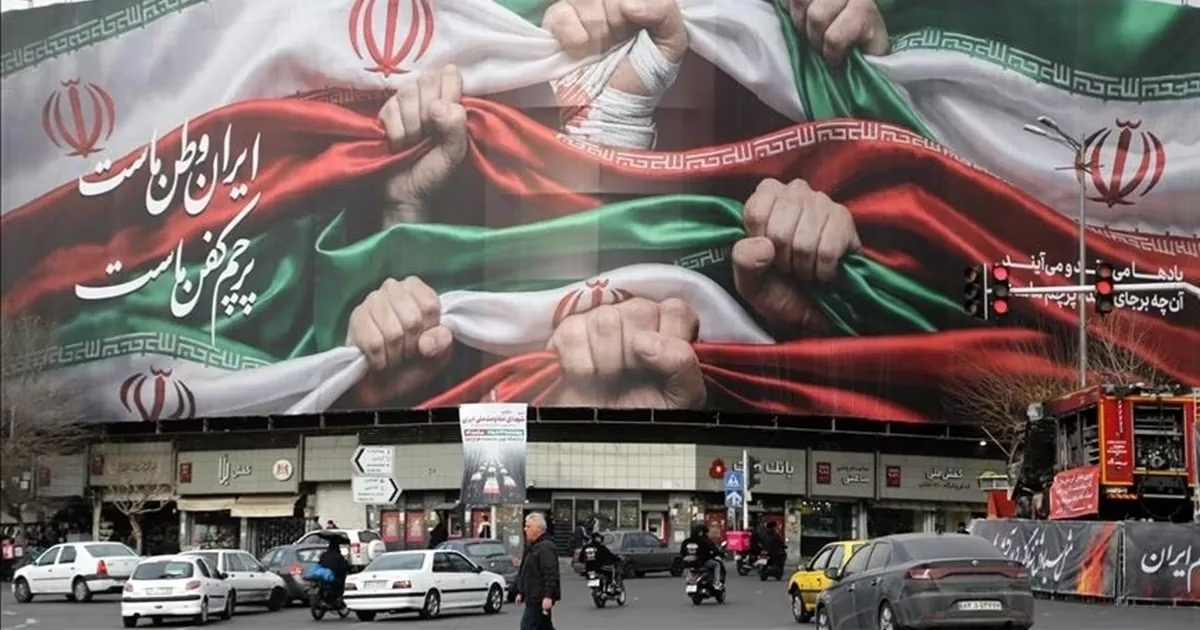
The hypothesis of concentrated air strikes as a tool to achieve rapid political collapse in Iran dominates Western strategic thinking, based on successful historical models in previous wars. However, this perception clashes with a complex geopolitical reality, as Iran is not merely a centralized military structure that can be crippled by a single blow, but rather a state with immense geographical depth and a solid combat doctrine.

This resilience dates back to ancient historical roots, where successive empires on the Iranian plateau realized that independence required the ability to absorb initial military shocks. From the Achaemenid era to conflicts with the Romans and Ottomans, the vast geography and multiple population centers remained an impenetrable barrier against any complete control.

The Iran-Iraq War in the 1980s served as the real laboratory that reshaped the modern Iranian military mind. Under suffocating international isolation and a severe shortage of advanced weapons, the leadership in Tehran drew a lesson: relying on external forces to ensure national security is a losing gamble.

From this lesson, a long-term project was launched to build a local defense industrial base, primarily focused on bridging the technological gap through asymmetric means. Instead of draining resources into building an air force that would be difficult to secure under sanctions, the compass turned towards developing a terrifying missile arsenal capable of achieving deterrence.

Iran's missile arsenal today is the largest in the region, designed to overcome advanced air defense systems through maneuverability and saturation techniques. Missiles such as 'Khorramshahr' stand out as strategic deterrent tools due to their heavy warheads and their ability to reach distant targets with increasing accuracy.

In addition to missiles, drones have emerged as a crucial element in Iranian military doctrine, providing a low-cost means of carrying out precise strikes. In this context, Tehran relies on a 'quantitative saturation' strategy aimed at exhausting enemy defenses through a barrage of synchronized drones and missiles.

What distinguishes the Iranian situation is its state of 'strategic independence,' as the country is not part of international military alliances such as NATO. This reality has pushed it to build an autonomous defense system that makes the cost of any attack on it extremely high, prompting adversaries to hesitate before engaging in an all-out confrontation.

Iran's topographical nature plays a pivotal role in protecting its military capabilities, as its geography varies between rugged mountain ranges and vast deserts. These terrains have enabled Tehran to construct underground 'missile cities' and fortified bases that are difficult to fully target even with the latest bunker-buster bombs.

Analytical sources confirm that the purpose of these fortified facilities is to ensure the continuity of the ability to retaliate even after being subjected to intense waves of aerial bombardment. This means that any conflict that might begin as a quick surgical operation would quickly turn into a regional war of attrition whose effects would extend over vast areas.

Compared to its situation in the 1980s, Iran today appears more prepared to manage long-term conflicts thanks to its advanced industrial base. It no longer relies on the black market for weapons but has become a source of military technologies used in various international conflicts, which enhances its leverage.

At the core of Iran's strategy is the principle of 'denying the enemy victory,' a defensive concept that seeks to transform any hostile technological superiority into a financial and military burden. By integrating geographical depth with missile capabilities, Tehran has created an equation that makes war an option with uncertain outcomes.

Experts indicate that any military assessment that ignores Iran's resilience may fall into the trap of miscalculations that preceded major wars. History proves that states with vast areas and ideological centrality do not fall to air strikes, no matter how destructive their power.

Ultimately, the idea of a 'blitzkrieg' against Iran remains merely a risky strategic gamble in the presence of a complex network of defenses and offensive capabilities. The transformation of the conflict into an open regional confrontation is the most likely scenario, which major powers fear and take into account.

Based on current data, Iran's military power is specifically designed to confront invasion or concentrated bombing scenarios. This design makes any attempt to militarily subdue the state a complex operation that far exceeds merely controlling the skies or destroying vital facilities.

The true power of the Iranian state lies not only in achieving a quick victory but in preventing the enemy from achieving a swift victory and turning the conflict into a war of attrition.

ANALYSIS

Sun 08 Mar 2026 5:18 pm - Jerusalem Time

From the Twelve-Day War to the February War: The Gradual Path of US-Israeli Aggression Against Iran

Said Erikat

Opinion Writer

Washington – Said Arikat – 3/8/2026

News Analysis

The developments of the past two years in the confrontation between the United States and Israel on one side, and Iran on the other, reveal a gradual path of wars and temporary truces. This reflects a recurring pattern in the management of major conflicts, where rounds of fighting are interspersed with short pauses to re-evaluate military and political calculations. The chronological sequence of events shows that the ceasefire announced in mid-2025 was not the end of the confrontation, but rather a transitional phase between two wars.

This phase began on June 13, 2025, when Israel, led by Prime Minister Benjamin Netanyahu, launched a widespread war on Iran, later known as the "Twelve-Day War." According to military assessments, Tel Aviv aimed to weaken Iran's military capabilities and re-establish the deterrence equation that had eroded due to accumulated tensions in the region. However, Iranian responses, both direct and through its regional allies, raised the level of risks and opened the door to the possibility of the confrontation expanding into a wider regional war.

Amidst that war, US President Donald Trump announced a ceasefire on June 23, 2025, after twelve days of fighting. The decision was presented at the time as a step aimed at containing the war and preventing its expansion in the Middle East. However, subsequent readings of this decision within political and military circles in Washington led a number of analysts to consider it closer to a tactical truce than a sustainable settlement, especially since it was not accompanied by a clear diplomatic path or political negotiations that could lead to a long-term de-escalation.

During the months following the ceasefire, a relative calm prevailed for approximately eight months. However, this calm was not widely interpreted as the end of the war, but rather as a phase for re-evaluation and repositioning. This period gave Washington and Tel Aviv an opportunity to review the results of the first round of fighting and re-arrange their military preparations, while Tehran worked to strengthen its defensive capabilities and prepare for the possibility of a new confrontation.

Historical experiences in managing international conflicts indicate that periods of calm between wars are often used to rebuild military capabilities or modify strategic plans, especially when parties are not ready for a long war at a specific moment. In this context, the ceasefire in the summer of 2025 seemed more like a transitional phase in an ongoing conflict, rather than an endpoint.

After about eight months of relative calm, the confrontation returned to the forefront when the United States and Israel launched a widespread war against Iran on February 28, 2026, which appeared more extensive than the previous war, both in terms of the nature of the targets and the level of military coordination between Washington and Tel Aviv.

According to multiple accounts, the initial strikes focused on targeting the Iranian political and military leadership structure, including Supreme Leader Ali Khamenei and a number of senior military officials. Initial estimates indicate a large number of Iranian leaders were killed in these strikes, as part of an attempt to create a shock within the political and military system.

In addition to military targets, reports emerged of a large number of civilian casualties, adding a sensitive humanitarian dimension to the war. Among the most controversial incidents was what the "New York Times" revealed about the killing of at least 158 girls from the "Good Tree School" as a result of an American bombing, which sparked widespread reactions in the media and among human rights organizations.

In contrast, US President Donald Trump continued to defend the strategy of intense military pressure, considering that the war might ultimately push Iran to accept new conditions or modify its regional policies. This assessment is based on the premise that the accumulation of military and economic pressures can weaken the Iranian regime's ability to continue the confrontation for a long period.

However, this assessment is not universally accepted within strategic analysis circles. Iran still possesses a wide network of regional allies, in addition to missile and military capabilities that could contribute to expanding the scope of the war if it decides to respond more broadly. Moreover, the confrontation is not limited to its direct military dimension, but is also linked to regional power balances and the future of security arrangements in the Middle East.

The chronological sequence of events since the summer of 2025 indicates a clear pattern in the management of this conflict, where wars are interspersed with temporary truces that allow parties to re-evaluate the field and prepare for new rounds. The ceasefire announced in June 2025 did not open a clear diplomatic path as much as it paved the way for a subsequent, more extensive war.

At the same time, the reliance on targeting the supreme leadership of countries as a means to bring about rapid change in their behavior remains a controversial strategy in modern conflicts. Many experiences have shown that this type of operation can sometimes lead to counterproductive results, as it strengthens internal cohesion and gives the political leadership an opportunity to mobilize society around a confrontational discourse.

Specifically in the Iranian case, external military pressure may reinforce nationalist sentiment within Iranian society and expand the circle of support for the regime, which could make the war more complex and prolonged. Thus, the current confrontation appears to be part of an extended strategic conflict that may continue through successive phases of wars and truces, rather than being resolved in a single military round.

ARAB AND WORLD

Sun 08 Mar 2026 5:18 pm - Jerusalem Time

Two Israeli Soldiers Killed and Bloody Escalation in Lebanon: Evacuation Warnings for 100 Towns South of the Litani

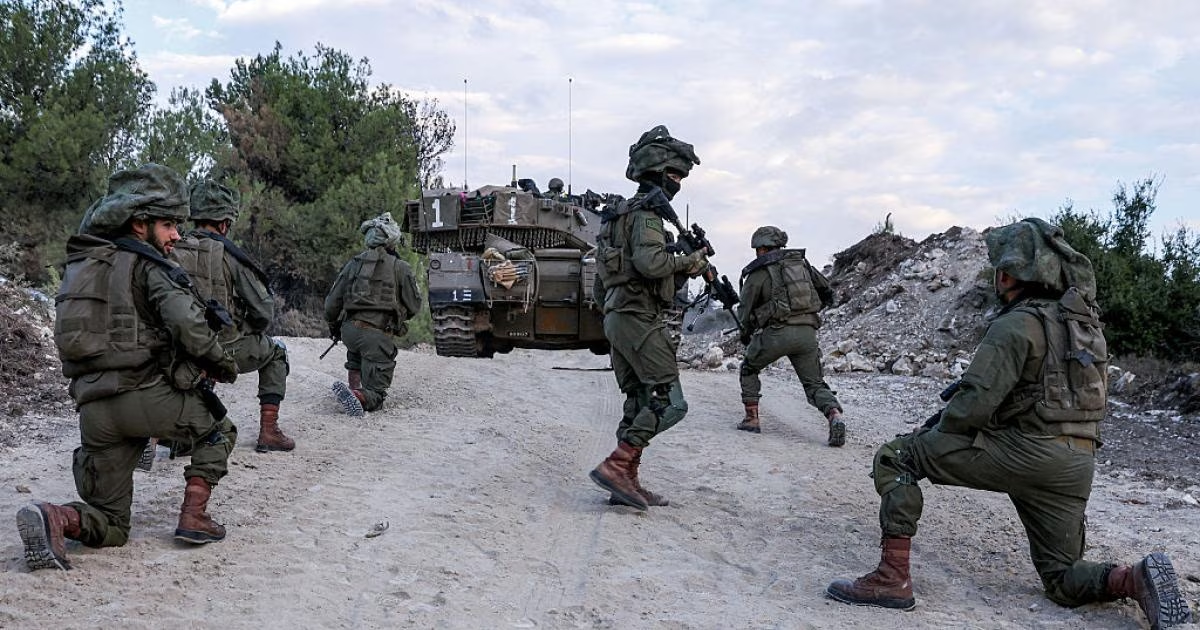
The Lebanese front witnessed a significant field escalation today, Sunday, as the Israeli army admitted to the killing of two of its soldiers and the injury of an officer with varying degrees of wounds. These losses followed a direct targeting of a 'D9' military bulldozer during ongoing ground operations in southern Lebanon, amidst continued fierce clashes on the front lines.

Field sources reported that Israeli forces were subjected to five qualitative targeting operations in recent hours, including the firing of anti-tank missiles, mortar shells, and intense rocket barrages. These attacks focused on troop concentrations and vehicles near the border, reflecting the ferocity of the field resistance in confronting infiltration attempts.

In a related context, reports indicated that most operations were carried out using anti-tank missiles from long distances, reaching approximately seven kilometers. The shelling also targeted barracks and military sites within the Israeli side, where eight soldiers were previously injured, five of whom were described as being in serious condition, after shells fell on a military position.

On the humanitarian side, Israeli aircraft continued their violent raids, resulting in the martyrdom of 23 Lebanese in an initial toll for Sunday. The raids targeted a hotel in the heart of the capital Beirut, in addition to a residential building in the south, leading to widespread destruction and casualties among unarmed civilians.

Lebanon's Ministry of Health revealed shocking statistics since the start of the aggression earlier this month, recording the martyrdom of 394 people, including 83 children and 32 women. The number of injured also rose to 1130, including hundreds of children and women, due to the intense and continuous air raids across various governorates.

In a new massacre at dawn today, 19 people were martyred after an airstrike targeted a three-story residential building in the town of Sair Al-Gharbi in the Nabatieh district. This raid is part of a series of attacks targeting residential areas and southern villages, exacerbating the humanitarian crisis and cases of forced displacement.

On the ground, the Israeli army issued widespread and unprecedented evacuation warnings covering more than 100 towns and villages located south of the Litani River. These orders were characterized by being open-ended and not specifying a return date, suggesting the occupation's intention to expand the scope of its ground military operations in these strategic areas.

Military estimates indicate that the occupation seeks to impose field control over a border strip ranging from 5 to 8 kilometers deep inside Lebanese territory. Evacuation orders were not limited to the south but extended to include villages in the Beqaa region and specific neighborhoods in the southern suburbs of Beirut, amidst warnings of a major displacement wave.

These rapid developments confirm that the confrontation has entered a more dangerous phase, as the Israeli army seeks to strike newly established Lebanese fortifications and military points. In contrast, Lebanese field forces continue to target Israeli concentrations and prevent the stabilization of invading forces, leaving the situation open to all possibilities.

For the fourth time, the Israeli army renewed evacuation warnings directed at residents of wide areas south of the Litani River, covering more than 100 Lebanese towns.

ARAB AND WORLD

Sun 08 Mar 2026 5:18 pm - Jerusalem Time

Netanyahu Vows 'Surprises' for Iran in Second Phase, Trump Threatens Harsh Strikes

Israeli Prime Minister Benjamin Netanyahu announced that his government has developed an organized military plan that includes a series of surprises for the next phase of confrontation with Iran. Netanyahu clarified in his statements that the military operations are directly aimed at destabilizing the Iranian regime and creating conditions for radical political change in Tehran.

Netanyahu stressed that Israel has succeeded in changing the face of the Middle East region as previously promised, noting that the decisions he made involved significant risks but were necessary to eliminate those he described as Israel's enemies. He considered that the Hebrew state has been undergoing a comprehensive internal and regional transformation since the events of October 7th.

In contrast, the Iranian arena witnessed remarkable diplomatic moves, as Iranian President Masoud Pezeshkian apologized for the attacks on neighboring countries during the past period. This apology coincided with Tehran's continued launching of barrages of missiles and drones targeting various locations, including countries in the Arabian Gulf region.

Reports from Tehran indicate a sharp division within Iranian decision-making circles, specifically between the pragmatic wing seeking de-escalation and the hardline wing committed to continuing the fight. This tension comes at a sensitive time following the killing of Supreme Leader Ali Khamenei in the first airstrikes that initiated the war.

For his part, US President Donald Trump entered the crisis with strong threats, affirming that Iran will be subjected to extremely harsh strikes in the coming period. Trump warned that US military operations would not be limited to inside Iran, but would also include other regions and groups that would become legitimate targets for US forces.

On the ground, the Israeli army officially confirmed the transition to the second phase of the war against Iran, after carrying out extensive operations targeting more than 300 strategic sites. These successive strikes led to severe disruptions in global markets and contributed significantly to weakening the military and political leadership structure in Tehran.

Despite increasing international pressure, Iranian President Pezeshkian categorically rejected the US President's call for unconditional surrender, describing these demands as dreams that will not come true. Pezeshkian affirmed that his country would not raise the white flag despite the significant human and material losses caused by hundreds of Israeli and American airstrikes.

The roots of the current escalation date back to a series of bloody events that began on October 7, 2023, when Palestinian factions launched Operation Al-Aqsa Flood against Israeli bases and settlements. Since then, the region has been embroiled in a spiral of violence, including a devastating war in the Gaza Strip that lasted two years before a fragile ceasefire agreement was reached.

Direct confrontation between Israel and Iran began on February 28, when Tel Aviv and Washington launched intensive attacks that led to the killing of high-ranking security and political leaders. Iran has since responded by launching ballistic missiles and suicide drones towards Israeli territory, leading to strict military censorship over the extent of the damage.

Informed sources reported that the Israeli media blackout on the results of Iranian missile barrages aims to prevent the collapse of the home front and deprive Tehran of accurate intelligence information. Israeli security circles fear that leaked information could lead to updating the coordinates of Iranian missiles and increasing their accuracy in upcoming rounds.

In the absence of effective Iranian air and naval cover, Tehran relies primarily on its missile arsenal to deter continuous attacks carried out by Israeli air forces with American support. Observers believe that the collapse of the central command in Iran could lead to unexpected repercussions on the entire map of alliances in the Middle East.

Military estimates indicate that the second phase of the war will witness an intensification of qualitative operations targeting vital installations and remaining command and control centers. Netanyahu seeks through these 'surprises' to quickly resolve the conflict before Iran can reorganize its leadership ranks after the absence of the Supreme Leader.

On the humanitarian level, the mutual attacks have caused hundreds of casualties and widespread destruction of infrastructure, amid international warnings of the region sliding into an uncontrollable comprehensive war. International organizations continue their calls for restraint, but the language of threat remains dominant among the parties to the conflict.

Anticipation remains the master of the situation for what the coming days will bring in terms of 'surprises' promised by Netanyahu, amid Iranian insistence on continuing despite the siege and strikes. All eyes are on the new Iranian Leadership Council to see whether it will move towards de-escalation or escalate the military confrontation to unprecedented levels.

Israel has an organized plan that includes many surprises for the next phase of the war, and the goal is to destabilize the regime and allow for change.

LATEST NEWS

Sun 08 Mar 2026 5:18 pm - Jerusalem Time

Tehran Vows More Painful Strikes, Affirms Ability to Continue War for Six Months

Iranian authorities affirmed on Sunday their long-term resilience and sufficient military capability to continue the open confrontation against Israel and the United States for at least an additional six months. These statements reflect Tehran's determination to proceed with current military operations at the same pace, while hinting at a qualitative escalation in the field in the coming phase.

In official statements broadcast on Iranian television, the spokesperson for the Revolutionary Guard, Ali Mohammad Naeini, revealed the armed forces' intention to adopt a new offensive approach in the coming days. Naeini explained that the anticipated attacks would rely on long-range missiles and advanced weapons not extensively used before, warning that the strikes would be more precise, focused, and painful for the Israeli side.

On the ground, hundreds of thousands of Israelis experienced a state of terror early Sunday morning, as air raid sirens blared across wide geographical areas including the cities of Haifa, Tel Aviv, and Beersheba. These missile barrages prompted the occupation authorities to activate extreme emergency procedures, urging residents to remain in shelters and fortified areas to avoid direct injuries.

Military sources reported that Israeli air defense systems faced a difficult night, intercepting no less than four consecutive waves of missiles launched from Iranian territory. These offensive waves continued for five consecutive hours, leading to a state of confusion in navigation and public life within major cities and settlements.

For its part, Israeli police confirmed that shrapnel from interception operations fell in the Hof Hacarmel area, south of Haifa. Concurrently, loud explosions were heard in central Tel Aviv and its eastern suburbs, extending to areas in the southern West Bank, as Iranian missiles reached long-range targets.

Field sources indicated that the pace of Iranian missile bombardment has seen a significant escalation over the past forty-eight hours, which contradicts the Israeli narrative that previously claimed the destruction of most launch platforms. It appears that Tehran has succeeded in changing its military tactics more than once to circumvent defensive systems and direct successive barrages.

In recent attacks, a significant reduction in the early warning period available to Israelis was observed, decreasing from ten minutes to only about five minutes in some areas. This technical development in the speed of missile arrival or launch method has increased pressure on the Israeli home front, which has faced unprecedented security challenges since the escalation began.

These rapid developments come within the framework of the war that erupted on February 28, following attacks by the United States and Israel on sites inside Iran. The mutual missile confrontations have so far resulted in the deaths of 10 people inside Israel, amid international fears of the region sliding into an uncontrollable comprehensive regional conflict.

Iranian armed forces are capable of continuing a fierce war for at least six months at the current pace of operations, and the enemy should expect more painful strikes.

ANALYSIS

Sun 08 Mar 2026 5:17 pm - Jerusalem Time

War of Uncertainty: How the Current Confrontation Reshapes Civilizational Balances in the East?

The current confrontation in the region has transcended the boundaries of traditional military engagement, transforming into a comprehensive civilizational and ideological conflict that pits Western technological superiority directly against the resilience of history and geography. This in-depth reading reveals the necessity of moving from reliance on international illusions towards building comprehensive sovereignty that includes food, medicine, and weaponry.

The collective Arab and Islamic mind is experiencing a state of analytical confusion and wishful chatter fueled by superficial media platforms, leading to the absence of robust methodologies in understanding the psychology of peoples. The war raging today acts as a strategic laboratory, exposing the falsity of fragile concepts that peoples have clung to for long decades, while highlighting, in contrast, solid truths that were previously obscured.

One of the most prominent features of this stage is the collapse of the myth of absolute technological decisive victory, as it has been proven that artificial intelligence and cyber arsenals cannot end wars with the push of a button. Reality has revived Clausewitz's principle of 'uncertainty,' confirming that war is a living entity whose final paths cannot be predicted solely through inanimate machines.

The concept of a 'civilizational state' emerges on the horizon as an alternative to the functional state that feeds on external support, where vast geography and a human mass believing in a trans-generational ideology grant immense capacity to absorb shocks. This model pushes towards the necessity of developing solid regional alliances, such as transforming cooperation entities into more cohesive political units.

The region is currently witnessing a contemporary version of what was known as the 'Eastern Question' that previously dismantled the Ottoman Empire, but with 21st-century tools. The new colonial goal is no longer to rapidly change regimes, but to manage creative chaos to keep the region in a state of permanent attrition that serves regional expansion projects.

The conflict is systematically being transformed from a political dispute over borders into a comprehensive holy war, where the West is reviving the spirit of the Crusades with a modern Zionist tint. This transformation calls for a reciprocal response from regional powers that find in religious doctrine the only means of mobilization capable of steadfastness and confrontation.

The current war has acted as a 'surgical scalpel' that excised the illusions of international protection, as it has become clear to everyone that international law is merely a tool to serve Western centrality. Reliance on external umbrellas has proven to be the beginning of self-erosion for states that do not possess independent decision-making or self-strength.

Recent confrontations have revealed the impotence of the 'ignorant educated' and the procrastinating analyst who sells illusions to the masses through screens, and a dire need has emerged for the appearance of the 'engaged intellectual.' This type of intellectual is capable of connecting the movement of a tank on the battlefield with the deep historical roots that move peoples.

Field experience has proven the fragility of small states lacking geographical depth and industrial sovereignty, as they have become mere pawns in the struggle of giants, susceptible to sacrifice. The absence of sovereignty in the food, medicine, and weapons sectors makes any political entity vulnerable to collapse at the first real confrontation.

Within this suffering, what can be called the 'Islamic and Arab Civilizational Basin' is forming, where artificial borders in popular consciousness fade under the pressure of successive shocks. This concept transcends narrow sectarian differences to coalesce as a geopolitical bloc capable of standing against the fragmentation projects targeting the region.

Self-responsibility for defense has become an inescapable destiny, as the production of knowledge and the localization of basic industries are no longer an intellectual luxury but a fundamental condition for existence. In the jungle of international uncertainty, there is no place for the weak who await solutions from international institutions that have proven their complete bias towards the aggressor.

We are not living at the end of a war, but rather the throes of birth of a new regional order in which thrones based on corruption and external dependence will fall. This system will restore dignity to pivotal states that have the courage to possess deterrent weapons and make their sovereign decisions away from international dictates.

The current conflict redefines power; it is not merely possessing advanced technology, but a combination of solid doctrine, vast geography, and popular will. Peoples who understand their historical roots are the only ones capable of resisting attempts at civilizational erasure practiced by colonial powers.

In conclusion, the 'War of Uncertainty' remains the primary driver for redrawing the boundaries of consciousness before geographical boundaries, as true powers emerge from beneath the ruins of old illusions. The future in this new East will belong to those who possess long-term endurance and the ability to transform existential threats into opportunities for independent civilizational building.

The future is not for those who possess the latest technology, but for those who possess the deepest history, the most solid doctrine, and the widest geography.

ARAB AND WORLD

Sun 08 Mar 2026 5:17 pm - Jerusalem Time

Member of the Political Bureau of the CPC Central Committee, Foreign Minister Wang Yi Answers Questions from Chinese and Foreign Journalists on China's Foreign Policy and International Relations

The Fourth Session of the 14th National People's Congress held a press conference at the Media Center, where Wang Yi, Member of the Political Bureau of the CPC Central Committee and Foreign Minister, answered questions from Chinese and foreign journalists on China's foreign policy and international relations.

Wang Yi: Good morning, friends from the press! I am very pleased to meet you again. Today is International Women's Day, and first of all, I would like to extend my sincere wishes to all women. I would also like to take this opportunity to express my sincere thanks to our media friends and personalities from various circles for your attention and support for Chinese diplomacy.

Today's world is witnessing rapid developments of unprecedented changes in a century, with transformations and turbulences intertwined, and wars and conflicts continuously succeeding each other. Meanwhile, China is experiencing a rapid pace of building a strong nation, an irresistible momentum of national rejuvenation, and international influence growing day by day. Under the strong leadership of the CPC Central Committee with Comrade Xi Jinping as its core, Chinese diplomacy revolves around the central task of the Party and the nation, follows the scientific guidance of Xi Jinping Thought on Diplomacy, firmly defends the country's sovereignty, security, and development interests, firmly upholds the rule of law in the world, fairness and justice, firmly opposes all unilateral actions, power politics, and bullying, firmly adheres to and fulfills required international commitments, and firmly stands on the right side of history's progress. We are full of confidence in the future of humanity as the most important force for peace, stability, and justice in the world, and we are ready to work with all like-minded and ambitious countries to continue writing a contemporary chapter characterized by peace, development, cooperation, and win-win outcomes towards the lofty goal of building a community of shared future for mankind.

Therefore, I am ready to answer your questions.

CCTV: The year 2025 is a very special year for Chinese diplomacy. Could you highlight the achievements of summit diplomacy in the past year? And what are the new notable points for this year?

Wang Yi: Summit diplomacy is an anchor for Chinese diplomacy. In the past year, President Xi Jinping engaged in fruitful summit diplomatic practices, in the face of strong winds and turbulent waves in the international situation, creating a series of important historical moments.

Over the past year, President Xi Jinping held important meetings with leaders of major countries in the world and conducted strategic communication with them, creating a new experience of dialogue and coordination among major powers; he visited Southeast Asia, Russia, Central Asia, and the Republic of Korea, establishing a new landscape of good neighborliness with neighboring countries; he presided over the Tianjin Summit of the Shanghai Cooperation Organization and the China-CELAC (Community of Latin American and Caribbean States) Forum, mobilizing new impetus for the solidarity of the Global South; and he attended a series of events commemorating the 80th anniversary of the victory of the Chinese People's War of Resistance Against Japanese Aggression and the victory of the World Anti-Fascist War, issuing a strong new voice for defending peace and justice.

Over the past year, the international community has come to know China, approached it, and placed greater trust and expectations on it through summit diplomacy. An increasing number of countries have realized that Chinese diplomacy, personally planned and led by President Xi Jinping, has provided factors of stability and certainty, which are the most precious things in a turbulent world, and it has become an irreplaceable backbone amidst the world's turbulences. Especially, the important initiatives and concepts put forward by President Xi Jinping embody his distinguished strategic insight and broad global vision, and they have set the correct direction for the development of unprecedented changes in a century.

This year, President Xi Jinping will welcome world guests to China, preside over the informal APEC leaders' meeting, the Second China-Arab States Summit, and other major events hosted by China, and make several important visits. This will undoubtedly promote the development of relations between China and countries around the world in a more positive direction, undoubtedly open up new prospects for building a community of shared future for mankind, and undoubtedly enable the Chinese nation to make new contributions to the cause of world peace and development.

Sputnik: In the complex international situation, how do China and Russia, as two major countries, confront attempts to reshape international law and global trade rules?

Wang Yi: This year marks the 30th anniversary of the establishment of the China-Russia strategic partnership of coordination, and the 25th anniversary of the signing of the "Treaty of Good-Neighborliness, Friendship and Cooperation between China and Russia." China-Russia relations have always "stood firm as a mountain amidst storms" in the intertwined changes and turbulences of the international situation.

Why have these relations reached this level? I believe the main reason is that the China-Russia strategic partnership of coordination has been established from the outset on the basis of equality, respect, and mutual benefit, reflecting the content of a new type of international relations and representing the direction of development of a new type of relations between major countries.

China and Russia are strategically independent. We always respect each other's core interests, do not forcibly impose our will and agenda on each other, and adhere to non-alliance, non-confrontation, and non-targeting of a third party.

China and Russia have a high degree of mutual political trust. Standing shoulder to shoulder is a fundamental characteristic of China-Russia relations, which possess enormous strategic resilience regardless of any attempts to sow discord or exert external pressure.

China and Russia have extensive practical cooperation. China and Russia have the most strategic consensus and closest strategic cooperation on important international and regional affairs, including the issue you mentioned of defending international rules and the international order.

The international order established after World War II is once again at a critical juncture after enduring 80 years of challenges and difficulties. Last year, the Chinese and Russian presidents attended commemorative events for the victory of the Anti-Fascist War held on the other side, where both sides issued three weighty joint statements on deepening comprehensive strategic cooperation, consolidating global strategic stability, and defending the authority of international law. This sent a clear message to the world about the necessity of upholding the correct understanding of the history of World War II, defending the outcomes of the victory of World War II, and rejecting unilateral actions and bullying with unwavering determination. 80 years ago, we made a "Sino-Russian contribution" to establishing the post-war order, and today, 80 years later, we will inject "Sino-Russian energy" to welcome a multipolar world.

Phoenix TV: The United States and Israel have once again launched military strikes on Iran, and the conflict is currently extending to the entire Middle East region. What are China's views on resolving the Iranian issue?

Wang Yi: This is a matter of concern to all parties, and also a focal point of the current international situation. The Chinese side adheres to an objective and just position, and has repeatedly clarified its principled stance, which can be summarized in one sentence: cease fire and prevent war. Ancient Chinese say, "War is a dangerous tool, one must be cautious in resorting to it." In the face of the Middle East engulfed in the flames of war, I would like to emphasize that this war should not have broken out in the first place, and no party wins in it. The history of the Middle East repeatedly reminds people that resorting to force is not a solution to problems, and war only leads to more hatred, and only generates more crises. The Chinese side once again calls for an immediate cessation of military operations, preventing the continuous escalation of the situation, and avoiding the expansion of the war's scope.

The Chinese side believes that finding correct and appropriate solutions to the relevant problems in Iran and the Middle East requires adherence to the following basic principles:

First, respect for state sovereignty. Sovereignty is the cornerstone of the existing international order. We call for the necessity of respecting the sovereignty, security, and territorial integrity of Iran and all countries in the Gulf region, without prejudice.

Second, refraining from arbitrary use of force. The power of the fist does not equal the power of right, and the world should not return to an era governed by the law of the jungle. Those who use force arbitrarily do not prove themselves strong, and the peoples should not be innocent victims of war.

Third, adherence to non-interference in internal affairs. The peoples of the Middle East are the true masters of this region, and the countries of the Middle East should decide their affairs by their independent will. Planning colored revolutions and carrying out regime change is unacceptable to the peoples.

Fourth, politically resolving hot issues. China always advocates for prioritizing peace, and all parties should return to the negotiating table as soon as possible, settle differences through equal dialogue, and make efforts to achieve common security.

Fifth, major countries should play a constructive role and use their power in good faith. Another ancient Chinese proverb says, "Without justice, the scales tip from victory to defeat." Major countries should adhere to justice and follow a straight path, and provide more positive energy for peace and development in the Middle East.

As a sincere friend and strategic partner of the Middle Eastern countries, China is ready to work with them to implement the Global Security Initiative, thereby restoring order to the Middle East, restoring security to its peoples, and restoring peace to the world.

CNN: Since President Donald Trump's return to the White House, China-US relations have seen fluctuations. His visit to China at the end of this month is highly anticipated. How will the US and Israeli military strikes on Iran affect this visit? And what are China's expectations for the outcomes of Trump's visit to China and the developments in bilateral relations in the coming period?

Wang Yi: China-US relations concern everyone and affect the world. Cutting off communication between the two countries will only lead to misunderstanding and misjudgment, and the two countries heading towards wrestling and confrontation will harm the world. China and the United States are two major countries, and neither can change the other, but they can change the way they deal with each other, which is to adhere to a position of mutual respect, defend peaceful coexistence as a red line, and pursue a horizon of cooperation and win-win outcomes. This approach is consistent with the interests of the two peoples and the aspirations of the international community.

What is heartening is that the two heads of state have made personal efforts and maintain good communication at the highest level, which has provided an important strategic guarantee for improving and developing China-US relations, and contributed to the overall stability of these relations after going through twists and turns. This year is a busy year for China-US relations, as the agenda for high-level communication between the two countries has been placed on our table. Now, it is required of both sides to make full preparations, create favorable conditions, control existing risks, and remove trivial disturbances. The Chinese side's position has always been positive and open, and it is important for the American side to move in the same direction as well. I am confident that as long as both sides deal with each other with sincerity and faithfulness, we can continuously extend the list of cooperation and shorten the list of problems, and under the strategic leadership of the two heads of state, we can achieve satisfactory results for both peoples, reach consensuses welcomed by the entire international community, and make 2026 a pivotal year for China-US relations to move towards a sound, stable, and sustainable development path.

China Daily: What is your assessment of the leading role played by the countries of the Global South in the reform process of the global governance system? Since this year, the international situation has witnessed significant changes, with protectionism and power politics escalating. How can the Global South achieve the solidarity and self-strengthening that the Chinese side always advocates?

Wang Yi: The collective rise of the Global South is a remarkable sign of major changes in the world. The share of the Global South in the global economy has risen from 24% to over 40% in the past four decades, making it a pivotal driving force for global multipolarity.

Currently, hegemony and power politics are rampant, posing a serious shock to the existing international order. Therefore, the Global South should enhance communication and coordination, and make joint efforts to safeguard its legitimate rights and interests and expand the space for its independent development.

The Global South is an emerging, active, and benevolent positive force in the international arena. The more intense the transformations and turbulences in the world, the greater the need to consolidate confidence, strengthen solidarity and cooperation, and jointly raise the banner of peace, development, cooperation, and win-win outcomes. It should also activate the role of BRICS, the Shanghai Cooperation Organization, the "Group of 77 and China," and other important platforms, in order to voice peace and drive development.

Multilateralism is the "safe haven" for countries of the South. The Global South should push the international community to implement true multilateralism, and maintain healthy growth of the international system centered on the United Nations and the international order based on international law. It should adhere to dealing with world affairs through consultation among all countries, and setting international rules with the participation of all countries.

The development of the Global South needs an international environment characterized by openness and cooperation. Therefore, we must advocate for economic globalization characterized by inclusiveness and benefit for all, push for the building of an open world economy, and firmly maintain the multilateral trading system, so that we can share opportunities and achieve win-win outcomes through openness.

China has always cared for the Global South and integrated into its fabric, ready to work hand in hand with other countries of the South on the path of modernization, and push for the building of a community of shared future for mankind.

CGTN: Amidst the ongoing Israeli-Palestinian conflict and the fragile ceasefire in Gaza, the United States proposed establishing a "Peace Council" to resolve the Gaza issue and arrange for the post-war period. How does the Chinese side truly push for a solution to the Palestinian issue?

Wang Yi: The situation in Gaza concerns the preservation of the minimum international morality. The international community's efforts to achieve a ceasefire in Gaza are welcome, but continuous efforts are still needed to consolidate the ceasefire, push for reconstruction, and then find a comprehensive and lasting solution to the Palestinian issue.

There is only one reasonable and universally recognized solution to the Palestinian issue, which is the "two-state solution." Any other arrangement or new mechanism must support the "two-state solution" rather than undermine it. The international community will not accept marginalizing the Palestinian issue again. The United Nations, in particular, should bear the responsibility of playing a leading role in this process.

Living under the burden of turmoil and wars is not the written destiny of the Palestinian people, who have the same legitimate right as peoples in other regions of the world to achieve peaceful development away from the flames of war. As a responsible major country, China will, as usual, support the just cause of Palestine to restore its legitimate national rights, and push the international community to restore justice to the Palestinian people.

NBC: Does the Chinese side accept the framework of "governance by China and the United States" to address global challenges? If not, what is China's alternative solution to avoid confrontation between China and the United States, and to make the world trust that China does not intend to overturn the current international order after its rise?

Wang Yi: There is no doubt that China and the United States have significant influence on the world. But we must not forget that there are more than 190 countries on this planet, and they jointly write the history of the world, and their peoples jointly create the future of humanity. Coexistence in diversity is the original face of human society, and the presence of multiple poles is the desired appearance of the international equation.

If we review history, we will find that every time major powers fought for hegemony and confrontation between blocs brought disasters and suffering to humanity. Therefore, China will never follow the old path of the inevitability of hegemony for a major country, nor does it agree with the logic of "joint governance by major countries." The Chinese Constitution clearly states the necessity of adhering to an independent foreign policy and adhering to the path of peaceful development. Chinese leaders have repeatedly emphasized in international forums that China will never seek hegemony or expansion, no matter how the international situation changes, and no matter how much China develops.

As for how the international equation develops, the Chinese solution calls for building a global multipolarity characterized by equality and order. Equality means equal membership for all countries in the international community, whether large or small, strong or weak, and they can find their own place in the multipolar equation and play their required role. Order means that all countries must adhere to universally recognized international rules, namely the purposes and principles of the UN Charter and the basic principles of international relations.

Building a global multipolarity characterized by equality and order must be a shared responsibility of all countries. Since major countries have greater resources and capabilities, they must bear more responsibility with a broader mind, and be a model for adhering to rules, fulfilling promises, and upholding the rule of law. China is keen to be a constructive force in a world undergoing transformations, and welcomes a multipolar world with all countries.

Brazil de Fato: The "National Security Strategy" issued by the United States last year indicates that the US priority is to interfere in relations between China and Latin American countries by pressuring Latin American countries. How does the Chinese side deal with this?

Wang Yi: The old play of the 19th century should not be staged again in the international theater of the 21st century. The resources in Latin America belong to its peoples, and they choose their countries' paths and choose their friends by their independent will.

Cooperation between China and Latin America is mutual assistance and mutual support between countries of the Global South. If we review what has happened over more than half a century, we will find that the key to the rapid development of relations between China and Latin America lies in China's constant respect for the peoples of Latin America, and China's adherence to dealing with Latin American countries on an equal footing and on the basis of mutual benefit and win-win outcomes. We have not made geopolitical calculations, nor have we interfered in the internal affairs of other countries, nor have we asked other countries to take sides. We jointly launched the five initiatives of solidarity, development, civilization, peace, and people-to-people communication at the ministerial meeting of the China-CELAC Forum, which outlined the broad strokes for China and Latin America to move together towards modernization.

China-Latin America cooperation is not aimed at a third party, and should not be disturbed by a third party. We are full of confidence in the future of China-Latin America relations. China is keen to work together with Latin American countries to steadily advance the building of a China-Latin America community of shared future, no matter how the situation changes, so that the comprehensive cooperative partnership between China and Latin America can better serve the peoples of both sides.

China Review News Agency: Recently, the Lai Ching-te (Lai Qingde) authorities have repeatedly claimed that Taiwan is a "sovereign independent state," and that the Taiwan issue is not China's internal affair. The Taiwan issue and the situation in the Taiwan Strait are continuously escalating, how do you assess this?

Wang Yi: Taiwan has been Chinese territory since ancient times, and it was never in the past, nor is it in the present or future, a so-called "state" at all. The return of Taiwan to China is the result of the victory of the Chinese People's War of Resistance Against Japanese Aggression, and also a fruit of the victory of World War II. Taiwan's status has been definitively settled by a series of international legal documents such as the "Cairo Declaration," the "Potsdam Proclamation," the "Instrument of Surrender of Japan," and UN General Assembly Resolution 2758. Any attempt to create so-called "two Chinas" or "one China, one Taiwan" on the international stage is doomed to failure.

The Democratic Progressive Party authorities, who stubbornly adhere to the separatist stance of "Taiwan independence," are the source of the turmoil that undermines peace and stability in the Taiwan Strait. Facts have repeatedly proven that the clearer the international community's stance in rejecting "Taiwan independence" separatist forces, and the firmer its stance in adhering to the One-China principle, the greater the guarantee for peace and stability in the Taiwan Strait.

The Taiwan issue is China's internal affair, and it is the most important core of China's core interests. This red line must not be crossed or trampled upon. We will never allow anyone or any force to separate Taiwan, which was recovered from Japanese occupation more than 80 years ago, from China again. An overwhelming consensus has formed in the international community on adhering to the One-China principle. An increasing number of countries are standing with China, reaffirming their adherence to the One-China principle and recognizing that Taiwan is part of Chinese territory, and even explicitly rejecting all "Taiwan independence" separatist activities and supporting China's reunification cause. This clearly proves that rejecting "Taiwan independence" and supporting China's reunification is in line with the general trend of the times and also consistent with the aspirations of the international community.

The resolution of the Taiwan issue and the complete reunification of the motherland is an irresistible historical process. Those who follow it prosper, and those who oppose it perish.

Global Times: In the current situation, conflicts and disputes in the world are increasingly intensifying, and the pace of competition and confrontation is escalating. Why does Chinese diplomacy set building a community of shared future for mankind as its goal?

Wang Yi: Indeed, as you said, humanity is currently living in an era full of challenges. When we review history, we find that there are always pioneers who tirelessly pursue ideals and light, no matter the difficulties the world faces. President Xi Jinping proposed building a community of shared future for mankind, which embodied his profound vision, far-sightedness, and broad mind as a leader of a major country, and answered the contemporary question "where is humanity heading?" He told the world that humanity's enemy is not within itself, but rather war, poverty, hunger, and injustice. These challenges cannot be overcome individually, and it is impossible to distance oneself from them; solidarity, cooperation, mutual support, and collaboration are essential throughout the world. Isolation cuts off assistance, and solidarity generates strength. The peoples of the world are increasingly realizing the contemporary value and power of truth of the concept of a community of shared future for mankind, which serves as a beacon illuminating humanity's path forward.

The concept of a community of shared future for mankind also embodies China's responsibility as a major country and its historical mission towards the world. Chinese people have always been characterized by a broad vision to create a world shared by all and characterized by greater harmony. The path of the great rejuvenation of the Chinese nation and the rise of a major country with a population of 1.4 billion will not be a reproduction of the old path taken by traditional major powers of practicing hegemony and expansion. Instead, we will follow the path of peaceful development with unwavering determination, and encourage all countries to follow the path of peaceful development and work together to build a clean and beautiful world characterized by lasting peace, global security, common prosperity, openness, and inclusiveness.

We have seen with great satisfaction that the concept of building a community of shared future for mankind has been taking root in people's hearts day by day in recent years, and has received support from more than 100 countries and international organizations, and endorsement from about 80% of international public opinion. More than 40 countries and regional organizations have participated in cooperation in building a community of shared future, which once again proves that "those who stand with justice receive greater help," and the just cause will be supported by all countries and will mobilize the strength of the peoples.

The future of humanity is bright, but it will not be realized automatically. Building a community of shared future for mankind is a beautiful prospect, and it is also a historical process that requires continuous struggle and joint efforts generation after generation. China will work hand in hand with all parties with firm conviction and practical actions to continuously transform the community of shared future for mankind from vision to reality.


PALESTINE

Sun 08 Mar 2026 12:50 pm - Jerusalem Time

Fears of a long attrition.. Israel and America seek to resolve the confrontation with Iran through the 'oil weapon' and regional alliances

The direct military confrontation between Iran on the one hand, and Israel and the United States on the other, entered its second week amidst an unprecedented escalation targeting vital facilities. Tel Aviv and Washington are seeking to achieve a strategic breakthrough that will quickly decide the battle, fearing a slide into a long-term war of attrition that could drain the military and economic resources of both sides.

The current strategy involves intensifying strikes against Iranian oil facilities to undermine the regime's financial resilience, in conjunction with widespread displacement operations in Lebanese border towns. These moves come amidst a shared desire between US President Donald Trump and Israeli Prime Minister Benjamin Netanyahu to achieve a swift victory that will fundamentally end the Iranian threat.

Despite the painful blows Tehran has received, including the martyrdom of Supreme Leader Ali Khamenei and prominent military commanders in the first strike, signs of internal cracks have not appeared as clearly as intelligence circles had hoped. Iran is currently struggling to confront the 'hell' targeting its capabilities, amidst warnings of missile responses that could ignite the entire region uncontrollably.

Inside Israel, opinion polls show widespread support for the war, reaching 79%, but dissenting voices have begun to rise, warning of the cost of this adventure. Yair Golan, head of the 'Democrats' party, warns that Netanyahu may be driven by sectarian and personal motives in prolonging this war, which could put Israel's national security at grave risk.

For his part, Israeli Education Minister Yoav Kisch called for continued military pressure on all fronts, including Hezbollah in Lebanon, even if it requires a large ground campaign. Kisch believes that retreating at this stage would give Israel's adversaries an opportunity to regroup and launch more ferocious attacks in the future.

On the analytical front, Reserve General Michael Milstein warned against indulging in 'illusions' of reshaping the Middle East anew through military force alone. Milstein stressed that the brilliant intelligence successes achieved in the early days of the war must be translated into a realistic strategic path, warning against the 'fantasy' of immediate normalization with the region's countries.

In a related context, political analyst Shimon Sheffer pointed out that history proves the failure of American attempts to change regimes by force, citing historical examples that ended in disasters and chaos. Sheffer expressed concern that this adventure might end with the control of more extremist parties if the Iranian state collapses without a ready and stable political alternative.

Economic estimates indicate that Israel has incurred heavy losses amounting to approximately 9.4 billion shekels weekly since the outbreak of the war on February 28. The United States is also spending nearly a billion dollars daily to cover the costs of its military operations and protect its interests in the region, which could put political pressure on the Trump administration in the future.

On the ground, sources reported that Israeli military pressures also aim to push Gulf states to engage directly in the conflict against Tehran. Reports speak of the possibility of Saudi Arabia joining the confrontation if Iran continues to target its facilities, especially after cracks were observed in the Iranian decision-making structure following the recent attacks.

In parallel with the regional war, the West Bank is witnessing a dangerous escalation in settler attacks, which have increased by 25%. These attacks have resulted in the martyrdom of two Palestinian brothers in the town of Qaryut, in addition to forced displacement operations targeting Bedouin communities in the Jordan Valley under the cover of the raging war.

US President Donald Trump affirmed in his recent statements that he seeks 'complete surrender' and not just a political deal with Tehran, threatening to expand the target bank to include vital state joints. However, Trump backed down from the idea of militarily involving the Kurds in the confrontation, which sources attributed to Turkish pressure and fears of complicating the regional scene.

Observers warn that the continuation of the war could lead to Israel losing popular support in the United States, as forecasts indicate growing opposition to military aid. Analyst Ben-Dror Yemini believes that any military victory will be worthless if it ultimately leads to international isolation and a long-term existential threat to the Hebrew state.

Amidst these complexities, the question remains about the ability of the Israeli home front to withstand the continuous missile barrages that force millions to remain in shelters. Analysts criticize the insufficient preparation of the home front during Netanyahu's long years in power, which makes Israeli society vulnerable to immense psychological and economic pressures.

In conclusion, the region appears to be at a historical crossroads, where the political ambitions of leaders intertwine with the harsh realities of the military field. While air raids continue with thousands of tons of explosives daily, the possibilities of sliding into comprehensive chaos remain, unless a strategic way out is found to end the escalating cycle of violence.

Brilliant intelligence and military gains are not enough; they must be translated into strategic action away from illusions.

ARAB AND WORLD

Sun 08 Mar 2026 12:50 pm - Jerusalem Time

Iran's Assembly of Experts Decides on Khamenei's Successor Amid Israeli Assassination Threats

Members of Iran's Assembly of Experts revealed today, Sunday, that a new Supreme Leader for the Islamic Republic has been officially chosen to succeed Ali Khamenei, confirming that the voting process was successful. Despite the identity being decided, the General Secretariat of the Assembly has not yet officially announced the name, pending necessary protocol and security arrangements given the current circumstances the country is facing.

Ahmed Alamolhoda, a member of the Assembly, clarified that the decision made by the Assembly of Experts is final and irreversible, emphasizing that the Iranian constitution prevents members from changing their opinions after the result is issued. He indicated that official institutions would announce the name later, affirming that the process was conducted according to strict legal controls applicable in such major political transitions.

For his part, Ayatollah Mohammad Mehdi Mirbagheri confirmed that the majority of the Assembly members reached a comprehensive consensus on the figure who will lead the country in the next phase. He added that intensive consultations led to the selection of the person the Assembly deems most suitable to confront the grave challenges facing Iran, especially in light of the open war with the Israeli occupation and the United States.

In the same context, Mohsen Heidari, the representative of Khuzestan province in the Assembly, stated that the chosen candidate gained the confidence of the vast majority of members. Heidari described the selection as reflecting the unity of the religious and political establishment in Iran, noting that the chosen figure possesses the necessary competence to manage state affairs at this critical historical moment.

On the other hand, the Israeli army quickly issued direct threats to pursue any figure who assumes the position of Supreme Leader after Khamenei. The occupation army published messages in Persian via social media platforms, vowing to target anyone involved in the appointment process of the new successor, in a clear attempt to intimidate members of the Assembly of Experts and obstruct the transfer of power.

Media sources reported that the Israeli warnings come after information circulated about Mojtaba Khamenei, the son of the late leader, surviving a failed assassination attempt. Monitoring circles believe that the occupation seeks through these threats to disrupt internal Iranian calculations and prevent the stability of the new leadership by brandishing the weapon of direct assassinations against senior officials.

Field assessments indicate that Israeli and American policy aims essentially to create a comprehensive constitutional vacuum in Tehran, not just a vacuum at the top of the leadership pyramid. This is evident through the direct targeting of members of the Assembly of Experts and the attempt to undermine the legitimacy of their meetings to choose the country's new leadership.

Through its repeated statements, Israel seeks to suggest that it possesses extensive intelligence influence within the capital Tehran and the ability of its agencies to penetrate the narrow circles of decision-making. This psychological warfare runs parallel to field military operations targeting vital facilities and buildings belonging to Iranian sovereign institutions in various cities.

In Tehran, informed sources confirmed that Iranian authorities have imposed strict and unprecedented security measures to protect members of the Assembly of Experts and the venue of their meetings. These precautions come after a building belonging to the Assembly in Qom was directly targeted, in addition to serious threats detected during the last meeting that witnessed the decisive voting process.

The region has been experiencing military escalation since late February, with Israel and the United States waging a large-scale war against Iranian targets. These confrontations have resulted in the deaths of hundreds of Iranians, including Leader Ali Khamenei and a number of security commanders, plunging the country into a critical transitional phase under mutual bombardment.

Tehran continues to respond to Israeli attacks by launching batches of ballistic missiles and drones targeting sites deep within Israel. The attacks have also extended to what Iran describes as American interests in the region, amid widespread international and Arab condemnations of targeting civilian facilities and demands for an immediate halt to the military escalation that threatens regional security.

The Assembly of Experts has made its decision and elected the new Supreme Leader, and this decision is irreversible, and no one has the right to retract their vote under the constitution.

ARAB AND WORLD

Sun 08 Mar 2026 12:50 pm - Jerusalem Time

Israeli Massacres in Lebanon and Hezbollah Strikes Intelligence Bases in Tel Aviv

The southern suburbs of Beirut (Dahiyeh) and wide areas in southern Lebanon witnessed a violent wave of Israeli airstrikes this Sunday morning, targeting residential neighborhoods and infrastructure. These attacks were accompanied by forced evacuation orders from the occupation army for residents of four southern towns: Arnoun, Yahmar, and Zawtar East and West, under claims of military activities in their vicinity.

Field sources reported that the raids on Dahiyeh focused on adjacent buildings, leading to widespread destruction that affected residential blocks surrounding the direct targets. The sources indicated that fires broke out in the Haret Hreik area, with extreme difficulty in determining the nature of the targets due to the intensity and indiscriminate nature of the shelling, which affected civilians.

In the Nabatieh district, occupation forces committed a horrific massacre in the town of Sair Al-Gharbi, where warplanes targeted a three-story building. The attack resulted in the martyrdom of about 19 citizens, most of them women and children who were inside the building, in a bloody escalation added to the series of ongoing violations.

The aerial aggression extended to include the town of Aitit, where three people were martyred as a result of a direct raid on one of the houses, while the town of Sha'itiyeh in the Tyre district was subjected to similar strikes that left a number of martyrs and wounded. The shelling also affected the towns of Rashaf, Sarbin, Ghaziyeh, and Konin, amid intense artillery shelling targeting the border city of Khiam.

In contrast, Hezbollah announced the execution of a series of qualitative military operations at dawn today, targeting strategic sites deep inside Israel. In its statements, the party confirmed the use of swarms of suicide drones and advanced missile barrages to respond to the massacres committed against Lebanese civilians.

Among the most prominent targets hit by the party's response was the Glilot base, which houses the headquarters of Military Intelligence Unit 8200 in the suburbs of Tel Aviv. The statement clarified that the drones accurately hit their targets, emphasizing that these operations come within the framework of defending Lebanon and its people and supporting the Palestinian resistance.

Lebanese resistance also targeted the Ramla base, which is the headquarters of the Israeli Home Front Command southeast of Tel Aviv, with an intense missile barrage. Sources stated that these strikes caused confusion within the occupation's defense system, with widespread activation of air interception systems.

In the Upper Galilee and northern occupied Palestine, Hezbollah announced the shelling of a military division command headquarters and the Nahariya settlement with large missile barrages. The party confirmed direct hits among the occupation forces, in response to attempts at ground incursions and continuous aerial aggressions on border villages.

On the ground at the border, Hezbollah fighters targeted a gathering of occupation soldiers at the Al-Malikiyah site opposite the town of Ayta al-Shaab using a guided missile. A gathering of occupation military vehicles was also observed targeted at the Qaba'a hill on the southeastern outskirts of the town of Markaba, leading to the destruction of several of them and casualties.

Sirens continuously blared in more than 58 Israeli settlements along the border with Lebanon, following the detection of infiltrating drones and missiles. Hebrew media acknowledged significant material damage to several buildings in the settlement of Ofarim in the Western Galilee as a result of exploding suicide drones.

This escalation comes amid the ongoing Israeli aggression that has been escalating since the beginning of March, despite previous understandings for a ceasefire. The escalating bloody attacks have caused the displacement of hundreds of thousands of Lebanese from their villages and cities, especially in the south, Bekaa, and Dahiyeh.

Reports indicate that the occupation army is pursuing a scorched-earth policy in border areas, by destroying entire neighborhoods and preventing ambulance crews from reaching victims. Despite this, field sources confirm that the resistance still retains its ability to inflict painful blows deep inside Israel and disrupt life in the northern settlements.

The southern suburbs of Beirut (Dahiyeh) witnessed a difficult morning with renewed Israeli raids that follow a clear methodology of destroying residential buildings.

ARAB AND WORLD

Sun 08 Mar 2026 12:50 pm - Jerusalem Time

Air strikes target oil facilities in Tehran and Isfahan, halting fuel distribution

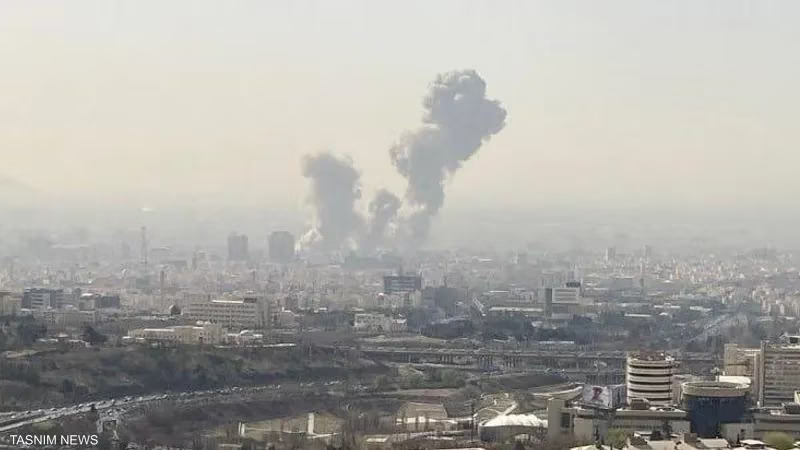
The Iranian capital, Tehran, and its surroundings witnessed a series of violent air raids at dawn on Sunday, targeting energy infrastructure. The strikes hit four main oil depots, in addition to a vital logistics center used for the transportation and distribution of petroleum derivatives, causing widespread destruction at the targeted sites.

The National Iranian Oil Products Distribution Company announced the death of four of its personnel as a result of these attacks, including two drivers who were at the scene. The company's general administration confirmed that the targeting was concentrated in the Tehran and Alborz regions, which necessitated a decision to temporarily suspend fuel distribution in the capital to assess the damage and ensure safety.

Official sources reported that firefighting and civil defense teams made strenuous efforts to control the massive fires that broke out in the storage tanks. Despite the extent of the damage to the facilities, Iranian officials reassured citizens that there are sufficient strategic fuel reserves to cover local needs in the coming period.

A thick black cloud covered the sky of the capital, Tehran, as a result of the smoke rising from the burning oil facilities, which raised significant environmental and health concerns. Local residents reported the spread of strong burning odors in various parts of the city since the early morning hours as a result of successive explosions.

The Iranian Red Crescent issued a warning statement confirming the emission of huge quantities of toxic gases, including nitrogen and sulfur oxides, due to the burning of hydrocarbons. The organization warned of the danger of rain in the coming hours, as it will be highly acidic and may cause skin burns and severe respiratory damage.

Coinciding with the strikes on the capital, Isfahan province in the center of the country was subjected to widespread attacks that included eight different cities. Field sources confirmed that the bombing targeted industrial facilities and civilian sites, including an equestrian club, reflecting the expansion of the circle of targets in this wave of military escalation.

Health authorities in Isfahan recorded an initial death toll of 11 as a result of the raids that targeted the provincial center and surrounding cities. Rescue teams are working to remove debris at the affected sites, with expectations of a rise in the number of victims due to the intensity of the explosions that rocked the region.

Military operations extended to include areas in southern Iran and along the northwestern border strip all the way to the southwest. Sources reported that the raids were coordinated and targeted strategic and vital points, indicating a new phase of direct confrontation in the region.

Qeshm Island, located in southern Iran, was directly targeted, hitting a desalination plant, which led to its complete shutdown. This attack caused an interruption in the supply of potable water to several villages on the island, exacerbating the suffering of local residents under the current circumstances.

Iranian Parliament Speaker Mohammad Bagher Ghalibaf warned of the repercussions of the continuation of these attacks on the global and regional energy sector. In his statements, he indicated that the continuation of military operations may impose a new reality that leads to the cessation of Iranian oil production and export, which threatens the stability of international markets.

These rapid developments come in the context of what observers describe as an 'energy war' that has begun to emerge in the region, with increasing threats to international shipping lanes and the Strait of Hormuz. These strikes reflect a qualitative shift in the nature of the chosen targets, as vital and service facilities have become at the heart of the military confrontation.

The continuation of the war may lead to a halt in the sale of Iranian oil and a complete disruption of its production.

PALESTINE

Sun 08 Mar 2026 11:32 am - Jerusalem Time

The Exodus of Pain at the Gates of Rafah: 18,000 Wounded Face Death Awaiting 'Lifeboats'

Under a pale sun and in a rubble-strewn square in front of the gates of the Palestinian side of the Rafah crossing, white ambulances line up like last bridges of hope, trying to connect Gaza's pain with opportunities for healing abroad. The dust in the air does not obscure the details of the surrounding destruction, where shell-pierced buildings stand as silent witnesses to a forced escape from continuous suffering.

Behind the iron fence of the Palestinian Red Crescent hospital, children who have not yet reached their dreams watch the convoys of departing wounded with astonishment, considering these buses 'lifeboats' carrying their loved ones into the unknown. For these little ones, the crossing represents a harsh geographical and psychological divide, as they bid farewell to patients who may not be able to return home soon due to circumstances.

Inside one of the ambulances, young Mahmoud Al-Abd lay on a narrow bed, surrounded by oxygen tubes like fragile threads of life, while a paramedic wiped the sweat of pain from his forehead. Every movement in this place is precisely calculated, and every glance from the relatives of the wounded carries a silent question about the chances of survival and return amidst complex health conditions.

Hajja Khadija, Mahmoud's mother, summarized two years of suffering, explaining that her son sustained severe damage to the bone mass of his leg after a missile strike on his workplace in the Al-Bureij area. The mother recounts bitterly how other shrapnel lodged in his chest and stomach, making his treatment inside the Strip impossible, according to specialized doctors.

The mother adds, with tears filling her eyes, that separation is difficult for the soul, but the desire to see her son walk again overcame the pain of farewell. Mahmoud underwent numerous operations in Gaza hospitals, but the need for advanced reconstructive surgeries made traveling abroad the only remaining option to save his leg from amputation.

The Rafah crossing had seen a partial opening for humanitarian cases before being re-closed on February 2nd for security reasons imposed by the occupation authorities. This mechanism allowed about 60 patients to pass daily, but the sudden closure returned thousands of names to long and harsh waiting lists, exacerbating the deterioration of critical cases.

Mahmoud Al-Abd was one of the few who were lucky enough to cross days before the last closure, where he confirmed to journalistic sources his insistence on remaining composed in front of his mother despite his severe pain. He recalled the moment he was hit by a missile while installing solar energy systems, describing feeling a burning heat in his body before losing all sensation in his limbs.

Behind Mahmoud's story, the tragedy of thousands of other wounded, like Mohammed Ayyad, who was injured in the Shuja'iyya neighborhood and suffers from a fractured femur, emerges. Mohammed is still waiting for his name on travel lists for months, indicating that the pain increases daily as he sees the dream of treatment close behind the borders but cannot reach it.

In the Nuseirat camp, young Abdul Rahman Abu Awda faces the risk of losing the ability to move due to a precise injury to the spinal nerves. Doctors confirmed his need for urgent surgery, the capabilities of which are not available in Gaza, making every day of delay an additional step towards permanent disability.

For his part, Dr. Samer Hamdan from Al-Shifa Hospital explained that Mahmoud Al-Abd's case represents a model of complex injuries that require specialized intervention in international bone reconstruction centers. Hamdan warned that the severe shortage of equipment and staff within Gaza makes it impossible to deal with severe bone damage and associated neurological complications.

Data from the World Health Organization and the United Nations Office for the Coordination of Humanitarian Affairs (OCHA) indicate that more than 18,000 patients and wounded in Gaza are in urgent need of medical evacuation. UN estimates confirm that the current pace of evacuation is too slow and disproportionate to the scale of the health catastrophe, putting thousands of lives at immediate risk.

In turn, Amjad Al-Shawa, director of the network of non-governmental organizations, considered that preventing the wounded from traveling represents a blatant violation of international humanitarian law, which guarantees the right to treatment. Al-Shawa stressed that the restrictions imposed on the movement of individuals and medical equipment have led to a near-complete collapse of the health system, necessitating the immediate opening of safe and sustainable medical corridors.

The reality of the 'medical exodus' in Gaza turns borders into a harsh test of patience and hope, where healing becomes a dream suspended between the rubble of war and the bars of waiting. Every ambulance that leaves leaves behind hundreds of families raising their hands in prayer, awaiting the moment when the gates will open again to save what can be saved from bodies exhausted by war.

As Mahmoud's car moves away towards the other side, Hajja Khadija stands in her place, watching the dusty trail of the vehicle with tearful eyes. She is one of thousands of mothers who face the daily fate of waiting, amidst a bitter health reality that makes traveling for treatment a journey fraught with risks and tears.

I know my mother is in more pain than I am, but I have to travel; I just want to return standing on my feet again.

ARAB AND WORLD

Sun 08 Mar 2026 11:31 am - Jerusalem Time

Trump threatens Iran with a "very strong strike" on Saturday

Said Erikat

Opinion Writer

Washington – Said Arikat - 7/3/2026

News Analysis

US President Donald Trump's statement about launching a "very strong strike" against Iran has sparked a wide wave of political and media controversy, not only because of its potential military content, but also because of the sharp tone of the discourse, which was characterized by escalation and direct threat. In a post on his "Truth Social" platform, Trump said that Iran would be subjected to a strong strike "this Saturday," adding that his administration was considering expanding the list of targeted areas and groups as a result of what he described as Tehran's "bad behavior." Although the statement did not include operational or military details, it reflects a rhetorical trend that tends towards verbal escalation and the use of the language of force in dealing with adversaries.

The statements come in the context of chronic tension in relations between the United States and Iran, a tension that dates back decades but has escalated significantly since Washington withdrew from the Iranian nuclear agreement in 2018. Since then, the relationship between the two countries has been characterized by a series of economic sanctions, military threats, and mutual statements. However, Trump's rhetoric has often been characterized by a higher degree of intensity compared to the rhetoric of previous US administrations, as he tends to use direct and politically and media-shocking phrases, which is clearly evident in his talk of a "very strong strike."

Trump also indicated in his post that Iran had apologized to its neighbors after strikes targeting them, considering this an "surrender." This description also reflects a rhetorical style based on portraying the adversary as weak, a style Trump has repeatedly used in the context of foreign policy. However, this type of rhetoric raises questions about whether it represents an actual policy under implementation, or whether it falls within the framework of political and psychological pressure as part of a deterrence strategy.

Strategically, escalatory rhetoric often aims to send multiple messages simultaneously. It may be directed at the external adversary to deter them, and it may also be directed at regional allies to reassure them that the United States is prepared to use force. At the same time, it can serve internal goals, as it enhances the image of decisive leadership among a segment of the president's political base.

However, the danger of this type of statement lies in the fact that it may raise the level of regional tension even in the absence of an actual intention for direct military escalation. Waving new strikes or expanding the list of targets can push other parties to take precautionary measures or reactions that may increase the chances of unintended confrontation. In a sensitive region like the Middle East, where interests and military alliances are intertwined, any verbal escalation can quickly turn into a security crisis.

Trump's rhetoric towards Iran reflects a political pattern based on "shock diplomacy," where extremely sharp language is used to create a rapid political and media impact. This approach differs from traditional diplomatic discourse, which tends towards calculated ambiguity. Stating a "very strong" strike without providing details may be part of a psychological pressure strategy, but at the same time, it opens the door to multiple interpretations that may increase regional tension, especially when it comes from a president of a country with enormous military capabilities and global political influence.

From an international relations perspective, Trump's statements can be understood within the framework of deterrence policy, which is based on convincing the adversary that the cost of escalation will be extremely high. However, the effectiveness of deterrence usually depends on a combination of clarity and credibility. If threats are repeated and not accompanied by concrete actions, they may lose some of their impact over time. Therefore, the question remains whether these statements represent a prelude to actual military action or merely a political message aimed at reshaping the balance of deterrence in the region.

Also noteworthy in Trump's rhetoric is the use of vocabulary with a personal or moral character, such as describing Iran's behavior as "bad," a description that deviates from the technical language often used in official statements. This approach reflects Trump's way of addressing the public directly through social media, often bypassing traditional diplomatic channels. Although this approach gives him the ability to have a rapid media impact, it can also create a state of ambiguity about whether the statement represents an institutional position or a personal political opinion.

PALESTINE

Sun 08 Mar 2026 11:31 am - Jerusalem Time

Five Potential Scenarios: How Will the War on Iran Shape the Future of the Gaza Strip?

The pace of the comprehensive Israeli-American war against Iran is escalating, entering its seventh day amidst widespread regional and international anticipation for the outcomes of this direct confrontation. In this context, the eyes of the Israeli occupation are turned towards the Gaza Strip, to monitor the effects of this confrontation on the Palestinian factions that have been suffering from an ongoing war of annihilation for more than two years, which opens the door to questions about the fate of Hamas and Islamic Jihad.

Tzachi Hanegbi, the former head of the Israeli National Security Council, affirmed that the future of Palestinian organizations in Gaza is organically linked to the results of the war in Tehran. Hanegbi explained that the Iranian regime is now fighting for its survival after the martyrdom of Supreme Leader Ali Khamenei and Commander Mohammad Pakpour, indicating that the fall of this regime will inevitably mean drying up the sources of strategic and financial support that Hamas has absolutely relied on since 2007.

Israeli analysts believe that the first scenario is the 'unconditional surrender' of the Iranian regime, similar to what happened at the end of World War II. In this case, Iran will be subject to an international or local administration loyal to Washington, which will lead to a complete cessation of military and financial support for Palestinian factions, and the beginning of a coercive disarmament process in the Gaza Strip under the name 'New Gaza'.

The second scenario revolves around an 'internal coup' led by the Iranian masses with the support of the opposition abroad and the United States. With the Revolutionary Guard losing its leaders and headquarters as a result of intensive air raids, state institutions may collapse and a transitional authority may be formed that completely severs its ties with resistance movements in the region, leaving Hamas and Islamic Jihad in complete political and field isolation.

The third scenario emerges as a 'unilateral victory' option, where US President Donald Trump declares the end of operations after destroying Iran's military and nuclear infrastructure without completely overthrowing the regime. Despite the authority remaining in Tehran, the collapse of the economy and the loss of air defenses will render it unable to continue funding its regional proxies, which weakens Hamas's ability to military resilience in Gaza.

In contrast, the fourth scenario speaks of a 'comprehensive diplomatic agreement' in which the new Iranian leadership is forced to make painful concessions to ensure its survival, including dismantling the nuclear and missile program. This agreement includes an Iranian commitment to cut all contacts with Palestinian factions, which will force Hamas to accept disarmament demands in exchange for engaging in international reconstruction plans promoted by Trump.

The fifth and final scenario assumes 'war failure' to achieve its strategic objectives, which gives Iran and its allies an incentive to continue the confrontation. In this case, Hamas may succeed in maintaining its status as an armed resistance movement with renewed Iranian support, which will necessarily lead to renewed direct military confrontations with the Israeli army inside the Gaza Strip to overthrow the movement's authority.

On the ground, reports indicate that the war has cost the Israeli economy about 9.4 billion shekels weekly, while Washington is incurring a billion dollars daily. While countries like Spain and Portugal refuse to allow their bases to be used for attacks, naval units from France, Germany, and the Netherlands are participating in operations in the Eastern Mediterranean, reflecting the complexity of the military and political scene surrounding the region.

In conclusion, Trump's repeated condition of disarming Gaza remains the biggest obstacle to any future settlement for the Strip, as the war on Iran places Hamas leaders at a historic crossroads. Either accept the new regional transformations and engage in the path of disarmament, or bet on the resilience of the Iranian axis despite the severe blows it has received in recent days.

Gaza's eyes are turned towards Tehran, and the war against Iran will have a decisive impact on the future of Palestinian organizations; the survival or fall of the Iranian regime will determine the fate of Hamas.

PALESTINE

Sun 08 Mar 2026 11:31 am - Jerusalem Time

3 Dead in Settler Attack on Abu Falah Village and Widespread Arrest Campaign in the West Bank

Groups of settlers committed a new massacre today, Sunday, in the village of Abu Falah, located northeast of Ramallah city in the occupied West Bank, resulting in the martyrdom of three Palestinian citizens. Medical sources reported that the attack took place under the direct protection of occupation forces, who provided cover for the settlers as they targeted the homes of unarmed citizens.

The Palestinian Ministry of Health clarified that martyrs Thaer Farouk Hamayel, 24, and Farea Jawdat Hamayel, 57, died from live settler bullets. They were directly targeted while attempting to confront the attack aimed at terrorizing families inside their homes in the village.

In a related context, citizen Mohammed Hussein Marra, 55, was martyred due to inhaling large quantities of toxic gas fired heavily by occupation forces towards residents. Sources confirmed that the gas caused Marra's heart muscle to stop before medical teams could save him or before he reached the hospital.

This crime comes less than 24 hours after a similar incident in the southern West Bank, where a young man was martyred and his brother injured by settler bullets in the Wadi Al-Rakheem area. The two brothers were trying to move settlers' livestock away from their home before the settlers surprised them by opening fire from close range.

Regarding field raids, Israeli occupation forces launched a widespread arrest campaign targeting the cities of Bethlehem and Nablus and their camps. In Bethlehem, three young men were arrested from the town of Tuqu', the Ta'amra area, and Saf Street after their homes were raided, searched provocatively, and their contents tampered with.

In Nablus city, arrests targeted six citizens from the city's neighborhoods and Al-Ain camp, where local sources reported that the invading forces deliberately damaged private property during the search operations. These arrests fall within the systematic escalation policy pursued by the occupation against Palestinian cadres and youth in all governorates.

In a dangerous field development, occupation forces converted a residential house in Qasra village, south of Nablus, into a military barracks and a field interrogation center. Military vehicles stormed the village at dawn, detaining a number of citizens inside the house and interrogating them for long hours without revealing their fate until now.

Qasra village and its neighboring villages witness repeated attacks by settlers and the occupation army, aiming to restrict residents and displace them from their lands. These measures coincide with the closure of village entrances, turning them into closed military zones that hinder citizens' movement and their access to their work.

Official data issued by the Palestinian Authority indicates that the pace of violence in the West Bank has reached unprecedented levels since October 7, 2023. Human rights organizations have recorded the martyrdom of more than 1042 individuals in various West Bank governorates by both the army and settlers.

Observers believe that giving settlers free rein in the West Bank reflects a political direction by the occupation government to impose a new reality on the ground. These attacks continue amidst international silence, threatening a wider explosion of the situation in the absence of any international protection for Palestinian civilians under occupation.

Settlers attacked citizens' homes and fired live bullets at residents under the direct protection of occupation soldiers.

ARAB AND WORLD

Sun 08 Mar 2026 11:30 am - Jerusalem Time

Trump administration considers military options to seize Iranian uranium stockpile

Informed sources revealed a trend within the US administration to study specific military options directly targeting the Iranian nuclear program. These options include sending special operations units to carry out missions aimed at seizing and securing the enriched uranium stockpile.

Reports citing US officials stated that discussions within the White House focused on two main paths for dealing with nuclear materials. The first path involves removing the entire stockpile from Iranian territory, while the second proposes sending experts to reduce the enrichment level at the sites themselves.

The force tasked with this mission is likely to include elite elements from US Special Forces, along with specialized nuclear scientists. Experts from the International Atomic Energy Agency may also be called upon to ensure proper technical handling of radioactive and sensitive materials.

These plans face complex field and logistical challenges, most notably identifying the precise locations where enriched uranium is stored. The difficulty lies in accessing these materials within fortified underground facilities and effectively controlling them in a hostile environment.

Beyond the nuclear file, proposals circulated within the US administration to control the strategic Kharg Island in the Arabian Gulf. This island holds paramount importance as it is responsible for exporting approximately 90% of Iran's total oil exports abroad.

Observers believe that talk of US ground intervention has begun to escalate with the continuation of military operations without achieving a clear decisive outcome against the Iranian regime. However, these steps remain fraught with the risks of sliding into a wide-scale regional war that Trump does not desire.

In a related context, media sources indicated that President Donald Trump has not ruled out the option of limited ground intervention, describing it as possible if there are strong motives. Iran's possession of 60% enriched uranium is one of the most prominent of these motives that concern Washington.

Previous negotiations held in Oman saw Washington raise the issue of transferring or reducing the stockpile as a prerequisite for de-escalation. It appears that the failure of diplomatic paths has pushed the US administration to search for more decisive operational alternatives on the ground.

Military indicators supporting the hypothesis of preparation for a special operation have emerged, including the cancellation of planned maneuvers for the 82nd Airborne Division. This division is known for its high capability for rapid deployment and intervention in complex operational theaters behind enemy lines.

It is worth noting that the 82nd Division has a distinguished record in specific operations in the Middle East, most notably its participation in the elimination of Iranian commander Qassem Soleimani. Analysts link the cancellation of its current training with the possibility of its recall to carry out urgent missions deep inside Iran.

These movements coincide with reports about the possibility of sending a third US aircraft carrier to the Middle East to reinforce the military presence. These preparations reflect Washington's desire to possess field pressure cards capable of paralyzing Tehran's nuclear and oil capabilities.

Despite these preparations, Trump's stated position remains cautious about getting involved in long-term wars that drain American soldiers. The primary stated goal remains to dismantle the Iranian leadership structure and prevent Tehran from reaching the nuclear threshold at any cost.

The main challenge is to accurately locate the uranium within the fortified facilities and effectively control it before deciding to move it.

OPINIONS

Sun 08 Mar 2026 11:30 am - Jerusalem Time

The Exodus of a Nation!

Dr. Ibrahim Melhem

Editor-in-Chief

The least that can be said is that the rogue state's issuance of warnings under the threat of bombing and raids, which has caused the displacement of villages, towns, and cities in Lebanon, and what the Gaza Strip has been subjected to, and still is, of extermination and displacement, is nothing but a re-enactment of the atrocities committed by the "Stern," "Irgun," "Lehi," and "Haganah" gangs in '48, more of which have been revealed through the testimonies of their perpetrators, as published by Israeli newspapers days ago.The re-enactment of crimes stems from an ideology that shapes the thought and behavior of the leaders of the political and military establishments in Israel, an ideology based on ethnic cleansing, emptying cities, taking revenge on geography and demography, and striking the incubators and infrastructure within them to make them uninhabitable.In the face of this state of lawlessness, and Washington's subservience to Netanyahu's desires and dreams of forming a new Middle East, in which Tel Aviv is expected to play the role of the "cat's paw" in the region, and have full sovereignty, hegemony, and freedom to expand, the next phase portends dangers that affect the core of Arab, regional, and international national security.What if Israel issued warnings to evacuate towns and villages in Arab capitals under the threat of raids, taking advantage of the excessive fluidity in a world where savagery prevails and is governed by "Epstein's rules," amid a complete absence of international norms and laws?Evacuation warnings, if they continue, could make the "tent" the symbol of a phase that portends grave dangers.

OPINIONS

Sun 08 Mar 2026 11:30 am - Jerusalem Time

Palestinian Woman... Guardian of Memory and Maker of Life

On the eighth of March, International Women's Day, the world celebrates the achievements of women and their long struggle for justice, dignity, and equality. However, the Palestinian woman has a different story; a story that cannot be summarized by a fleeting occasion or encompassed by a few words, because she is an integral part of the history of a people who are still writing their daily lives between pain and hope.The Palestinian woman has never been merely a witness to history, but rather a partner in its making. From the first moments when the Palestinian tragedy began to unfold, the woman was present at the heart of the story: protecting the home, preserving memory, and rearranging life whenever storms tried to scatter it.The Palestinian woman realized early on that protecting the homeland is not limited to direct confrontation, but extends to protecting the meaning itself. Therefore, she bore the responsibility of memory, becoming the primary preserver of the names of villages, homes, fields, and springs. She would tell her children stories of the place as if she were replanting the land with words, so that the country would not be lost in the dust of oblivion.In old Palestinian homes, mothers would tell their children stories of the land and olive trees, teaching them that belonging is not just a word, but a deep relationship between a person and their soil. This is how entire generations grew up realizing that memory is a form of resistance, and that preserving the story is preserving existence.In the field, the woman was a partner of the land, working in silence similar to the silence of the soil itself. She would plant wheat and olive trees and care for the land as she cared for her children, because the relationship between the Palestinian woman and her land was never just a working relationship, but a relationship of belonging and extension.As for school and university, the woman carried the message of knowledge with a deep belief that education is the most solid path to the future. She was the teacher who enlightened minds, the student who persevered despite challenges, the researcher who contributed to building knowledge, and the writer who documented the Palestinian human experience in the language of thought and creativity.The Palestinian woman has proven her presence in various fields of life: in education, medicine, social work, art, literature, and scientific research. This presence was not merely symbolic participation, but a real contribution to building society and shaping its cultural and human consciousness.The Palestinian woman is not just a symbol of patience, but a model of quiet strength that knows how to build life despite cruelty. She is the mother who raises her children with dignity, the wife who protects the home in the absence of her partner, the nurse who bandages wounds, and the writer who guards memory with words.In a time when challenges are complex and transformations are intertwined, the presence of the Palestinian woman becomes increasingly important as a human and cultural force capable of contributing to building a more conscious and just society. Empowering women is not a theoretical slogan, but a civilizational necessity that means expanding the space for intellect, work, and creativity within society.Despite all the pain and loss she has endured, the Palestinian woman has been able to preserve her humanity. She has not lost her ability to love, to dream, or to plant joy in the hearts of her children. This deep ability to protect the humanity of the soul is, at its core, one of the greatest forms of steadfastness.On the eighth of March, we do not stand before the image of one woman, but before a broad canvas of Palestinian women: the mother, the teacher, the doctor, the nurse, the writer, the artist, the researcher, and the worker. Each of them has her own story, but they all converge in one meaning: faith in life despite all the difficulties surrounding it.The Palestinian woman is not just half of society, as the common saying goes, but she is often its soul that gives it the ability to continue. She is the one who maintains the balance between memory and the future, between pain and hope, and between harsh reality and an unextinguished dream.Therefore, celebrating the Palestinian woman on her international day is not just a symbolic tribute, but a deep acknowledgment of her historical and human role in protecting society from collapse. She was not just a witness to history, but she was – and still is – one of its most important makers.Thus, the Palestinian woman remains, at the core of her presence, the guardian of memory... and the maker of life.
OPINIONS

Sun 08 Mar 2026 11:30 am - Jerusalem Time

Will Trump declare victory over Iran as he declared peace in Gaza? Will the Middle East be redrawn by force?

Today, the Middle East is not just witnessing a military escalation between Israel and Iran with American support, but is living a pivotal moment that could redraw the features of the region for decades to come. What is happening far exceeds the title of "Iran's nuclear program" which is presented as the core of the crisis. In essence, we are facing a struggle over who has the ability to shape the new regional order, and to define the rules of security and politics that will organize the balances of the Middle East in the next phase.The joint American-Israeli strikes against Iran in 2026 are not a fleeting military event, but an indicator of the conflict's transition from proxy wars to direct confrontation, and from conflict management to an attempt to reshape it. In this context, Israel is no longer merely a regional actor moving within existing balances, but has become part of a military-strategic alliance led by the United States to re-engineer the regional order.Understanding this transformation requires looking at the American interior as well. The failure of the Senate resolution to restrict President Donald Trump's powers in using military force against Iran reflects the continued granting by the American political establishment to the president a wide margin for military action in the Middle East, despite the escalating internal debate about the cost of wars. Here the paradox of the "America First" (MAGA) current emerges. This current raises the slogan of reducing foreign wars and protecting the American economy from the burdens of long conflicts, but at the same time supports strong deterrence policies in the Middle East, especially towards Iran, under the title of protecting allies and enhancing national security. This contradiction reflects a struggle within the conservative current between an isolationist tendency that rejects costly wars, and a security tendency that sees military force as a tool to protect American interests even beyond borders.In this context, the concept of the "New Middle East" is changing. It is no longer an economic or diplomatic project as previously proposed, but has become a security project par excellence. The reordering of borders is no longer merely geographical, but political and functional, based on the redistribution of influence and the creation of security systems led by Israel with American support. The Israeli ambition goes beyond normalization towards strategically subjugating the regional environment, so that any party rejecting this system becomes outside the equation of regional legitimacy.This transformation is linked to the development of the Zionist project itself. From a colonial settlement project in "Judea and Samaria," to a geopolitical influence project across borders. The idea of "Greater Israel" no longer means direct geographical annexation only, but security and economic hegemony that makes Israel the center of regional decision-making without the need to officially change maps. Control here is functional: permanent military superiority, control over security paths, and regional integration conditioned on accepting this superiority. Within this equation, the doctrine of "permanent war" emerges. Constant tension justifies the militarization of Israeli society, settlement expansion, and the obstruction of any political solution to the Palestinian issue. True peace may end the justifications for military superiority, while the continuation of the threat reproduces the legitimacy of force. Here interests converge: Israel needs a turbulent regional environment to justify its superiority, and some decision-making circles in Washington see this as a means to enhance deterrence without being drawn into long occupations as happened in Iraq and Afghanistan.The Palestinian issue is not a marginal detail in the process of reshaping the Middle East, but represents the central obstacle to establishing the new regional order. Therefore, Palestinian geography is being dismantled, institutions weakened, and the conflict transformed from a national liberation issue into a humanitarian-relief file, in an attempt to strip it of its political and legal dimension and turn it into merely a matter of managing populations, not a matter of right and sovereignty. What we are witnessing today is not just a war on Iran, but a moment of comprehensive reformulation of the region where the strategy of Israeli superiority intersects with the "America First" debate within Washington. The Middle East is being redrawn by force, and religious narratives are being invoked to justify policies of hegemony and entrench Israel's long-term superiority.The Middle East is being redrawn by force and theology that employs politics to achieve Israel's greater goals.Trump may come out and declare victory at any moment, just as he declared peace in Gaza regardless of the reality, but the real question is no longer who will declare victory, but what kind of Middle East will emerge from this historical moment: a Middle East governed by the equation of power and permanent deterrence, or a new regional order that restores consideration to diplomacy, international law, and the principles of justice? The way this phase ends will not only determine the balance of power, but will also determine the form of peace – or the continuation of conflict – in the Middle East.

PALESTINE

Sun 08 Mar 2026 11:30 am - Jerusalem Time

Closing Al-Aqsa and Ibrahimi Mosques: A Systematic Policy to Impose New Realities on the Ground

Sheikh Muhammad Hussein: Al-Aqsa and Ibrahimi Mosques are among the holiest Islamic mosques, and we demand that the occupation authorities open them to worshippers. Hatem Abdel Qader: The closure of Al-Aqsa and Ibrahimi Mosques is a dangerous escalation and a systematic policy to impose new realities on the ground. Aziz Al-Assa: Israeli claims are baseless and false, and what the occupation is doing is part of a plan to control Al-Aqsa and Ibrahimi Mosques. Dr. Muhammad Jadallah: The occupation government seeks to impose its vision on holy places, benefiting from the imbalance of power in its favor. Mazen Al-Jaabari: The real danger lies in Israel's and the Temple groups' move to transform daily security control into long-term realities. Imad Abu Awwad: Israeli planning regarding the Ibrahimi Mosque has moved from the planning stage to the implementation stage in some aspects. Exclusive to Al-Quds - At a time when Palestinians are supposed to flock to Al-Aqsa Mosque and the Ibrahimi Mosque during the blessed month of Ramadan, the occupation authorities continue to close them to worshippers, under false and baseless pretexts, which has sparked a state of resentment and anger in religious and popular circles. Religious scholars and specialists in Jerusalem and Hebron affairs warn that the continuation of these measures represents a clear violation of freedom of worship and reflects a continuous Israeli policy aimed at imposing increasing restrictions on access to Islamic holy sites, especially during religious seasons that witness a wide presence of worshippers, in a desperate Israeli attempt to transform daily security control into new realities on the ground. Prominent Religious and Historical Status The Mufti of Jerusalem and the Palestinian Territories, Sheikh Muhammad Hussein, says: Al-Aqsa Mosque and the Ibrahimi Mosque are among the holiest Islamic mosques, and they have a great status in the hearts of Muslims. He adds: We demand that the Israeli authorities open these mosques to worshippers, especially during the blessed month of Ramadan, despite the difficult conditions in the region, due to the spiritual and devotional specificity of this month. The Mufti of Jerusalem stresses the need for Al-Aqsa, the Ibrahimi Mosque, and the houses of God to remain open to Muslim worshippers, especially in this holy month in which Muslims are keen to perform acts of worship and prayers, including Taraweeh and Friday prayers, in special spiritual atmospheres. Sheikh Hussein believes that the closure of these mosques deprives worshippers of special spiritual atmospheres with which they are associated, and they feel a deficiency in their devotional experience during the blessed month of Ramadan. These two mosques have permanent visitors who are keen to travel to them, especially in Ramadan, due to their great religious and historical status. A Blatant Violation of Freedom of Worship The Secretary-General of the Islamic-Christian Commission for the Support of Jerusalem and Holy Sites, Hatem Abdel Qader, considers the closure of Al-Aqsa Mosque and the Ibrahimi Mosque a dangerous step and a blatant violation of freedom of worship and an assault on the right of Muslims to access their holy places, especially during the blessed month of Ramadan, during which hundreds of thousands of worshippers flock to Al-Aqsa Mosque to perform prayers and revive religious rituals. Abdel Qader adds that the closure of Al-Aqsa and the Ibrahimi Mosque comes within a systematic policy aimed at restricting worship and imposing new realities on the ground, rejecting Israeli pretexts that claim the closure was for security reasons. Abdel Qader considered these arguments a repeated justification for violations against both Islamic and Christian holy sites. Abdel Qader affirms that the decision to close Al-Aqsa Mosque constitutes a blatant interference in the powers of the Islamic Endowments, which has administrative and legal authority, and an attempt to undermine the historical and legal Hashemite guardianship over the Holy Sanctuary, which constitutes a serious violation of the status quo in Islamic and Christian holy sites. Abdel Qader calls on the international community and UN institutions to work to stop these violations targeting holy sites and freedom of worship, warning that the continuation of these arbitrary measures may lead to an escalation of tension in the Holy City. A Racist View of Jerusalemites and Palestinians Inside The writer and researcher interested in Jerusalem affairs, Aziz Al-Assa, says: There is no doubt that what happened at dawn on Saturday, February 28 of this year (2026), an attack on the Iranian state, is a pivotal event at the level of the Middle East in particular, and at the global level in general. Al-Assa confirms that the occupation state, which has become vulnerable to Iranian missiles, has taken many measures related to its residents, for whom it provides all means of protection and care, and shelters equipped with all the requirements for comfortable living, enjoying leisure time, and dedicating mechanisms for immediate intervention and rescue for any harm that befalls them, individually and collectively. He adds: The Palestinians inside and the Jerusalemites, who live within the state's borders, have no one to mourn them, and they have no escape from the security and precautionary measures taken by the various occupation agencies. The right-wing government, through the statements of its ministers, views them as hostile human blocs spread within the state, considering them not Israeli in terms of belonging, feelings, or emotions. Al-Assa believes that the decision of the Israeli Home Front to close Al-Aqsa Mosque to Muslim worshippers during these days of the blessed month of Ramadan, under security pretexts, can only be classified under the title of "a word of truth intended for falsehood," because there are many daily service institutions that are not subject to closure in such a case, such as places of worship, bakeries, hospitals and clinics, pharmacies, and many other institutions related to people's daily lives, and the state does not usually close them. Al-Assa considers the security claims for closing Al-Aqsa Mosque in Jerusalem and the Ibrahimi Mosque in Hebron to be baseless and false, not out of concern for the safety and security of Muslims, but rather as part of a plan being prepared in the dark of night to control them. Maximum Speed in Implementing the Decision Al-Assa says that what indicates this is the maximum speed in implementing the decision to forcibly and coercively remove hundreds of worshippers from Jerusalemites and those who arrived from the Palestinian interior. In addition, the employees of the Endowments who belong to the Jordanian state were removed, and the matter ended with the complete closure of the mosque's doors. The arbitrary measures of the occupation expanded to include the closure of commercial shops surrounding Al-Aqsa Mosque. Al-Assa pointed to the abuse and aggression by the occupation agencies, and the infringement on the rights of the mosque's administration and the right to worship in it, and the blatant assault on those rights, which cannot be justified by the alleged security situation, but rather its goal is to control the place and remove it from the control of the Endowments and the Jordanian state, which imposes a new "status quo" that grants the occupation authorities the right to close Al-Aqsa Mosque whenever they want, however they want, and under any pretext they invent at any time, with the aim of tampering with its identity and Judaizing it - partially or completely. Al-Assa adds: Perhaps the peak of the danger is that the occupation forces that carry out these actions are directed by "Ben Gvir," the Minister of Security in the occupation government, who is the engineer and patron of the incursions into Al-Aqsa Mosque, which are carried out under his personal leadership and programmed by the occupation police. Call for Jordan to Intervene Al-Assa called on the sisterly Hashemite Kingdom of Jordan, which has the internationally guaranteed right of "Hashemite guardianship" over the holy sites in Jerusalem - Islamic and Christian - to intervene at the international level to lift the siege on Al-Aqsa Mosque and allow Muslims to perform religious rituals in it, who are not deterred by war or missiles, due to their belief in God's decree and destiny, and that there is no repeller of God's decree, in whose hand are the keys to the unseen, as Almighty God says: "And no soul perceives what it will earn tomorrow, and no soul perceives in what land it will die. Indeed, Allah is Knowing and Acquainted." (Surah Luqman, verse: 34). Aggressive Plans Towards Holy Sites Political analyst Dr. Muhammad Jadallah believes that Israel has continuous plans towards holy sites, whether in Jerusalem, Hebron, or any part of historical Palestine. Jadallah explains that in light of the current situation and the expanding, extended, and multiple wars, a state of negligence emerges in the Arab and Islamic realities, which Israel benefits from to achieve its goals. He points out that Israel seeks, as it always declares, to impose its vision on these holy places at the expense of Islamic landmarks, benefiting from the imbalance of power in its favor, which may push it to take harsh measures, whether by imposing more control or even harming some of these holy sites. Political analyst Jadallah adds that while the world is preoccupied with major issues, such measures may pass without effective Arab or Islamic reactions. In contrast, he affirms that Palestinians have proven throughout their history that they defend Al-Aqsa Mosque and the Ibrahimi Mosque and cling to them, and are willing to sacrifice for them. The Current Stage Represents a Crossroads Jadallah believes that the current stage represents a crossroads that may bring losses related to holy sites, but the presence of the Palestinian people and their high readiness to defend them may surprise the world and prevent any attempts to impose new realities or harm these holy places. Jadallah concludes his speech by explaining that this closure leaves a profound impact on the souls of worshippers, as many of them feel a deficiency in their worship and devotional activity when they are deprived of access to Al-Aqsa Mosque or the Ibrahimi Mosque, due to the special religious status of these two mosques, and their close connection with their permanent visitors, especially during the blessed month of Ramadan. Leaving the Endowments Administration Facing a Forced Reality The writer and researcher in Israeli affairs, Mazen Al-Jaabari, says that the occupation authorities are trying to present the closure of Al-Aqsa Mosque and the Ibrahimi Mosque as a "preventive measure" related to the war and the instructions of the "Home Front" and preventing gatherings, and present it as a security matter only: removing worshippers, closing doors, and then leaving the Endowments administration facing a forced reality until further notice. Al-Jaabari confirms that this justification, as it appears in Israeli narratives, aims to show the closure as a neutral technical step, while events show that it is used to entrench the idea that opening and closing the two mosques is a sovereign Israeli decision that has nothing to do with Islamic parties. Al-Jaabari points out that in recent years, the model of closure or "forced evacuation" of Al-Aqsa has been repeated at important junctures: the Bab Al-Asbat uprising in 2017 when the occupation tried to impose new security arrangements at the gates, then the Corona closure in March 2020 by decision of the Endowments due to the pandemic, leading to the closure during the June 2025 war, and then the current closure with the outbreak of the war on February 28, 2026. In other words, closure is no longer an exceptional rare event, but an Israeli tool used in every crisis to redefine the sovereign power within Al-Aqsa Mosque. However, Al-Jaabari warns that the real danger is not only in the pretext of war, but in the cumulative context that preceded and accompanied Ramadan, where Israel and the Temple groups are moving towards a clear goal, which is to transform daily security control into long-term political and religious realities. He says that before Ramadan 2026, Al-Aqsa witnessed a wave of widespread expulsion decisions affecting hundreds of Jerusalemites, in addition to the expulsion of imams and preachers, and tightening restrictions on the entry of Ramadan needs, including Iftar meals and Endowments preparations. In the field, the morning incursion period for settlers increased by an additional hour during Ramadan, in a step considered a deepening of temporal division and an expansion of the Jewish area and period within the Sanctuary. Al-Jaabari adds that at the legislative level, legal paths are advancing to expand the concept of "holy places," which opens the door to subjecting Al-Aqsa to an Israeli rabbinical religious authority. He points out that this series does not seem to be separate measures; it is an integrated pressure group: expulsion, arrests, reduction of Endowments powers, and expansion of the presence of Temple groups in the courtyards. Al-Jaabari believes that the continuation of the current situation, where the Israeli police hold the keys to entry and exit, and the courtyards are transformed into a public space managed securely according to estimates and justifications, will lead to the gradual normalization of the idea of Israeli sovereignty over Al-Aqsa administratively and securely, and then gradually transfer that to the level of an Islamic and Jewish religious site. Here specifically, the model of the Ibrahimi Mosque after 1994 appears, for after the Ibrahimi Mosque massacre, a spatial and temporal division was imposed, Muslim access was reduced, and the mosque was closed to them on Jewish holidays, and security control became a permanent system until today. Al-Jaabari affirms that this similarity is a behavior of religious and security colonialism that tests the limits of what is possible in Al-Aqsa: reducing the powers of the Islamic Endowments Department, establishing security control, and then forcibly normalizing that the place has become shared by Jews and Muslims. Therefore, if the current cumulative situation continues, Israel will religiously, securely, and administratively control Al-Aqsa Mosque and abolish its pure Islamic religious identity. Israel Imposes Actual Control Over the Ibrahimi Mosque The analyst specializing in Israeli affairs, Imad Abu Awwad, believes that Israeli planning regarding the Ibrahimi Mosque has moved from the planning stage to the implementation stage in some aspects. Abu Awwad believes that Israel is imposing actual control over the Ibrahimi Mosque and increasingly linking it to a Jewish religious administration, which raises concerns about expanding the scope of control or reducing the prayer space available to Palestinians. Abu Awwad points out that Israeli policies towards Al-Aqsa Mosque have gradually evolved through different stages, starting from imposing restrictions on Palestinian access, through increasing the number of intruders, and reaching allowing prayers inside its courtyards at certain times. Abu Awwad also refers to discussions about the possibility of building a Jewish synagogue inside the courtyards of Al-Aqsa Mosque, benefiting from the world's preoccupation with multiple international and regional issues. The analyst Abu Awwad concludes his speech by saying that this global preoccupation may create a space that Israel may exploit to strengthen its actual control over Al-Aqsa Mosque, including discussions about possibilities related to changing some of its features or imposing new realities, while warning against any measures that may lead to changing the status quo in it.

PALESTINE

Sun 08 Mar 2026 11:30 am - Jerusalem Time

Netanyahu declares air control over Tehran and affirms continuation of war until 'the face of the region changes'

Israeli Prime Minister Benjamin Netanyahu, in a televised address on Saturday evening, emphasized that Israel is proceeding with its military campaign against Iran with full force. He clarified that joint air operations with the United States have led to almost complete control over the airspace of the capital, Tehran, a week after the intensive strikes began.

Netanyahu revealed the existence of a strategic and systematic plan aimed at undermining the current Iranian regime and achieving a set of security and political objectives in the region. He indicated that these moves come in response to the demands of the Israeli public and soldiers in the field for the necessity of continuing the fight until what he described as 'decisive victory' is achieved.

In the context of reviewing military capabilities, military sources reported that the Israeli Air Force has carried out approximately 3,400 airstrikes since the outbreak of the confrontation on February 28. About 7,500 various munitions were used in these attacks, which targeted strategic and vital sites deep within Iran.

These statements come at a sensitive time, as field reports confirmed the assassination of Iranian Supreme Leader Ali Khamenei and Commander Mohammad Pakpour in previous strikes. Netanyahu considered that these developments directly contributed to changing the balance of power and reshaping the face of the Middle East anew according to the Israeli vision.

For its part, Hebrew media sources stated that the Ministerial Committee for National Security (the Security Cabinet) will hold an emergency meeting to assess the rapidly developing field situation. The meeting will be attended by Defense Minister Yoav Gallant and leaders of the security establishment to discuss available options for dealing with the ongoing escalation on the Iranian and Hezbollah fronts.

On the Iranian side, Ali Larijani, Secretary of the Supreme National Security Council, accused both Washington and Tel Aviv of systematically seeking to dismantle the Iranian state from its roots. He affirmed in televised statements that the continuous attacks aim to destroy the Iranian national entity, stressing that Tehran continues to respond with missile barrages and drones.

Regarding regional repercussions, the United Arab Emirates has been subjected to more than a thousand missile and drone attacks since the start of the conflict. Iranian responses also targeted American military bases in the Gulf region, including Al Udeid Air Base, which was targeted by drones and ballistic missiles, increasing the pace of regional tension.

Economically, the war has caused severe shocks to global markets, with oil and gas prices jumping by up to 25%. Israel faces internal economic pressures, with its weekly losses reaching 9.4 billion shekels, while the United States incurs about a billion dollars daily to finance its military operations.

At the international level, clear divisions emerged in European positions, with Spain and Portugal refusing to allow the use of their military bases for attacks against Iran. In contrast, Britain expressed its preference for the negotiation path, despite the participation of naval vessels from France, Germany, and the Netherlands in reinforcing the military presence in the Eastern Mediterranean.

In Washington, US Secretary of Defense Pete Hegseth tried to reassure public opinion that this war would not be an endless conflict like the Iraq War. He affirmed that the objectives are specific and operations are proceeding according to a studied timetable, despite the high cost and field complexities imposed by the direct confrontation with Tehran.

Finally, Netanyahu sent a direct message to the Iranian people, claiming that Israel seeks to liberate them from what he described as 'the yoke of tyranny.' He considered that 'the moment of truth' has come to change the political reality in Iran, at a time when scholars of the nation continue to issue statements rejecting the targeting of Iran and considering it a service to expansionist projects in the region.

We have a systematic plan to eliminate the Iranian regime and achieve many other goals, and we will continue the war with all our might.

ARAB AND WORLD

Sun 08 Mar 2026 11:29 am - Jerusalem Time

Accusations against Trump of waging war on Iran to cover up 'Epstein files' scandals

Representative André Carson, a member of the US House Intelligence Committee, dropped a bombshell by linking the recent military escalation against Iran to attempts by the US administration to cover up thorny legal cases. Carson asserted that the decision to go to war was not based on real or imminent security threats, as the White House promoted, but rather was a calculated political maneuver.

The Democratic representative explained in press statements that a review of available intelligence data does not provide any logical justification for launching an attack of this magnitude. He pointed out that the timing, coinciding with the emergence of new details in the Jeffrey Epstein case, raises deep suspicions about the true motives behind igniting the conflict in the Middle East.

In a related context, international press reports revealed secret FBI documents recently released under intense political pressure. These documents include shocking testimonies from an anonymous woman, who claims to have been physically and sexually assaulted by Donald Trump when she was a teenager during the 1980s.

The leaked testimonies indicate that the alleged victim was taken by the late billionaire Jeffrey Epstein to one of Trump's properties in New York. According to official transcripts, the incident involved physical violence after the girl refused to comply with immoral requests, which led to her being beaten and punched by the current president.

Documents that were classified as 'missing' from the Epstein investigation files showed that the victim received anonymous phone threats for many years to force her into silence. The woman claims that Epstein used compromising photos of her mother to blackmail her family, which led the mother to commit financial crimes to pay off the blackmail amounts before she was later imprisoned.

For its part, the White House quickly denied these allegations outright, describing them as slanders lacking reliable material evidence. Press Secretary Karoline Leavitt said that these accounts came from a person with a criminal record, considering that the Department of Justice's previous inaction proves the president's innocence.

On the ground, joint US and Israeli airstrikes led to the killing of Iran's Supreme Leader, plunging the region into a comprehensive regional war. Gulf states became embroiled in the conflict amid fears of widespread security collapse that could extend to vital international interests in waterways.

Representative Carson warned that the repercussions of this attack might not be limited to the Iranian arena, but could lead to a wave of civil wars within Iran. He also expressed his deep concern about the possibility of retaliatory operations within US territory carried out by cells linked to organizations that consider the attack an illegal aggression.

Democrats in Congress are currently leading an extensive investigation to find out the reasons that led to the withholding of these sensitive documents from the public for a long time. Lawmakers accuse the Department of Justice of trying to protect influential figures by concealing materials that include serious sexual assault allegations against the head of the political hierarchy in Washington.

Despite Trump's repeated denials of any involvement in Epstein's illegal activities, the appearance of these documents at the height of the war puts the administration's credibility to the test. Observers believe that the disclosure of these 'disgusting' details aims to exert public and legal pressure that may change the course of internal political developments.

Intelligence sources cited by Carson indicate that the changing messages from the White House regarding the war's objectives reinforce the 'distraction' hypothesis. While 'self-defense' is being discussed, judicial documents appear as shadows haunting the decision-maker in the Oval Office and revealing deep moral crises.

FBI memos include precise details about how the victim met Epstein and Trump through old photos. The victim described meeting Trump in a 'very tall building,' where he asked those present to leave before he began to engage in aggressive behavior towards her because of her appearance.

Reports indicate that the publication of these files outside the usual timeframe for publication raises legal questions about the independence of the American judiciary in light of major conflicts. Lawyers fear that the Epstein files will be further politicized to be used as tools in settling political scores during periods of war.

The scene remains open to all possibilities, as the sounds of cannons in the Middle East intertwine with the echoes of legal scandals in Washington. While the war continues to claim lives, the 'Epstein files' remain a mystery that threatens to undermine the pillars of the American administration and expose what is hidden in the relationships of the political elite.

I have not seen any intelligence that could justify such an attack; this was clearly an attempt to distract from the Epstein files.

OPINIONS

Sun 08 Mar 2026 11:26 am - Jerusalem Time

Trump’s Iran War and the Collapse of “America First”

March 8, 2026


News Analysis


Washington, D.C—Wars have a way of clarifying political ideas that once seemed comfortably vague. For nearly a decade, Donald Trump’s rise in American politics rested on a simple claim: the United States had squandered its strength in misguided foreign wars and needed to refocus on national interests. The promise of “America First” was never only about trade or immigration. It also signaled a rejection of the interventionist mindset that shaped Washington after the Cold War.


A war with Iran now places that promise under its harshest test.


By any historical measure, a major American military confrontation with Tehran represents a turning point for the political project that carried Trump to power. He emerged not only as a Republican outsider, but as the first modern presidential contender willing to condemn the Iraq War and question decades of American military activism in the Middle East.


That critique became central to his political identity. During the 2016 campaign and throughout his presidency, he argued that Washington’s foreign policy elite had wasted lives, money, and strategic focus on wars that delivered little benefit to ordinary Americans. Again and again he called the Iraq invasion a historic blunder and vowed the United States would avoid new open-ended Middle Eastern conflicts.


That commitment now faces profound doubt.


A sustained American campaign against Iran marks the clearest break yet from the principles that animated Trump’s movement. Whatever strategic justification the administration presents—deterrence, regime pressure, or alliance solidarity—the reality is unmistakable: Washington has again entered the kind of Middle Eastern war Trump once condemned as reckless.


The contradiction is not merely rhetorical; it reaches the core of what Trumpism claimed to represent.


From the start, the “America First” coalition joined groups with different visions of American power. One faction included populist nationalists, libertarian-leaning conservatives, and voters weary of decades of war. Their priority was restraint: fewer interventions, fewer permanent commitments, and greater focus on domestic renewal and border security.


Another faction, however, remained committed to traditional Republican national security doctrine. For them, American strength required readiness to project military force decisively against adversaries. Iran, in particular, has long been viewed by many Republican hawks as the region’s central destabilizing power, backing militant groups and challenging U.S. partners.


For years, Trump managed to hold these factions together through instinct and strategic ambiguity. His rhetoric favored restraint, yet policy often swung between withdrawal and confrontation. He criticized endless wars while ordering targeted strikes and tightening pressure on Tehran.


The Iran war removes that ambiguity. It forces a choice between visions that were always uneasy partners.


For the anti-interventionist wing, the moment feels like betrayal. Trumpism promised to break the cycle of Middle Eastern wars that drained American resources and credibility. Instead, the United States risks repeating a familiar pattern: military escalation without a clear political endgame.


Even supporters favoring a harder line toward Tehran concede the path ahead is uncertain. History offers few cases where outside military pressure alone produced lasting political change inside entrenched authoritarian systems.


The geopolitical consequences are already visible. Tension in the Persian Gulf has unsettled energy markets, raising fears of higher fuel prices and renewed inflation. Shipping through the Strait of Hormuz remains vulnerable to disruption, and prolonged instability could ripple across the global economy.


Strategically, the implications extend further. As Washington focuses military attention on the Middle East, rival powers gain room to maneuver. Russia, heavily dependent on energy exports, could benefit from rising oil prices. China, meanwhile, may watch as the United States diverts resources and diplomacy from the Indo-Pacific, the arena many strategists consider central to twenty-first-century competition.


None of this guarantees immediate political collapse for Trump or his movement. Charismatic leaders often survive contradictions that might destroy conventional politicians. Trump’s strength has long rested less on ideological coherence than on channeling voter anger at established elites.


Yet movements built around one personality rarely escape the consequences of strategic decisions once that leader eventually leaves the stage.


At some point, future leaders of the American right will inherit a question Trump long postponed: what does “America First” actually mean in practice?


Does it represent restraint that rejects the interventionist instincts of Washington’s foreign policy establishment? Or is it simply a nationalist rebranding of the same willingness to use American military power abroad?


The Iran war pushes that dilemma into the open.


History suggests such tensions rarely remain unresolved. Political movements forged in disruption often fracture once competing visions become impossible to ignore. The Iraq War reshaped the Republican Party for years, deepening divisions between traditional hawks and voters skeptical of intervention.


A conflict with Iran could trigger a similar reckoning.


If that occurs, the most lasting legacy may not appear on the battlefield or in diplomacy. It may lie in the transformation—and possible fragmentation—of the movement that once promised to end America’s wars, only to find itself launching another.


That paradox could ultimately define how historians judge Trump’s foreign policy revolution and its unfinished political consequences for America itself.

ECONOMY

Sat 07 Mar 2026 3:18 pm - Jerusalem Time

Become 1xCasino partners and earn income from traffic

The online casino market continues to offer high potential for affiliate marketing and digital projects. 1xCasino partners receive rewards for the activity of attracted players and their deposits on the platform. The program is aimed at both experienced webmasters and novice specialists who are just testing traffic sources. Registration is free and requires no investment, which lowers the entry threshold and allows you to focus on promotion.


The work is based on a transparent system of statistics and financial indicators. Within the platform, partners have access to tools for tracking clicks, registrations, deposits, and net income in real time. Partners independently choose a monetization model and tailor their strategy to their audience. Flexible conditions allow you to scale advertising campaigns without restrictions on geography or promotion channels. 


How to become an agent and what the program offers


To connect, you need to create an account and confirm your contact details. After activating the 1xCasino affiliate program, all partners get access to their personal account with affiliate links, analytics, and ready-made marketing materials. Commissions are calculated automatically when the conditions for attracting players are met. The system supports several payment models, allowing you to build a convenient financial strategy.


Before actively launching advertising campaigns, it is important to consider the additional features of the program that enhance its effectiveness: 


- individual agreement on increased interest rates for large traffic volumes.


-extended statistics with details by country, device, and traffic source .


a hybrid payment model combining a fixed fee and a percentage of revenue.


-a referral program with a percentage of the profit of invited partners. 


These tools help you flexibly manage profitability and adjust your strategy based on analytical data. Partners have the opportunity to test different advertising formats and optimize conversion. With stable performance, the terms of cooperation can be revised to increase commissions, which encourages long-term work.


Growth opportunities and features


The program is focused on the international market and supports a wide geography of player acquisition. The casino offers a diverse selection of gaming products and bonus offers, which has a positive effect on audience engagement. Partners have access to ready-made banners, landing pages, and promotional materials adapted for mobile and desktop devices. This speeds up the launch of campaigns and reduces the cost of developing creative content. 


ARAB AND WORLD

Sat 07 Mar 2026 11:42 am - Jerusalem Time

Military escalation in the Gulf: Saudi Arabia intercepts missile, Qatar condemns Iranian attacks on civilian facilities

The Saudi Ministry of Defense announced that air defense forces successfully intercepted and destroyed a 'cruise' missile in the eastern region of Al-Kharj Governorate, part of the Riyadh region. Official sources clarified that the operation was successful with no casualties, at a time when the region is witnessing escalating security tensions due to mutual missile barrages.

In Manama, sirens blared across Bahrain, prompting the Ministry of Interior to issue urgent instructions to citizens and residents to remain calm and immediately proceed to the nearest shelters or safe places. Bahraini authorities emphasized the importance of obtaining information from official sources and avoiding rumors amidst the current circumstances.

Concurrently, the Kuwaiti Ministry of Defense confirmed that air defense systems effectively dealt with hostile targets that penetrated national airspace. Sources indicated that the attacks included missiles and drones attempting to target vital sites, affirming full readiness to protect the state's sovereignty and security.

For its part, the State of Qatar directed sharp criticism at Tehran during an emergency meeting of the Organization of Islamic Cooperation group in New York, where Permanent Representative Alia Ahmed bin Saif Al Thani described the attacks as a blatant violation of international laws. She affirmed that Doha would keep the UN Security Council constantly informed of all facts and aggressions affecting its national security.

The Qatari representative revealed details of the damage incurred within Qatar, noting that air defenses intercepted a series of attacks targeting sensitive civilian facilities. The targets included a main water tank and natural gas production stations, in addition to shrapnel falling in the vicinity of Hamad International Airport, resulting in human casualties and material damage.

In a related context, Tehran vowed to escalate its military operations, declaring its readiness for a long-term confrontation in response to Israeli-American movements in the region. Iranian attacks target what it describes as American interests in the Gulf states, Iraq, and Jordan, which has led to damage to civilian assets and casualties in several Arab countries.

Qatar called on the Organization of Islamic Cooperation to take a unified and firm stance to condemn these attacks, which it described as illegal and unjustified. It clarified that the continuation of Iranian military operations comes despite all diplomatic efforts made by the Gulf Cooperation Council countries to de-escalate and avoid sliding into a comprehensive confrontation in the region.

Iranian attacks represent a blatant violation and a direct threat to the security and stability of the region, and have targeted vital civilian facilities in Qatar.

ARAB AND WORLD

Sat 07 Mar 2026 11:42 am - Jerusalem Time

Baghdad and Erbil affirm rejection of using Iraqi territory as a launchpad for aggression against neighboring countries

The central government in Baghdad and the Kurdistan Regional Government, today, Friday, emphasized their firm official stance rejecting the transformation of Iraqi territory into an arena for carrying out attacks against neighboring countries. This came during a phone call between Prime Minister Mohammed Shia' al-Sudani and the President of the Region, Nechirvan Barzani, where the two sides discussed recent security developments and threats to national sovereignty.

In separate statements, both sides affirmed the necessity of protecting border security and preventing any armed groups from using Iraqi depth as a launchpad for external military operations. The officials also expressed their categorical rejection of the repeated attacks targeting Iraqi cities and areas within the Kurdistan Region, considering this a blatant violation of international norms and regional stability.

This diplomatic move coincided with a series of military strikes targeting the headquarters of Iranian Kurdish opposition parties in northern Iraq. Field sources reported that the shelling targeted rear positions of these groups, amid accusations from Tehran that they were preparing for cross-border infiltration operations and implementing agendas serving hostile international powers.

In a parallel security development, the southern province of Basra witnessed the downing of four drones that targeted vital facilities, including Basra Airport and two oil fields. These incidents raise the level of concern among Iraqi authorities about the country sliding back into a spiral of regional proxy conflicts, after a period of relative stability witnessed on the local scene.

For its part, Tehran escalated its warning tone towards the Kurdistan Regional authorities, threatening to target all vital facilities in the region if it allowed the passage of opposition fighters towards its territory. The spokesman for Iran's 'Khatam al-Anbiya' headquarters, Ibrahim Dhul-Fiqari, stated that any cooperation for the stationing of hostile forces on the borders would be met with a firm and direct response from Iranian forces.

Reports indicate that the Kurdistan Region, which enjoys self-rule, is facing increasing pressure as a result of missile and drone attacks targeting various objectives. Iran accuses Kurdish groups stationed in the region of working for Western and Israeli interests, which has led to repeated strikes over the past years targeting camps and rear bases.

In a related context, media outlets circulated reports about American efforts to arm opposing Kurdish factions in the region to use them as a pressure tool against Tehran. These data further complicate Iraq's security landscape, as it strives to distance itself from the ongoing war between major powers and their allies in the region, and to maintain a policy of balance in its foreign relations.

Iraqi territory will not be a launchpad for attacking neighboring countries, and we reject attacks targeting Iraqi cities, including the Kurdistan Region.

ANALYSIS

Sat 07 Mar 2026 11:41 am - Jerusalem Time

Regional War Repercussions on Energy Markets: Between Sanctions on Moscow and Global Oil Pressures

Said Erikat

Opinion Writer

Washington – Said Arikat – 3/7/2026

News Analysis

Global energy markets are experiencing a highly turbulent phase amidst the increasing overlap between geopolitical conflicts and major economic decisions. In this context, Washington announced that recent measures related to Russian oil are not aimed at easing restrictions on Moscow, but are limited to dealing with shipments still en route to Russia, in an attempt to contain market disruption without a fundamental adjustment to the sanctions regime.

This announcement coincided with statements by US Treasury Secretary Scott Bessent on Friday, in which he indicated that the US administration is considering the possibility of lifting sanctions on additional quantities of Russian oil. This direction comes just one day after Washington temporarily allowed India to purchase Russian oil shipments stranded at sea, a move that reflects a clear attempt to increase oil supply in global markets experiencing sharp price increases.

These developments coincide with escalating tensions in the Middle East, where the US-Israeli war on Iran and retaliatory attacks launched by Tehran in the Gulf region have led to widespread disruption in the international energy and transport sectors. These disruptions culminated in a near halt to movement in the Strait of Hormuz, one of the most important maritime passages for oil transport in the world, raising significant concerns about the stability of global supplies.

These developments were quickly reflected in prices, as crude oil prices rose by 8.5% on Friday, marking an increase of nearly 30% in one week. This rise came after US President Donald Trump's statement that "unconditional surrender of Iran" is the only way to end the Middle East war, a statement that heightened global market fears about the potential for the conflict to expand.

In an interview with "Fox Business," Bessent explained that there are hundreds of millions of barrels of sanctioned crude oil at sea, noting that lifting restrictions on some of them could provide additional supplies to markets. However, Washington stressed that these steps do not reflect a change in its policy towards Moscow or its stance on the war in Ukraine, but rather fall within temporary measures to alleviate pressure on global and domestic markets.

Bessent added that the Treasury Department will continue to take measures aimed at easing tension in the energy market during the conflict, indicating the growing concern within the US administration about the repercussions of rising oil prices on the global economy and on American consumers at home.

In contrast, Kirill Dmitriev, economic advisor to the Kremlin, indicated that he is discussing this issue with the United States, asserting via the "X" platform that Western sanctions have harmed the global economy as much as they targeted Russia.

On Thursday, the US government announced a temporary easing of some sanctions to allow the sale of Russian oil stranded at sea to India. It clarified that these transactions, including those conducted via vessels listed on sanctions lists in various sanctions regimes, are permitted until the end of April 3, 2026.

This step reflects a delicate balance that Washington is trying to maintain between continuing political and economic pressure on Moscow on the one hand, and preventing a sharp shock in global energy markets on the other, at a time when geopolitical risks are increasing and the calculations of supply and demand in the international oil market are becoming more complex.

These developments reveal a paradox in US policy towards Russia, as Washington tries to maintain the sanctions regime as a tool of political pressure, while at the same time being forced to practically ease some restrictions to avoid a global energy crisis. A sharp rise in prices could negatively impact the US economy itself, especially given the sensitivity of domestic markets to fuel prices. Therefore, these measures appear to be more of a tactical management of the crisis, allowing for a temporary increase in supplies without officially acknowledging the easing of sanctions.

The Strait of Hormuz crisis once again confirms the fragility of the global energy system in the face of military conflicts in the Middle East. The mere disruption of navigation in this vital passage can push oil prices to record levels within a few days. This shows that markets react not only to the actual volume of supplies, but also to anticipated risks. Therefore, any additional military escalation in the region could push major consumer countries to search more quickly for long-term strategic alternatives.

On the other hand, this crisis gives Russia an opportunity to highlight its narrative that Western sanctions harm the global economy as much as they target Moscow. Allowing the sale of Russian oil stranded at sea, even if temporary, reflects a practical acknowledgment that excluding large quantities of Russian crude from the global market is not easy. Furthermore, continued demand for it from countries like India demonstrates that energy considerations often outweigh political calculations in the international economic system.

PALESTINE

Sat 07 Mar 2026 11:40 am - Jerusalem Time

Iran Facing the 'Pyramid Vacuum': Will the Regime Collapse After Khamenei's Assassination?

The first hours of the widespread Israeli-American aggression on Iranian territory witnessed an event that shook the foundations of the region: the assassination of the Supreme Leader of the Islamic Republic, Ali Khamenei, along with a number of senior military and political leaders. This targeting appeared to be an attempt to break the backbone of the Iranian regime by striking the head of the pyramid directly, at a time when columns of smoke rose over Tehran, announcing a new phase of open conflict.

In Washington, US President Donald Trump did not hide his enthusiasm for this development, describing the moment as a 'moment of freedom' for the Iranian people, and even went further by expressing his desire to directly intervene in the selection of Khamenei's successor. However, the old dilemma arises about the extent to which the absence of a pivotal figure can undermine a regime deeply rooted in complex military and ideological institutions, whose survival does not depend on a single individual.

On the ground, the Iranian response to the assassination was not delayed, as sources reported that vital sites in Gulf countries and oil tankers in the Gulf of Oman were targeted, threatening to disrupt global energy supplies. This escalation did not stop at the Iranian borders but extended to ignite the Lebanese front, which slid into a comprehensive confrontation, accompanied by unprecedented Israeli evacuation orders for large areas in the southern suburbs, the south, and the Beqaa.

On the internal political front, Tehran quickly activated constitutional continuity protocols, with a temporary leadership council assuming the powers of the Supreme Leader, including President Masoud Pezeshkian, the head of the judiciary, and prominent religious figures. This council is expected to manage the country's affairs until the Assembly of Experts chooses a permanent successor within a legal period not exceeding three months, amidst anticipation of the Revolutionary Guard's role in resolving this issue.

Observers believe that the Iranian regime is not a 'one-man system' in the traditional sense, but rather an institutional system that includes the Revolutionary Guard, the Guardian Council, and the Expediency Discernment Council. These structures possess a high capacity to absorb major security shocks and may seek to turn the assassination incident into an opportunity to strengthen internal cohesion and rally around 'the banner' instead of the collapse that Washington hopes for.

In contrast, Trump's strategy is characterized by ambiguity, with his statements oscillating between calling for the overthrow of the regime and the possibility of negotiating with a new, more moderate leadership, which is known as the 'behavior change' model. Trump cited the Venezuelan model, where he previously expressed willingness to work with Vice President Delcy Rodriguez after Maduro's detention, suggesting that he might accept a settlement with factions within the Iranian regime.

Historically, the record of American failures in 'system engineering' haunts the 'moment of freedom' promises made by the White House, starting from Roosevelt's promises in North Africa in 1942 to the invasion of Iraq in 2003. In the Iraqi case, George H.W. Bush's calls for an uprising in 1991 led to a great betrayal of the demonstrators, while George W. Bush's invasion ended with years of chaos, the rise of extremist groups, and exorbitant material costs.

Middle East experts warn that air power alone, no matter how precise and painful, rarely succeeds in changing political regimes without ground intervention or widespread military defections. As of now, there are no indications that the Iranian armed forces or the Revolutionary Guard are willing to abandon their loyalty to the regime, making the bet on a rapid fall of power a risky one.

Khamenei's absence, who ruled the country for 36 years, undoubtedly represents a major symbolic and practical loss, as he was the ultimate authority that balanced the conflicting currents within the state. But the religious establishment in Qom and the security networks that have accumulated over decades possess the experience that may enable them to overcome the vacuum, especially in the presence of a direct external threat that unites the internal front behind the interim leadership.

At the regional fronts, it appears that the Supreme Leader's assassination has accelerated the pace of war expansion, as Iran's allies in the region believe that targeting 'the head of the axis' requires a strategic response that goes beyond traditional rules of engagement. This explains Hezbollah's intense firepower in Lebanon and the waves of displaced people, putting the entire region on the brink of a volcano that could erupt at any moment.

Intelligence reports indicate that the US Central Intelligence Agency (CIA) had been closely tracking Khamenei's movements before carrying out the strike on Saturday morning, reflecting an American desire to create a political 'shock and awe'. However, the scenes coming from Tehran, showing thousands of angry mourners, suggest that the shock may turn into fuel for the engine of revenge, complicating Washington's calculations in containing the conflict.

The American dilemma lies in the fact that Trump's political rhetoric always precedes the building of realistic plans for what happens after the fall of leaders, which has been repeated in previous experiences that led to counterproductive results. While Trump talks about destroying the nuclear program, the question remains about who will sign any future agreement if Iran enters a state of political chaos or a long civil war.

In this complex scene, the 'behavior change' hypothesis remains the most realistic in American decision-making circles, despite the revolutionary rhetoric surrounding the current administration's statements. The United States realizes that the human and material cost of overthrowing a regime the size of Iran would be many times what it paid in Iraq, which contradicts the 'America First' slogan raised by Trump.

In conclusion, 'post-Khamenei' Iran remains an open arena for all possibilities, between the resilience of ideological institutions and the slide into an internal power struggle fueled by external military pressure. But the only constant is that the region has entered a dark tunnel, where the assassination of leaders no longer guarantees the end of wars, but may merely be a spark to ignite wider, uncontrollable fires.

The distance between overthrowing a leader and creating an alternative is still wide, and American behavior oscillates between regime change and behavior change.

ARAB AND WORLD

Sat 07 Mar 2026 11:40 am - Jerusalem Time

Gitler: Trump Leads 'Third Gulf War' Against Iran Without Clear Exit Strategy

Investigative journalist Warren Gitler confirmed that US President Donald Trump has succeeded in overcoming initial opposition within Congress regarding his intensified military campaign against Iran. Despite the Senate's move to vote on a resolution forcing the administration to end airstrikes, expectations indicate that this move will not be able to bring about real change in the course of operations.

Gitler believes that Trump relies on a cohesive Republican majority in Congress, which provides him with the necessary political cover to bypass the War Powers Act. This law, enacted during the Vietnam War era, now appears to be merely a simple procedural obstacle to the current administration's ambitions to reshape the balance of power in the Middle East.

Reports indicate that the United States has effectively entered what can be called the 'Third Gulf War,' a comprehensive confrontation aimed at overthrowing the Iranian regime and dismantling its nuclear and missile capabilities. Trump clearly defined these objectives by the end of the first week of military operations, in which Israel is directly participating.

On the ground, American-Israeli strikes have succeeded in targeting Iranian central command, missile launch platforms, and naval vessels. However, the extent of damage to American bases in the region due to the Iranian response with ballistic missiles and drones remains significant and alarmingly continuous.

This confrontation differs from the First Gulf War in the nature of the weapons used, as it now relies on highly accurate and widely destructive guided missiles. Despite relatively low American casualties so far, concerns are growing about an increase in civilian casualties in the region's countries and within Iran.

The global economy has begun to be directly affected by the conflict, especially with escalating disputes in the Strait of Hormuz, which is a lifeline for 20% of global oil supplies. This tension has led to sharp jumps in energy prices, putting additional pressure on major capitals to find a way out of the crisis.

Strategic questions arise about the effectiveness of air bombardment alone in changing regimes, as history has proven that defeating an entrenched enemy requires more than just missiles. Washington and Tel Aviv are currently testing the hypothesis that military pressure will incite the Iranian people to revolt, which has not happened tangibly so far.

There are fears that widespread attacks could backfire by fueling anti-foreign nationalist sentiment among Iranians. This feeling could strengthen the internal front behind the regime instead of weakening it, a danger analysts have warned about since the beginning of planning the military campaign.

Domestically in Washington, there is concern about the depletion of advanced air defense systems such as 'Patriot,' 'Aegis,' and 'THAAD.' Sources indicate that the continuation of the war at the current pace could lead to the depletion of these interceptor missiles within a few weeks, leaving American forces and their allies exposed.

Senior military leaders have repeatedly warned Trump that the United States does not have sufficient stockpiles for a sustained air campaign aimed at regime change in a country the size of Iran. The administration is currently considering difficult options, including transferring defensive systems from vital American bases in South Korea to fill the deficit in the Middle East.

Iran, with a population of 92 million, possesses rugged mountainous terrain and the strongest missile arsenal in the region thanks to billions of dollars in investment. Its experience in developing drones, which have been effectively used in other international conflicts, gives it the ability to deliver painful strikes despite concentrated bombardment.

President Trump is hesitant to make a decision to send ground troops, fearing entanglement in a human quagmire that could affect his chances in the upcoming midterm elections. But experts question the possibility of achieving 'regime change' without boots on the ground, recalling the need for 400,000 troops in previous experiences.

Attention is now turning to the possibility of Washington resorting to Kurdish forces in Syria and Iraq to form a ground spearhead within Iranian territory. However, the question remains about the extent of the Kurds' response to this call, especially after previous experiences where they felt abandoned by the United States at critical moments.

Amid this ambiguity, international capitals such as London, Paris, and Berlin are demanding clear answers about an exit strategy from this war. As 2026 enters a major missile conflict phase, the most important question remains: what will success look like in Washington's eyes, and what will be the ultimate price the world pays?

The idea that American and Israeli strikes will be sufficient to urge the Iranian people to reclaim their destiny is being severely tested today in the absence of a tangible revolutionary uprising.

ARAB AND WORLD

Sat 07 Mar 2026 11:40 am - Jerusalem Time

Pezeshkian apologizes to Arabs: Iran pledges to stop attacks against neighboring countries and sets conditions for de-escalation

Iranian President Masoud Pezeshkian announced today, Saturday, a shift in his country's military policy towards the region, offering a formal apology to neighboring Arab countries, foremost among them the Gulf Cooperation Council states and Iraq. This apology came in the wake of a series of missile and drone attacks that targeted vital facilities in those countries over the past few days.

Pezeshkian affirmed in a video statement that the interim leadership council, which currently holds the reins in Tehran, approved a decision not to carry out any future attacks against neighboring countries. The Iranian president stipulated for adherence to this pledge that no hostile attacks against Iranian territory should originate from within the borders of those countries, emphasizing his country's desire to end the state of tension.

The Iranian president stressed in his speech the absence of any premeditated intention for hostility with the countries of the region, stating that Tehran does not seek to attack any neighboring party. These statements come under exceptional circumstances experienced by Iran following the assassination of Supreme Leader Ali Khamenei on February 28, which led to the formation of an interim leadership council to manage the crisis.

On the Arab diplomatic front, the Assistant Secretary-General of the Arab League, Hossam Zaki, revealed arrangements for an emergency meeting of Arab foreign ministers tomorrow, Sunday. The meeting, which will be held via video conference, will focus on discussing the repercussions of recent Iranian aggressions on the sovereignty of Arab territories in light of the ongoing military escalation.

Zaki explained that this Arab move came at the official request of several countries, including Saudi Arabia, Kuwait, Qatar, Oman, Egypt, and Jordan. The meeting aims to formulate a unified Arab position towards repeated Iranian violations that coincided with direct confrontations between Tehran on one hand and the United States and Israel on the other.

For his part, Arab League Secretary-General Ahmed Aboul Gheit strongly condemned the Iranian attacks, describing them as a blatant violation of international law and the United Nations Charter. Aboul Gheit warned that these actions create an unprecedented state of hostility and cause a deep rift in good neighborly relations, which will negatively affect the future of the region.

Aboul Gheit considered Tehran's attempts to drag Arab countries into a conflict that is not their war to be a grave strategic mistake that must be rectified immediately. He demanded a halt to all Iranian military operations targeting Arab facilities, stressing that there is no acceptable justification for targeting neighbors under any political or military pretext.

On the ground, the Saudi Ministry of Defense announced the success of its forces in intercepting and destroying 21 drones that were targeting the 'Shaybah' oil field located southeast of the Kingdom. This operation is considered one of the largest targeting attempts against Saudi oil facilities during the recent wave of escalation in the region.

In a related context, Saudi military sources confirmed the destruction of a ballistic missile that was heading towards Prince Sultan Air Base, which houses units of US forces. Air defenses also managed to intercept another drone in the skies of the capital Riyadh, in addition to thwarting previous attacks that targeted the strategic Ras Tanura refinery.

Saudi Defense Minister Prince Khalid bin Salman sent a firm message to Tehran, calling on it to prioritize reason and avoid miscalculations. Prince Khalid, after meeting with the Pakistani army chief, indicated that the Kingdom is exploring ways to stop these aggressions within the framework of joint strategic defense agreements to ensure the security and stability of the region.

These rapid developments come at a time when the Iranian capital, Tehran, was subjected to a widespread attack by about 80 Israeli fighter jets, in response to Iranian missile barrages. The region is in a state of high alert, awaiting the outcome of Arab and international diplomatic moves to contain the situation and prevent it from escalating into a comprehensive regional war.

Observers believe that Pezeshkian's apology may represent an attempt to calm the Arab front in light of the enormous military pressures Iran faces internally and externally. However, the gamble remains on the extent of Iranian military factions' commitment to the decisions of the interim leadership council, and the ability of Arab countries to extract real guarantees that prevent the recurrence of these aggressions in the future.

There is no animosity between Iran and the countries of the region, and we have no intention of attacking any neighboring country.