







Washington – Said Arikat – 16/4/2024
News Analysis
The United States is pursuing a delicate diplomatic path to manage the Israeli escalation on Lebanon, preferring to avoid pushing for an immediate ceasefire, in favor of working to develop a sustainable negotiating framework that allows both parties to engage in direct dialogue. This approach, revealed during a background briefing following a high-level meeting at the State Department, reflects an approach based on "managing complexity" rather than imposing ready-made solutions, in a conflict where regional and internal calculations are intertwined in a highly sensitive manner.
According to high-ranking officials, Washington was keen to clarify a pivotal point: no American demand for a ceasefire was raised during the talks, contrary to what was circulated in media circles. "This position is attributed to a realistic reading of the field, where hostilities continue, while each party adheres to its conditions"; the Lebanese government calls for an immediate cessation of military operations, while Israel believes that suspending its operations is not possible as long as rocket fire continues, some of which is said to have coincided even with the meeting. According to American officials.
In this context, American officials acknowledge the duality of pressures: on the one hand, deep concern about the humanitarian cost, especially the widespread displacement waves within Lebanon; and on the other hand, the continuous affirmation of Israel's right to defend itself. Accordingly, Washington believes that imposing a ceasefire from outside, without mutual acceptance, will not be sustainable, but may turn into a fragile truce that will quickly collapse under the weight of field realities.
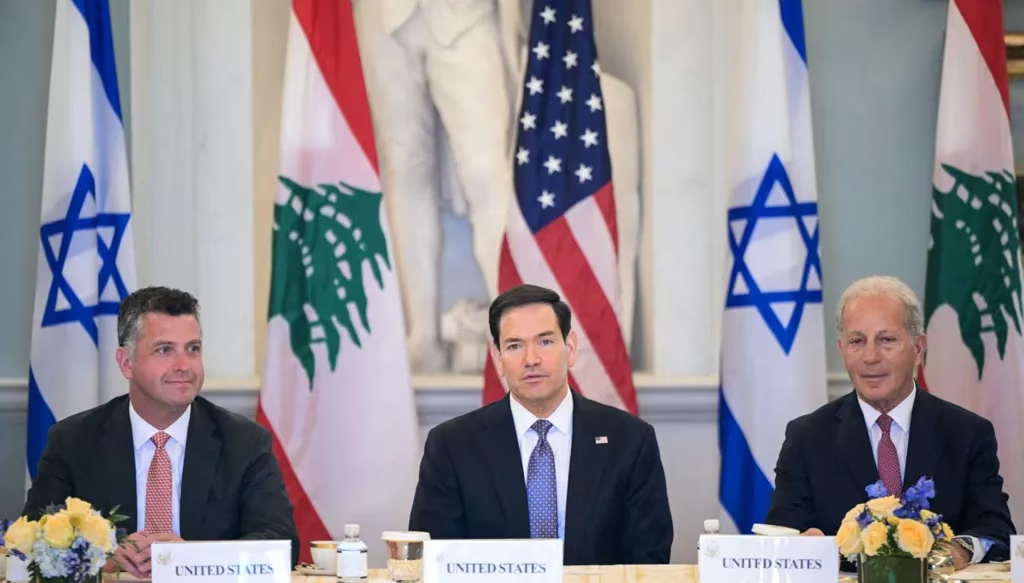
Instead, the American strategy focuses on establishing a "negotiating framework" rather than an "immediate settlement." The last meeting, which lasted longer than scheduled, was described as a "constructive first step," not only in terms of content, but also in terms of symbolism, as it is considered one of the first meetings of this level between the two sides since the early nineties. According to participants, the atmosphere was characterized by cautious positivity, with each party presenting its concerns, and the outlines of potential paths began to form, without translating into concrete proposals yet.
Washington affirms that its role remains limited to "building trust" not imposing dictates. The American administration, despite its influence, recognizes the limits of its ability to direct the course of the conflict, given the presence of international and non-international actors. Hence, it seeks to keep communication channels open, and create a negotiating environment that allows for a gradual accumulation of trust, rather than jumping to uncertain outcomes.
However, the most prominent obstacle remains the position of "Hezbollah," which is a central player in the field, but is not recognized by the United States as a legitimate negotiating partner. Washington insists that any sustainable agreement must be between two states: Israel and Lebanon, with the strengthening of the Lebanese state's position as the sole representative. This position also explains the American reservation about any parallel negotiation channels that may arise between Israel and the party, due to the potential repercussions on Lebanon's sovereignty and on the prospects for long-term stability.
In the background, Iran is present as an influential factor in American calculations. Washington believes that reducing Tehran's influence in Lebanon is a prerequisite for any sustainable settlement, and at the same time seeks to "separate the tracks" between this file and its broader talks with Iran on nuclear and regional issues. The American administration affirms that allowing Iran to determine the outcomes of the Lebanese situation will be a factor aggravating the crisis, not an entry point for its solution.
The American approach is not limited to the security dimension, but extends to the economy as a pillar of stability. Washington proposes reforms in the banking sector, improving the investment environment, and enhancing financial transparency as supporting elements for the Lebanese state's ability to assert its authority. This relationship is approached as a "chicken and egg" dilemma: there is no security stability without economic recovery, and no cohesive economy in the absence of security.
Despite the cautiously optimistic tone that accompanied the talks, American officials realize that the road is still long and full of challenges. The field is volatile, the gaps between the parties are large, while multiple diplomatic paths intersect, some of which are public and others are taking place away from the spotlight. Reports about the possibility of a short-term truce remain unconfirmed, given the limited access to all negotiating channels.
Nevertheless, Washington indicates that any reduction in the level of violence is a welcome step, provided that it does not come at the expense of the broader negotiating path. Stopping the fighting, although an urgent humanitarian goal, does not negate the need for a political framework that addresses the roots of the conflict and prevents its recurrence.
In conclusion, the American approach reflects a deep understanding that the conflict between Israel and Lebanon does not tolerate quick solutions or ready-made recipes. However, this approach faces increasing criticism, which sees it as a structural bias towards Israel, manifested in the refusal to exert serious pressure to stop military operations, despite their high humanitarian cost, especially in southern Lebanon.
Critics argue that Washington, by focusing on "managing the conflict" rather than ending it, gives Israel a wider temporal and military margin to continue its operations, while keeping Lebanon in the position of receiving pressure. This imbalanced balance is seen as reflecting a constant American priority to protect Israeli interests, even at the expense of regional stability.
The exclusion of "Hezbollah" from any official negotiating path also raises questions about the realism of the American approach, as it is difficult to imagine a sustainable settlement without the involvement of the main actor on the ground. Some analysts believe that this exclusion aims not only to strengthen the Lebanese state, but also to reshape the internal balance of power in a way that limits the influence of Washington's adversaries, within a policy closer to "divide and conquer."
At the regional level, the attempt to separate the Lebanese track from tensions with Iran appears, in the view of critics, to be a selective approach, ignoring the structural interconnectedness between the arenas of conflict. It is feared that this separation will lead to partial treatments that will not last long, given the continuation of the factors that fuel tension.
In light of this, it seems that the American bet on the "strength of the process" rather than the "speed of results" may face a difficult test, not only in its ability to achieve a diplomatic breakthrough, but also in its ability to convince regional parties that Washington is playing the role of an impartial mediator, not a biased party.
Share your opinion
Washington Manages Israeli Escalation on Lebanon within a Negotiating Framework, and a Biased American Approach to Israel