OPINIONS

Wed 29 Apr 2026 12:33 pm - Jerusalem Time

"Earth's Solutions Are Over"!

Dr. Ibrahim Melhem

Editor-in-Chief

The least of words, that was the sigh of anger uttered by Finance Minister Stephan Salameh during a meeting with journalists who celebrate bad news and love to break away from rigid molds and ready-made meals. They seize upon that departure and jump over what came in the meeting, from numbers carried in diplomatic language that does not satisfy their craving for the "trend" that fills the world and occupies people.

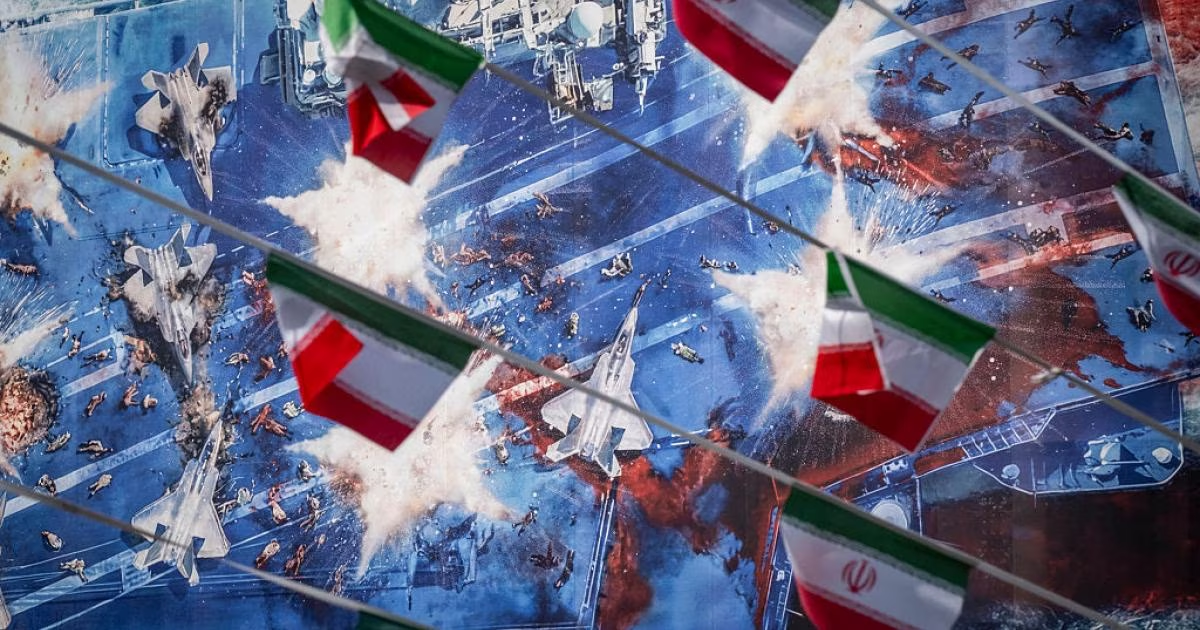
The evocation of the "headline phrase" is dictated today by the successive developments in the faltering negotiations between Washington and Tehran; at a time when animosities are intensifying and tribulations are crowding in; for it was said long ago: "Animosities bring tribulations." After Trump's statements about destroying civilizations, Katz's statements about burning Lebanon came, and these are statements that suckle from one breast, harboring hostility, and spreading discord and grudges among nations, sects, and ethnicities, to facilitate control and expand the "yellow zones" from Sham to Baghdad, and from Najd to Yemen, to Egypt then Tetouan, as came in the dream maps of those who love to swim in the blood of others.

With each passing day of negotiations, solutions move further away between those who want to impose surrender and those who threaten with imminent death. Neither Trump can back down from his goals for which he went to war, nor Netanyahu "is content with the spoils of return," in front of opponents who are lurking to overthrow him in the upcoming elections, which makes resuming the war a way out of his crisis. The more he is pressured, the more he generates new wars to keep himself afloat and prolong the life of his government, as long as he finds someone in the White House who responds to his impulses.

The warning against resuming the war is not only because the tear is widening on the mender, but because "wolves" can only live in the forest.

OPINIONS

Wed 29 Apr 2026 12:33 pm - Jerusalem Time

The Bennett–Lapid Alliance and the Attempt to Reshape the Camp

Elections in Israel are not an event that begins on polling day, but rather a moment when preceding transformations intensify. In this sense, it can be said that the 2026 elections effectively began on April 27, with the announcement of the alliance between Naftali Bennett and Yair Lapid. This alliance was not a result of natural convergence, but rather a product of political pressure imposed by the balance of power within the camp itself. In Israeli discourse, this alliance is presented as a step to rebuild the “change camp” that ended Benjamin Netanyahu’s rule in 2021. But a deeper reading reveals that what is happening is not so much a change as it is a reorganization within the same framework. The competition is not between two contradictory projects, but within a single Zionist vision with multiple management styles. Within this framework, the slogans raised by the right, from “Greater Israel” to “Complete Israel,” are distributed not as real differences but as different expressions of the same ideological structure. Therefore, the gap between the Likud and its opponents appears smaller than what election battles suggest. This explains the absence of a fundamental disagreement regarding the Palestinians. Whether the discourse is more confrontational or more pragmatic, the constants remain the same: expanding settlements, consolidating security control, and managing the conflict instead of resolving it. Even in the most intense moments, there is no real discussion about ending the occupation, but rather about how to manage it with the least political cost. In this context, the Bennett–Lapid alliance does not seem to be an exception to the rule as much as it is an embodiment of it. Bennett, who comes from the religious Zionist current, and who previously served as the Director-General of the Yesha Council (Council of West Bank Settlements) and enjoys support within settlement circles, has never hidden his rejection of the establishment of a Palestinian state, nor his call for the annexation of large parts of the West Bank. This ideological dimension does not contradict his partnership with Lapid, who in the 2013 elections chose to launch his political program from a college in the Ariel settlement, but rather reflects an intersection in the essence of the political vision despite the difference in rhetoric. Ultimately, this alliance is not based on sharp contradictions as much as it is based on managing internal differences, while keeping the Palestinian issue outside of fundamental discussion, or freezing it within the limits of minimal divergence. Even the 2021 experience, which is being invoked today as a model, did not constitute a real exception. It is true that it witnessed the notable precedent of Mansour Abbas joining, but this partnership remained conditional and temporary. Today, Bennett is keen to send a contrary message, emphasizing that he will not rely on Arab parties in any future coalition. In this sense, the alliance does not reproduce the “change” experience, but rather readjusts it within more restrictive limits. What drove the two parties to this alliance was not vision, but necessity. Opinion polls showed the erosion of Lapid’s position, against the rise of Likud, and the emergence of Gadi Eizenkot as a potential player within the camp. At this point, the alliance was no longer an option, but a tool to prevent further decline. But this step does not mean unifying the camp as much as it reveals its fragility. In addition to this alliance, Avigdor Lieberman is moving as an independent force targeting the same base, especially the secular right. In the background, attempts are emerging to recycle figures who have left the Likud fold, such as Moshe Kahlon and Gilad Erdan, within a new right-wing framework. This movement does not reflect genuine pluralism, but rather competition within the same political space. Instead of expanding the party map, it is being divided among players seeking to redistribute the same votes. This is what makes the impact of the Bennett–Lapid alliance limited: it may rearrange the camp, but it does not change its rules. War, siege, and settlement have become part of the “new normal” that no longer needs justification. Eizenkot’s decision remains a crucial factor in determining the direction of the battle. His joining could give the alliance broader security cover, while his remaining outside could deepen the fragmentation. But whatever his decision, it will not change the nature of the scene as much as it will redistribute its centers. Ultimately, the real battle in the 2026 elections is not between right and left, but over the “spirit of the right” and who has the legitimacy to represent it. While the Bennett–Lapid alliance tries to present a hybrid formula for governance, other right-wing figures emerge to compete for the same electoral base. This competition may give the alliance temporary momentum, but it reveals its fundamental dilemma. In Israel today, no one leaves the right; it is only redefined. How can Bennett maintain his right-wing image among settlers while moving in Lapid’s orbit? And how can a camp claiming change do so without affecting the core of the conflict?

OPINIONS

Wed 29 Apr 2026 12:33 pm - Jerusalem Time

What did Iranian steadfastness offer Russia and China??

Perhaps the Russian and Chinese stance during and after the ceasefire in the war that has not yet ended between Iran on one side and the United States and "Israel" on the other side was somewhat cautious in issuing political statements, despite the close follow-up by various circles in both countries, as they are very interested and concerned in this matter and what arises from it and its consequences. The reason is known and obvious, which is the enmity and competing polarity between Russia, China, and the United States. For example, the statements of "Wang Yi," the Chinese Foreign Minister, and the Russian Foreign Minister, "Sergei Lavrov," were very scarce and rare. The first reason is that this battle has not ended, has not been decided, and perhaps chapters of it may yet come, but they certainly viewed the Iranian steadfastness against the American-Israeli aggression with great positivity, and the inability of the United States and Israel to achieve any of the goals they raised since the beginning of the war. Therefore, they used their veto power in favor of Iran in the Security Council and dropped the resolution submitted by the Gulf states, led by Bahrain and Jordan, which bears the number (2817). And because they also believe that if a diplomatic solution to this war is reached, they will have an important role in it, not to mention their economic impact as a result of this war. Perhaps China will be negatively affected because it relies heavily on Iranian oil and gas, unlike Russia, which found in this war and the rise in global oil prices an opportunity to lift the blockade on some of its oil and gas exports due to its war with Ukraine, and that it benefits from the rising cost of energy to revive its financial treasury. However, this economic disparity between Russia and China may be politically different, as both countries, which have more than one strategic relationship with Iran, in more than one file, and have together formed and established more than one bloc with the aim of getting rid of the unipolar American dominance, not to mention the economic war between America, the world's number one economy, which fears the enormous growth of its competing second economy, China. In addition, Russia, which is waging a fierce war with Ukraine, supported by NATO and the United States, believes that resolving the military situation in Ukraine requires, among other things, that the differences between European countries in NATO and America reach a break and the cessation of American financial and military support, which Trump hinted at more than once. The stumbling of the United States and behind it Israel in its war with Iran revealed to a large extent the American military capability that did not achieve any of its goals despite the intensive aggressive strikes on Iran for forty days and in a way that affected more than twenty thousand targets, which China considers a real test of American military power that could collide with it if any escalation occurs between them in the South China Sea against the backdrop of the cold war between them regarding Taiwan, and that this power, which US President Trump boasted about and still does, has shown its realism and that it is not without limits, and that a country the size of Iran, despite the siege and sanctions imposed on it for forty-seven years, has managed to nullify their effect despite the losses and destruction, and thus has now imprinted in the consciousness of the Chinese leadership an important and useful experience for it, which may encourage it to proceed with the recovery of Taiwan to the Chinese embrace at any opportunity that comes with less hesitation than was the case before the outbreak of the war between America and Iran. As for Russia, its welcome and inclination to support the Iranian position appeared in the statements of Russian President Vladimir Putin and what he said at the end of his meeting with Iranian Foreign Minister Abbas Araghchi when he met him on Monday in St. Petersburg when he praised the Iranian people and their steadfastness and added, "Russia, like Iran, intends to continue our strategic relationship," and this in itself carries satisfaction with the Iranian action in the field and politics. This steadfastness and Iranian performance, both military and political, will also strengthen the understandings that bring the three countries together individually and with other blocs such as the "Shanghai" or "BRICS" blocs and others, and strengthens the trend to dismantle the unipolar dominance in the world. The conclusion is that China and Russia have reaped strategic gains from Iranian steadfastness, not all of which have appeared yet, but their revenues will grow day by day, especially when the goals - or a large part of them - of this war raised by the United States in particular and behind it Israel fail.

However, this economic disparity between Russia and China may be politically different, as both countries, which have more than one strategic relationship with Iran, in more than one file, and have together formed and established more than one bloc with the aim of getting rid of the unipolar American dominance

OPINIONS

Wed 29 Apr 2026 12:33 pm - Jerusalem Time

Sanur's Return: The Annexation Message That Shatters the Illusions of the Disheartened

The issue of settlement in the West Bank is no longer merely a policy of gradual expansion imposed by successive Israeli governments under security or religious pretexts. Rather, it has become a clear expression of a deeper strategic transformation: the transition from managing the occupation to reproducing it in a more rigid and comprehensive form. In this context, the re-establishment of the Sanur settlement stands out as a significant marker, not because it is a new settlement site, but because it is a model for re-occupying what was previously evacuated, as if political time can be erased and started from scratch. What is happening in Sanur cannot be separated from a broader context witnessing a rapid erosion of the very idea of “withdrawal” within the Israeli political mind. The disengagement plan of 2005, which was presented at the time as a strategic step for repositioning, is being re-read today within the right-wing current as a historical mistake that must be corrected. With the rise of the religious and national right to the center of decision-making, the goal is no longer just to prevent the establishment of a Palestinian state, but to go beyond that towards regaining direct control over the largest possible area of land. Sanur, in this sense, is merely a test, a test of the ability to break previous restrictions, whether legal or political, and a test of Palestinian and international reactions alike. The re-establishment of a settlement that was evacuated by an official Israeli decision implicitly means that everything previously agreed upon or implemented is no longer binding, and that the current balance of power is the sole reference. But more dangerous than that, this step reflects a shift in the function of settlement itself. After it was a tool for imposing gradual facts on the ground, today it is being used as a tool to radically re-engineer the Palestinian geographical space. The goal is no longer just to expand a settlement or link it to another, but to create an integrated control network based on isolation and fragmentation, which transforms Palestinian communities into isolated islands lacking any real geographical connection. In the northern West Bank specifically, this policy acquires an additional dimension. The area, which was historically considered less densely settled compared to the central and southern West Bank, is gradually turning into an open arena for settlement redeployment. With the re-establishment of sites like Sanur and Homesh, it becomes clear that there is a trend to redraw the settlement map in this area, imposing a new reality that restricts Palestinian movement and reshapes the balance of control. The question that arises here is not only why now, but also where is this policy heading? The answer seems linked to the nature of the political stage within Israel, where there is no longer any embarrassment in openly presenting annexation projects, and there is no longer a need to wrap settlement policies in “security” or “temporary” discourse. We are facing a political moment that sees the land as an open field for decisive action, not for negotiation. In contrast, this escalation comes amid a distressed Palestinian reality, suffering from deep political division and a decline in the ability to formulate a unified confrontation strategy, which gives the settlement project a wider margin for movement, in the absence of a real political cost that could deter it. The re-establishment of Sanur is not just a step on the ground, but an announcement of a new phase in the conflict, titled by the redefinition of the occupation itself. It is no longer about managing an existing situation, but about completely reshaping it according to a vision that considers every previous withdrawal merely a detail that can be erased. In light of this transformation, the biggest challenge is not only to confront settlement expansion, but to realize that what is happening is an attempt to close any future horizon for a political solution, and to replace it with a permanent reality imposed by force and reproduced whenever the opportunity arises. ————————————————————————————————————The re-establishment of Sanur is not just a step on the ground, but an announcement of a new phase in the conflict, titled by the redefinition of the occupation itself. It is no longer about managing an existing situation, but about completely reshaping it according to a vision that considers every previous withdrawal merely a detail that can be erased.

OPINIONS

Wed 29 Apr 2026 12:33 pm - Jerusalem Time

Israel and the Phenomenon of Targeting Journalists: A Crime That Goes Unpunished!!

The murder of Lebanese journalist Amal Khalil has once again brought to light the issue of targeting media professionals, in general, by Israel. The question posed by every person with a conscience and a free pen is: Why does Israel always escape punishment? And who provides it with a protective cover for these crimes against humanity?

In wars, words and images transform into a parallel front, no less dangerous than the battlefields. A journalist does not merely report the event but contributes to shaping global awareness towards it. However, this reality, when it concerns the crimes of the Israeli occupation, makes the journalist himself a direct target, in a clear attempt to silence the voice that documents and exposes.

The recent war on the Gaza Strip, and its extensions in southern Lebanon, revealed a dangerous pattern of systematic targeting of journalists. The circulating figures indicate that more than 150 to 200 Palestinian journalists have been killed in Gaza since the beginning of the war, one of the highest casualty tolls among media professionals in the history of modern conflicts. In Lebanon, a number of journalists were killed during field coverage, reflecting the widening circle of targeting beyond Gaza's borders.

These numbers, though shocking, do not tell the whole story. The issue is not about collateral damage or military errors, but rather points to a clear policy that targets anyone carrying a camera or a pen attempting to convey the truth from the field. Herein lies the danger of what can be described as "criminalizing the truth," where reporting reality becomes an act fraught with death.

Benjamin Netanyahu's government, in this context, seems to view the camera as an "act of resistance." The image that documents the targeting of children, the destruction of hospitals, or the leveling of residential neighborhoods, represents a direct threat to the Israeli narrative and embarrasses it before global public opinion. Therefore, silencing this image becomes an objective in itself.

This policy cannot be separated from the political cover enjoyed by the occupation government, where Netanyahu often relies on protection guarantees provided by Donald Trump's stances and policies, which many see as no less biased, and even provide a political umbrella that weakens opportunities for international accountability, granting Israel a wider margin to continue its policies without fear of real reckoning.

Since October 7, Israel has taken an additional step, which is to prevent foreign journalists from entering the Gaza Strip, in a clear attempt to impose a comprehensive media blackout. This ban was not a security measure, as much as it was part of a strategy aimed at concealing what is happening on the ground: killings, destruction, starvation, siege, and even forced displacement policies.

However, despite these restrictions, Israel has not succeeded in completely obscuring the truth. Palestinian journalists, with simple means and limited capabilities, have managed to convey the image of the tragedy to the world. Scenes of destruction emerged from under the rubble and reached the world's screens, revealing the extent of the humanitarian catastrophe and placing the international community before its moral responsibilities.

Yet, the painful irony is that this revelation has not translated into real deterrence. International positions, for the most part, remained within the framework of verbal condemnation, without practical measures to ensure accountability. This inability or hesitation encouraged the continuation of the targeting policy and sent a message that killing journalists can pass without serious consequences.

Targeting journalists is not only a violation of freedom of expression but a direct assault on humanity's right to know the truth. Every journalist killed is a witness assassinated, a narrative erased, and evidence lost. Hence, international silence cannot be considered neutrality; rather, it is a form of indirect complicity.

Today, the world stands before a real test: either international accountability mechanisms are activated, and those responsible for these crimes are held accountable, or this approach will continue, with its serious repercussions for the future of journalistic work and for the entire international justice system.

In conclusion, the camera that the occupation fears is not a weapon, but it possesses something more dangerous: the ability to reveal the truth. Therefore, protecting journalists is not merely a professional demand but a humanitarian and moral necessity. If the world does not act to stop these crimes, the killing will continue, and the truth will remain targeted… and the crime will go unpunished, time after time.

ARAB AND WORLD

Wed 29 Apr 2026 12:32 pm - Jerusalem Time

Massacre in Jabshit: A complete family martyred and Israeli raids escalate on southern Lebanon

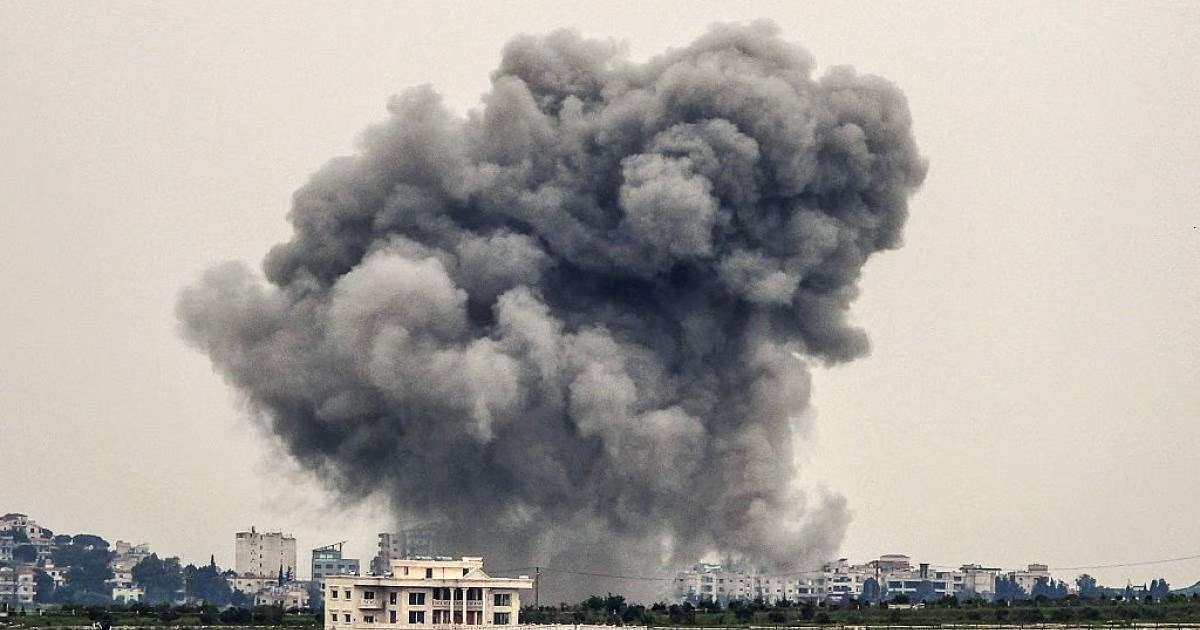
Israeli occupation forces committed a new massacre in the town of Jabshit, southern Lebanon, where their warplanes targeted a populated residential building at night, completely destroying it over the heads of its inhabitants. The raid resulted in the martyrdom of five members of one family: Muhammad Jawad Bahja and his wife Latifa, in addition to Amani Jaber and her two children, Maryam and Ali Al-Reda Hilal Bahja.

Rescue and rubble removal operations continued in Jabshit for several consecutive hours, with ambulance teams working to retrieve bodies from under the debris amidst difficult field conditions. This raid comes in the context of a wide Israeli escalation directly targeting residential areas and civilians deep within southern Lebanese villages.

On the ground, Israeli attacks did not stop at Jabshit; dawn raids also hit the town of Hanin, where occupation forces carried out extensive demolition operations of residential homes. Loud explosions were also heard in the city of Tyre, resulting from artillery and aerial bombardment targeting the border town of Naqoura, causing severe material damage to properties.

In the Marjayoun district, field sources reported that the Al-Jalahiya area in the town of Khiam was subjected to a series of violent night raids, coinciding with intensive sweeping operations with heavy machine guns. These Israeli operations aim to create a buffer zone by destroying infrastructure and homes in villages adjacent to the border.

On the other hand, the Israeli occupation army admitted that one of its soldiers was injured by the explosion of an explosive drone launched from Lebanon. Hebrew sources confirmed a wide internal debate due to the failure of defense systems to deal with the threat of drones launched by Hezbollah, which have now begun to accurately target troop gatherings.

For its part, Hezbollah announced in an official statement that it carried out an aerial attack with a swarm of kamikaze drones targeting the newly established Nimr Al-Jamal site belonging to the occupation army. The statement confirmed that the attack achieved confirmed hits among enemy soldiers, noting that this operation comes in response to the continuous aggressions against villages and civilians in the south.

In the context of official reactions, Lebanese President Joseph Aoun condemned the occupation's targeting of civil defense elements in the town of Majdal Zoun, which led to the martyrdom of three paramedics while performing their humanitarian duty. Aoun stressed that this targeting represents a blatant violation of international laws that impose special protection for workers in relief and medical fields.

In turn, Lebanese Prime Minister Nawaf Salam described the targeting of rescue teams as a described war crime added to the record of Israeli violations against the Lebanese people. Salam affirmed that the government is following up on these aggressions with international bodies to document the crimes affecting civilians and paramedics who are trying to save victims of air raids.

Targeting civil defense elements while performing their duty is a described war crime that falls within a series of repeated aggressions affecting civilians and rescue teams.

ISRAELI AFFAIRS

Wed 29 Apr 2026 12:32 pm - Jerusalem Time

Crisis of Confidence Plagues 'Shin Bet': Accusations Against Agency Head of Ignorance Regarding Hamas Ideology

Hebrew press sources have revealed an escalation of internal disputes within the occupation's General Security Service (Shin Bet), as a deep crisis of confidence plagues the relationship between agency head David Zini and senior security officials. These tensions arise against a backdrop of accusations that Zini lacks the necessary professional competence to manage the agency under current conditions, in addition to his adoption of a tense management style that irritates his assistants.

Reports, citing informed security sources, stated that the crisis reached its peak after a series of failures in situational assessment, with Zini seen as lacking a deep understanding of the intelligence environment in which he operates. This professional deficiency has led many leaders within the agency to express their concern about the repercussions of this approach on the entity's security and deterrent capabilities.

In an incident that astonished senior security commanders, Zini requested to meet with a Hamas detainee undergoing intensive interrogation to understand their motives. During the confrontation, the Shin Bet head asked the detainee why he adhered to the movement's ideology despite what Zini described as 'failure' in the events of October 7th, which experts considered conclusive evidence of his complete ignorance of the nature of the ideology driving the resistance factions.

Officials in the agency described this question as reflecting 'blatant professional ignorance,' noting that attempting to measure ideological convictions by tactical military profit and loss metrics indicates a lack of understanding of the conflict's essence. This incident has deepened the rift between the agency head and the interrogation and intelligence teams working in the field who understand the complexities of the other side's combat doctrine.

Regarding the internal work environment, sources described the atmosphere under Zini as 'extremely hostile,' where a dry military discourse prevails that does not accept discussion or review. Zini is accused of practicing a policy of silencing dissenting voices against his opinions in closed meetings, which has led to a state of paralysis in the exchange of ideas and different intelligence assessments.

Sources also reported complaints about Zini's disdainful treatment of his subordinates and his use of vulgar and crude language during sensitive professional discussions, which created a general sense of aversion. This behavior has led to a decline in morale among Shin Bet personnel, amid warnings of mass resignations or a decrease in the quality of security performance due to the absence of mutual respect.

In conclusion of the warnings, agency employees expressed serious fears of the collapse of what they described as 'the sovereignty of public security,' affirming that the intelligence system is threatened with breakdown. They believe that Zini's quick temper and his continuous disregard for specialized professional advice place the agency in a real predicament, especially at a time when occupation intelligence faces critical and multi-front challenges.

The sovereignty of the General Security Service is on the verge of collapse due to Zini's quick temper and his disregard for professional advice.

OPINIONS

Wed 29 Apr 2026 12:32 pm - Jerusalem Time

Deep American Divide Over Iran War: Trump Loses Broader Alliance Despite "MAGA" Base Solidity

Washington Message"

Washington – Said Arikat – 29/4/2026

News Analysis

Latest polls in the United States indicate a widespread decline in public support for the war on Iran, launched by President Donald Trump, with only a quarter of Americans considering it a "war worth fighting." With its economic cost continuing to rise, domestically and globally, this percentage is expected to decline further in the coming months.

Despite this sharp decline in popular support, Trump appears to be in a unique political position as a president at the end of his term, making him less susceptible to traditional pressures from Congress or even from public opinion. The war, and the accompanying economic inflation and rising energy prices, are likely to weaken the Republican Party in the midterm elections, but without the president facing a direct threat of impeachment or institutional rebellion.

However, the most important debate is not only about public opinion, but about the cohesion of Trump's political base itself. While the solid base of "MAGA" supporters remains committed to him, even with the war, prominent figures from the populist right have begun to declare their opposition, accusing the president of abandoning his electoral promises, foremost among them the slogan "America First."

The division within the Republican Party is no longer a simple one between supporters and opponents, but rather reflects a deeper rift within the alliance that brought Trump to power in 2024. While a part of the base shows almost absolute loyalty to the president, another part sees the war on Iran as a direct betrayal of promises to end the "endless wars" that have exhausted American society for a quarter of a century.

Poll data indicates that about 66% of Americans oppose the decision to go to war, while 68% oppose the use of ground forces in Iran. Also, 69% are concerned about its economic repercussions, especially on fuel prices, while 64% express their lack of confidence in the president's ability to manage the crisis. These numbers clearly reveal that about two-thirds of Americans stand against the continuation of the war.

But this general rejection is accompanied by a sharp partisan division. About 77% of Republicans support the war, and the percentage rises to about 90% among those classified as "MAGA" within the party. However, even within this category, Iran does not appear to be a political priority, as only 11% consider it a central issue, compared to a greater focus on inflation and domestic economic conditions.

In contrast, sharp divisions have emerged within the right-wing media itself. Trump entered into an open confrontation with prominent figures such as Tucker Carlson, who declared his feeling of "betrayal" and his rejection of the war, while the president responded by describing him and those who criticize the war as "losers" who do not represent the true MAGA movement.

However, this media conflict hides a broader reality: opponents of the war are not limited to media figures, but also include a wing within the Republican establishment itself. Some former officials resigned in protest, considering that the war contradicts the principle of "America First," and some even went so far as to accuse external influences, including Israeli pressures, of pushing the decision towards escalation.

Poll studies reveal that Trump's electoral base is not a single homogeneous bloc. Only about 30% of his voters are classified as "solid MAGA," while the rest form a fragile alliance of independent voters and voters dissatisfied with the Democratic Party. These latter categories are currently the most opposed to the war.

Divisions also appear based on age and education; young Republicans are about 30 points less supportive of the war compared to older people, and working-class voters without a college education have gradually begun to withdraw their support, especially with the deterioration of economic conditions.

In this context, it appears that the war in Iran has not only weakened the president's international image, but has begun to dismantle parts of the electoral alliance that brought him to the White House. Although the solid base remains cohesive, the broader margin of supporters shows a clear decline, raising questions about the future of this political alliance after Trump.

The war in Iran reveals a fundamental contradiction in Trump's political project between the slogan "America First" and the options of widespread military intervention. While his popularity was built on rejecting foreign wars, the military decision weakened trust between him and the base that joined him for economic and social reasons more than ideological ones. This shift reflects the fragility of the populist alliance, which coheres around personality more than around policies. With increasing economic costs, maintaining this balance becomes more difficult over time and as the effects of the war expand domestically.

The division within the Republican Party does not merely reflect a disagreement over foreign policy, but expresses a deeper struggle over the party's identity itself. There is a current that tends towards isolationism and avoiding military interventions, versus a more traditional current that leans towards hard power and foreign alliances. The Iran war ignited this contradiction in an unprecedented way, especially with media and populist voices entering into direct confrontation with the president. This division may have long-term repercussions that extend beyond Trump's term, reshaping Republican foreign policy for years to come.

Moreover, public opinion figures indicate a broader crisis of confidence in the American political establishment as a whole, not just in the Trump administration. The rejection of the war by two-thirds of Americans reflects societal exhaustion from repeated foreign interventions over the past decades. This popular mood places any future administration, Democratic or Republican, under strict constraints regarding the use of military force. The erosion of confidence in the executive leadership in crisis management also deepens the gap between citizens and decision-makers, making foreign policy more susceptible to internal fluctuations.

OPINIONS

Wed 29 Apr 2026 8:14 am - Jerusalem Time

Rebuild Gaza by Ending Its Destruction First


Ny: Said Arikat


April 29, 2026


News analysis


Washington, D.C- The latest technocratic fantasy about Gaza arrives wrapped in the language of empowerment. In a recent Foreign Affairs essay, three prominent academics argue that Gaza should be rebuilt by Gazans, not by distant planners or foreign governments. On its face, that sounds sensible, even overdue. Palestinians should indeed determine their own future. But the article’s central flaw is profound: it discusses reconstruction as though Gaza’s devastation were a natural disaster or a neutral planning challenge, rather than the direct consequence of military destruction, siege, displacement, and decades of denial of Palestinian sovereignty.


You cannot seriously discuss rebuilding Gaza without first naming who destroyed it, who continues to control its borders, airspace, coastline, population registry, imports, exports, and movement, and who can resume bombing at any moment.


This is not simply an urban planning problem. It is a political and moral one.


The authors compare Gaza to postwar Tokyo, Dresden, Beirut, and earthquake-hit India. These analogies are tidy but misleading. Tokyo and Dresden were cities emerging from concluded world wars under new political arrangements. Kutch was recovering from a natural disaster. Gaza is different. It remains trapped under a matrix of siege, occupation, and recurring war. Its people are not merely survivors of destruction; they are a population systematically denied normal civic life.


To speak of land readjustment systems, zoning flexibility, tax incentives, and special economic zones while Gaza remains subject to blockade is like discussing interior design in a house that is still on fire.


The essay is correct on one point: top-down schemes imposed by outsiders often fail. Palestinians do not need another foreign blueprint drafted in Cairo, Washington, Tel Aviv, or think tanks in Cambridge and Manhattan. They do not need Jared Kushner’s recycled real-estate fantasies about turning Gaza into a Mediterranean resort. They do not need donor conferences that pledge billions while leaving intact the structures that guarantee future ruin.


But if Gazans are to rebuild Gaza, then Gazans must first be free.


That means freedom of movement, control over borders, access to construction materials, functioning ports, secure fishing waters, reliable electricity, water sovereignty, telecommunications autonomy, and the right to elect accountable leadership without external vetoes. None of these are secondary details. They are prerequisites for any genuine reconstruction.


Without sovereignty, “rebuilding” becomes little more than managed dependency.


The article also praises property rights as the engine of democratic transformation. There is truth in the argument that secure ownership can strengthen civil society. But in Gaza, the most basic property question is not whether neighbors can pool parcels for development. It is whether homes, farms, shops, schools, and hospitals can be obliterated overnight without consequence.


Property rights are meaningless when one side can demolish entire neighborhoods with impunity.


The discussion of eminent domain and compensation likewise feels detached from reality. Who compensates the families whose apartment towers were flattened? Who compensates farmers whose orchards were razed? Who compensates parents whose children were buried beneath the rubble? International law does not reduce mass destruction to a spreadsheet of redevelopment costs.


Then there is the seductive language of the “special economic zone.” This is a familiar formula: create a heavily secured enclave with low taxes, relaxed regulation, and foreign investment incentives. It sounds modern and pragmatic. In practice, such zones often become islands of inequality—spaces designed for investors, not citizens.


Gaza does not need to become a laboratory for neoliberal experimentation. It needs schools, hospitals, housing, ports, manufacturing, universities, and a dignified labor market integrated with the wider world. It needs the ability to trade normally, not to survive inside a fenced showcase for foreign capital.


The most troubling omission in the essay is accountability. Reconstruction discourse often functions as a political eraser. It shifts attention from responsibility to logistics, from justice to management, from rights to engineering. Once the conversation becomes about concrete, cranes, and cadastral surveys, the perpetrators of devastation fade conveniently into the background.


But rubble has authors.


Any serious Gaza recovery plan must include international guarantees against renewed destruction, legal accountability for violations of humanitarian law, compensation mechanisms for victims, and binding protections for civilians. Otherwise, rebuilding becomes cyclical absurdity: donors pay to reconstruct what bombs may destroy again next year.


There is another missing actor in these elite proposals: the Palestinian public itself. Not as passive beneficiaries, not as case studies, not as labor inputs—but as a political people with national rights. Gaza’s future cannot be separated from the future of the West Bank, East Jerusalem, refugees, and Palestinian self-determination as a whole. Treating Gaza as an isolated urban management puzzle serves those who prefer fragmentation over justice.


Yes, Gazans know better than foreign planners how to shape their neighborhoods, streets, markets, and homes. Yes, reconstruction should be locally led. Yes, bureaucratic megaplans can suffocate organic recovery.


But none of that matters if Gaza remains enclosed, vulnerable, and subordinate.


The first brick in rebuilding Gaza is not concrete. It is freedom.


The first blueprint is not zoning. It is rights.


The first investment is not foreign capital. It is security grounded in law, not domination.


And the first principle must be simple: no people should be asked to master the art of reconstruction while the machinery of destruction remains in place.


If the world truly wants “a Gaza for Gazans,” it must begin by ending the conditions that made Gaza unlivable in the first place. Anything less is not reconstruction. It is public relations.


Above all, the mass killing of Gaza’s men, women, and children must end once and for all. Those responsible for this genocide must be held fully accountable under international law, because no rebuilding can stand on foundations of impunity.

PALESTINE

Tue 28 Apr 2026 12:35 pm - Jerusalem Time

The Disguised Occupation: Israel Establishes the 'Yellow Line' as a Buffer Zone in Southern Lebanon

The Israeli occupation authorities continue to establish a new approach of disguised occupation in southern Lebanon, by imposing what it calls the 'Yellow Line' as a security buffer zone outside its international borders. This step comes within the framework of Tel Aviv's efforts to expand its field control, similar to models it previously implemented in the Gaza Strip and Syrian areas, amidst warnings of catastrophic humanitarian consequences.

The 'Yellow Line' consists of imaginary borders imposed by the occupation army south of the Litani River, where the area extending from it to the border is known as a closed combat zone. This measure aims to prevent the return of displaced Lebanese to their homes, while giving the green light to target any civilian or military movements as a violation of security understandings.

Field data indicates that the occupation army has penetrated distances of up to about 10 kilometers inside Lebanese territory, including areas from the vicinity of Rashaya to Naqoura and Ras al-Bayada. This penetration does not seem to be merely a temporary measure, but rather an indication of an Israeli desire to establish a new geographical reality that gives it permanent fire superiority.

For his part, MP Hussein Fadlallah affirmed that all consequences of the war, including the 'Yellow Line', will be overturned and will not be allowed to be established as a fait accompli. This position comes amid widespread official and popular Lebanese rejection of attempts to seize border lands and turn them into buffer zones lacking any legal or international legitimacy.

These developments bring to mind the experience of the 'border strip' established by the occupation between 1978 and 2000, with fundamental differences in the extent of current destruction. While the previous occupation allowed some residents to remain, the current strategy relies on complete displacement and the destruction of all means of life in the targeted villages.

Field sources monitored massive destruction in the town of Khiam and its surrounding villages, where occupation forces carried out extensive bombing and bulldozing operations of homes and public facilities. Israel claims that these operations target military infrastructure, despite the continued validity of recently extended ceasefire agreements.

In the Arqoub area, the head of the Union of Municipalities, Qassem Al-Qadri, explained that the villages adhered to a peaceful confrontation approach and did not witness any armed manifestations throughout the conflict. Al-Qadri pointed out that the local authorities are fully affiliated with the Lebanese state, which refutes the Israeli pretexts used to justify targeting the area and destroying its infrastructure.

Al-Qadri added that after the truce, residents were surprised by the establishment of the security belt, which began to devour vast areas of agricultural land and residential areas. This belt led to the isolation of villages from each other, and cut off vital arteries connecting the Arqoub region to the Hasbaya district and the Nabatieh governorate, exacerbating the living crisis.

The towns located within the 'Yellow Line' suffer from severe crises in the services sector, especially water outages due to preventing maintenance teams from accessing basic sources. Municipalities have sent official memos to 'UNIFIL' forces and international bodies to intervene urgently to ensure freedom of movement and secure humanitarian needs.

Observers believe that Israel seeks, through this buffer zone, to acquire additional bargaining chips in any future political negotiations with Lebanon. By emptying the area of its residents, Tel Aviv is trying to impose harsh security conditions that go beyond recognized international decisions, and legitimize its repeated aggressions.

On the political level, Washington held two rounds of direct talks between the Lebanese and Israeli sides to discuss ways to cease hostilities. The Lebanese side, headed by Joseph Aoun, insists on the necessity of the occupation's withdrawal to international borders and the deployment of the Lebanese army as the sole force responsible for security in the south.

Official statistics indicate the extent of the tragedy left by the aggression, with more than 2500 martyrs and thousands injured, in addition to the displacement of about a fifth of Lebanon's population. These figures reflect the ferocity of the Israeli attack, which was not limited to military targets, but also affected the social and economic fabric of the Lebanese state.

The continued occupation's encroachment on Lebanese, Palestinian, and Syrian territories reflects a consistent policy that refuses to comply with UN resolutions calling for withdrawal. The 'Yellow Line' remains a new title for the conflict, as the occupation tries to turn the border into a forbidden zone for its legitimate owners under the guise of 'security and defense'.

In conclusion, the fate of the border villages remains suspended between the steadfastness of the residents and international political maneuvers, amid Israeli insistence on turning the south into a destructive security belt. Attention is now turning to the international position and its ability to compel the occupation to respect Lebanese sovereignty and stop systematic bulldozing operations.

This belt did not remain within a narrow scope, but gradually expanded towards the Arqoub area, which practically led to the isolation of villages, cutting off vital roads, and preventing farmers from accessing their lands.

PALESTINE

Tue 28 Apr 2026 12:34 pm - Jerusalem Time

Legal Challenge in Britain: 130 Prominent Figures Sign Letter Supporting 'Palestine Action' Movement

The political and legal arena in Britain has witnessed widespread activity following the signing of an open letter by over 130 public figures, explicitly declaring support for the 'Palestine Action' movement. This bold move comes just days before an anticipated judicial appeal hearing to review the legality of the British government's decision to ban the movement and classify it as a terrorist organization.

Media sources reported that the list of signatories included prominent international names, among them Swedish environmental activist Greta Thunberg, Irish novelist Sally Rooney, and actress Judith Butler. The letter also included signatures from distinguished academics and law professors from prestigious universities such as Oxford and Cambridge, in addition to an elite group of British musicians and intellectuals.

Addressed to the Court of Appeal, the letter was concise and firm, with signatories declaring their opposition to what they described as 'genocide' and their full support for the activities of 'Palestine Action'. This declaration represents a direct challenge to the authorities, especially since British anti-terrorism law criminalizes any form of public support for banned organizations.

The British government seeks, through the upcoming hearing, to challenge a previous ruling issued by the High Court last February, which questioned the legality of the ban. Observers believe that this judicial conflict reflects a deep division within British state institutions regarding how to deal with protests related to the war in Gaza.

The roots of the crisis date back to July 2025, when authorities decided to classify 'Palestine Action' as a banned organization following a series of direct protest activities. The most prominent of these incidents was activists storming a Royal Air Force base and spraying red paint on military aircraft engines, expressing their rejection of what they call British complicity in the war.

The organization, which employs a 'direct action' approach, accuses the British government of indirect involvement in war crimes by providing Israel with military and logistical support. In contrast, the government uses these attacks on military installations and defense companies as a primary justification for tightening the legal noose on the movement's activists.

The open letter was published through the British organization 'Defend Our Juries', a human rights body that advocates for judicial independence and the rights of protesters. The organization clarified that the signatories are fully aware that their stance may expose them to criminal prosecution and potential penalties under the country's strict anti-terrorism laws.

The human rights organization indicated that the police's arrest of these prominent figures would put the authorities in a significant moral and legal dilemma, as it would reveal what it described as the 'authoritarian nature' of the ban decision. If the authorities refrain from acting, it will open the door to questioning the legality of thousands of arrests that previously targeted unknown activists.

World-renowned musician Brian Eno was among the signatories, known for his political stances supporting the Palestinian cause and his repeated calls to boycott Israeli artistic events. Eno's joining of the letter reflects the widening support for the movement among cultural elites who view the ban as a restriction on freedom of expression and peaceful protest.

For her part, Penny Green, a professor of law at Queen Mary University of London, stated that stigmatizing protesters opposing genocide as terrorists is legally unacceptable. She considered that the government faces serious accusations of complicity in the ongoing events, making the debate around 'Palestine Action' a political issue par excellence that transcends the courts.

Recent weeks have seen an escalation in the pace of field protests demanding the lifting of the ban on the movement, with authorities carrying out widespread arrests in the capital, London. Sources reported that Trafalgar Square witnessed the detention of over 500 people during a massive protest gathering, a clear indication of the extent of public anger at government policies.

These demonstrations are considered the largest of their kind since the High Court ruling, which offered a glimmer of hope to the movement's defenders for the possibility of overturning the ban. International human rights organizations are monitoring the course of this case, considering it a true test of Britain's commitment to protecting the right to protest and political dissent.

The legal debate continues amid great anticipation for the outcome of the upcoming court sessions, which will determine the fate of 'Palestine Action's' activities in the United Kingdom. Legal experts believe that the upcoming ruling will set a legal precedent that could affect the future of other protest movements adopting similar methods of expressing their political views.

Ultimately, this open letter places the British government before difficult choices: either proceed with legal prosecutions against cultural and international figures, or backtrack on the ban decision, which faces widespread human rights criticism. All eyes remain on the Court of Appeal, which has become an arena for conflict between national security considerations and fundamental human rights.

We oppose genocide, and we support Palestine Action.

ISRAELI AFFAIRS

Tue 28 Apr 2026 12:34 pm - Jerusalem Time

Israeli Academic: Ceasefire Gives Tehran a Chance to Survive Collapse

Israeli Professor Eyal Zisser expressed his strong criticism of the ceasefire decision that temporarily ended the 'Lion's Roar' operation, noting widespread dissatisfaction within Israeli occupation circles and some circles in the United States. Zisser explained that expectations of the collapse of the Iranian regime were not met, as Tehran continued to launch missile barrages, with intelligence indicators confirming its possession of an arsenal sufficient to continue fighting for several additional weeks.

The Israeli analyst considered that the Iranian leadership quickly used the calm to declare 'victory,' acting from a position of strength and initiative in managing the pace of negotiations with Washington. He also pointed out that Tehran began to brandish the card of closing the strategic Strait of Hormuz, coinciding with what he described as its success in imposing a ceasefire equation on the Lebanese front, which enhances its regional influence in various arenas.

The article published in 'Israel Hayom' newspaper indicated that the absence of accurate information and images showing the actual extent of destruction within Iranian territory, along with the continued internet blackout policy, enabled the regime to market the confrontation as a strategic achievement. Zisser believes that this behavior mimics Hezbollah's approach in Lebanon, which, with Iranian support, was able to impose tangible restrictions on the military capabilities of the occupation compared to the situation before the outbreak of the confrontation.

In his reading of the internal scene, the Israeli academic explained that the 'survival means victory' equation is the primary driver of the celebrations in the streets of Tehran, despite the bitter economic reality the country is experiencing. He affirmed that this propaganda attempts to cover up a state that is effectively on the brink of collapse, after a year of unprecedented unrest and protests that shook the foundations of the ruling regime's stability.

The analysis touched upon shocking economic figures, where the Iranian rial lost about 90% of its original value, leading to huge jumps in inflation rates and the erosion of citizens' purchasing power. Sources indicated that millions of Iranians are now living below the extreme poverty line, with the average monthly income per individual not exceeding $120, amid suffocating living crises including water shortages and prolonged power outages.

Zisser concluded his analysis by noting that the Iranian regime allocates a quarter of the state budget to nuclear programs, developing its missile arsenal, and funding military proxies in Iraq, Yemen, and Lebanon at the expense of the people's basic needs. He warned that any potential agreement that US President Trump might conclude at this stage could be a 'lifeline' for the regime, especially with reports indicating that the losses incurred by the US military in the region may be much greater than officially disclosed.

The most dangerous thing that could happen at this stage is for Trump to contribute to saving the Iranian regime through a potential agreement.

PALESTINE

Tue 28 Apr 2026 12:34 pm - Jerusalem Time

Palestinians of the Interior.. Decades of Confrontation Against Policies of Israelization and Land Confiscation

The Palestinian community that remained steadfast in the occupied territories in 1948 embarked on a complex struggle to confront the colonial policies that targeted its national existence. This confrontation ranged from organized political action to overwhelming popular uprisings, amidst continuous attempts by Israeli authorities to impose 'Israelization' and isolate this authentic part of the Palestinian people from its national and ethnic extension.

The period of military rule, which lasted until 1966, represented the peak of administrative and security repression, where Palestinians were besieged in their villages and cities under the pretext of 'security threat'. This system was based on British emergency regulations to restrict movement and prevent the formation of any unifying national framework, making Palestinians strangers and persecuted in their historical land, where they became a minority after the displacement of hundreds of thousands during the Nakba.

Despite close intelligence surveillance, armed resistance models emerged from within the Green Line, most notably the 'Akka 778 group' led by Fawzi Al-Nimr. This cell succeeded in carrying out qualitative operations targeting oil refineries and railway lines, exploiting its members' ability to move deep inside Israel and mislead security agencies for long periods before their discovery.

The issue of compulsory conscription imposed on Druze youth in 1956 represented another station of popular rejection, as the occupation sought to detach them from their Arab identity. Despite the pressures, organized movements led by religious and intellectual figures, such as the Druze Arab Initiative Committee, affirmed Palestinian belonging and refused involvement in military service within the occupation army.

'Land Day' on March 30, 1976, marked the most significant turning point in the history of Palestinians of the interior, as the uprising erupted in response to plans to Judaize the Galilee and confiscate thousands of dunams. This movement broke the barrier of fear and proved the failure of containment policies, after the masses united in a comprehensive strike that Israeli forces confronted with live ammunition, resulting in the martyrdom of six individuals who became symbols of eternal steadfastness.

Attempts to control the land did not stop, which led to the outbreak of the 'Al-Zaboud' confrontations in the town of Beit Jann in 1987, where residents waged a historic strike that lasted for more than a hundred days. The residents defended their lands, threatened with confiscation for settlements, with their bare chests, and managed to confront police forces in violent clashes that resulted in dozens of injuries among Israeli security personnel.

In the late nineties, the 'Al-Rouha Uprising' emerged as a successful model of popular field action in the Umm al-Fahm and Wadi Ara region, protesting the closure of lands for military purposes. Angry crowds and continuous sit-ins forced the then Israeli Minister of Defense to retract his decisions, which constituted an important moral and material victory in the struggle to preserve what remained of Palestinian land.

In 1999, the city of Lod witnessed a strong movement against the policy of home demolitions, a policy aimed at tightening the noose on the Palestinian presence in coastal cities. Political leaders and intellectuals were subjected to direct assault, but the tents erected over the rubble remained a testament to the Palestinian determination to stay and reject the silent displacement practiced by Israeli municipalities.

The October 2000 uprising reconnected the interior with the entire Palestinian entity in a bloody and formidable way, coinciding with the outbreak of the Al-Aqsa Intifada in the West Bank and Gaza. Israel confronted the demonstrators with unprecedented brutality, using snipers against its Palestinian citizens, leading to the martyrdom of 13 young people, a scene that revealed the true face of the colonial system that does not differentiate between one Palestinian and another.

Observers believe that after 2000, Israeli authorities adopted a policy of 'flooding with crime' as an alternative tool for security control and dismantling the social fabric in the interior. The complicity of police agencies with criminal gangs indicates an official desire to occupy Palestinian society with internal conflicts that drain its energies and distance it from engaging in major national issues.

The 'Dignity Uprising' in May 2021 caused a deep shock in Israeli consciousness, as coastal cities and the Negev exploded in the face of settlers and security forces. This uprising coincided with the 'Sword of Jerusalem' battle, and proved that the young generations who did not experience the Nakba or Land Day are still committed to their national identity and willing to sacrifice for Jerusalem and Al-Aqsa.

The Dignity Uprising was characterized by the participation of broad youth groups outside traditional party frameworks, reflecting a state of accumulated anger against economic marginalization and racial discrimination. Israel confronted this movement with a frantic arrest campaign that affected hundreds, and issued unjust sentences aimed at deterring any future movement that might threaten the internal front during any comprehensive military confrontation.

Researchers analyze the reality of Palestinians of the interior through the concept of 'threshold state', which describes the rupture between sincere national belonging and material attachment to Israeli civil reality. This state, despite its complexity, did not prevent the masses from rising up at pivotal moments, confirming that national identity remains the primary driver despite all policies of domestication and control.

The struggle of Palestinians of 1948 remains an integral part of the comprehensive Palestinian liberation story, as they confront the most severe policies of Judaization with their bare chests. The continuation of popular uprisings and the development of confrontation tools confirm that attempts at 'Israelization' have shattered against the rock of national consciousness, and that the Palestinian interior will always remain at the heart of the conflict over land and identity.

The central idea in Israeli colonialism is based on the equation of more land and fewer people, which Palestinians have confronted with steadfastness and successive uprisings.

ISRAELI AFFAIRS

Tue 28 Apr 2026 12:34 pm - Jerusalem Time

Trump Pressures Netanyahu to 'Exercise Restraint' in Lebanon Until Vision with Iran Becomes Clear

Hebrew media reports revealed details of a phone call between US President Donald Trump and Israeli Prime Minister Benjamin Netanyahu, in which Trump demanded the necessity of maintaining a state of containment on the northern front. During the call, Trump emphasized the importance of not taking steps that could lead to the collapse of the fragile ceasefire agreement in Lebanon during the current phase.

Sources clarified that the new American approach closely links de-escalation in Lebanon with the negotiation path that Washington intends to pursue with Iran. It appears that the White House seeks to exhaust all diplomatic opportunities with Tehran before allowing any widespread military escalation that could complicate regional affairs.

In contrast, Netanyahu tried during the conversation to obtain authorization to expand the Israeli army's freedom of movement in Lebanon, claiming to respond to immediate threats and protect soldiers. However, Trump clearly rejected these demands, insisting that the stability of the Lebanese front represents a strategic priority for his administration at the present time.

On the ground, the Israeli army announced on Tuesday morning that its soldiers had sustained injuries following a new drone attack in southern Lebanon. This incident comes after a series of targeted attacks that aimed at transporting wounded and nearly brought down a military helicopter in the border town of Taybeh.

Domestically, the ruling coalition in Israel faces a growing wave of anger from the heads of local authorities in northern settlements. These officials announced an open rebellion against government decisions by closing schools today, asserting that the security promises made by the political leadership do not translate into real security on the ground.

A recent poll conducted by the official Hebrew radio showed a state of pessimism in the Israeli street, with 57% of respondents believing that Israel has not achieved victory on any of the fighting fronts. The percentage of conviction in victory on the Lebanese front dropped to only 14%, reflecting an erosion of trust in the official narrative of the army and government.

For his part, Cabinet Minister Zeev Elkin tried to reassure the Israeli public through radio statements, claiming that Israel had succeeded in moving the Radwan forces away from the border. However, Elkin admitted that Hezbollah still possesses existing military capabilities, considering that future agreements with Lebanon and Iran may be in Israel's interest.

In Washington, Secretary of State Marco Rubio described the efforts to reach a permanent agreement with Lebanon as historic and unprecedented endeavors. Rubio indicated that the absence of a formal state of war between the two countries facilitates the task of reaching understandings that satisfy the majority of the Lebanese and Israeli peoples who desire peace.

Israeli analyses indicate that Netanyahu finds himself in a strategic dilemma, as he cannot oppose Trump's wishes, who places his political prestige in the balance of these negotiations. Netanyahu fears that Israel will appear as an obstacle to the new US administration's steps aimed at expanding the circle of normalization and the Abraham Accords.

Sources quoted Israeli security officials as saying that negotiations with Lebanon may contribute to increasing internal pressure on Hezbollah. However, estimates still indicate that the field situation in the north will remain volatile for a long time due to the Lebanese army's weak ability to curb armed factions.

In a related context, the newspaper 'Yedioth Ahronoth' considered that the current ceasefire agreement has turned into a complex strategic problem affecting Israel's deterrence prestige. The newspaper affirmed that the continued human and material bleeding in the north weakens Israel's negotiating position and fuels disagreements within the military establishment.

Channel 13 Hebrew addressed the technical failure in confronting Hezbollah's drone weapon, describing them as smart weapons that are difficult to detect with traditional radars. It explained that these drones are now capable of reaching any target in the north, making the internal front in a state of constant alert.

Despite optimistic statements from some international parties, estimates within the Israeli security establishment prevail that the negotiation path with Iran may end in failure. Analysts believe that the outbreak of a comprehensive confrontation on the Lebanese and Iranian fronts is only a matter of time, awaiting the outcome of intensive diplomatic moves.

In conclusion, the scene in southern Lebanon and northern Israel remains suspended between the pressures of the White House and Netanyahu's political ambitions, amidst a ground reality that imposes its own conditions. The coming days will determine whether the 'containment' demanded by Trump will withstand the increasing security challenges.

Trump rejected and insisted on the necessity of containing Israel and avoiding operations that would threaten the ceasefire now.

PALESTINE

Tue 28 Apr 2026 12:34 pm - Jerusalem Time

Israeli Military Confessions: Gaza Bombing at Start of War Was 'Hysterical' and Driven by Revenge

Erez Winter, head of the Operational Planning Division in the Southern Command of the Israeli occupation army, admitted that military operations in the early days of the aggression on the Gaza Strip were characterized by randomness and excessive intensity. Winter described the bombing as 'hysterical' in his testimony, indicating that this military approach was primarily aimed at inflicting the greatest possible damage on the Strip and its residents.

The military official responsible for developing field plans for the ground operation explained that the motives behind this level of violence were a mixture of a desire for revenge and inflicting harm, along with a state of distrust that prevailed within the military establishment at that stage. These statements shed light on the combat doctrine followed since October 8, 2023, which left enormous destruction in the infrastructure.

Winter spoke about what he called the 'fire curtain' that accompanied ground forces during their initial incursion into the Strip's territory, confirming that the level of artillery and aerial bombardment was exceptional. He considered that the intensity of the fire used had not been seen in modern wars for many decades, making Gaza an arena for an unequal confrontation in terms of destructive power.

In a striking admission, the military commander indicated that the world would need many years, perhaps decades, to realize the extent of the 'hell' that the Gaza Strip actually experienced. These words reflect the magnitude of the atrocities committed by the Israeli military machine, which, according to statistics, led to the martyrdom and injury of hundreds of thousands of Palestinians and the destruction of 90% of vital facilities.

These statements, broadcast by Hebrew media sources, sparked a wide wave of anger in Palestinian circles and on social media platforms. Activists considered Winter's testimony nothing but official documentation from within the military establishment of the genocidal crimes committed in full view and hearing of the entire world.

Observers believed that the Israeli official's remarks reinforce the human rights narratives and field testimonies documented by the residents of the Strip from the first moments of the war. They affirmed that the admission of a 'desire to inflict harm' proves the premeditated intention to commit war crimes and directly target civilians without any humanitarian or legal considerations.

For their part, Palestinian bloggers reacted to these confessions by emphasizing that they did not need testimony from the occupation leaders to realize the extent of the criminality they had been subjected to. They pointed out that the intense bombing, whose images were broadcast live on television screens, was sufficient to condemn the occupation before history and international justice.

Activists stressed that the use of destructive weapons, including concussion bombs in areas crowded with displaced persons, was a systematic policy to kill the largest number of Palestinians. They added that this policy did not differentiate between a child or a woman, but rather targeted the Palestinian presence in Gaza completely and comprehensively.

Despite this 'hysterical' intensity of fire that Winter spoke about, Palestinian analysts believe that the occupation failed to achieve its strategic and field objectives. They affirmed that the legendary steadfastness on the ground prevented this destruction from turning into a clear political or military victory for the occupation, despite the scale of human and material sacrifices.

These testimonies come at a time when international demands continue for accountability for the occupation leaders for the atrocities they committed in Gaza. Winter's statements are an additional document that can be used in international legal forums to prove the deliberate intent of the occupation army to destroy the means of life in the Strip and turn it into an uninhabitable area.

Humanity will need many decades to understand the extent of the hell that Gaza has been subjected to due to the intensity of fire not seen in contemporary wars.

PALESTINE

Tue 28 Apr 2026 12:34 pm - Jerusalem Time

Investigation reveals tragedy of disappearance of dozens of children in Gaza and rising numbers of missing under rubble

Palestinian families in the Gaza Strip are facing a worsening tragedy with the escalating numbers of missing children. Estimates from the Palestinian Center for Missing Persons indicate that approximately 2,700 children's bodies are still buried under the rubble of destroyed homes. In parallel with these shocking figures, about 200 other children are believed to have disappeared under mysterious circumstances related to forced displacement or proximity to contact points with occupation forces.

A recent journalistic investigation shed light on this phenomenon, presenting painful human stories of children who disappeared from displacement camps or while searching for food. This comes at a time when Hebrew media often ignores the scale of the humanitarian catastrophe in the Strip, giving these testimonies exceptional importance in documenting the suffering of civilians.

Among the cases documented by the investigation is the story of four-year-old Muhammad Ghabin, who went missing three weeks ago from his family's tent in Beit Lahia, north of the Strip. His mother told media sources that her child was playing in front of the tent before suddenly disappearing within just ten minutes, leaving no trace of his whereabouts.

Reports indicate that Muhammad's case is not isolated, as social media platforms and local groups in Gaza are filled with daily appeals from families searching for their missing children. Most of these children are between three and ten years old, which increases the danger of their situation amid the security and humanitarian chaos left by the ongoing aggression.

The disappearance of some children is directly linked to military operations, as a number of them went missing after approaching the Netzarim axis or aid distribution points. There are serious concerns that these children may have been subjected to direct gunfire or arrest by occupation forces that impose a strict siege on those areas.

In another story reflecting the extent of psychological trauma, ten-year-old Samer Abu Jameh disappeared near the city of Rafah last March. Samer was suffering from severe psychological disorders as a result of witnessing horrific killings during the war, which left him in a state of psychological withdrawal before his disappearance.

Samer's mother spoke bitterly about the absence of any information about her son's fate, noting that she constantly sees him in her dreams crying for help. The family affirmed its determination to continue the search despite the harsh conditions, calling on international bodies to intervene to find out if he is detained or injured.

On the ground, security agencies in Gaza denied the occurrence of organized kidnappings, attributing the disappearances to disorientation resulting from repeated displacement or family disputes. Local sources accused parties linked to the occupation of spreading rumors aimed at inciting panic and destabilizing internal stability in the displaced community.

The investigation revealed extortion methods practiced by the occupation, where the family of the child 'Zeina' was blackmailed by Israeli intelligence after their neighbors' house was bombed. An intelligence officer demanded the family provide security information in exchange for revealing the fate of their missing daughter, which the family categorically refused.

For its part, the International Committee of the Red Cross confirmed that it is dealing with thousands of open requests for missing persons in Gaza, but its ability to act remains very limited. The occupation authorities obstruct the access of international teams to detainees or providing them with lists of names, leaving thousands of families in a state of constant anxiety about the fate of their children.

He always appears in my dreams crying. He is a part of my soul, and I will continue to search for him until my last breath to know what happened to him.

OPINIONS

Tue 28 Apr 2026 12:33 pm - Jerusalem Time

Bennet-Lapid Unit - A Change in Form, Not in Substance

This merger unit of two former prime ministers of the occupation state, Naftali Bennett and Yair Lapid, is based on ending the era of Netanyahu's rule, which is the longest in the history of the occupation state, surpassing the term of the founder of the occupation state, Ben-Gurion. He has been prime minister of the occupation state from 2009 until today. This unit could attract former military leaders Gantz and Ashkenazi, and is supported by the leader of "Yisrael Beiteinu," Avigdor Lieberman. It might also cause a rift and disruption within the Likud, succeeding in attracting a number of its leaders. All indicators suggest that the upcoming political election scene in Israel next October will be the hottest, due to a combination of internal, regional, and international considerations and factors. In the Likud, internal disputes and conflicts over Netanyahu's succession will intensify, after the revelation of his cancer diagnosis. Similarly, disputes and conflicts between the loyalists and the opposition will escalate. Netanyahu, an expert in exporting his internal crises abroad, may resort to exploiting security and political circumstances to his advantage. Perhaps, as is customary in every sharp turn, and the possibility of a ceasefire on one of the fronts, he will pour oil on the fire, or go to open a new military front. He might undertake an adventure that disrupts those elections, where he will use security circumstances as an excuse, and the impermissibility of holding elections in wartime. He realizes that his loss in the elections means that an official investigation committee will be formed into the failures of October 7, 2023, security and intelligence-related, and a fundamental part of the responsibility for that will fall on him. Consequently, he will not only be prosecuted for the criminal charges pending against him before the Israeli judiciary – bribery, breach of trust, and fraud – but those failures will be one of the charges against him. Therefore, Netanyahu will fight with all his might to avoid losing his political and personal future and exiting the scene, even if he resorts to the Samson option. We realize that the unity between Bennett and Lapid brings only a change in form, not in substance. These generals and leaders of these parties are from the core right, entrenched and positioned on the same right-wing ground. They differ with Netanyahu on the strategy of managing the conflict and reducing its scope, while strongly adhering to the position of right-wing forces: no independent Palestinian state on a part of historical Palestine, no recognition of the existence of the Palestinian people, intensification of settlement in the West Bank, and increasing the number of settlers there to one million settlers, to transform it into what is known as the state of Judea and Samaria, through annexation and Judaization policies, and the continuation of geographical and demographic "engineering" operations against the Palestinian people there, and the endeavor to definitively resolve sovereignty and control over Jerusalem, and the continuation of aggression against the Gaza Strip at low to medium levels, through qualitative operations, incursions, assassinations, and liquidations, expanding the seized area, maintaining siege and starvation policies, and expanding the Judaization operations of the Negev and Galilee, what is known as the historical land of Israel. Some believe that if these forces succeed in overthrowing Netanyahu, his government, and his coalition, they will promote and spread false awareness of achieving a resounding victory, added to dozens of previous victories, for which our people pay the price on their skin through oppression, abuse, siege, starvation, expulsion, displacement, and ethnic cleansing. Our fundamental issue is related to the demise and end of the occupation, not the overthrow of Netanyahu, even if that has significant importance. In light of the occupation army's shortage of manpower, especially since the last war on more than one front indicated that this army, given this shortage, will not be able to fight on more than one front, the clash with Netanyahu will be over internal issues such as the endeavor to form an official investigation committee into the failures of October 7, 2023, security and intelligence-related, and the issue of recruiting Haredi Jews and the large budgets poured into religious parties to maintain their loyalty, through spending on their schools and religious institutions. Experts in internal Israeli affairs believe that Benjamin Netanyahu's chances of winning the next elections in six months have become nil after the opposition succeeded in uniting its ranks behind the duo Naftali Bennett and Yair Lapid, ensuring them a comfortable majority that could reach 70 votes amid a significant decline in Netanyahu's popularity to 35% and expectations that his parliamentary bloc with his allies will not exceed 40 deputies. Experts say that failure in Lebanon and the stalemate in an unending war with Iran form the basis of the decline in Netanyahu's and his government's popularity, after this popularity had seen a tangible rise before the last war with the promotion of the equation of eliminating the nuclear and missile programs in Iran and getting rid of the threat of Hezbollah to the occupation army and northern settlements, and the facts strongly refuted these claims. Netanyahu, at this moment, is the strong man in the occupation state, who holds political and military decision-making power, and he is capable of leading the opposition where he wants. This opposition, its alliance comes within a tactical framework, and it does not possess a comprehensive political program, nor does it have solutions for fundamental issues, foremost among them the Palestinian issue, ending the occupation, addressing structural racism, or even proposing regional political solutions. The crisis Netanyahu is going through is multi-dimensional; it relates to his political performance after the ceasefire in Lebanon under American pressure, in addition to his health condition, which suggests that he is going through a phase of political decline. This could lead to a realignment within the Zionist opposition, as well as within the right-wing camp itself, including the Likud, which could weaken Netanyahu's internal position. By the way, we must remember that Israeli political parties, in their historical approaches to forming Israeli governments, have dealt with Arabs as a political reserve used to ensure staying in power, not as a partner in changing policies, ending the occupation, or confronting racism.

OPINIONS

Tue 28 Apr 2026 12:33 pm - Jerusalem Time

Political Islam and the Nation-State: Between Structural Problematic and System Responsibility

Amidst the renewed debate surrounding the position of Islamist currents in public life, the discussion about the Muslim Brotherhood stands out as the most sensitive and divisive. Between those who view it as an existential threat to the nation-state and those who place it within the context of political pluralism, a gray area emerges that requires a deeper and more candid reading, far from both idealization and absolute demonization. The rise of this current cannot be understood without returning to the historical context in which it was formed, especially during the Cold War era, when Arab regimes, to varying degrees, allowed the growth of Islamist movements as a counterweight to their ideological adversaries. In this context, the group gained a margin for social and organizational work, at a time when other political forces were being dismantled or marginalized. This historical paradox not only granted Islamists a space for presence but also contributed to reshaping social consciousness, where the religious intertwined with the political, and the missionary with the ideological. However, this expansion was not without cost. The intellectual structure upon which the group was founded, since its establishment by Hassan al-Banna, stems from a vision that transcends the boundaries of the nation-state, viewing the "Ummah" (global Muslim community) as a higher and more comprehensive framework. This vision, despite its validity in a religious-civilizational context, practically clashes with the concept of the modern state based on sovereignty, borders, and equal citizenship. Here, the first structural problematic emerges: Is the state a final goal or a stage within a broader project? In practice, the group did not provide a decisive answer; instead, a dual discourse often appeared: a flexible political language that recognized the state and its institutions, contrasted by an organizational and intellectual structure that maintained different priorities. This duality was not merely a detail but became one of the reasons for the loss of trust, both from the state and from segments of society. Pluralism, in the view of many critics of the group, seemed closer to a temporary tactic than to a principled commitment, especially when the group approached positions of influence or power. As for citizenship, the group's discourse witnessed a relative evolution, but it remained governed by a religious reference that raised questions about full equality among citizens. When "doctrinal identity" is part of the political structure, it becomes difficult to achieve state neutrality towards all its components. However, the most dangerous dimension in testing these problematics clearly manifested in the Palestinian case, where political competition transformed into a structural division that struck the political system at its core. The events of the 2007 Palestinian division constituted a pivotal turning point when the dispute between national forces and the political Islamist current escalated to the level of field control, accompanied by the disintegration of the unity of political and institutional decision-making. This division was not merely an internal dispute but opened the door for direct and indirect investments by Israel, which found in it an opportunity to deepen the geographical and political separation between the West Bank and Gaza, and weaken the Palestinian position in international forums. Regional polarization axes also fueled this division, making the Palestinian arena part of broader conflicts, at the expense of the unity of the national cause. The result was catastrophic on several levels: erosion of the political system's legitimacy, weakening of the national project, exhaustion of society, and deepening of people's suffering under occupation and division simultaneously. Here, the danger of prioritizing the ideological project over the requirements of national unity becomes clear when "political difference" turns into "political separation." Nevertheless, holding this current alone fully responsible, despite the validity of a large part of the criticism, may overlook other factors related to the structure of the Palestinian political system itself and the nature of its management of internal conflict. But what cannot be ignored is that introducing a closed ideological dimension into a national liberation arena, which inherently requires the broadest degrees of unity, was a decisive factor in deepening the crisis. Jordan, by virtue of its geopolitical specificity and social composition, stands before this experience as a living lesson. The challenge lies not only in managing the relationship with the Islamist current but in avoiding reaching a moment where internal balance breaks down. Any imbalance in this balance—whether through complete exclusion or uncontrolled empowerment—could open the door to unforeseen possibilities. In conclusion: Yes, the Islamist current, and foremost among them the Muslim Brotherhood, has real intellectual and organizational problems in reconciling its ideological project with the requirements of the modern nation-state. The Palestinian experience, especially after the 2007 division, showed how political disagreement, when managed with a closed mindset, can turn into a division that weakens everyone and gives the adversary an opportunity to advance. But the most important truth, which should be clear to everyone, is that the state does not weaken due to only one current, but rather weakens when fair and clear rules that govern everyone without exception are absent. When any current—Islamist or otherwise—feels that it can operate outside the law, or above the state, chaos begins. And when the citizen feels that the state does not represent them equally, or that it favors one party over another, trust erodes, and the rift within society widens. In both cases, the result is the same: internal division, general weakness, and opening the door to external interventions and exploitation. Therefore, the solution does not lie in replacing one current with another, nor in excluding one party in favor of another, because exclusion does not end crises but postpones them and makes them more complex. The real solution lies in building a state with clear rules, felt by every citizen, and based on three fundamental pillars: that the law is above all, so no group, party, or individual is stronger than the state; that citizenship is equal, so people are not discriminated against based on ideology, religion, or affiliation; and that political pluralism is managed within a peaceful, organized framework governed by the constitution, not the logic of open conflict. When these rules are achieved, any political current—no matter its ideology—will be forced to operate within the state's boundaries, unable to impose its vision on society, or monopolize truth or power. In simpler words: a strong, just state does not fear any current, but all currents must submit to a strong, just state. Only then can society be protected, national unity preserved, and the painful experiences witnessed in our region prevented from recurring.

OPINIONS

Tue 28 Apr 2026 12:33 pm - Jerusalem Time

He takes every ship by force!

Dr. Ibrahim Melhem

Editor-in-Chief

With every failed assassination attempt on the man infatuated with his inflated self, the world must hold its breath for the reaction of the "madman"; who sees his survival as destiny, and his wars as blessings upon humanity, which should pray for his long life until he reaches "political maturity." He believes that his opponents should hold their tongues, for "no voice rises above the sound of battle," and the woman next door to the luxurious hall in the White House should withdraw her lawsuit, for if the celebration had been inside that hall, the failed attempt would not have occurred!The man leaves no incident without exploiting it to intimidate his opponents and incite his supporters; for the hero is in danger. After "Isfahan," where he attempted a landing operation, he sent his ships and aircraft carriers to the high seas to enforce his blockade, and began to practice the hobby of the tyrannical king: "He takes every ship by force," while the world is plunged into darkness and thirsts for the "elixir of life" that he hoards in the strait, making no distinction between enemy and friend.The "trader" trades in everything, even in losses and collapsing stock markets. His volatile words have become an indicator of rising and falling prices, and his price, threats, clamor, anger, and extensions of fragile truces confuse the universe, and ignite red signals before a man who does not hesitate to threaten to destroy civilizations. This is the era of the "rogue state"; where the world is run by the whims of a gambler who sees in the misfortunes of peoples benefits that pour dollars into his greedy piggy bank.

OPINIONS

Tue 28 Apr 2026 10:02 am - Jerusalem Time

Trump's 'Israel is a tiny country' statement: How was it translated on the ground?

In Palestine, major questions don't arise suddenly; rather, they accumulate slowly until they become too heavy to postpone. Among these questions, the question of the current phase stands out: Is what has happened and is happening merely political chaos, or is it a carefully managed process, in which reality is being reshaped in preparation for something else?

When Donald Trump's administration returned to the forefront, it didn't announce an explicit new plan as much as it revived an old logic in a clearer form: less talk, and let the facts speak for themselves. There was no statement saying that settlements would be granted a 'grace period,' but what happened on the ground was as if it were. Construction accelerated, pressures eased, and effective opposition disappeared, as if time itself had been redirected to serve one party over another.

On more than one occasion, Donald Trump did not hesitate to describe Israel as a 'very small country.' This description might seem fleeting or even purely geographical, but in the context of the conflict, it carries much deeper implications. When a state is presented as 'small,' it implicitly opens the door to justifying expansion, or at least to understanding it as a natural need, not a debatable political choice.

This discourse is inseparable from the Israeli security narrative, which has long linked geography with security, and strategic depth with the ability to survive. In this narrative, settlement expansion is not viewed merely as an ideological project, but as a defensive tool used to reduce risks and enhance control. Here, settlement becomes not only a fait accompli but a necessity that is politically and media-wise reproduced.

And when a narrow political horizon in approaching the conflict is added to this, manifested in Donald Trump's perception that 'Israel's problems' can be dealt with all at once, or at least its concerns, whether imagined or real, can be reduced by imposing new realities, then we are faced with a vision that reduces a complex historical conflict to a matter of security management that can be quickly resolved. This type of thinking does not merely adopt the security narrative but seeks to close it, as if it were a file that can be concluded by rearranging geography, not by redefining the relationship between the parties.

When this perception intersects with practical policies on the ground, accelerating construction, the absence of real international pressure, and gradual normalization with new realities, the result is not just a change in the map, but a redefinition of the concept of 'security' itself. Security for whom? At whose expense? And with what boundaries?

In this context, settlement does not appear to be merely a policy, but a tool to redefine negotiation before it even begins. When the map gradually changes, any subsequent negotiations are governed by what has already been imposed, not by what was theoretically proposed. Here, the question shifts from 'What is a just solution?' to 'What can be salvaged from the existing reality?'

This approach is not entirely new. Its roots go back to what was previously proposed in what was known as the Deal of the Century, where settlements were treated as a fait accompli that could be integrated into any future settlement. What is new today is not the idea, but the pace of implementation and the imbalance in international reactions.

In contrast, the West Bank seems to be undergoing a silent reshaping. Roads, checkpoints, urban expansion—all seemingly minor details, but they accumulate a profound political impact. No comprehensive annexation declaration, no peace agreement, but a gray area that expands day by day.

As for Gaza, it is seemingly in a different position, but it is part of the same equation. However, its practical reality indicates increasing exclusion from any near political horizon, as it will be preoccupied with a long and complex reconstruction that may extend for decades, making its presence in any comprehensive negotiating path limited or postponed.

Amidst all this, 'postponing the solution' no longer seems like a transitional phase, but a policy in itself. There is no rush towards a comprehensive settlement, but rather continuous crisis management, with the door left open for negotiations to come later, if they come, on a completely different footing.

However, this approach carries a fundamental contradiction. Reshaping reality may facilitate the imposition of new conditions, but it does not end the conflict. Rather, it may deepen it, because what is imposed without consensus remains vulnerable to instability, no matter how long it lasts.

And here the first question returns, but in a sharper form: If time is used as a political tool, can it alone be relied upon to resolve the conflict? Or is what appears to be a long-term strategy merely a continuous postponement of a larger explosion?

After all this, reality poses a question that seems simple in its formulation but is extremely complex in its content: Is it still possible to return to the previous situation? Or has what happened crossed the point of no return?

For Israel, the gamble seems to be heading in a clear direction: not just managing the conflict, but reshaping it so that returning to the past becomes almost impossible. Every new settlement expansion, every road built, and every structure erected, not only adds to the present but solidifies a different future, making it difficult to reverse even if the political will were available.

Hence, talk of a two-state solution is no longer just a postponed option, but a possibility that is gradually eroding. Not because the idea has lost its theoretical legitimacy, but because the land on which it is supposed to be based is constantly changing. And even if governments or parties in Israel came to power supporting this direction, they would find themselves facing a reality so complex that implementation would be closer to impossible than to a traditional political challenge.

The complexity here does not fall on the Palestinians alone but extends to the Israeli interior itself. How can a settlement structure that has become part of the economy, geography, and daily life of hundreds of thousands be dismantled? And how can borders be redrawn after realities have intertwined to this extent?

In this sense, the change has not only closed the door to a solution but has redefined it. Instead of the question being: How do we reach a two-state solution? The question becomes: Is this solution still applicable at all, or has it transformed into a political idea that facts precede and do not follow?

In this scene, time does not seem to act as a neutral mediator, but as a weighting factor. Every day that passes without radical treatment does not leave things as they are, but pushes them one step further towards a more complex reality, less amenable to separation or rearrangement.

Thus, the dilemma is not only the absence of solutions but the diminishing possibility of returning to a point where a solution can even be sought. In Palestine, transformations are measured not only by what is announced but by what changes silently. And perhaps the most dangerous thing in this phase is not what was said, but what was passed without needing to be said.


ARAB AND WORLD

Tue 28 Apr 2026 9:59 am - Jerusalem Time

Trump Adheres to Oil Embargo, Doubts Tehran's Proposals on Strait of Hormuz

The current crisis between the United States and Iran has entered a new phase of complexity, amid Washington's insistence on continuing its comprehensive embargo policy. US President Donald Trump expressed deep skepticism towards recent Iranian proposals regarding navigation in the Strait of Hormuz and the nuclear program, considering them insufficient to ensure international security.

Informed sources reported that the current US stance is based on serious concerns about Tehran's failure to adhere to its future commitments. The US administration believes that any agreement must ensure the permanent and stable opening of the Strait of Hormuz, away from the repeated threats that marred the past phase, which the latest Iranian offer did not convincingly provide to Washington.

The proposal presented by Tehran included controversial ideas, among them imposing financial fees on commercial ships crossing the strait to allocate them to finance reconstruction operations within Iran. This step was met with widespread international rejection and shock in American circles, where Washington officials considered it an attempt to impose a new legal reality that affects the freedom of international navigation.

A state of reservation prevails within the White House regarding the idea of returning to 'square one,' i.e., before the outbreak of the recent military confrontations. The Iranian proposal calls for ending the embargo and opening waterways first, then starting nuclear negotiations, which Washington sees as an unacceptable political retreat after the heavy military and human costs it has incurred.

Political circles in Washington raise fundamental questions about the feasibility of military operations if they are to end with a return to old negotiating paths without achieving tangible gains. The hardline current believes that accepting the current Iranian conditions would mean the failure of the 'maximum pressure' strategy adopted by Trump since he took office.

In contrast, the US administration is betting on the weapon of economic embargo, especially in the energy sector, which represents the lifeline of the Iranian regime. Technical estimates indicate that the continuation of current restrictions on oil exports will lead to a near-complete paralysis in this industry within a period not exceeding two months, which will put Tehran before difficult choices.

US officials believe that Iran will soon face a severe internal energy crisis as a result of accumulated inventories and the inability to dispose of global production. This technical and economic pressure, in addition to the costs of closing oil wells, may force the Iranian leadership to make fundamental concessions to reach an agreement that alleviates the economic stranglehold.

Domestically, sources revealed clear differences in views within the US administration regarding how to deal with the Iranian file. While a team of advisors tends to open negotiation channels to avoid sliding into an all-out war, another team insists that sanctions will achieve their ultimate goals in a very short time.

The pressures are not limited to the Iranian side only, but the United States also faces economic challenges resulting from rising oil prices in global markets. This rise has led to increased fuel costs domestically and rising inflation rates, which has sparked a wave of popular and political criticism of the administration's foreign policies and their impact on the livelihood of the American citizen.

The current situation is described as an ongoing 'finger-biting game' between the two powers, where each side tries to buy time in its favor, waiting for the other to back down. With options remaining open between military escalation or a conditional political settlement, the region remains hostage to a state of 'no war, no peace' awaiting what the next few weeks will bring.

The Iranian proposal returns matters to before the outbreak of the war, which may be interpreted within the American administration as a political concession after high military and human costs.

PALESTINE

Tue 28 Apr 2026 9:19 am - Jerusalem Time

7amleh Secures Inclusion of Palestinian Geographic Terminology Across Microsoft Platforms

April 27, 2026, 7amleh - The Arab Center for the Advancement of Social Media confirms that recent changes across Microsoft platforms' maps have ensured the inclusion of Palestinian geographic references and the removal of a number of false and misleading Israeli labels that had been imposed in the occupied West Bank. 


This matters all the more at a time when Israel is accelerating de facto annexation across the occupied West Bank while intensifying settler violence and forced displacement, which amount to ethnic cleansing. In this context, the way digital systems classify Palestinian places cannot be treated as incidental. Such classifications can reinforce the erasure of the Palestinian geography and normalize unlawful Israeli claims over the occupied territory.

Following months of documentation, direct engagement, and sustained pressure, 7amleh succeeded in compelling changes across Microsoft platforms. This includes Bing’s geolocation infrastructure, which had misclassified locations across the occupied West Bank under the so-called “Judea and Samaria, IL”; a legally incorrect and politically dangerous term used by Israeli settler movements advocating annexation and implicated in ongoing violence against Palestinians. Microsoft has now introduced the appropriate label “West Bank” across these locations, removing “Judea and Samaria” and Israeli attribution from Palestinian areas. This is not a gesture of goodwill but a necessary correction secured through Palestinian pressure after Palestinian geography was misrepresented within a major company’s digital infrastructure. What had been rendered through colonial and settlement-driven nomenclature is now being pushed back toward accurate Palestinian geographic identification. “This is a necessary correction. We now call on all platforms and companies to respect international law and stop participating in the digital erasure of Palestinian geography and the normalization of annexation in the occupied West Bank,” says Lama Nazeeh, Advocacy Manager at 7amleh.

What remains unresolved is accountability. Microsoft cannot reduce this to a limited data issue while leaving unanswered how Palestinian locations were placed under Israeli labels and why no safeguards prevented it before Palestinian advocacy forced a correction. This is not an isolated case, but part of a wider digital reality in which Palestinian rights and geography are treated as negotiable, while Israeli domination is reproduced through supposedly neutral systems.

7amleh will continue to monitor these services and pursue full transparency, accountability, and effective guarantees against recurrence. Technology companies must respect international law and uphold their responsibility not to contribute, directly or indirectly, to the erasure of Palestinian geography or the normalization of Israel’s unlawful annexation and settlement policies in the occupied West Bank

PALESTINE

Tue 28 Apr 2026 8:11 am - Jerusalem Time

Comprehensive Violation of the West Bank: An Israeli Plan for Forced Displacement and Undermining the Two-State Solution

West Bank cities and refugee camps are witnessing an unprecedented Israeli military escalation, with widespread incursions targeting Qalandia refugee camp, Kafr Aqab neighborhood, and Al-Ram town north of occupied Jerusalem. Field sources reported that occupation forces carried out an arrest campaign targeting dozens, while converting a number of citizens' homes into military barracks and observation points.

Concurrently with the military movements, settlers escalated their systematic attacks against Palestinians and their properties, firing live ammunition at citizens in the Jabal Harasha area and Beit Sahour city. These aggressions come within a climate of official incitement provided by the far-right government, exacerbating the security and humanitarian situation in the region.

Dr. Mustafa Barghouti, Secretary-General of the Palestinian National Initiative, described what is happening as a state of 'complete violation' whose pace has sharply accelerated since October 7, 2023. Barghouti affirmed that the occupation is operating according to a strategic plan aimed at absolute control over the land, noting that approximately 50% of the West Bank's area has already been seized through confiscation and force.

For his part, academic and expert in Israeli affairs, Dr. Muhannad Mustafa, analyzed the current occupation policy, considering it to be based on three main pillars, starting with imposing a repressive security grip. He explained that the second layer involves targeting Palestinian refugee camps in the north and south to dismantle their social and political structure, leading to the expansion of Jerusalem's borders and systematic home demolitions.

Observers warned that the ultimate goal of these moves is to make the establishment of a Palestinian state geographically and politically impossible, through the implementation of what is known as 'creeping annexation.' The current Israeli government is exploiting international preoccupation to pass legislation that entrenches permanent control over the occupied territories and alters their demographic reality.

In a related context, reports revealed silent ethnic cleansing operations taking place in Tulkarm, Nur Shams, and Jenin refugee camps, where large parts of them have been evacuated and infrastructure and homes destroyed. Despite direct threats and prevention of return under fire, Palestinians continue to show legendary steadfastness in the face of forced displacement plans reminiscent of the 1948 Nakba.

Regarding internal public opinion in Israel, statistics indicate a sharp decline in support for the two-state solution, with the percentage dropping from 60% two decades ago to only about 30% at present. This shift reflects the Israeli society's drift towards the far-right, amidst a complete media silence regarding the crimes committed against Palestinian civilians in the West Bank.

Internationally, shifts have emerged in the positions of some European countries such as Spain, Ireland, and Slovenia, which have begun to seriously demand the cancellation of the partnership agreement with Israel due to its continuous violations. However, major powers within the European Union such as Germany and Italy still oppose taking tangible punitive measures, hindering the achievement of real international deterrence.

Experts believe that Israeli Prime Minister Benjamin Netanyahu, who faces prosecution by the International Criminal Court, primarily relies on absolute American support, specifically from Donald Trump. Netanyahu uses European pressure as a domestic political tool to appear as a leader who confronts external dictates to protect the settlement project.

In conclusion to the current scene, it appears that the two-state solution has practically reached a dead end given the presence of 800,000 settlers and over 400 settlement outposts tearing apart the West Bank. This reality raises major questions about available alternatives, including the option of a single state that guarantees equal rights, amidst continued Israeli rejection of any just political settlement.

What is happening in the West Bank goes beyond usual operations; it is a state of violation aimed at implementing a strategic plan for unprecedented settlement and expansion.

PALESTINE

Tue 28 Apr 2026 8:11 am - Jerusalem Time

Activists storm Israeli arms factory in Britain, disrupting drone production

Four activists from the 'People Against Genocide' organization successfully carried out a security breach at the UAV Tactical Systems facility in Leicester, UK, a site wholly owned by the Israeli company Elbit Systems. This action occurred despite intensive security reinforcements recently imposed by British authorities around the site, with activists managing to reach the heart of the vital facility.

The operation began at 3 AM on Friday, with participants using ten-meter ladders to overcome high fences equipped with barbed wire. Upon reaching the factory roof, the activists proceeded to use advanced power tools to cut through the roof and create openings that allowed them to access and directly damage the equipment and weapons inside.

The operation escalated as activists rappelled down ropes from the openings they made in the roof into the factory, where they specifically targeted the air supply system for the 'clean room.' This room is considered the sensitive nerve center of the facility, as it is used to manufacture precise components for military drones. The activists asserted that contaminating this sterile environment would put the factory out of service for several months.

In statements made by a group spokesperson to media sources, it was explained that this field action came as a result of the occupation's continued use of British-made weapons to kill civilians in the region. He pointed out that the targeted company represents a fundamental pillar in the industry of death and destruction, which necessitated direct intervention to disrupt this war machine based on British soil.

The activists emphasized that all traditional peaceful means, including petitions, protests, and political pressure, had failed to bring about real change or stop the supply of weapons to the occupation. They considered that decision-makers had become effectively complicit in the genocide in the Gaza Strip, which pushed them to bypass official channels and take direct action aimed at closing the facility and disrupting Israeli military supply chains.

It is worth noting that the targeted facility was a joint venture with the French company Thales before Elbit Systems fully acquired it at the beginning of this year. The company is responsible for developing 'Watchkeeper' drones, which actively participated in military operations in the Gaza Strip, and its name has also been linked to incidents targeting international aid workers, including World Central Kitchen staff in the spring of 2024.

Israel continues to kill people with British-made weapons, and we cannot stand idly by while Elbit Systems continues to manufacture death and destruction here in Leicester.

PALESTINE

Tue 28 Apr 2026 8:11 am - Jerusalem Time

Two martyrs, including a child, in Gaza and an escalation of Israeli violations of the ceasefire agreement

Israeli occupation forces continue their daily series of violations of the ceasefire agreement in the Gaza Strip. Medical sources reported the martyrdom of two Palestinians and the injury of another by Israeli army gunfire in various areas north and south of the Strip today, Monday. These attacks come within the context of ongoing violations of the agreement in effect since October 10, 2025, threatening the fragile calm experienced by the residents of the Strip.

In field details, 15-year-old child Ayham Al-Omari was martyred by occupation army gunfire in the town of Beit Lahia, north of the Strip, and another citizen was injured in the same area. Concurrently, medical sources confirmed the martyrdom of a young Palestinian man in the city of Khan Yunis, south, after being subjected to direct gunfire by occupation forces stationed in areas outside their agreed-upon deployment under the terms of the truce.

Violations were not limited to direct gunfire; the occupation army carried out extensive demolition operations targeting a number of civilian buildings and facilities in the eastern areas of Gaza City. The demolition operations were accompanied by intense artillery shelling and indiscriminate firing in the vicinity of the targeted areas, causing a state of panic among citizens attempting to inspect their properties in those areas.

In the southern part of the Strip, the eastern neighborhoods of Khan Yunis city were subjected to Israeli artillery shelling targeting residential and agricultural areas, in a clear violation of the security understandings in place. These Israeli military movements continue in the absence of effective international oversight of the agreement's provisions, leading to more civilian casualties almost daily since the cessation of major military operations.

Regarding official statistics, the Ministry of Health in Gaza announced that hospitals received 7 martyrs and 18 injuries in the past twenty-four hours as a result of the various Israeli attacks. The ministry clarified that among the martyrs was a person whose body was recovered from under the rubble in one of the recently bombed areas, raising the death toll since the truce began.

According to updated data, the number of martyrs since last October 11 has risen to 817, while the number of injured reached 2296 as a result of Israeli violations. These figures reflect the magnitude of the challenges facing the health system amid the continued direct targeting of civilians, despite the official announcement of a ceasefire that followed two years of comprehensive war.

In a related context, the Ministry of Health revealed the total toll of the Israeli aggression since October 7, 2023, which amounted to 72,593 martyrs and 172,399 injured. The two-year war, supported by the United States, caused massive destruction to nearly 90% of the infrastructure and civilian facilities in the Gaza Strip, making recovery operations extremely slow amid repeated field violations.

The number of victims since the ceasefire agreement came into effect last October has risen to 817 martyrs and 2296 injured, according to Ministry of Health data.

PALESTINE

Tue 28 Apr 2026 8:10 am - Jerusalem Time

Mustafa Launches National Plan to Boost AI and Digital Economy in Palestine

Palestinian Prime Minister Mohammed Mustafa on Monday unveiled an ambitious government plan aimed at advancing the artificial intelligence sector and strengthening the pillars of the digital economy in the country. This announcement came during the opening of the 'Palestine AI Week 2026' events held in Birzeit town, north of Ramallah, with a wide presence of experts and specialists.

The event saw significant participation from over 25 local and international institutions, where Mustafa emphasized that moving towards modern technology is no longer a secondary option but a strategic necessity. He clarified that the government is focused on transforming Palestine into an active hub for producing digital technologies, rather than merely being a consumer in the region.

The national plan includes clear digital targets, most notably training 10,000 young men and women in future skills, in addition to qualifying and employing about a thousand graduates annually in this vital sector. Through this step, the government seeks to bridge the gap between educational outcomes and the rapidly evolving technological labor market requirements.

In the context of developing administrative work, the Prime Minister announced an ambitious goal to digitize 50 percent of government services provided to citizens by 2028. This process aims to improve the quality of public services and facilitate public access to them through advanced and fully secure electronic platforms.

Mustafa pointed out that artificial intelligence has become a key driver of global economic growth, stressing that countries possessing these tools enhance their digital sovereignty and their position on the international economic map. He affirmed that Palestine possesses the necessary human competencies to compete in this field if the appropriate enabling environment is provided.

To ensure the implementation of this vision, the Prime Minister revealed a plan to establish a National Council for the Digital Economy, which will be responsible for coordinating policies between the public and private sectors and academic institutions. The council will work to unify the national agenda for digital transformation and identify priorities that serve the supreme interests of the state and its citizens.

The new strategy also includes developing the legislative environment and laws regulating the digital space, with an intensive focus on strengthening technological infrastructure and cybersecurity. Through these measures, the government aims to reduce the time required to complete official transactions by up to 40 percent, which will positively impact the business environment.

The plan focused on qualitative areas including the development of applications and software solutions in Arabic, in addition to integrating artificial intelligence into the education and digital health sectors. The government also attaches great importance to analyzing big data and using it to make decisions based on accurate facts that contribute to improving the standard of living.

In conclusion, Mustafa stressed the importance of attracting expatriate and creative Palestinian competencies abroad to contribute to this major national project. He affirmed the endeavor to build strong partnerships with major global technology companies to attract investments and transfer knowledge, ensuring the building of local capabilities capable of production and export to international markets.

The world has entered a new phase where artificial intelligence has become one of the most important drivers of growth and competitiveness, and a matter of digital sovereignty and position in the global economy.

PALESTINE

Tue 28 Apr 2026 8:10 am - Jerusalem Time

Testimony of a former British soldier: The occupation turns aid points in Gaza into a real 'Squid Game'

Dave McIntosh, a former security contractor and former Royal Marine infantry soldier, gave shocking testimony about the practices of the Israeli occupation army in the Gaza Strip. McIntosh, who worked within a system linked to the Gaza Humanitarian Foundation, confirmed that he witnessed incidents of direct shooting and killing at aid distribution sites, where bullets targeted civilians trying to obtain their livelihood.

The former British soldier described the scenes he saw as closer to a 'hunting day' targeting people exhausted by hunger, rather than a relief operation aimed at protecting civilians. He pointed out that the field environment in Gaza has deteriorated sharply, where humanitarian operations have become mixed with a state of severe security tension imposed by the occupation on the ground.

McIntosh spoke about what he described as the 'color system' used within distribution points, which relies on 'red and green' signals to organize the movement of hungry crowds. He explained that this system has actually turned into a tool for spreading terror and chaos, likening what is happening to a real-life 'Squid Game,' where the movement of civilians becomes linked to signals that could mean death or survival at any moment.

In horrific detail, the witness recounted the incident of a Palestinian child, no older than 12, who was killed after being shot by an Israeli sniper in the shoulder area while near a distribution site. McIntosh confirmed that the child was left bleeding in his place for more than half an hour without being allowed to receive any first aid, until he died in front of those present.

The former security contractor criticized the absence of any official investigations by the operating parties or concerned authorities into these crimes, despite his direct reporting of the details of what he witnessed. He stressed that these incidents are not individual actions, but rather reflect a recurring and systematic pattern in dealing with Palestinian civilians within the vicinity of the relief points designated for them.

McIntosh revealed that he possesses video clips he documented during his work, clearly showing the tragic events taking place within those sites, noting that they have not been officially published yet. He stressed that the humanitarian situation in the Strip has exceeded all logical limits, describing it as 'like the end of the world' as a result of continuous repression and indiscriminate killing.

This testimony sheds light on the serious risks facing relief operations in Gaza and reveals the use of deadly force in an environment that is supposed to be safe for civilians. This direct account places the international community before its responsibilities to protect the hungry who are subjected to physical liquidation while trying to obtain their most basic human rights.

What is happening in Gaza is a 'hunting day' targeting the hungry, not a humanitarian relief operation; it is like the end of the world.

ARAB AND WORLD

Tue 28 Apr 2026 8:10 am - Jerusalem Time

'No War, No Peace' Dilemma: Washington and Tehran in a Battle of Wills on a Hot Plate

Tehran and Washington are mired in a complex political dilemma characterized by a state of 'no peace, no war,' as diplomatic efforts to launch peace talks between the two parties falter. Each side hopes to outlast the other, facing a confrontation with severe consequences that could directly impact the stability of the global economy.

Analytical readings indicate that officials in Iran show cautious confidence in their ability to withstand the current economic repercussions for a period longer than US President Donald Trump's capacity to wait. However, concern prevails in Iranian circles about remaining in a stalemate that leaves the country vulnerable to continuous threats of sudden American or Israeli strikes.

Sasan Karimi, a former Iranian official and academic at Tehran University, described the current scene as resembling the end of short wars that lack permanent guarantees. He explained that what is happening now is a cessation of military operations without reaching a political framework that ensures the conflict will not resume at any moment.

For its part, the conservative newspaper 'Khorasan' considered the current situation to be a 'strategic stalemate' that entails serious risks that may outweigh the risks of direct military confrontation. The newspaper pointed out that the retreat of both parties from the option of an all-out war was not followed by an abandonment of the logic of maximum pressure and the use of force.

The faltering efforts to restart ceasefire talks, mediated by Pakistan, reflect the complexities of the field and political landscape that followed the recent mutual shelling. Each party claims to have a superior negotiating position, which hinders reaching compromises that would end the escalating tension in the region.

In an escalatory move, President Trump decided to cancel sending his special envoy Steve Witkoff and his son-in-law Jared Kushner to the Pakistani capital, Islamabad. Trump justified this decision by stating that the Iranian side was trying to waste time, reflecting the deep trust gap separating the White House and Tehran.

In contrast, senior officials in Iran adhere to their position of refusing to hold any direct meetings before the lifting of the American naval blockade imposed on Iranian ports. Tehran considers this blockade, which was tightened after the last ceasefire, a violation of initial understandings and an obstacle to any diplomatic progress.

Despite this stalemate, Iranian Foreign Minister Abbas Araghchi is leading intensive diplomatic efforts, including visits to Pakistan and Oman, with plans to travel to Russia. These moves aim to coordinate with regional and international powers to ensure the security of navigation lanes in the strategic Strait of Hormuz.

Observers believe that coordination with Oman is vital for the Iranian side, given its geographical location overlooking the strait and its traditional role as a mediator. Iranians are trying to build a regional front that supports their demands to end the naval blockade in exchange for concessions related to the security of international navigation.

Political experts in Tehran urged the Iranian leadership to establish a comprehensive framework for a potential agreement that includes clear demands and a vision for a regional peace charter. They warned that the current conservative political approach might hold Iran responsible for future failure if the fragile calm collapses.

On the economic front, Iran is betting that the disruptions in the Strait of Hormuz will cost the US administration more than they will cost Iran domestically. Economic analysts believe that the disruption of oil and fertilizer exports could cause global shocks that would push Washington to accelerate the pace of negotiations within weeks.

Despite these stakes, the Iranian economy faces a crushing crisis characterized by a severe shortage of medicines and petrochemical products, in addition to a widespread wave of layoffs. Local economic reports expect the annual inflation rate to jump to record levels ranging between 70% and 120% if the political deadlock continues.

Estimates indicate that the Iranian regime has economic maneuvering margins that enable it to withstand for a period ranging from three to six months at most. This period depends on the government's ability to manage available resources and avoid slipping into hyperinflation that could threaten internal stability.

The question remains about the ability of both parties to continue this dangerous game without sliding back into military confrontation. While Iran remains vulnerable to strategic risks in the absence of a formal agreement, Trump faces increasing international pressure to secure global energy supplies and prevent the situation from exploding.

The current situation may be more dangerous than a short-term war itself, as both parties have retreated from the cost of an all-out confrontation without transcending the logic of power.

PALESTINE

Tue 28 Apr 2026 8:08 am - Jerusalem Time

Amidst the collapse of the healthcare system.. Al-Shifa Complex saves a child from permanent disability with a complex operation

Medical staff at Al-Shifa Complex in Gaza City have recorded a remarkable medical achievement amidst the harsh conditions in the Strip, as a surgical team managed to save two-and-a-half-year-old child Yaman Barakat from the risk of permanent motor disability. This success came after a delicate and complex surgical operation on the hip joint, at a time when the health sector is suffering from a near-total collapse due to continuous targeting and a shortage of essential supplies.

The child's mother, Halima Barakat, explained that her child's suffering began from the moment of his birth, as he needed urgent surgical intervention that could not be achieved due to the widespread destruction of the healthcare system and the disruption of travel procedures for treatment abroad. She pointed out that Yaman had an official medical referral for about a year, but the closure of crossings and imposed restrictions prevented his departure, which led to a significant deterioration in his health condition before the operation was performed locally.

The family considered the return of orthopedic surgeon Dr. Faisal Siam to the Gaza Strip as a lifeline for their child, as coordination was made with him to perform the surgery inside Al-Shifa Complex despite the surrounding dangers and lack of equipment. The mother described the decision to perform the operation under these circumstances as a 'necessary risk,' emphasizing that the alternative was to surrender to the reality of permanent disability that would have accompanied her child throughout his life.

For his part, Dr. Faisal Siam, head of the orthopedic surgery department at Al-Shifa Complex, confirmed that this type of surgical intervention requires high technical skill and special techniques, which makes its implementation in an environment lacking the most basic components an unprecedented medical achievement. Medical sources stated that the surgical team is striving to secure the minimum level of care for thousands of injured and sick people who are awaiting their turns on long waiting lists for operations.

Despite the success of the operation, challenges still remain for child Yaman, as he needs an intensive medical follow-up program extending for at least six months to ensure the full success of the surgery. The healthcare system faces severe difficulties in providing post-operative care for patients, amidst the continued siege and the shortage of essential medicines and medical consumables for the recovery and rehabilitation phase.

In a related context, reports issued by the World Health Organization revealed that the rehabilitation of the health sector in Gaza requires huge investments amounting to 10 billion dollars over the next five years. The reports stated that more than 1,800 health facilities, including hospitals, clinics, and laboratories, were completely or partially destroyed, making access to basic medical services extremely difficult.

The humanitarian crisis in the Strip is escalating with the continued evasion of the occupation from its international obligations and ceasefire agreements that stipulated the opening of crossings and facilitating the entry of relief and medical aid. Approximately 1.9 million displaced people face catastrophic living and health conditions, amidst the overcrowding of injured and sick people inside the remaining health facilities that are operating beyond their capacity and with primitive tools.

Performing this operation under the current circumstances is an exceptional achievement, as medical staff are working with almost non-existent capabilities to save thousands of patients.

PALESTINE

Tue 28 Apr 2026 8:08 am - Jerusalem Time

Shocking Testimony of a Palestinian Child: Beating, Choking, and Forced to Kiss the Occupation Flag

Palestinian child Thayer Hamayel, 12 years old, revealed horrific details of his arrest journey that began at dawn on April 14th. The child stated in his testimony that the occupation forces took him from his home, initiating a series of forced transfers and harsh interrogations that reflected a tragic reality experienced by children inside Israeli detention centers.

Thayer's suffering began in the 'Al-Asour' camp near his town, where he was left alone in the open, facing severe cold for a full hour without any consideration for his age. Following that, he was transferred to 'Jaba'it' camp, located northeast of Ramallah, where he was thrown into a very narrow room with another prisoner for several hours under conditions lacking the most basic human necessities.

Sources reported that the child was subjected to serious physical and psychological abuses during his interrogation at the 'Binyamin' interrogation center, including severe beatings and attempts at strangulation. Thayer stated that the interrogators accused him of belonging to armed organizations and described him as a 'saboteur,' while keeping his hands bound with painful restraints throughout the interrogation to increase pressure on him.

After the interrogation, Hamayel was transferred to 'Ofer' prison west of Ramallah, where the policy of abuse and ill-treatment continued during the transfer process. The child indicated that the prison administration exerted humiliating psychological pressure on him, reaching the point of forcing him to kiss the Israeli occupation flag under threat, in a blatant violation of international child rights conventions.

Thayer described the daily life in the 'Cubs Section' of Ofer prison as characterized by deliberate cruelty, especially regarding the quality of food and the rough treatment by the jailers. He explained that the administration follows daily punitive measures that include removing mattresses from young detainees from early morning until afternoon, forcing them to sit on the hard floor throughout that period.

This testimony comes at a time when field data indicates an escalation in the repression against Palestinian prisoners, whose number is approximately 9600. Among these detainees, 350 children and 86 women are held in conditions described by human rights organizations as a vengeful journey lacking adequate food, medicine, and blankets, especially in light of the current situation.

According to reports from prisoner affairs institutions, the number of administrative detainees has reached record levels, totaling 3532 people, which is the highest historically. The presence of 1251 detainees under the designation of 'unlawful combatants' was also recorded, a number that does not include all detainees from the Gaza Strip who are held in secret camps belonging to the occupation army, away from legal oversight.

I was beaten and choked during the interrogation, and harsh accusations were leveled against me while my hands were tied the entire time.