







Ny: Said Arikat
April 29, 2026
News analysis
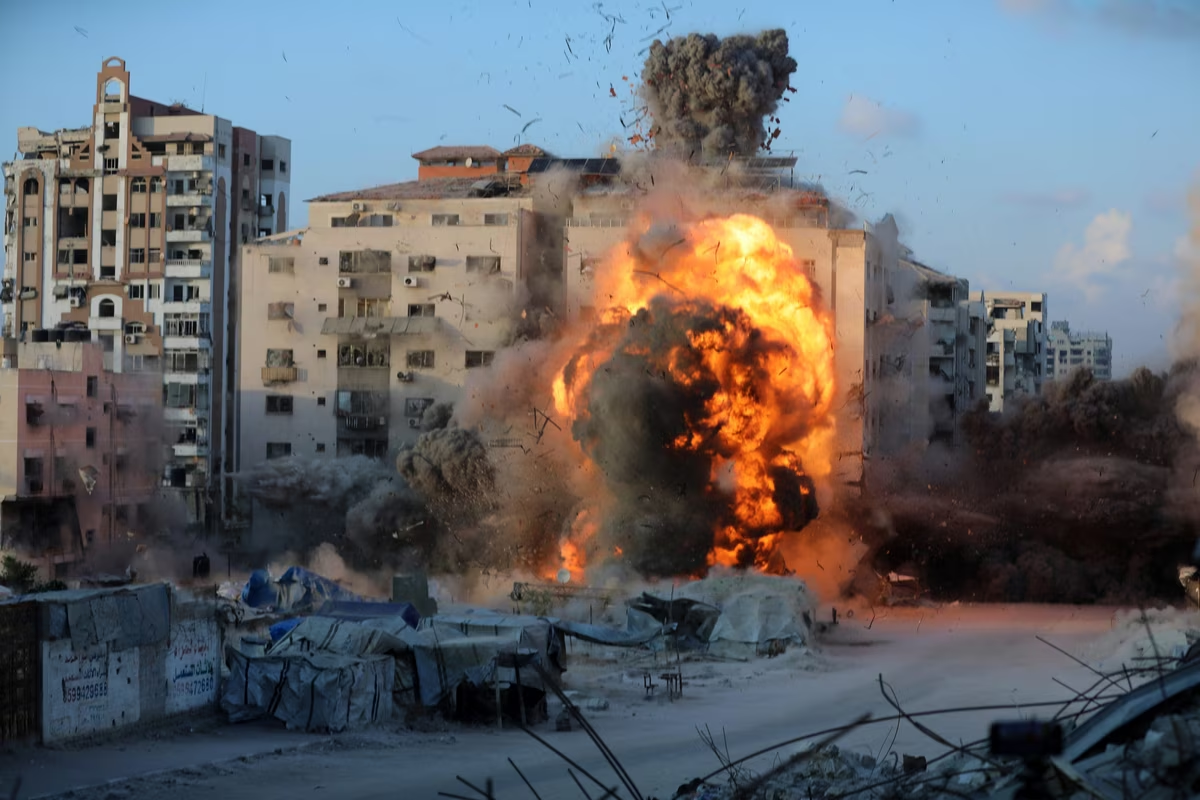
Washington, D.C- The latest technocratic fantasy about Gaza arrives wrapped in the language of empowerment. In a recent Foreign Affairs essay, three prominent academics argue that Gaza should be rebuilt by Gazans, not by distant planners or foreign governments. On its face, that sounds sensible, even overdue. Palestinians should indeed determine their own future. But the article’s central flaw is profound: it discusses reconstruction as though Gaza’s devastation were a natural disaster or a neutral planning challenge, rather than the direct consequence of military destruction, siege, displacement, and decades of denial of Palestinian sovereignty.
You cannot seriously discuss rebuilding Gaza without first naming who destroyed it, who continues to control its borders, airspace, coastline, population registry, imports, exports, and movement, and who can resume bombing at any moment.
This is not simply an urban planning problem. It is a political and moral one.
The authors compare Gaza to postwar Tokyo, Dresden, Beirut, and earthquake-hit India. These analogies are tidy but misleading. Tokyo and Dresden were cities emerging from concluded world wars under new political arrangements. Kutch was recovering from a natural disaster. Gaza is different. It remains trapped under a matrix of siege, occupation, and recurring war. Its people are not merely survivors of destruction; they are a population systematically denied normal civic life.
To speak of land readjustment systems, zoning flexibility, tax incentives, and special economic zones while Gaza remains subject to blockade is like discussing interior design in a house that is still on fire.
The essay is correct on one point: top-down schemes imposed by outsiders often fail. Palestinians do not need another foreign blueprint drafted in Cairo, Washington, Tel Aviv, or think tanks in Cambridge and Manhattan. They do not need Jared Kushner’s recycled real-estate fantasies about turning Gaza into a Mediterranean resort. They do not need donor conferences that pledge billions while leaving intact the structures that guarantee future ruin.
But if Gazans are to rebuild Gaza, then Gazans must first be free.
That means freedom of movement, control over borders, access to construction materials, functioning ports, secure fishing waters, reliable electricity, water sovereignty, telecommunications autonomy, and the right to elect accountable leadership without external vetoes. None of these are secondary details. They are prerequisites for any genuine reconstruction.
Without sovereignty, “rebuilding” becomes little more than managed dependency.
The article also praises property rights as the engine of democratic transformation. There is truth in the argument that secure ownership can strengthen civil society. But in Gaza, the most basic property question is not whether neighbors can pool parcels for development. It is whether homes, farms, shops, schools, and hospitals can be obliterated overnight without consequence.
Property rights are meaningless when one side can demolish entire neighborhoods with impunity.
The discussion of eminent domain and compensation likewise feels detached from reality. Who compensates the families whose apartment towers were flattened? Who compensates farmers whose orchards were razed? Who compensates parents whose children were buried beneath the rubble? International law does not reduce mass destruction to a spreadsheet of redevelopment costs.
Then there is the seductive language of the “special economic zone.” This is a familiar formula: create a heavily secured enclave with low taxes, relaxed regulation, and foreign investment incentives. It sounds modern and pragmatic. In practice, such zones often become islands of inequality—spaces designed for investors, not citizens.
Gaza does not need to become a laboratory for neoliberal experimentation. It needs schools, hospitals, housing, ports, manufacturing, universities, and a dignified labor market integrated with the wider world. It needs the ability to trade normally, not to survive inside a fenced showcase for foreign capital.
The most troubling omission in the essay is accountability. Reconstruction discourse often functions as a political eraser. It shifts attention from responsibility to logistics, from justice to management, from rights to engineering. Once the conversation becomes about concrete, cranes, and cadastral surveys, the perpetrators of devastation fade conveniently into the background.
But rubble has authors.
Any serious Gaza recovery plan must include international guarantees against renewed destruction, legal accountability for violations of humanitarian law, compensation mechanisms for victims, and binding protections for civilians. Otherwise, rebuilding becomes cyclical absurdity: donors pay to reconstruct what bombs may destroy again next year.
There is another missing actor in these elite proposals: the Palestinian public itself. Not as passive beneficiaries, not as case studies, not as labor inputs—but as a political people with national rights. Gaza’s future cannot be separated from the future of the West Bank, East Jerusalem, refugees, and Palestinian self-determination as a whole. Treating Gaza as an isolated urban management puzzle serves those who prefer fragmentation over justice.
Yes, Gazans know better than foreign planners how to shape their neighborhoods, streets, markets, and homes. Yes, reconstruction should be locally led. Yes, bureaucratic megaplans can suffocate organic recovery.
But none of that matters if Gaza remains enclosed, vulnerable, and subordinate.
The first brick in rebuilding Gaza is not concrete. It is freedom.
The first blueprint is not zoning. It is rights.
The first investment is not foreign capital. It is security grounded in law, not domination.
And the first principle must be simple: no people should be asked to master the art of reconstruction while the machinery of destruction remains in place.
If the world truly wants “a Gaza for Gazans,” it must begin by ending the conditions that made Gaza unlivable in the first place. Anything less is not reconstruction. It is public relations.
Above all, the mass killing of Gaza’s men, women, and children must end once and for all. Those responsible for this genocide must be held fully accountable under international law, because no rebuilding can stand on foundations of impunity.
Share your opinion
Rebuild Gaza by Ending Its Destruction First