PALESTINE

Tue 19 May 2026 12:19 am - Jerusalem Time

Amnesty International Attacks Israeli Repression of the Flotilla of Steadfastness, Describing it as 'Shameful and Inhumane'

Amnesty International has strongly condemned recent Israeli practices against the international Flotilla of Steadfastness, describing Tel Aviv's insistence on suppressing this humanitarian initiative as shameful and inhumane behavior. In an official statement, the organization clarified that the use of military force to prevent activists from delivering essential aid to the Gaza Strip comes within the context of the ongoing commission of the crime of genocide against Palestinians.

The organization affirmed that these military movements are directly aimed at tightening the illegal siege imposed on the Strip for years, and further isolating its residents from the outside world. It stressed that depriving civilians under occupation of basic supplies and vital needs constitutes a blatant violation of international law and amounts to a war crime.

In a related context, media sources reported that the Israeli navy carried out extensive raids targeting the flotilla's ships about 100 nautical miles off the coast. These operations resulted in the arrest of approximately 100 international activists who were on board the boats, in an attempt to disrupt the relief mission launched to break the siege imposed on Gaza.

Amnesty International expressed its grave concern about the safety of the detained solidarity activists, noting a long record of ill-treatment and violations suffered by activists in previous missions. The organization warned against the repetition of these abuses inside Israeli detention centers, calling on the international community to assume its responsibilities towards protecting civilians and peaceful activists.

The statement strongly criticized the state of international silence regarding the systematic attacks targeting solidarity activists, considering that this dereliction cannot be justified in the face of the scale of human suffering in Gaza. The organization demanded the necessity of providing immediate protection for activists and ensuring the unimpeded arrival of relief convoys without military obstacles to rescue the deteriorating situation in the besieged Strip.

It is worth noting that the international Flotilla of Steadfastness includes a group of ships carrying medical and food aid, and involves solidarity activists of different nationalities who seek to shed light on the humanitarian crisis. These field developments come at a time when international pressure on Israel is increasing to stop its policy of collective punishment against more than two million Palestinians.

Israel's shameful and inhumane insistence on suppressing solidarity efforts aims to tighten the illegal siege imposed on the Strip and isolate it from the world.

PALESTINE

Tue 19 May 2026 12:19 am - Jerusalem Time

UN condemnation of 'ethnic cleansing' indicators in Gaza and West Bank amid continued Israeli raids

Israeli raids continued on various areas of the Gaza Strip today, Monday, resulting in the martyrdom of one Palestinian and the injury of four others with varying degrees of wounds. These attacks come as part of a series of continuous violations of the ceasefire agreement that came into effect on October 10, 2025, threatening the stability of the fragile truce.

Medical sources at Nasser Medical Complex in Khan Yunis city, south of the Strip, reported the arrival of a martyr's body and two injuries as a result of shelling targeting the vicinity of Bani Suhaila roundabout. Medical teams also announced the death of child Abdul Rahman Fathi Abu Shab in the intensive care unit, succumbing to wounds he sustained days earlier after being targeted by a drone in the same area.

In the northern Strip, two young Palestinians were injured, one of whom was described as serious, as a result of Israeli shelling targeting Jabalia camp. Local sources stated that a drone launched a raid on an area outside the scope of the occupation army's control specified by the existing agreement, reflecting an escalation on the ground in the northern areas.

Coinciding with this escalation on the ground, the United Nations called on the Israeli occupation authorities to take immediate measures to prevent acts of 'genocide' in the Gaza Strip. The international organization condemned strong indicators of 'ethnic cleansing' operations taking place simultaneously in both the Strip and the occupied West Bank.

UN High Commissioner for Human Rights, Volker Türk, affirmed in a recent report that Israeli practices since October 7, 2023, constitute a blatant violation of international law. Türk clarified that these actions often resemble war crimes and crimes against humanity that require urgent international accountability.

The UN Commissioner called on Israel to abide by the orders issued by the International Court of Justice, which oblige it to take preventive measures to prevent genocide. He stressed the need to ensure that soldiers do not commit any acts falling under this classification, with the necessity of suppressing and holding accountable for public incitement to violence.

The UN report focused extensively on the number of victims in the Gaza Strip, where the latest data from the Ministry of Health indicates the death of approximately 72,769 martyrs since the beginning of the aggression. These horrifying figures reflect the unprecedented human devastation suffered by Palestinians during the past months of intensive military operations.

For his part, Ajith Sunghay, head of the Human Rights Office in the Occupied Territories, stated that the ceasefire reduced levels of violence but did not end the suffering. Sunghay warned that killings and destruction of infrastructure continue on an almost daily basis, stressing that the general humanitarian situation remains at a catastrophic level.

The report pointed to a systematic pattern followed by the occupation forces in targeting civilian and protected objects, including hospitals and medical facilities. It also noted the deliberate targeting of internationally protected groups such as journalists, civil defense personnel, and humanitarian workers, which hinders relief and rescue operations.

The United Nations warned that Israeli behavior has made living conditions in large areas of the Gaza Strip unsustainable for human life. The report considered that this policy aims to make the presence of Palestinians as a group in those areas impossible, which reinforces the hypothesis of systematic ethnic cleansing.

The report did not overlook the situation in the West Bank, where it observed excessive and disproportionate use of force that led to hundreds of arbitrary killings. It explained that repeated incursions into camps in the northern West Bank aim to empty them of their residents and deliberately destroy their basic livelihoods.

The international organization documented widespread forced displacement, noting strong indications of the occupation's intention to perpetuate this displacement and prevent residents from returning. It considered that the destruction of residential blocks in Gaza and the bulldozing of camps in the West Bank fall under the collective punishment imposed on the Palestinian people.

The report also warned of the danger of inflammatory and dehumanizing rhetoric launched by Israeli officials against Palestinians without any internal legal accountability. It considered that this rhetoric paves the way for committing further grave violations under an official political cover that encourages impunity.

In conclusion of its report, the Human Rights Office stressed the need for independent and credible investigations by international judicial bodies to ensure accountability for all violations. Sunghay affirmed that the silence of the international community in this context cannot be considered neutrality, but rather a green light for the continuation of crimes against civilians.

Failure to act on violations in the Palestinian territories is not neutrality, but rather a license to continue crimes.

PALESTINE

Tue 19 May 2026 12:18 am - Jerusalem Time

Experts: UAE leads an advanced model in humanitarian work within the Gaza Strip, supported by the UAE International Aid Agency

The "Gallant Knight 3" humanitarian operation concluded its Volunteer Work Week activities, after implementing a wide range of humanitarian and voluntary initiatives in various areas of the Gaza Strip. These included blood donation campaigns, cleaning campaigns, organizing a medical day within the camps, distributing various relief aid, and launching initiatives to support patients, workers, and athletes, as part of its continuous efforts to alleviate the suffering of the residents and enhance the spirit of community solidarity.\n\nAs part of the week's activities, the "Gallant Knight 3" operation carried out a voluntary day at Al-Shifa Medical Complex in Gaza City, which included removing rubble and cleaning the hospital grounds, as well as planting trees, watering, and installing benches in the outdoor area, with wide participation from volunteers, in support of health facilities and to enhance the hospital environment and services provided to patients.\n\nThis initiative comes within the efforts aimed at supporting health facilities and creating a more suitable environment within the hospital's surroundings, thereby supporting the continuity of medical services and enhancing the ability of health teams and patients to face the current humanitarian challenges.\n\nRepresentatives from a number of humanitarian organizations in the Gaza Strip participated in the voluntary day at Al-Shifa Medical Complex, along with the Logistics Support Manager at the United Nations Relief and Works Agency for Palestine Refugees in the Near East (UNRWA), Miranda Barakat, the Head of OCHA's office in the Gaza Strip, Taher Imam, the Director of Al-Shifa Medical Complex, Mohammed Abu Salmiya, and the Director-General of the Ministry of Health, Munir Al-Bursh, in addition to staff from the Gaza Municipality.\n\nAt the conclusion of the Volunteer Work Week, the "Gallant Knight 3" operation reiterated its commitment to continue providing humanitarian and relief support to the residents of the Gaza Strip, by enhancing the response to the health, humanitarian, and service sectors, thereby contributing to alleviating the burdens on the residents and supporting their resilience in facing the harsh challenges and conditions witnessed in the Strip.\n\nExperts in political science and international law affirmed that the UAE's presence in the Gaza Strip has transcended the boundaries of traditional humanitarian response to emergency crises, establishing an advanced model for what is known as "sustainable humanitarian diplomacy," noting that the relief efforts led by the UAE have become a vital lifeline that combines urgent intervention with safeguarding human dignity and enhancing the elements of their resilience.\n\nIn exclusive statements to "Al-Ittihad," the experts explained that the UAE's leadership did not stop at launching air and sea bridges and delivering aid, but extended to the active field presence of national cadres at the heart of events, reflecting a firm leadership vision that places humans and their fundamental rights at the forefront of priorities, and contributes to supporting stability and rebuilding the elements of life in the Strip.\n\nDr. Haitham Omran, Professor of Political Science and International Law, stressed that the UAE was among the first countries to establish an integrated concept of humanitarian solidarity, affirming that the UAE's support for the Gaza Strip is not a circumstantial or temporary response, but an extension of a deeply rooted humanitarian approach that has made UAE relief work a global model to be emulated in terms of speed of response, efficiency of implementation, and comprehensiveness of humanitarian impact.\n\nOmran explained that the UAE's convoys of giving did not stop with the receding of confrontations, but moved from the stage of urgent relief amidst the flames to a deeper and more comprehensive stage based on rebuilding and restoring the elements of a dignified life in the Gaza Strip, embodying a firm humanitarian and moral commitment towards the Palestinian people and their just cause.\n\nHe pointed out that the "Gallant Knight 3" operation constituted an advanced model for integrated humanitarian work, as it transcended the concept of traditional aid and relief distribution, to transform into an integrated system that had a tangible impact on the lives of the residents, by supporting vital sectors and meeting urgent humanitarian needs on the ground.\n\nOmran affirmed that the UAE's vision is now based on sustainability and enhancing humanitarian recovery, by providing integrated housing solutions, and supporting the health, service, and livelihood sectors that affect the daily lives of Palestinian citizens, stressing that this approach reflects the UAE's keenness to instill hope and rebuild the elements of stability, and not just suffice with emergency response.\n\nHe added that UAE medical facilities played a pivotal role in saving thousands of lives by providing advanced specialized care, supported by continuous air and sea relief bridges, in addition to evacuating hundreds of wounded and injured people and cancer patients to receive treatment in UAE hospitals, in a scene that embodied the courage and humanity of UAE cadres working at the heart of the crisis to heal the wounds of their brethren in Gaza.\n\nThe Professor of International Law explained that the UAE's efforts were not limited to providing medical care, but extended to addressing the food and water crises through qualitative initiatives characterized by speed, boldness, and innovation, noting that the UAE was among the first countries to carry out air-dropping operations for humanitarian aid as part of the "Birds of Goodness" initiative, in addition to its active contribution to establishing and activating sea corridors that ensured the continuous flow of relief supplies to the Gaza Strip despite the complex field and logistical challenges.\n\nHe affirmed that the UAE's desalination plants located on the borders played a pivotal role in sparing the Strip a serious humanitarian and environmental catastrophe, after providing potable water to thousands of families, and contributed to reducing the risks of epidemics and diseases spreading, in light of the widespread collapse that affected infrastructure and basic services in the Gaza Strip.\n\nIn this context, Dr. Taysir Abu Jumaa, Professor of Political Science at the University of Palestine, stressed that the UAE's supportive stance towards the Palestinian people reflects a firm historical commitment, which has never been linked to a fleeting political or humanitarian circumstance, but is based on a firm vision based on supporting the Palestinian people and their resilience at various stages.\n\nAbu Jumaa said, in a statement to "Al-Ittihad," that the UAE played a pivotal role in supporting the Gaza Strip during the current crisis through the "Gallant Knight 3" operation, which has become one of the most prominent field humanitarian initiatives, after succeeding in reaching the most affected groups and meeting the needs of displaced persons in an urgent and organized manner.\n\nHe added that the UAE relief teams provided an exceptional model in humanitarian work in highly dangerous areas, where they continued to perform their duties despite the complex field challenges, affirming that the relatively improved security situation contributed to expanding the scope of movement of these teams and enabling them to reach affected areas more efficiently, which embodies a true UAE commitment to a field presence alongside the people of Gaza, and not just sending aid from afar.\n\nAbu Jumaa pointed out that the UAE, in parallel with relief efforts, was keen to launch humanitarian and community initiatives that restore hope within the Strip, most notably organizing mass weddings for Palestinian youth, considering that supporting youth, providing shelter, and helping them establish a stable life represents a clear message that the will to live in Gaza is stronger than war and destruction, and that enhancing social and psychological cohesion is an essential part of recovery efforts and rebuilding Palestinian society.

PALESTINE

Tue 19 May 2026 12:18 am - Jerusalem Time

Occupation seizes 'Freedom Flotilla' ships in the Mediterranean and arrests dozens of activists

The command of the Global Freedom Flotilla announced a complete loss of communication with all ships participating in the journey to break the siege on the Gaza Strip, following a sudden attack by Israeli naval forces in the open Mediterranean Sea. Sources clarified that the attack led to the loss of control over the ships after they were surrounded by occupation warships.

Khalidia Abu Bakra, the flotilla's spokesperson, confirmed that occupation soldiers carried out a boarding operation during which they seized most of the ships participating in the international convoy. In media statements from the Spanish capital, Madrid, she indicated that this aggression represents clear piracy in international waters, aimed at preventing humanitarian aid from reaching those besieged in Gaza.

According to incoming information, the Israeli naval commando unit 'Shayetet 13' was responsible for carrying out the interception and seizure of the flotilla. Informed sources mentioned that the operation took place off the Cypriot coast, hundreds of kilometers from its final destination, reflecting the occupation's determination to prevent the ships from reaching even before they approached Palestinian territorial waters.

Immediately after gaining control of the ships, the occupation forces began arresting a large number of international activists who were on board, transferring them under heavy guard to naval warships. All detainees and confiscated ships are expected to be taken to the Israeli port of Ashdod for legal and security procedures against them.

For its part, the Israeli Ministry of Foreign Affairs stressed in a brief statement that Tel Aviv will under no circumstances allow the breach of the naval blockade imposed on the Gaza Strip for years. The Foreign Ministry considered attempts to reach Gaza's shores a security provocation that necessitates direct military intervention to prevent it.

Prior to the loss of communication, tracking systems published on the flotilla's official website showed that the distance separating the convoys from Gaza's shores was approximately 300 nautical miles. Participants had observed suspicious movements of unidentified ships that began pursuing the flotilla as soon as it entered international waters, raising early fears of an imminent attack.

The Freedom Flotilla had set sail last Thursday from Marmaris port on the Turkish coast, on a humanitarian journey that included 54 boats and cargo ships. Activists and human rights defenders from about 70 countries around the world are participating in this initiative, through which they seek to highlight the escalating humanitarian suffering in the Strip as a result of the ongoing siege.

In the context of the legal response, the flotilla's command confirmed that it has already begun preparing legal files to prosecute the Israeli authorities before international courts on charges of maritime piracy. Abu Bakra stressed that what happened represents a blatant violation of international maritime law, which guarantees freedom of navigation in international waters, especially since the ships were purely civilian and humanitarian in nature.

This new attempt to break the siege comes amid difficult humanitarian conditions experienced by the residents of the Gaza Strip, as the flotilla was carrying quantities of medical aid and basic necessities. The journey received widespread international solidarity, with political and parliamentary figures from various continents among its members.

It is worth noting that the Israeli blockade imposed on the Gaza Strip since 2007 has caused a near-complete paralysis in all aspects of life, and this convoy is one of the largest maritime attempts to challenge this closure. Despite the recent aggression, the campaign organizers affirmed that their efforts will not stop and that Israeli piracy will not prevent them from repeating the attempt in the future.

The campaign expected the Israeli occupation to seize the flotilla and prevent the breaking of the siege, and we will sue Israel for its violation of maritime law and piracy of our ships.

PALESTINE

Tue 19 May 2026 12:17 am - Jerusalem Time

Gaza: 46 New Casualties in 24 Hours, Death Toll Exceeds 72,000

Medical sources in the Gaza Strip reported today, Monday, that hospitals received 6 martyrs and 40 injured during the past twenty-four hours, due to the continued Israeli violations of the recently concluded ceasefire agreement. These new casualties come amidst a deteriorating humanitarian situation and continuous attempts to retrieve victims from targeted areas.

According to the daily statistical report issued by the Ministry of Health, the total death toll from the ongoing Israeli aggression since October 7, 2023, has risen to 72,769 martyrs, in addition to 172,704 people sustaining various injuries, reflecting the unprecedented humanitarian catastrophe facing the Strip.

Regarding the period following the announcement of the ceasefire on October 11 last year, sources clarified that the number of martyrs increased to 877, while injuries reached 2,602 cases. Specialized teams have also managed to recover 776 bodies from under the rubble since the truce began, while reports of missing persons still indicate the presence of victims in places difficult for civil defense crews to reach.

Many victims remain under the rubble and in the streets, with ambulance and rescue teams unable to reach them to this moment.

PALESTINE

Tue 19 May 2026 12:17 am - Jerusalem Time

Israeli Army Activates Military Order to Execute Palestinian Prisoners in West Bank

The commander of the Israeli occupation army's Central Command, Avi Bluth, approved a new military order on Sunday evening that legalizes the application of the death penalty against Palestinian prisoners in the occupied West Bank. This military move gives the green light to military courts to issue death sentences against Palestinians convicted of killing Israelis, under the pretext of 'denying the existence of the State of Israel'.

Media sources reported that this military order grants military judges broad powers, with a legal loophole that allows for the replacement of the death penalty with life imprisonment in cases described as 'exceptional'. This measure aims to institutionalize executions within the military judicial system that has managed Palestinian affairs in the occupied territories for decades.

Last March, the Israeli Knesset paved the way for this step by approving the 'Execution of Terrorists' law with direct support from Benjamin Netanyahu, despite international human rights warnings. At the time, the law was supported by 62 members against 48, a move that human rights organizations considered an entrenchment of the apartheid system and blatant legal discrimination.

Legal interpretation of the military order's text indicates that it is specifically designed to target Palestinians, as the evidentiary conditions related to ideological motives make it difficult to apply to settlers. According to legal sources, this discrimination makes it almost impossible to prosecute perpetrators of attacks by Jewish extremists under the same law.

In a related context, reports clarified that this legislation does not cover 'elite' elements of the Hamas movement who participated in the events of October 7, as a separate legal path and military court have been allocated for them. This multiplicity of laws reflects the occupation authorities' desire to create a complex punitive system that ensures the maximum degree of abuse for prisoners of all classifications.

For his part, Defense Minister Israel Katz pushed for this military amendment to overcome legal obstacles that prevented the direct application of Knesset civil laws in the West Bank. Katz stated that the goal is to ensure that no 'comfortable conditions' are provided for those he describes as terrorists inside prisons, emphasizing the need to activate maximum deterrent tools.

Legal bodies within the Knesset warned that imposing these legislations on West Bank residents who do not hold Israeli citizenship represents a grave violation of international law. The legal advisor to the National Security Committee considered that this approach breaks an Israeli policy followed for decades that avoided the direct application of Knesset laws in the occupied territories.

On the human rights front, data indicates that there are more than 9,500 Palestinian prisoners in occupation prisons, suffering from tragic detention conditions including systematic torture and deprivation of treatment. Among these prisoners are about 350 children and 73 women, all facing the danger of new laws that legalize cold-blooded killing under judicial cover.

Statistics from the Prisoners' Affairs Authority indicate that there are at least 117 Palestinian prisoners who immediately meet the criteria of the new death penalty law. This number raises serious concerns about the start of a wave of field and legal executions that could lead to an unprecedented explosion of the situation in the occupied territories.

This legal escalation comes at a time when the occupation continues its widespread aggression on the Gaza Strip, where the number of victims has exceeded 72,000 martyrs and 172,000 injured. Observers believe that the activation of the death penalty law is part of a comprehensive war waged by the far-right government to liquidate the Palestinian issue and intimidate the resistance in both the West Bank and Gaza.

Those who kill Jews will not receive comfortable conditions in prisons, and we will work to apply deterrent penalties against them.

PALESTINE

Tue 19 May 2026 12:17 am - Jerusalem Time

Settlers Burn Sheep Pen, Assault Children in Hebron and Ramallah

Israeli settlers have escalated their attacks on Palestinian properties in the cities of Hebron and Ramallah in the occupied West Bank. Field sources reported that armed groups set fire to agricultural facilities and cut down fruitful trees. These attacks occur under the direct protection of the occupation army, leading to injuries among citizens who attempted to defend their properties.

In details of the attacks in Hebron, settlers stormed the Wadi Al-Rakheem area and targeted the home of citizen Riyad Shanaran, where they deliberately set fire to a sheep pen and a traditional tabun oven. The incident resulted in the homeowner sustaining burns to his hand while desperately trying to extinguish the fire and prevent it from spreading to other parts of the dwelling.

In Ramallah Governorate, human rights organizations documented settlers cutting down a number of olive trees in the town of Taybeh, as part of a systematic policy aimed at destroying the Palestinian agricultural sector. The attacks were not limited to inanimate objects, but extended to children in the Abu Faza' Al-Kaabneh community, who were chased and intimidated while on their way to school.

According to official reports issued by the Wall and Settlement Resistance Commission, these attacks have caused severe losses, including the uprooting and poisoning of more than 4,400 olive trees in various governorates. These acts of sabotage were concentrated in the areas of Hebron, Nablus, Jerusalem, and Bethlehem, threatening the primary source of livelihood for thousands of Palestinian families in those areas.

These attacks coincide with the ongoing Israeli military incursions into West Bank cities and towns, which have intensified unprecedentedly since October 2023. Data indicates that these practices are part of a general climate that allows settlers to act with complete freedom to implement plans of forced displacement and to restrict Bedouin and agricultural communities.

Regarding the overall toll, official Palestinian data indicates that the attacks by the occupation and settlers have resulted in the martyrdom of 1,162 Palestinians and the injury of approximately 12,245 others in the West Bank. Arrest campaigns have also reached record levels, with the number of detainees reaching nearly 23,000 citizens, amid extremely complex field conditions.

Settlers stormed the Abu Faza' Al-Kaabneh community and assaulted children through intimidation and harassment while they were on their way to school.

PALESTINE

Tue 19 May 2026 12:17 am - Jerusalem Time

Boats from the "Fleet of Steadfastness" break the Israeli blockade and continue their journey towards Gaza

The organizers of the "Fleet of Steadfastness" initiative, aimed at breaking the siege on the Gaza Strip, announced that one of the participating boats managed to evade interception attempts by the Israeli occupation navy. Participants confirmed that the boat is steadily continuing its journey towards the shores of the Strip, defying the intense pursuit and harassment operations the fleet faced in international waters.

In field details from the heart of the event, Khalil Al-Obaidi, one of the participants on board the ship "Al-Qasr 1," explained that the boat's crew engaged in a complex naval maneuver that lasted for more than two hours. Al-Obaidi indicated that this maneuver enabled them to penetrate the first military interception barrier imposed by the occupation in the open sea, allowing them to continue their journey.

Al-Obaidi added in live updates that the occupation's warships were behind them after the successful infiltration of the security cordon. He stressed that the current destination is directly Gaza port, despite the imminent dangers and continuous threats facing the journey amid widespread Israeli alert.

For his part, former Tunisian President Moncef Marzouki joined the statements, confirming that a number of boats had indeed succeeded in escaping the grip of Israeli forces. Marzouki explained that this success came despite at least ten other boats being subjected to direct interception operations by the occupation navy, which tried to prevent their progress.

Marzouki pointed out in statements made today, Monday, that the issue of these boats reaching the shores of Gaza remains fraught with risks and is not definitively resolved. However, he affirmed that the determination to break the siege will remain, and attempts will not stop, no matter the magnitude of the challenges or military obstacles placed in the way.

The former Tunisian President considered that the "Fleet of Steadfastness" has already achieved a large part of its political and moral objectives before its field arrival. He believed that the most important message that reached the occupation is that the siege imposed on Gaza cannot last forever, and that it is destined to disappear thanks to international popular will and humanitarian initiatives.

Marzouki stressed that the occupation authorities are currently fighting a completely losing battle in terms of international reputation and moral standing before the world. He explained that any field gains the occupation might achieve by intercepting ships are met with severe diplomatic losses and an escalation in the pace of global criticism of its policies towards civilians in Gaza.

According to the organizers, the messages of this fleet extend beyond Palestinian geography to reach decision-making centers in the international community. The movement primarily aims to stir stagnant waters in European capitals and the United States, to pressure for an end to the deafening silence regarding ongoing Israeli violations.

These developments come amid a state of popular and human rights anticipation for the fate of the boats that managed to cross, with international organizations closely monitoring the journey. This attempt is considered one of the most daring attempts in recent years to break the naval blockade imposed on the Strip for many years.

Participants concluded their affirmations that the journey is not just a relief effort, but a political cry in the face of an international community that is failing to protect Palestinian rights. The surviving boats continue to make their way through the sea, with hopes that this step will create real pressure to open waterways for Palestinians.

After a maneuver lasting more than two hours, we managed to bypass the first interception barrier imposed by the occupation forces, and we are now directly on our way to Gaza.

PALESTINE

Tue 19 May 2026 12:16 am - Jerusalem Time

Gaza Health Ministry launches distress call: Lives of 225,000 blood pressure patients in imminent danger

The Palestinian Ministry of Health in the Gaza Strip issued a strong warning coinciding with World Hypertension Day, confirming that the lives of approximately 225,000 patients are directly threatened. Medical sources explained that this disease, known as the 'silent killer,' is spreading in an environment lacking the most basic healthcare provisions, which portends an unprecedented rise in sudden death cases among those affected.

The Ministry stated in an urgent press release that the severe shortage of essential medications for treating blood vessels represents the biggest obstacle to stabilizing patient conditions, especially with the general drug deficit reaching 50%. The complete cessation of regular check-ups for long periods has also deprived patients of the opportunity to control the disease before it worsens, turning stable cases into critical ones lacking even minimal follow-up.

Sources indicated that the systematic destruction of primary healthcare centers has led to a complete absence of monitoring and early diagnosis, leaving patients to face their fate without medical coverage. This health collapse coincides with the lack of healthy, balanced food and living in a polluted environment that weakens the immunity of exhausted bodies, thereby exacerbating the burden of the disease on the most vulnerable groups in Gazan society.

In a related context, medical teams stressed that repeated and forced displacement under the constant bombardment has created severe psychological and nervous pressures that increase the likelihood of strokes and heart attacks. The spread of poverty, unemployment, and food insecurity has also contributed to accelerating the pace of fatal complications, at a time when the deficit in medical consumables has reached 57% and laboratory materials around 71%.

The Ministry of Health renewed its urgent call to the international community and UN institutions for immediate intervention to save thousands of lives before it's too late, demanding the provision of urgent shipments of chronic disease medications. The Ministry affirmed that the continued destruction of the healthcare system requires serious international action to improve living and environmental conditions and stop the bleeding in the health sector, which has become unable to meet patients' needs.

High blood pressure has become a ticking time bomb, claiming patients' lives without prior warning amidst the absence of care and diagnosis.

PALESTINE

Tue 19 May 2026 12:16 am - Jerusalem Time

International Academic Association Warns Against Israel's Use of Antiquities as a Tool to Annex the West Bank and Erase Palestinian Identity

The Middle East Studies Association of North America (MESA) has issued an international warning regarding escalating Israeli policies targeting archaeological sites in the occupied West Bank, including East Jerusalem. In a joint statement with the Committee on Academic Freedom, the association affirmed that the occupation seeks to establish direct civilian control over Palestinian cultural heritage, employing archaeology as a political tool to seize land and fragment the historical ties of the Palestinian people to their land.

The association sent urgent messages to senior international officials, including the UN High Commissioner for Human Rights Volker Türk and the Director-General of UNESCO, to alert them to the seriousness of a bill recently approved by the Israeli Knesset. This legislation, which passed its first reading, aims to establish a so-called 'Judea and Samaria Heritage Authority' to be affiliated with the Israeli Ministry of Heritage, giving settlers direct influence over historical sites in areas classified as 'C'.

Sources explained that this legal shift represents a transition from temporary military administration to permanent civilian administration, which falls within the plans for the 'creeping annexation' of the occupied territories. The association considered that subjecting archaeological sites to Israeli political appointments primarily aims to serve the settlement agenda and change the demographic and geographical reality under the guise of preserving heritage and historical antiquities.

In a related context, the message warned of the law's repercussions on the Ibrahimi Mosque (Cave of the Patriarchs) in Hebron, where the occupation seeks to transfer renovation and oversight powers from the Palestinian Hebron Municipality to settlement bodies. Academics described this step as an illegal assault on legitimate Palestinian jurisdiction over a global religious and heritage site, threatening to erase civilizational evidence that does not conform to the Israeli narrative.

The association stressed that these measures constitute a grave violation of international law, particularly the 1954 Hague Convention for the Protection of Cultural Property in the Event of Armed Conflict and the Fourth Geneva Convention. It also noted that these steps undermine the legal frameworks established by UNESCO to protect world heritage and prevent illicit trafficking in antiquities, placing the international community before a moral and legal responsibility to stop these transgressions.

The message touched upon living examples of systematic erasure in sites such as Sebastia, Susiya, Battir, and Silwan, where archaeological classifications are used as a pretext to restrict Palestinian urban and agricultural expansion and displace them from their homes. It affirmed that the occupation re-presents these sites as an exclusive biblical heritage, ignoring the multiple civilizational layers—Islamic, Christian, and human—that form the core of the region's historical identity.

The association concluded by calling on international organizations to activate oversight tools over Israeli practices and protect the 'living memory' of the Palestinian people from systematic erasure. It called for the rejection of all measures aimed at marginalizing non-Jewish heritage, emphasizing that the protection of antiquities must remain free from political instrumentalization that seeks to legitimize the occupation and sever the Palestinian people's connection to their ancient cultural heritage.

This proposed body will transfer the management of archaeological sites from military administration to a civilian authority under the influence of the settlement movement, which is a step towards the direct annexation of Palestinian land.

PALESTINE

Mon 18 May 2026 12:51 pm - Jerusalem Time

Ministry of Education and Higher Education and British Council Sign New Agreement to Strengthen UK–Palestine Academic Cooperation

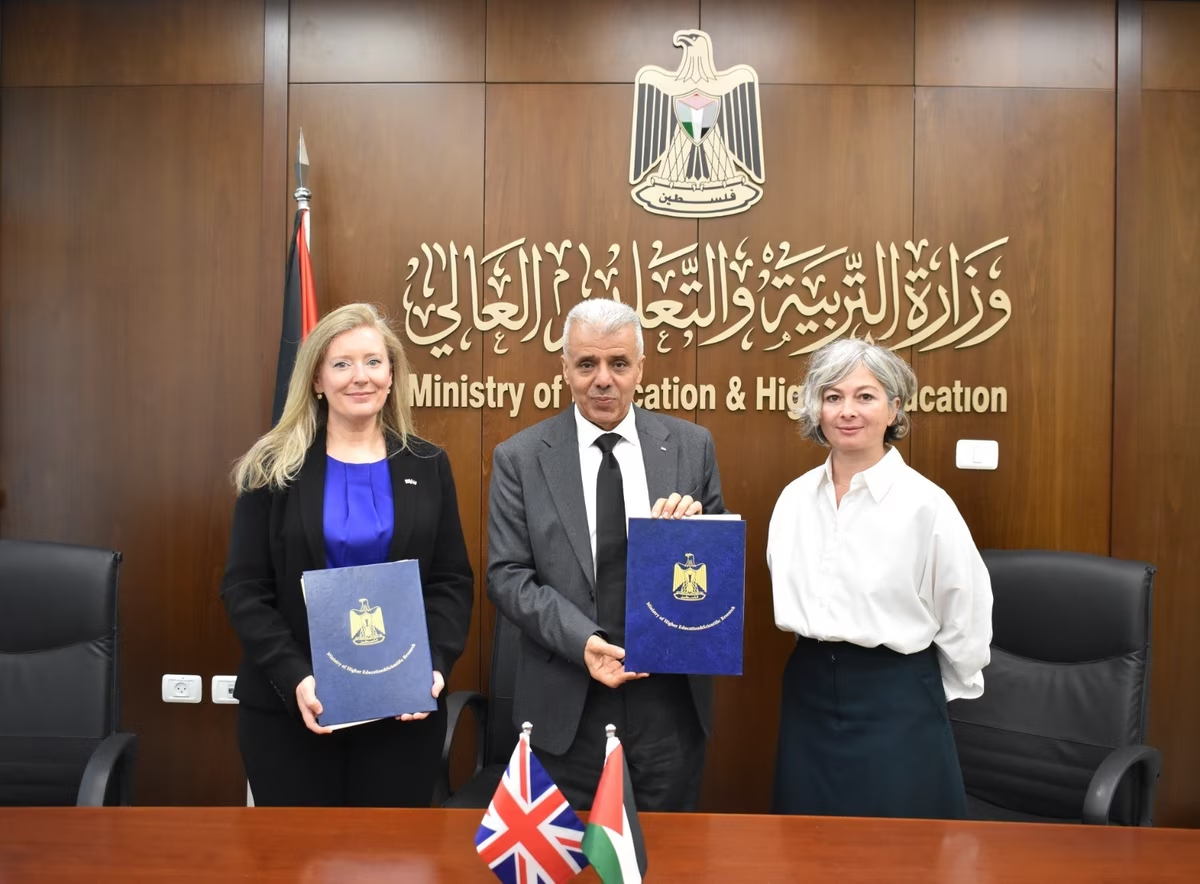
The Ministry of Education and Higher Education and British Council signed a new Memorandum of Understanding (MoU) earlier this week, marking an important milestone in UK–Palestine academic cooperation under the Higher Education Scholarship Palestine (HESPAL) programme.

Signed at the Ministry’s headquarters in Ramallah, the agreement strengthens collaboration in higher education and scientific research between Palestinian and UK institutions. The MoU was signed by His Excellency Prof. Amjad Barham, Minister of Education and Higher Education, and Shahida MacDougall, British Council Director in Palestine, in the presence of the British Consul General in Jerusalem, Helen Winterton.

The agreement establishes a framework for deeper cooperation between UK and Palestinian higher education institutions, reinforcing the British Council’s long-standing commitment to supporting higher education in Palestine through the HESPAL programme. Through this partnership, the British Council works with 19 universities across Palestine and 35 UK universities to strengthen academic collaboration, research partnerships and international exchange opportunities.

The collaboration will expand academic partnerships between UK and Palestinian universities, promote collaborative research through grants and research opportunities, increase scholarships, offer a new fellowship programme and create capacity-building opportunities for Palestinian academics and institutions.

Shahida MacDougall, British Council Director in Palestine, said:

“This agreement reflects the long-standing and mutually beneficial partnership between Palestine and the UK in higher education and research. Through HESPAL, Palestinian scholars and researchers have made valuable contributions to academic communities in both Palestine and the UK through innovative research, leadership and collaboration. We are proud to continue creating opportunities that strengthen institutions, support academic resilience and deepen cooperation between Palestinian and UK universities.”

The MoU comes at a particularly important moment for Palestinian higher education, as universities, academics and students continue to face unprecedented challenges, particularly in Gaza and across the West Bank. The partnership reflects a shared commitment to sustaining access to quality education, supporting academic resilience and creating opportunities for future generations of students and researchers

About the British Council

The British Council is the UK’s international organisation for cultural relations and educational opportunities. We support peace and prosperity by building connections, understanding and trust between people in the UK and countries worldwide. We do this through our work in arts and culture, education and the English language. We work with people in over 200 countries and territories and are on the ground in more than 100 countries. In 2022–23 we reached 600 million people.

HESPAL is a flagship scholarship and capacity-building programme that supports Palestinian academics and professionals to pursue postgraduate study opportunities in the UK. Since its launch 15 years ago, the programme has played a significant role in strengthening Palestinian higher education institutions through the development of academic leadership, research capacities and institutional partnerships between Palestinian and UK universities.


www.britishcouncil.org


ANALYSIS

Mon 18 May 2026 8:58 am - Jerusalem Time

Thucydides' Trap: Are Washington and Beijing Sliding Towards Inevitable Confrontation?

The corridors of American think tanks are witnessing a heated debate about the future of global hegemony, led by prominent academics and theorists such as Robert Kagan, a pillar of the 'neoconservatives'. They believe that current foreign policy faces a strategic dilemma that redefines the concept of American imperial power and its impact on Washington's international reputation.

In a striking article in 'The Atlantic' magazine, Kagan argued that the Trump administration has become unable to retreat from the path of confrontation or control its catastrophic repercussions. He stressed that the failure to extract real concessions from the Iranian regime, despite intensive military operations, reflects the limits of hard power in changing the regional political reality.

Despite the destructive force used in the last 37-day war, joint US-Israeli efforts failed to overthrow the existing regime. This failure has led some to call for a comprehensive ground invasion, an option analysts consider unlikely given current balances and logistical and political complexities.

These views intersect with the demands of Israeli Prime Minister Benjamin Netanyahu, who seeks to acquire enriched uranium stockpiles under the rubble. The American side threatens to re-target Iranian nuclear facilities if Tehran refuses to hand over radioactive materials that survived the previous bombing last June.

US strategy has shifted from direct military confrontation to a suffocating naval blockade, with the US Navy imposing a cordon on the Strait of Hormuz for over a month. This measure aims to cripple the Iranian economy and prevent the export of oil and gas, in an attempt to force concessions in stalled negotiations mediated regionally.

On the other hand, China emerges as a rival power that refuses to submit to American dictates, as President Xi Jinping affirmed 'red lines' during his meeting with Trump. Beijing refuses to stop buying Iranian oil, considering that the security of navigation in the Strait of Hormuz is an international interest not subject to fees or political blackmail.

'Thucydides' Trap' stands out as a historical projection that Chinese leaders warn against, referring to the inevitable conflict between a dominant power (America) and a rising power (China). This concept, derived from the ancient Greek wars, indicates that the fear of losing status is the primary driver of major conflicts that threaten world peace.

US intelligence and defense reports confirm that China is the only competitor capable of challenging American leadership in the fields of technology, artificial intelligence, and space. It is no longer about a competitor that can be contained, but an international pole that imposes a new strategic reality that transcends the traditional capabilities of American deterrence.

Meanwhile, Tehran seeks to establish a 'win-win' equation in international forums such as the BRICS summit, benefiting from Chinese and Russian support. This trend reflects an Iranian desire to break international isolation and circumvent sanctions by building strong economic alliances with rising powers in the East.

The question remains about the international community's ability to avoid sliding into a comprehensive war, given the declining trust in the American ally. Mismanagement of competition between great powers could lead to a repetition of bloody historical scenarios, unless the language of cooperation prevails over the logic of hegemony and confrontation.

The rise of Athens and the fear that this instilled in Sparta made war inevitable.

OPINIONS

Mon 18 May 2026 5:35 am - Jerusalem Time

Fatah After the Elections: Seize the Moment or Just Manage It?

The results of the recent Fatah elections cannot be read as a limited internal organizational event. Rather, they represent a revealing political moment for the movement's repositioning within the Palestinian scene, at a stage where deep internal transformations intersect with unprecedented regional and international changes after the Gaza war.

At this precise moment, the importance of the elections is not measured solely by the positions and names they produced, but by the general direction they reflect: How does Fatah see itself today? And how does it see its position within a Palestinian national project that is being reshaped under the pressure of accelerating realities?

The results, in their political reading, reveal that the movement has so far chosen the path of "managing continuity" more than the option of "radical transformation." The basic leadership structure still tends to reproduce internal power balances, with a limited introduction of new faces, without affecting the essence of the existing organizational equation. This reflects a clear concern: preserving the cohesion of the movement at a highly sensitive Palestinian and regional moment.

However, this choice cannot be separated from a parallel reality that has become clearer after the Gaza war: Fatah today effectively sits at the forefront of the Palestinian political scene, amidst the decline of Hamas's external presence and the diminishing influence of other Palestinian organizations at the international and regional levels compared to the previous stage. This reality grants the movement greater political weight in representing the Palestinian cause externally, and in managing communication with regional and international actors.

Here lies the fundamental paradox: Fatah is in an unprecedented position of relative strength, but at the same time, it faces a crisis of project, not just a crisis of position.

The movement, which represents the backbone of the Palestinian National Authority, still holds the keys to the existing political system, but it faces a deeper challenge related to its ability to transform this weight into renewed legitimacy, not just continuous management of reality.

The elections came in a highly complex Palestinian context. The Gaza war was not just a military confrontation, but a moment that reshaped global awareness of the Palestinian issue, bringing it back to the forefront of international discussion. For the first time in decades, Palestine is no longer a marginal issue, but a central one in the global ethical and political debate, driven by widespread popular movements in universities, streets, and institutions around the world.

This external shift created a rare opportunity, but at the same time placed a double burden on the Palestinian leadership: How can this global momentum be translated into tangible political results?

Internally, the Fatah election results show an attempt to maintain a delicate balance between internal stability and preventing organizational disintegration, and the need for limited renewal that does not threaten the existing structure. But at the same time, they reveal that the ceiling for change is still constrained by internal calculations more than by the dictates of comprehensive national transformation.

The deeper dilemma is that the new Palestinian generation no longer measures legitimacy from the perspective of history alone, but from the perspective of the ability to act, influence, and create a political horizon. This creates a growing gap between the traditional structure of the movement and the general popular mood.

Nevertheless, Fatah's current position cannot be ignored. The movement, by virtue of its organizational and political weight, its presence in the Authority's institutions, and the decline of Hamas's direct external presence, has become the primary central player in the current Palestinian scene. This grants it a rare political opportunity that may not be easily repeated.

But this opportunity carries its essential condition: transforming from managing dominance to investing in it.

Possessing the lead at a moment of declining rivals is not enough to produce sustainable legitimacy, unless it is translated into a clear political project that redefines the national role and accommodates the global transformations that have reshaped the image of Palestine in international consciousness.

The world after the Gaza war no longer deals with the Palestinian issue as a traditional negotiation file, but as a matter of justice, rights, and a political narrative being shaped in the media, universities, international courts, and global public opinion. This opens a window of strategic opportunity for Palestinians, but it also imposes new conditions for political effectiveness.

Hence, the Fatah election results become part of a question larger than their organizational details: Can the movement move from a position of relative strength to a position of effective political leadership for a renewed national project?

Or will it be content with managing a stage characterized by declining rivals and growing crises, without redefining its role in the new historical moment?

What these elections reveal in their depth is not just an internal rearrangement, but a test of Fatah's ability to transform the current balance in the Palestinian arena into a viable political project, before the moment of leadership turns into a lost opportunity in a history changing faster than institutions can keep up with it.

PALESTINE

Mon 18 May 2026 5:26 am - Jerusalem Time

The Future of the Palestinian National Project in Light of the Elections of the Two Movements and Political Polarization

The Palestinian arena has recently witnessed internal activity represented by the elections of the two central movements, Fatah and Hamas, where supporters of both parties celebrated results considered a path to renewing organizational structure. However, interpretations of these outcomes varied between those who see it as a healthy step and those who criticize its ability to bring about real change in overall political performance.

Current data indicate that the chances of a third current emerging to break the intensity of traditional polarization appear very slim, at least for the next four years. It is ingrained in the collective consciousness that the struggle between the two major poles will remain the primary driver of Palestinian political life, despite all criticisms directed at them.

This political situation coincides with accelerating threats, most notably the emergence of separatist tendencies in the Gaza Strip, fueled by the occupation and harsh humanitarian conditions. This erosion of the unified political system opens the door to complex scenarios that threaten the unity of Palestinian national representation in international forums.

At the popular level, there is a clear public apathy towards engaging in organized political work, due to the high cost of affiliation and the rigidity of organizational structures. This reluctance has led to a decline in the factions' ability to convince the street of the usefulness of participation in the absence of tangible results on the ground.

In light of this institutional confusion, tribal structures and interest-based sectors have begun to rise as alternatives that provide protection and support to citizens. This shift reflects a state of loss of trust in official political institutions and a search for more traditional frameworks capable of meeting immediate needs.

Palestinian political movement suffers from a clear inability to formulate a comprehensive national program that responds to the complexities of the current stage and its major challenges. This programmatic vacuum paves the way for international powers to impose unilateral paths that bypass existing representative frameworks.

Indicators are increasing that the United States and Israel are seeking to test new political formations as alternatives to current Palestinian institutions. These attempts aim to create a new political reality that aligns with the security and political visions of external powers, away from national constants.

The fundamental question remains about the extent to which internal elections can bring about a qualitative transformation in political discourse and practice. So far, indicators still suggest a reproduction of the same old patterns that governed organizational work over the past years without fundamental change.

At this delicate stage, the Palestinian national project needs to restore societal trust by building a convincing representative structure. This structure must reflect forces with real popular weight, away from the narrow quota system that has exhausted the national situation.

Formulating a practical program that addresses people's daily concerns and alleviates their economic and social wounds has become an urgent necessity. The Palestinian citizen in the West Bank and Gaza needs a political vision that intersects with their livelihood needs and provides them with the means to steadfastness on their land.

A phased political vision for the next five years must be developed, focusing primarily on stopping the war of extermination and confronting settlement encroachment. This vision must prioritize strengthening the steadfastness of Palestinians in the face of forced displacement policies.

It is essential to stop the bleeding in national consciousness by protecting the rights of the families of martyrs, prisoners, and wounded, given their moral symbolism. Any infringement on these issues weakens the internal front and negatively affects the morale of the Palestinian people in facing challenges.

The stage requires a comprehensive restructuring of Authority institutions to enhance efficiency in vital sectors such as health, education, and internal security. Selection and employment mechanisms must be based on criteria of competence and professionalism to ensure the best services are provided to citizens and the rights of employees are protected.

In conclusion, balancing active diplomatic action and popular steadfastness on the ground is the only way to confront Israeli control projects. Reality dictates that political forces reach a minimum level of joint action to overcome the prolonged state of stagnation.

Moving from a state of waiting to a state of action is not a political luxury, but a historical and national duty imposed by the complexities of the current stage.

PALESTINE

Mon 18 May 2026 5:25 am - Jerusalem Time

International Criminal Court issues secret arrest warrants for 5 Israeli officials

Hebrew media sources have revealed a prominent international legal development, as the International Criminal Court has issued secret arrest warrants for five Israeli officials. This step comes within the framework of ongoing investigations by the court regarding war crimes and genocide committed in the Gaza Strip, in addition to settlement expansion files in the occupied West Bank.

Reports quoted diplomatic sources as saying that the list of new wanted persons includes high-ranking political figures, along with two senior military commanders in the occupation army. Despite confirmation of the issuance of these warrants, the exact timing of their issuance remains confidential, and the names have not been officially disclosed to ensure the effectiveness of legal prosecution.

These secret warrants are an extension of the legal procedures initiated by the court in November 2024, when it issued public arrest warrants for Prime Minister Benjamin Netanyahu and former Minister of Security Yoav Gallant. This expansion of the wanted list indicates the international public prosecutor's determination to prosecute the leadership structure responsible for military operations and settlement policies.

In a related context, previous reports had indicated that the court's prosecutor's office was seriously considering prosecuting extremist ministers in the Israeli government, led by Finance Minister Bezalel Smotrich and National Security Minister Itamar Ben-Gvir. These prosecutions are linked to inflammatory policies and field measures that contributed to the worsening humanitarian situation in Gaza and the escalation of settlement activities.

The issuance of these warrants entails strict legal obligations on member states of the Rome Statute, as these states become obligated to arrest the officials covered by the warrants and hand them over to the court if they enter their territories. This move imposes additional international isolation on the Israeli leadership and tightens the noose on the movements of its officials in the international arena.

The court issued arrest warrants against five Israeli officials, including political figures and two military officials.

PALESTINE

Mon 18 May 2026 5:25 am - Jerusalem Time

Escalation in Gaza: 13 Martyrs in Intense Raids and Worsening Humanitarian Crisis

The Gaza Strip has been facing a continuous field escalation for several days, as Israeli forces have intensified their aerial and artillery bombardment of densely populated areas. These repeated targeting incidents have exacerbated the state of instability and increased the scale of humanitarian suffering experienced by the residents of the Strip under harsh conditions.

The death toll has risen in recent hours to at least 13 martyrs, eight of whom fell in an airstrike targeting Izz al-Din al-Haddad, a leader in the Al-Qassam Brigades. These field developments come at a time when battle axes are witnessing intermittent clashes and intense gunfire in vital areas.

In details of Sunday's field developments, five Palestinians were martyred and others injured as a result of raids targeting various locations. The bombing coincided with intense gunfire from military vehicles in areas south of Khan Yunis and the Al-Tuffah neighborhood, located east of Gaza City, which disrupted the movement of citizens.

Medical sources at Al-Aqsa Martyrs Hospital reported the arrival of the bodies of three martyrs and a number of injured people following a raid carried out by an Israeli drone in Deir al-Balah city. Nasser Medical Complex also confirmed the martyrdom of another Palestinian in a similar bombing that targeted the center of Khan Yunis city in the southern Strip, amidst continuous intensive air activity.

In the northern Strip, the targeting did not stop, as a drone launched a raid on Jabalia camp at dawn on Sunday, resulting in the martyrdom of a Palestinian and the injury of others with varying degrees of wounds. Military operations are currently concentrated in the southern areas, with daily field breaches including artillery shelling and gunfire from warships.

On the humanitarian front, Ministry of Health data indicates a continuous increase in the number of victims since the start of the war in October 2023, with the toll reaching tens of thousands. Civil defense crews still face extreme difficulties in recovering the missing from under the rubble due to a lack of equipment and widespread destruction of infrastructure.

The remaining hospitals in service are suffering from immense pressure beyond their capacity due to a severe shortage of medicines and fuel needed to operate generators. This catastrophic situation threatens the continuity of life-saving health services, especially in intensive care and emergency departments that are overflowing with injured people.

Regarding humanitarian aid, the Government Media Office revealed that the percentage of trucks allowed to enter since October 10th has not exceeded 38% of the actual need. These supplies are subject to strict restrictions that prevent the entry of essential items, leading to a crazy rise in prices and a severe shortage of food.

Hundreds of thousands of displaced people live in overcrowded tents and shelters that lack the most basic necessities for a dignified life, especially in the southern areas. With the continued قطع of water and electricity, the humanitarian crisis deepens and becomes more complex in the absence of any near political horizon for a permanent ceasefire.

The number of aid trucks that entered the Strip since the start of the ceasefire did not exceed 38% of the supposed total.

PALESTINE

Mon 18 May 2026 5:25 am - Jerusalem Time

From Withdrawal to Land Grabbing.. How Did Israel Redraw Operational Maps in Gaza?

Brigadier General Hassan Jouni, a military and strategic expert, revealed the features of a radical transformation in the security doctrine of the occupation army within the Gaza Strip, stressing that the military leadership no longer deals with control lines as temporal intervals for withdrawal. He explained that the occupation has transformed these lines into launching pads for expanding military operations and imposing field realities aimed at securing a long-term presence and changing previously agreed-upon rules of engagement.

The military analysis indicated that what is known as the 'Yellow Line', which in agreements with the Hamas movement represented a transitional phase for withdrawal and facilitating the prisoner exchange file, has effectively been bypassed. Instead of retreating, Israeli forces launched from it towards the so-called 'Orange Line', leading to the emergence of a new security operations area located between these two lines, which reflects a comprehensive change in the Israeli vision towards the geography of the Strip.

Jouni clarified that the occupation has shifted from a strategy of 'gradual withdrawal' to a systematic policy of 'land grabbing', where the buffer zones have become areas for maneuver and continuous military movement. Through this expansion, the occupation army aims to tighten its control over Salah al-Din Street, which is the vital artery connecting the north and south of the Strip, to ensure complete control over movement and displacement.

On the humanitarian level, the military expert noted that the Israeli security vision ignores the presence of more than two million Palestinians besieged in a very narrow area not exceeding 30% of Gaza's total area. Tel Aviv deals with the Strip as an abstract 'security operations area', without regard for the high population density or the basic living needs of citizens facing harsh conditions.

The analysis suggests that the current escalation, which includes intensive raids, assassinations, and expansion of areas of influence, comes as an exploitation of a critical regional moment characterized by international preoccupation with the Iranian file and tensions in the Strait of Hormuz. The Israeli government finds in this preoccupation a favorable opportunity to redraw security rules in Gaza away from international pressures that might demand a ceasefire or a comprehensive withdrawal.

The military reading linked these field movements to the statements of Israeli Prime Minister Benjamin Netanyahu, who claimed his forces controlled about 60% of the Strip's area. Through these figures, Netanyahu seeks to export 'military gains' to the Israeli public, in an attempt to cover up security failures in confronting regional threats and increasing challenges on the northern front with Lebanon.

Regarding the negotiation track, Jouni stressed that the issue of disarming the resistance remains the main obstacle hindering any real progress, as the Hamas movement insists on linking this file to the full implementation of the first phase of the agreement. In contrast, Israel places disarmament as a prerequisite for any understandings, which keeps negotiations in a state of continuous stalemate amidst a field insistence on establishing the reality of a 'dynamic operations zone'.

Israel has shifted from the concept of gradual withdrawal to a policy of land grabbing, transforming Gaza into a security operations area, not a populated region.

PALESTINE

Mon 18 May 2026 5:24 am - Jerusalem Time

Katz orders activation of death penalty law against Palestinian prisoners in the West Bank

Media sources reported that the commander of the Central Command in the occupation army, Avi Bluth, officially signed a new legal amendment allowing military courts to issue death sentences against Palestinian prisoners in the occupied West Bank. This military measure aims to enhance judicial powers in prosecuting resistance activists, representing a radical and dangerous shift in the policy adopted by the occupation over the past decades towards detainees.

For his part, occupation war minister Yisrael Katz affirmed that this signing transforms the new policy into a tangible reality on the ground, indicating that he issued direct instructions to the army leadership to begin immediate implementation. Katz stressed in his statements that the goal of this step is to ensure that those he described as 'targets of Jews' do not remain in prisons under comfortable living conditions, in reference to tightening retaliatory measures against prisoners.

Legal data indicates that this military amendment came at Katz's direct request to overcome legal obstacles that prevented the application of the death penalty in the West Bank areas. It is noteworthy that the new law does not require the unanimity of judges or even a request from the public prosecution to carry out the punishment, and it is characterized by clear racial discrimination as it applies only to Palestinians, not to settlers who commit similar crimes.

In a related context, human rights reports warned of the repercussions of this decision, which could lead to an explosion of the field situation and an escalation of confrontations in various cities and villages of the West Bank. Legal circles believe that legislating killing through military courts represents a blatant violation of international conventions, especially given the presence of more than 9,500 Palestinian prisoners in occupation prisons, including hundreds of children and women who face harsh detention conditions.

Statistics from the Prisoners' Affairs Authority indicate that there are approximately 117 Palestinian prisoners to whom the criteria of this unjust law apply immediately, placing their lives under direct threat. This legal escalation comes at a time when the occupation continues its widespread aggression on the Gaza Strip and the West Bank, amidst international demands to stop systematic violations against the fundamental rights of the Palestinian people and protect prisoners from retaliatory laws.

I directly instructed the army leadership to immediately implement the death penalty law, and those who target Jews will no longer remain in comfortable conditions.

PALESTINE

Mon 18 May 2026 5:24 am - Jerusalem Time

The Occupation Legitimizes the Execution of Prisoners in the West Bank with a New Military Amendment

Media sources reported that the commander of the Central Command in the Israeli occupation army, Avi Bluth, has officially signed a legal amendment that allows the application of the death penalty against Palestinian prisoners in the occupied West Bank. This measure comes in line with legislation previously approved by the Israeli Knesset, which faced procedural obstacles related to the nature of military rule in the West Bank areas.

The Knesset had approved the law for the execution of prisoners on March 30th with a majority of 62 members, a step that sparked widespread human rights condemnation. The law explicitly states the possibility of imposing the death penalty on any Palestinian accused of killing an Israeli, while the legislation discriminately exempts settlers or Israelis who commit murder against Palestinians.

The latest military move came at the direct request of Defense Minister Yisrael Katz, who considered this amendment to end what he described as the 'era of containment.' Katz affirmed in his statements that the goal is to deprive prisoners of waiting for exchange deals or living in normal prison conditions, emphasizing the need to pay the 'highest price' for resistance operations.

Procedurally, the new amendment grants military courts broad powers to issue death sentences without the need for a unanimous judicial decision, as a simple majority is sufficient. The law also dropped the requirement for an official request from the public prosecution to implement the penalty, which facilitates the swift issuance of these unjust sentences against detainees.

Data from the Palestinian Commission of Detainees and Ex-Detainees Affairs indicates that this law may directly affect about 117 prisoners currently held in occupation prisons on charges of killing Israelis. Human rights organizations fear that this legislation may be a prelude to systematic legal liquidations targeting national symbols and Palestinian activists inside detention centers.

In a related context, more than 9,500 Palestinian prisoners are held in occupation prisons, including hundreds of children and women who suffer from tragic detention conditions. Human rights reports confirm that these prisoners are subjected to systematic torture policies and deliberate starvation, as well as medical neglect that has led to the martyrdom of dozens of them in recent months.

These dangerous legal developments come at a time when the occupation continues its genocidal war on the Gaza Strip since October 2023, which has left tens of thousands of martyrs and wounded. The escalation measures against prisoners coincide with intensive military campaigns in West Bank cities and camps, which warns of an unprecedented explosion of the situation in all occupied territories.

The era of containment is over, and those who kill Jews will not remain in prisons under comfortable conditions but will pay the highest price.

PALESTINE

Mon 18 May 2026 5:24 am - Jerusalem Time

Assassination of a leader in the Islamic Jihad movement and his daughter in an Israeli raid on Baalbek

Israeli occupation aircraft carried out a new assassination operation targeting a prominent leader in the Islamic Jihad movement in the city of Baalbek, eastern Lebanon, in the early hours of Monday morning. Official sources reported that a guided missile hit a residential apartment inhabited by a Palestinian family on the southern outskirts of the city, leading to the destruction of large parts of the targeted building.

The airstrike resulted in the martyrdom of leader Wael Abdel Halim and his 17-year-old daughter, Rama, while ambulance and civil defense teams continue search operations under the rubble. This operation comes at a time when no official comment has been issued by the Islamic Jihad movement regarding the details of the assassination or the nature of the tasks Abdel Halim was performing.

This attack represents a serious breach of the ceasefire agreement that came into effect last April and was recently extended for an additional 45 days until early July. Concerns are growing about the collapse of the fragile calm amid repeated Israeli targeting of various Lebanese areas during the past twenty-four hours.

Sunday witnessed a bloody escalation, as Israeli forces killed at least nine people and wounded about 18 others in a series of field violations. Reports from the field confirm that the occupation army continues to target Palestinian and Lebanese resistance cadres despite international understandings aimed at stopping military operations.

Since the start of the extensive Israeli offensive on Lebanese territories in March 2026, the Lebanese Ministry of Health has recorded the killing of 2,988 people and the injury of more than nine thousand others. The ongoing military operations have also caused the displacement of more than one million citizens from their villages and cities, amid extremely complex humanitarian conditions in shelters.

The targeting led to the martyrdom of the leader in the Islamic Jihad movement, Wael Abdel Halim, and his young daughter, Rama, and rescue teams are still working at the scene.

OPINIONS

Mon 18 May 2026 5:24 am - Jerusalem Time

Washington Drops Last Restrictions: Pentagon Dismantles Civilian Protection System, Leading the World Towards the Law of Force

Washington – Said Arikat – 18/5/2026

News Analysis

In a development that reveals profound shifts within the American military establishment, a report by the Inspector General of the Department of Defense showed that the Pentagon has not only weakened the program for reducing civilian casualties in wars but has effectively dismantled a large part of the institutional structure established after decades of international criticism of American military operations in the Middle East and Asia. The report does not merely highlight an administrative failure or bureaucratic reduction; rather, it reflects a political and strategic shift in Washington's view of war, international law, and the limits of using force.

Established in 2022 by a decision from former Secretary of Defense Lloyd Austin, the program was a result of immense pressure accumulated after years of American wars in Iraq, Afghanistan, Syria, and Yemen, where human rights organizations documented the deaths of tens of thousands of civilians due to airstrikes and drones. The program's goal was to create a permanent system within the Pentagon to review strikes, analyze errors, and develop mechanisms to reduce civilian deaths, thereby maintaining – at least formally – the image of the United States as a nation claiming to respect international law.

However, what the Inspector General's report revealed indicates that the Trump administration views this system as a political and military burden that restricts the freedom to use force, especially at a stage witnessing widespread American escalation against Iran and its allies in the region. The report confirms that oversight meetings have ceased, technical monitoring tools have been suspended, and the program has been emptied of its specialized personnel, to the extent that former officials described what remains of it as an “empty shell.”

The political significance of this step lies in its timing. The dismantling of the program accelerated concurrently with intensive American strikes against Iran, which drew widespread criticism due to the high number of civilian casualties, especially after a primary school in Minab city was targeted, resulting in a large number of child deaths. Here, it does not appear to be an administrative coincidence, but rather part of an American redefinition of the concept of “acceptable war,” where humanitarian restrictions become less important in the face of the priority of rapid military decisive action.

More tellingly, the Trump administration did not even try to fully conceal this trend. Secretary of Defense Pete Hegseth repeatedly defended American military operations with the same logic Israel uses in Gaza and Lebanon: holding the adversary fully responsible for civilian deaths under the pretext of using residential areas for military purposes. This discourse, previously seen as part of Israeli security doctrine, has now become an increasingly integral part of official American military rhetoric.

This shift reflects a deeper change in American political culture after two decades of the “War on Terror.” In the post-9/11 era, successive American administrations tried – even if formally – to maintain a balance between the use of force and respect for international law. Today, however, the Trump administration appears closer to adopting an approach based on the idea that American military superiority grants Washington the right to set the rules itself, rather than adhering to shared international rules.

Hence, the danger of the Inspector General's report lies not only in disrupting an administrative program but in being an indicator of a gradual decline in the idea of “accountability” within the American military establishment. When investigative and review bodies are weakened, military operations become less subject to scrutiny, and civilian deaths become a secondary issue that can be contained by political discourse in the media.

This transformation places the United States on an increasingly intersecting path with the Israeli experience. Israel, which has faced widespread international accusations of committing grave violations in Gaza, has for years relied on a fundamental principle: maintaining military superiority while managing political costs through controlling the media narrative and Western support. Today, it seems that Washington is gradually adopting the same logic, not only in the Middle East but as part of its broader military doctrine.

The problem is that the United States is not an ordinary state in the international system. When Washington disregards the laws of war or weakens institutions for civilian protection, it does not merely change its own behavior; it reshapes global standards. Other major powers, such as Russia and China, will find in this American behavior an additional justification for rejecting Western criticisms concerning human rights. Moreover, smaller regional states will realize that adherence to international law is no longer an actual condition for international legitimacy, as long as military power and political alliances provide protection.

Experts in international law fear that this path will accelerate the collapse of what remains of the international humanitarian law system established after World War II. International laws derive their strength not only from texts but from the commitment of major powers to them. When these powers themselves begin to treat these laws as optional, they lose their ability to compel others.

In this context, the dismantling of the civilian protection program becomes more than just an internal American issue; it is an indicator of the world's transition to a new phase where humanitarian considerations recede before the logic of raw power. This phase may witness more bloody wars in the future, more blurred lines between civilian and military, and an increasing normalization of the idea that widespread human losses are merely a “necessary price” for achieving strategic goals.

It is difficult to understand the current American shift in isolation from the increasing Israeli influence on Western security doctrine, especially after the events in Gaza and the war with Iran. For years, Israel has succeeded in imposing an equation that considers any criticism of its military conduct an infringement on its right to “self-defense,” an equation that Washington has begun to adopt almost completely. Over time, this logic transforms into a political cover that allows for the expansion of military operations and the reduction of the importance of civilian casualties, thereby creating an international environment where power, not law, becomes the primary source of legitimacy.

The most dangerous aspect of these policies is that they not only weaken the moral image of the United States but also undermine its long-term strategic capability. Wars with high numbers of civilian casualties often generate new waves of anger, extremism, and instability. In other words, ignoring civilian protection may achieve short-term tactical military gains, but it simultaneously sows the seeds of more complex future conflicts. This has been proven by America's own experiences in Iraq and Afghanistan, where widespread violations contributed to fueling armed movements instead of eliminating them.

If the United States continues in this direction, the world may witness an unprecedented decline in the effectiveness of international humanitarian law in the coming years. States do not adhere to international laws solely out of moral imperative, but because they see that major powers are also committed to them. However, when Washington itself becomes a model for circumventing these rules, the message that reaches the world is clear: any state with sufficient power can act without real accountability. This is a dangerous precedent that could return international relations to the logic of raw power that prevailed before the establishment of the United Nations and modern Geneva Conventions.

PALESTINE

Mon 18 May 2026 5:23 am - Jerusalem Time

11 Martyrs and Dozens Wounded in a Series of Occupation Raids on Gaza and its North

Palestinian medical sources reported on Saturday evening that the death toll from the ongoing Israeli aggression on the Gaza Strip has risen to 11 martyrs and over 60 injured. The sources explained that this toll resulted from a series of violent aerial raids and artillery shelling that targeted various neighborhoods in Gaza City and northern areas since Friday evening.

The sources stated that civil defense and ambulance crews were able to recover the bodies of the martyrs and transport the wounded, including a number of children and women, to Al-Ahli and Kamal Adwan hospitals. These field operations come amid a severe deterioration in the health system, which has become unable to provide adequate services due to the tight siege and the depletion of fuel and medicine supplies.

These bloody field developments coincide with escalating warnings from international organizations regarding the humanitarian catastrophe afflicting the residents of the Strip. This escalation comes at a time when the region is witnessing increasing field tensions, amid continued violations and military operations targeting civilians and infrastructure in various governorates of Gaza.

Medical facilities are suffering catastrophic health conditions as a result of the ongoing siege and the shortage of basic supplies and fuel.

PALESTINE

Mon 18 May 2026 5:23 am - Jerusalem Time

Chants Against the Occupation in Cairo Streets: Implications of the Sudden Appearance of Egyptian Thunderbolt Forces

Obour City in Qalyubia Governorate, Egypt, witnessed an unusual field appearance of Thunderbolt forces, as three companies conducted 'cross-country' training in military sportswear amidst residential neighborhoods. This scene sparked widespread interaction across social media platforms, given that the forces deviated from traditional training in desert areas or closed military bases.

This military movement coincided with the anniversary of the declaration of the establishment of the occupying state on May 14th, which gave a clear political character to the military sports event. Observers considered that the specific choice of 'Obour' City carries historical symbolism related to the October 1973 victories and the breaching of the Bar Lev Line.

During their march, Thunderbolt personnel chanted enthusiastic slogans directly targeting the Israeli occupation, describing it as a 'scarecrow' and emphasizing the superiority of the Egyptian soldier. These chants, which had been absent from official discourse for many years, returned to the forefront of the Egyptian media scene amidst celebration from media figures close to decision-making circles.

Media sources reported that this training represents a clear deterrent message to any external parties attempting to test the combat readiness of the Egyptian state under current circumstances. Analysts indicated that allowing the filming and dissemination of these movements aims to reassure the Egyptian public about the capabilities of the armed forces in confronting regional challenges.

This appearance comes about two weeks after the conclusion of the 'Badr 2026' maneuvers conducted by the Egyptian army in the Sinai Peninsula and near the borders with occupied Palestine. These maneuvers, which used live ammunition, caused a state of concern and anticipation within security and political circles in Tel Aviv.

Hebrew reports monitored increasing fears among settlers in the Gaza envelope and border areas of the possibility of a recurrence of surprise offensive scenarios similar to 'Al-Aqsa Flood'. These fears were reflected in statements by Knesset members who called for the necessity of monitoring intensive Egyptian military movements in the border area.

On the legal front, observers pointed out that not preventing citizens from filming forces in the streets is unusual, as Law No. 292 of 1956 prohibits photographing military personnel. This security oversight was interpreted as a desire to turn the training into propaganda material reaching the widest possible local and international audience.

In contrast, data analysis researchers believe that the Egyptian regime seeks through these scenes to create a 'trend' that enhances its popularity amidst economic and geopolitical crises. They considered that focusing on military propaganda sometimes aims to divert attention from thorny issues such as water security and the forced displacement of Palestinians.

Some analyses linked the show of force in Cairo to recent developments in Sinai, especially with the noticeable re-emergence of movements by armed tribal militias. Proponents of this view believe that the army wanted to assert its absolute control and field influence in the face of any parallel entities that might appear in the security landscape.

Public debate also touched upon the nature of modern warfare, with academics questioning whether the physical readiness of individuals is still the decisive criterion in the age of drones and technology. They pointed out that military superiority is now measured by advanced intelligence and technical capabilities rather than reliance on human numbers in the streets.

Egypt's army ranking recorded a decline in the 'Global Firepower' index for 2025, where it ranked 19th globally after being in ninth place a few years ago. This decline prompted some to call for focusing efforts on technical modernization to keep pace with rising regional powers such as Turkey, Iran, and the occupation.

The event coincided with official announcements about the presence of an Egyptian fighter jet detachment in the UAE, which sparked controversy about the nature of the Egyptian army's foreign missions. Some considered that the Thunderbolt's chants against Israel in Cairo aim to restore the army's mental image as a protector of Arab national security in the face of the occupation.

Field sources confirmed that the training included specialized companies in urban warfare and counter-terrorism, indicating the diversity of training objectives behind this appearance. It seems that the military leadership chose a sensitive timing to send multi-directional messages, starting from within Egypt and reaching the core decision-making centers in Tel Aviv.

The scene of Thunderbolt soldiers roaming the streets of Obour City remains a significant mark in the nature of communication between the military establishment and the public in the current phase. While some see it as national pride, others see it as a propaganda attempt, but what is certain is that the message reached its destination across the borders, where the occupation monitors every Egyptian movement with caution.

Israel is a scarecrow... Israel is under the boot; chants echoed by Egyptian Thunderbolt soldiers in the heart of Obour City.

PALESTINE

Mon 18 May 2026 5:23 am - Jerusalem Time

Palestine warns of 'ethnic cleansing' after occupation approves confiscation of properties adjacent to Al-Aqsa

The Palestinian Ministry of Foreign Affairs and Expatriates expressed its strong condemnation of the Israeli government's approval of a new colonial plan aimed at seizing a group of Palestinian properties in the Old City of occupied Jerusalem. The Ministry affirmed in an official statement that this decision directly targets the Bab Al-Silsila neighborhood, which is adjacent to the blessed Al-Aqsa Mosque, posing a serious threat to the Arab and Islamic identity of the area.

The Palestinian Ministry of Foreign Affairs described these moves as falling within the systematic 'ethnic cleansing' policy practiced by the occupation authorities to displace Palestinian citizens from the heart of the Holy City. It indicated that the step aims to enhance full settlement control over the vicinity of Al-Aqsa Mosque and forcibly change the existing legal and historical reality in the Old City.

For its part, the Jerusalem Governorate revealed in a separate statement that the Israeli plan stipulates the confiscation of between 15 and 20 Palestinian properties, including residential buildings and ancient Islamic endowments. The Governorate clarified that these properties represent great historical value, as their construction dates back to the Ayyubid, Mamluk, and Ottoman eras, making their targeting a crime against human heritage.

According to official sources, this plan is based on previous recommendations submitted by the resigned Israeli Minister of Jerusalem and Heritage, Meir Porush, in addition to activating an old government decision dating back to 1968. The occupation justifies these confiscations by the necessities of 'strengthening Jewish control and security,' arguments aimed at justifying settlement expansion at the expense of private property.

The Palestinian Ministry of Foreign Affairs stressed that targeting the Bab Al-Silsila neighborhood carries extremely serious dimensions, as it is considered one of the most important historical and vital passages leading to the courtyards of Al-Aqsa Mosque. It considered that emptying this neighborhood of its original inhabitants aims to isolate the blessed mosque and impose new Judaization facts that serve the settlement project in Jerusalem.

The Ministry also pointed out that reviving confiscation decisions dating back decades clearly reveals the occupation's intentions to expand the so-called 'Jewish Quarter' in the Old City. It affirmed that these Judaization projects are being carried out gradually and deliberately to complete the settlement encirclement around Islamic and Christian holy sites and ensure the demographic superiority of the settlers.

As part of diplomatic action, the State of Palestine called on the international community, the United Nations, and UNESCO to uphold their legal and moral responsibilities towards the city of Jerusalem. It called for an unequivocal rejection of all Israeli measures, stressing that the occupation has no legal sovereignty over the Holy City under international resolutions.

The Palestinian Ministry of Foreign Affairs urged all countries to intervene urgently to provide international protection for the holy sites and impose deterrent sanctions on the occupation government to stop its policies of theft and seizure. It affirmed that international silence encourages Israel to continue destroying the civilizational and cultural heritage of the Palestinian people in occupied Jerusalem.

This escalation comes at a time when East Jerusalem neighborhoods, such as Sheikh Jarrah and Silwan, are witnessing a fierce campaign by settlement associations to seize citizens' homes. These associations, with the support of the Israeli judiciary, use eviction orders and old property claims as tools to carry out forced displacement operations against Palestinian families.

The Ministry concluded its statement by emphasizing the steadfastness of the Palestinian people in Jerusalem and their adherence to their historical and legitimate rights to their land and properties despite all attempts at Judaization. It called on the Arab and Islamic nations to take immediate action to support the steadfastness of Jerusalemites in the face of these plans aimed at liquidating the Palestinian presence in the city.

This decision represents a direct assault on the civilizational and historical heritage of the Palestinian people and the Islamic world in occupied Jerusalem.

PALESTINE

Mon 18 May 2026 5:23 am - Jerusalem Time

Widespread Protests at 'Eurovision 2026' Against Occupation's Participation in Solidarity with Gaza

Despite the conclusion of the 'Eurovision' Song Contest 2026, the echoes of cultural and artistic rejection of the Israeli occupation delegation's participation continue to dominate the international scene. Hebrew media reports observed an unprecedented state of tension behind the scenes of the competition in the Austrian capital, Vienna, where the stage transformed into a platform for expressing political stances against the aggression on the Gaza Strip.

Journalistic sources reported that the final rehearsals witnessed a sharp escalation in statements against the Israeli delegation, with representatives of major countries such as Sweden and Finland leading media campaigns demanding the exclusion of the occupation. While the European Broadcasting Union attempted to impose strict rules of neutrality, political and humanitarian pressures notably transcended the organizational frameworks of the competition.

Swedish singer Felicia Eriksson, 24, spearheaded the voices rejecting the occupation's presence in the competition, describing its participation as illegitimate. Eriksson affirmed in public statements after her victory in the Swedish qualifiers that the ongoing 'killings' make it difficult to focus on music amidst the great human suffering.

The Swedish artist stressed that she would not back down from her stance or apologize for it despite intense pressure from music production companies to remain silent. She clearly stated that it is her right to express her moral viewpoint, noting that she sought to ensure that the occupation delegation would not achieve any moral victory in this edition of the competition.

For his part, competition director Martin Green tried to contain the situation by asking national broadcasters to remind artists of the necessity of neutrality and not to attack participating countries. However, the reactions of the European public, especially in Sweden, varied between supporting the courageous stances of the artists and opposing the intrusion of politics into art, creating a sharp division in artistic circles.

In the same context, the Finnish duo Linda Lampenius and Peeta Parkkonen stood out, directing sharp messages against the occupation's participation despite their great musical success. The duo affirmed in a joint statement that their competition to represent Finland comes in the name of 'music and humanity,' considering that allowing Israel to be present at this event is a completely wrong decision.

The Finnish artists added that what is happening in Palestine is an inhumane act and condemned by all standards, which gave their artistic performance a clear political character. These statements caused a wide uproar among fans and followers, leading to a decline in interest in Israeli singer Naom Patin, who had previously topped the nominations.

Protests were not limited to individual statements but extended to sovereign decisions, as five countries announced their complete boycott of the competition this year in protest of the occupation's policies. These countries refused to send any representatives, a move observers considered the biggest geopolitical drama the competition has witnessed in decades, putting the organizers in an embarrassing position.

Artistic sources indicated that international boycott organizations targeted a large number of participating artists to pressure them to take clear stances on the war on Gaza. Many of these artists responded to these calls, making the backstage of Vienna an arena for confrontation between humanitarian principles and the organizational rules that the Broadcasting Union tries to impose.

Ultimately, this edition of 'Eurovision' showed that art cannot be separated from political and moral reality, especially when it comes to crimes against humanity. Despite the occupation's attempts to use the competition to improve its international image, the widespread popular and artistic rejection confirmed the isolation of the Israeli narrative in young European cultural circles.

What is happening in Palestine is an inhumane and condemned act, and the decision to allow Israel to participate in the competition is completely wrong.

PALESTINE

Mon 18 May 2026 5:23 am - Jerusalem Time

Bloody escalation in southern Lebanon: Martyrs and wounded in Israeli raids, and the resistance responds with 10 operations

The Lebanese Ministry of Health announced the martyrdom of five people, including two children, and the injury of about 15 others in an initial toll of a series of air raids launched by Israeli occupation aircraft on various areas in southern Lebanon on Sunday. These aggressions come amid the fragility of the recently extended ceasefire agreement, raising the level of field tension to record levels.

Medical sources explained that the town of Tayr Falsay, affiliated with the Tyre district, witnessed the death of three martyrs, including a child, in addition to the injury of eight citizens with varying injuries. The raids also targeted the town of Tayr Debba, resulting in the martyrdom of two people, including a child, and the injury of a woman and two others, in a scene that reflects a direct targeting of populated areas.

The aggressions did not stop at the Tyre district but extended to include the town of Zrarieh in the Sidon district and the town of Jibshit in the Nabatieh district, where reports indicated injuries among civilians. These data confirm the occupation's continued violation of international understandings that were supposed to guarantee a de-escalation of military operations until early next July.

For its part, Hezbollah announced the implementation of ten qualitative military operations targeting sites and gatherings of the Israeli occupation army along the southern border. The resistance used suicide drones, artillery shells, and guided missiles in its attacks, stressing that these operations come within the framework of a legitimate response to repeated Israeli violations.

In the details of the field operations, Hezbollah fighters targeted gatherings of occupation soldiers in the towns of Rashaf, Naqoura, Bayada, and Deir Syriane, achieving direct hits. Resistance statements indicated that the attacks focused on the movements of military vehicles attempting to position themselves at advanced points within Lebanese territory.

For its part, the Israeli occupation army admitted that five of its soldiers were injured as a result of an explosive device explosion that targeted their force in one of the areas of southern Lebanon. This admission coincided with field reports confirming the detonation of an explosive device by an Israeli force that tried to advance towards the Safita area in the vicinity of the town of Yahmar al-Shaqif.

The response operations also included the destruction of an Israeli military vehicle and the targeting of a bulldozer in the town of Bayada using drones, which led to it catching fire completely. The shelling also targeted an artillery position in the town of Adayssa and technical jamming devices in the town of Rashaf, in an attempt to disrupt the occupation's monitoring capabilities.

Official statistics issued by Lebanese authorities indicate that the widespread aggression that began in March 2026 has so far resulted in 2988 martyrs and more than nine thousand wounded. Continuous military operations have caused the displacement of more than one million people from their villages and towns, creating a worsening humanitarian crisis in shelters.

Observers believe that the recent escalation puts the ceasefire agreement at stake, especially after the decision to extend it for an additional 45 days last Friday. Field sources insist that the occupation seeks to impose a new reality on the ground through intensive air raids, which the resistance is countering with precise attrition operations.

Amid this complex scene, Lebanese ambulance and civil defense teams continue to remove rubble and search for missing persons in the targeted sites. International fears are growing of the situation sliding into a comprehensive confrontation that goes beyond the current border clashes, in the absence of real guarantees that oblige the occupation to stop its aggressions.

Our operations came in defense of Lebanon and its people, and in response to the Israeli enemy's violation of the ceasefire and its continuous aggressions.

ARAB AND WORLD

Mon 18 May 2026 5:23 am - Jerusalem Time

Trump hints at 'zero hour' against Iran: Act immediately, or nothing will remain

US President Donald Trump issued a stern warning to the Iranian leadership, emphasizing that the deadline for Tehran to make decisive decisions is rapidly running out. Trump clarified via his 'Truth Social' platform that failure to act quickly would expose the country to catastrophic consequences that could lead to the demise of everything it possesses, stressing that time has become the primary driver of upcoming American actions.

In contrast, Iranian media sources revealed that recent American responses did not include any tangible concessions that could be built upon in the diplomatic track. The 'Mehr' agency indicated that Washington insists on imposing strict and long-term restrictions on the nuclear sector, linking any comprehensive de-escalation on various fronts to the start of direct negotiations that meet American conditions.

Regarding field coordination, informed sources reported that President Trump held a phone call with Israeli Prime Minister Benjamin Netanyahu to discuss developments related to the Iranian file. This communication comes within the framework of coordinating positions between the two allies, amidst indications of a consensus on the need for firmness in dealing with Tehran's nuclear and regional threats.

The White House is expected to host a high-level meeting in the Situation Room next Tuesday, where Trump will meet with the national security team to discuss military action options in detail. These deliberations aim to finalize potential intervention scenarios should the current political stalemate persist and diplomatic efforts fail.

Media sources in Washington reported that leaks from within the US administration, including the Department of Defense and the White House, indicate the approaching zero hour for a military decision. These sources confirmed that the US President is increasingly leaning towards activating the tough option to end the long-standing stalemate in the Iranian file.

Arab diplomats quoted intelligence reports stating that military action could begin in the coming days, perhaps as early as this week. The reports indicated that Trump has already reviewed a draft of integrated military options prepared by the Department of Defense, which include specific strategic targets deep within Iran to ensure the crippling of its offensive capabilities.

Scenarios on the decision-making table include intensive aerial bombardment targeting energy infrastructure and vital military facilities in various Iranian provinces. The option of using ground commandos in specialized operations aimed at directly controlling enriched uranium stockpiles is also prominent, to prevent Tehran from reaching the nuclear threshold.

In addition, military circles in Washington are considering the possibility of moving towards Iran's southern coasts and controlling the Strait of Hormuz and some strategic islands. These plans are part of an old strategy that has been updated to suit current data, with the aim of securing international shipping lanes and cutting off Iranian maritime supply lines.

For their part, senior military officials at the Pentagon, including the Secretary of Defense and the Chairman of the Joint Chiefs of Staff, affirmed the US military's full readiness to execute any orders issued by the Commander-in-Chief. Officials explained in parliamentary hearings that US forces are on high alert, while maintaining sufficient flexibility to return to a de-escalation path if a sudden political breakthrough occurs.

US Central Command estimates indicate that previous operations succeeded in destroying about 90% of Iran's capabilities in drones, ballistic missiles, and naval power. The US administration believes that the remaining Iranian capabilities do not pose an existential threat, which enhances the chances of success of any swift military action aimed at completing the mission and dismantling the remainder of Tehran's arsenal.

Despite the military readiness, which includes over 65,000 troops and two aircraft carriers in the region, there is a degree of hesitation within the White House. These concerns stem from Trump's fear of the human and political costs of any widespread conflict, especially in the absence of major diplomatic achievements in other international files such as the relationship with China.

Time is running out for Iran, and they must act quickly, or nothing will remain for them. Time is a critical factor!

OPINIONS

Mon 18 May 2026 5:15 am - Jerusalem Time

A Lobby in Panic: Why America’s Political Ground Is Shifting Beneath Israel’s Defenders


By: Said Arikat


May 18, 2026


News analysis


Washington, D.C- For decades, support for Israel functioned in Washington as a near-sacred article of faith. Democrats and Republicans competed to demonstrate unwavering loyalty to the Israeli state, while lobby organizations such as American Israel Public Affairs Committee operated with extraordinary confidence, shaping congressional discourse through campaign money, donor pressure, and political intimidation.


Today, however, the political atmosphere surrounding Israel is undergoing a historic transformation — and the panic now visible among pro-Israeli lobbyists reveals just how serious that shift has become.


The staggering sums being poured into Kentucky’s Republican primary on Tuesday, May 19, 2026, against Representative Thomas Massie are not merely about one congressional seat. They are a desperate attempt to halt a widening erosion of unquestioned American support for Israel across the political spectrum.


More than $32 million has reportedly been spent in the race, making it the most expensive House primary in American history. Much of that money originates from pro-Israel political organizations and billionaire donors determined to destroy Massie politically because he dared to question Israeli policy, military aid, and the growing influence of the Israel lobby over American foreign policy.


That reality alone tells a larger story: Israel’s defenders no longer feel secure.


For years, organizations aligned with Israel relied on an atmosphere of fear inside Washington. Politicians who criticized Israeli policy risked donor retaliation, media smears, or accusations of antisemitism. The strategy worked remarkably well, especially after the September 11 attacks, when support for Israel became deeply fused with America’s “war on terror” consensus.


But the wars in Gaza — particularly the catastrophic destruction unleashed after October 2023 — changed something fundamental inside the American public consciousness.


Millions of Americans watched entire neighborhoods flattened, hospitals bombed, journalists killed, and starving civilians trapped under siege conditions. Social media shattered the monopoly once held by establishment media narratives. Younger Americans, especially, no longer receive the conflict through the traditional lens of Israeli victimhood alone. They increasingly see Palestinians as human beings living under occupation, blockade, and systematic dispossession.


This generational shift is now visible not only among progressive Democrats, but increasingly among conservatives and libertarians on the American right.


That is why the campaign against Massie matters so profoundly.


Massie is not a left-wing anti-Zionist. He is a libertarian conservative who opposes foreign intervention broadly. He has repeatedly stated that he opposes all foreign aid, not merely aid to Israel. Yet even this limited dissent appears intolerable to pro-Israel organizations.


Why?


Because the danger for the lobby is not Massie himself. The danger is normalization.


If a Republican congressman can openly question military aid to Israel and survive politically, others may follow. If criticizing Israeli Prime Minister Benjamin Netanyahu no longer ends political careers, the taboo collapses. Once fear disappears, the lobby’s power weakens dramatically.


The scale of the response against Massie therefore resembles political containment.


Organizations linked to AIPAC, the Republican Jewish Coalition, and major pro-Israel megadonors have flooded Kentucky with advertising portraying Massie as dangerous, disloyal, and outside the Republican mainstream. President Donald Trump himself joined the effort by endorsing Massie’s challenger, demonstrating how closely establishment Republican politics still aligns with pro-Israel interests.


Yet beneath the surface, cracks are spreading.


The most remarkable aspect of this episode is not that Israel’s defenders are spending enormous sums of money. It is that they feel compelled to do so in a deeply conservative district that should once have been politically automatic terrain for them.


Even more revealing is the language now emerging from within the American right itself.


Figures associated with “America First” politics — including commentators such as Tucker Carlson — increasingly frame support for Israel as contradictory to nationalist priorities at home. Many conservative voters now ask why billions of American taxpayer dollars continue flowing abroad while economic insecurity, debt, and social crises deepen domestically.


This does not necessarily reflect hostility toward Jewish Americans. Rather, it reflects growing exhaustion with endless foreign entanglements and a rising belief that Israeli interests have exercised disproportionate influence over American policymaking.


The Israel lobby understands the danger perfectly.


For decades, its greatest strength lay in bipartisanship. Israel was protected simultaneously by liberal interventionists, evangelical conservatives, neoconservatives, and establishment centrists. But now that coalition is fraying from both directions.


Among Democrats, younger voters increasingly view Israel through the framework of settler colonialism, apartheid, and human rights abuses. Polling repeatedly shows collapsing sympathy for Israel among voters under 35. Progressive lawmakers who once feared criticizing Israel now openly accuse it of war crimes.


Meanwhile, on the Republican side, populist conservatives increasingly resent foreign aid packages, military interventions, and what they perceive as ideological policing surrounding Israel.


This dual-front erosion explains the extraordinary aggressiveness now displayed by pro-Israel groups.


The lobby is not operating from confidence. It is operating from anxiety.


The repeated invocation of antisemitism against critics of Israeli policy has also begun losing effectiveness among many Americans. While genuine antisemitism remains a serious and dangerous problem, voters increasingly distinguish between hatred of Jews and criticism of Israeli state actions.


Indeed, the overuse of antisemitism accusations for political purposes may itself be backfiring. Many Americans now perceive such accusations as tools deployed selectively to silence debate rather than defend vulnerable communities.


This does not mean Israel is about to lose American support entirely. Far from it. The institutional architecture backing Israel inside Washington remains enormous: lobbying networks, donor alliances, think tanks, media relationships, evangelical activism, and military partnerships still provide Israel with tremendous influence.


But political hegemony rarely collapses overnight. It erodes gradually — then suddenly.


The Massie race represents one moment in that erosion.


Whether Massie ultimately wins or loses in Tuesday’s May 19 primary may matter less historically than the fact that such a rebellion is now politically conceivable within the Republican Party itself. A decade ago, a Republican openly questioning Israeli policy while surviving nationally would have been almost unimaginable.


Today, it is becoming increasingly normal.


That is precisely why pro-Israeli organizations appear so alarmed.


They understand that American public opinion is changing faster than Washington’s political class. They understand that younger Americans consume information differently, distrust establishment narratives more deeply, and increasingly reject unconditional foreign alliances. And they understand that Israel’s devastating conduct in Gaza has accelerated those trends dramatically.


The enormous money now flooding into American elections on Israel’s behalf may therefore signal not enduring dominance, but mounting insecurity.


Political machines spend most aggressively when they fear losing control.

PALESTINE

Sun 17 May 2026 6:17 pm - Jerusalem Time

Silent Displacement.. How is Israel Reshaping the Demographic Reality in the West Bank and Jerusalem?

The occupied West Bank has recently been facing rapid and dangerous transformations in its demographic and geographical structure, as a result of the escalating pace of settlement expansion and systematic settler attacks. Human rights activists and Palestinians describe this reality as 'hidden displacement' carried out through coercive tools that gradually push residents to leave their lands without the need for direct military evacuation orders every time.

These tools vary between the expansion of random settlement outposts and the tightening of military restrictions on major cities and villages, which undermines the stability of Palestinian communities. Sources have reported that travel between cities, such as the journey between Ramallah and Nablus, now takes many hours due to military checkpoints and the closure of vital roads to citizens.

The system of administrative and military measures, including the refusal of building permits and the demolition of structures, forms a fundamental pillar in entrenching this new reality. In the Masafer Yatta areas south of Hebron, the occupation authorities prevent Palestinians from developing their communities under flimsy security pretexts related to military training, threatening hundreds of families with homelessness.

As for occupied Jerusalem, the Al-Bustan neighborhood in Silwan is subjected to a fierce attack aimed at changing its urban identity, where more than 57 homes have been demolished in the past two years. Field data indicates that at least eight additional homes face the imminent threat of demolition in the coming weeks, amidst a state of overwhelming public concern.

The occupation authorities seek to establish the so-called 'King's Garden' project at the site of the Al-Bustan neighborhood, which is a tourist park with a biblical religious character. This project aims to link the area to Israeli historical narratives, threatening to dismantle the social and demographic fabric of the town of Silwan adjacent to the blessed Al-Aqsa Mosque.

In parallel with official policies, settler attacks are escalating, including burning agricultural crops, destroying private property, and attacking peaceful villages. These attacks are no longer isolated incidents, but have become a recurring pattern aimed at exerting constant pressure on Palestinian residents to force them to leave areas near settlements.

Illegal settlement outposts receive widespread political and financial support from the Israeli government, starting as small points on hilltops and then transforming into permanent communities. This expansion extends to controlling pastures and water sources, reducing the areas available to Palestinians and depriving them of their basic livelihoods.

For his part, international law expert Anis Qassem affirmed that the displacement practices in the West Bank and Gaza fall within the framework of genocide crimes according to international classifications. Qassem explained that these violations aim to tear apart the Palestinian social fabric and produce a reality characterized by systematic impoverishment and deprivation of the Palestinian individual.

Qassem warned that any Israeli move to annex the West Bank or the Jordan Valley represents a clear violation of international agreements, especially those prohibiting the forced transfer of populations. He pointed out that these policies could lead to pushing Palestinians towards forced migration towards Jordan, a scenario that requires high political and security vigilance to confront.

In the same context, the United Nations Human Rights Office warned of the growing 'coercive environment' that leads to the displacement of thousands of Palestinians annually as a result of home demolitions and settler violence. UN reports confirmed that tens of thousands have been forced to leave their camps and villages due to ongoing military operations and increasing security pressure in various governorates.

The United Nations stresses that evictions in East Jerusalem may amount to 'forced transfer,' which is classified as a war crime under international law. It also warned that the continuation of these systematic policies leads to the dismantling of Palestinian society and the creation of a demographic reality that will be difficult to reverse in the near future.

The Wall and Settlement Resistance Commission documented more than 443 attacks carried out by settlers in March alone, reflecting the scale of the escalation on the ground. These attacks led to the martyrdom of nine citizens and the complete displacement of six Bedouin communities, in the complete absence of legal accountability for the perpetrators of these crimes.

International human rights organizations indicate that the impunity of settlers reinforces the feeling of lack of protection among Palestinians, putting local communities before difficult choices. This constant pressure forces some families to leave their lands to avoid escalation and protect the lives of their children from armed settler attacks.

What is happening in the West Bank today is not merely transient security measures, but a comprehensive strategy to reshape the land and its people to serve the settlement project. Palestinian steadfastness in the face of this 'coercive environment' remains the only obstacle to the completion of silent displacement plans targeting the Palestinian presence in their land.

The displacement operations to which Palestinians are subjected fall within the framework of genocide crimes and reflect a deliberate intention to harm Palestinian society.

PALESTINE

Sun 17 May 2026 6:17 pm - Jerusalem Time

Ecocide and Martyrs in Gaza: Occupation Destroys Livelihoods and Disables Health System

The Ministry of Health in the Gaza Strip announced the martyrdom of five Palestinians due to a series of Israeli targeting operations that hit various areas of the Strip in recent hours. The most violent of these attacks were concentrated in the city of Deir al-Balah, where an airstrike targeted the vicinity of Al-Aqsa Martyrs Hospital, resulting in severe injuries and immediate martyrdoms.

Medical sources confirmed the arrival of three martyrs and a number of injured to the hospital as a result of the shelling that hit the vital area surrounding the only functioning medical facility in the central region. These raids come amid immense pressure faced by medical staff who are trying to deal with the influx of injuries with primitive and very limited means.

Field sources reported that announcements of martyrdoms are made gradually due to the severity of injuries arriving at operating rooms, where many lose their lives due to a lack of resources. This gradual announcement of victims reflects the fragility of the current health situation and the inability of doctors to save the injured who suffer from complex injuries.

The health system in Gaza is facing a state of complete collapse, with more than 40 hospitals and health centers out of service, either completely or partially, due to direct shelling or running out of fuel. Official reports speak of a severe shortage of essential medical equipment and life-saving medicines, turning hospitals into mere pain relief centers.

The Ministry of Health indicated that the occupation continues to prevent the entry of necessary medical supplies, which has caused the death of many injured who could have been saved under normal circumstances. This imposed medical blockade exacerbates the number of victims daily and makes providing healthcare an almost impossible task amidst widespread destruction.

On another note, the Gaza Strip faces an unprecedented environmental catastrophe that threatens the lives of residents for many years to come due to the systematic destruction of infrastructure. Piles of rubble and solid waste are spread in streets crowded with displaced people, turning residential areas into open hotbeds of pollution, diseases, and epidemics.

Farmer Youssef Shaldan described what happened to agricultural lands in the Strip as an environmental disaster, confirming that the occupation deliberately changed the features of the area completely and bulldozed fertile soil. He explained that areas that used to provide food for the population have turned into barren lands or sites for displaced people's tents lacking the most basic sanitation.

In the same context, environmental specialist Mohammed Al-Ashi warned of a severe deterioration affecting all environmental elements, including water, soil, and air, in various areas of the Strip. Al-Ashi stressed that the pollution of sewage water and its mixing with groundwater sources represents a ticking time bomb whose health effects will explode in the short and long term.

Recent human rights reports indicate that the extent of environmental destruction in Gaza has eliminated any immediate hope of recovery, as sewage networks and treatment plants have been completely destroyed. This reality forces residents to live amidst floods of wastewater that fill alleys and cause the spread of dangerous skin and respiratory diseases.

For his part, Anas Al-Jarjawi, Operations Officer at the Euro-Med Human Rights Monitor, affirmed that what Israel is doing in Gaza falls under the term 'ecocide'. Al-Jarjawi explained that the destruction of water sources and agricultural lands is a deliberate act aimed at making Gaza uninhabitable for humans.

The human rights monitor stressed that this strategy is at the heart of the genocide plan, where the environment is used as a weapon to impose living conditions that lead to actual annihilation. Targeting basic means of survival reflects a desire to eliminate the Palestinian presence by destroying the pillars upon which daily life depends.

The environmental catastrophe has become a tangible reality haunting Gazans in every detail of their lives, as they are forced to breathe air polluted with rubble dust and chemicals resulting from explosives. The absence of solutions for disposing of tons of accumulated waste further complicates the tragic humanitarian scene experienced by more than two million people.

Reports concluded that the war of annihilation did not stop at targeting lives but extended to the land, water, and everything related to the natural environment in Gaza. This widespread destruction requires urgent international intervention to stop the humanitarian and environmental bleeding and to restore what can be saved before it is too late and the future of future generations is lost.

Israel committed ecocide in the Gaza Strip by destroying agricultural lands and water sources to impose impossible living conditions.