PALESTINE

Tue 20 Jan 2026 4:05 am - Jerusalem Time

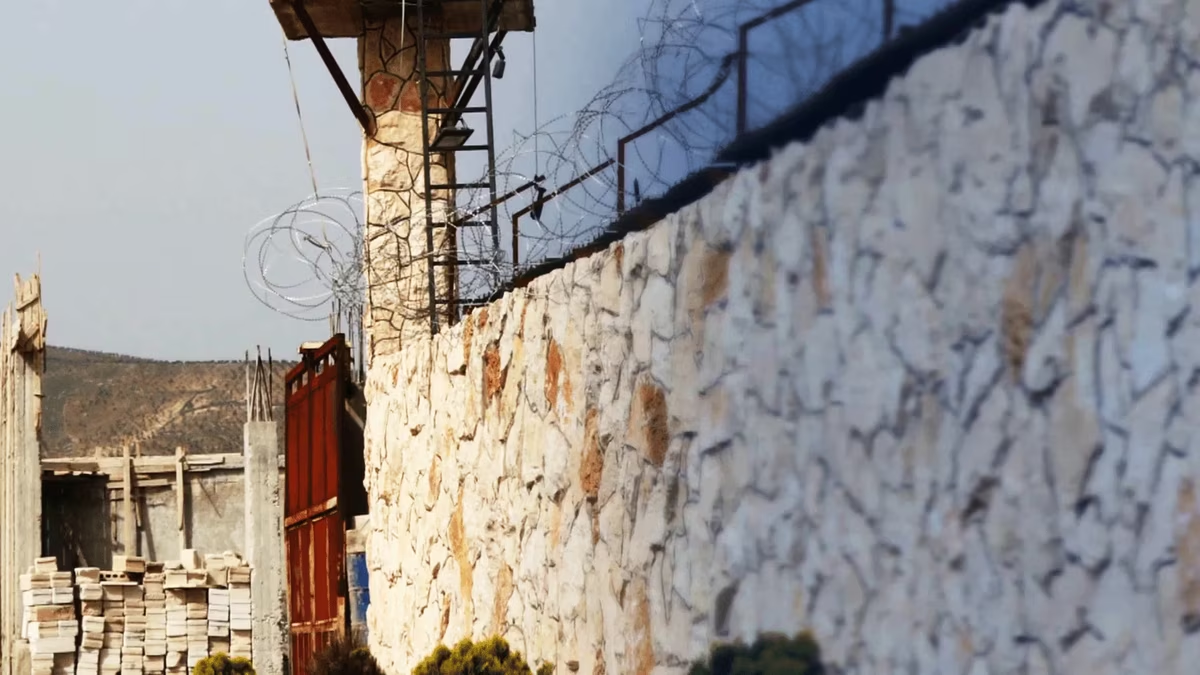
How many prisoners does Israel hold in its prisons? Shocking numbers until early 2026

A report issued by Palestinian prisoner institutions stated that the Israeli occupation authorities are holding more than 9,350 Palestinian prisoners and detainees in their prisons, as of early January 2026, amid escalating policies of detention without charges, and detention conditions described as inhumane.

The report, issued today, Monday, and based on data from the Palestinian Prisoner's Club, Al-Dameer Foundation, and the Commission of Detainees and Ex-Detainees Affairs affiliated with the Palestine Liberation Organization, in addition to what was announced by the occupation prison administration, clarified that among the prisoners are 53 female prisoners, including two children. It added that the number of child prisoners reached 350 children, held by the occupation in Megiddo and Ofer prisons.

According to the data, about 50 percent of the total prisoners and detainees are held without charges, such as administrative detention or under the category of "unlawful combatants." The report indicated that the number of administrative detainees reached 3,385 detainees without charges, and they alone constitute more than 36 percent of the total number of prisoners.

Israel uses what is known as "administrative detention," a law dating back to the British era, which allows the detention of Palestinians without trial, based on what security agencies describe as secret files, for periods ranging from 3 to 6 months, renewable indefinitely. Israel classified 1,237 detainees under the designation of "unlawful combatants," a definition that does not include all detainees from the Gaza Strip held in Israeli army camps, and also includes Arab detainees from Lebanon and Syria.

The report stressed that the continuation of administrative detention and detention without trial reflects a systematic Israeli policy that contradicts international laws and norms related to prisoners' rights.

In a related context, the Islamic Resistance Movement (Hamas) said in a statement issued on Monday that Palestinian prisoners in occupation prisons face inhumane conditions, describing it as a full-fledged crime, amid international silence. The movement added that the occupation authorities boast of serious violations committed against prisoners, while continuing to conceal the true numbers of detainees from the Gaza Strip and reveal their fate.

Coinciding with the Israeli war on the Gaza Strip, which began in October 2023, Israel, according to human rights organizations, escalated its violations against Palestinian prisoners, especially Gaza detainees, through starvation, torture, medical neglect, and holding them in harsh conditions. Recently released prisoners spoke of extremely difficult detention conditions, confirming that they were subjected to abuse and starvation, and that signs of torture appeared on their bodies, in addition to some of them suffering from psychological disorders as a result of what they were exposed to during their detention.

ISRAELI AFFAIRS

Tue 20 Jan 2026 4:05 am - Jerusalem Time

Israeli Army Chief of Staff Declares Readiness to Use "Unprecedented" Offensive Capabilities

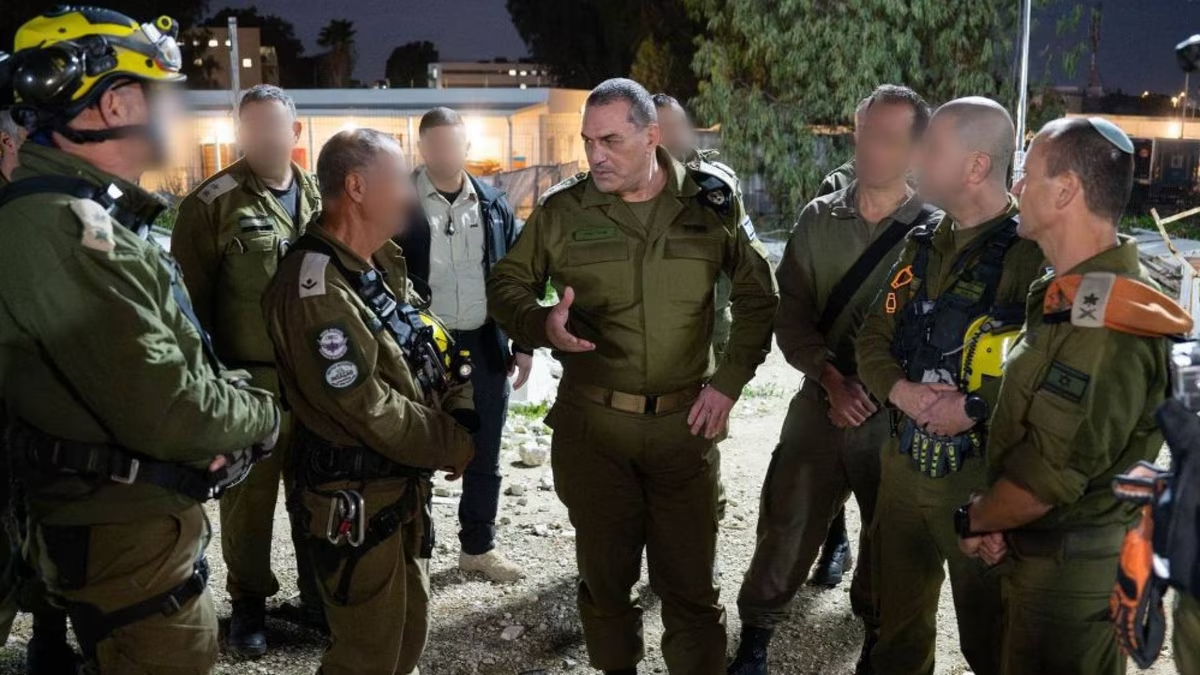
The Chief of Staff of the Israeli occupation army, Eyal Zamir, confirmed on Monday the readiness of his forces to carry out offensive operations with "unprecedented" capabilities against any threat targeting the security of the entity. Zamir stressed that the current phase requires the highest degree of readiness to confront all possibilities, including "surprise war" scenarios, noting that the army has absorbed lessons learned from recent confrontations with Iran to enhance field superiority.

Zamir's statements come amidst highly complex regional conditions, where military threats coincide with major diplomatic moves led by America under the presidency of Donald Trump to redraw the balance of power in the Middle East. Recent years have witnessed a shift in confrontation strategies, after tensions with Tehran reached unprecedented levels, necessitating a comprehensive re-evaluation of the occupation forces' defense and attack systems. This trend reflects concern about the possibility of a multi-front conflict, which has led the General Staff to focus on the "home front" as a crucial element in any future war. While Washington monitors these developments with interest to ensure the stability of its allies, the role of joint military coordination between America and the occupation forces emerges as a fundamental pillar for confronting increasing security challenges.

During a field tour of the Home Front Command headquarters, accompanied by its commander Shay Klapper, Zamir reviewed the readiness of the teams and authorities. The Chief of Staff explained that the home front is now at the "highest level of alert" to confront any attacks targeting civilians, stressing that the ability to save lives is closely linked to the extent of cooperation between the army and emergency organizations.

Zamir stated in a declaration: The partnership between the army and local authorities is the main pillar for strengthening resilience. He added that his forces will not hesitate to use their "advanced offensive arsenal" to deter any party attempting to exploit weaknesses, noting that the operational plans set for 2026 take into account the possibility of verbal threats turning into tangible military actions on the ground.

These statements indicate the occupation's desire to send strong deterrence messages to regional adversaries, especially with the continued shifts in America's foreign policy. The brandishing of "unprecedented capabilities" reflects the extent of military investment in offensive and defensive technology developed to keep pace with threats related to precision missiles and drones. This state of alert is likely to continue as long as major political settlements remain absent from the scene.

ARAB AND WORLD

Tue 20 Jan 2026 4:03 am - Jerusalem Time

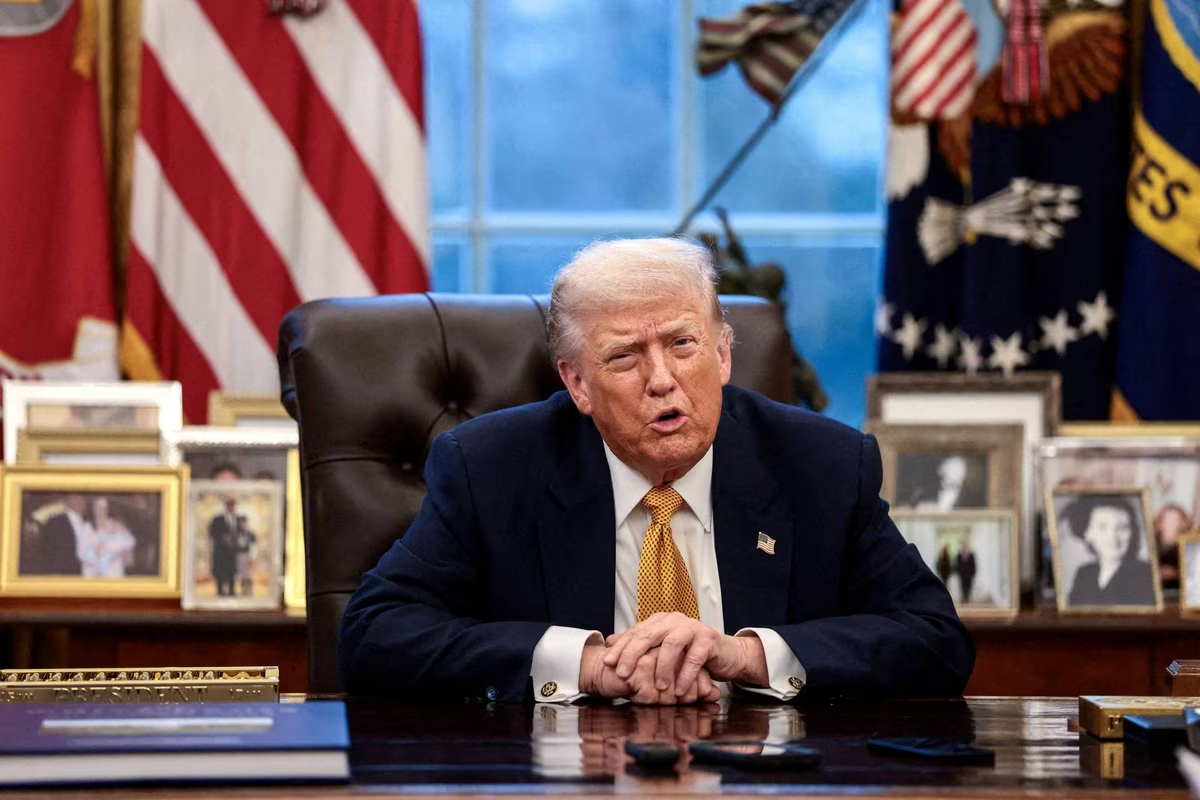
Morocco accepts Trump's invitation to join 'Peace Council' for Gaza

Morocco's Ministry of Foreign Affairs said in a statement today (Monday) that King Mohammed VI, the country's monarch, accepted an invitation from US President Donald Trump to join the US-led 'Peace Council' as a founding member.

The ministry stated that the Moroccan monarch responded positively to the invitation, adding that the Kingdom of Morocco "will work to ratify the founding charter of this council."

It continued: "The Kingdom of Morocco commends the announcement of the launch of the second phase of President Trump's comprehensive peace plan, as well as the official establishment of the National Committee for Gaza Administration as an interim transitional body."

PALESTINE

Tue 20 Jan 2026 3:57 am - Jerusalem Time

Israel inaugurates new settlement near Bethlehem to cut off Palestinian connection

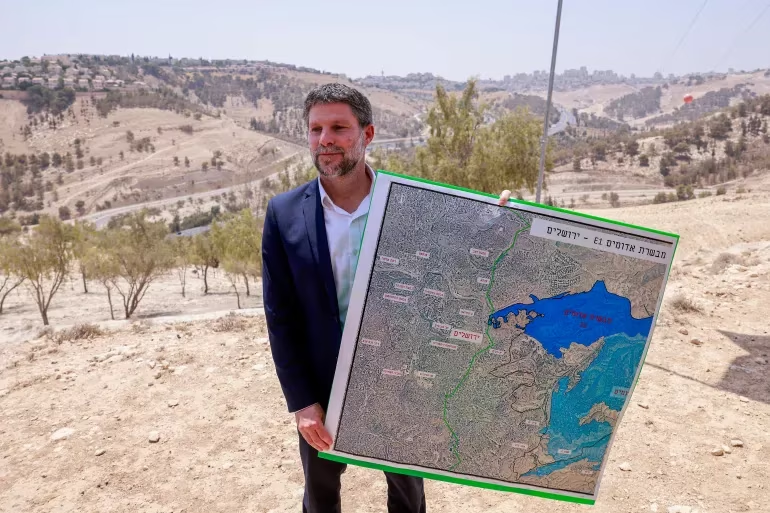
Israel today, Monday, inaugurated a new settlement named "Yatsiv" near Bethlehem in the southern occupied West Bank, which would cut off Palestinian geographical connection in the area.

A video clip broadcast by journalists and Israeli media showed Finance Minister Bezalel Smotrich and Settlement Minister Orit Strock cutting the ribbon of the new settlement, a month and a half after the government's decision to approve a series of settlements.

Sources close to the Israeli right said that "this settlement constitutes a strategic extension between Har Homa, an Israeli settlement southwest of Jerusalem, and Tekoa, a settlement southeast of Bethlehem, near the Palestinian town of Beit Sahour, east of Bethlehem."

For its part, right-wing Israeli sources reported that the "Yatsiv" settlement is the closest Jewish point to Bethlehem and will create a direct geographical connection between the eastern part of the Gush Etzion settlement bloc and Jerusalem.

Yatsiv settlement established in a unique strategic location near Bethlehem (AFP)

Sources said that "the Yatsiv settlement was established in a unique strategic location near Bethlehem, and it is the closest Jewish settlement to the city to date, which contributes to creating continuous communication between eastern Gush Etzion and Jerusalem, and enhances the continuity of settlement and security in the region."

The establishment of this settlement comes within the decision of the Political-Security Cabinet, which approved about a month and a half ago the organization and declaration of new settlements in the occupied West Bank, and ten families live in these settlements today, according to sources.

Smotrich said at the ceremony held on the occasion, "Laying the cornerstone is a Zionist, strategic and political step of the highest levels, and according to the policy I lead, we are eliminating the idea of a Palestinian state and strengthening Jewish control over the land, and deepening the continuity of settlement and security."

The Israeli mini-cabinet had approved a plan to establish 19 settlements in the occupied West Bank, in a plan that includes expanding the scope of settlement and strengthening the Israeli presence in several areas of the West Bank, which would escalate tension in the Palestinian territories.

This came amid escalating international criticism of settlement expansion policies, which are considered a violation of international law, and amid warnings of their repercussions on the chances of a political solution and the establishment of an independent Palestinian state.

PALESTINE

Tue 20 Jan 2026 3:57 am - Jerusalem Time

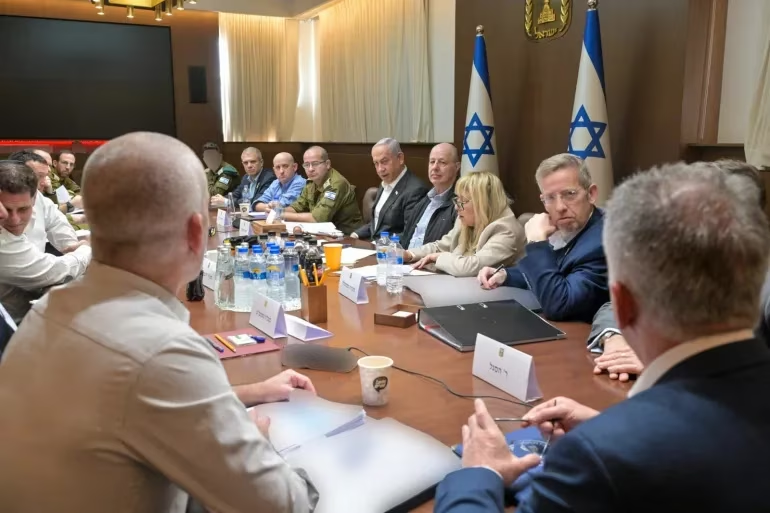
Israel decides not to open Rafah crossing at present despite Washington's demand

The Israeli government decided, yesterday evening, not to open the Rafah crossing temporarily, despite the United States' demand for it as part of the second phase of the agreement to end the war in the Gaza Strip, and US President Donald Trump's plan to end the war in Gaza.

Sources reported that the Israeli mini-cabinet (the security cabinet) decided not to open the Rafah crossing at present, and clarified that this decision comes within the framework of "confrontation with the United States" regarding the second phase of the American plan.

Sources quoted a senior Israeli official as saying that "the inclusion of representatives from Turkey and Qatar in the executive council for Gaza was not mentioned in the original understandings between Israel and the United States, and the powers of this new council are not yet clear, nor is its role. The Rafah crossing will remain closed due to the Israeli-American dispute.

Israeli Prime Minister Benjamin Netanyahu had a phone call on Saturday with US Secretary of State Marco Rubio, in which he expressed his reservations about including Qatar and Turkey in the advisory council that will oversee the interim administration of the Gaza Strip, according to informed sources.

Sources said that Rubio informed Netanyahu - who is wanted by the International Criminal Court for committing war crimes in Gaza - during the call, that there is no turning back on the involvement of Qatar and Turkey in the advisory council and that the decision has been made.

Netanyahu had said that he disagreed with Washington regarding the Gaza executive council announced by the White House last Friday evening, but he clarified that he was about to begin the second phase of the US President's plan for Gaza.

Netanyahu's office had previously said that there was no coordination between America and Israel regarding the announcement of the Gaza executive council, and that Tel Aviv would discuss the matter with Secretary of State Rubio.

PALESTINE

Tue 20 Jan 2026 3:46 am - Jerusalem Time

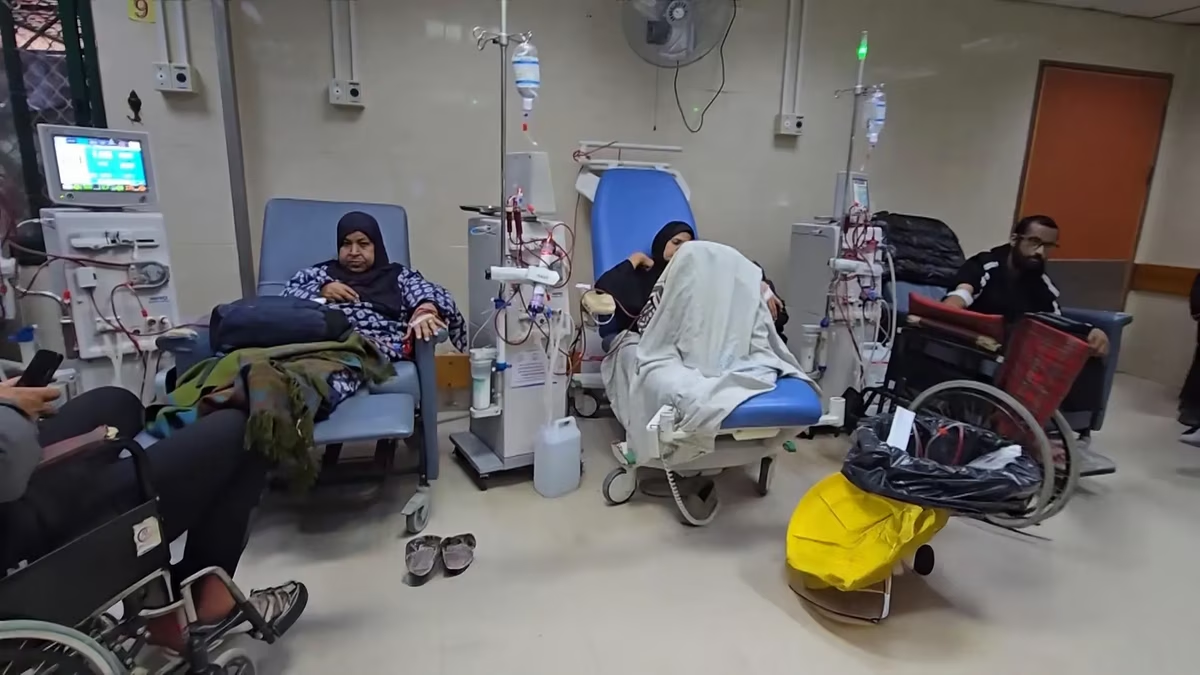
Death on Waiting Lists.. A Silent Pain Afflicting Kidney Failure Patients in Gaza

Humanitarian warnings are escalating regarding a grim fate facing kidney failure patients in the Gaza Strip, with the continued closure of crossings and prevention of their travel for treatment, at a time when medical waiting lists have turned into a daily race against pain, silently threatening the lives of hundreds of patients.

From inside the dialysis unit at Al-Aqsa Martyrs Hospital in Deir al-Balah, the features of a complex crisis are unfolding, as patients suffer from a severe shortage of medicines and medical supplies, due to Israeli restrictions that have extended even to vital equipment necessary for the continuation of dialysis sessions.

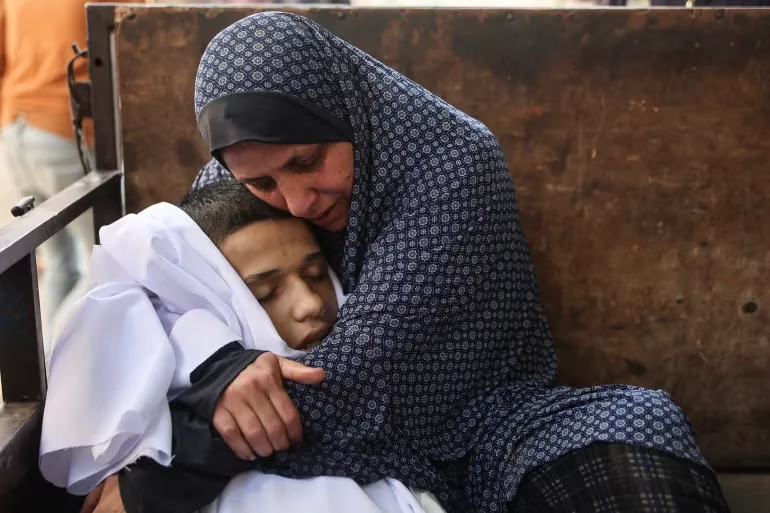
Sources indicate that these departments have begun to receive numbers exceeding their capacity, with patients accumulating daily, which has led to repeated deaths recently due to the absence of treatment and regular medical sessions.

Suffering is not measured by numbers alone, but is embodied in the testimonies of the patients themselves, as one patient describes her nights as sleepless due to pain, confirming that the pain does not leave her body in the absence of medicines and any means to alleviate her suffering.

Another patient clearly summarizes her demand, confirming that patients only ask for the opening of crossings and the entry of medicines, in light of the hospitals' inability to provide basic needs, which makes treatment within the Strip an incomplete, even risky, option.

The Palestinian Ministry of Health speaks of about 30,000 patients and wounded accumulating inside the Strip's hospitals, all awaiting the green light to travel outside Gaza, after the capabilities of local treatment became unable to respond to critical cases.

One patient's words reflect the extent of health deterioration, as he points to a sharp drop in his hemoglobin level due to the unavailability of necessary treatment, which doubles health risks and makes every day of delay a direct threat to life.

For his part, a doctor at Al-Aqsa Martyrs Hospital warns of a shortage of essential medicines, most notably the hormone "erythropoietin", explaining that its absence has led to one or two deaths per month among dialysis patients, due to the loss of control over blood levels in their bodies.

In light of this deteriorating reality, demands from international and Palestinian institutions, along with the Ministry of Health, are escalating to pressure Israel to open all crossings, especially the Rafah crossing, to allow patients to leave for treatment before waiting turns into a final death sentence.

The first phase of the ceasefire agreement in Gaza began on October 10th last year, after two years of Israeli genocide that left more than 70,000 martyrs and destroyed most of the civilian infrastructure in the Palestinian Strip.

However, Israel continues to violate the agreement with its repeated raids on the Strip and by changing the agreed-upon points for the withdrawal line known as the Yellow Line, and also continues to restrict the access of vital humanitarian aid to the residents of Gaza.

PALESTINE

Tue 20 Jan 2026 3:45 am - Jerusalem Time

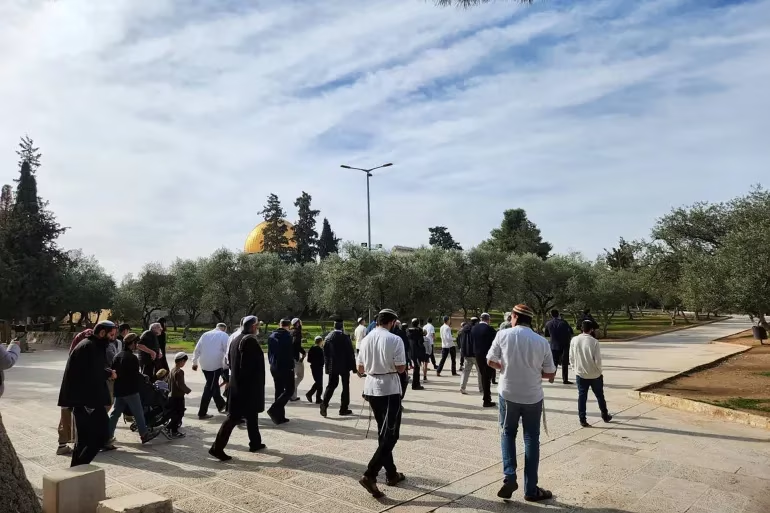
Hundreds of settlers storm Al-Aqsa and attempts to seize lands in Jerusalem

Hundreds of settlers stormed the courtyards of the blessed Al-Aqsa Mosque this Monday morning, performing Talmudic rituals under tight protection from the Israeli occupation police, while others attempted to seize lands belonging to Palestinians in the village of Beit Iksa, northwest of occupied Jerusalem. The Jerusalem Governorate stated that 476 settlers stormed Al-Aqsa Mosque during the morning and afternoon incursions. Local sources reported that the settlers performed Talmudic rituals in front of the Dome of the Rock, in addition to the eastern area of the mosque, near the Bab al-Rahma prayer hall.

In a related context, the occupation authorities handed a young Jerusalemite a decision to ban him from Al-Aqsa Mosque for a week, renewable, and also issued a decision to ban a Jerusalemite activist from the mosque for 6 months. Last Thursday, the Israeli occupation authorities summoned nearly 100 released prisoners and interrogated them on-site for hours, informing them to appear before investigators again with the intention of issuing them expulsion orders from Al-Aqsa Mosque before the holy month.

On the ground, dozens of settlers, accompanied by the deputy mayor of the occupation municipality in Jerusalem, Aryeh King, stormed the village of Beit Iksa northwest of occupied Jerusalem today, in an attempt to seize a plot of land located on the western side of the village.

The head of the Beit Iksa village council, Murad Zayed, said that the settlers stormed the areas of Ras Farij and Kroum al-Gharaba, and tried to seize lands owned by citizens of the village, by erecting barbed wire around them with the aim of confiscating them.

Zayed added that the villagers confronted the attempt and prevented the settlers from completing their work, before the Israeli occupation forces intervened, arriving at the scene, and superficially evacuating the settlers, then declared the area a closed military zone, and prevented citizens from accessing their lands.

He pointed out that this attempt falls within a systematic policy targeting the isolated lands of Beit Iksa, which are surrounded by the Mevaseret Zion settlement built on the lands of the village and the depopulated village of Qalunya.

The village of Beit Iksa suffers from strict occupation measures, most notably the only military checkpoint that controls its entrances, in addition to strict restrictions on construction and access to agricultural lands, which exacerbates the suffering of the residents and threatens their presence on their land.

The occupation forces also continued to tighten their military measures in the city of Jerusalem, as they began - according to the Jerusalem Governorate - to replace military installations and iron gates at the southern Hizma checkpoint northeast of the city. Occupation municipality crews also stormed the Al-Bustan neighborhood in Silwan, south of Al-Aqsa Mosque, coinciding with incursions into the Shuafat refugee camp north of Jerusalem.

PALESTINE

Tue 20 Jan 2026 3:45 am - Jerusalem Time

Premature births and deformities.. catastrophic effects of Israel's war on the Gaza Strip

The Israeli occupation war on the Gaza Strip has left serious health consequences affecting the most vulnerable groups, especially pregnant women and newborns. Hospitals in the Strip recorded an unprecedented increase in premature births, a decrease in birth weights, in addition to a significant increase in cases of birth defects and child deaths, amid a severe shortage of health care and food insecurity.

Dr. Ziad Al-Masry, a consultant pediatrician and neonatologist at the Ministry of Health, confirmed that most of the cases admitted to Al-Shifa Hospital's nursery are premature babies under 30 weeks old and weighing less than two kilograms, explaining that the majority of children admitted "were born below normal age and weight," under harsh conditions that the Strip had not witnessed before the war.

Al-Masry linked this deterioration to multiple factors, most notably malnutrition, water scarcity, difficulty in providing basic needs for pregnant women, and constant fear, noting that "the fumes resulting from bombing, and the smoke from burning wood and alternative fuels, directly affect the mother's health, and thus the fetus inside the womb."

He added that one of the most dangerous complications facing premature babies is "incomplete lung development, which forces us to keep them on ventilators for long periods," in addition to recording deformities in the digestive system that required urgent surgical interventions, at a time when hospitals suffer from a severe shortage of vital medicines, ventilators, and broad-spectrum antibiotics.

For his part, Zaher Al-Wahidi, director of the Health Information Center at the Palestinian Ministry of Health, revealed figures reflecting the scale of the disaster. He stated that the ministry recorded more than 4,900 births of underweight babies, and more than 4,100 premature births before completing "38 weeks," an increase of more than 52% compared to the year before the war.

Al-Wahidi also pointed to the recording of 315 cases of birth defects, an increase of more than 56%, and an increase in infant deaths after one week of birth by more than 90%, noting the recording of more than 616 intrauterine deaths, and more than 67% of pregnant women suffering from anemia.

The crisis is not limited to numbers, but is clearly reflected in the testimonies of mothers. Ahed Khalil Musbah, one of the displaced, recounted her experience with pregnancy amidst bombing and displacement. She said, "I carried my son during months of famine, displacement, and continuous bombing. I suffered from dehydration and fatigue, and after birth, doctors told me he had water on his brain."

She added that the scarcity of food and the lack of basic necessities increased her suffering, explaining that "flour and lentils were all that was available, and I was shocked by the large size of my baby's head, but we try to be patient despite everything."

In light of this reality, the Ministry of Health warns against the continued repercussions of the war and siege on the health of mothers and children, demanding the opening of crossings, especially the Rafah crossing, to allow medical evacuation and the entry of medicines and medical consumables, at a time when data indicate that the continuation of the current situation portends a generation suffering from long-term health consequences, whose effects may extend for years to come.

PALESTINE

Tue 20 Jan 2026 3:44 am - Jerusalem Time

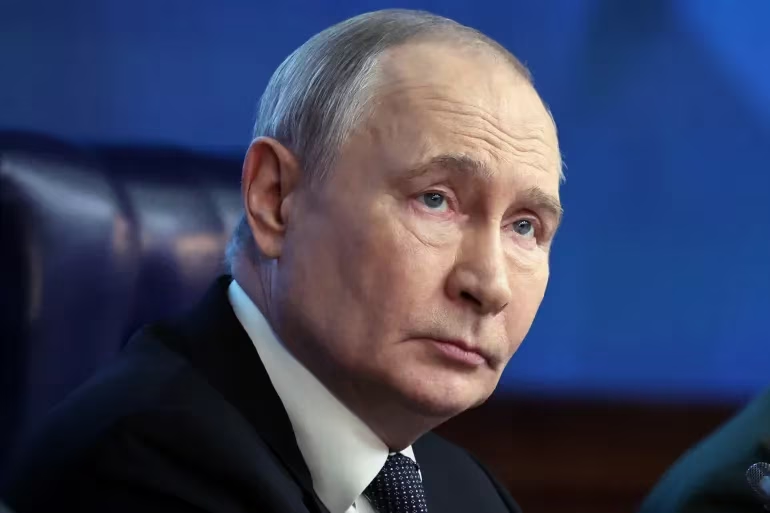
Putin receives invitation to join Gaza Peace Council amid fears of UN marginalization

Russian President Vladimir Putin has received an invitation to join the Gaza Peace Council, announced by US President Donald Trump, joining a long list of world leaders who have received similar invitations. This comes amid fears that these invitations could undermine the work of the United Nations. Kremlin spokesman Dmitry Peskov told reporters: "President Putin has also received an invitation to join the Peace Council." Peskov did not indicate Putin's response, but added that Russia would consider this offer, which the Russian President received through diplomatic channels, stressing that Moscow seeks to "clarify all the precise details" related to the offer with Washington.

For its part, Hungary announced that it had received an invitation from the United States to join the Peace Council. Hungarian Prime Minister Viktor Orbán, a close ally of Trump, wrote on the X platform: "We have, of course, accepted this honorable invitation." Sources also reported from the Onet news website that Polish President Karol Nawrocki received an invitation from Trump to join the Gaza Peace Council.

The White House announced on Friday evening the formation of the "Peace Council" in parallel with the adoption of the composition of the "Palestinian National Committee for the Administration of Gaza," as part of the second phase of the comprehensive plan proposed by the US President to end the war in the Strip.

Warnings against establishing an alternative peace structure On the other hand, the Wall Street Journal reported, citing a document it reviewed, that President Trump expanded the idea of the proposed Gaza Peace Council to become a global body that would take on the conflict resolution role currently held by the United Nations, charging a fee of one billion US dollars for permanent membership.

The newspaper quoted officials as saying that several Arab countries object to the Gaza Peace Council's involvement in other conflicts, emphasizing the need for it to focus exclusively on implementing the Gaza peace plan initially. The newspaper stated that establishing an alternative structure for global peace and security under Trump's control is "fraught with risks."

In this context, several governments on Sunday expressed caution regarding Trump's invitation to join the Peace Council, amid warnings that it could undermine the work of the United Nations. A diplomat said the initiative resembles a Trump-style United Nations, ignoring the foundations of the UN Charter. Three other Western diplomats warned that the Council, if launched in its current form, could undermine the existing international order.

A draft charter published by Western media showed that US President Donald Trump extended invitations to nearly 60 countries to join the "Peace Council" for Gaza, requiring a payment of one billion dollars in cash to extend membership for more than 3 years.

The draft charter stipulates that President Trump will assume the first presidency of the Council and will have the final say in extending invitations to join and approving its decisions, although the document indicates that these decisions are taken by majority, on the basis of one vote per member state. The draft also grants the US President the authority to adopt the official seal of the Council.

PALESTINE

Tue 20 Jan 2026 3:43 am - Jerusalem Time

Netanyahu reserves the right to include Qatar and Turkey in the Gaza Executive Council

Israeli Prime Minister Benjamin Netanyahu held a phone call with US Secretary of State Marco Rubio, during which he expressed his reservation about including Qatar and Turkey in the advisory council that will oversee the interim administration of the Gaza Strip, according to Israel's Channel 12, citing informed sources. The channel quoted its sources as saying that Rubio informed Netanyahu - who is wanted by the International Criminal Court for committing war crimes in Gaza - during the call that there was no turning back from involving Qatar and Turkey in the advisory council and that the decision had been made. The channel explained that Netanyahu expressed his reservation that the decision to announce the formation of the council was a surprise to Israel and without prior notification, adding that he made the call directly with Rubio despite having previously announced that he had tasked his foreign minister, Gideon Sa'ar, with following up on this matter.

In this context, Yedioth Ahronoth newspaper quoted a senior Israeli official as saying that the inclusion of representatives from Qatar and Turkey in the executive committee overseeing Gaza was not part of the original understandings with Washington, noting that the powers of this committee are unclear. The official added, according to Yedioth Ahronoth, that "the involvement of Qatar and Turkey was against Netanyahu's will and constitutes revenge from (Jared) Kushner and (Steve) Witkoff due to the insistence on not opening the Rafah crossing before the return of the last prisoner's body in Gaza."

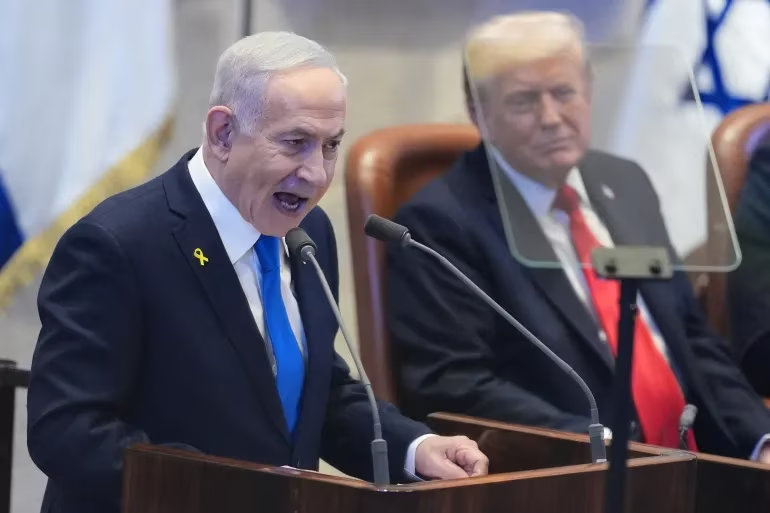
Netanyahu said on Monday that he was at odds with Washington over the Gaza Executive Council, which the White House announced last Friday evening, but he clarified that he was about to begin the second phase of the US President's plan for Gaza. Netanyahu did not specify, in a speech he delivered during a session of the Israeli Parliament (Knesset) General Assembly, the nature of the dispute between him and US President Donald Trump's administration regarding the Gaza Executive Council, which will accompany operations in Gaza.

Sources in Palestine said that Netanyahu spoke about a discussion between him and the Trump administration regarding the composition of the Gaza Executive Council, and added that he was not afraid of this discussion. Netanyahu's office said on Sunday that there was no coordination between America and Israel regarding the announcement of the Gaza Executive Council, and that Tel Aviv would discuss the matter with US Secretary of State Marco Rubio.

International Force in Gaza

Sources in Palestine added that Netanyahu stressed, during his speech in the Knesset, that there would be no Turkish or Qatari soldiers in the Gaza Strip, according to him, but he did not confirm that there would be no Turkish and Qatari role in the reconstruction of Gaza and other aspects related to the future of the Strip. Washington had said that an international stabilization force would be deployed in the Gaza Strip soon, and this force is one of the provisions in Trump's plan that formed the framework for the ceasefire in Gaza since October 10th after two years of Israeli extermination.

The UN Security Council issued its resolution on November 17th last year, which stipulated the formation of an international stabilization force in Gaza. Regarding the second phase of the ceasefire agreement in Gaza, the Israeli Prime Minister stated that "Hamas will be disarmed, and Gaza will be handed over either the easy way or the hard way."

Welcome in Gaza

In contrast, the government media office in Gaza welcomed, in a statement, the Palestinian National Committee for the administration of the Gaza Strip. The office considered that the step comes in the context of addressing the administrative and service reality in the Strip, and in line with the priority of a complete cessation of the ongoing aggression, ensuring the protection of civilians, and alleviating humanitarian suffering. The statement affirmed full readiness to transfer relevant powers, and complete preparedness for handover and takeover procedures, ensuring a smooth and organized transition in institutional work, preserving the rights of citizens and employees in the public sector, and guaranteeing the continuity of services.

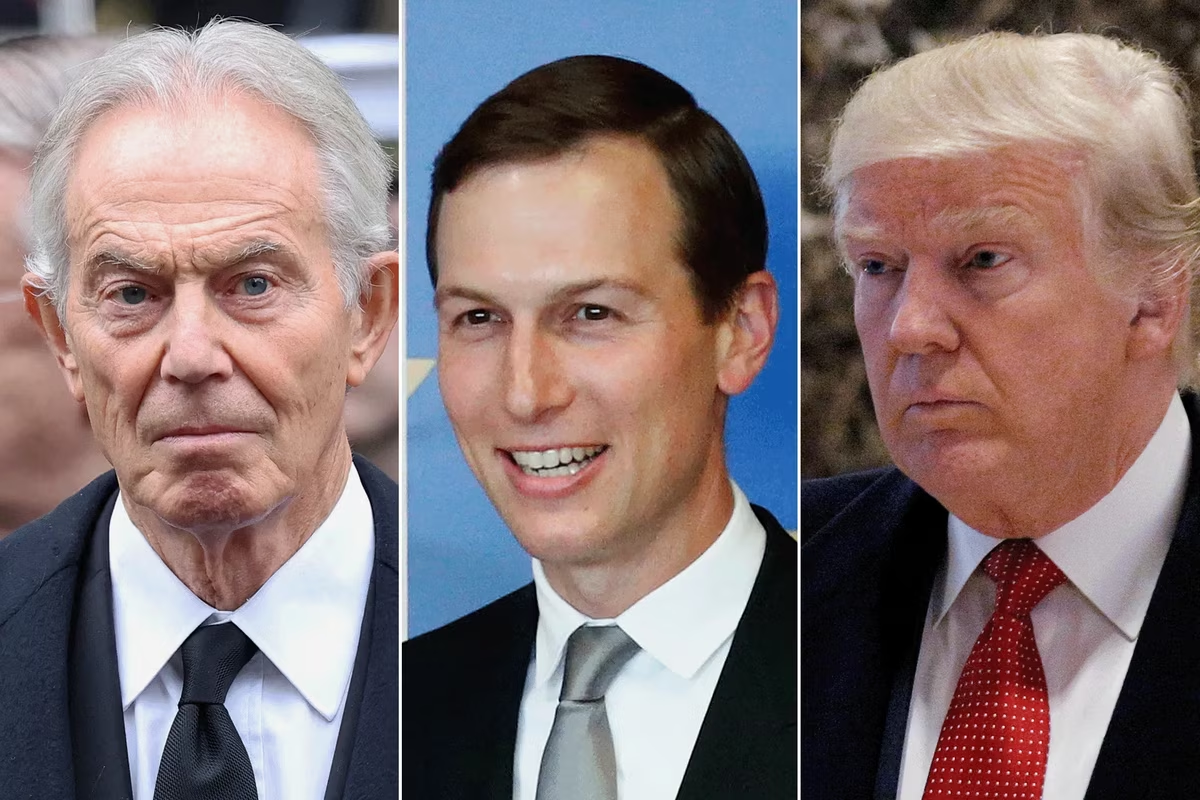
According to the White House statement regarding the Gaza Executive Council, the latter's role is to support the office of the High Representative and the National Committee for the administration of Gaza; with the aim of promoting effective governance, accelerating the provision of quality services, and supporting stability and prosperity for the residents of the Strip. The Gaza Executive Council includes members of the "Founding Council" who are: Steve Witkoff, Jared Kushner, Tony Blair, and Mark Rowan, in addition to prominent regional and international figures, including Turkish Foreign Minister Hakan Fidan, Qatari diplomat Ali Al-Thawadi, advisor to the Prime Minister for Strategic Affairs, and Egyptian intelligence chief Hassan Rashad.

The White House said that the Gaza Executive Council will operate under the broader umbrella of the "Peace Council" chaired by President Trump, as part of his 20-point plan to end the war in Gaza.

In a related context, Bloomberg quoted an informed source as saying that the European-American talks regarding the Peace Council are very difficult. According to the sources, Washington's European allies are working to amend the provisions of the Peace Council and are seeking to persuade Arab countries to pressure Trump to make changes to the Council. The sources revealed that Trump wants to sign the charter and powers of the Peace Council next Thursday during the Davos conference.

In the same context, Axios quoted a French official as saying that Paris does not intend to respond positively to the invitation to participate in the Peace Council on Gaza. The French official added to the website that the Peace Council raises fundamental questions regarding respect for the principles and structure of the United Nations.

PALESTINE

Tue 20 Jan 2026 3:43 am - Jerusalem Time

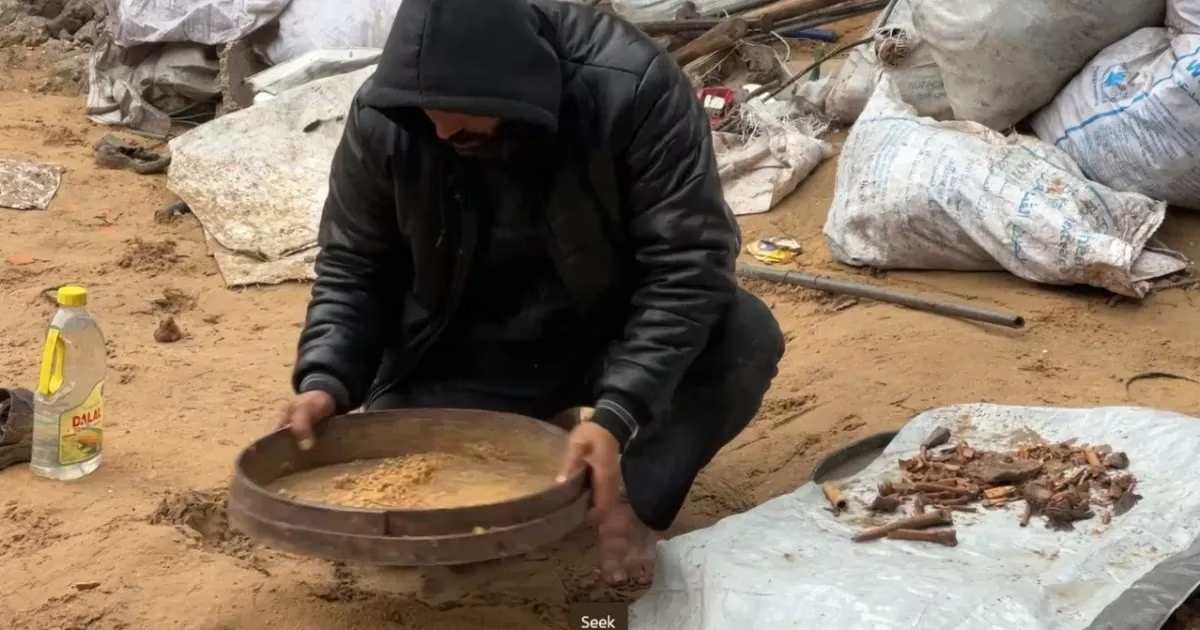
With a sieve and for two years.. a Palestinian collects the remains of his family from under the rubble of his home in Gaza

In a destroyed house in the Sabra neighborhood, south of Gaza City, Palestinian Mahmoud Hammad has been searching for more than two years for the remains of his wife, her fetus, and his six children, all of whom were martyred in an Israeli occupation bombing. It is a harsh mission, only comparable to the magnitude of the tragedy Hammad experienced, as he is the sole survivor of the massacre that occurred when the family's home was targeted in the first months of the war in late 2023, in which his brother, his wife, and their six children were also martyred.

Hammad still suffers from injuries due to that targeting to this day, in the absence of treatment and healthcare. He affirms that that day "destroyed his entire life," as he emerged injured and remained alone after losing his entire family.

After successfully retrieving and burying the remains of his brother and his family, Hammad returned to the rubble of his home to search for what remained of his wife and children using primitive tools, such as a "sieve."

Hammad said that sources used the sieve at the beginning of the war to sift flour from dirt to feed children, adding, "But today I use it to collect the remains of my wife and children."

He pointed out that he descends to depths of up to 9 meters underground, using an axe, a hammer, and hand tools, with limited help from neighbors and relatives, before beginning to sift the sand and dirt in search of the bones of his wife and children.

He explained that with every piece he finds, he sends its photos to specialized doctors to determine if it belongs to his wife or her fetus, who was martyred in her womb, clarifying, "When I saw the bones of the fetus, I was sure that my wife was martyred while pregnant."

He affirmed his refusal of any assistance to fund this arduous task despite the exorbitant cost of using electrical equipment in light of the scarcity of electricity and its high prices, explaining, "I sold everything I own, but this blood is not for sale."

Regarding the reason for his insistence on continuing despite two years of pain, Hammad stressed that what he is doing is a moral duty, affirming, "The least loyalty to my wife and children is to bury them with dignity," noting that he will continue searching until the last speck of dust in his home.

Hammad considered that his story represents one of thousands of similar stories in Gaza, where the bodies of thousands of martyrs are still under the rubble, asking, "If I am doing this alone, who will retrieve the children of thousands of other families?"

PALESTINE

Tue 20 Jan 2026 3:43 am - Jerusalem Time

Dead by occupation bullets south of Gaza and Smotrich calls for closing the coordination center

Sources in Gaza Strip hospitals reported that 3 Palestinians were martyred and 7 others injured today, Monday, by Israeli occupation army fire in several areas in the southern Strip, while Israeli Finance Minister Bezalel Smotrich called for closing the civil-military coordination center established by Washington near the Strip's borders to monitor the ceasefire agreement. A source at Nasser Medical Complex said that one of the martyrs died by Israeli drone fire outside the deployment areas of the occupation forces in Sheikh Nasser neighborhood, east of Khan Yunis city, while another was martyred by occupation bullets within their deployment areas east of the city. The ambulance and emergency service announced the martyrdom of a Palestinian child by occupation fire in Mawasi Rafah area, south of the Strip.
This comes amidst daily Israeli violations of the ceasefire agreement that came into effect on October 10th, after a two-year genocide war launched by Israel. Sources quoted local sources as saying that warplanes and artillery vehicles shelled several areas east of Khan Yunis city early this morning, while Israeli artillery shelled the eastern areas of Deir al-Balah city in the central Strip.

The occupation army still controls the southern and eastern strips of the sector, and large parts of northern Gaza, continuing to occupy more than 50% of the sector's area, according to army data.

War casualties The Palestinian Ministry of Health in Gaza announced today, Monday, that the number of casualties from the Israeli genocide war on the Strip has risen to 71,550 martyrs and 171,365 injured.

On the humanitarian front, the French Ministry of Foreign Affairs said today that a container ship carrying 383 tons of food aid left the French port of Le Havre yesterday, Sunday, heading to Gaza. The ministry explained in a statement that this aid aims to "improve the health of more than 42,000 children in Gaza, aged between 6 months and two years, who suffer from malnutrition."

The aid consists of nutritional supplements, and will be given at a rate of "one dose per day for 6 months.. to prevent severe malnutrition." The container ship will arrive at Port Said in Egypt in approximately ten days, and then the World Food Program will transport the aid to Gaza.

Gaza Coordination Center Israeli Finance Minister Bezalel Smotrich urged Prime Minister Benjamin Netanyahu today, Monday, to close a US-led multinational coordination center that supports President Donald Trump's plan to end the war in Gaza.

Minister Smotrich considered, in statements published by his office, that "it is time to dismantle the headquarters in Kiryat Gat," referring to the Israeli city located northeast of Gaza, where the center is located.

Smotrich added that Britain, Egypt, and other countries "hostile to Israel and undermining its security" should be excluded from the military coordination center.

The American administration established the Civil-Military Coordination Center last October to serve as a center for civilian and military personnel from other countries to work alongside American and Israeli officials in planning for post-war Gaza. The center was also tasked with facilitating the entry of humanitarian aid into Gaza.

ARAB AND WORLD

Mon 19 Jan 2026 5:49 pm - Jerusalem Time

Trump: Time to Change Iranian Leadership

Washington – Said Arikat


In a calculated escalation of political rhetoric without sliding into direct military confrontation, US President Donald Trump brought the Iran file back to the forefront of international debate, clearly hinting that the option of regime change remains on the table, even if the use of military force has been postponed. Trump said in an interview with Politico on Saturday: "It's time to look for new leadership in Iran," a statement that recalled his administration's approach of combining political pressure and military threats on one hand, and tactical retreat on the other.

These statements came just days after Trump's surprising decision not to launch military strikes against Iran, even though he had seriously considered a limited attack in response to the Iranian authorities' suppression of popular protests. This retreat, according to American sources, was not an expression of de-escalation as much as it was the result of precise calculations regarding the feasibility of strikes and the potential for the region to slide into a wider confrontation.

Trump's remarks coincided with verbal escalation from the Iranian leadership, as Supreme Leader Ali Khamenei's account on the "X" platform published a series of sharply worded posts, holding the US President responsible for what he described as "violence and bloody unrest" inside Iran. Khamenei wrote: "We consider the US President guilty for the losses, damages, and slanders he has inflicted on the Iranian people," a direct accusation reflecting the extent of tension between the two sides.

In another post, Khamenei accused Trump of distorting the image of the Iranian people by describing them as violent groups, considering it a "heinous slander." This escalatory language did not go unnoticed in Washington, as Trump responded by saying that Tehran's rulers govern only through repression and violence. He added: "What he is guilty of, as a leader of a country, is the complete destruction of the country and the use of violence at unprecedented levels," accusing the Iranian leadership of killing thousands to maintain its grip on power, instead of focusing on managing the country's affairs.

Over the past weeks, Trump has intensified his statements that combine encouraging Iranian protesters and threatening the government, emphasizing on more than one occasion that the United States might resort to targeting Iran's nuclear program and missile facilities if it sees Tehran moving in a direction that threatens regional and international security. Despite his temporary abstention from striking, American officials confirm that the military option is still on the table, and a decision in this regard could be made within weeks, according to what the "Axios" website reported from informed sources.

All of this comes at a time when the US military presence in the Middle East is experiencing a noticeable decline compared to its peak during the Israeli-Iranian war last June. Leaks from within the US administration indicate that one of the main reasons for Trump's reversal on launching a strike is doubt about the ability of any limited attack to overthrow the Iranian regime or even decisively weaken it, in addition to fears of widespread retaliatory reactions.

The United States also faces logistical and security challenges, most notably the lack of adequate missile defense systems in the region to protect its forces and bases, as well as to protect Israel from any potential Iranian response. Nevertheless, Washington seeks to carefully strengthen its military presence, as the US aircraft carrier "Abraham Lincoln" is expected to arrive in the region later this week, sending a clear deterrent message without declaring direct offensive intentions.

In parallel, an old debate re-emerges within American circles about the potential alternative to the Iranian regime. Some proponents of regime change call for installing Reza Pahlavi, the son of the former Shah of Iran, as a leader for a transitional phase. However, Trump himself explicitly rejected this proposal, considering that Pahlavi lacks a real popular base inside Iran, and that imposing him from outside would only deepen the crisis.

Trump's rhetoric towards Iran reflects a structural contradiction in US policy: the desire for regime change without bearing the cost of overthrowing it. The constant brandishing of the military option, coupled with repeated retreats, weakens the credibility of deterrence and gives Tehran a wider margin for maneuver. Moreover, relying on an internal uprising, without a clear support strategy or a vision for the post-regime phase, seems closer to political wishes than to realistic planning.
In contrast, Khamenei's sharp responses reveal deep concern within the structure of the Iranian regime, but it is a concern that translates into further isolation rather than reform. Portraying the protests as a product of an "American conspiracy" allows the authorities to justify repression, but it deepens the gap with society. Between Washington's threats and Tehran's rigidity, the Iranian people remain caught in an equation of international conflict over whose paths they have no control.

PALESTINE

Mon 19 Jan 2026 9:29 am - Jerusalem Time

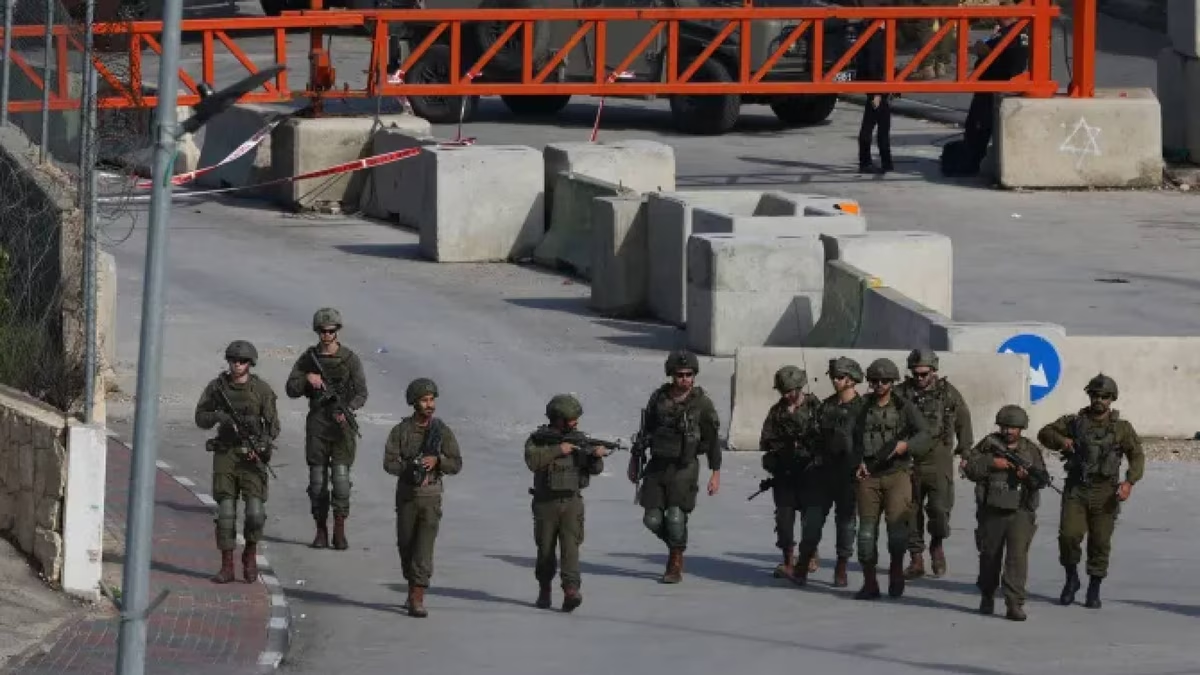
Occupation army claims to launch security operation in Hebron, south of the West Bank

Occupation forces, in cooperation with the General Security Service (Shin Bet), the police, and border guard forces, launched a wide-ranging operation in the city of Hebron, south of the West Bank (within what is called the "Judea Brigade"), according to what the army spokesman announced.

The army clarified that the operation, which included the "Jabal Jawhar" neighborhood, aims - according to its claim - to deal with what it described as "security infrastructure and the possession of illegal weapons," and to enhance security in the area.

The army statement indicated that the operation will continue for several days, during which explosions are expected to be heard, and intensive movement of forces and military vehicles will be observed in the area, stressing that it will continue to work proactively throughout the West Bank (Judea and Samaria Brigade).

OPINIONS

Mon 19 Jan 2026 8:14 am - Jerusalem Time

Gaza: Why Does International Intervention Worry Israel… And Why Does It Not Reassure Palestinians?

Dr. Ibrahim Nairat

Opinion Writer

The current Israeli government does not view the idea of international intervention in Gaza as a humanitarian response to an unprecedented crisis. Instead, it sees it as a highly dangerous political shift that could move the Strip from the realm of “security management” to an open international path, re-raising questions of sovereignty, responsibility, and the future. This concern is not limited to Gaza alone; in Israeli calculations, it extends to the West Bank, where Tel Aviv fears that any international presence in the Strip could become a precedent that would be difficult to contain later.

Since ideas related to an organized international framework—whether in the form of a peace council, a political oversight body, or a transitional administration mechanism—began to circulate, Israel has shown sharp rejection, even when the proposal comes from its traditional allies, foremost among them the United States. The problem, from the Israeli government's perspective, lies not in the identity of the international party or its stated intentions, but in the principle itself: a permanent international presence within Palestinian territories that treats Gaza as a political entity requiring external administration.

This is the core of Israeli concern. Simply accepting such an international framework would imply an implicit recognition that Gaza is not merely a security arena or a transient military issue, but a political space with a special status, which opens the door to redefining its legal position, and perhaps its political future. This is what Israel seeks to avoid, not only in Gaza but also in the West Bank.

Israeli policy for years has relied on a delicate equation: effective control without declaring sovereignty, and direct influence without assuming full legal responsibility. It does not officially annex Gaza, nor does it recognize it as an independent entity, but at the same time, it rejects any external intervention that treats the Strip as outside its sphere of influence. This contradiction is not a casual flaw, but a tool of governance that allows control over the Palestinian domain without being bound by the full consequences of occupation.

This stance on international intervention cannot be separated from the broader context of Benjamin Netanyahu's and the Israeli right's approach, which, since he took power, has been based on dismantling the idea of a Palestinian state, systematically eliminating peace paths, and replacing them with the logic of “managing the conflict” rather than resolving it. In this framework, the Gaza war was not an isolated event or a circumstantial reaction, but rather the culmination of a long endeavor aimed at definitively closing the political horizon and solidifying a fragmented Palestinian reality: an isolated Gaza, a subdued West Bank, and a weak, non-sovereign authority.

However, Israeli concern about international intervention is not limited to state interests; it extends to Benjamin Netanyahu's personal calculations. Netanyahu, as the entire Israeli society agrees, fears that the end of the crisis and the opening of an international path in Gaza could lead to his political and legal accountability, and perhaps expose him to trial, which could undermine his support base and lead to his loyal parties losing political dominance. This fear of political decline and personal loss deepens Israel's rejection of any international framework, even if it is dedicated to humanitarian intervention or is temporary, because it later opens the way for Netanyahu to be directly held accountable for managing the crisis and previous policies.

In contrast, the Israeli government tries to distinguish between humanitarian intervention and political intervention. It accepts the former as long as it remains confined to relief and alleviating suffering, and is separate from any sovereign or oversight framework, but it rejects the latter because it brings politics back to the center of the scene, which Netanyahu and the Israeli right have long worked to exclude.

As for the Palestinian Authority, it stands in a more fragile and complex position. Unlike Israel, it does not have the luxury of rejecting the American approach or any potential international path, no matter its reservations. The Authority is in dire need of stopping the humanitarian catastrophe, ending the suffering of the people of Gaza, and extricating the Strip from the clutches of Israeli occupation on the one hand, and from the recklessness of Hamas's policies on the other.

Nevertheless, the Palestinian Authority does not hide its fears that this path could lead to new approaches that reproduce non-sovereign self-governance models, or the administration of Palestinians through international and regional frameworks, while the essence of Israeli control remains. This scenario alarmingly converges with the very Israeli vision that seeks to reduce the cost of occupation without ending it, and to prevent the establishment of a viable Palestinian state.

In this sense, Palestinians face a harsh paradox: the urgent need for international intervention to stop the humanitarian bleeding, countered by a genuine fear that this intervention will become an alternative to a political solution, rather than a bridge towards it. Between a structural Israeli rejection of any internationalization and a forced Palestinian acceptance of incomplete paths, Gaza—and the West Bank with it—remains suspended between crisis management and the postponement of a solution.

The conclusion is that what is happening in Gaza today cannot be read as an isolated matter, but rather as a central episode in a struggle over the definition of the Palestinian issue itself. The question is no longer just: who will manage Gaza after the war? But rather: Will Israel succeed in containing the repercussions of a war by which it sought to end politics, only to bring it back to the forefront? And will Netanyahu's personal and political interests be able to continue to control the scene, or will international intervention place him—and Israel—in an unprecedented position of accountability and assessment?


PALESTINE

Sun 18 Jan 2026 8:39 pm - Jerusalem Time

Leaked documents: Israel pressured Britain to prevent the arrest of its officials on war crimes charges

Leaked files obtained by a British investigative newspaper showed that the Israeli government launched a decade-long campaign to protect its officials from criminal prosecution in Britain on charges of committing war crimes. Sources added that these discoveries come at a time when the International Criminal Court has issued an arrest warrant for Israeli Prime Minister Benjamin Netanyahu on charges of genocide and war crimes in Gaza.

Sources said: "When retired Israeli General Doron Almog boarded his flight from Tel Aviv on September 11, 2005, he expected to set foot on British soil soon. However, minutes after the plane landed at Heathrow Airport, an official from the Israeli embassy boarded the plane and warned Almog not to leave; an arrest warrant had been issued for the former army commander on charges of committing war crimes in Gaza, and British police officers were waiting at immigration to arrest him."

Sources continued: "Almog remained inside the plane for two hours before it took off back to Israel. British counter-terrorism police decided not to storm the plane, fearing that the attempt would lead to an armed clash on the Heathrow Airport runway."

According to sources, that incident apparently represented the first time an arrest warrant was issued in Britain against an Israeli citizen for violations against Palestinians, which caused a shock within the Knesset.

After General Almog's escape in 2005, the Israeli government launched a relentless campaign to ensure that such a situation would never be repeated, launching a campaign to pressure Britain to change its approach to "universal jurisdiction" legislation, which allows for the prosecution of perpetrators of serious crimes in another country.

Universal jurisdiction allows for the prosecution of the most serious crimes such as genocide and torture in another country. Its modern application evolved during the Nuremberg trials, when criminal proceedings were brought against high-ranking Nazi officers.

Sources said that "leaked emails and memos during a hack of the Israeli Ministry of Justice carried out by a group calling itself 'Anonymous for Justice' revealed that the goal of the Israeli pressure campaign was to allow Israeli officials to visit Britain without fear of arrest, especially those accused of serious violations against Palestinians."

Israeli authorities acknowledged a "cyber incident" last April and said it was under review. They did not respond to a request for comment.

An Israeli memo to the British Ministry of Justice indicated concerns about "the misuse of existing criminal procedures in the United Kingdom in universal jurisdiction cases and their impact on Israeli citizens."

Israel demanded that "the consent of the Attorney General or the Director of Public Prosecutions be required before issuing any arrest warrant or summons."

These recommendations apparently found a receptive audience, as in September 2011, David Cameron's government passed new legislation requiring the consent of the Director of Public Prosecutions before issuing arrest warrants under universal jurisdiction, which is exactly what Israel requested. The then British Foreign Secretary, William Hague, stated, "We cannot be in a situation where Israeli politicians feel they cannot visit this country."

Despite the changes, Israel was not entirely reassured, and in October 2011, former Foreign Minister Tzipi Livni faced an arrest request during her visit to Britain on charges of war crimes in Gaza.

According to the new legislation, the request was sent to the then Director of Public Prosecutions, Keir Starmer, who an Israeli document showed was "seriously considering granting his consent to the arrest." However, Starmer circulated the evidence long enough for the Foreign Office to grant Livni's visit "special mission" status, which gave her temporary diplomatic immunity, allowing her to escape.

High-level discussions continued until 2016 with the establishment of the "British-Israeli Dialogue on Universal Jurisdiction." The files showed Israeli instructions to "ensure that the meeting is not subject to the Freedom of Information Act."

During those meetings, Israel continued to push for additional amendments, and in a secret correspondence, the British Ministry of Justice tried to reassure the Israelis that "since the introduction of the requirement for the consent of the Director of Public Prosecutions, no arrest warrants have been issued against anyone, including Israeli visitors."

In a secret cable, the British Ministry of Justice tried to reassure the Israelis that "since the introduction of the requirement for the consent of the Director of Public Prosecutions for special arrest warrant applications, no such arrest warrants have been issued against anyone, including Israeli visitors."

Commenting on the crisis, Huda Ammouri, co-founder of "Palestine Action," said that "it is despicable and an insult to our democracy that the Israeli government has the ability to pressure our government to change laws in its favor, and prevent their prosecution for war crimes."

She continued: "Our system in this country works in a way that favors those accused of war crimes over the rights of its citizens who are trying to stop those crimes from happening."

To date, the British government continues to provide "special mission" certificates to Israeli officials, including War Minister Benny Gantz, who received diplomatic immunity to visit London in March 2024, amidst the ongoing war in Gaza.

PALESTINE

Sun 18 Jan 2026 8:39 pm - Jerusalem Time

International Newspapers: "Peace Council" a step towards creating a parallel structure to the UN

International newspapers and websites highlighted the formation of what was called the "Peace Council" to oversee the administration of the Gaza Strip. A report in the French newspaper Le Monde indicated that the council was formed amidst criticism, three months after the ceasefire came into effect. According to Le Monde's report, Israel has succeeded since October in excluding all Palestinian representatives and foreign diplomats who paved the way for the Peace Council. The French newspaper pointed out that Israel and the Islamic Resistance Movement (Hamas) still have much to negotiate in the coming months, such as the disarmament of the movement, the withdrawal of the Israeli army from Gaza, in addition to the deployment of an international force to stabilize the Strip.

For its part, the Israeli newspaper Haaretz quoted sources as saying that the Peace Council established by US President Donald Trump is not designed to operate in the Strip, but worldwide, and said that the Peace Council's charter shows that Trump has begun steps to create a rival structure to the United Nations. American officials promoting this idea - the newspaper says - believe that "the council will be an organization much like the United Nations, where selected countries sit and make decisions about the world." Sources quoted a Western diplomat as saying, "We are concerned about this step, which would create a parallel mechanism to the United Nations without the support of international law."

The White House had announced, last Friday evening, the formation of what was called the "Peace Council," along with the adoption of the composition of the "Palestinian National Committee for the Administration of Gaza," as part of the second phase of the comprehensive plan proposed by Trump to end the war in the Gaza Strip.

Some newspapers also touched on Iranian affairs, as an analysis in the British newspaper The Telegraph highlighted Iran's military power, which it believes forced the US President to reconsider striking Iran. The tone in Washington has changed significantly - the analysis adds - and "the US President's missiles were not launched, after municipal workers in Israel were reopening public shelters in anticipation of a US airstrike on Iran this week."

The analysis considered that the Iranian regime now appears stronger than ever since the protests began, noting that Tehran still possesses enough military capabilities to worry its adversaries in the region, according to The Telegraph. In the same context, the British newspaper Financial Times believed that isolation, intransigence, and severe economic hardship were factors that led to a wave of protests in Iran.

PALESTINE

Sun 18 Jan 2026 8:37 pm - Jerusalem Time

Churches of Jerusalem Reject External Interference and Warn Against Christian Zionism

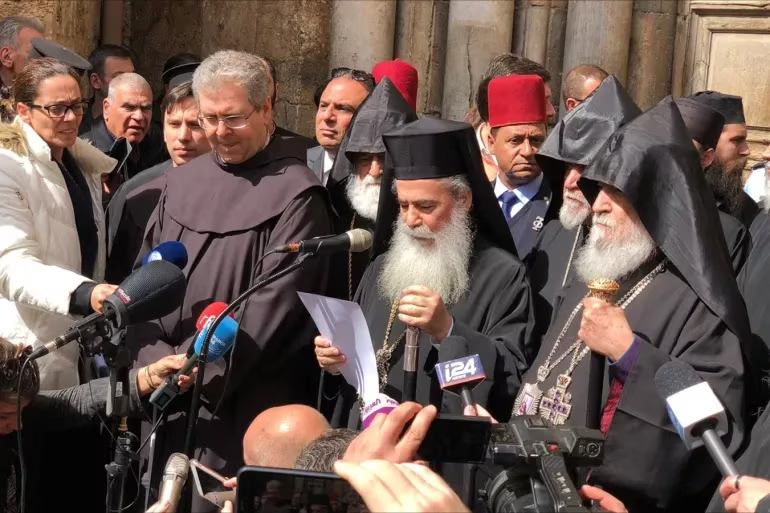
The patriarchs and heads of churches in Palestine announced their strong rejection of the phenomenon of "Christian Zionism" and its promotion, affirming that it serves only Israel and warning of its harm to the Christian presence in the Holy Land. They emphasized that the representation of Christians in the Holy Land is an exclusive ecclesiastical responsibility undertaken by the historical churches, warning against individuals and initiatives that claim to represent Christianity outside the official ecclesiastical framework, as this constitutes misleading public opinion, harming the unity of the flock, and serving political agendas that affect the Christian presence in Jerusalem and the Holy Land. This came in a statement that stressed that the care of Christians in this land "is entrusted to the apostolic churches that have carried their sacred message throughout the centuries with unwavering devotion," adding that "recent activities by local individuals promoting harmful ideologies such as Christian Zionism mislead public opinion, sow discord, and harm the unity of the flock."

Sources say that the efforts of these individuals have been welcomed by some political actors in Israel and abroad, "who seek to impose a political agenda that may harm the Christian presence in the Holy Land and the Middle East in general."

In the statement, the churches of Jerusalem expressed "grave concern" over the welcome these individuals have received at both official local and international levels, "because these actions are considered interference in the internal affairs of the churches, and a disregard for the pastoral responsibility entrusted to the patriarchs and heads of churches in Jerusalem." The heads of churches affirmed that "claiming authority outside the scope of the church harms the unity of believers and burdens the pastoral mission entrusted to the historical churches in the very land where our Father lived, taught, suffered, and rose from the dead." They stressed that "the patriarchs and heads of churches alone represent the churches and their congregations in matters related to Christian religious, social, and pastoral life in the Holy Land."

What's happening?

Sources approached the Latin Patriarchal Vicar General in Jerusalem, Archbishop William Shomali, and asked him about what was happening and about the individuals referred to in the statement issued last Saturday evening. He refused to disclose names for fear of giving these individuals importance, but he warned of the danger of spreading this ideology "because those individuals change, fluctuate, change their minds, and become more fundamentalist."

He said that the heads of churches refrain from mentioning names, "but they criticize the ideology that defends one party over another and gives rights to one party over another, and this is not permissible."

He added: "Firstly, it is known that Christian Zionism supports extremist Zionist ideology against the rights of the Palestinian people, and secondly, these individuals claim to represent Christian opinion, thought, and the street, but in reality, they are a minority, and the true representative of Christianity in the Holy Land are the heads of churches, and we do not want anyone to outbid us because this is against the truth, and it creates discord against the Christianity present in this country, which holds a moderate view towards the required solution for the Palestinian issue."

Regarding the visits organized by these individuals to official Israeli figures, Shomali said that after organizing them, they issue statements or make certain demands for Christians in order to give themselves legitimacy, such as demanding the opening of a specific closed church, or obtaining a right here or there.

He added, "They are in fact asking for small things to give themselves legitimacy that they are defending the Christian street as representatives of Christians, and we say that they represent only themselves."

Dangerous Misleading

Shomali warns of the danger of these individuals despite their small number, for "their ideology is present and has an impact, and its proponents mislead public opinion, including American public opinion, and this is dangerous because America is a decision-maker in the region."

But what is important - according to Shomali - is to note that these individuals "do not represent us, and what represents us Christians in the Holy Land are the statements issued by the heads of churches in the social, religious, and official spheres, and not just anyone who raises a flag and says they represent Christians."

Regarding the future impact of these individuals' activities, he said that they create local discord and may mislead diverse public opinion, "and although many know the truth and will not be affected by the ideology of Christian Zionism, there is a group that does not know it and is affected by what it hears."

"Therefore, those concerned with the issue must have a unified stance, not listen to dissonant voices that create discord, which show that Christians are against the rights of their people and have double standards, and it is assumed that what is said in secret is said in public and vice versa, and this is what the patriarchs and heads of churches do," according to Shomali.

When asked if the activity of individuals leading the thought of Christian Zionism in the Holy Land has increased since the beginning of the last war on Gaza, he said, "No, it has not increased, but every word during the war creates a bigger stir... The people are the same and the ideology itself has not changed, but every word spreads like lightning in war."

Faithful, Not Political, Teachings

For his part, George Akroush, Director of Development and Planning at the Latin Patriarchate in Jerusalem, said that Christians categorically reject the manipulation of some interpretations and the invention of new meanings not intended by the Bible in order to justify one people seizing the land of another, referring to the support of religious Zionism for Israel.

He added, "As Christians, we refuse to give any political interpretation to the Bible because it is a book of religious and faith teachings and encourages love, self-sacrifice for others, giving, and peace, and carries no political meanings."

It is worth noting that a Christian delegation, including religious leaders representing friends of Israel, the largest in history - according to Israeli media - visited Israel in coordination with its foreign ministry in early December last year.

PALESTINE

Sun 18 Jan 2026 8:37 pm - Jerusalem Time

Gaza Peace Council: Crisis Resolution or Political Subjugation?

On January 16, 2026, US President Donald Trump announced the establishment of what he called the “Gaza Peace Council,” as the second phase of his plan to end the war in the Strip, which came into effect in October, following the announcement of a ceasefire agreement. The White House revealed the members of the council, which Trump will chair, and includes prominent political and economic figures from within and outside the US administration, among them US Secretary of State Marco Rubio, Special Envoy for the Middle East Steve Witkoff, former British Prime Minister Tony Blair, Trump’s son-in-law and former advisor Jared Kushner, in addition to World Bank President Ajay Banga, and businessmen Mark Rowan and Robert Gabriel. According to the White House statement, the council is supposed to be a strategic administrative body to navigate the transitional phase in Gaza, by overseeing reconstruction, attracting investments, managing regional relations, and supporting a Palestinian technocratic government. However, reading these objectives in their political context leads us to a fundamental question: Are we truly facing a peace project, or an American strategy to re-impose sovereignty on the Middle East and manage the crisis without resolving it?

Despite Washington's attempt to give the council an international character, its composition reveals an almost complete American dominance over decision-making; the council includes figures loyal to Trump's policy, and their mere presence restores the centrality of American decision-making in Palestine after years of war and mediations. In contrast, political representation for the Palestinian side, the primary party concerned with the crisis, was absent, whether from resistance factions or elected members, which reflects a perception that change in Gaza can only be managed from outside. In this context, it seems that supporting a technocratic government is merely part of a broader plan aimed at separating politics from administration, and transforming governance in the Gaza Strip into a technical administration under international supervision, excluding Palestinian sovereignty and the right to self-determination, and producing guardianship, not peace.

However, the most dangerous aspect of the council's announcement is the accompanying explicit speech by Trump, in which he asserts that Hamas will disarm voluntarily or by force, in a direct threatening language that empties the idea of peace of its content, and redefines it as a mechanism of military subjugation, while ignoring that weapons in the Palestinian context are not a luxury or rebellion, but are directly linked to the continuation of the Israeli occupation and its ongoing violations and breaches, which makes the option of disarmament unrealistic.

Thus, it is clear that the Gaza Peace Council was not established to address the roots of the Palestinian-Israeli conflict, but rather to manage the crisis without resolving it, and to restore American power and decision-making in the Middle East. This plan falls within broader international moves by Washington to re-impose its system established during World War II, and its leading role, in addition to demonstrating its ability to manage crises in the presence of strong competitors such as Russia and China.

In conclusion, the council lacks neutrality, and the foundations upon which peace is built are absent from it, namely the recognition of the Palestinian people's right to self-determination and their involvement in decision-making.

On January 16, 2026, US President Donald Trump announced the establishment of what he called the “Gaza Peace Council,” as the second phase of his plan to end the war in the Strip, which came into effect in October, following the announcement of a ceasefire agreement. The White House revealed the members of the council, which Trump will chair, and includes prominent political and economic figures from within and outside the US administration, among them US Secretary of State Marco Rubio, Special Envoy for the Middle East Steve Witkoff, former British Prime Minister Tony Blair, Trump’s son-in-law and former advisor Jared Kushner, in addition to World Bank President Ajay Banga, and businessmen Mark Rowan and Robert Gabriel. According to the White House statement, the council is supposed to be a strategic administrative body to navigate the transitional phase in Gaza, by overseeing reconstruction, attracting investments, managing regional relations, and supporting a Palestinian technocratic government. However, reading these objectives in their political context leads us to a fundamental question: Are we truly facing a peace project, or an American strategy to re-impose sovereignty on the Middle East and manage the crisis without resolving it?

Despite Washington's attempt to give the council an international character, its composition reveals an almost complete American dominance over decision-making; the council includes figures loyal to Trump's policy, and their mere presence restores the centrality of American decision-making in Palestine after years of war and mediations. In contrast, political representation for the Palestinian side, the primary party concerned with the crisis, was absent, whether from resistance factions or elected members, which reflects a perception that change in Gaza can only be managed from outside. In this context, it seems that supporting a technocratic government is merely part of a broader plan aimed at separating politics from administration, and transforming governance in the Gaza Strip into a technical administration under international supervision, excluding Palestinian sovereignty and the right to self-determination, and producing guardianship, not peace.

However, the most dangerous aspect of the council's announcement is the accompanying explicit speech by Trump, in which he asserts that Hamas will disarm voluntarily or by force, in a direct threatening language that empties the idea of peace of its content, and redefines it as a mechanism of military subjugation, while ignoring that weapons in the Palestinian context are not a luxury or rebellion, but are directly linked to the continuation of the Israeli occupation and its ongoing violations and breaches, which makes the option of disarmament unrealistic.

Thus, it is clear that the Gaza Peace Council was not established to address the roots of the Palestinian-Israeli conflict, but rather to manage the crisis without resolving it, and to restore American power and decision-making in the Middle East. This plan falls within broader international moves by Washington to re-impose its system established during World War II, and its leading role, in addition to demonstrating its ability to manage crises in the presence of strong competitors such as Russia and China.

In conclusion, the council lacks neutrality, and the foundations upon which peace is built are absent from it, namely the recognition of the Palestinian people's right to self-determination and their involvement in decision-making.

On January 16, 2026, US President Donald Trump announced the establishment of what he called the “Gaza Peace Council,” as the second phase of his plan to end the war in the Strip, which came into effect in October, following the announcement of a ceasefire agreement. The White House revealed the members of the council, which Trump will chair, and includes prominent political and economic figures from within and outside the US administration, among them US Secretary of State Marco Rubio, Special Envoy for the Middle East Steve Witkoff, former British Prime Minister Tony Blair, Trump’s son-in-law and former advisor Jared Kushner, in addition to World Bank President Ajay Banga, and businessmen Mark Rowan and Robert Gabriel. According to the White House statement, the council is supposed to be a strategic administrative body to navigate the transitional phase in Gaza, by overseeing reconstruction, attracting investments, managing regional relations, and supporting a Palestinian technocratic government. However, reading these objectives in their political context leads us to a fundamental question: Are we truly facing a peace project, or an American strategy to re-impose sovereignty on the Middle East and manage the crisis without resolving it?

Despite Washington's attempt to give the council an international character, its composition reveals an almost complete American dominance over decision-making; the council includes figures loyal to Trump's policy, and their mere presence restores the centrality of American decision-making in Palestine after years of war and mediations. In contrast, political representation for the Palestinian side, the primary party concerned with the crisis, was absent, whether from resistance factions or elected members, which reflects a perception that change in Gaza can only be managed from outside. In this context, it seems that supporting a technocratic government is merely part of a broader plan aimed at separating politics from administration, and transforming governance in the Gaza Strip into a technical administration under international supervision, excluding Palestinian sovereignty and the right to self-determination, and producing guardianship, not peace.

However, the most dangerous aspect of the council's announcement is the accompanying explicit speech by Trump, in which he asserts that Hamas will disarm voluntarily or by force, in a direct threatening language that empties the idea of peace of its content, and redefines it as a mechanism of military subjugation, while ignoring that weapons in the Palestinian context are not a luxury or rebellion, but are directly linked to the continuation of the Israeli occupation and its ongoing violations and breaches, which makes the option of disarmament unrealistic.

Thus, it is clear that the Gaza Peace Council was not established to address the roots of the Palestinian-Israeli conflict, but rather to manage the crisis without resolving it, and to restore American power and decision-making in the Middle East. This plan falls within broader international moves by Washington to re-impose its system established during World War II, and its leading role, in addition to demonstrating its ability to manage crises in the presence of strong competitors such as Russia and China.

In conclusion, the council lacks neutrality, and the foundations upon which peace is built are absent from it, namely the recognition of the Palestinian people's right to self-determination and their involvement in decision-making.

PALESTINE

Sun 18 Jan 2026 4:38 pm - Jerusalem Time

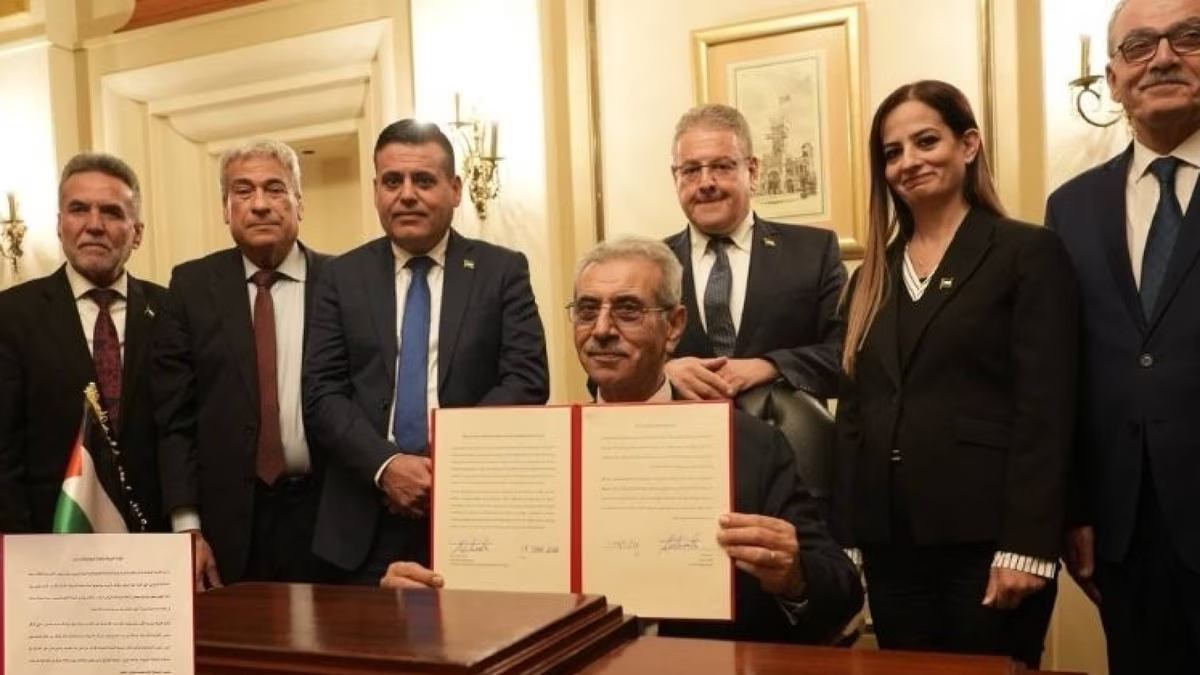
National Committee for Gaza Administration begins work.. Ali Shaath signs first official decisions

The Commissioner-General of the "National Committee for Gaza Administration," Ali Shaath, announced on Sunday the official commencement of the committee's work by signing its first official decisions, revealing details related to the tasks entrusted to the committee in the coming period.

Shaath wrote on his "X" account: "Today, in my first official act, I approved and signed the statement of the National Committee for Gaza Administration (NCAG); confirming our administrative mandate and operational principles."

He explained that "under UN Security Council Resolution 2803, and President Donald Trump's 20-point peace plan; the committee is dedicated to transforming the transitional period in Gaza into a foundation for lasting Palestinian prosperity."

The Commissioner-General added: "Under the supervision of the Peace Council, chaired by President Trump, and with the support and assistance of the High Representative for Gaza, our mission is to rebuild the Gaza Strip not only in infrastructure, but also in spirit."

He continued: "We are committed to establishing security, restoring essential services that are the cornerstone of human dignity, such as electricity, water, healthcare, and education, as well as building a society based on peace, democracy, and justice."

Shaath affirmed that the committee will work according to the highest standards of integrity and transparency, to build a productive economy capable of providing equal opportunities for all instead of unemployment, concluding his speech by saying: "We embrace peace, through which we seek to secure the path towards genuine Palestinian rights and self-determination."

For his part, US Secretary of State Marco Rubio welcomed working with the committee, and wrote in a tweet on the "X" platform: "I look forward to working with Dr. Ali Shaath and the National Committee for Gaza Administration to build a better future for the people of Gaza and the entire region."

PALESTINE

Sun 18 Jan 2026 4:37 pm - Jerusalem Time

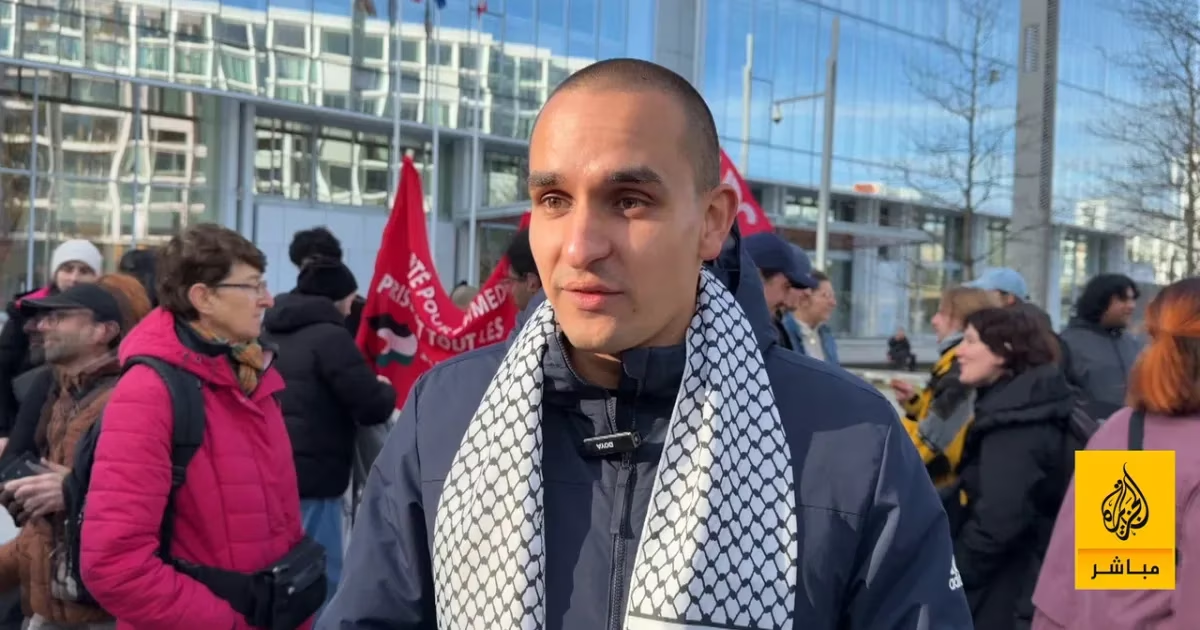
When solidarity becomes a crime.. a French activist faces prison because of Gaza

In a Paris courtroom, Alex is not an ordinary defendant, but a young man in his twenties who found himself facing terrorism charges because of his supportive stance on the Palestinian cause. The French public prosecutor is demanding a one-year prison sentence for him, along with two years of judicial supervision, his name being registered on the list of terrorism suspects, in addition to a fine of one thousand euros.

Alex, who preferred to be identified only by his first name, speaks of a path of harassment that began with his arrest for 48 hours last March on charges of promoting terrorism, before he was fired from his job and his bank accounts were frozen. Despite this, he says that what he was subjected to "is nothing compared to the repression faced by the Palestinian people," a comparison that summarizes his position and reveals his motives.

The young man belongs to the "French Revolutionary Youth League" and is facing legal prosecution after giving a speech at a pro-Palestine demonstration, in which he called for the release of the Lebanese activist Georges Abdallah, who was detained in France at the time. Since then, his name has been present in judicial files, but he asserts that this has not deterred him from continuing to take to the streets.

To this day, Alex participates in demonstrations condemning what he describes as the French role in the war on Gaza. He says in a sharp voice, "France is not just a supporter of the Zionist regime, but a direct partner in the genocide in Gaza, by sending weapons to Israel." Words he repeats, aware of their legal cost, but he insists on not backing down from them.

Alex is awaiting a new court hearing scheduled for next February 10th, but he affirms that his compass is still directed towards Palestinian prisoners, saying, "We must think of the thousands of Palestinian prisoners, more than 12,000 prisoners held in Israel." He believes that his personal battle is part of a broader issue that transcends the borders of his country.

The young man says, "We can tell them that we will be with them until the end, and that they can count on the French people and we will not let them down." For him, Gaza today represents "a model of pride and honor for all free peoples and revolutionaries in the world."

Despite the persecution and pressure he faces, Alex concludes his speech with a tone not devoid of determination, "The people of Gaza are entering history. They have written its pages with ink of blood. They are leading a battle for the freedom of the whole world, not just for Gaza."

Between the walls of the courtroom and the clamor of the street, the young man continues his battle, believing that the personal cost is less burdensome than silence.

OPINIONS

Sun 18 Jan 2026 7:08 am - Jerusalem Time

Netanyahu... swallowing his tongue!

Ibrahim Melhem

Ibrahim Melhem

Opinion Writer

The “Likud wolf” could not bear to continue the “silence” he had resorted to since the announcement of the formation of the National Committee for the Administration of the Gaza Strip, headed by the national engineer Ali Shaath, and the Peace Council headed by Trump, which includes Turkey and Qatar as members. This was a silence of lurking, typical of him, as he had bet on the Authority's rejection of the council to relieve him of the burden of confronting the costs and uproar of Trump's anger towards those who oppose him or deviate from the path he sets.  


Contrary to his usual arrogance and peacocking in media power displays, Netanyahu contented himself with a brief, leaked statement after the end of Shabbat, indicating his limited options; the administrative council, born in Cairo, put the “Likud wolf” in direct confrontation with his ally in the White House, forcing him to proceed on a path he had long tried to avoid by citing unresolved issues."


Before that, Netanyahu instructed the militias under his control, which feed on his agendas, to announce their rejection of the committee's formation, indicating his confusion, after the committee begins its tasks as defined by the twenty clauses of Trump's plan, with the start of the second phase that Netanyahu suspended over the body of "Ran Goli," and announced its commencement against his will.


Whatever the plots, traps, and drawn plans, they will not be able to bypass national rights. Just as the “National Guidance Committee,” formed in the seventies of the last century and during the Stone Intifada, came with the entitlement of recognizing national entity, the Gaza Committee, with its formation, clear objectives, and sound positions, is capable of thwarting all attempts at separation and overthrowing the illusions of fragmentation. 


 The bet today is not only on the committee's administrative prowess but also on its ability to transform the “technical” into the “political” and prevent Gaza from being turned into an administrative canton disconnected from the rest of the homeland.

ARAB AND WORLD

Sun 18 Jan 2026 7:05 am - Jerusalem Time

Widespread Anger After US Diplomat's Remarks Equate Refugees with "Barbarian Hordes of Rapists"

Remarks attributed to Sarah B. Rogers, US Under Secretary of State for Public Diplomacy, have sparked a massive wave of anger and criticism on social media, after she used language described as racist and anti-Islamic, which starkly contradicts the principles the United States claims to uphold in its official discourse on human rights and pluralism.

The media storm erupted after Rogers posted on Thursday on the "X" platform (formerly Twitter), where she re-shared an unverified screenshot of an alleged news article, before accompanying it with comments that evoked dangerous stereotypes about refugees and Muslim communities, and at the same time raised sensitive allusions related to Germany's history and its Jewish community.

The post, which quickly spread widely, included the expression that "Germany retains very few Jews, yet it imported barbarian hordes of rapists," a phrasing that human rights activists and campaigners saw as inflammatory language crossing red lines, especially when coming from a high-ranking American official tasked with managing discourse directed at global public opinion.

These statements came in the context of Rogers' response to a discussion about German laws to combat hate speech on social media. She had referred to what is known as the "Cologne attacks" that occurred on New Year's Eve 2015–2016, when hundreds of women reported being harassed and sexually assaulted near the city's main train station, incidents that at the time sparked widespread debate about asylum policy in Germany.

However, Rogers' critics emphasized that invoking those events does not justify generalizing the accusation to entire groups of refugees, nor using language that reduces religious or ethnic groups to being described as "hordes" or "invaders." The controversy was further intensified by the fact that the tweet was in response to a comment from another user who said that "Jews allowed black people in," in a clear attempt to fuel hate speech, which many considered a moral and professional failure in dealing with a racist provocation.

Across social media platforms, condemnations poured in from activists, journalists, and politicians who saw the statements as evidence of a worrying slide in the language of official American discourse. Some went as far as to say that the incident cannot be reduced to a "slip of the tongue," but rather reflects a broader trend towards adopting ideological and polarizing rhetoric in government officials' accounts, at the expense of balanced diplomatic language.

Critics pointed out that this shift has become more evident in recent months, especially in the context of discussions related to immigration and refugees within the United States, where some official statements tend towards cultural conflict rhetoric, and the repetition of internal political narratives instead of adhering to traditional diplomatic standards.

Observers believe that the seriousness of the incident is compounded by Rogers' own position. As Under Secretary of State for Public Diplomacy, she is responsible for presenting the image of the United States abroad, countering disinformation campaigns, and promoting values such as tolerance, freedom of religion, and human rights. However, her language, according to her critics, reflects the very discourse that Washington claims to fight when it comes from extremist groups or authoritarian governments.

Anti-racism activists warn that normalizing this type of discourse, even through officials' personal social media, legitimizes hatred and encourages extremist voices globally, and also undermines the moral credibility of the United States in sensitive issues such as combating anti-Semitism and Islamophobia.

This incident reveals a structural flaw in understanding public diplomacy as merely an extension of internal debate on social media. A diplomat, unlike a local politician, does not speak to a single audience, but to a world of multiple cultures and sensitivities. Using language charged with stereotypes not only offends the targeted groups but also empties the concept of "soft power" of its meaning, and transforms American discourse from a tool of persuasion into a factor of repulsion.

According to experts, the most dangerous aspect of this incident is that it comes within a broader context witnessing an erosion of the ethical constraints of official discourse, especially on issues of immigration and identity. When high-ranking figures adopt provocative language instead of responsibility, racist discourse becomes less shocking and more commonplace. This shift is not only reflected internally but also weakens the ability of the United States to present itself as a moral authority in a world experiencing a sharp rise in policies of hatred and exclusion.


PALESTINE

Sun 18 Jan 2026 1:55 am - Jerusalem Time

The Occupation announces its rejection of Trump's declaration of a "Gaza management committee".. and confirms: it contradicts our policy

In a surprising development that may reshuffle the cards in the region, the office of the Prime Minister of the Israeli Occupation, Benjamin Netanyahu, announced on Saturday its categorical rejection of the declaration issued by US President Donald Trump regarding the formation of the "Executive Committee for the Administration of Gaza" affiliated with the "Peace Council."

The official statement issued by the Israeli Occupation Prime Minister's Office stated that "Israel was not part of the coordination" that led to the announcement of the names of the committee members or its executive tasks. The statement considered that any administrative structure for the Gaza Strip that does not guarantee "full Israeli security control."

This rejection comes hours after Dr. Ali Shaath announced from Cairo the start of the committee's work with American and Arab support. Observers believe that Netanyahu fears that the transformation of the "technocratic committee" into an actual authority may mean: reducing Israeli influence in the reconstruction file and aid distribution.

Pressure to withdraw: International demands began for the occupation to withdraw from the "Netzarim Corridor" and the northern part of the Strip to enable the committee to do its work.

Clash with Trump: This position is the first public confrontation between Netanyahu and the Trump administration in its second term, after months of close coordination.

Attention is now turning to US envoy Steve Witkoff to see if Washington will proceed with supporting the committee despite the Israeli occupation's objection, or if Trump will exert "behind-the-scenes" pressure on Netanyahu to accept this settlement, which was approved by Palestinian factions in Cairo.

PALESTINE

Sun 18 Jan 2026 1:55 am - Jerusalem Time

Hebrew media: The army will carry out operations in the southern Gaza Strip within hours, and strong explosions and artillery sounds will be heard

Military analysts believe that these operations may aim to destroy what remains of the resistance's infrastructure.

Sources reported that military forces intend to carry out a series of field operations in the southern areas of the Gaza Strip within the next few hours.

This new escalation comes amidst tragic humanitarian conditions experienced by the residents of the Strip, portending a new wave of violence that could deepen the current crisis and increase the complexities of the political and security landscape.

The southern areas of the Gaza Strip, particularly the cities of Khan Yunis and Rafah, are sensitive contact points that have witnessed intensive military operations by the occupation throughout the past months.

These areas have suffered widespread destruction of infrastructure as a result of continuous aerial and artillery bombardment, leading to the displacement of hundreds of thousands of civilians to more crowded and less secure areas.

This field movement intersects with international pressures led by "America" to reach a truce, as leaks indicate the "Trump" administration's desire to politically handle the Gaza file to allow the "occupation" to focus on other fronts, including the escalating tension with Iran.

In the context of warning settlers and its public opinion, sources clarified that the southern region of the Strip will witness significant military activity.

Sources indicated that residents in the surrounding areas will hear violent explosions and strong artillery sounds resulting from these planned military movements.

Military analysts believe that these operations may aim to destroy what remains of the resistance's infrastructure or carry out localized raids based on intelligence information.

These anticipated military operations in southern Gaza place the region before grim scenarios, as the "occupation" appears to be continuing its military decisive approach despite international warnings.

As the sound of artillery is awaited in the coming hours, eyes remain on the extent to which diplomatic moves, especially from "America," can curb the escalation and prevent the Strip from sliding into further destruction, amidst the "Trump" administration's ambitions to rearrange the Middle East files.

PALESTINE

Sat 17 Jan 2026 10:43 pm - Jerusalem Time

Earthquake in Dimona.. Did Israel conduct a nuclear test before the war with Iran?

A strong earthquake measuring 4.2 on the Richter scale struck the Negev Desert in southern Israel yesterday, Thursday, causing sirens to blare in various areas and sparking widespread online speculation about the possibility of Israel conducting a secret nuclear test.


Did Israel conduct a nuclear test before the war with Iran? 

The earthquake occurred amidst a nationwide school emergency drill, and during one of the most tense periods in years between Israel, Iran, and the United States.


Residents felt the ground shake for several seconds in northern areas reaching central Israel and even beyond occupied Jerusalem, and social media quickly filled with questions.


One X user wondered if the 3.9-magnitude earthquake near Dimona meant that Israel had just conducted a nuclear test. American fighter Jake Shields claimed that the timing and location, near the secret Dimona nuclear facility, seemed like a deliberate signal, and perhaps even a warning directed at US President Donald Trump to intervene in a war against Iran.


The uproar increased because the earthquake's strength and short duration reminded some of the feeling of low-to-medium yield underground nuclear explosions, and this event came just hours after Trump backed down from his earlier threats to strike Iran.


Jordan also felt it

The director of the Jordanian Seismological Observatory, Ghassan Sweidan, reported yesterday, Thursday, that an earthquake measuring 4.1 on the Richter scale was felt by residents of several areas in Jordan, including the governorates of Amman and Balqa, this Thursday morning at 10:00 AM.


Sweidan explained, in press statements, that the epicenter of the tremor was in the Dead Sea region north of Ghor as-Safi at a depth of 17 kilometers, without recording any additional details.


Sweidan indicated that this type of earthquake does not pose a danger to buildings or facilities, noting that Jordan recorded 106 earthquakes within its borders and neighboring areas last year. 


He affirmed that the areas of Aqaba, Wadi Araba, the Dead Sea, the Jordan Valley, and Tiberias are historically among the most seismically active areas, considering that the current situation is not out of the ordinary.

PALESTINE

Sat 17 Jan 2026 7:40 pm - Jerusalem Time

A humanitarian tragedy in Khan Yunis.. "Bitter cold" claims the life of an infant

Medical and local sources in the Gaza Strip reported on Saturday the death of an infant girl in the city of Khan Yunis, coinciding with security tensions east of the city.

The sources confirmed the death of the infant Aisha Ayash Al-Agha, 27 days old; as a result of being affected by the cold wave and low temperatures.

The sources indicated that the death resulted from a lack of necessary heating means for newborns, in light of the current living conditions.

On the security front, eyewitnesses reported that occupation vehicles stationed on the security fence opened fire towards citizens' lands and homes east of Khan Yunis, and no injuries among citizens were reported as a result.

PALESTINE

Sat 17 Jan 2026 5:13 pm - Jerusalem Time

Acquittal of Jerusalemite Ihab Al-Abbasi and 23 humanitarian workers on Lesbos Island after 8 years of prosecution

A Greek court on Lesbos Island acquitted Ihab Abbasi and 23 male and female humanitarian workers of all charges against them, ending a case that lasted eight years and constituted one of the most prominent cases of criminalizing humanitarian work in Europe.


The Palestinian Ihab Al-Abbasi, from the city of Jerusalem – a native of Silwan, was working at the time with Doctors Without Borders as the medical project coordinator for the organization on Lesbos Island (Lesvos) in Greece. He and his colleagues were charged with serious offenses, including human smuggling and belonging to a criminal organization, due to their role in coordinating humanitarian aid and reporting on refugee and migrant boats at risk in the Aegean Sea.

The case dates back to 2018 and has been widely criticized since its inception by human rights organizations and international institutions, which considered it a clear attempt to “criminalize solidarity” and deter humanitarian workers from performing their life-saving duties.

During the long years of trial, Ihab Abbasi and the rest of the defendants lived in a state of legal uncertainty and psychological and professional pressure, despite their continuous affirmation that their actions were purely humanitarian and fell within their professional and ethical duties.

On January 16, 2026, the court issued its final verdict acquitting all defendants, confirming the absence of any evidence of criminal activity, and emphasizing that saving lives and providing humanitarian assistance do not constitute a crime.

This ruling is seen as a legal and moral victory, and a clear message about the necessity of protecting humanitarian workers and respecting their role, rather than prosecuting them.

PALESTINE

Sat 17 Jan 2026 2:40 pm - Jerusalem Time

Trump invites Sisi and Erdogan to participate in "Peace Council"

Washington – Said Arikat

Official sources in Ankara and Cairo revealed that US President Donald Trump has extended invitations to both Egypt and Turkey to join what he called the "Peace Council," a new international framework announced by the White House to oversee the transitional phase in the Gaza Strip after the ongoing war.

According to the White House announcement on Friday, the "Peace Council" will be tasked with overseeing a temporary administration for the Gaza Strip, as part of a plan previously announced by Trump to end the Israeli war on the Strip, which international human rights organizations describe as a war of genocide against Palestinians in an area besieged for years. The announcement comes amid increasing international pressure to stop the fighting and growing criticism of US policies biased towards Israel.

In Ankara, the Turkish Presidential Communications Director, Burhanuddin Duran, confirmed via social media that President Recep Tayyip Erdogan received an official message from Trump on Friday, inviting him to be a "founding member" of the new council. The Turkish official did not disclose Ankara's final position on the invitation, merely indicating that the proposal is under consideration in light of regional developments and the sensitivity of the Palestinian issue.

In Cairo, Egyptian Foreign Minister Badr Abdel Atty stated during a press conference on Saturday that his country had received a separate invitation from the US President addressed to President Abdel Fattah el-Sisi to join the council, explaining that Egypt is "carefully studying the invitation" in light of its historical role in the Palestinian issue and its regional responsibilities, particularly concerning the Gaza file, crossings, and political mediation.

The White House had previously announced the names of several members forming what it described as the "Founding Executive Council," led by President Trump himself as chairman of the council, alongside US Secretary of State Marco Rubio, the President's Special Envoy Steve Witkoff, former British Prime Minister Tony Blair, in addition to Jared Kushner, Trump's son-in-law and former advisor, known for his role in drafting the "Deal of the Century."

The establishment of the council dates back to a plan revealed by Trump last October, which stipulated the formation of a Palestinian technocratic body to manage Gaza's affairs during a transitional phase, with this body operating under direct international supervision from the Peace Council. The plan, according to the American narrative, aims to "restore stability" to the Strip and create conditions for a subsequent political settlement, without including clear commitments regarding ending the occupation or guaranteeing Palestinian national rights.

However, the announcement of the council was met with sharp criticism from international law experts and human rights activists, who considered that the supervision of a major head of state over the administration of a foreign territory, without the participation of representatives of its people, reflects a modernized colonial model that ignores the principle of self-determination. The inclusion of Tony Blair's name also sparked a new wave of objections, against the backdrop of his role in the Iraq War and the grave violations associated with it, as well as the British colonial legacy in the region.

The White House did not provide precise details about the powers of each member of the council or its decision-making mechanisms, merely indicating that additional names would be announced in the coming weeks. It also confirmed that the council would include prominent economic and international figures, including Mark Rowan, CEO in private equity, World Bank President Ajay Banga, in addition to Robert Gabriel, one of Trump's advisors. It clarified that Nikolay Mladenov, the former UN envoy to the Middle East, would serve as the "High Representative for Gaza."

What is striking about the council's composition, according to observers, is the complete absence of any Palestinian representation, whether from the Palestinian Authority, civil society organizations, or political factions, which raises fundamental questions about the council's legitimacy and its ability to manage a highly complex phase in Gaza's history.

The proposed "Peace Council" reflects a traditional American approach to crisis management in the Middle East, based on internationalizing supervision and marginalizing the original stakeholders. Instead of empowering Palestinians to determine their own destiny, Gaza's future is being reshaped behind closed doors, under the guise of stability and reconstruction. This approach does not address the roots of the conflict but postpones them, and may entrench a fragile political reality, prone to explosion at the first field or popular test.

Experts believe that the participation of regional countries like Turkey and Egypt in the council, if it happens, will place them in a difficult equation between maintaining their traditional role in supporting the Palestinian cause and engaging in an international framework led by Washington on its terms. Joining may provide a limited margin of influence, but it could also be interpreted as political cover for a plan that does not guarantee Palestinian rights. Rejection, on the other hand, carries the risks of marginalization from an international path that may be imposed as a fait accompli.

Ultimately, the "Peace Council" remains a controversial initiative, reflecting an American attempt to re-engineer the scene in Gaza after the war, amidst deep skepticism about its intentions and feasibility, and open questions about the future of a strip whose people were not consulted in determining their own destiny.

OPINIONS

Sat 17 Jan 2026 2:14 pm - Jerusalem Time

Why the Iranian Regime Does Not Fall: A Reading of the Pillars of Survival, Hybrid Warfare, and the Limits of Protest

The world held its breath over the past two days, anticipating a decisive American strike against the regime in Iran, amidst unprecedented political and media escalation, and military movements that suggested the moment of truth was approaching. However, this charged anticipation did not succeed in shaking the firm conviction of reputable research centers and strategic decision-makers, who remained in agreement on one conclusion: the Iranian regime is not on the verge of collapse.

Behind the noise generated across social media, most international research centers — including the Council on Foreign Relations, the Brookings Institution, the RAND Corporation, the Center for Strategic and International Studies, the International Crisis Group, Chatham House, the European Policy Centre, the Carnegie Endowment for International Peace, and the Middle East Institute — have confirmed one result: the Iranian regime remains standing and capable of absorbing shocks, and that the overall field and political developments, and the threat of using military force, represent only a new chapter in a long-term conflict whose battles are managed with more complex tools, where a military strike is only a pressure element within a broader system of attrition and hybrid warfare, not a rapid lever for overthrow.

There are multiple reasons that make this conclusion realistic, logical, and more likely.

First: Cohesion of the Power Structure and Deep Ideologization

The role of the solid structure of the regime, primarily the Revolutionary Guard, intelligence agencies, and the judicial system, goes beyond traditional security and judicial functions to form one of the fundamental pillars integrated into the heart of the regime, and its ideological, political, and economic backbone.

The Revolutionary Guard, for example, plays a complex set of security, economic, doctrinal, and political roles. At the security level, it constitutes the first line of defense for the regime against internal and external threats; it is responsible for protecting the political system, managing sensitive internal security files, and confronting protests when they are classified as a “security-systemic” threat, which is the case in the current crisis.

This role is based on a doctrine founded on the sanctity of the principle of “defending the revolution,” and defending the survival of the regime as the survival of the intertwined security institution. This loyalty is nurtured through a cohesive ideological structure, constantly reformulated through cultural and educational institutions, a mobilizing religious-revolutionary discourse, and a narrative of a “besieged state.” Therefore, we are not talking about security personnel, but about ideologized actors who see defending the regime as defending identity, which makes any attempt at defection classified as an “existential betrayal.”

In addition, a network of economic interests protects this ideological loyalty; the Revolutionary Guard plays a pivotal economic role through direct or indirect control over strategic sectors, including energy, telecommunications, construction, and ports, which provides it with a high ability to circumvent sanctions through parallel economic networks. This economic influence makes the survival of the regime a direct interest for military and bureaucratic elites, as collapse means not only loss of power, but also loss of wealth, influence, and legal protection.

Added to this is the political role played by the Revolutionary Guard in Iranian political life, through influencing the selection of elites, drawing red lines for political action, and directing regional and security policies.

The functional roles of the Revolutionary Guard and intelligence agencies are integrated into an intertwined circle: doctrine protects loyalty, economics protects interests, security protects control, and politics protects continuity. This intertwining makes any attempt to separate one of these dimensions from the other almost impossible.

Thanks to this precise equation, a split in the hardline elite becomes extremely difficult, which is a crucial factor in the fall of authoritarian regimes. Most major collapses — from the Soviet Union to the Arab Spring regimes — were preceded by a moment of disintegration or division within the institutions of power.

In the Iranian case, this moment has not materialized; rather, the security agencies have so far shown cohesion and a high capacity for control and loyalty. As long as these agencies remain united in their vision and loyalty, the regime remains capable of resilience, even in the face of suffocating economic and social crises. The cohesion of the regime in the authoritarian Iranian model is not linked to the issue of popular acceptance or Rousseau's model of social contract theory, but rather is based on a Hobbesian approach that prioritizes security over rights and freedoms, where the regime does not need national consensus to continue, but rather the cohesion of the tools of power, which is the condition available until now.

Second: Weak and Disunited Opposition

The geographical and ideological map of the Iranian opposition reveals its fragility and limited capacity to influence; it suffers from organizational fragmentation, political contradiction, and an inability to produce a realistic governing alternative.

The opposition is geographically divided between an internal opposition and an exile opposition. The internal opposition is concentrated in major cities such as Tehran, Isfahan, Shiraz, Tabriz, and Mashhad, in addition to ethnic groups such as Kurds in the west, Baloch in the south, Arabs in Ahwaz, and some Azeri movements. This opposition suffers from decentralization, its focus on human rights issues, and weak leadership and organization, which prompts the regime to adopt a policy of direct repression against it. Despite enjoying social legitimacy, it lacks organized political transformation.

As for the exile opposition, centered in the United States, Canada, and Western Europe, despite its ability to access international media and Western decision-makers, it suffers from weak organizational reach within Iran, which puts it in a real crisis of representation.

Ideologically, the opposition is divided between a fragmented secular liberal current, a declining leftist current, and an ethnic nationalist opposition concentrated in limited areas and unable to agree on unified demands. The problem is not in diversity itself, but in the inability to transform it into a strength factor within a comprehensive political project.

Third: Absence of Strategic Pressure Tools

Symbolic demonstrations rarely overthrow a cohesive authoritarian regime. This requires shifting the conflict from the street to the joints of the state and economy through tools such as prolonged strikes, economic boycotts, and sustained civil disobedience. However, the Iranian experience shows a recurring pattern: escalation, then repression, then decline, due to the regime's ability to cut coordination chains, disrupt the internet, raise the cost of organization, and invest in the discourse of an “external conspiracy” to justify repression.

Fourth: The Parallel Economy as a Tool of Political Control

Iran possesses what research centers describe as an “adaptation economy,” where regime institutions, primarily the Revolutionary Guard, control strategic sectors through parallel economic networks, front companies, and mechanisms to circumvent sanctions. This leads to shifting the cost of economic pressures from the authority to society, while the ruling elite remains protected through monopoly, political protection, and redistribution of privileges.

In light of the above, it is clear that the Iranian regime does not survive by repression alone, nor does it fall by protest alone. The ongoing conflict is not a conflict of a decisive moment, but a long-term war of attrition whose battles are managed with hybrid tools that restrict behavior without overthrowing the regime, and exhaust society without dismantling the power structure. Between the external bet on gradual pressure and the internal bet on institutional resilience, Iran remains stuck in a complex equation: a cohesive regime, a crisis-ridden society, and an opposition unable to transform into an alternative. This equation explains why, despite all the noise, collapse seems far from imminent.