PALESTINE

Tue 10 Feb 2026 12:37 pm - Jerusalem Time

Widespread Arrest Campaign Targets Dozens in the West Bank, Occupation Closes Vital Roads in Jerusalem

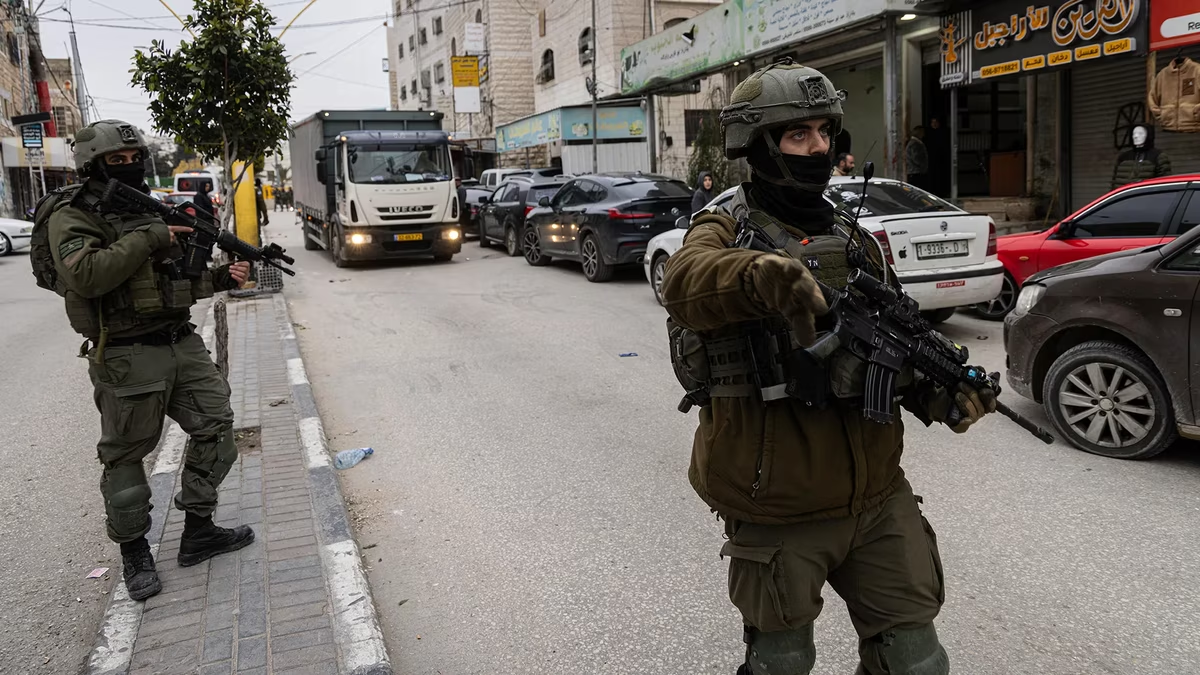
Human rights and field sources reported that Israeli occupation forces launched a widespread arrest campaign since dawn on Tuesday, targeting more than 30 Palestinians, including children, in various areas of the occupied West Bank. The raids focused on cities in the north and center, where military vehicles stormed several residential neighborhoods amidst strict security measures that included firing gas and sound bombs at the homes of unarmed citizens.

In Qalqilya city, the military operation continued for more than five consecutive hours, during which occupation soldiers conducted field surveys and photographed streets and alleys before withdrawing. The raids also targeted the cities of Jenin and Nablus, in addition to the towns of Siris, Maysalun, and Al-Laban Al-Sharqiya, where six citizens were arrested from the latter village alone after thorough searches of homes and tampering with their contents.

In the central and southern West Bank, the occupation army stormed the cities of Bethlehem and Jericho, and the town of Al-Mughayyir northeast of Ramallah, while the town of Ni'lin was subjected to four consecutive raids during the past hours. Local sources confirmed that occupation soldiers deliberately destroyed household furniture and closed town entrances, hindering the movement of citizens and causing a state of extreme tension among residents.

In occupied Jerusalem, the occupation police completely closed the vital 'Dahiyat Roundabout' near Beit Hanina town, which is a crucial passage for Palestinians holding Jerusalem IDs heading to the city center. This closure coincided with the storming of Silwan town south of Al-Aqsa Mosque, where municipal and police teams raided commercial shops and began implementing restrictive measures against business owners and residents.

These escalations come amidst a continuous increase in the pace of security pursuits since October 2023, with official data indicating the arrest of more than 21,000 Palestinians since that date. According to the latest updates from the Prisoner's Club, more than 9,300 prisoners are currently held in occupation prisons, living in harsh conditions, including 58 female prisoners and 350 children facing systematic punitive measures.

Occupation forces stormed most West Bank cities since dawn, carrying out field surveys and home raids.

PALESTINE

Tue 10 Feb 2026 12:37 pm - Jerusalem Time

3 Dead and Extensive Demolition Operations of Residential Buildings in Gaza Amid Warnings of Health System Collapse

Israeli occupation forces escalated their field attacks this Tuesday morning, resulting in the martyrdom of three Palestinians and the injury of several others in various areas of central and northern Gaza Strip. Medical sources confirmed the arrival of the bodies of two martyrs at Al-Aqsa Martyrs Hospital following a direct targeting on Salah al-Din Street, while a Palestinian citizen was killed by occupation bullets in Al-Masdar village.

In Gaza City, sources from Al-Shifa Hospital reported injuries among citizens due to gunfire from occupation forces stationed around the Al-Zaytoun neighborhood. This coincided with intense artillery shelling targeting residential neighborhoods in Beit Lahia city, northern Gaza Strip, leading to injuries among civilians who were transported to nearby ambulance and emergency centers.

On the ground, the occupation army carried out extensive and massive demolition operations, targeting entire residential blocks in the eastern areas of Khan Yunis city, southern Gaza Strip. Systematic destruction operations also affected buildings in Gaza City, as the occupation seeks to erase the features of residential areas within its ground incursion.

Jabalya refugee camp, northern Gaza Strip, witnessed a dangerous development, as 'quadcopter' drones dropped explosive boxes over the remaining partially destroyed Palestinian homes. These operations aim to prevent displaced people from returning or settling in areas that have been subjected to invasion in recent weeks.

At sea, Israeli warships participated in the aggression by firing their machine guns heavily towards the coasts of Rafah and Khan Yunis cities. This naval shelling was accompanied by movements of military vehicles in the eastern areas, increasing the state of tension and displacement in those areas.

In a recent statistic, the government media office in Gaza revealed that 573 martyrs have fallen and more than 1,500 others have been injured by occupation fire since the ceasefire agreement last October. These figures reflect the continued direct targeting of civilians despite declared understandings, exacerbating the humanitarian catastrophe in the Strip.

On the health level, medical authorities in Gaza issued an urgent distress call, warning of a complete halt to laboratory services and blood banks in hospitals. This threat comes as a result of the depletion of essential laboratory materials and medical solutions due to the severe blockade that prevents the arrival of necessary supplies.

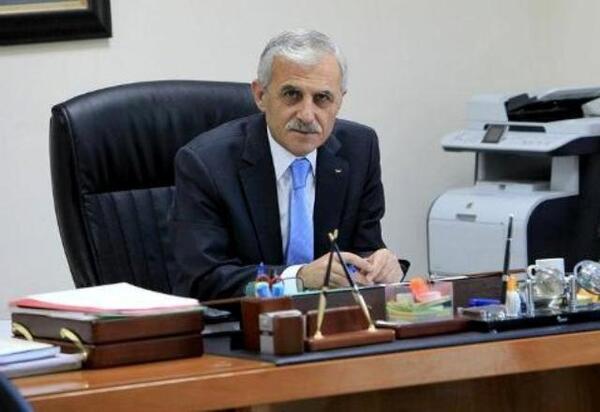
For his part, the Director-General of the Ministry of Health, Munir Al-Barsh, explained that the deficit in medicines and medical consumables has reached about 46%. He pointed out in statements to media sources that this severe shortage puts the lives of thousands of wounded and sick people at risk, especially in light of the destruction of hospital infrastructure.

In light of this crisis, the United Nations Relief and Works Agency for Palestine Refugees 'UNRWA' announced a positive step by reopening the Al-Bureij Health Center in the central Strip. The center aims to provide basic health services to thousands of displaced people after being closed for several months due to ongoing military operations.

Despite these attempts to alleviate suffering, the humanitarian situation in Gaza remains prone to further deterioration amid continued airstrikes and artillery shelling. Human rights organizations demand the permanent opening of crossings to ensure the flow of medical and food aid to save what can be saved of civilian lives.

Lack of medicines and medical equipment exposes many patients and wounded to the risk of certain death amid the continued obstruction of aid entry.

ARAB AND WORLD

Tue 10 Feb 2026 12:06 pm - Jerusalem Time

Iranian Diplomatic Movement in Muscat and Doha to Save Nuclear Negotiations

Tehran intensified its diplomatic moves in the region ahead of an anticipated visit by Israeli Prime Minister Benjamin Netanyahu to Washington, where the Iranian Foreign Ministry warned of pressures and influences it described as destructive, aimed at undermining ongoing diplomatic efforts. The Foreign Ministry spokesperson, Ismail Baqaei, affirmed that the responsibility lies with the United States to make independent decisions away from interventions that harm regional stability.

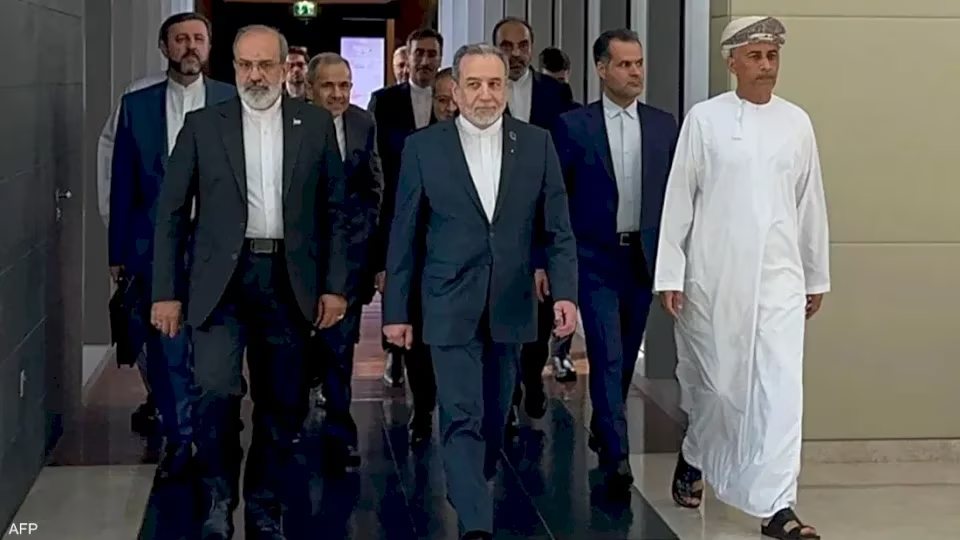
In this context, Ali Larijani, Secretary of Iran's Supreme National Security Council, began a tour that included the Qatari capital Doha and the Sultanate of Oman, as part of a pre-planned program to strengthen bilateral relations and regional consultations. These visits come to complete the diplomatic path related to the nuclear file, as Tehran seeks to ensure the support of neighboring countries for the dialogue process and reduce the intensity of escalating tensions.

Iran's Foreign Ministry stressed that the Israeli regime has proven on several occasions its opposition to any diplomatic process that could lead to peace in the region, describing it as a disruptive party. Sources clarified that the current Iranian move aims to block any attempts to obstruct potential understandings between Tehran and international powers, especially in light of the intensive Israeli activity in Washington.

Baqaei pointed out that the fundamental problem lies in the seriousness of the American administration in returning to the right path, especially after previous experiences described by Tehran as bitter. He noted that last year's talks ended with attempts at military action, which necessitates a comprehensive and accurate assessment by the Iranian side before proceeding with any new steps.

The Sultanate of Oman is considered a vital center for these talks, where Tehran appreciated Muscat's historical role in mediation and its continuous efforts to bridge viewpoints. The current discussions in the Sultanate are taking place in an atmosphere described as positive, with Iran emphasizing its commitment to red lines that prevent discussing any files outside the framework of the nuclear program.

In parallel with the political movement, Iran affirmed the continuation of its consultations with active countries in the region, including Egypt, Turkey, the UAE, and Saudi Arabia, to ensure comprehensive regional stability. Tehran believes that the security of the region must stem from the cooperation of its countries, away from external interventions aimed at inciting conflicts or imposing specific agendas.

On the military front, the commander of the Iranian Air Force announced that the armed forces are on high alert and fully prepared to confront any aggressive action that may target the country. These statements come as a deterrent message coinciding with political pressures, to emphasize that the diplomatic option does not mean a weakening of the Islamic Republic's defensive posture.

In the context of strengthening trust with neighboring countries, the Iranian Minister of Defense visited Azerbaijan to discuss military cooperation in the South Caucasus region. These moves aim to build a regional security system based on mutual trust and contribute to promoting peace and stability away from border tensions.

Iran's Foreign Ministry reiterated its emphasis on the peaceful nature of its nuclear program, noting that it is seriously striving to remove any artificial global concerns about possessing nuclear weapons. It called on Washington to focus on actions, not words, stressing the need to curb the practices of lobbies that try to sabotage the course of diplomatic talks.

Informed sources reported that recent meetings between Iranian and American officials, including the meeting between Araghchi and Witkoff, showed an understanding on Washington's part of the necessity of continuing dialogue. However, Tehran remains wary of potential contradictions in American policy, insisting that the lesson lies in the actual implementation of international commitments.

The party we are negotiating with is the United States, and the decision is theirs to act independently of the destructive pressures and influences that harm the region.

PALESTINE

Tue 10 Feb 2026 11:58 am - Jerusalem Time

Emergency Meeting of the Arab League to Discuss Escalating Settlement in the West Bank

The Arab League is preparing to hold an emergency meeting at the level of permanent delegates in an extraordinary session next Wednesday, in response to an official request submitted by the State of Palestine. This diplomatic move aims to study effective Arab and international actions to confront the series of aggressive decisions recently approved by the Israeli occupation government, which aim to seize more occupied Palestinian lands.

The agenda of the upcoming meeting focuses on addressing the systematic occupation policies aimed at consolidating the reality of annexation and colonial expansion in the West Bank. These policies include expanding settlements by seizing private and public lands, in addition to the escalation of home demolitions and Palestinian structures, leading to forced displacement of residents in flagrant violation of international laws and conventions.

The permanent delegates will also discuss the seriousness of the recent measures in the city of Hebron, which involve transferring municipal powers to the so-called 'Civil Administration' affiliated with the occupation army, in a step aimed at strengthening settlement control over the heart of the city. Diplomatic sources warned that these moves are accompanied by dangerous attempts to change the existing legal and historical status of the Ibrahimi Mosque (Cave of the Patriarchs), which threatens the identity of Islamic holy sites.

Through this emergency session, the attendees seek to formulate a unified and firm Arab position that places the international community and UN institutions before their legal and moral responsibilities to stop these null and void measures. The Palestinian leadership considers these practices to be a continuation of the comprehensive war of aggression waged by the occupation authorities against the Palestinian people, their land, and their holy sites, which requires immediate international action to provide international protection.

The meeting seeks to formulate a unified Arab position that places the international community before its responsibilities to stop the null and void Israeli measures.

OPINIONS

Tue 10 Feb 2026 11:50 am - Jerusalem Time

Elections in the Age of Digital Noise: A Battle of Awareness Against Misinformation

Information is no longer exclusive to media institutions or official sources. With the widespread proliferation of social media and its various platforms, news has become accessible to everyone, in terms of production, dissemination, and commentary. This openness, despite the opportunities it presents for enhancing participation and interaction, has, in turn, created a serious challenge: the difficulty of controlling information, especially during sensitive national moments.

In Palestine, we are living through a delicate and pivotal phase with the approaching local elections, including the nomination and electoral campaign stages. This phase demands the highest levels of awareness and responsibility, not only from official institutions but from society as a whole. Elections, at their core, are a purely democratic practice, and local elections, in particular, affect the daily lives of citizens because they involve competition to provide better services within local bodies that form the service backbone of society.

However, these democratic atmospheres are not without challenges. In every election, misleading news, rumors, and inaccurate information proliferate, whether targeting the electoral process itself, questioning its integrity, or affecting candidates, organizers, and those responsible for its administration. With the rapid spread of digital content, a rumor can turn into a circulating "truth" before there is an opportunity to verify or deny it.

The danger lies not only in false information but in its cumulative effect on public awareness. Continuous questioning, sowing doubts, and undermining trust in institutions are all tools used—intentionally or unintentionally—to weaken faith in the entire democratic process. In the Palestinian context, such news often goes beyond legitimate criticism to become an insult to everything Palestinian, individuals and institutions alike, in a complex political and media environment open to targeting.

In many cases, the goal of those spreading misleading news is not to seek truth or public interest, but rather to achieve greater interaction, settle political and personal scores, target specific candidates, or disrupt the bodies organizing the electoral process. Here, digital platforms transform from a space for public discussion into an open arena of conflict, where information is used as a weapon.

However, in contrast to this confusing scene, Palestinian popular awareness emerges as a fundamental line of defense. The Palestinian people, who have accumulated long experience in confronting misinformation and directed propaganda, possess an advanced critical sense and realize the danger of being drawn behind everything that is published. This awareness is what makes many rumors short-lived and gives truth a chance to emerge despite the noise.

Nevertheless, awareness alone is not enough without fostering a culture of verification and digital responsibility. Today's citizen is not just a recipient but a partner in shaping the media landscape. Every share, repost, or comment can contribute to solidifying correct information or expanding the circle of misinformation. Hence, responsibility becomes both individual and collective.

Official and media institutions also have a pivotal role in this phase, by providing accurate and timely information, promptly responding to rumors, and adopting clear and transparent discourse that preempts interpretation and questioning. The absence of official information opens a wide door for alternative narratives, some innocent and most misleading.

Local elections are not just a political competition at this particular time, but a real test of society's awareness and democratic maturity. Protecting this entitlement from misleading news is not the task of a specific entity, but a shared national responsibility, starting with the individual, passing through the media, and not ending with institutions.

In the end, truth remains stronger than rumor, and awareness stronger than misinformation, when we all choose to be part of the solution, not the problem, and to treat words as if they were actions, because their impact in election time can change the fate of trust, distort an image, or demolish an entire national effort.

OPINIONS

Tue 10 Feb 2026 11:50 am - Jerusalem Time

Israel and the Logic of Creeping Annexation: The Most Dangerous Settlement Decisions in 58 Years

The Israeli government, through the Ministerial Committee for National Security Affairs (the Cabinet), has approved a package of decisions and budgets considered the most dangerous since 1967, according to the description of the Settlement Council itself, which deemed them a practical declaration that "the Land of Israel belongs to the Jewish people" and a consolidation of Israeli sovereignty over the land de facto. This development constitutes a pivotal station in the path of annexation and settlement, not as a transient measure, but as a fully-fledged strategic option.

Yedioth Ahronoth newspaper confirms that the government has allocated millions of shekels to what is called "Hill Management," i.e., the random settlement outposts that are gradually being transformed into self-sufficient settlements.

This step represents a central tool in the policy of "creeping annexation," based on creating accumulated facts on the ground, without official declaration, but ultimately producing actual sovereignty over the occupied Palestinian land.

The danger of these decisions lies in their being a direct continuation of the "Nation-State Law of the Jewish People" approved by the Knesset in 2018, which granted constitutional cover for discrimination and denied the right to self-determination for the Palestinian people. Therefore, what is happening today is not an emergency deviation in Israeli policy, but a practical translation of an ideological structure that views the land as an exclusive right and Palestinians as an existence without sovereign rights.

From the perspective of international law, these policies represent a blatant violation of peremptory norms that are beyond dispute.

The West Bank, including East Jerusalem, is occupied territory according to international humanitarian law and is subject to the Fourth Geneva Convention, which prohibits the transfer of the population of the occupying power to occupied territories.

Moreover, Security Council resolutions, especially Resolution 2334, affirm the illegality of settlements and the nullity of any measures aimed at changing the legal or demographic status of the occupied territories.

Despite this, the Israeli government continues to defy international law and resolutions of international legitimacy, disregarding all efforts aimed at achieving a just peace. Settlement and annexation policies empty the talk of a "two-state solution" of its content, transforming the West Bank into isolated islands, while Jerusalem is encircled by a suffocating settlement belt, practically eliminating any possibility of a viable Palestinian state.

More dangerously, these decisions do not threaten Palestinians alone but undermine regional stability as a whole. Expanding occupation does not produce security but accumulates reasons for explosion.

Denying the national rights of the Palestinian people will not impose a permanent reality but opens the door to further tension and violence, keeping the region hostage to an open conflict.

What is happening today confirms, beyond any doubt, that Israel acts as a state above the law, seeing itself immune from international accountability. This behavior not only threatens peace prospects but strikes at the foundations of the international system based on respect for rules and law.

In the face of this reality, the responsibility of the international community becomes a legal and moral responsibility that cannot be postponed.

Statements of concern are no longer sufficient; what is required is a serious transition from managing the conflict to holding the occupation accountable and enforcing respect for international law, to protect international peace and security.

As for the Palestinian people, despite the magnitude of the challenges, they reaffirm once again that rights do not lapse with time, and that annexation and settlement projects, no matter how great, will not grant legitimacy to the occupation, nor will they negate a fixed truth: that this land has a people, and this people continues its legitimate struggle in defense of its right to its homeland.

OPINIONS

Tue 10 Feb 2026 11:49 am - Jerusalem Time

Palestine Faces Its Most Dangerous Test: Do We Have the Courage to Awaken?

The call for a Palestinian awakening, as presented in the previous article, was not an expression of a moral inclination or a longing for a past national moment, but an attempt to capture a harsh historical moment, imposed by the war of extermination on Gaza, and what it revealed of a comprehensive collapse in protection, representation, and meaning systems. The question today is no longer: Do we need an awakening? But rather: Does this awakening possess the conditions for its realization, and the tools for its transformation into an actual political and social path?

There are objective elements that prepare the ground for a national renaissance, even if its realization is not automatically guaranteed. Foremost among them is the deep collective shock caused by the war, not only as crimes of extermination but also as a revealing moment of the failure of the international system, the inability of the existing Palestinian political system, and the dead end for the continuation of the old rules for managing the conflict.

In addition, there is the accelerating erosion of the legitimacy of the prevailing political structures, in contrast to an existential anxiety that crystallizes with the rise of social awareness that transcends, even if partially, the duality of division, and seeks a new meaning for nationalism, which is not reduced to authority nor monopolized in the name of resistance. Nor can the remarkable shift in global public opinion be ignored, especially in the West, where the monopolies of the Israeli narrative have been broken, and a broader moral readiness to listen to the Palestinian voice has emerged, provided that this voice is unified, rational, and capable of addressing the world in the language of politics, not just the language of the victim.

The call for a Palestinian awakening is not an intellectual luxury nor a romantic restoration of an imagined national past, but a conscious attempt to capture a pivotal historical moment.

The question is no longer whether the Palestinian cause is going through a comprehensive structural crisis, as this has become self-evident, but whether Palestinians are capable of transforming this catastrophic moment into a historical turning point that rebuilds politics and meaning, or whether they will allow it to be drained within the same cycle: authority without sovereignty, resistance without horizon, sacrifices without price, and a society without a voice.

The Awakening: From Emotion to Historical Consciousness

Awakening, in its deep meaning, is not an explosion of anger nor a fleeting awakening of conscience, but a transition from a policy of reaction to a policy of conscious action. It is a moment of collective realization that the old tools are no longer just ineffective, but dangerous, and that their continuation is no longer only politically costly, but existential and moral.

Awakenings are not born from the magnitude of the tragedy alone, but from the ability to transform tragedy into knowledge, knowledge into organization, and organization into responsible political action. It is not a break with resistance, but its liberation from monopoly and exploitation, and not a revolution against the past, but a liberation from its captivity.

Why Now? The Window of Historical Opportunity

What distinguishes the war of extermination on Gaza is that it came in a different global context; an unprecedented moral exposure of the international system, a tangible crack in the Israeli narrative among global public opinion, and a sharp erosion of the legitimacy of the existing Palestinian political structures. This synchronicity created a deep gap between Palestinian society and its political elites, but it is a gap that can be transformed into a historical bridge, if it is filled with a new national project that redefines politics as a service to the people, not their management, and representation, not guardianship, and responsibility, not privilege.

Major Challenges: Why Does Awakening Seem So Difficult?

In the face of this opportunity, stands a thick and heavy shield of structural challenges. Division is no longer just a political dispute, but has turned into a self-producing system; interests, apparatuses, mobilization discourses, and mutual fear of accountability. Therefore, any real awakening will be met as a threat to an existing structure, not just a debatable idea.

Added to this is a deep societal exhaustion, where anger intersects with fear of change, and despair becomes a form of self-defense. As for the regional environment, it deals with Palestine from the perspective of stability and conflict management, not from the perspective of justice and liberation.

The Two Existing Authorities: Adopting the Discourse and Rejecting the Entitlement

In this context, it is unlikely that the dominant forces on the scene will welcome the idea of awakening as an opportunity for reconstruction.

Hamas may verbally identify with the vocabulary of awakening, but it will practically reserve any path that separates resistance from the monopoly of decision-making, or redefines the relationship between weapons and society.

As for the Palestinian Authority, it will view awakening as a direct threat to existing balances, and tend to contain or empty it, instead of engaging in a real structural transformation. The problem here is not in intentions, but in the logic of authority when it becomes an end in itself.

Palestinians: Between Skepticism and Readiness

The Palestinian street, despite its fatigue and frustration, is more ready than it seems to interact with any path that restores its voice and role. The reception will not be immediately enthusiastic, but cautious and skeptical, as a result of long experiences of disappointments. However, this caution can turn into actual support if people perceive three clear things:

First, that this approach does not seek to replace one guardianship with another.

Second, that it does not compromise on rights or exploit blood in internal conflicts.

Third, that it grants society a real, not symbolic, role. Palestinians are not looking for new discourses, but for a different policy.

Levers and Tools Capable of Turning Awakening into Reality

Transforming awakening from an idea into a path requires realistic tools, foremost among them:

1. A carrier that links the national and the democratic-social as a vision for the philosophy of governance and administration, and as an independent framework that accommodates living social forces, credible independent figures, serious democratic forces, and social movements, especially from youth, women, and camp residents, in addition to trade unionists and academics, without claiming exclusive representation, and without turning into a party.

2. A minimum national program that does not compete with ideological programs, but focuses on rebuilding national representation on democratic foundations, protecting society from political disintegration and the danger of social disintegration, and linking resistance to a comprehensive national decision.

3. Redefining resistance and politics;

Resistance not reduced only to weapons, and politics not reduced to authority, but to the ability to manage the conflict in a way that serves rights and people together.

4. Popular and community action tools such as unions, popular committees, and public opinion campaigns, capable of imposing national discussion, without waiting for permission from anyone.

5. A rational discourse directed abroad that addresses the world in the language of law, justice, and human rights, without compromising the essence of the cause.

6. Flexible and vital structures and frameworks capable of investing in and developing popular innovations.

Palestinian society is not a desperate mass or outside of history. It is a skeptical society, yes, but it is not indifferent. Long experience has taught it caution towards slogans, not withdrawal from politics. Therefore, the reception of any awakening will be conditional on its sincerity; does it restore people's role? Does it protect sacrifices from exploitation? Does it open a path, however long, to salvation? Palestinians are not waiting for miracles, but for a credible policy.

The Arab and International Dimension: A Conditional Opportunity

The popular Arab mood is in line with any Palestinian orientation that restores the moral meaning of the Palestinian cause, but it needs a reliable Palestinian carrier that gives it a political horizon. Arab regimes will deal cautiously, fearing a political model that transcends guardianship. Internationally, popular forces need a rational Palestinian partner, and Palestinians need this moral depth. The official West will try to contain any new path within the logic of "conflict management," while the countries of the South will find in it an opportunity to strengthen their anti-colonial discourse. The Israeli occupation realizes that the most dangerous thing it faces is not a faction, but a comprehensive national project that redefines the conflict outside the duality of security and violence.

From Awareness to Path: Levers and Tools

Awakening is not measured by the eloquence of texts or the sincerity of intentions, but by its ability to transform into a viable social and political path. For awareness, no matter how mature, remains fragile if it does not find levers to organize it, tools to protect it, and mechanisms to transform it into an influential force for change.

Foremost, an independent national framework emerges, not a new party or a factional alternative, but a comprehensive and flexible space, deriving its legitimacy from society, not from authority, and from independence, not from positioning. A framework that does not claim exclusive representation, but creates a new moral and political balance in public life.

Related to this is a minimum national program, which does not postpone major disputes or drown in them, but focuses on clear historical tasks: ending division as an existential threat that contradicts the national need to strengthen the ability to survive and endure, rebuilding political representation, protecting the national fabric of society, and linking all forms of resistance to a comprehensive and responsible national decision.

And to transform this program into a force for action, there must be peaceful and community pressure tools: unions, professional associations, youth movements, popular committees, and public opinion campaigns, which impose national discussion as a right, and return politics to society after it has long been monopolized by ossified elites.

Finally, awakening is not complete without a new political discourse that reconnects the Palestinian interior with the exterior, not on the basis of begging, but on the basis of moral and political partnership, and gives popular allies in the world a clear Palestinian address that they can defend.

In this sense, awakening is not an event, but a dynamic structure: nourished by society, pressuring authority, unsettling the occupation, and addressing the world with confidence.

Palestinian awakening is not a promise of quick salvation, nor a ready-made recipe for victory, but a difficult commitment to rebuilding politics from below, not from above; from society to leadership, not the other way around.

And in a time of extermination, this commitment becomes a form of resistance, because it refuses to turn sacrifices into fuel for stagnation, or to reduce the conflict to managing the catastrophe instead of striving to overcome it.

History does not give peoples many opportunities.

And when it does, it does not forgive wasting them in the name of fear, or false realism, or waiting for a miracle that will not come.


PALESTINE

Tue 10 Feb 2026 11:49 am - Jerusalem Time

New Batch of Returnees Arrives in Gaza via Rafah Crossing Amidst Israeli Restrictions

A new batch of Palestinian returnees from Egyptian territories arrived in the Gaza Strip via the Rafah land crossing early Tuesday morning, comprising 40 individuals, including women and children. This return comes amidst severe Israeli restrictions imposed by the occupation authorities on movement since the partial and limited reopening of the crossing recently.

Medical sources in the Strip confirmed that specialized teams immediately transferred the returnees upon their arrival to Nasser Hospital in Khan Yunis city, south of the Strip, to assess their health conditions. The sources clarified that the batch included a number of injured and sick individuals who had been receiving medical care in Egyptian hospitals during the past period.

For his part, Raed Al-Nims, spokesperson for the Palestinian Red Crescent Society, stated that this batch is the sixth of its kind and consists of 20 patients accompanied by 20 of their relatives. Al-Nims indicated that the society's teams continue their humanitarian efforts to evacuate critical cases and secure the return of stranded citizens despite significant field challenges.

Israeli occupation authorities had reopened the Palestinian side of the Rafah crossing on February 2nd, after imposing full military control over it since May 2024. However, movement through the crossing remains extremely slow and subject to strict restrictions, depriving thousands of Palestinians of their right to movement and return.

Official estimates in Gaza indicate a huge gap in health needs, with approximately 22,000 injured and sick individuals awaiting their turn to leave the Strip for life-saving treatments. This backlog is a result of the near-complete collapse of the medical system due to the direct targeting of hospitals and health facilities during the ongoing war.

In a related context, field data revealed that approximately 80,000 Palestinians have registered on lists of those wishing to return to the Gaza Strip from abroad, which observers see as evidence of their steadfastness on their land despite the immense destruction. Returnees recounted harsh testimonies about being subjected to humiliating interrogations by occupation forces during their crossing, including the elderly and minors.

It is worth noting that the Rafah crossing was the only lifeline for the movement of individuals before the outbreak of the war, where it was managed in Palestinian-Egyptian coordination away from direct Israeli intervention. Despite the understandings included in the October 2025 ceasefire agreement regarding the reoperation of the crossing, Israeli procrastination continues to hinder the restoration of normal movement for travelers.

Approximately 22,000 injured and sick individuals are in urgent need of leaving the Strip for treatment amidst the near-complete collapse of the health system.

PALESTINE

Tue 10 Feb 2026 11:48 am - Jerusalem Time

Washington Rejects West Bank Annexation, Remains Cautious Amid Israeli Moves Deepening Occupation Control

The White House on Monday reiterated its opposition to Israel's annexation of the West Bank, emphasizing that maintaining stability in the occupied territories is a fundamental pillar of the American vision for Israel's security and for "peace" arrangements in the region. This came in response to the Israeli Security Cabinet's decision, which on Sunday approved a package of measures aimed at expanding Israeli administrative influence in areas of the West Bank that, under the Oslo Accords, are supposed to fall within the Palestinian Authority's jurisdiction.

A White House official said in a written statement distributed to journalists who requested comment on the Israeli decision: "President Trump has made it unequivocally clear that he does not support Israel's annexation of the West Bank." The official added that "the stability of the West Bank enhances Israel's security and is consistent with this administration's goal of achieving peace in the region."

However, the American statement appeared remarkably cautious, as it did not include a direct condemnation of the measures approved by Israel, nor did it address them in detail, even though observers consider them steps that affect the core of the existing arrangements since Oslo, by transferring administrative and sovereign powers from the Palestinian Authority to Israel, and expanding the Israeli government's ability to impose facts on the ground in disputed areas.

The measures were announced by Israeli Finance Minister Bezalel Smotrich and Defense Minister Israel Katz, following their approval by the Security Cabinet. They include allowing Jewish Israelis to directly purchase land in the West Bank, in addition to transferring the authority to issue building permits for Jewish settlements in Hebron—the largest city in the West Bank—from the Palestinian Authority to Israel. These amendments also strengthen Israeli control over two prominent religious sites in the southern West Bank: Rachel's Tomb near Bethlehem, and the Ibrahimi Mosque (Cave of the Patriarchs) in Hebron.

Analysts believe that Washington continues to adhere to rhetoric that rejects "annexation" as an announced concept, but avoids confronting the policies that produce de facto annexation step by step. Annexation, in the current reality, no longer requires a dramatic decision as much as it requires legal and administrative engineering that redistributes control over land, resources, planning, ownership, and the management of religious sites. This distinction allows the United States to reassure its Arab partners on the one hand, and avoid a direct political confrontation with a hardline Israeli government on the other, but at the same time leaves ample room for Israel to gradually change the reality in a way that is difficult to reverse.

The White House statement did not mention whether the US administration had conveyed its objection or concern to Prime Minister Benjamin Netanyahu's government, nor did it include any reference to potential pressure or punitive measures. Similar American statements calling for "de-escalation" and "stability" in the West Bank have been repeated in recent months, especially following Israeli decisions related to settlement expansion or amendments to the powers of the civil administration.

Trump had hinted, upon his return to the White House (on December 20, 2025), that he was considering the possibility of declaring a supportive stance on West Bank annexation, a move that raised widespread questions about the future of traditional US policy. However, with escalating Israeli indications of moving in this direction, Arab allies of Washington expressed concern that annexation would undermine any realistic possibility of a two-state solution, and erode their willingness to participate in "day after" arrangements in Gaza after the war.

Last September, Trump announced that he would not "allow" Israel to annex the West Bank. However, the Israeli Knesset a month later approved two symbolic resolutions supporting annexation, in a move described as having caused discomfort to the US administration, particularly Vice President J.D. Vance, who was visiting Israel at the time, according to press reports.

In a second reading of the American position, it appears that the real red line is not the gradual policies themselves, but rather the official declaration of annexation, which carries significant political and regional costs. The administration realizes that any explicit declaration would put it in direct confrontation with its Arab partners and weaken its ability to build regional arrangements, especially in light of managing the Gaza file. Creeping annexation, however, is managed as a containable crisis as long as it does not turn into a final legal step. However, this distinction gives Israel room to maneuver: changing reality step by step, while Washington merely manages the repercussions instead of stopping the process.

Although Israel has so far avoided an official declaration of West Bank annexation, it has continued to push for measures that monitoring bodies say constitute de facto annexation, by expanding the powers of Israeli ministries within the West Bank and establishing administrative rules that give settlements a status closer to inside Israel than to the occupied territories. This reflects a political trend within the Netanyahu government, where the influence of the current advocating for full Israeli sovereignty over the West Bank is growing, with Smotrich emerging as one of the most prominent architects of this project.

During Netanyahu's last visit to the United States in late December, Trump's aides raised their concerns about developments in the West Bank, as reported by American media at the time. These concerns focused on three issues: the escalation of settler violence without accountability, the acceleration of settlement construction, and Israel's continued withholding of billions of dollars in tax revenues belonging to the Palestinian Authority, which pushed the Palestinian Authority to the brink of financial collapse.

American circles fear that weakening or collapsing the Palestinian Authority would lead to a security vacuum in the West Bank, opening the door to a widespread explosion that could threaten not only Palestinian stability but also Israeli security, and undermine Washington's ability to manage regional issues in the post-war phase.

While the White House reiterates its rejection of annexation, the gap between American statements and actual Israeli actions is widening. The measures that transfer planning, construction, ownership, and religious site management powers from the Palestinian Authority to Israel have no less impact than official annexation, because they gradually redefine the rules of control. In the absence of direct American pressure, the scene is heading towards a new reality in which the West Bank is managed by the logic of administrative dominance, not by a path of political settlement.

PALESTINE

Tue 10 Feb 2026 11:47 am - Jerusalem Time

Israeli Officer: Hamas Maintains High Readiness, Resembles 'Radwan Unit' in Tactics

The deputy commander of the Alexandroni Brigade in the Israeli occupation army made statements revealing the ongoing field challenges faced by forces in the Gaza Strip, where he affirmed that the Hamas movement still maintains high levels of combat readiness. The officer indicated that the resistance continues to challenge the Israeli military presence in the strategic 'Yellow Line' area, an area that the occupation refuses to abandon due to complex security and operational considerations.

Hebrew military sources claimed that current technology allows the occupation army to accurately monitor the underground reality, asserting that there are no offensive tunnels crossing the separation fence towards the occupied territories of 1948. However, these claims clash with the field realities recorded by the 'Al-Aqsa Flood' operation, where the resistance proved its ability to penetrate fortifications through advanced tunnel networks that were very close to the security fence.

In the context of acknowledging field losses, the officer revealed that a violent armed clash occurred about two weeks ago during a night military activity in contact areas, resulting in the injury of an Israeli company commander and his transfer for treatment. These incidents reflect the continuation of the resistance's defensive operations and its ability to target infiltrating forces despite intensive technological surveillance and ongoing military operations.

Media reports quoted a high-ranking officer as saying that the operational patterns of Hamas fighters in the current phase have become very similar to the tactics of Hezbollah's 'Radwan Unit' in terms of precision and high professionalism. The source explained that the movement, despite not carrying out large-scale offensive operations at present, maintains operational capabilities that enable it to engage in long-term attrition confrontations.

Regarding the tunnel issue, military officials admitted that the army has only been able to deal with about 50% of the tunnel network extending beneath the Strip, which is estimated at about 150 kilometers. Military commanders described this network as a 'strategic knot' that requires a long time and double engineering effort to dismantle, emphasizing that the mission is not yet over despite the use of massive amounts of water and soil to flood them.

These field developments come at a time when the ceasefire agreement, signed under a US proposal, faces continuous violations by the occupation army through shelling and assassinations. These tensions coincide with a worsening humanitarian crisis in Gaza, where residents suffer from famine, lack of medicine, and tents, amid harsh weather conditions that increase the suffering of displaced people in various areas of the Strip.

Regarding the siege, the conditions set by Benjamin Netanyahu continue to obstruct the movement of travelers and patients through the Rafah crossing, despite international mediations that took place in early February. Estimates indicate that strict security restrictions will prolong the evacuation of the wounded for several months, while the return of those stranded may take years, amid accusations against the US administration of silence regarding these practices that undermine the announced understandings.

Hamas maintains high operational readiness, with operational patterns similar to the special Radwan Unit, and continues to challenge our presence in the strategic Yellow Line areas.

PALESTINE

Tue 10 Feb 2026 11:47 am - Jerusalem Time

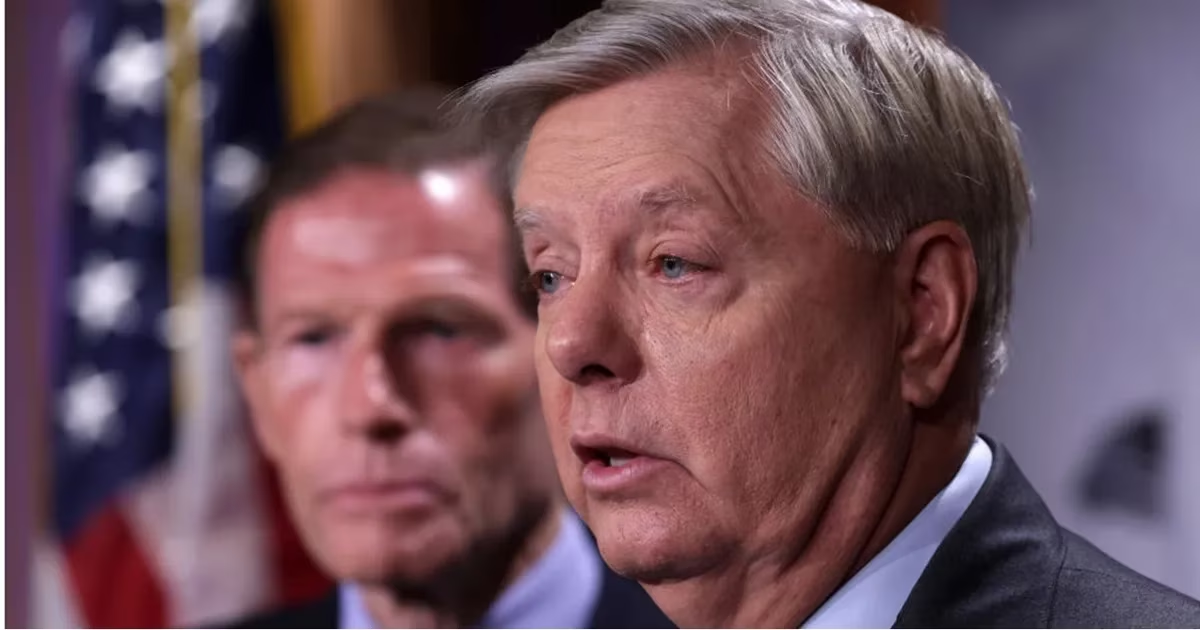
Graham attacks Washington's regional allies and describes the Iranian regime as a 'religious Nazi'

Prominent Republican Senator Lindsey Graham launched a scathing attack on what he described as 'United States allies in the Middle East,' accusing them of living in a world of illusions due to the continued channels of communication and engagement with the Iranian regime. Graham considered that attempts to maintain the stability of the regime in Tehran contradict the popular movement rejecting the current authority, emphasizing the necessity of taking more decisive stances.

Graham directed his speech directly to Turkey, Qatar, and Egypt, considering that their desire to maintain the status quo and ignore the aspirations of the Iranian people exceeds acceptable standards in international politics. The senator affirmed that these trends not only harm American national security interests but also clash with the fundamental moral principles that should govern international relations.

In a striking verbal escalation, Graham described Iranian Supreme Leader Ali Khamenei as a 'religious Nazi,' indicating that the regime in Tehran represents an existential threat to the stability of the entire region. He called on regional countries to abandon the policy of balancing and to stand cohesively and courageously against what he described as the killing machine targeting Iranians and threatening neighbors.

Graham cited the position of US President Donald Trump, who sent a direct message of support to protesters in Iran, assuring them that 'help is on the way.' The senator expressed his absolute confidence in Trump's ability to fulfill his promises, indicating that the current administration will be on the right side of history by supporting radical change in Tehran.

These statements come at a sensitive time when the region is witnessing intense diplomatic movements, where Arab and Turkish mediation has played a role in curbing an impending military escalation. The compass of negotiations has recently shifted from Ankara to the Omani capital, Muscat, where an indirect round of talks was held last Friday to discuss the thorny nuclear file.

On the ground, Tehran showed surprising flexibility by announcing its initial readiness to reduce the concentration of highly enriched uranium, provided that all financial sanctions imposed on it are lifted. Mohammed Eslami, head of the Atomic Energy Organization of Iran, stated that this technical concession aims to break the stalemate in the negotiation process with Washington and achieve an economic breakthrough.

In a related context, Washington continues to pressure Iran to dispose of its stockpile of 60% enriched uranium, which has exceeded 440 kilograms. The International Atomic Energy Agency considers that this percentage dangerously approaches the 90% level required for producing nuclear weapons, which increases the intensity of international tension regarding the Iranian program.

On the Palestinian side, this political pressure coincides with the continued suffering of the Gaza Strip despite the signing of a ceasefire agreement under Trump's proposal for the first phase. Field sources report continued Israeli bombing and assassinations, which empties the agreement of its humanitarian content amid worsening famine and a shortage of medical supplies and tents.

The US administration faces silent criticism due to its stance on the restrictive conditions set by Benjamin Netanyahu for opening the Rafah crossing, which allow a very limited number of wounded to leave. Estimates indicate that the current pace of evacuation may take six months for emergency cases, while the process of returning those stranded may extend to three years, exacerbating the humanitarian crisis.

Observers believe that Graham's statements reflect a strong current within the Republican Party pushing for military escalation against Iran, coinciding with turning a blind eye to Israeli violations in Gaza. Anticipation remains the master of the situation, awaiting the outcome of the upcoming rounds of negotiations in Oman, and the ability of regional mediators to contain the imminent explosion.

To Turkey, Qatar, and Egypt... your desire to maintain the status quo and ignore the demands of the Iranian people exceeds acceptable limits and contradicts our national security interests.

PALESTINE

Tue 10 Feb 2026 11:47 am - Jerusalem Time

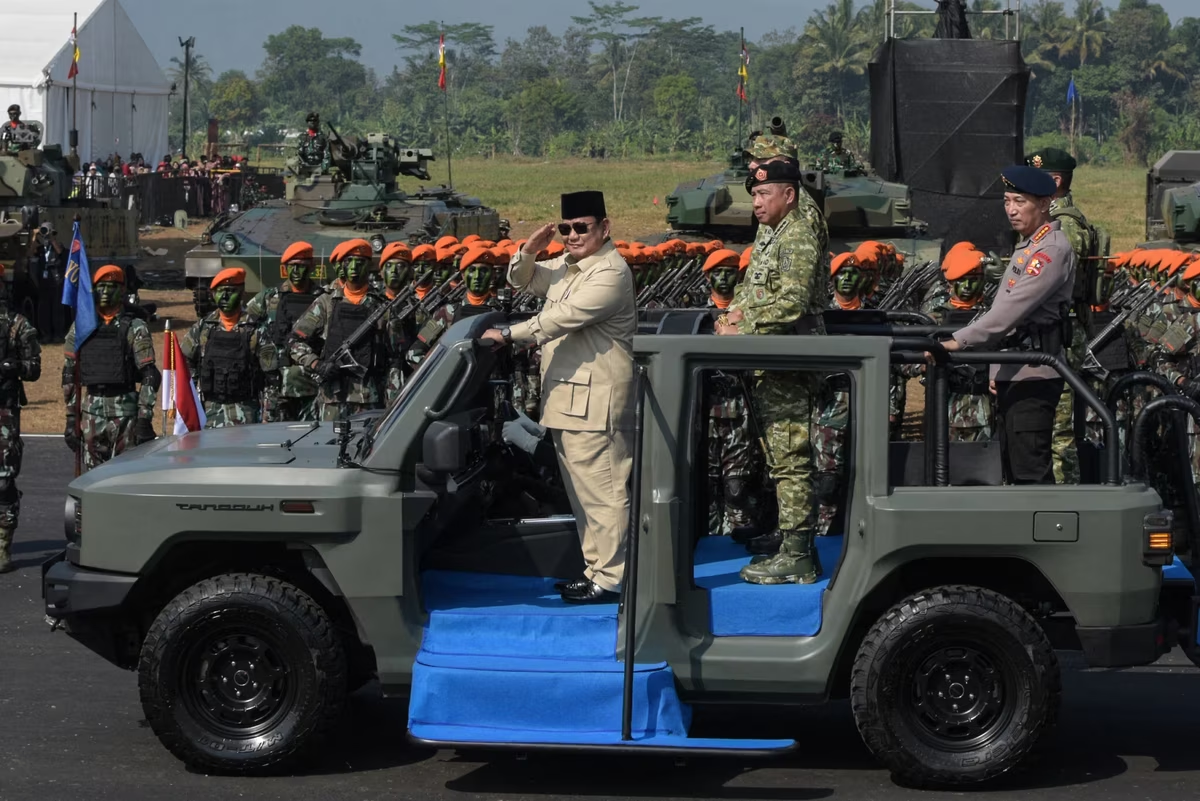
Indonesia Decides to Send Thousands of Soldiers to Gaza as Part of Trump's Proposed 'Stabilization Force'

International press reports have revealed intensive Indonesian movements to deploy thousands of soldiers to the Gaza Strip, as part of Jakarta's commitment to participate in the peacekeeping forces stipulated by US President Donald Trump's plan. This Indonesian step is the first official announcement from a major Islamic country to participate on the ground in securing and rebuilding the Strip.

General Maruli Simanjuntak, Chief of Staff of the Indonesian Army, confirmed that the armed forces have already begun specialized training operations to pave the way for a potential deployment in Gaza and other conflict areas. Simanjuntak explained that the proposed force could reach the size of a full brigade, with estimates ranging between 5,000 and 8,000 soldiers, noting that the final details are still subject to ongoing negotiations.

The current training programs for Indonesian soldiers focus on humanitarian tasks and reconstruction operations, away from direct combat missions. This force aims to be part of the 'International Stabilization Force' that Trump seeks to form, to be a multinational umbrella ensuring calm in the post-war phase, despite the continued ambiguity surrounding the structure of this force.

Informed sources indicated that expectations suggest the possibility of deploying these forces in areas under the control of the Israeli occupation army within the Strip, specifically near the 'Yellow Line'. This line represents the geographical separation between areas controlled by Israel and those still under the administration of Palestinian factions, making the mission sensitive and complex.

This step represents a fundamental pillar in the new US administration's strategy to transition to a stabilization phase in Gaza, amidst difficulties Washington faces in convincing regional allies to participate. US proposals have been met with outright rejection from pivotal Arab countries such as Saudi Arabia and Jordan, which conditioned a clear political path before any military involvement.

In a related context, reports indicate that Morocco may be the second country to join this plan after Indonesia, according to information leaked by diplomatic sources. This trend reflects the desire of some countries to engage in the new security arrangements led by Washington to ensure a role in shaping the future of the region.

Indonesian President Prabowo Subianto seeks through this participation to enhance his country's diplomatic weight on the global stage and transform it into a key player in conflict resolution. Jakarta has already agreed to join the 'Peace Council' established by Trump, an entity aimed at mediating international conflicts away from traditional UN frameworks.

Subianto is scheduled to participate in a high-level meeting in the United States on February 19 to discuss the details of the 'Peace Council' and the role of Indonesian forces. The Indonesian President, a former general, had previously shown flexibility in the possibility of sending up to 20,000 soldiers for various international missions.

Despite this involvement, Jakarta affirms its historical stance supporting the establishment of an independent Palestinian state, as it still refuses to establish official diplomatic relations with Israel. However, observers believe that Subianto's statements about the need to ensure 'Israel's security' may indicate a gradual shift in Indonesian political discourse.

Officials in Indonesia link any potential normalization of relations with the occupying state to the actual and complete achievement of a two-state solution on the ground. These developments come at a sensitive time, as regional and international powers await the success of Trump's plan in imposing a new security reality within the Gaza Strip with the participation of international forces.

The number may range between 5,000 and 8,000 soldiers, but the matter is still under negotiation and has not yet been finalized.

PALESTINE

Tue 10 Feb 2026 11:47 am - Jerusalem Time

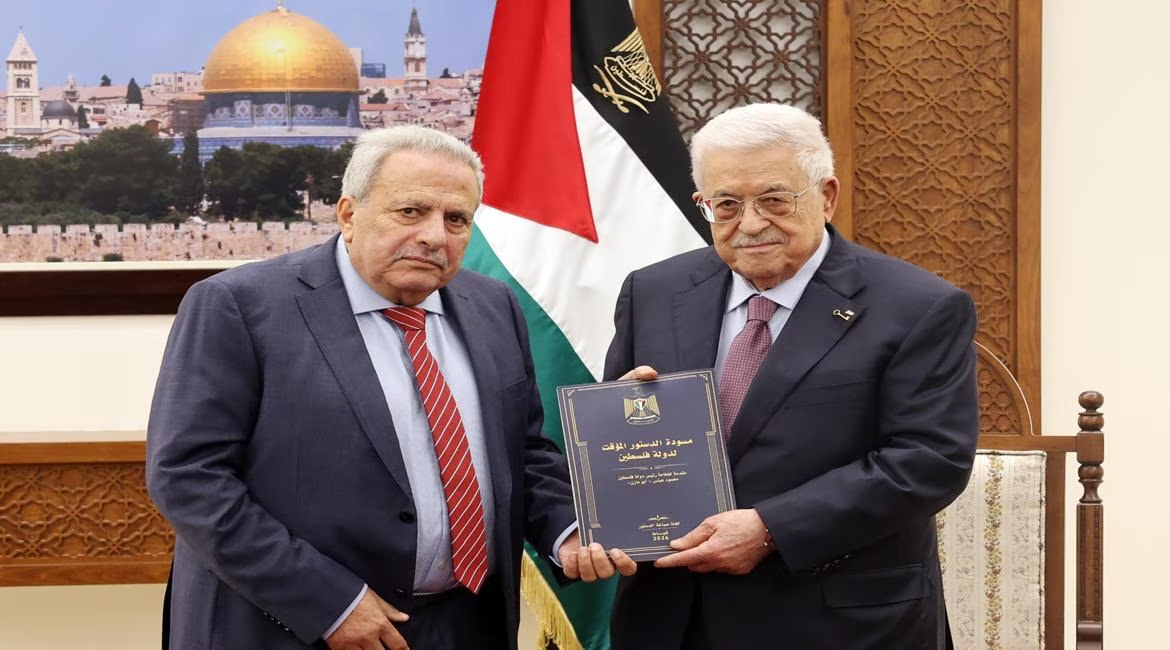
President Abbas decides to publish the draft interim constitution of the State of Palestine for public review

The President of the State of Palestine and Chairman of the Executive Committee of the Palestine Liberation Organization, Mahmoud Abbas, issued a presidential decree to present the first draft of the interim constitution project for the state for public review. This step comes in the context of striving to enhance the values of transparency and openness, and laying the foundational building blocks for an integrated legal and constitutional system that befits the aspirations of the Palestinian people. The decree has made the document accessible to the public through the electronic platform of the National Committee for Drafting the Constitution, in addition to approved official publication channels.

Through this measure, the Palestinian presidency aims to broaden the base of popular and societal participation in drafting the state's social contract. A comprehensive invitation has been extended to all citizens, civil society organizations, political forces, and academic experts to contribute their opinions and suggestions regarding the draft texts. This approach emphasizes the desire to produce a constitutional document that enjoys broad national consensus and meets the political and legal ambitions for the next phase.

The presidential decree set a time limit for receiving observations and contributions, extending for sixty days from the date of the official publication of the draft. This period is considered a golden opportunity for in-depth public discussion on the constitutional principles that will regulate the work of state institutions and guarantee the rights and freedoms of individuals. Through this timeline, the authorities seek to ensure the seriousness of the proposal and allow sufficient time for study and analysis by relevant parties and interested individuals.

On the executive level, sources clarified that the Coordination and Drafting Committee will be responsible for receiving and accurately categorizing all incoming observations. Proposals will be divided into substantive aspects related to major constitutional principles, and technical aspects aimed at improving linguistic and legal drafting. The committee will carefully study these inputs to ensure the integration of those that align with the comprehensive national vision for the constitution.

In the final stage, the committee will prepare a detailed report including the proposed amendments based on public feedback, to be submitted to the President of the State in preparation for the adoption of the final version. The decree stipulated its immediate entry into force from its date of issuance, with the necessity of its publication in the Official Gazette to ensure its legal and administrative enforceability. This step represents a significant transformation in the path of institutionalizing the Palestinian state and solidifying its sovereign pillars.

The decree aims to enhance transparency and pave the way for building an integrated legal and constitutional system that reflects Palestinian national consensus.

OPINIONS

Tue 10 Feb 2026 11:46 am - Jerusalem Time

The West Bank in the Imagination of the Israeli Right: Control, Settlement, and the Management of Long-Term Conflict

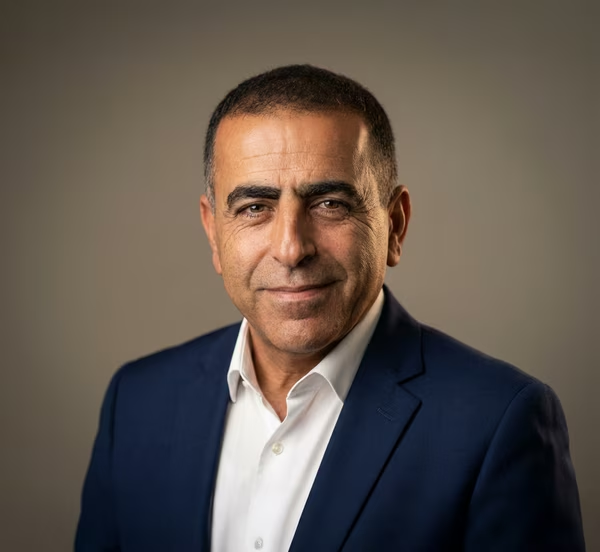
Dr. Ibrahim Nairat

Opinion Writer

The Israeli Right views the West Bank not as a disputed geographical area awaiting a political settlement, but as a land whose fate has been historically and ideologically decided. What is happening today is merely an advanced stage in solidifying this decision on the ground. In the political imagination of this Right, the West Bank is not understood as “post-occupation,” but rather as “pre-completion,” where settlement becomes not a bargaining chip, but a means to reshape both place and people. This transforms any subsequent talk of a Palestinian state into something closer to political fantasy than a realistic, achievable project.

After waves of extensive settlement, the Israeli Right does not speak of an end to the conflict or a comprehensive settlement, but rather of a quiet transition from a phase of expansion to a phase of normalizing a new reality. A reality in which Israel exercises near-complete control over the land, while Palestinians are left with limited administration of civilian affairs. The land is effectively annexed, even if not legally, and borders are erased on the ground, even if they remain present in international discourse. What matters to this current is not official declaration as much as it is for the world to wake up years later and find that a Palestinian state has become unviable, geographically, economically, and securely.

In this vision, the West Bank is reconfigured as a mosaic of large settlement blocs, bypass roads, and military zones, interspersed with besieged Palestinian cities and towns, isolated from each other, and lacking any real sovereign connection. The Palestinian here is not seen as a political partner, but as “residents” who must be managed at the lowest possible security cost. There is no place for the idea of Palestinian national rights, nor recognition of the right to self-determination. Instead, these concepts are replaced by soft administrative language that speaks of improving living standards, facilitating conditional movement, and granting expanded municipal powers, without touching the core of Israeli control.

The Israeli Right, especially in its national-religious version, treats time as a strategic ally. Every year that passes with expanding settlement and the erosion of Palestinian geography is an additional year that weakens the possibility of imposing a comprehensive political solution. The gamble is not only on military superiority, but on slow exhaustion, on Palestinians getting used to a reality without a horizon, and on the world becoming accustomed to the scene of control as a permanent state, not an emergency. In this context, the Palestinian Authority transforms into a functional tool rather than a political entity, allowed to exist as long as it plays its role in controlling Palestinian society and preventing a comprehensive explosion, without being allowed to transform into a sovereign project.

As for the Palestinian in the Right's conception, there are two options, not clearly stated: accepting a life of diminished sovereignty and rights within besieged population enclaves, or individually seeking salvation outside the place, through emigration or withdrawal from the public sphere. These options are not officially presented, but they are embodied in daily policies that tighten the noose on land, economy, and movement, turning life into a series of small concessions that appear non-political on the surface, but are eminently political in their outcomes.

Although the public discourse of a part of the Right, especially the pragmatic Right, avoids the language of explicit annexation to avoid international confrontation, the practice on the ground does not fundamentally differ from the discourse of the more extreme Right. The difference is not in the goal but in the method. The goal is one: land under permanent Israeli control, with the fewest possible Palestinians and the least possible rights for them. A Palestinian state is rejected here not only because it is portrayed as a security threat, but because it threatens the ideological narrative that sees the West Bank as an integral part of the Zionist project.

This perception is also based on a deep demographic obsession that is almost existential in the mind of the Israeli Right. From its perspective, Palestinians do not constitute merely a security or political challenge, but a cumulative numerical threat that endangers Israel's definition as a Jewish state in the long run. This fear is not always explicitly stated, but it is strongly present in policies related to land, planning, housing, and borders. Land is desired, while Palestinian residents are viewed as a problem that must be neutralized, contained, or pushed to the geographical and political margins, without being incorporated into the political body of the state.

From this standpoint, the Israeli Right sees itself today in a phase of reaping the fruits of long-term policies pursued by successive Netanyahu governments. Netanyahu was not an ideologically confrontational politician in his rhetoric, but he was an architect of a new reality that slowly and quietly took shape. During his years in power, the idea of partnership with Palestinians was gradually dismantled, not by declaring its end, but by emptying it of its content. Negotiations turned into an empty ritual, and the two-state solution remained present in external discourse while being practically undermined on the ground, and settlement continued as a state policy, not an exception.

In this context, Palestinians, and specifically the Palestinian Authority, were redefined in the Israeli political mind from “potential partner” to “managed enemy.” The Authority was no longer an entity supposed to lead to a state, but a functional apparatus used to control Palestinian society and prevent its complete collapse, without being granted any real political horizon. This shift was not surprising, but a cumulative result of discourse and policies that entrenched the idea that Palestinians only respond to pressure, and that any political concession is read as weakness, not a gesture of peace.

Added to this picture is an equally important security dimension, represented by the way the growing Palestinian military formations in the West Bank and Gaza Strip have been dealt with. In the West Bank, during the years preceding the war on Gaza, a kind of calculated tolerance was observed with the emergence of local armed groups, and they were not dealt with the decisiveness that was prevalent in previous stages. This leniency was not an intelligence oversight, but part of a political reading that sees these phenomena as a future justification for tightening security control, and deepening the narrative that portrays the Palestinian as a permanent threat, not a political partner.

As for Gaza, the Strip was left for years to grow militarily within the framework of a policy of conflict management, not resolution. The increasing capabilities of armed factions were treated as a containable or postponable danger, not a threat requiring a radical change in strategy. Partial economic facilitations, controlling the pace of confrontations, and allowing the entrenchment of a de facto rule, all contributed to creating a postponed explosive environment, which later exploded violently, and was re-employed to justify more force and reshape the political and security reality.

In contrast, the Israeli Right does not imagine the future of the West Bank as an endless state of permanent alert. Alertness, in its view, is a temporary tool used to establish control, not a long-term way of life. After achieving the minimum it deems necessary in terms of land, infrastructure, and the dismantling of Palestinian geography, the goal becomes to lower the level of explosion, not to end the conflict. Calming the population here is neither reconciliation nor partnership, but a functional calming that allows settlements to live, expand, and transform from an ideological project into an overwhelming natural reality in the public sphere.

In this framework, security itself is redefined: from an open state of emergency to routine, highly controlled security, based on surveillance, intelligence, and localized interventions, with a permanent but less noisy military presence. This model serves settlement more than open confrontation, because it provides an environment of relative stability that allows settlements to grow, invest, and impose themselves as a reality, not an exception, while the Palestinian remains in a state of permanent control, without a political horizon and without the ability to change the rules of the game.

Thus, all these threads converge into one coherent vision: demographic fear, rejection of political partnership, accelerated settlement, a Palestinian Authority stripped of its horizon, hotspots that are managed not resolved, and alertness used when needed then eased for functional calm that serves the long-term control project. What is happening in the West Bank, and what happened in Gaza, is not a series of isolated errors, but an expression of a logic that sees conflict as a permanent state that can be controlled and exploited, and explosion sometimes as a tool to rearrange reality, not a failure to be avoided.

PALESTINE

Tue 10 Feb 2026 11:46 am - Jerusalem Time

Arrangements for the deployment of thousands of Indonesian soldiers as the first foreign force in the Gaza Strip

Occupation media sources revealed on Tuesday extensive arrangements and intensive logistical preparations aimed at accommodating thousands of Indonesian soldiers in the Gaza Strip. These soldiers are set to form the first nucleus of any foreign force entering the Strip since the ongoing aggression began, as part of an international plan to manage the security situation in the coming phase.

The sources stated that these forces will be integrated into what is known as the 'International Peacekeeping Force,' where a 'field cell' has already been identified and prepared. This cell will serve as a main headquarters for the soldiers in a strategic area located between the cities of Rafah and Khan Yunis in the southern part of the Strip, to ensure control over vital contact points.

Regarding infrastructure, reports confirmed that the area extending between Khan Yunis and Rafah is technically ready to receive the forces at any time. However, sources indicated that the construction of permanent residential complexes and integrated logistical facilities for the soldiers may require several additional weeks to ensure the sustainability of the foreign military presence.

Despite no official announcement of the 'zero hour' for the arrival of the first batches, estimates suggest that the operation will come into effect within a few weeks. This timeline is linked to an anticipated pivotal meeting between Indonesian President Prabowo Subianto and US President Donald Trump in Washington in mid-February as part of the 'Peace Council' meetings.

Leaked details indicate that the Indonesian forces could number up to twenty thousand soldiers, based on previous preparations by Jakarta to participate in stabilization efforts. The tasks of these forces will not include any direct confrontation with Palestinian resistance factions or intervention in complex issues such as disarmament, but rather will focus on specific organizational and field tasks.

The main tasks of the international forces include monitoring ceasefire lines to ensure that the truce between the warring parties is not violated, in addition to direct supervision of border areas. These units will also secure certain defensive lines to ensure the separation of engagement in agreed-upon areas, especially in the southern axis which experiences continuous tensions.

Observers believe that the occupation authorities, through this step, seek to find international cover for the security administration of the Strip in the post-major military operations phase. Indonesia is considered a relatively acceptable party to play this role given its international standing, while political circles await the Washington summit which will outline the final features of this foreign presence.

The extended area between Khan Yunis and Rafah is ready to receive the forces, although the construction of permanent residential complexes may require several weeks.

PALESTINE

Tue 10 Feb 2026 11:45 am - Jerusalem Time

Death toll from bombing of residential apartment in Al-Nasser neighborhood in Gaza City rises to 4

Medical and field sources in the Gaza Strip announced today, Monday, that the death toll from the aerial bombardment that targeted a residential building in the heart of Gaza City has risen. The sources confirmed that the number of martyrs reached four citizens as a result of the raid that directly targeted an apartment in the densely populated Al-Nasser neighborhood, causing massive destruction to the area.

Civil defense and ambulance crews rushed to the targeted site immediately after the explosion, where they began searching for survivors under the rubble and recovering the bodies of the martyrs. The bombing caused extensive damage to parts of the residential building and neighboring buildings, creating a state of extreme terror among the families living in the area.

Meanwhile, Al-Shifa Medical Complex received a number of injuries of varying severity from the bombing site in Al-Nasser neighborhood. Medical teams are providing urgent first aid to the wounded who were injured as a result of the collapses that followed the violent explosion, amid difficult health conditions facing the medical sector due to the ongoing aggression.

On another field level, the northern areas of the Gaza Strip witnessed a shooting incident by the occupation forces stationed at the border. The occupation army claimed in a statement that it targeted a Palestinian with bullets after he crossed what it called the 'yellow line', claiming that the targeted person posed an imminent threat to the forces stationed in that geographical area.

These developments come in the context of a continuous escalation adopted by the occupation in various axes of the Gaza Strip, through intensifying air raids and tightening field control. Observers believe that this policy aims to impose a new security reality and establish buffer zones by targeting any Palestinian movements close to the separation lines defined by the occupier.

The violent explosion led to the destruction of large parts of the building, as civil defense teams rushed to recover the victims and rescue the injured amidst a state of panic.

PALESTINE

Tue 10 Feb 2026 11:45 am - Jerusalem Time

Israeli 'Decisive Plan': Cabinet Decisions Legitimise De Facto Annexation of the West Bank

The Israeli Ministerial Committee for Political and Security Affairs, the "Cabinet," has approved a package of escalatory decisions aimed at changing the legal and civil reality in the occupied West Bank. These moves are intended to strengthen direct Israeli control and undermine the international and legal frameworks that prevailed before 1967, paving the way for a large-scale annexation process.

In a swift diplomatic response, eight Arab and Islamic countries announced their categorical rejection of these measures, describing them as an attempt to impose "illegitimate sovereignty" and expand settlement activity. These countries considered the Israeli steps a blatant violation of international law and a direct threat to what remains of the chances for achieving a two-state solution.

Legal experts believe that these decisions are the product of a systematic effort led by Finance Minister Bezalel Smotrich, who is responsible for civil administration in the current government. This administration acts as a governmental arm seeking to manage all affairs of the West Bank, bypassing the previous administrative divisions defined by international agreements between areas (A), (B), and (C).

Hebron stands out as one of the main targets of these decisions, as planning and construction powers have been withdrawn from the Hebron municipality regarding the Ibrahimi Mosque (Cave of the Patriarchs) and Tel Rumeida neighborhood. These powers have been officially transferred to the Civil Administration, giving the occupation full ability to change the features of the sanctuary and divide it temporally and spatially to serve the settlers.

The measures also included the establishment of a new local authority within the Old City of Hebron, granting settlers independent urban and administrative powers. This step is a direct reinforcement of the settlement presence in the heart of Palestinian cities and a devastating blow to Palestinian legal jurisdiction over historical and religious centers.

In the context of land control, the Cabinet decided to declassify land records in the West Bank, allowing settlers and settlement associations access to Palestinian owners' data. Observers warned that this measure opens the door to widespread forgery operations for transferring ownership, especially since most land leakage operations occur through illegal means.

Measures did not stop there but also included the annulment of the Jordanian law that prevented the transfer of land ownership to foreigners in the West Bank. This legislative amendment aims to facilitate the purchase of land by international settlement entities or non-resident individuals, accelerating the pace of encroachment on the remaining areas of Palestinian land.

Among the most dangerous developments is granting the Civil Administration the authority to demolish Palestinian homes and structures in areas classified (A) and (B) under the pretext of protecting the environment or archaeological sites. This decision represents a complete nullification of the Oslo Accords and the Hebron Agreement of 1997, as there is no longer any legal immunity for areas supposedly under full Palestinian control.

Political readings indicate that these steps embody Smotrich's previously proposed "Decisive Plan," which aims to annex 62% of the West Bank. This plan is based on granting Palestinians very limited local self-rule in population enclaves, with absolute security and administrative control remaining in the hands of the occupation authorities.

Despite an advisory opinion from the International Court of Justice considering the occupation illegal, the absence of effective international political tools prevents these policies from being curbed. Legal options before Israeli courts remain very limited given the extreme right-wing orientation of the judges, making political and field confrontation the only remaining path for Palestinians.

These decisions represent a step towards de facto annexation of the West Bank and embody the Decisive Plan adopted by the settler right-wing led by Smotrich.

ISRAELI AFFAIRS

Tue 10 Feb 2026 11:45 am - Jerusalem Time

Accusations against Netanyahu of distorting facts and evading responsibility for the October 7 failure

The intensity of criticism directed at the head of the occupation government, Benjamin Netanyahu, has escalated, with Rafi Ben Shitrit, one of the founders of the 'October Council,' accusing him of outright lying in his testimony regarding the security and military failure on October 7. Ben Shitrit indicated that Netanyahu is trying by all means to shirk responsibility by blaming security agencies and distorting facts before public opinion.

According to informed sources, Netanyahu went further by accusing the General Security Service (Shin Bet) of falsifying an official document dating back to the day of the attack, claiming that he had not issued orders to update it. This accusation is a dangerous precedent that reflects the extent of tension between the political level and the security establishment in the occupation state, and Netanyahu's continuous attempt to erase the word 'responsibility' from his political dictionary.

Ben Shitrit explained in an article published by Hebrew media that the document Netanyahu presented to the State Comptroller, 'Matanyahu Engelman,' is nothing but a distorted personal narrative aimed at exonerating himself. He considered this step an attempt to circumvent ongoing investigations and export a narrative that serves his political survival at the expense of the historical truth of what happened on that day.

Data indicates that Netanyahu exploited the Supreme Court's decision to freeze the State Comptroller's investigation to portray himself as a victim to the public. However, the truth confirms that the freezing decision was issued based on legal petitions that questioned the ability of the comptroller appointed by Netanyahu to neutrally examine intelligence and fundamental issues.

The document presented by the Prime Minister ignored his long-standing policies towards the Gaza Strip, which allowed Qatari funds to flow for many years under the pretext of maintaining calm. Netanyahu promoted the idea that strengthening Hamas made it an 'asset' that contributed to weakening the Palestinian Authority, which he described as a 'burden' on Israel.

In a related context, the State Comptroller's report issued in September 2025 revealed continuous negligence by Netanyahu throughout his 13 years in power. The report confirmed that the absence of a clear national security concept ultimately led to the collapse of civilian and military systems at the moment of truth.

Sources confirmed that Netanyahu disregarded a series of accurate intelligence warnings that predicted widespread invasion scenarios from the Gaza Strip borders. Despite the clarity of these warnings, he continued to promote the policy of 'economic peace' and claim that the Hamas movement had been completely deterred.

Among the shocking facts revealed by Ben Shitrit is that the security establishment offered Netanyahu the liquidation of Yahya Sinwar on 11 different occasions. However, Netanyahu rejected these recommendations every time, justifying it by his fear of comprehensive military escalation, which gave Sinwar additional time to build his capabilities.

Observers believe that Netanyahu is systematically working to corrupt investigations and leak fragmented information to serve his own agenda. He also shows fierce opposition to the formation of an independent governmental investigation committee, realizing that any impartial investigation would reveal the extent of his disregard for the warnings that preceded the attack that killed 1,200 Israelis.

Reports indicate that Netanyahu's record is full of contradictions, as he currently claims to oppose withdrawal from Gaza, while historical records prove his initial vote in favor of it. This political chameleonism always aims to rewrite history to suit his personal ambitions and escape judicial and popular accountability.

Netanyahu's continuous attempts to distort the role of the Shin Bet and security institutions reflect a state of political panic within his office. He seeks to transform strategic failure into a conflict of powers, ignoring that leadership requires bearing the consequences, no matter how harsh, especially in the face of major national disasters.

Opposition leaders and civil society organizations demand the necessity of ending the procrastination and immediately starting a comprehensive national investigation. They believe that Netanyahu's continued presence in office represents an obstacle to reaching the truth and contributes to deepening the division within Israeli society, which is exhausted by the repercussions of the war.

Ultimately, the question remains in the Israeli street about Netanyahu's ability to withstand this wave of documented accusations. The facts that have begun to emerge indicate that the extent of the failure goes beyond a mere tactical error, reaching the level of structural failure in conflict management.

The formation of an independent investigation committee with broad powers is the only demand that may provide satisfactory answers to the families of the victims and society as a whole. Without it, Netanyahu's distorted narrative will remain the main obstacle to drawing lessons and correcting the security and political course in the future.

Netanyahu is ultimately responsible for the failure, and the document he presented is a cowardly attempt to evade a real investigation.

OPINIONS

Tue 10 Feb 2026 6:56 am - Jerusalem Time

Netanyahu’s Eighth White House Visit: Trump’s Mideast Doctrine Takes Shape—Pressure on Iran, Managed War in Gaza

Said Arikat

February 10, 2026

News Analysis

 Benjamin Netanyahu’s latest trip to the White House — his eighth within a single year — is not simply another high-level meeting between Israel’s prime minister and America’s president. It is a political signal about how Donald Trump’s second-term Middle East policy is taking form: not through sweeping peace initiatives, historic deals, or grand diplomatic architecture, but through a deliberate strategy of pressure, containment, and controlled escalation.

The sheer frequency of the meetings matters. This is not “coordination” in the abstract, nor a symbolic reaffirmation of alliance habits. It is a sustained attempt to treat the region’s crises as one integrated portfolio — Iran, Gaza, normalization, and regional alignments — managed increasingly as if from a joint political-security operations room. The governing logic is consistent across all files: keep pressure permanent, set the tempo, deny adversaries strategic breathing room, and use diplomacy only as an instrument operating inside coercion rather than replacing it.

Two issues sit at the center of this emerging doctrine. The first is Iran, treated as a standing arena of punitive confrontation in which the baseline must always remain hostile. The second is Gaza, treated less as a war to be ended than as a conflict to be contained — through a cease-fire or extended truce that reduces Washington’s political exposure without forcing Israel into a final settlement it cannot, or will not, accept.

On Iran, the alignment between Trump and Netanyahu is clearer than ever: pressure is policy; diplomacy is optional — and only legitimate if it remains subordinate to pressure. The nuclear program remains the headline, but the campaign is broader: sanctions, international mobilization, overt and covert threats of force, and intensified intelligence operations across the region.

Netanyahu is expected to arrive in Washington with a blunt demand: guarantees that any American engagement with Tehran will not drift toward what Israeli officials often call a “soft deal” — one that reduces sanctions pressure or gives Iran space to stabilize economically and politically. He wants to lock the Trump administration into a negotiating posture that expands beyond centrifuges and enrichment levels. From Netanyahu’s perspective, any agreement must also include Iran’s ballistic missile program, its regional posture, and its relationships with armed allies and proxy networks.

Trump appears to be pursuing a dual-track approach: a hard-line public posture that fits domestic American instincts, paired with a narrow diplomatic opening he can later present as a political win if circumstances allow. But the principle remains unchanged. Negotiations are not a substitute for pressure; they are an extension of it — another lever in the same toolkit.

That same philosophy now shapes Washington’s Gaza calculations, with one major shift: the hostage-and-prisoner file is no longer the central negotiating engine it once was. Israel announced it recovered the body of the last captive on January 26. Whatever one makes of Israel’s framing, the political consequence is unmistakable: the hostage issue — for months the emotional and diplomatic core of the war — has largely moved off center stage.

That changes the nature of the discussion. The question is no longer “What deal ends the hostage crisis?” It is the far more politically explosive question: what comes next?

Washington is not pursuing a sweeping settlement. It is looking for an exit ramp — or, more precisely, for a mechanism that reduces the war’s political and media costs without confronting the deeper structure of the conflict. This helps explain the gap between public rhetoric and private diplomacy. In public, officials speak of “ending the war.” In private, the language shifts toward “security arrangements,” “renewable cease-fires,” and truce mechanisms designed to hold long enough to stabilize optics.

This is where Trump and Netanyahu overlap — and where their interests quietly diverge. Trump wants managed calm. Gaza has become, for Washington, a strategic liability: a constant drain on credibility, a source of friction with allies, and a moral-political burden that complicates broader regional ambitions. A truce would allow the administration to claim progress, recover diplomatic bandwidth, and reopen the door to larger projects — including normalization tracks and a reset with key Arab capitals.

But Trump also appears unwilling to pay the price of a comprehensive settlement. That would require imposing firm obligations on Israel, pushing for a credible Palestinian political horizon, and confronting the deeper architecture of occupation, governance, and statehood. In effect, he wants the benefits of calm without the costs of forcing an endgame.

Netanyahu arrives with a different constraint: not international, but domestic. His coalition remains anchored in a hard-right political balance that punishes major concessions. Any meaningful compromise risks being interpreted at home as defeat. Even the language of “ending the war” can become politically toxic if it implies limits on Israel’s freedom of action, external oversight, or a postwar arrangement that reduces Israeli control.

This makes a clear political end to the war unlikely. What is more plausible is a phased formula Netanyahu can sell as tactical rather than strategic: a long truce, renewable cease-fire terms, narrowly defined humanitarian openings, and adjustments in military posture or monitoring — all without a formal declaration that the conflict has ended, and without a coherent political pathway for Gaza’s governance and reconstruction.

This is not peace. It is managed de-escalation. And managed de-escalation is fragile by design. A cease-fire without a political horizon is a pause, not a settlement. A truce without enforceable guarantees is a temporary contract waiting to collapse. Security understandings without political foundations are scaffolding — useful for a moment, but easy to dismantle under pressure.

The removal of the hostage file from the center of negotiations exposes the underlying divergence. Washington wants to reduce the war’s political cost and move on. Netanyahu wants to preserve a narrative of victory while avoiding any process that imposes future obligations — especially those tied to Gaza’s governance, reconstruction, and the broader Palestinian question.

This is why the most likely outcome of the visit looks familiar: a united posture on Iran paired with tactical flexibility on Gaza.

In practice, three scenarios emerge. The first — and most probable — is a high-profile show of unity against Iran, reinforced by rhetorical escalation and renewed sanctions-and-threats posture, alongside a limited Gaza arrangement that allows Washington to claim “progress” while leaving Netanyahu maximum room politically and militarily. The second is a stronger American push for a more durable cease-fire, which would immediately collide with Netanyahu’s coalition arithmetic and the demands of his far-right partners. The third is the most cynical but entirely plausible: vague statements, no breakthrough, and continued crisis management — keeping both files suspended until circumstances shift.

Whatever the immediate outcome, the deeper meaning of the visit is already visible. Under Trump and Netanyahu, the Middle East is not being managed through historic compromises. It is being managed through enforced “rules of engagement”: pressure, deterrence, tactical diplomacy, and constant recalibration.

On Iran, the joint goal is to keep Tehran boxed in under sanctions and containment, with the military option framed not as a last resort but as a bargaining instrument. On Gaza, the goal is not resolution but political reset: a truce that reduces international pressure and stabilizes Washington’s posture without addressing the roots of the conflict.

Which is why Gaza is likely to remain trapped in the same cycle: calm today, eruption tomorrow .

ARAB AND WORLD

Mon 09 Feb 2026 7:10 pm - Jerusalem Time

The Controversy of Revisions and Dissolving the Organization: Will the Muslim Brotherhood End Its Political Crisis?

Recently, questions have been escalating regarding the utility of the Muslim Brotherhood's continued existence in its current form, amidst repeated calls for the necessity of dissolving the organization or undertaking structural and ideological revisions. These calls are driven by the escalating political situation the group has been experiencing since its removal from power, a decision observers describe as a result of mistaken estimations in running for the presidency without sufficient readiness to manage the state.

The experience of the Islamic Group in Egypt stands out as a model cited in the context of revisions, as that step led to ending a long armed conflict and the release of thousands of detainees from prisons. However, analysts believe that the fundamental difference lies in the nature of the revision; while the Islamic Group's revisions were jurisprudential and religious, related to renouncing violence, what is required of the Brotherhood is a political revision related to the mechanisms of democratic practice and acknowledging the procedural errors that led to confrontation with state institutions.

Internally, the issue of revisions faces organizational obstacles within the group, most notably the lack of desire among historical leaders to step down or acknowledge responsibility for successive failures. The article also raises a legal problem regarding how to dissolve an officially unrecognized entity, indicating that the actual solution may require a new generation that overcomes the bitterness of past experience, amidst expectations of the group staying away from competing for power for decades to come.
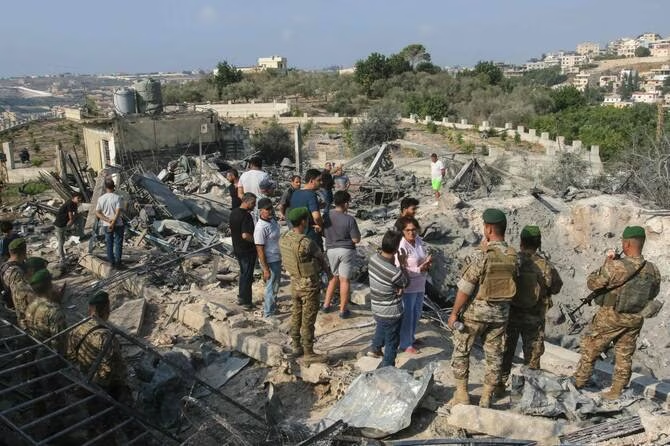
The revisions required from the Brotherhood are related to practice, and acknowledging the error in competing for the presidential elections without possessing the political eligibility for it.

PALESTINE

Mon 09 Feb 2026 7:10 pm - Jerusalem Time

Smotrich storms Ni'lin and vows to prevent the establishment of a Palestinian state

The Israeli occupation government's Finance Minister, Bezalel Smotrich, stormed the town of Ni'lin, located west of Ramallah in the occupied West Bank, this Monday morning. The raid took place amidst intense security reinforcements imposed by army forces, which closed the main entrances and roads leading to the area to secure the extremist minister's tour.

Smotrich was accompanied on this provocative tour by several Knesset members and groups of settlers, who roamed the town's lands under the protection of military vehicles. The minister made sharp political statements, affirming the Israeli government's pursuit of full field control over the West Bank lands, emphasizing efforts to undermine any attempts aimed at establishing a Palestinian state in the region.

Coinciding with this raid, occupation bulldozers carried out demolition operations targeting agricultural facilities in the town, including an agricultural room owned by citizen Raed Surour. Youssef Al-Khawaja, head of Ni'lin Municipality, explained that these measures come in the context of tightening the noose on Palestinian farmers and preventing them from accessing their lands, which are threatened with confiscation for settlement projects.

A state of extreme tension and popular anger prevailed among the residents of Ni'lin, who confronted the raid, amidst the ongoing systematic attacks they are subjected to. The town is considered one of the most prominent points of popular confrontation against the separation wall and settlement expansion that devours vast areas of its agricultural lands surrounding the settlements.

This step reflects the tendencies of the far-right in the current Israeli government towards accelerating the pace of settlement and effectively annexing lands. Observers believe that Smotrich's statements from the heart of Palestinian towns represent a dangerous escalation aimed at imposing a new reality that ends any future opportunities for political settlement or the establishment of an independent Palestinian entity.

We are strengthening control over the land, and eliminating the idea of establishing an Arab terror state in the heart of the country.

ARAB AND WORLD

Mon 09 Feb 2026 7:10 pm - Jerusalem Time

Israeli escalation in southern Lebanon: Citizen killed in Ayta al-Shaab and Islamic Group official kidnapped

Border areas in southern Lebanon witnessed a new field escalation today, Monday, as the Lebanese Ministry of Health announced the martyrdom of a citizen by Israeli occupation forces' bullets in the town of Ayta al-Shaab, in the Bint Jbeil district. This incident comes in the context of a series of continuous violations of the ceasefire agreement that came into effect in late 2024, raising the level of tension in the southern regions.

Meanwhile, field sources reported the martyrdom of three Lebanese, including a child, as a result of an airstrike carried out by an Israeli drone targeting a civilian vehicle in the town of Yanouh, in the Tyre district. This raid comes a few hours after the first incident, indicating the occupation's intensification of its direct military operations against civilian and military targets in the deep south.

For its part, the Israeli occupation army issued a statement claiming to have eliminated a Hezbollah element in the Ayta al-Shaab area, alleging that the target was carrying out intelligence gathering missions on the movements of Israeli forces stationed near the border. No immediate comment was issued by the party regarding the identity of the martyr or the nature of the missions he was performing at the time of the targeting.

In a remarkable security development, the Islamic Group in Lebanon announced that a special Israeli force carried out a ground infiltration operation targeting the border town of Al-Habbariyeh. The group clarified that the infiltrating force kidnapped Atwi Atwi, one of its officials in the region, from inside his home and took him to an unknown destination inside the occupied territories.

The spokesperson for the Israeli army confirmed the authenticity of the kidnapping operation, noting that the special forces successfully carried out the operation and transferred Atwi for interrogation by Israeli security agencies. This operation is unprecedented since the signing of the ceasefire agreement, as it reflects the occupation's ability to carry out swift ground incursions to kidnap Lebanese figures.

On the official level, Lebanese Prime Minister Nawaf Salam condemned the repeated Israeli aggressions, describing the kidnapping of the Lebanese citizen from his home as a blatant violation of international law. Salam tasked the Minister of Foreign Affairs with urgent action at the United Nations and the Security Council to document this violation and submit an official complaint against Israeli practices.

The Prime Minister stressed that what happened in Al-Habbariyeh and Ayta al-Shaab represents a clear violation of the declaration of cessation of hostilities sponsored by international parties. He added that the Lebanese government will not hesitate to protect its sovereignty and its citizens by all available diplomatic and legal means in international forums.

In a related context, Hezbollah issued a statement strongly condemning the kidnapping operation, considering it a dangerous development that portends a new phase of uncontrolled Israeli recklessness. The party called on Lebanese state institutions to assume their national responsibilities and take deterrent measures to stop these transgressions that threaten the fragile stability in the region.

For his part, Hezbollah Secretary-General Naim Qassem praised the Prime Minister's recent visit to southern Lebanon, considering it a positive step in strengthening the steadfastness of the people and building the state. Qassem stressed that the top priority at present must be to stop the comprehensive Israeli aggression and extricate the country from its accumulated economic crises.

Qassem criticized international and local attempts to link the file of reconstructing what the war destroyed with the file of exclusive weapons, considering it a pretext to obstruct Lebanon's recovery. He pointed out that the occupation continues its daily violations of the agreement, in addition to its continued occupation of five strategic Lebanese hills that it seized during the recent confrontations.

It is worth noting that the Israeli aggression on Lebanon since October 2023 has left a heavy toll of victims, with more than 4,000 people martyred and about 17,000 others injured. Despite the ceasefire agreement coming into effect in November 2024, Israeli violations have not stopped, putting the agreement to severe tests that threaten its collapse at any moment.

The dangerous development in the town of Al-Habbariyeh portends the beginning of a new phase of Israeli recklessness and lawlessness that requires immediate action.

ISRAELI AFFAIRS

Mon 09 Feb 2026 6:40 pm - Jerusalem Time

Intense Israeli Moves in Washington: Is Netanyahu Paving the Way for a US Strike Against Iran?

Political and military circles in Tel Aviv are in a state of anticipation as Prime Minister Benjamin Netanyahu heads to the United States on a surprise visit. These moves come at a very sensitive time, as Netanyahu seeks to ensure his imprint on any strategic decision taken by US President Donald Trump regarding the Iranian file, whether it be military escalation or a new negotiation path.

Hebrew press sources reported that Netanyahu aims through this visit to preempt any shifts in US policy, and to try to claim credit for himself if Trump decides to carry out his previous threats to attack Tehran. This step is part of a political strategy that guarantees Netanyahu domestic gains regardless of the final outcomes of US moves in the region.

The timing of the visit raises fundamental questions about its relationship with the anticipated negotiations between Washington and Tehran, as the Israeli side seeks to ensure that no concessions are made that affect its national security. It also highlights the hypothesis that Netanyahu is trying to avoid participating in the Washington conference scheduled for the nineteenth of this month, which focuses on establishing a peace council in the Gaza Strip.

Observers believe that the peace forum adopted by Trump is not consistent with the current orientations of the Israeli government, especially since the US President's plans to end the war in Gaza contradict the promises Netanyahu made to his right-wing public. Therefore, focusing on the Iranian file may be a way to escape US pressure related to the Palestinian issue and expand the circle of regional conflict.

In a related context, informed sources revealed that leaked messages from Netanyahu's circle indicate that the primary goal is to convince Trump of the necessity of launching a military strike against Iran. This mission is considered a political gamble, as Netanyahu believes that merely attempting it enhances his image as 'Israel's protector' in the eyes of local public opinion, even if Trump ultimately chooses a different path.

In the background of this visit is a state of distrust between the Prime Minister's office and some figures close to Trump, led by his son-in-law Jared Kushner and envoy Steve Witkoff. The roots of this tension go back to previous disagreements during the 'Deal of the Century' negotiations in 2020, in addition to differing views on prisoner exchange deals with Hamas.

What reinforces the military nature of the visit is the accompaniment of Brigadier General Amir Tischler, the incoming commander of the Israeli Air Force, to the Prime Minister's delegation. Tischler's presence indicates that the talks will not be limited to political aspects only, but will also touch upon precise operational details related to air and intelligence coordination between the Israeli and US armies.

Tischler's assignment to this mission comes amid a military diplomatic vacuum, as Israel has lacked a military attaché in Washington for several months due to sharp disagreements between Netanyahu and Defense Minister Yoav Gallant on the one hand, and the Chief of Staff on the other. Tischler was chosen to be the direct link with the US side at this critical stage.

This visit comes as a continuation of a series of high-level meetings held by Israeli security officials in Washington recently. Mossad chief David Barnea and Military Intelligence chief Aharon Haliva had previously visited the United States, reflecting serious preparations for potential military scenarios regarding Iran's nuclear program.

Analysts believe that this intensification of security visits indicates close operational coordination that goes beyond mere information exchange. It appears that Israel is seeking a US green light, or at least logistical and operational support, should it decide to act unilaterally against vital Iranian targets.

On the political front, Netanyahu is trying to exploit his close relationship with President Trump to strengthen his political standing, which has been shaken by the ongoing war in Gaza. The Prime Minister is betting that the Iranian file is the strongest common denominator through which absolute US support can be mobilized and disagreements over the future of the Gaza Strip can be overcome.
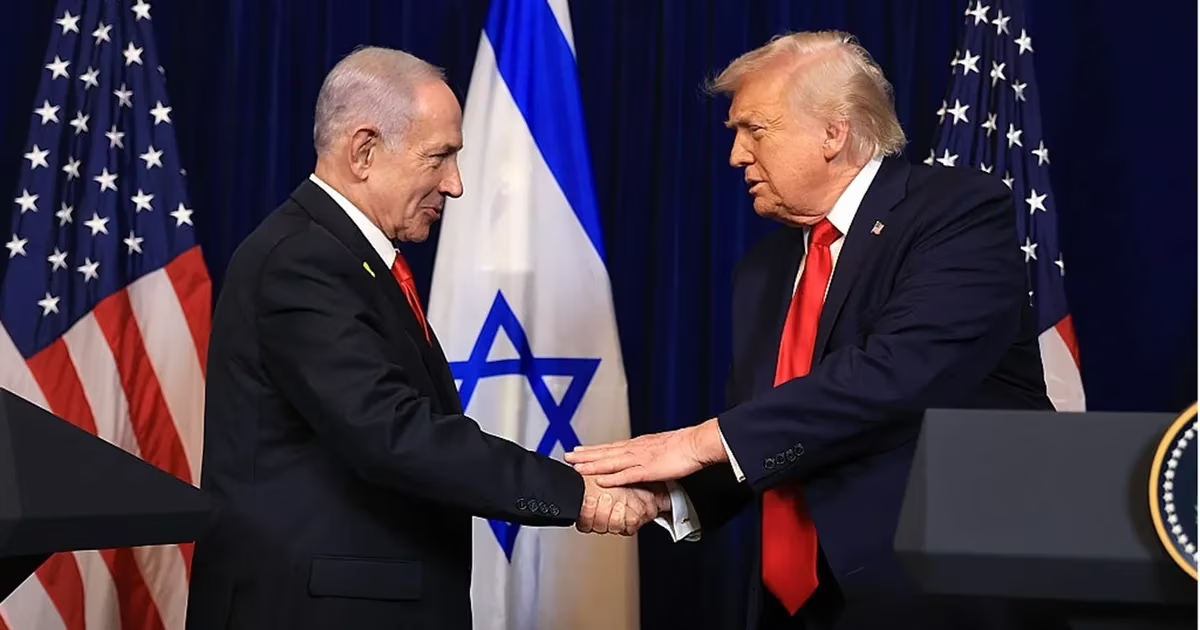
In contrast, Trump faces internal and international pressure to end conflicts in the Middle East, which makes his position on attacking Iran surrounded by many complexities. While Trump tends to use strong threatening language, his desire to avoid long wars of attrition may push him to seek major deals rather than direct military confrontation.

Iran's expansionist policies in the region, and its role in supporting armed factions, remain the primary driver of Israeli concern. Tel Aviv believes that any new US-Iranian agreement that does not include dismantling Tehran's nuclear and missile capabilities will pose an existential threat to it, which Netanyahu is trying to prevent during his current meetings in Washington.

In conclusion, the outcomes of this visit remain dependent on the extent of the Trump administration's response to Israeli demands, and whether Washington is indeed prepared to enter into a direct confrontation with Iran. Whether Netanyahu succeeds in convincing Trump to attack or fails, the coming days will reveal the features of the new US strategy in the region and its impact on the stability of the Middle East.

The persuasion journey is a mutual gain for Netanyahu; if Trump launches an attack, he will claim credit, and if he backs down, he will have at least tried.

ISRAELI AFFAIRS

Mon 09 Feb 2026 6:40 pm - Jerusalem Time

Israel hints at military option and sets strict conditions for any US agreement with Iran

Israeli Energy Minister Eli Cohen stressed that any understandings or agreements that the American administration might conclude with Iran would have no actual value from an Israeli perspective. Cohen affirmed in press statements that the option of direct military action against Tehran remains strongly on the table, indicating that Tel Aviv would not hesitate to act unilaterally if it perceived a direct threat to its security.

The Israeli minister considered the current regime in Tehran an obstacle to regional stability, claiming that the demise or change of this regime would benefit all neighboring Islamic countries. These sharp statements come at a sensitive time when the Omani capital, Muscat, is witnessing rounds of diplomatic talks between representatives from Washington and Tehran, which began last Friday without concrete results being disclosed so far.

In a related context, Israeli Prime Minister Benjamin Netanyahu is preparing to travel to Washington next Wednesday, where the Iranian file is at the top of his agenda for his meeting with US President Donald Trump. Netanyahu aims through this visit to exert direct pressure to ensure that no American concessions are made in the ongoing negotiations, and to impose an Israeli vision that guarantees the complete containment of Iranian capabilities.

Media reports indicate that Netanyahu will demand that the US administration shorten the duration of negotiations with the Iranian side as much as possible, to prevent Tehran from using the time to enhance its nuclear capabilities. He will also emphasize that the goal should be the final dismantling of the nuclear program, not just its temporary freezing for a period that might end with changes in political administrations in the White House.

The list of Israeli demands that Netanyahu will carry includes a complete halt to uranium enrichment operations, with the condition that no quantities enriched to more than 4 percent be kept within Iranian territory. Israel also demands the imposition of a strict and comprehensive monitoring system by the International Atomic Energy Agency that ensures access to all suspected facilities without restrictions.

In addition to the nuclear file, Netanyahu seeks to include Iran's ballistic missile program in any potential agreement, by setting clauses that restrict the range of these missiles and prevent them from reaching the occupied territories. The Israeli side believes that ignoring missile capabilities in previous agreements was a strategic mistake that allowed Iran to threaten regional security through its proxies.

Regarding the economic aspect, the Israeli Prime Minister will propose that the lifting of sanctions on Tehran be a gradual and very slow process, linked to its commitment to security provisions. This proposal aims to dry up the sources of funding that might reach Iran's proxies in the region, specifically Hezbollah in Lebanon and the Houthi group in Yemen, who largely depend on Iranian financial support.

Sources concluded that Netanyahu might propose an alternative option in case of diplomatic failure or Iran's rejection of these strict conditions, which is to carry out a joint military operation. This proposal involves directing widespread and coordinated strikes between the United States and Israel targeting a large number of strategic and vital sites deep inside Iran simultaneously.

Any agreement with the current Iranian regime is worthless, and regime change in Tehran is in the interest of all surrounding countries.

ANALYSIS

Mon 09 Feb 2026 5:10 pm - Jerusalem Time

The Conflict of Wills Between Washington and Tehran: How Does Iran Manage the Battle of Values in the Face of American Threats?

The region is witnessing a sharp escalation in political and military rhetoric between Washington and Tehran, where the current confrontation extends beyond armed clashes to become a deep conflict of wills revolving around ideas and civilizational values. Observers believe that military material superiority does not necessarily mean a decisive victory, as long as the defeated party does not surrender or abandon the will to resist.

Peoples with deep civilizational roots adopt a different view of battles, where results are not measured by momentary balances of power, but by the ability to establish values of dignity and sovereignty for future generations. In this context, Iran emerges as a model that tries to transform external pressures into a state of renewed steadfastness that rejects humiliation despite the disparity in military power balances.

While military experts are busy analyzing maps of American deployment on land and sea, and determining the zero hour for potential attacks, another parallel battle is being fought in the arena of terminology and symbols. This battle, described as 'pushing towards the abyss,' reflects a fundamental divergence in rhetoric between the American speaker who focuses on power, and the Iranian speaker who focuses on rights.

US President Donald Trump has long boasted about his military's destructive capabilities, threatening to use battleships and missiles to change the regime of an independent state. Trump has appeared on many occasions as an arrogant figure who grants one deadline after another, trying to break the opponent's will by brandishing 'hellfire' and mass destruction.

In contrast, the Iranian leadership has shown remarkable calm in dealing with American threats, with officials in Tehran repeatedly affirming their rejection of any dialogue conducted under duress or preconditions. Iranian leaders emphasize that they are ready for an equal dialogue, and at the same time, they are fully prepared to fight if necessary.

The statements of Iranian Supreme Leader Ali Khamenei stand out as one of the most assertive positions, when he affirmed that his country does not seek war, but will not hesitate to wage it if it is imposed upon them. His words carried an implicit warning that the losses would not be limited to the Iranian side alone, reflecting the strategy of mutual deterrence adopted by Tehran.

On the ground, Iran did not content itself with political statements; its military leaders hinted at the ability of missiles and drones to strike strategic and vital targets. These threats included the Israeli entity and any countries hosting American military bases that could be used as a launching pad for hostile attacks against Iranian territory.

Analysts believe that the American mindset manages the conflict with a balance of matter and numbers, where power is calculated by the number of soldiers and the quality of available equipment. In contrast, the Iranian mindset views the confrontation from the perspective of justice and human dignity, which creates a gap in mutual understanding between the warring parties.

It seems that President Trump has moved from the stage of direct threats and military arrogance to a state of questioning the source of confidence and reassurance among Iranian leaders. This shift recently led him to speak in religious language, expressing his confidence in achieving 'heaven' by claiming to bring peace and stop wars in different parts of the world.

Doubts continue to hover over the intentions of the American administration, as critics see a vast difference between those who defend sovereign principles and those who view the world as a commercial arena for profit. The commercial mindset with which Trump manages foreign policy files often lacks commitment to ethical standards and the rights of peoples to self-determination.

Iran has succeeded, through the current 'heating up' phase, in preserving its political identity and ideological reference despite extreme pressures. Tehran has been able to maneuver to prevent direct aggression against it, while adhering to its rights to develop its nuclear and missile programs, which it considers a guarantee of its national security.

Tehran has not abandoned its partners in what it calls the 'axis of resistance,' which was one of the conditions set by Trump and the Israeli side for lifting sanctions or stopping threats. This adherence to regional ties strengthens Iran's negotiating position and makes it difficult to isolate it politically or militarily in the region.

This current conflict reveals the failure of the 'maximum pressure' policy to achieve its fundamental goals of subjugating the Iranian regime. Instead of collapsing, Iranian institutions have shown an ability to adapt to crises, drawing this from a historical philosophy that views steadfastness as a higher value than fleeting material superiority.
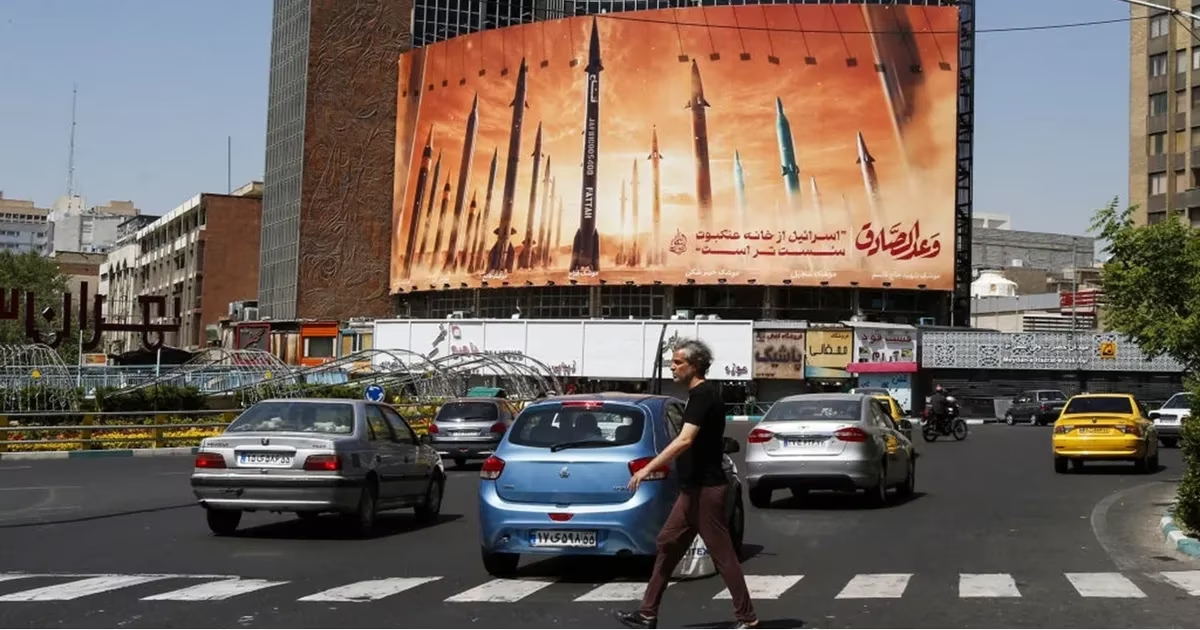
Ultimately, the scene remains open to all possibilities, between a fragile calm and an escalation that could erupt at any moment. However, the constant in this confrontation is that the 'battle of wills' has been decided in favor of the party that managed to maintain its principles without being drawn into the opponent's terms, which puts the American administration before difficult choices.

We do not want war, but if it is imposed on us, we will fight it and we will not die alone.

PALESTINE

Mon 09 Feb 2026 2:55 pm - Jerusalem Time

Investigation reveals MSC Global's involvement in transporting Israeli settlement goods to international markets

A joint investigative report by media sources in cooperation with the Palestinian Youth Movement has revealed the involvement of the Mediterranean Shipping Company (MSC), ranked as the world's largest shipping company, in facilitating the transport of goods and products from illegal Israeli settlements. Documents showed that these shipments originated from settlement outposts in the occupied West Bank and the Syrian Golan Heights, heading towards international markets, primarily the United States of America.
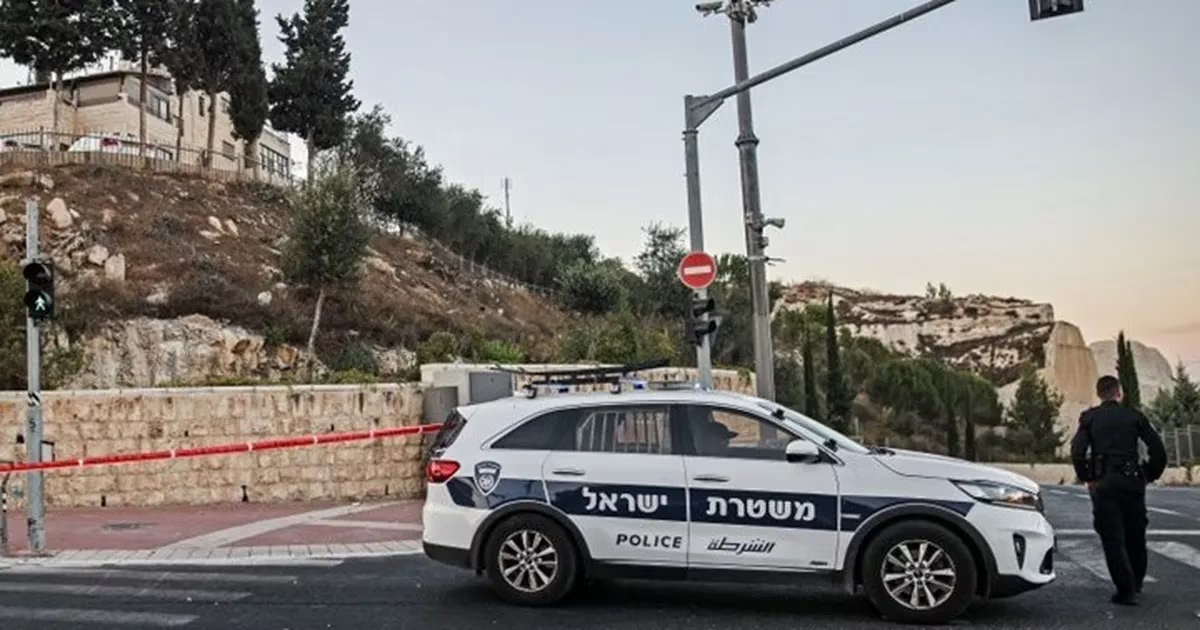
The investigation relied on commercial documents and US import databases, which showed that the Swiss company, owned by Italian billionaire Gianluigi Aponte and his wife Rafaela, shipped at least 957 consignments from the settlements. These operations took place between early January and the end of November 2025, reflecting the continuity of commercial activity despite international warnings.

Data indicated that European ports served as major transit points for this trade, with 529 shipments passing through the old continent. Spanish ports topped the list with 390 shipments, followed by ports in Portugal, the Netherlands, and Belgium, which raises legal and ethical questions for these countries regarding their obligations under international law.

This revelation coincides with an official Israeli escalation, as the Ministerial Committee for National Security Affairs (the 'Cabinet') approved decisions aimed at accelerating the pace of settlement expansion in the West Bank. These decisions included lifting restrictions on the sale of Palestinian properties to Israelis, expanding demolition powers in areas under Palestinian control, and transferring planning powers in vital areas such as Hebron and Bethlehem to Israeli authorities.

From a legal perspective, experts believe that this commercial activity represents a clear violation of the Fourth Geneva Convention, which affirms the illegality of settlements in occupied territories. Nicola Perugini, a lecturer at the University of Edinburgh, stressed that the continued marketing of these products by international companies grants the occupation an illegal economic legitimacy, emphasizing the need to stop these practices that profit from an illegal situation.

The role of MSC also contradicts the advisory opinion issued by the International Court of Justice in 2024, which obliges states and organizations to prevent any commercial relations that contribute to the perpetuation of the occupation. The court considers any economic activity that supports the infrastructure of settlements as a contribution to the continuation of the illegal situation in the occupied Palestinian territories.

Shipping bills showed that the global company delivered shipments to companies operating in major settlement blocs such as 'Ma'ale Adumim' and the 'Barkan Industrial Zone'. Among these entities are 'Extal', associated with Israeli military industries, and 'Ahava Laboratories', accused of plundering Palestinian natural resources, both of which are listed on the UN blacklist.

In response to these accusations, MSC stated that it respects the global legal frameworks applicable in the shipping sector. The company affirmed in a statement its continued cooperation and commercial agreements with the Israeli shipping company 'Zim', considering its operations to fall within normal commercial activity, despite increasing human rights criticisms.

On the political front, a clear contradiction emerges in international positions; while Washington, under President Donald Trump, adopted a lenient policy towards settlements, the European Union faces a legal dilemma. Despite countries like Spain and Slovenia announcing a ban on importing settlement goods, their ports are still used as logistical platforms for these goods to transit to other destinations.

Economic estimates indicate that the settlement economy contributes approximately $30 billion annually to the Israeli economy, enhancing the occupation's ability to expand. In contrast, the West Bank economy suffers from cumulative losses estimated at $170 billion, making global shipping companies the vital artery that feeds settlement and opens the doors to international trade for it.

The profits of illegal occupation cannot be legitimized, and marketing these products is an actual support for the continued control over the occupied territories.

ISRAELI AFFAIRS

Mon 09 Feb 2026 11:40 am - Jerusalem Time

Uncovering Iranian Spy Recruitment Methods Inside Israel: Phishing Networks Targeting Military Personnel and Civilians

Hebrew press reports issued today, Monday, revealed that intelligence agencies have detected an increasing and organized pattern of espionage attempts led by Iran within the occupied territories. This new strategy relies on widespread phishing operations via social media platforms, aiming to reach the largest possible number of users without initial discrimination between their targets.

Sources explained that the Iranian method does not initially target specific individuals but rather relies on flooding the digital space with massive amounts of attractive messages and posts. Those responsible for these operations seek to entice anyone who interacts with these prompts, after which a gradual and systematic recruitment process begins.

Tasks requested from targets begin with simple procedures that appear innocuous on the surface, such as writing specific comments or posting particular entries on their personal accounts. This stage is considered an initial test to gauge the individual's responsiveness and seriousness in execution before moving on to more complex and dangerous stages.

Over time, these activities evolve to include field sabotage operations aimed at destabilizing internal security, including assigning recruits to burn vehicles or carry out acts of sabotage in public facilities. These developments reflect a desire to transform digital spies into executive tools on the ground.

Regarding the judicial aspect, data revealed that approximately 35 official indictments have been filed recently on charges related to espionage for hostile parties. These cases involved nearly 60 defendants, and it was found that some cases were not individual but included organized cells consisting of dozens of people working in coordination.

'Contact with a foreign agent' is the most common charge in investigation files that have affected various segments of Israeli society. Of concern to security circles is the involvement of military personnel in these networks, including reserve soldiers and officers still serving in various units of the occupation army.

Among the most prominent cases uncovered was an attempt to recruit an employee of the Iron Dome defense system, who was asked to photograph parts of the system and provide technical information to operators. This incident highlights the extent of the danger posed by these breaches to sensitive military systems.

Investigations indicated the difficulty of creating a unified profile for these spies, as their social and geographical backgrounds varied greatly. The list included Jews from the city of Beit Shemesh, residents of Jerusalem, as well as new immigrants who recently arrived from countries such as Azerbaijan.

Regarding motives, reports confirmed that all defendants received varying sums of money in exchange for their cooperation with Iranian intelligence. Money transfers were carried out through complex methods to avoid detection, often via intermediary exchange offices or through the use of untraceable cryptocurrencies.

In an exceptional case, investigations recorded an individual from the Golan Heights initiating contact with Iranian parties to offer their services. Security circles express deep concern about the presence of individuals within Israeli society who are predisposed to cooperate with Tehran despite continuous warnings about the dangers of the Iranian threat.

Iranians do not use a fishing rod but a complete net with which they flood the digital space to lure anyone who responds to their messages.

OPINIONS

Mon 09 Feb 2026 11:31 am - Jerusalem Time

Tucker Carlson's Plea

About a thousand years ago, the Crusaders were surprised to find Christians in our lands as well, but illusions and ambitions were greater than sympathy or religious ties. Therefore, these invaders put the sword to the necks of the Christians of the land, just like their Muslim brethren. The invaders did not believe that there were Christians who had their churches, fields, schools, businesses, and contributions to public life. That reality did not fit at all with the colonial Crusader project, and therefore history does not record that the Christians of our lands dealt with or cooperated with the invaders except to a minimal and narrow extent, and that was due to helplessness, destitution, or the desire for salvation, exactly as happens to every people under occupation. And in our days, too, the American right-wing journalist Tucker Carlson carries the task of clarifying the ordinary truth for us, which is astonishing for the extremist Christian right in his country: that there are Christians in Palestine and Jordan who have lived for thousands of years as the salt of the earth, in deed not just in word, and that they and their Muslim brethren present a living example of harmony, cooperation, and cultural integration, as well as in patriotism and citizenship, and that all they are subjected to—displacement, hardship, persecution, and humiliation—their Muslim brethren had no role in it. Both Hosam Naoum, the Anglican Archbishop of Jerusalem, and As'ad Al-Ma'asher from Jordan, presented a very clear picture of fruitful pluralism and the dazzling mosaic of shared life in both Palestine and Jordan. Astonishment leaped from the eyes of the courageous American journalist as he heard and saw how all the lies and delusions spread by most American media fall on the hills and mountains of these lands. This man heard and saw with his own eyes that there is an Arab Muslim king who cares for Islamic and Christian endowments, and that Christians enjoy all rights and entitlements, and that Islam is part of Christian culture, and that coexistence, tolerance, and understanding are not imaginary concepts, but rather facts lived daily and ordinarily. What Tucker Carlson presented on his platform was a slap and a shock to the extremist right that claims Christianity—I mean Scofield's Christianity and his reference Bible, that American lawyer who presented messianic interpretations of the Bible that turned into another gospel. What Carlson did with living and tangible evidence is that the support provided by these extremist groups actually works to displace, impoverish, and humiliate Christians, and that their beliefs in interpretations and explanations of the Gospel harm Christians and their existence and lives in their land, which they have not left for thousands of years. What Carlson did was expose, strip bare, and dismantle all claims and lies as well, and presented a completely different picture from the malicious propaganda and flowing political money that serves the occupation, and that the set of facts and evidence Carlson presented in his program is a humanitarian plea against that broad current controlling American decision-making and public mood, which will intensify the ongoing discussions in the United States of America.

OPINIONS

Mon 09 Feb 2026 11:28 am - Jerusalem Time

War begins with "pictures"!

Dr. Ibrahim Melhem

Editor-in-Chief

The least that can be said is that the visit of Witkoff and Kushner to take pictures aboard the destroyer Lincoln, and the response of Araghchi less than twenty-four hours later, with similar pictures aboard an Iranian warship in the Arabian Sea, carry unmistakable connotations. Both parties resorted to exchanging insults through pictures and flexing muscles after the negotiations stalled. Tehran believes that the cost of these negotiations is much less than the cost of what is being offered to it: trimming its nails, amputating its arms, and zeroing its nuclear counter. It knows that if it does, it will become an easy meal for Trump, who will consume it without suffering from indigestion. The exchange of pictures is like the exchange of words before engaging in punches. If the first picture carries the meaning of the desire for acquisition, dominance, and subjugation by the force of arrogance, then the second carries the meaning of resistance, in whose body there is no inch left without a sword blow, a spear thrust, or an arrow shot. War, as an ancient poet said, begins with words, or pictures, if that were available to those who fought wars with horses, night, desert, spear, paper, and pen. The jostling of ships, battleships, and aircraft carriers in narrow waterways resembles the jostling of football players in the penalty area in the last breaths of a decisive match. Any miscalculated move could result in a friction that generates a penalty kick that could cause a bloody military "remontada," turning the result upside down and destroying the stadium and the audience at the same time. In visible evidence and public statements, the probability of war breaking out outweighs the chance of avoiding it. Both parties may engage in it unwillingly, due to misjudgment, or by the act of an instigator who lights a match in a region where everything is flammable. When war breaks out, no one can predict its outcomes, for the ghost of Nagasaki and Hiroshima hovers around Tehran and Qom... This time, the enemy will not accept less than complete subjugation amidst an international environment governed by Epstein's rules. The movement of "Trump's Armada" is no longer just a maneuver, or pressure on the exposed Iranian nerves, but rather a "dance on the edge of the abyss".. And what do you know about it?!

OPINIONS

Mon 09 Feb 2026 11:28 am - Jerusalem Time

Targeting Christians in Palestine

Zionism and its colonial project in Palestine target its entire Arab population in varying degrees. The situation in the 1948 areas differs from that in 1967, and the Gaza Strip surpasses the West Bank in terms of killing and extermination. In the West Bank, it is more violent than in Jerusalem. In the 1948 areas, the actions are not limited to the strongly targeted Bedouins of the Negev, but also include the people of the North and Center, the people of Carmel, Galilee, and the Triangle, who are targeted by criminal gangs. The people of the historical mixed Palestinian coastal cities are targeted by restrictions, lack of expansion, and imposition of taxes, whether they are Muslims, Christians, or Druze, even if the formulas, tools, and priorities differ. In the Palestinian West Bank, oppression, suppression, and destruction of the lives of all Palestinians are carried out with the aim of "driving them out" and pushing them to leave their homeland according to Smotrich's "Decisive Plan," which has become the title, tool, and program of the government and all coalition forces. The army and security agencies implement this program, but the strongest title and the most ferocious tool have become the "hill thugs" of the colonial settlers who work to "cleanse" the Palestinian West Bank of its people, reduce their numbers, close off opportunities for work and normal life, and kill their lives by burning and destroying homes, properties, farms, and cars. This is done under the protection of the army, which provides cover for them, does not pursue them, and freezes the systems through which they could be prosecuted and subjected to accountability and legal procedures. Recently, it has been observed that Christians are being targeted more than others, and are being exposed to deliberate danger. This is what happened in the villages of Taybeh, Aboud, Birzeit, and Ain Arik, and it was not a coincidence. Rather, it is clear that this is a deliberate policy targeting Christian families and communities, given that these Christian families most likely have extensions outside Palestine, which helps push them to find an alternative to their lives in Palestine, by encouraging them to leave and emigrate to both Americas and other parts of the world, especially since there is a program with some complicit Christian entities that can provide refuge and travel tools for Christians and facilitate them. For the same goal, other parties and organizations that believe in "Christian Zionism" are working in this direction, and are responding to the colonial program to reduce the Palestinian Christian presence, in addition to changing their culture, awareness, and faith by linking Christianity and Zionism. This malicious colonial criminal act is led by the US Ambassador to the colony, Mike Huckabee, who supports the colony and the policies of its far right, including the annexation of the West Bank, and refuses to call it "the West Bank" but rather calls it "Judea and Samaria," meaning it is part of the colony's map. He belongs to the Christian Zionist movement and openly said: "It is difficult for me to understand why everyone who bears the title Christian should not also bear the title Zionist." In response to his actions, tools, and delusions, and others, the Patriarchs and Heads of Churches in Jerusalem issued a courageous statement in which they expressed their rejection of so-called Christian Zionism, and of the fabrications and interference of the American ambassador who seeks to market this demagogic nonsense. It stated: "The Patriarchs and Heads of Churches in the Holy Land affirm to the faithful and to the world that the flock of Christ in this land (Palestine) has been entrusted to the Apostolic Churches, which have carried this sacred trust through the centuries with steadfastness and faithfulness. The recent activities of some local individuals promoting harmful ideologies, such as so-called Christian Zionism, mislead public opinion, sow confusion, and harm the unity of our flock. These 'initiatives' have been welcomed and supported by some political entities in Israel (the colony) and outside (the American ambassador), which seek to advance a political agenda that may harm the Christian presence in the Holy Land (Palestine) and in the wider Middle East (Arab countries)." The colonial policy requires a declared and clear ecclesiastical stance worldwide, because it targets the Christian heritage in our country, Palestine and Jordan, the origin of Christianity, and in our country it was born, and its content has been stolen, distorted, and alienated from us.