







Said Arikat
February 10, 2026
News Analysis
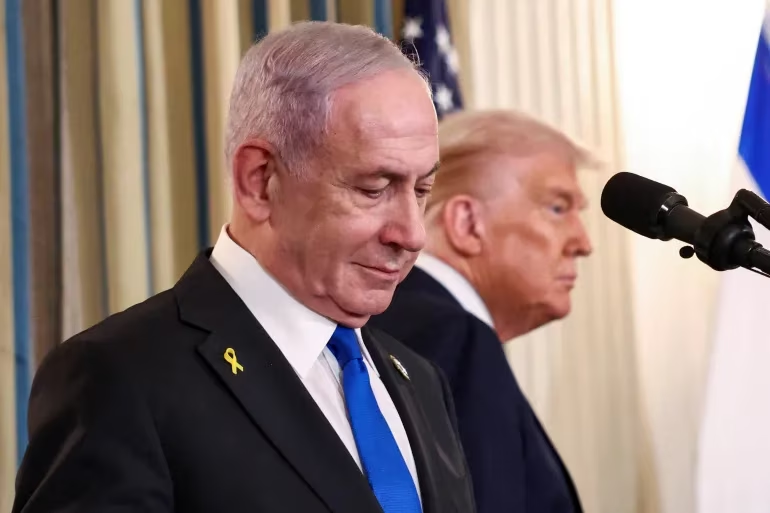
Benjamin Netanyahu’s latest trip to the White House — his eighth within a single year — is not simply another high-level meeting between Israel’s prime minister and America’s president. It is a political signal about how Donald Trump’s second-term Middle East policy is taking form: not through sweeping peace initiatives, historic deals, or grand diplomatic architecture, but through a deliberate strategy of pressure, containment, and controlled escalation.
The sheer frequency of the meetings matters. This is not “coordination” in the abstract, nor a symbolic reaffirmation of alliance habits. It is a sustained attempt to treat the region’s crises as one integrated portfolio — Iran, Gaza, normalization, and regional alignments — managed increasingly as if from a joint political-security operations room. The governing logic is consistent across all files: keep pressure permanent, set the tempo, deny adversaries strategic breathing room, and use diplomacy only as an instrument operating inside coercion rather than replacing it.
Two issues sit at the center of this emerging doctrine. The first is Iran, treated as a standing arena of punitive confrontation in which the baseline must always remain hostile. The second is Gaza, treated less as a war to be ended than as a conflict to be contained — through a cease-fire or extended truce that reduces Washington’s political exposure without forcing Israel into a final settlement it cannot, or will not, accept.
On Iran, the alignment between Trump and Netanyahu is clearer than ever: pressure is policy; diplomacy is optional — and only legitimate if it remains subordinate to pressure. The nuclear program remains the headline, but the campaign is broader: sanctions, international mobilization, overt and covert threats of force, and intensified intelligence operations across the region.
Netanyahu is expected to arrive in Washington with a blunt demand: guarantees that any American engagement with Tehran will not drift toward what Israeli officials often call a “soft deal” — one that reduces sanctions pressure or gives Iran space to stabilize economically and politically. He wants to lock the Trump administration into a negotiating posture that expands beyond centrifuges and enrichment levels. From Netanyahu’s perspective, any agreement must also include Iran’s ballistic missile program, its regional posture, and its relationships with armed allies and proxy networks.
Trump appears to be pursuing a dual-track approach: a hard-line public posture that fits domestic American instincts, paired with a narrow diplomatic opening he can later present as a political win if circumstances allow. But the principle remains unchanged. Negotiations are not a substitute for pressure; they are an extension of it — another lever in the same toolkit.
That same philosophy now shapes Washington’s Gaza calculations, with one major shift: the hostage-and-prisoner file is no longer the central negotiating engine it once was. Israel announced it recovered the body of the last captive on January 26. Whatever one makes of Israel’s framing, the political consequence is unmistakable: the hostage issue — for months the emotional and diplomatic core of the war — has largely moved off center stage.
That changes the nature of the discussion. The question is no longer “What deal ends the hostage crisis?” It is the far more politically explosive question: what comes next?
Washington is not pursuing a sweeping settlement. It is looking for an exit ramp — or, more precisely, for a mechanism that reduces the war’s political and media costs without confronting the deeper structure of the conflict. This helps explain the gap between public rhetoric and private diplomacy. In public, officials speak of “ending the war.” In private, the language shifts toward “security arrangements,” “renewable cease-fires,” and truce mechanisms designed to hold long enough to stabilize optics.
This is where Trump and Netanyahu overlap — and where their interests quietly diverge. Trump wants managed calm. Gaza has become, for Washington, a strategic liability: a constant drain on credibility, a source of friction with allies, and a moral-political burden that complicates broader regional ambitions. A truce would allow the administration to claim progress, recover diplomatic bandwidth, and reopen the door to larger projects — including normalization tracks and a reset with key Arab capitals.
But Trump also appears unwilling to pay the price of a comprehensive settlement. That would require imposing firm obligations on Israel, pushing for a credible Palestinian political horizon, and confronting the deeper architecture of occupation, governance, and statehood. In effect, he wants the benefits of calm without the costs of forcing an endgame.
Netanyahu arrives with a different constraint: not international, but domestic. His coalition remains anchored in a hard-right political balance that punishes major concessions. Any meaningful compromise risks being interpreted at home as defeat. Even the language of “ending the war” can become politically toxic if it implies limits on Israel’s freedom of action, external oversight, or a postwar arrangement that reduces Israeli control.
This makes a clear political end to the war unlikely. What is more plausible is a phased formula Netanyahu can sell as tactical rather than strategic: a long truce, renewable cease-fire terms, narrowly defined humanitarian openings, and adjustments in military posture or monitoring — all without a formal declaration that the conflict has ended, and without a coherent political pathway for Gaza’s governance and reconstruction.
This is not peace. It is managed de-escalation. And managed de-escalation is fragile by design. A cease-fire without a political horizon is a pause, not a settlement. A truce without enforceable guarantees is a temporary contract waiting to collapse. Security understandings without political foundations are scaffolding — useful for a moment, but easy to dismantle under pressure.
The removal of the hostage file from the center of negotiations exposes the underlying divergence. Washington wants to reduce the war’s political cost and move on. Netanyahu wants to preserve a narrative of victory while avoiding any process that imposes future obligations — especially those tied to Gaza’s governance, reconstruction, and the broader Palestinian question.
This is why the most likely outcome of the visit looks familiar: a united posture on Iran paired with tactical flexibility on Gaza.
In practice, three scenarios emerge. The first — and most probable — is a high-profile show of unity against Iran, reinforced by rhetorical escalation and renewed sanctions-and-threats posture, alongside a limited Gaza arrangement that allows Washington to claim “progress” while leaving Netanyahu maximum room politically and militarily. The second is a stronger American push for a more durable cease-fire, which would immediately collide with Netanyahu’s coalition arithmetic and the demands of his far-right partners. The third is the most cynical but entirely plausible: vague statements, no breakthrough, and continued crisis management — keeping both files suspended until circumstances shift.
Whatever the immediate outcome, the deeper meaning of the visit is already visible. Under Trump and Netanyahu, the Middle East is not being managed through historic compromises. It is being managed through enforced “rules of engagement”: pressure, deterrence, tactical diplomacy, and constant recalibration.
On Iran, the joint goal is to keep Tehran boxed in under sanctions and containment, with the military option framed not as a last resort but as a bargaining instrument. On Gaza, the goal is not resolution but political reset: a truce that reduces international pressure and stabilizes Washington’s posture without addressing the roots of the conflict.
Which is why Gaza is likely to remain trapped in the same cycle: calm today, eruption tomorrow .
Share your opinion
Netanyahu’s Eighth White House Visit: Trump’s Mideast Doctrine Takes Shape—Pressure on Iran, Managed War in Gaza