





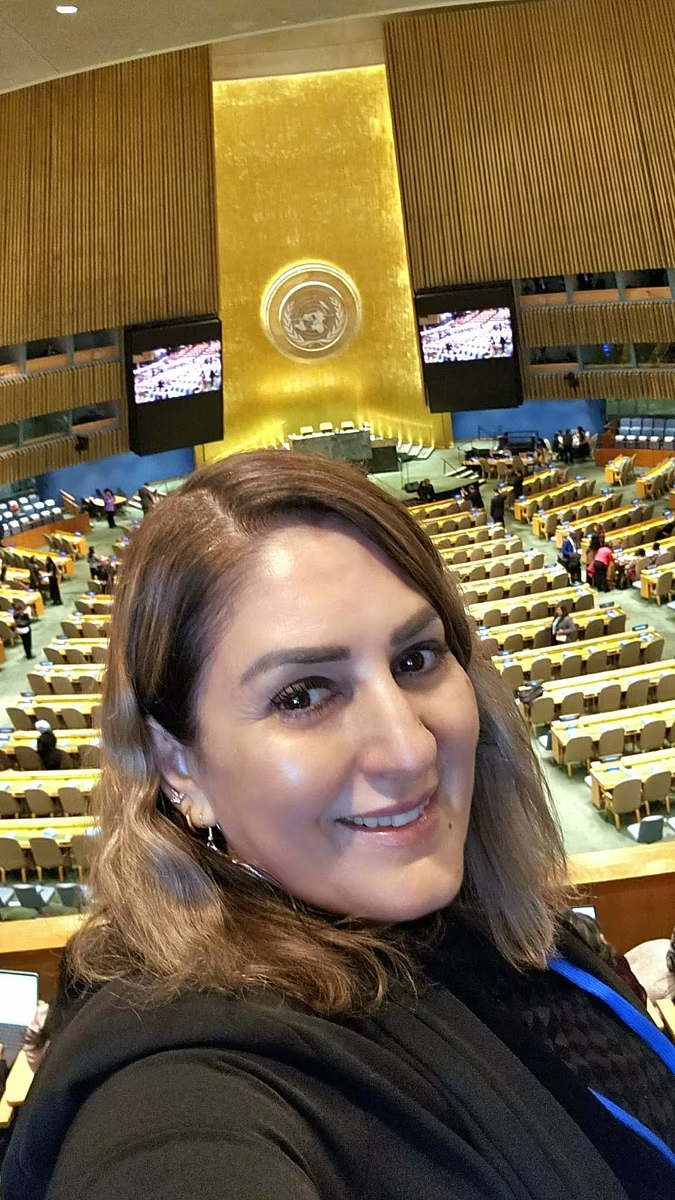
In 2022, the United Nations General Assembly adopted a resolution declaring June 24th as the International Day of Women in Diplomacy, in recognition of the growing role women play in international relations, and in belief of the importance of their participation in decision-making, promoting peace, and building partnerships between peoples. This occasion raises a question, in the Palestinian context, that goes beyond celebrating the traditional role of women in the diplomatic corps: Are Palestinian women today leading a new approach to diplomacy? The Palestinian experience, due to the complexities of the political and humanitarian reality, has produced a new approach to diplomatic work that I propose to call "Palestinian Community Diplomacy"; an approach that is not limited to negotiation halls and official meetings, but rather stems from the people, relies on listening to them, conveying their voices, building alliances, and influencing the positions of decision-makers. It is a diplomacy that places people and the cause at the heart of diplomatic work, and gives civil society, especially women, an active role in conveying and defending the Palestinian narrative in international forums. For many decades, the concept of diplomacy has been associated with closed meeting rooms, official negotiations, political protocols, and official ambassadors and representatives of states. However, the transformations the world has witnessed, and the unprecedented challenges imposed by the Palestinian reality, have reshaped this concept in a broader and more human-centered way. Palestinian women, although they have not always held the title of "diplomat" or occupied an official position, have practiced diplomacy in various forms. They have been present at international conferences, meetings with parliamentarians and diplomats, United Nations meetings, and global civil society platforms, where they conveyed the Palestinian narrative, defended the rights of their people, and raised issues of women, justice, and occupation before decision-makers. Diplomacy, thanks to the contribution of women, has moved from closed rooms to the field; to villages and camps, and to women who live the details of the occupation daily. Diplomacy is no longer merely an exchange of political positions, but has become a process that begins with listening to people, understanding their needs, and then transforming those voices into messages and positions presented to the international community. In contrast, we have begun to witness a remarkable shift in the practice of official diplomacy itself, as many female ambassadors and representatives of governments and Western diplomatic missions working in Palestine have become more present among the people, visiting local communities, meeting women and community organizations, and listening directly to the needs and challenges of citizens. This reflects a shift towards a diplomacy closer to society, believing that understanding reality begins in the field, and that the success of diplomatic work is achieved not only through official meetings, but also through direct communication with people. In recent years, Palestinian community diplomacy has emerged as a new space for influence, where civil society activists, researchers, and leaders in institutions play an influential role in building international relations, gaining support, and influencing policies, even though they do not hold official diplomatic titles. The Palestinian woman who meets ambassadors, ministers, parliamentarians, and UN officials, and provides them with evidence and testimonies, defends the rights of Palestinian women, and advocates and lobbies for accountability and justice, is essentially performing a comprehensive diplomatic act. She does not only represent a specific institution, but carries with her the voice of Palestinian women, their stories of resilience, and the aspirations of their communities, to present them to decision-makers in various international forums. Perhaps what has given Palestinian women this ability is the nature of their societal roles; they are closest to the details of daily life, to the suffering of families, women, and children, and are most capable of translating this human experience into a language the world understands. Therefore, their contribution is no longer limited to presenting facts, but has become building bridges of trust and dialogue with decision-makers, based on credibility, field experience, and a human narrative that is difficult to ignore. The Palestinian experience has proven that diplomacy is no longer exclusive to official institutions, but has become a collective responsibility in which everyone who has the ability to influence, build bridges, convey the truth, and defend rights participates. This does not diminish the importance of official diplomacy led by the Ministry of Foreign Affairs and Palestinian missions, but rather Palestinian community diplomacy has become a complementary tributary to it, enhancing the presence of the Palestinian cause in international forums by reaching parliaments, universities, think tanks, media, and civil society organizations, thereby expanding circles of influence and giving the Palestinian narrative a deeper and more humane presence. Official diplomacy continues to represent the State of Palestine in international forums, while community diplomacy contributes to building bridges of trust and influence with communities and decision-makers, so that the two approaches together form an integrated system for defending Palestinian rights. In light of the ongoing occupation violations, widespread displacement, and escalating settler attacks, Palestinian women have acquired an even more important role in international forums. They do not only convey numbers and statistics, but carry with them the stories of women and children, the suffering of families, and the resilience of local communities, transforming the human experience into an issue of international public opinion, and into political, legal, and ethical demands. This transformation calls on us to reconsider the concept of diplomacy itself. Is diplomacy only what happens in official meetings? Or is it also the daily effort made by women in building alliances, influencing public opinion, defending justice, and reaching decision-makers? The Palestinian experience pushes us to broaden the concept of diplomacy to include every organized effort that contributes to influencing international policies, conveying the voice of society, building partnerships, and defending rights. In this context, Palestinian women are no longer merely participants in diplomatic work, but have become among the most prominent actors in developing its tools and expanding its spaces. Perhaps future studies will write that Palestinian women did not just demand a place for themselves in diplomacy, but contributed to developing one of its most important transformations; a diplomacy that starts from people, returns to them, and makes society a partner in creating influence. This is Palestinian community diplomacy, which has today become an essential tributary to official diplomacy, and one of Palestine's tools in addressing the world, conveying its narrative, and mobilizing international support for its just cause.

OPINIONS
Mon 13 Jul 2026 7:59 am - Jerusalem Time
Palestinian Women Lead a New Approach to Diplomacy... Palestinian Community Diplomacy
Share your opinion
Palestinian Women Lead a New Approach to Diplomacy... Palestinian Community Diplomacy