







By: Said Arikat
July 13, 2026
News analysis
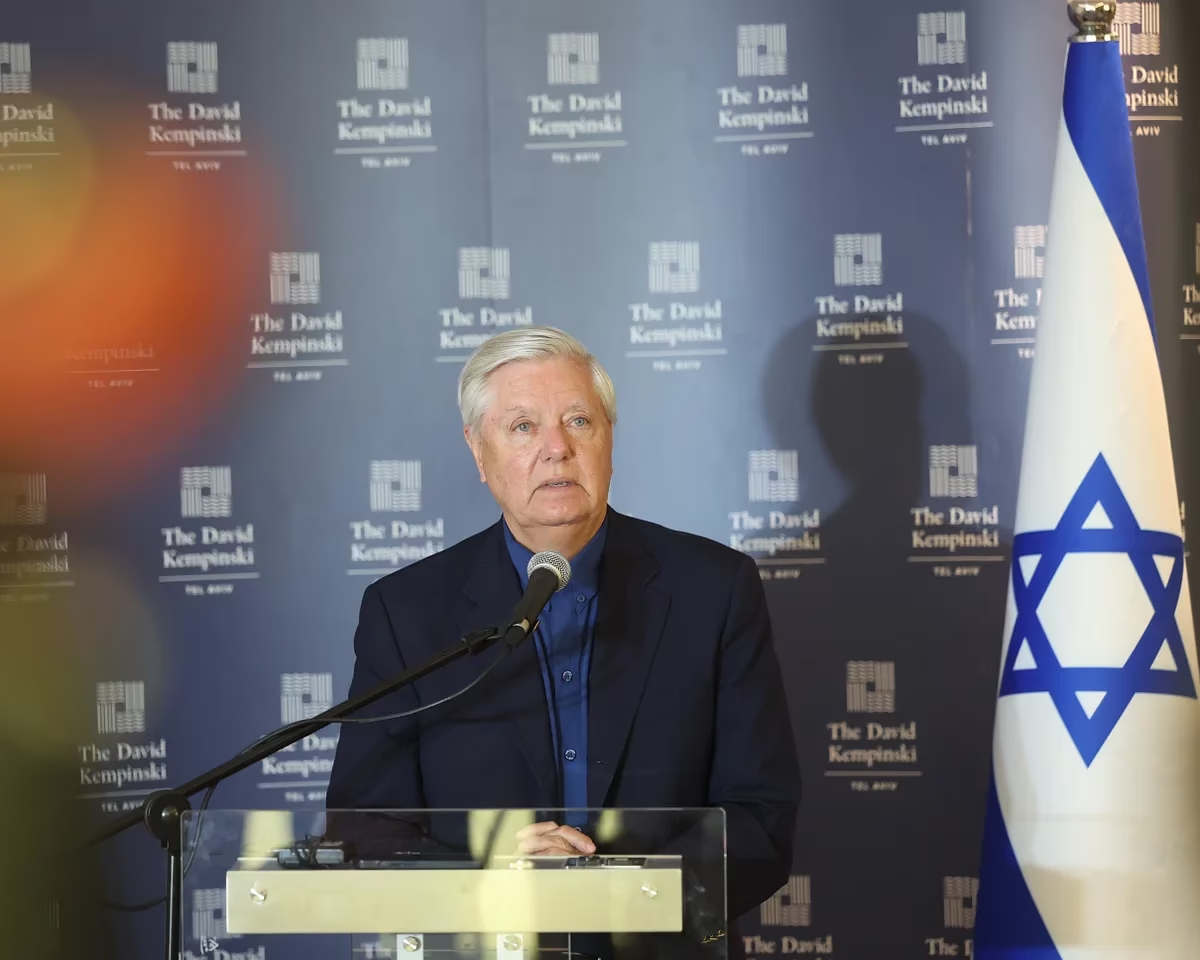
Washington, D.C: It is customary to speak generously of the dead, especially when they remained in public life until the end. Since Senator Lindsey Graham’s death on July 11, 2026, tributes have rightly acknowledged his decades in the Senate, his friendships across the aisle, and his devotion to causes he held dear. But history, unlike a eulogy, must reckon with the consequences of the choices a public figure championed. And for Graham, those consequences demand an accounting that his obituaries have largely avoided: he was one of the most relentlessly hawkish voices in modern American politics, a senator whose default answer to foreign crises was military force, whose interventions repeatedly produced disaster, and whose most infamous remarks justified the idea of nuclear annihilation as a legitimate tool of war.
Graham’s hawkishness was not an occasional posture; it was the defining thread of his career. From the aftermath of September 11 onward, he argued that American credibility rested on a willingness to project overwhelming power preemptively. He championed the 2003 invasion of Iraq and consistently urged that the war be prosecuted with maximal force, dismissing diplomatic caution as weakness. Across the Senate floor and cable news appearances, he became the embodiment of a conviction that war was not a last resort but a preferred instrument—that the United States should shape events before threats fully materialized, and that negotiations were meaningless unless backed by an unmistakable readiness to destroy.
That conviction led Graham to embrace military escalation with an almost reflexive predictability. He urged deeper U.S. intervention in Syria, backed the Libya campaign that left a failed state in its wake, pushed for hard-line confrontation with Sudan, and spent years demanding that the United States be prepared to bomb Iran. To his admirers, this was clarity and strength; to his critics, it was a destructive addiction to force that repeatedly ignored the long-term human and strategic costs. The Iraq War stands as a monument to the failure of that worldview, yet Graham never publicly reckoned with the hundreds of thousands of dead, the sectarian bloodshed, or the regional chaos his advocacy helped unleash.
Perhaps no relationship better illustrated Graham’s interventionist zeal than his bond with Israel’s right wing. He routinely adopted the lexicon of the settlement movement, calling the occupied West Bank “Judea and Samaria,” defending settlement expansion, and remaining silent about settler violence against Palestinians. He joked about spending more time in Israel than in South Carolina, and he served as Benjamin Netanyahu’s most reliable congressional shield, brushing aside international law and Palestinian suffering as secondary concerns. His commitment to Israel became indistinguishable from an endorsement of its most brutal military campaigns.
Nowhere was this more chilling than during Israel’s war on Gaza. At a moment when the International Court of Justice was weighing accusations of genocide, when U.N. officials described entire families obliterated, and when global protests demanded a ceasefire, Graham chose not to urge restraint but to offer the most incendiary justification imaginable. On Meet the Press, he invoked the U.S. atomic bombings of Hiroshima and Nagasaki to argue that Israel should be allowed “whatever means it deems necessary” to end the war—implicitly condoning the nuclear destruction of Gaza’s civilian population. The comment was not a gaffe; it was the logical endpoint of a worldview that had long treated the lives of people in distant lands as acceptable collateral in the projection of power.
The grim irony is that Graham’s hawkishness did not make the United States or its allies safer. The wars he cheered hollowed out American credibility, drained trillions of dollars, and generated blowback that continues to this day. Libya collapsed into warlordism. Syria became a charnel house. Iraq remains a cautionary tale of how military hubris breeds enduring instability. The Israeli-Palestinian conflict is more intractable than ever, and the unconditional support Graham embodied has only deepened the occupation’s brutality. He was not solely responsible for these catastrophes, but he was their most persistent Washington advocate—a senator who never met a war he did not think could be won with enough firepower.
The customary decency extended to the dead should not become a license to whitewash. Lindsey Graham’s legacy is not merely that of a committed public servant; it is the legacy of a man who, over two decades, helped normalize the idea that American greatness is measured by a willingness to wage war, and who, in defending Israel’s assault on Gaza, stripped away any remaining pretense of humanitarian limits. He leaves behind a record of hawkish zeal that was as consistent as it was calamitous—a testament to the enduring danger of confusing belligerence with strength.
Share your opinion
Beyond the Tributes: Remembering Lindsey Graham’s Foreign Policy Legacy