







Urgent: Washington's Message
Washington – Said Arikat – 11/6/2026
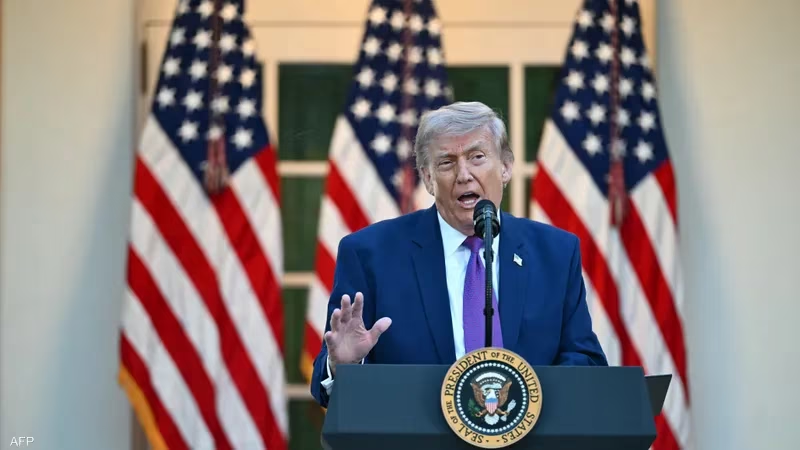
In a remarkable development that could redraw the equations of conflict in the Middle East, US President Donald Trump announced that an agreement with Iran had been reached, confirming that the official announcement of its signing would be made soon, after weeks of military tension and mutual threats of using force between Washington and Tehran.
Trump said in a post on the "Truth Social" platform that discussions with the Islamic Republic of Iran had reached the highest levels of Iranian leadership and received the necessary approvals, adding that he had decided to cancel the military strikes and bombing operations that were scheduled against Iran this evening, in a move that reflects a sudden shift from the brink of military confrontation to the path of political settlement.
The US President indicated that the "final points" of the agreement had been agreed upon "in principle and in precise details," and that several regional and international parties participated in the consultations or approved their outcomes, including Israel, Saudi Arabia, the UAE, Qatar, Turkey, Pakistan, Bahrain, Kuwait, Jordan, and Egypt.
Despite the confident tone used by Trump, the announcement was not accompanied by any official confirmation from the Iranian side, which left question marks about the maturity of the announced understandings, and whether Tehran views them as a final agreement or merely an initial framework for continuing negotiations.
Trump also affirmed that the US naval blockade imposed on Iranian ports would remain "in full force" until the agreement is finalized, which observers considered a clear indication that negotiations have not yet reached the stage of full implementation, and that Washington still retains key leverage to ensure Iran's commitment to what is agreed upon.
These developments come after a period of dangerous escalation that witnessed repeated American threats to target Iranian facilities, in exchange for Iranian warnings of retaliation for any attack. However, both sides seemed more inclined in recent days to contain the crisis, especially amid fears that any direct clash could ignite a wide regional confrontation involving the Gulf, Iraq, Syria, and Lebanon.
Circulating data indicates that the document on the negotiating table revolves around extending the current fragile ceasefire and creating conditions for broader negotiations on the Iranian nuclear program, in addition to other security and regional issues that have long been a source of disagreement between the two sides.
However, previous experiences lead many to treat the American announcement with caution. Trump has previously spoken more than once about the imminent conclusion of an agreement with Iran, before negotiations faltered or collapsed due to accumulated disagreements over sanctions, the nuclear program, and Tehran's regional role.
The history of the relationship between the Trump administration and Iran is also full of sudden shifts between escalation and de-escalation. On more than one occasion, the US President threatened to use military force against Iran, before returning to prefer the negotiating path, which led his opponents to believe that military threats were part of a negotiating pressure strategy rather than a prelude to an all-out war.
Observers believe that the success of the agreement, if it actually happens, will not only depend on direct US-Iranian understandings, but also on the ability of regional parties to accept new balances that may result from it. Israel, which considers the Iranian nuclear program an existential threat, will seek to ensure that any agreement does not allow Tehran to maintain capabilities that could be developed for military purposes in the future.
In contrast, Iran will seek to obtain tangible gains in exchange for any concessions it makes, whether through easing economic pressures or ending some forms of blockade and sanctions that have burdened its economy in recent years.
Although Trump's announcement may open a window of hope for reducing tension in the region, the path to a lasting agreement is still fraught with obstacles. The gap between Washington's and Tehran's demands has not completely disappeared, and the internal calculations of both sides may make any understanding vulnerable to shaking at the first political or security test.
Trump between the logic of force and the allure of diplomatic achievement
The American announcement reveals a strategic dilemma that Trump has faced in recent months. The US President wanted to maintain the image of a decisive leader capable of using force, but at the same time, he realized that any widespread war with Iran could turn into a costly conflict with uncertain outcomes. Therefore, military threats seemed to be used as a means to push Tehran towards negotiation rather than a final option. If the agreement succeeds, Trump will try to present it as a victory for diplomacy backed by force, not a retreat from confrontation.
Iran tries to turn pressures into political gains
The Iranian leadership is likely to view any potential agreement as an opportunity to break the cycle of isolation and economic pressures that have escalated in recent years. Tehran's acceptance of continued negotiation does not necessarily mean a retreat from its declared principles, but may reflect a conviction that easing sanctions and restoring some economic activity are urgent national priorities. From this perspective, Iran will seek to portray itself as a party that withstood military and economic pressures and then extracted a settlement that preserves its fundamental interests, rather than appearing as a party that succumbed to American dictates.
The Middle East faces a test of postponed stability
Beyond the details of the agreement itself, the importance of the current development lies in its potential to establish a new phase of conflict management in the region. Arab and Gulf states, along with Turkey and Pakistan, seem concerned about avoiding any widespread confrontation that could threaten the regional economy and global energy security. However, the success of this path requires more than just a ceasefire; it needs to address the root causes of tension, ranging from the Iranian nuclear file to intertwined regional conflicts. Therefore, the current announcement may be the beginning of a long path towards stability, or merely a temporary truce preceding a new round of escalation.
Share your opinion
Trump announces agreement with Iran is near, postpones military strike