







Washington – Said Arikat – 3/4/2026
News Analysis
In a report by the American newspaper "The New York Times" on Friday, the outlines of a striking shift in Israel's strategy in southern Lebanon are revealed. Military operations are no longer confined to limited responses but are moving towards a more organized and sustainable pattern, aimed at reshaping the security environment along the northern border.
The report indicates that Israel has intensified its targeting of Hezbollah's infrastructure, including weapons depots, command centers, communication networks, and tunnels that are part of its combat capabilities. This approach reflects a transition from a policy of containment to a policy of systematic weakening, thereby limiting the party's ability to initiate or maneuver in sensitive border areas.
In this context, the concept of "control without occupation" emerges, where Israel seeks to impose effective field influence without engaging in direct occupation or declaring a permanent presence of its forces within Lebanese territory. This is achieved through a combination of precise strikes, continuous aerial surveillance, and limited incursions targeting specific objectives before withdrawal, creating a new security reality without incurring significant political and military costs.
The report places particular importance on the technological superiority that Israel relies on in its operations, as it heavily depends on drones and advanced reconnaissance systems, which give it a high capability to gather real-time intelligence. This superiority has contributed to narrowing the gap that previously gave Hezbollah an advantage in a complex geographical environment, characterized by rugged terrain and high population density.
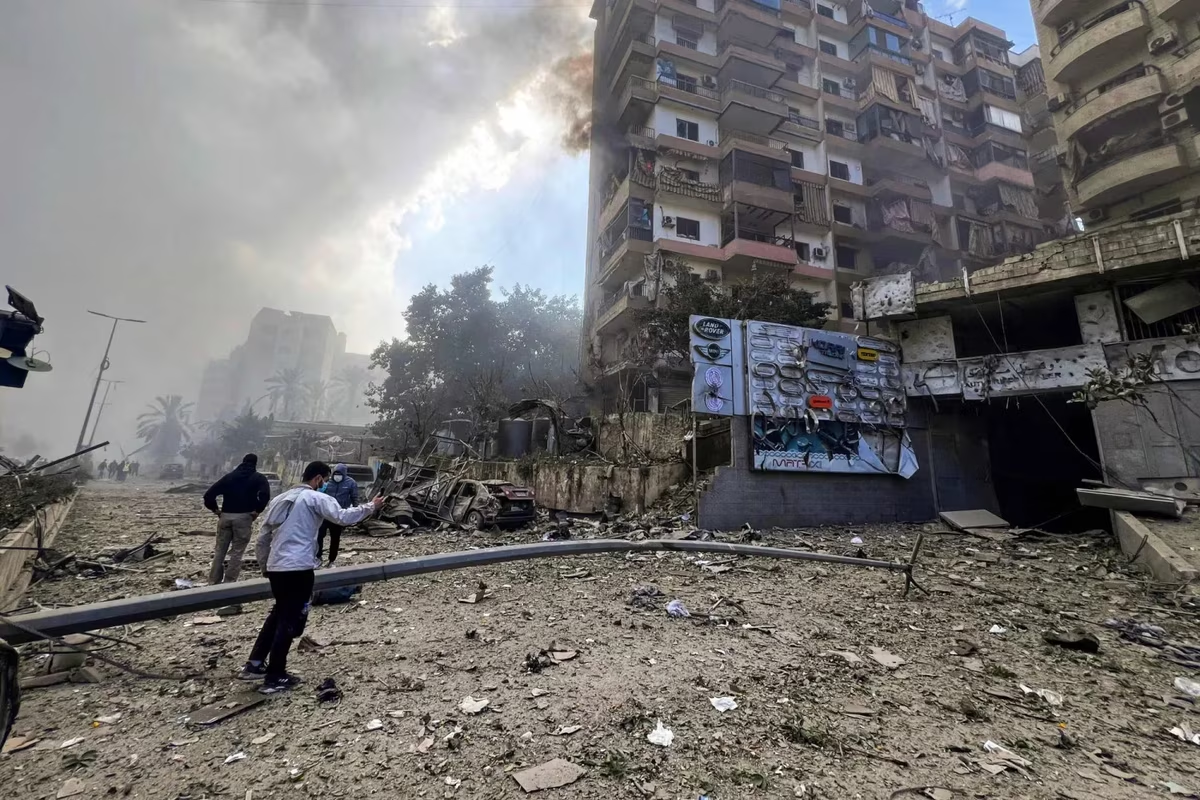
Conversely, the report highlights the escalating humanitarian consequences, as the escalation has led to the displacement of tens of thousands of residents from southern villages, transforming vast areas into semi-civilian-free zones. While this reality facilitates military freedom of movement, it poses ethical and political challenges and increases the fragility of the internal situation in Lebanon, which is already suffering from deep economic and political crises.
Hezbollah's reactions, however, appear carefully calculated, as it continues to carry out limited attacks, including launching rockets and targeting military sites, in an effort to maintain the deterrence equation without sliding into an all-out war. This behavior reflects a keenness to balance the display of power with the avoidance of uncalculated escalation, in light of an awareness of the repercussions of any wide confrontation on Lebanon and the region.
On the international level, concerns about the potential expansion of the conflict are growing, with the United States and European countries seeking to contain the escalation through diplomatic channels. However, these efforts so far seem unable to keep pace with the speed of field developments, opening the door to more complex scenarios if the escalation continues.
The report also indicates that the weakness of the Lebanese state, both militarily and politically, limits its ability to assert its sovereignty in the south, leaving a vacuum exploited by conflicting powers. In this reality, a new field equation is established, based on a fragile balance between a superior military force on one hand, and a non-state actor with long combat experience on the other.
In a deeper reading of these developments, it can be said that the Israeli strategy reflects a transition from traditional deterrence to what can be described as "dynamic deterrence," where the state does not merely demonstrate its ability to respond, but exerts continuous, low-intensity pressure to keep the adversary in a state of constant attrition. However, this pattern carries inherent risks, as it may lead to a gradual erosion of the rules of engagement, and open the door to miscalculations that could ignite a wider confrontation.
The scene in southern Lebanon also reveals a deeper problem related to the absence of an effective state, where the vacuum does not remain neutral but turns into an arena of competition between multiple powers seeking to impose their influence. In this context, borders become areas of security fluidity, where concepts of sovereignty intertwine with deterrence calculations, reflecting a structural crisis in the regional system where the roles of states recede in favor of non-governmental actors.
On the regional level, these developments put the rules of engagement established since 2006 to a real test. If Israel continues to expand the scope of its operations without a proportional response, this could be understood as a redefinition of these rules. However, if Hezbollah decides to break this pattern, the probabilities of rapid escalation become more likely, especially given the increasing interconnectedness between the fronts of conflict in the Middle East, making any potential confrontation have dimensions that extend beyond Lebanese borders to affect regional balances.
Regarding the American position, the United States appears to be facing a complex equation that combines its traditional support for Israel with its desire to prevent the regional expansion of the conflict. On one hand, Washington may see the Israeli strategy as a means to weaken Hezbollah without engaging in an all-out war, which aligns with its goals of reducing Iran's influence. But on the other hand, the US administration fears that gradual escalation could lead to an uncalculated explosion, forcing it into direct intervention or threatening its interests and forces deployed in the region.
The European position, however, is characterized by greater caution, as EU countries view developments from the perspective of regional stability and its humanitarian consequences. While some European capitals understand Israeli security concerns, they fear that the entrenchment of "control without occupation" could undermine international law and deepen the displacement crisis. This concern is likely to push Europe to intensify its diplomatic efforts, and perhaps propose initiatives to revive security arrangements similar to those that followed the 2006 war, with the aim of containing the escalation and preventing it from turning into an open confrontation.
Share your opinion
Israel in Southern Lebanon: A Strategy of Control Without Occupation and the Risks of Escalation Towards a Wider Confrontation