






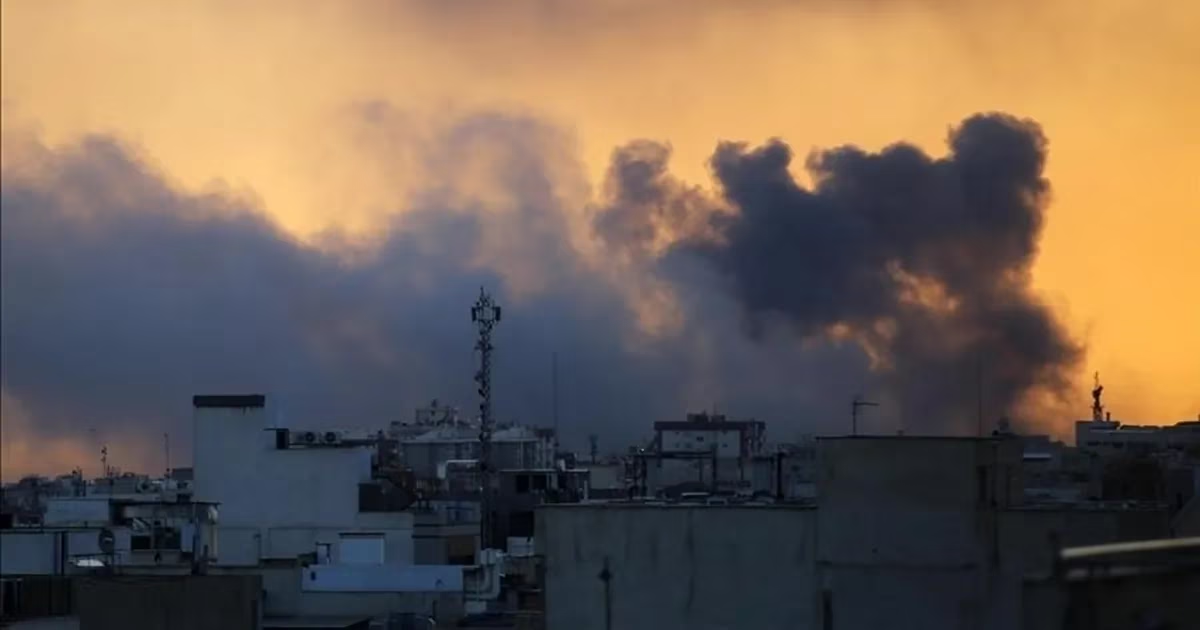
Robert Pape, a professor of political science at the University of Chicago and founder of the Chicago Project on Security and Threats, warned that the prevailing discourse about achieving military 'victory' conceals a dangerous path. Pape explained that the gradual slide towards an all-out war is happening without a clear exit strategy, which could ultimately lead to Iran emerging from this conflict in a stronger and more influential position.
The American academic, in an analysis published by the Israeli newspaper 'Haaretz', pointed out that manifestations of military power, such as precision strikes and assassinations, do not necessarily mean that political goals are being approached. He questioned whether these operations enhance actual security or are merely fuel driving a broad regional escalation that will be difficult to contain in the near future.
Pape based his argument on his thesis in his book 'Bombing to Win', emphasizing that air power alone is incapable of fundamentally changing adversaries' behavior. He argued that bombing might achieve temporary tactical gains, but it often fails to achieve strategic stability, and may even lead to increased resilience and determination to confront the targeted party.
The analysis considered that the occupying state and the United States are currently engaged in what he described as an 'escalation trap', where every military step appears as a major achievement but leads to dangerous consequences. The first phase of this trap, according to Pape, began with the bombing of the Fordow site in June 2025, which did not achieve its ultimate goal due to the transfer of enriched uranium before the attack.
Pape explained that the absence of international oversight over Iranian facilities led to a state of 'strategic panic' among decision-makers, pushing them towards military options aimed at regime change. He warned that this phase leads to a broader escalation, including intense missile attacks and targeting vital maritime passages that affect the global economy.
The academic believes that the Iranian regime has not shown signs of collapse under pressure; instead, it has become more hardline and dangerous as it gains increasing geoeconomic power. He pointed out that Tehran's potential control over the passage of 20% of the world's oil gives it enormous leverage that could tip the balance of power in any open conflict.
Pape warned against transitioning to the third phase, which involves ground operations, emphasizing that they might start limited but quickly expand into a long attrition. He considered that this path reinforces Iran's motives to acquire nuclear weapons as its sole guarantee of survival, rather than deterring it from this path.
The analysis noted a deep gap in decision-makers' perception between tangible military success and invisible strategic failure. While the destruction of military targets is easy to present to the public, it is difficult to measure the deep changes in the adversary's structure, which may become more complex after each strike.
Pape stressed that the Strait of Hormuz represents a trump card for Iran, through which it can achieve broad financial and political gains that burden international powers. He called on Washington to abandon the 'illusion of control' through military force, emphasizing that sustainable solutions only come through viable political and diplomatic arrangements.
Regarding a return to negotiations, Pape noted that opportunities are narrowing and that Iran may raise its demands to include international oversight of Israeli nuclear capabilities. He described Trump's withdrawal from the nuclear deal in 2018 as a grave mistake that accelerated the enrichment program and left the region without a safe alternative plan.
Pape concluded his warning by alerting to the danger of 'radiological attacks' that could cause a major strategic shock even without the use of conventional nuclear warheads. He affirmed that the policy of 'decapitation' and assassinating leaders might replace them with more radical figures, making diplomacy, despite its difficulty, the only path to avoid a catastrophic regional reality.
Tactical military successes can be easily displayed, but they often hide a deep strategic failure to change the adversary's behavior.



Share your opinion
American Academic Warns of 'Escalation Trap': Military Force Won't Break Iran and May Grant It Nuclear Weapons