







Washington – Said Arikat – 3/16/2026
News Analysis
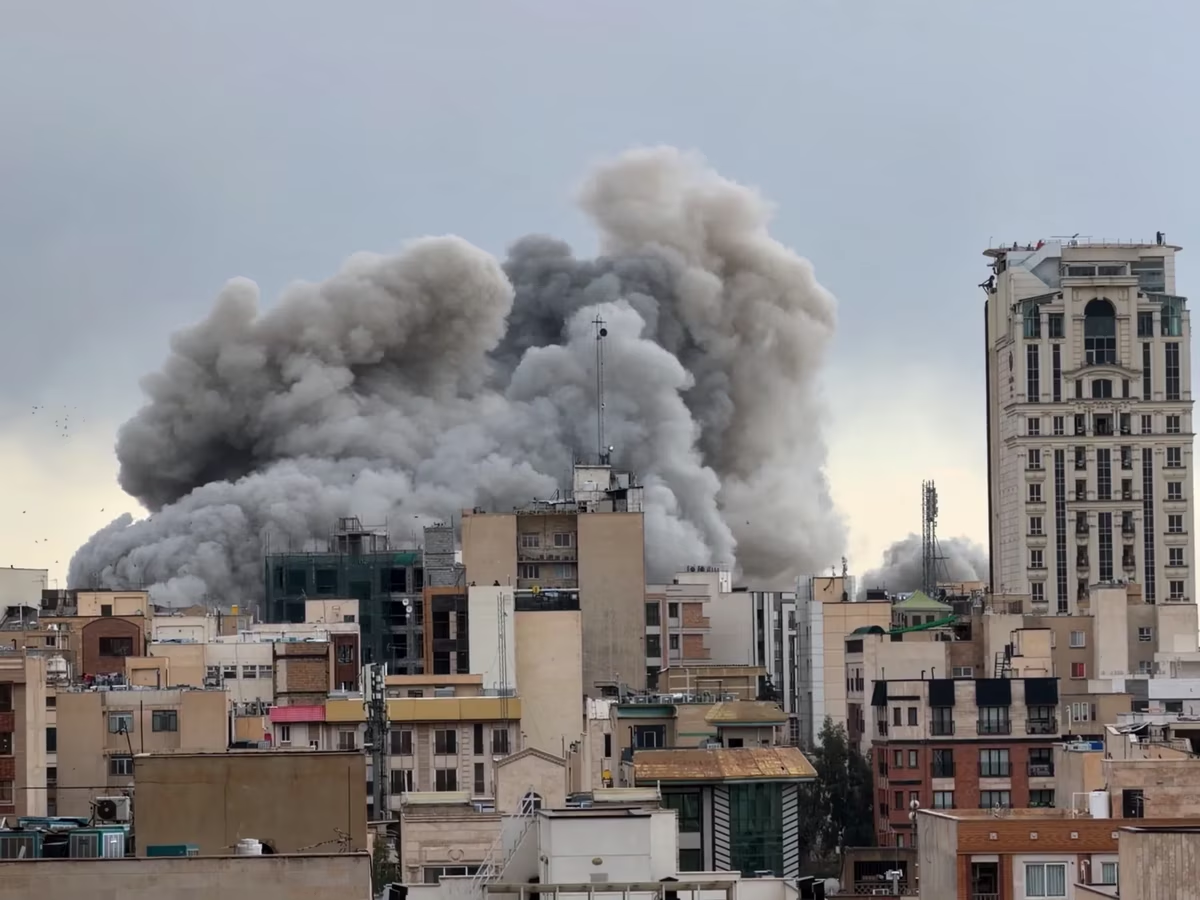
As the war between the United States and Israel on one side, and Iran on the other, enters its third week, indicators are growing that the conflict is heading towards a broader and more complex phase. What began as a series of limited military strikes has quickly transformed into a multi-front confrontation extending from the Gulf to Lebanon, casting heavy shadows over energy markets and the global economy. In contrast, the American strategy appears vague amidst conflicting statements and gradual escalation, raising fundamental questions about the war's objectives, its limits, and the possibility of containing it.
One of the most prominent field developments was the American strikes targeting Iran's Kharg Island, the main center for Iranian oil exports. Targeting this island represents a qualitative escalation because it is a vital economic artery through which a large percentage of Iranian oil exports pass. The implicit message in these strikes was clear and direct: pressure on Tehran will not be limited to the military sphere but will also extend to the economic sphere, attempting to reduce the state's financial resources.
In the same context, US President Donald Trump escalated his rhetoric, warning that his country might destroy the island's infrastructure if Iran continued to threaten navigation or attempted to close the Strait of Hormuz, through which a large part of global oil trade passes. He also hinted at the possibility of sending additional forces to the region, which some observers interpreted as a prelude to a potential larger military escalation in the coming period.
However, the tension did not remain confined to the Gulf. The Lebanese front entered the war more clearly after Hezbollah intensified its rocket and drone attacks against Israeli targets. Israel responded with a series of intense airstrikes inside Lebanese territory, targeting military sites, weapons depots, and logistical infrastructure associated with the party.
With the escalation of this exchange of strikes, the Israeli leadership hinted at the possibility of a ground invasion of southern Lebanon if rocket attacks continued at the same pace. Although this scenario has not yet materialized, merely raising it reflects the extent of the confrontation's scope and the possibility of it turning into an open regional war.
At the same time, the battle began to take on a broader geographical dimension. US bases and interests in several Middle Eastern countries were subjected to rocket or drone attacks carried out by groups allied with Iran. This development reinforces fears that the conflict will turn into a network of simultaneous confrontations in more than one arena.
Amidst this escalation, Iranian Foreign Minister Abbas Araghchi made controversial statements, saying that some of the strikes targeting facilities in Gulf countries might have been carried out by the United States or Israel with the aim of expanding the war and placing responsibility on Iran. Although there are no independent confirmations of these accusations, they reflect the depth of distrust between the parties to the conflict.
Economically, the repercussions of the war have begun to appear clearly. Tensions in the Gulf and repeated threats to close the Strait of Hormuz have led to a rise in oil prices in global markets, which directly reflected on fuel prices within the United States. With rising gasoline prices in several states, signs of public discontent began to emerge.
As the fighting continued, the major goals raised at the beginning of the war began to seem out of reach, foremost among them weakening or changing the Iranian regime. Despite the strikes the country has suffered, Iran still retains its basic political and military structure, and state institutions have not shown clear signs of internal collapse.
This reality has led an increasing number of analysts to question the utility of the war. Previous experiences in the region have shown that regime change through external military pressure rarely achieves declared results; in fact, it can sometimes lead to adverse outcomes that strengthen the cohesion of the targeted regime.
In parallel, efforts to push Gulf countries into direct involvement in the war have not succeeded. In the early days of the escalation, expectations prevailed that some of these countries would allow their territories to be used more widely in military operations. However, subsequent developments indicate that most Gulf governments prefer to remain outside direct confrontation and focus on protecting their internal stability and economic interests.
All these developments are taking place amidst what many observers describe as the absence of a clear American strategy for managing the war. Statements from President Donald Trump and his administration officials change from time to time between threatening to expand military operations and hinting at the possibility of containing the conflict. This disparity in political messages likely reflects the absence of a coherent vision for what the end of this war should be.
So far, it is not clear whether Washington seeks merely to deter Iran, or to weaken its military capabilities, or to push it towards new negotiations with different conditions. Amidst this ambiguity, fears are growing that the confrontation will turn into a long war of attrition, imposing increasing costs on all parties.
If the escalation continues without a clear political path, the possibility of the war expanding will remain. The longer the fighting lasts, the greater the chances of it spreading to new arenas in the region, and with it, the economic and security risks will increase. Moreover, continued tension around the Strait of Hormuz could push energy prices higher and increase pressure on the global economy. Ultimately, the Middle East faces a new phase of instability where military calculations intertwine with political balances and economic interests. With the absence of a clear diplomatic horizon, the region remains vulnerable to successive cycles of escalation whose effects could extend for many years.
Some observers believe that the most dangerous aspect of this phase is not the scale of military strikes as much as the absence of a clear vision for the end of the conflict. Wars that begin without specific political objectives often turn into open confrontations that are difficult to end quickly. If a serious negotiating path does not emerge, the region may find itself facing a long conflict that drains the resources of states and increases uncertainty. This makes the prospects for de-escalation in the short term limited and uncertain in the current complex regional circumstances.

Share your opinion
An American War Without a Compass Leading the Region to Catastrophe