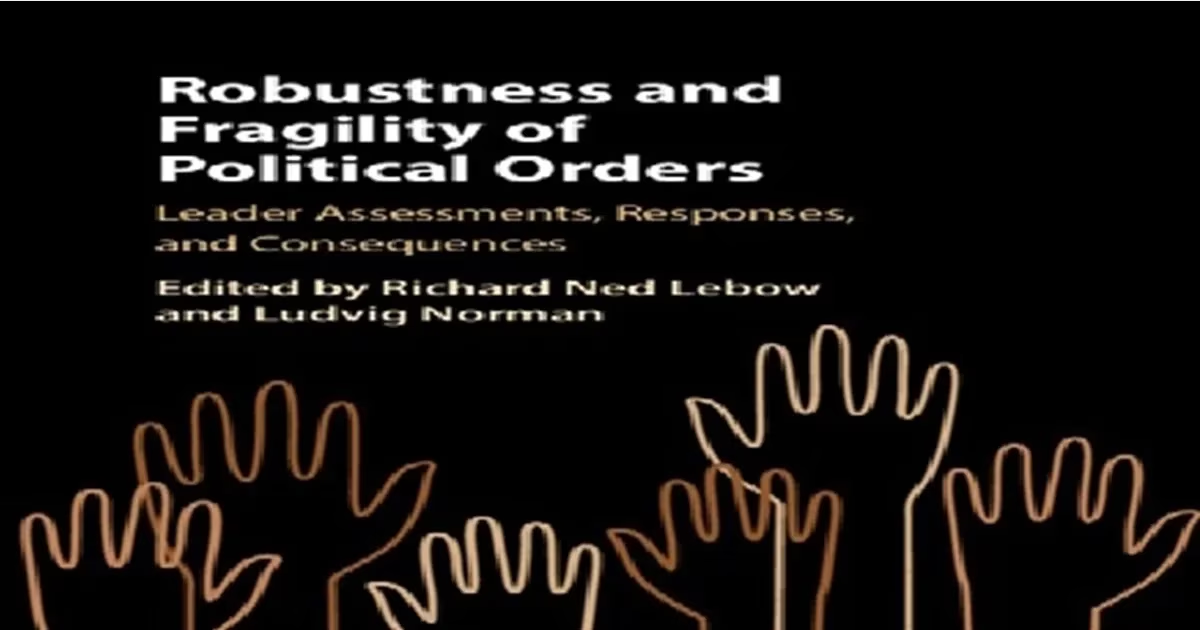







The issue of the robustness and fragility of political systems is one of the most pressing in contemporary political science, given its direct impact on global stability and the future of peoples. The book 'Resilience and Fragility of Political Systems,' published by Cambridge University Press, sheds light on the pivotal role leaders play in shaping these perceptions throughout history.
The book's editors, Richard Ned Lebow and Ludvig Norman, believe that major political transformations do not happen suddenly, but are the result of gradual processes influenced by how ruling elites assess the strength of their systems. These assessments are not merely an intellectual luxury, but are the primary driver of political behavior that determines whether a system will solidify or erode.
The book defines political systems as collections of formal and informal institutions and procedures that organize collective life and manage social conflicts. While governments may change rapidly, systems tend to endure, and when they collapse, the consequences are dire and often redraw political maps.
The work reviews prominent historical examples such as the collapse of the Soviet Union and the disintegration of the Ottoman Empire, illustrating how the weakness of central systems led to the emergence of new separatist states. In certain cases, the collapse did not stop at the boundaries of the political system, but extended to encompass the entire state, as happened in Yugoslavia and Libya.
The analysis addresses the fluctuation of perceptions of strength and fragility, where fears of collapse can suddenly appear even in seemingly stable systems. After World War II, there was great optimism about the resilience of democracy, but this optimism receded in the face of waves of coups and political unrest in Europe and Latin America.
In the last decade, pessimism has replaced liberal certainty, and democracy has become threatened even in its traditional strongholds in Western Europe and North America. Researchers attribute this shift to increasing economic inequalities and the emergence of populist movements that question the legitimacy of existing institutions and stable democratic norms.
The United States represents a current example of this concern, with warnings of the collapse of the democratic system escalating for the first time since the Great Depression. The events of the 2020 election and the storming of the Capitol reinforced these fears, making the system's survival a serious question for many analysts.
The book indicates that political leaders assess the strength of their systems based on an uncertain understanding of risks, rather than according to agreed-upon objective standards. While some see the resilience of American institutions in the face of the Trump era crises as evidence of their strength, others see it as an expression of a slow and continuous erosion of the system.
Historically, overconfidence in the resilience of democracy during the 1920s led to underestimating the danger of fascism and Nazism. The 'Weimar lesson' contributed to shaping the consciousness of European elites after the war, as they focused on ensuring institutional stability rather than merely deepening popular participation, which could be fraught with risks.
The phenomenon of misunderstanding events is not limited to democratic systems, but also extends to authoritarian systems, as happened in the Soviet Union under Khrushchev and Gorbachev. Uncalculated reform attempts, or excessive repression, accelerated the pace of collapse instead of protecting the system from disintegration.
In the contemporary Chinese case, the leadership seems to share a constant sense of fragility, which drives it to use brute force against any potential opposition. Analysts believe that this repression may buy the system additional time, but at the same time, it may increase the chances of a resounding fall in the long run.
International systems are also affected by these dynamics, with organizations such as the United Nations and the European Union built on the ruins of past failures. Despite the European project's success in enduring for decades, concerns about its fragility remain strongly present in the discourse of leaders and political actors.
The book concludes that no political system is absolutely robust; all systems lie somewhere on a continuum between resilience and collapse. Fragility is often a latent state whose true degree only becomes apparent when a sudden catalyst leads to the fracturing of the political structure.
Building legitimacy and robustness is a gradual and complex process, while external shocks or internal crises can quickly shift a system from strength to fragility. Therefore, leaders' ability to read reality and avoid self-deception remains the only, albeit uncertain, guarantee for the survival of nations.
Fragility and robustness are not merely objective facts, but are the product of leaders' perceptions that drive them to make decisions that may accelerate the collapse of their systems or grant them additional longevity.




Share your opinion
The Resilience and Fragility of Systems: How Leaders' Perceptions Shape the Fate of Nations?