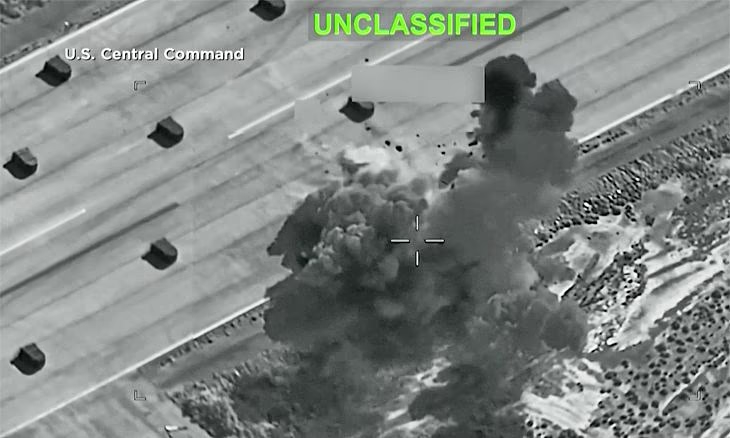







The Iranian scene witnessed a wave of angry reactions following US President Donald Trump's statements, in which he described Iranians with harsh terms, announcing the end of the memorandum of understanding signed between the two parties. These statements coincided with widespread military operations carried out by the US army targeting vital sites across Iran, which prompted the Iranian armed forces to respond by targeting American bases in Gulf countries, amid warnings of the region sliding into a comprehensive confrontation.
In this context, Hossein Shariatmadari, director of the Kayhan newspaper, which is close to decision-making circles, affirmed that his country possesses all the necessary technologies to produce nuclear weapons, pointing out that the only obstacle is the political decision based on religious fatwas. Shariatmadari explained that any change in this direction depends entirely on the vision of the supreme leadership in light of the unprecedented American escalation, considering that the language of force is the only one Washington understands at present.
For his part, Ali Akbar Velayati, advisor to the Iranian Supreme Leader, described the recent American moves as a dangerous political gamble that will be met with immediate and firm responses. Velayati held the US administration responsible for the collapse of diplomatic understandings, stressing that the region can no longer tolerate more adventures led by those he described as disreputable politicians, emphasizing that Tehran will not stand idly by in the face of continued practical violations of international conventions.
Hardline media circles in Tehran called for deterrent economic and military measures, including the complete closure of the Strait of Hormuz and preventing the flow of oil to global markets. These circles considered that exercising maximum pressure by disrupting navigation in Bab al-Mandab and strategic straits would make the cost of aggression prohibitive for the West, and force the United States to recalculate its security and psychological considerations in the region.
In a related context, the tone of personal threats against American and Israeli leaders escalated, with media platforms demanding the activation of operational capabilities to respond to the assassination of military commanders. In contrast, diplomatic voices emerged calling for the necessity of finding common interpretations of the provisions of security understandings to avoid armed conflict, warning that the transformation of the Strait of Hormuz into a nuclear or military conflict zone would destroy what remains of opportunities for fragile diplomacy.
The gap between us and nuclear weapons is will, not technology, and the Islamic Republic possesses the technical capability to produce them.
شارك برأيك
Tehran hints at nuclear option and Strait closure in response to US attacks