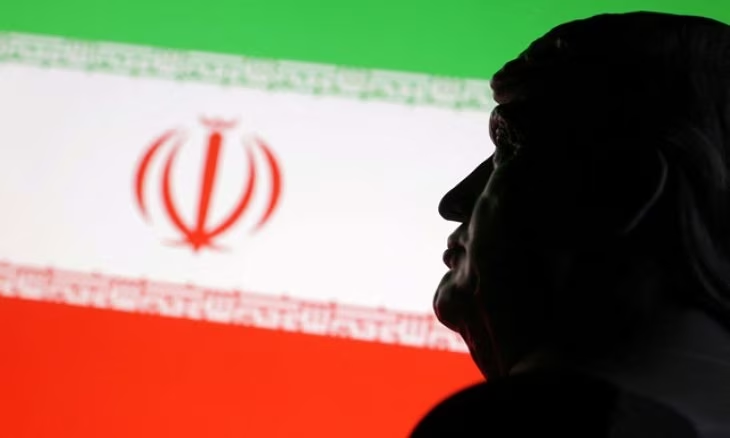







In his recent speeches, coinciding with the signing ceremonies of memoranda of understanding with Tehran, the American president reiterated what he considered a compelling economic argument in favor of this diplomatic path. Trump claimed that the signing would inevitably lead to a sharp drop in global oil prices, which would stimulate a stock market boom and restore lost economic prosperity.
The American president showed a willingness to make substantial concessions to the Iranian regime, justifying this by the desire to avoid what he described as a 'global economic catastrophe.' He indicated that continued tension in the Strait of Hormuz could lead to a collapse of energy supply chains, causing a global recession, mass unemployment, and uncontrollable waves of inflation.
These justifications resonated widely with some investors and politicians who recalled the bitter oil crises of the 1970s. However, analytical sources indicate that this discourse ignores the radical transformations that the global energy sector has witnessed over the past five decades, which have reduced oil's political dominance.
In 1980, oil contributed about 40% of global electricity production, while data from the last quarter of 2025 indicates that this percentage has fallen to a negligible level not exceeding 2%. This shift means that fluctuations in crude prices no longer directly and deeply affect production and service costs as they did in the past.
The global transport sector, in turn, has witnessed a revolution in energy efficiency, with a steady increase in reliance on electric and hybrid vehicles. This development has significantly reduced oil consumption per unit of GDP, making the global economy more resilient to threats of waterway closures.
Contrary to the claims of the US administration, stock markets showed stability and growth during the months of conflict in the Strait of Hormuz, while recording a 4% decline immediately after the agreement was signed. This contradiction weakens the argument that an agreement with Tehran was an inevitable necessity to save global financial markets from imminent collapse.
Economic figures confirm that Iran is suffering from suffocating internal crises, with a per capita GDP not exceeding $3,400, which represents a tiny fraction compared to American income. This structural weakness makes the Revolutionary Guard's ability to threaten international navigation freedom merely a media maneuver rather than a real existential threat.
It appears that Trump consciously chose to exaggerate economic fears to serve as political cover for his sudden shift towards Tehran and his preference for dialogue over confrontation. This political choice, despite its legitimacy, could have been marketed without the need to fabricate economic justifications that observers describe as unrealistic and ignoring the realities of the digital age.
The regime in Iran is on the verge of collapse and is effectively incapable of threatening America or the Western economy; it is waving a water pistol.
شارك برأيك
Behind the Economic Curtain.. Did Trump Surrender to Iranian Threats with a 'Water Pistol'?