






Washington's Message
Washington – Said Arikat – 6/18/206
News Analysis
In a historic shift that may be the most significant in US-Iranian relations since the 1979 Islamic Revolution, US President Donald Trump announced on Wednesday evening the full text of a fourteen-point memorandum of understanding between the United States and Iran, after it was electronically signed by officials from both sides, to enter into force immediately. US Vice President J.D. Vance is scheduled to participate in the official signing ceremony on Friday in Geneva.
The agreement puts an end to a period of dangerous military escalation that nearly pushed the region into a widespread war, before considerations of economic and strategic cost outweighed the logic of military confrontation. It also opens the door to a sixty-day negotiation process to reach a more comprehensive final agreement addressing nuclear, economic, and security issues, and regional relations between the two countries.
According to informed sources, the final signing was scheduled to take place during a direct meeting in Switzerland, but intensive diplomatic mediations prompted both parties to accelerate the process and approve the electronic signing with the aim of expediting the implementation of urgent provisions, foremost among them the reopening of the Strait of Hormuz and the restoration of freedom of international navigation in the Gulf.
The agreement includes fourteen main points, including an immediate cessation of hostilities, respect for mutual sovereignty, reaching a final agreement within sixty days, reopening the Strait of Hormuz, resuming Iranian oil exports, freezing new US sanctions, Iran's commitment not to seek nuclear weapons, freezing its nuclear program at its current level, returning maritime trade to normal, preventing any further military escalation, establishing a joint monitoring and implementation mechanism, launching an international program to rehabilitate the Iranian economy with an estimated value of 300 billion dollars, in addition to initiating negotiations on frozen Iranian assets and sanctions, and finally presenting the final agreement to the UN Security Council.
The agreement reflects a mutual acknowledgment of the limits of power for both parties. After many years of sanctions, pressure, and indirect military operations, Washington failed to impose a radical change in Iranian behavior, just as Tehran was unable to eliminate US influence from the region or overcome the impact of the US-led global financial system. Thus, the agreement came as a practical recognition that the continuation of the conflict had become more costly than reaching a political settlement that preserves the minimum interests of both sides.
The text of the memorandum also reveals a clear shift in the American approach. Instead of insisting on addressing all contentious issues at once, including Iran's missile program and Tehran's regional alliance network, Washington focused on more realistic goals: preventing nuclear armament, ensuring the security of maritime navigation, and opening a gradual path to address sanctions and economic issues. This reflects a growing conviction within the US administration that expanding the negotiation agenda to the maximum extent would have led to the collapse of the entire process.
Despite repeated comparisons with the 2015 nuclear agreement, the new document goes far beyond that model. The previous agreement was limited to the Iranian nuclear file in exchange for sanctions relief, while the current understanding establishes a broader political, security, and economic framework that includes Gulf security, freedom of navigation, economic reconstruction, de-escalation mechanisms, and the future of the relationship between Washington and Tehran itself. Therefore, considering it merely a modified version of the 2015 agreement is a misleading simplification of its nature and scope.
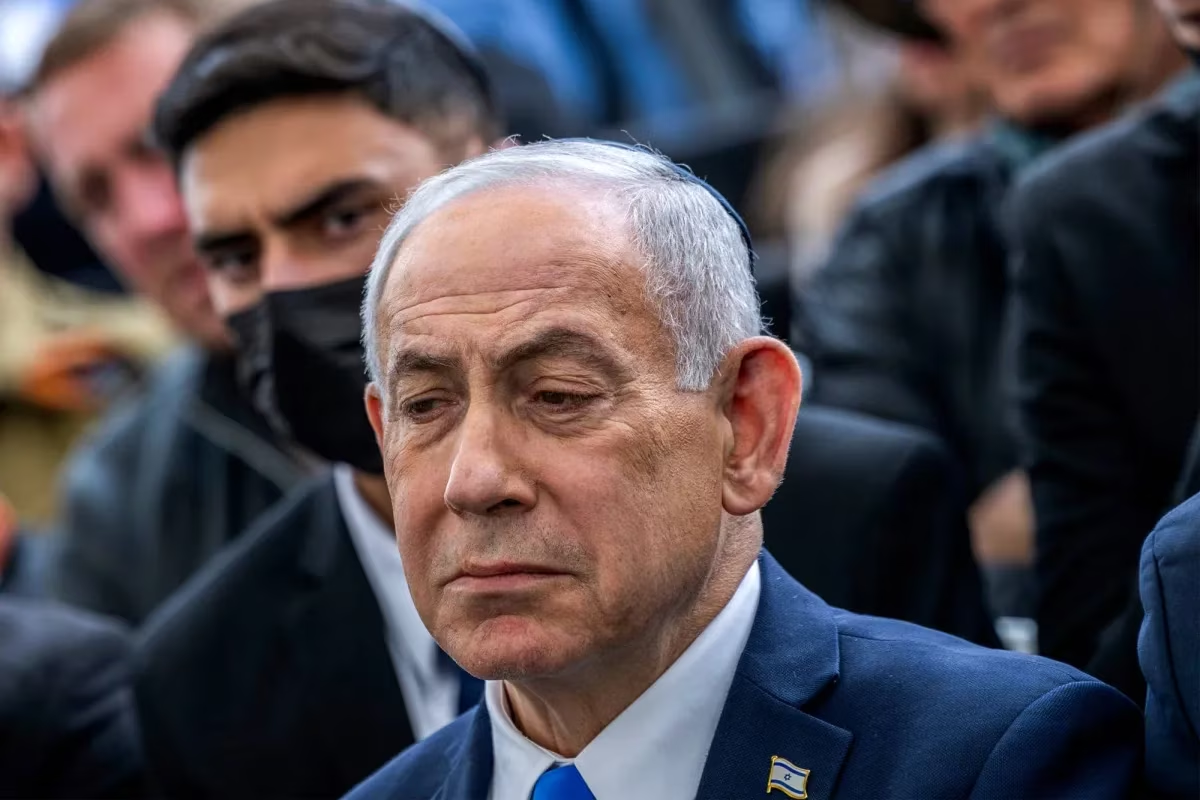
However, the most striking aspect of this development lies in its repercussions for Israel, specifically for Prime Minister Benjamin Netanyahu, who spent many years warning against any American openness to Iran, and made the policy of confrontation, isolation, and maximum pressure the cornerstone of his strategy towards Tehran.
Since the beginning of the recent crisis, Netanyahu gambled that military escalation would push Washington to adopt a tougher policy towards Iran, and perhaps to impose harsh conditions on it or enter into an open confrontation with it. However, the result was completely the opposite. Instead of expanding the circle of war, the crisis ended in an agreement that relaunches the US-Iranian dialogue and gives Tehran an opportunity to gradually emerge from economic isolation, and reintegrates it into new regional and international arrangements.
For this reason, many observers view the agreement as a clear political and strategic defeat for Netanyahu, not only because he failed to prevent the understanding, but because the war he advocated for practically ended in the very outcome he had sought for years to prevent: direct negotiations between Washington and Tehran under international auspices, and mutual recognition of the necessity of managing differences through diplomacy rather than open confrontation.
The agreement also deals an additional blow to the traditional Israeli narrative, which was based on portraying the conflict with Iran as an existential struggle that could only be settled through continuous pressure, sanctions, and the threat of military force. The success of Washington and Tehran in reaching this negotiating framework proves that a diplomatic alternative is still possible even after many years of hostility and distrust.
Regionally, the agreement may open the door to a new phase of de-escalation and reordering of priorities. US-Iranian hostility was one of the main drivers of crises in Iraq, Syria, Lebanon, Yemen, and the Gulf. If both parties succeed in solidifying the current understandings, real opportunities may arise to mitigate conflicts and open new political paths in a number of complex regional issues.
Nevertheless, the real challenge lies not in signing the agreement but in its continuation. The previous experience of the 2015 nuclear agreement showed that any understanding can collapse with changes in administrations or shifts in political calculations. Moreover, opponents of the agreement in Washington, Tehran, and Tel Aviv will work to test its resilience from the very first moment.
But, even if the agreement faces significant obstacles in the future, merely reaching it after nearly forty-seven years of estrangement and hostility represents a historic event in itself. It not only reflects the end of a round of confrontation but also signals the beginning of a reshaping of regional balances on new foundations, and solidifies a political reality that is difficult to ignore: that the war Netanyahu hoped would strengthen his position ended by strengthening the diplomacy he had long sought to prevent.
شارك برأيك
The US-Iran Agreement Reshapes the Middle East and Solidifies Netanyahu's Political Defeat