






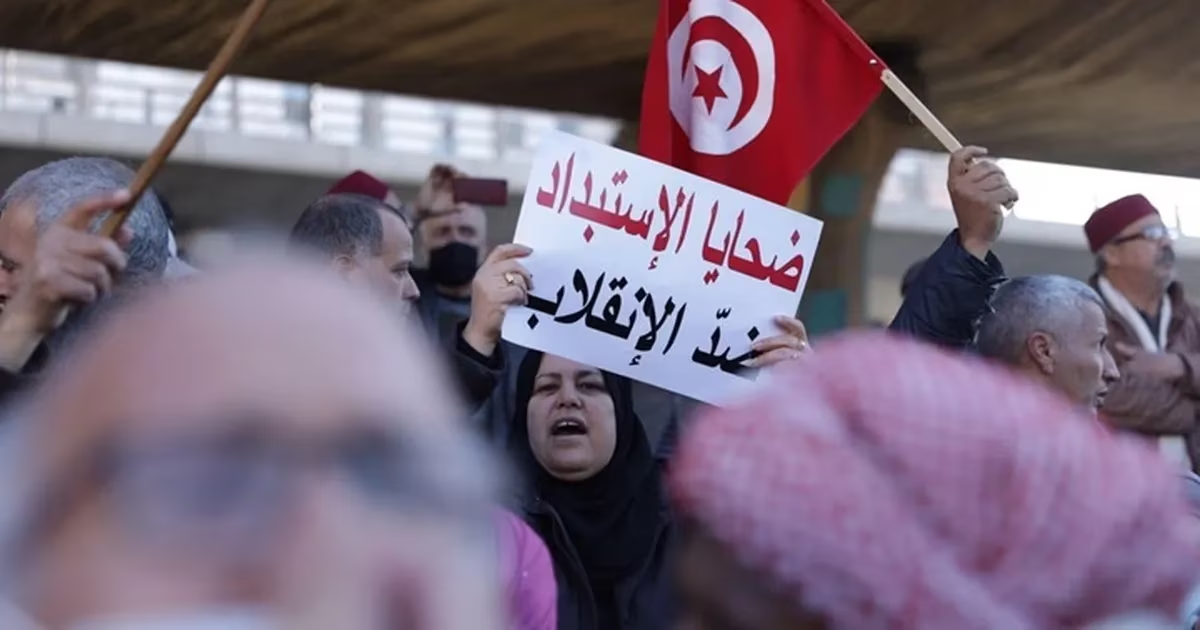
The term 'functional left' emerges in Tunisian political discourse to refer to those forces that placed their human and symbolic capital at the service of the ruling system since nominal independence. Despite this current's subservience to the hard core of power, it played a pivotal role as an ideological reservoir for successive regimes, from Bourguiba's era to current political narratives.
Rentier families and regional loyalties formed the backbone of the economy and decision-making centers in Tunisia, while leftists who abandoned their grand slogans became a human rights and political facade for Ben Ali's regime. This functional role enabled the system to possess ideologically-driven arms capable of marketing its policies and justifying the repression of political opponents under the guise of modernity.
After the events of the revolution, the hard core of the regime succeeded in diverting the primary struggle against the comprehensive corruption system, transforming it into a legal and criminal battle against specific individuals and families. This strategy primarily relied on downplaying the role of the 'functionaries' who were an integral part of the official machine of repression and propaganda.
The dissolution of the dissolved RCD party was considered merely a tactical step to absorb popular anger, while the real goal was to redeploy its cadres under new names. The absence of a political isolation law contributed to enabling these functional bodies to return to the forefront of the political scene and work to demonize the democratic process and its outcomes.
Ennahda Movement bears a significant part of the historical responsibility for this situation, as it participated, through silent or active complicity, in aborting the project of fortifying the revolution. This consensual choice allowed the functional left to shift the conflict from a confrontation with the old system to an identity struggle targeting Ennahda's political existence itself.
The functional left managed to convince broad sectors that the real battle was between 'democratic forces' and Islamists, ignoring its long history of supporting authoritarianism. This shift in the trajectory of the conflict led to the closure of political and moral accountability files for crimes committed against opponents over the past decades.
Questions are raised today about the reason for the silence of the forces harmed by Ben Ali's regime, especially the Ennahda Movement, regarding opening the file of political responsibility of the functional left. The issue is not only about criminal responsibility but also about the active support these currents provided for unpatriotic choices that led to the destruction of the political and social fabric.
Historical readings indicate that the former ruling party was a magnet for Marxist and nationalist leftists who joined the security, media, and educational apparatuses. These formed the 'spearhead' in confronting political Islam during the nineties, which explains the deep-seated animosity that still governs their relationship with the democratic process.
Analysts believe that Ennahda's leaders preferred to close this file not only because of weak power balances but also to avoid opening files of their own responsibility for catastrophic decisions made after 1987. The fear of mutual accountability led to the entrenchment of a state of political impunity, for which thousands of victims from the popular bases paid the price.
While the functional left raises slogans rejecting communication with Ennahda on the pretext of 'blood,' it ignores the blood shed because of it in the dungeons of the former regime. These exaggerations reflect a structural imbalance in the logic of transitional justice, which was corrupted in favor of fragile alliances that did not withstand the first real test.
The file of political assassinations in Tunisia has turned into a tool for political maneuvering instead of a path to uncovering the truth and achieving justice. These issues are exploited to reinforce ideological narratives that serve exclusionary agendas, far from the objective legal evidence and facts imposed by the ethics of political action.
Rewriting the history of the functional left in Tunisia has become an urgent necessity to understand the current reality and build a future based on facts, not illusions. This writing must be free from nationalistic exaggerations and self-serving claims promoted by these currents to cover up their past linked to authoritarian systems.
Experience has proven that the consensual choices adopted by Ennahda were its first victims, as it was overthrown by the same forces it tried to appease. The absence of political accountability allowed the revolution's adversaries to reposition themselves in coup projects targeting the aspirations of the Tunisian people for freedom and dignity.
In conclusion, a true democracy cannot be built under false narratives that ignore the rights of the oppressed and prioritize ideological grudges over national interest. Restoring the correct path requires courage in confronting history and opening all files that were closed by political deals that only complicated and exacerbated the scene.
The dissolution of the RCD without enacting a political isolation law was a necessary step in the old system's strategy to reposition and redeploy itself under the umbrella of the revolution.
شارك برأيك
Political Responsibility in Tunisia: A Reading of the Roles of the 'Functional Left' and Post-Revolutionary Transformations