






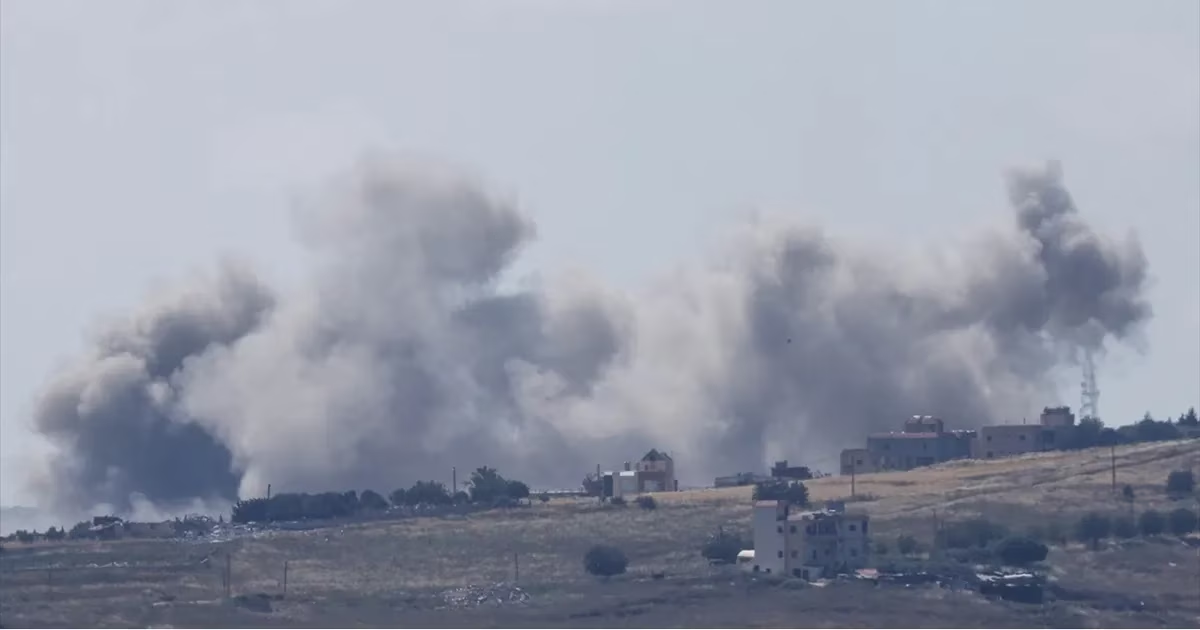
Recently, a series of ideas and questions have been escalating regarding the outcomes of the fierce conflict witnessed in Lebanon. Discussions primarily focus on what is known as the 'day after' the war. The current scene, in many of its aspects, appears to be a continuation or repetition of previous stages in Lebanon's complex political and military history.
In this context, the agreement that resulted from the direct negotiations at the US State Department earlier this month stands out. Observers believe that this agreement bears a strong resemblance to the May 17th Agreement of 1983, raising fears of reproducing formulas of political dependency.
The political landscape in Lebanon is currently divided into four main axes, led by the ruling faction that consolidates its ties with Washington. This faction fully relies on American political penetration to empower it to govern and solidify its influence in the state.
The second faction is described as having a rich history of relations with the Israeli occupation and relying on its army and influence. This party counts on continuous aggression to achieve internal political gains, represented by political models that historically sought to align with external projects.
The third faction consists of traditional forces involved in the sectarian system, most notably the 'Amal' and 'Hezbollah' duo, in addition to leftist and national forces. This alliance represents an extension of the Lebanese National Movement that was active in the mid-1970s to confront isolationist projects.
In contrast, a fourth party emerges, consisting of centrist parties and figures that do not form a unified or consistent current in their positions. These try to balance international pressures and local reality, but they lack a comprehensive strategic vision amidst the raging crisis.
Pro-Western parties adhere to a definition of 'sovereignty' from a perspective aimed at preserving traditional sectarian and confessional balances. This concept of sovereignty entrenches the privileges of specific parties and keeps Lebanon in a state of economic, cultural, and security dependency on the Western system.
The current stage calls for a precise review of policies and approaches regarding the absolute priority of confronting American and Zionist aggression. This review includes forces involved in sectarian power-sharing and those carrying the banner of radical change and reform.
National and leftist forces have undergone an important experience in the field of resistance and liberation, and have achieved much in confronting the occupation. However, the current crisis is likely to worsen more than before, necessitating serious engagement with the new Washington agreement.
Political review should not be an intellectual luxury, but rather a continuous process and an integral part of the national strategy. The goal is to improve popular and political performance, and to get rid of the mistakes that have accumulated over decades of internal and external conflict.
The history of liberation movements shows that popular struggle usually rises against an oppressive internal enemy or external aggression that the authority is unable to repel. In the Lebanese case, the authority often appears complicit with the aggressor, which raises the issue of authority as a central concern.
Looking at the experience of the national resistance 'Jamoul' in 1982, we find that it did not set reaching power as a primary goal despite the clarity of its liberation project. In contrast, the Islamic resistance engaged in the legislative and executive institutions of the state, especially after the Syrian withdrawal from Lebanon.
Today, the resistance faces exceptional challenges, as the occupation continues its brutality in the south while the American patron exerts immense pressure internally. This comprehensive war aims to liquidate Lebanon's resistant past and present and control its sovereign decision.
The current battle is not only military, but an existential battle that requires deep discussion to confront the immense dangers. The necessity today dictates the formation of the broadest national front to confront the aggressor and its partners, which requires developing a clear and comprehensive national action program.
The current great and exceptional dangers necessitate research and review without delay, as the enemy continues its brutality in the south while its American patron consolidates its presence internally.
شارك برأيك
A Reading on the Outcomes of the Lebanese Conflict: Will History Reproduce the May 17th Agreement?