






By: Said Arikat
May 16, 2026
News analysis
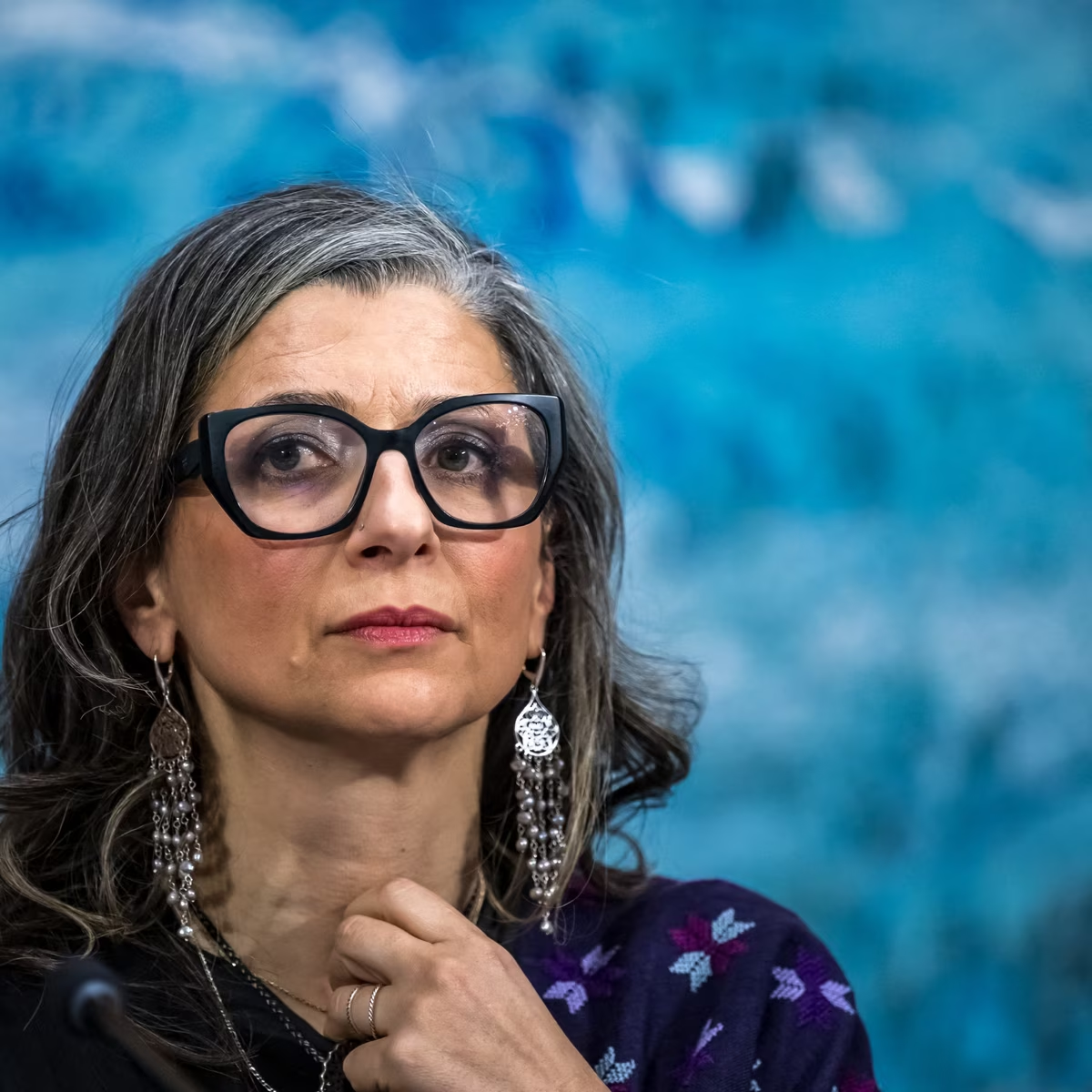
In a moment when moral clarity is increasingly punished rather than rewarded, the recent ruling by U.S. District Judge Richard Leon temporarily blocking sanctions against Francesca Albanese, United Nations Special Rapporteur on the Occupied Palestinian Territories, stands as more than a legal decision. It is a reaffirmation of one of the most fundamental democratic principles: that speaking uncomfortable truths must never become a punishable offense.
The Trump administration’s sanctions against Albanese — including travel restrictions and financial penalties — were not imposed because she committed a crime. They were imposed because she dared to speak openly and consistently about the devastating human toll of Israel’s military campaign in Gaza and the broader realities of occupation, dispossession, and impunity faced by Palestinians.
Judge Leon recognized precisely that. In a forceful rebuke, he concluded that Albanese had “done nothing more than speak,” underscoring the obvious but increasingly endangered truth that criticism of state policy, including that of Israel, remains protected political speech. That this reminder had to come from a federal courtroom is itself an indictment of the current political climate.
Albanese’s courage deserves recognition because she has persisted despite relentless intimidation campaigns, political pressure, and personal attacks. As United Nations Special Rapporteur, her mandate is neither ceremonial nor selective. It requires documenting violations of international law wherever they occur and regardless of who commits them. Yet in fulfilling that mandate with integrity, she became the target of one of the world’s most powerful governments.
The sanctions were especially alarming because they sought to weaponize state power against an independent UN expert for engaging with international accountability mechanisms, including discussions surrounding investigations by the International Criminal Court. Such measures carried chilling implications not only for Albanese personally, but for every human rights investigator, journalist, scholar, or advocate willing to scrutinize Israeli conduct in the occupied Palestinian territories.
What makes Albanese particularly significant is her refusal to retreat into euphemism. At a time when many public officials carefully calibrate their language to avoid political backlash, she has spoken directly about Palestinian suffering, collective punishment, forced displacement, and the destruction of civilian life. Whether one agrees with every formulation she has used is ultimately secondary to the principle at stake: human rights advocates must be free to investigate and speak without fear of political retaliation.
The court’s finding that Albanese possesses sufficient constitutional protections despite being a non-U.S. citizen living abroad is also noteworthy. It reinforces the idea that free expression cannot be selectively granted only to those whose views align with prevailing political interests. Rights lose meaning when they become contingent upon ideological approval.
Equally disturbing was the collateral damage inflicted on her family. The lawsuit revealed how the sanctions effectively “debanked” Albanese and disrupted the lives of her American husband and daughter. This was not merely symbolic punishment. It was an attempt to isolate and silence through financial coercion and personal hardship.
The broader implications of this case extend well beyond one individual. Around the world, governments increasingly seek to blur the line between criticism of state conduct and illegitimate speech. Human rights defenders who challenge powerful actors are often smeared, threatened, or criminalized. Albanese’s case demonstrates how fragile independent international oversight can become when political interests supersede legal principles.
And yet, despite these pressures, she did not retreat.
That perseverance matters profoundly for Palestinians living under bombardment, occupation, and blockade, many of whom feel abandoned by the international community’s selective outrage and inconsistent application of international law. Voices like Albanese’s offer something increasingly rare: a willingness to affirm Palestinian humanity with the same urgency and dignity routinely afforded to others.
Supporting Francesca Albanese is not about endorsing every political argument she has made. It is about defending the principle that exposing suffering and demanding accountability should never invite state repression. Democracies do not weaken because people speak critically. They weaken when governments attempt to silence those who do.
Judge Leon’s ruling is only preliminary, and the legal battle is far from over. But for now, it offers a necessary reminder that conscience still has defenders — in courtrooms, in civil society, and among those unwilling to look away from injustice.
Francesca Albanese has shown remarkable resolve under extraordinary pressure. History often vindicates those who choose principle over convenience. Whatever the outcome of this legal fight, her determination to defend Palestinian rights in the face of intimidation has already secured her place among those who refused silence when silence was easier.
شارك برأيك
Judge Leon’s Decision Affirms Francesca Albanese’s Courageous Commitment to Principle and Palestinian Rights