






By Said Arikat
May 15, 2026
News analysis
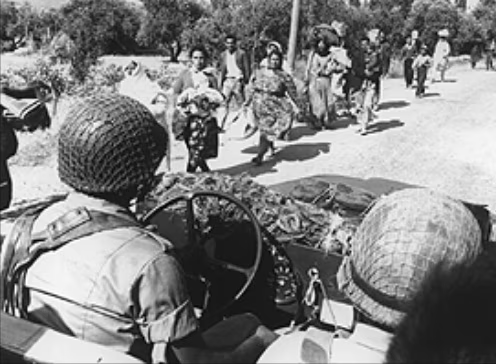
Washington, D.C. — Seventy-eight years after the Palestinian Nakba of 1948, the catastrophe endures not as memory, but as structure — a living system of dispossession sustained by military force, protected by Western power, and normalized through decades of political hypocrisy. What began with the expulsion of more than 750,000 Palestinians from their towns and villages evolved into one of the modern world’s longest-running projects of displacement and erasure. Hundreds of communities were destroyed, families scattered across refugee camps and exile, and an entire people condemned to occupation, siege, and statelessness. For Palestinians, the Nakba was never an event confined to history. It survives in settlement expansion, land confiscation, checkpoints, home demolitions, and the repeated destruction of Gaza.
The origins of this catastrophe lie in the logic of empire itself. The 1917 Balfour Declaration remains among the clearest expressions of colonial arrogance in modern history: Britain, ruling Palestine through imperial force, promised the homeland of one people to another political movement while denying the indigenous Palestinian population the right to determine its own future. Under the British Mandate, Zionist institutions were cultivated politically and militarily under imperial protection, while Palestinian resistance was crushed with extraordinary brutality, particularly during the Arab Revolt of 1936–1939. Palestinian aspirations for independence were treated not as legitimate national demands, but as obstacles to imperial strategy.
The Nakba did not emerge simply from the chaos of war. Decades of historical research — including by Israeli historians — have documented organized expulsions, massacres, psychological warfare campaigns, and the systematic destruction of Palestinian villages designed to prevent refugees from ever returning. The massacre at Deir Yassin became a symbol of terror that accelerated mass flight across Palestine. What followed was demographic engineering on a historic scale: the creation of a Jewish-majority state through the removal of much of the indigenous Arab population.
At the center of this history lies a moral contradiction that still haunts the modern world. European Jews, fleeing centuries of persecution culminating in the Holocaust, sought refuge after one of humanity’s greatest crimes. But Europe effectively resolved its “Jewish question” by transferring the consequences onto another people entirely innocent of European antisemitism. Palestinians — who bore no responsibility for the crimes of Nazi Germany — were forced to surrender their homeland so Europe could escape the full moral burden of its own history.
For Palestinians, and for much of the Global South, this remains the essence of the injustice: a settler-colonial project, backed by imperial power, displaced an existing population in the name of historical and biblical claims. Jewish historical attachment to the land may be real and deep, but Palestinians argue — with growing international resonance — that modern sovereignty cannot ethically rest on ancient claims while erasing the continuous presence, rights, and humanity of another people who lived on and cultivated that land for centuries.
What Palestinians lost in 1948 was far more than territory. They lost cities, ports, farms, businesses, libraries, cultural institutions, and entire social worlds. Jaffa and Haifa — once vibrant centers of Palestinian economic and intellectual life — were transformed through expulsion and confiscation. Under Israel’s “Absentee Property” laws, refugees who fled bombardment and massacres became legal ghosts: their homes, lands, and savings seized precisely because they were no longer physically present. Dispossession was not merely military. It was bureaucratic, legalized, and systematic.
Equally devastating was the assault on memory itself. Hundreds of Palestinian villages were erased from maps, repopulated, or renamed in Hebrew in an effort to sever the landscape from its Arab identity. Archives disappeared, books were looted, and historical records vanished. Increasingly, Palestinians see their struggle not only as resistance to occupation, but as resistance to erasure itself — a fight to preserve historical truth against a project determined to disconnect a people from their geography, culture, and legitimacy.
The violence of 1948 did not end with the armistice lines. The occupation of the West Bank and Gaza after 1967 became, for Palestinians, the continuation of the same catastrophe by different means. Settlements spread across confiscated land, checkpoints fragmented daily existence, homes were demolished, and military rule hardened into permanence. Gaza — subjected to blockade, siege, and repeated wars — emerged as the clearest symbol of collective punishment in the modern era.
The current destruction of Gaza has intensified global debate over whether the Nakba is continuing in real time. Images of flattened neighborhoods, starving civilians, mass displacement, and staggering civilian casualties have shattered decades of carefully managed Western narratives. Terms once dismissed as politically unacceptable — apartheid, ethnic cleansing, genocide — now dominate international legal and human rights discourse.
Nowhere has Western hypocrisy been more exposed. Governments that speak endlessly of human rights and a “rules-based international order” have armed, financed, and diplomatically shielded Israel even as entire Palestinian communities were obliterated. International law appeared absolute when applied to some conflicts, yet suddenly negotiable when Palestinians were the victims. In the moral hierarchy of global politics, Palestinian life remained conditional.
Yet the old consensus is fracturing. Across universities, civil society movements, human rights organizations, and even within Jewish communities, younger generations increasingly reject narratives that demanded recognition of Jewish suffering while denying Palestinian suffering equal humanity. The tragedy of Palestine lies not only in dispossession itself, but in the persistent refusal to acknowledge that dispossession. Palestinians were expected to negotiate endlessly over fragments of land while the foundational injustice of 1948 remained politically untouchable.
Seventy-eight years later, the Nakba survives not only in refugee camps across Lebanon, Syria, Jordan, the West Bank, and Gaza, but in memory carried across generations. It survives in rusted house keys preserved by descendants of destroyed villages, in oral histories passed from grandparents to grandchildren, and in the unbroken Palestinian determination to remain on their land and live in freedom and dignity despite decades of occupation, siege, exile, and war.
The Nakba endures because the structures that created it were never dismantled. But Palestinians themselves remain the clearest refutation of that project of erasure. After seventy-eight years of dispossession, bombardment, and exile, they continue to insist that they are not a people destined for permanent displacement, but a nation determined to live freely in its homeland. Their survival has become an act of resistance. Their persistence stands as proof that memory cannot be bombed into silence, identity cannot be buried beneath rubble, and a people cannot be erased simply because the powerful wish them invisible.
شارك برأيك
The Nakba Never Ended: Seventy-Eight Years of Erasure, Exile, and Western Complicity