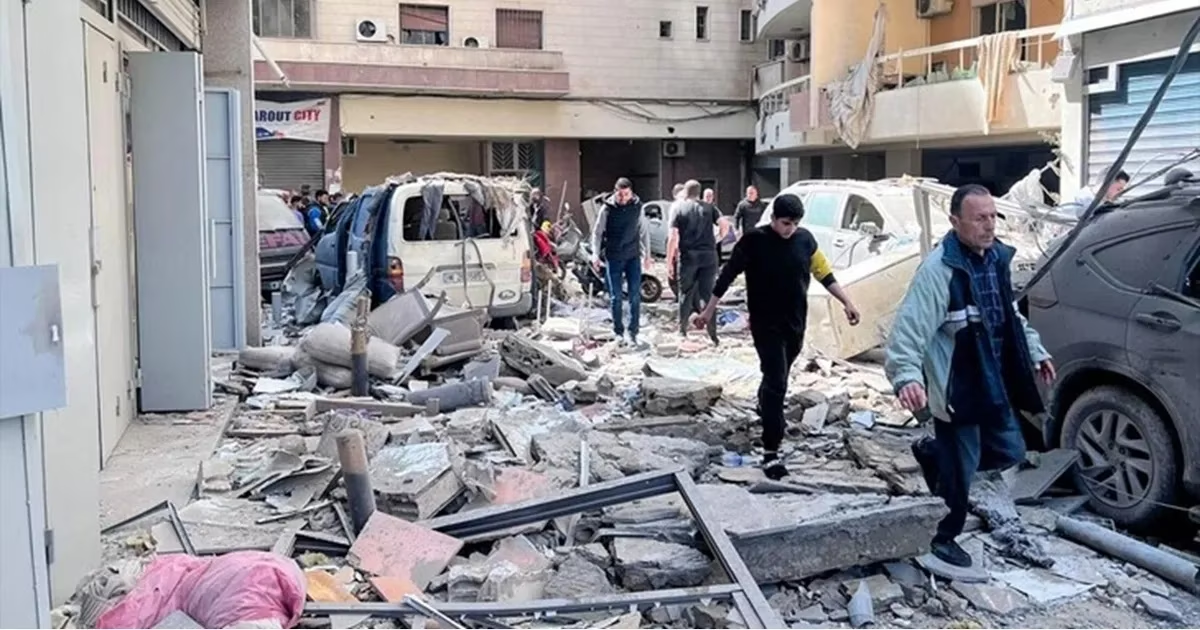







The region is experiencing a state of political and military deadlock that can be described as a 'truce on hold,' as US-Iranian understandings have been widely breached across multiple fronts, from the Arabian Gulf to Lebanon. This collapse was evident in the bloody aggression launched by the Israeli entity on the capital Beirut, leaving hundreds of casualties, both dead and wounded, among civilians.
In response to this escalation, Tehran took escalatory steps by suspending navigation through the Strait of Hormuz, asserting that this measure was a direct response to the violation of agreements in the Lebanese arena. Iranian strikes also targeted facilities in Gulf countries, serving as a deterrent message against earlier air raids that targeted Iranian territories and facilities.
For his part, US President Donald Trump attempted to disclaim responsibility for the Israeli violations, claiming that the concluded truce agreement did not cover the Lebanese arena. This statement completely contradicted what the Pakistani mediator, Prime Minister Shahbaz Sharif, had announced, who affirmed the comprehensiveness of the agreement for all fronts related to the conflict.
This fragility in the ceasefire reflects an unstable balance of power and high fluidity in the regional alliance system, where the truce has become a bargaining chip in the hands of the warring parties. Through these breaches, each party seeks to redraw the features of the future confrontation in a way that ensures the strengthening of its negotiating positions in any upcoming settlement.
The results of the current battles have reached a level of danger that threatens to reshape the regional and international system, both in its security and economic aspects. Repeated breaches of the truce have become the norm, while adherence to it has become the exception, awaiting the crystallization of new international conditions that allow for a sustainable agreement to end the state of war.
The field in southern Lebanon and the Eastern Mediterranean, in parallel with developments in Bab al-Mandab, indicates major shifts that weaken traditional American influence. This unrest has left Washington and the Israeli occupation with no choice but to try to adhere to the outcomes of the September 2024 agreement and seek to replicate it in other areas to encircle Iranian influence.
In contrast, Iran, supported by regional powers such as Turkey and Pakistan, and to some extent Egypt and Saudi Arabia, is leading efforts to impose a new agreement that takes into account the changing balance of power. This approach aims to extend the impact of the understandings to include the Gaza Strip and southern Syria, while asserting control over vital waterways such as the Strait of Hormuz.
American threats launched by Trump and the commander of CENTCOM, Admiral Brad Cooper, to mobilize more forces, did not prevent Tehran from tightening its grip on maritime traffic. This direct challenge reflects an Iranian desire to impose new equations that deter any future Israeli breaches supported by Washington.
The repercussions of this truce are not limited to the direct parties only, but extend to major international powers such as China, Russia, and Europe. Everyone is observing the engineering of the new balance of power, as the international system is moving towards multipolarity that is not necessarily subject to American control or sole management.
The equation of 'American-controlled multipolarity' has become difficult to achieve given Washington's loss of ability to influence its historical spheres of influence. The failure to control regional systems in the Gulf and the Eastern Mediterranean opens the door for the rebellion of other sub-systems against American hegemony.
The Trump administration is currently racing against time to regain the initiative in the region after a series of failures and misjudgments in dealing with the Iranian file. It seems that the shattering of the current truce is a last attempt to adjust the balance of power, either through a new round of fighting or by imposing separate negotiation paths.
Washington is actively seeking to separate the Lebanese and Gaza tracks from the ongoing negotiations in Islamabad, calling for direct negotiations in Washington. The aim of this step is to grant the Israeli entity stable influence in the Eastern Mediterranean with normalization features, away from the pressures of rising regional axes.
The Israeli regional project is facing continuous erosion in favor of rising projects from major regional powers supported by China and Russia. This shift comes at a time when European resentment towards Trump's policies is increasing, and the 'deep state' in the United States is unable to curb his tendencies, which some describe as reckless.
In conclusion, the current truce remains merely a transitional phase in a broader struggle over the identity of the regional order, where each party seeks to consolidate its gains before reaching the moment of truth. The ability to control waterways and volatile arenas will determine who will impose their terms in the final agreement that may end decades of conflict.
The field reality in Lebanon and the Gulf has opened the door for major transformations that reflect the fragility of American influence and the instability of its military and political balances.
شارك برأيك
Fragile Truce and Unstable Power Balances: The Struggle for Influence Between Tehran and Washington Reshapes the Region's Map